The Enemy Within:
Organizational Insight
Through the Eyes of a
Webserver
By
Ramece Cave
Research Analyst
Who Am I
Started working in IT Security in 1999 as a Fraud and Abuse
Investigator for UUNET. Held various forensic focused roles.
Transitioned into Research and Development in 2009 focusing on
the areas of malware analysis, reverse engineering and host and
network intrusion detection.
Research Interests
 Analysis automation and correlation
 Covert channel analysis and identification
 Threat Intelligence
 Protocol Anomalies
 Mobile Malware
Presentation Overview and
Objective
This presentation will cover, the knowledge gained from a webserver and
what it can indicate about your security posture. We will review
information obtained from various malicious campaigns to illustrate how
this information is being applied. Leading up to a POC depicting what can
possibly occur on a compromised server.
Learning Objectives
 Outdated web servers are alive and well, still actively being used.
 Outdated services can be indicative of how the rest of the network
looks: unpatched and outdated systems, similar passwords etc.
 Owning a webserver is not just about defacements anymore, servers
are being re-appropriated for other nefarious acts including, industrial
espionage.
 A compromised server does not have to use standard methods to
provide access to proprietary information.
Presentation Outline
 Evolution of the web server role
 Attack roles of web servers
 Summer of Mischief
 Web Server Cause and Effect (The Naughtiness Factor)
 Remote vs. Local Hosting: The Good, The Bad and The Ugly
 A Deeper Look Into Ugly: Proof of Concept
 Closing
 Questions
Evolution of the Web Server Role
 Late 90s – hosting basic web pages, the idea of a web
presence not common.
 2000 to 2006 – Web presence is a must, businesses and
organizations highly dependent upon web service availability.
Key business component.
 2007 to Today – Web presence is critical and mandated for
survival, down time is unacceptable, can result in a loss of
millions of dollars per hour. E-Commerce is now a way of life.
We live by the mantra: Make everything faster, better, keep it
online, keep it fresh, no matter what.
Web Server Attack Roles
 Usually the victim
 Compromises result in defacements or theft of data from
attached databases.
 Highly coveted and guarded, if this were a game of chess the
webserver is the King, and everyone protects the king.
The Summer of Mischief
Summer of Mischief: Threat
Campaigns Targeted at the US and
Other Nations.
Staring in the beginning of May, 2013 a string of operations
were initiated by various foreign based threat actor groups.
Their objective was to disrupt the US banking and economic
systems. Three of the campaigns were:
 OpUSA
 OpPetrol
 Op911
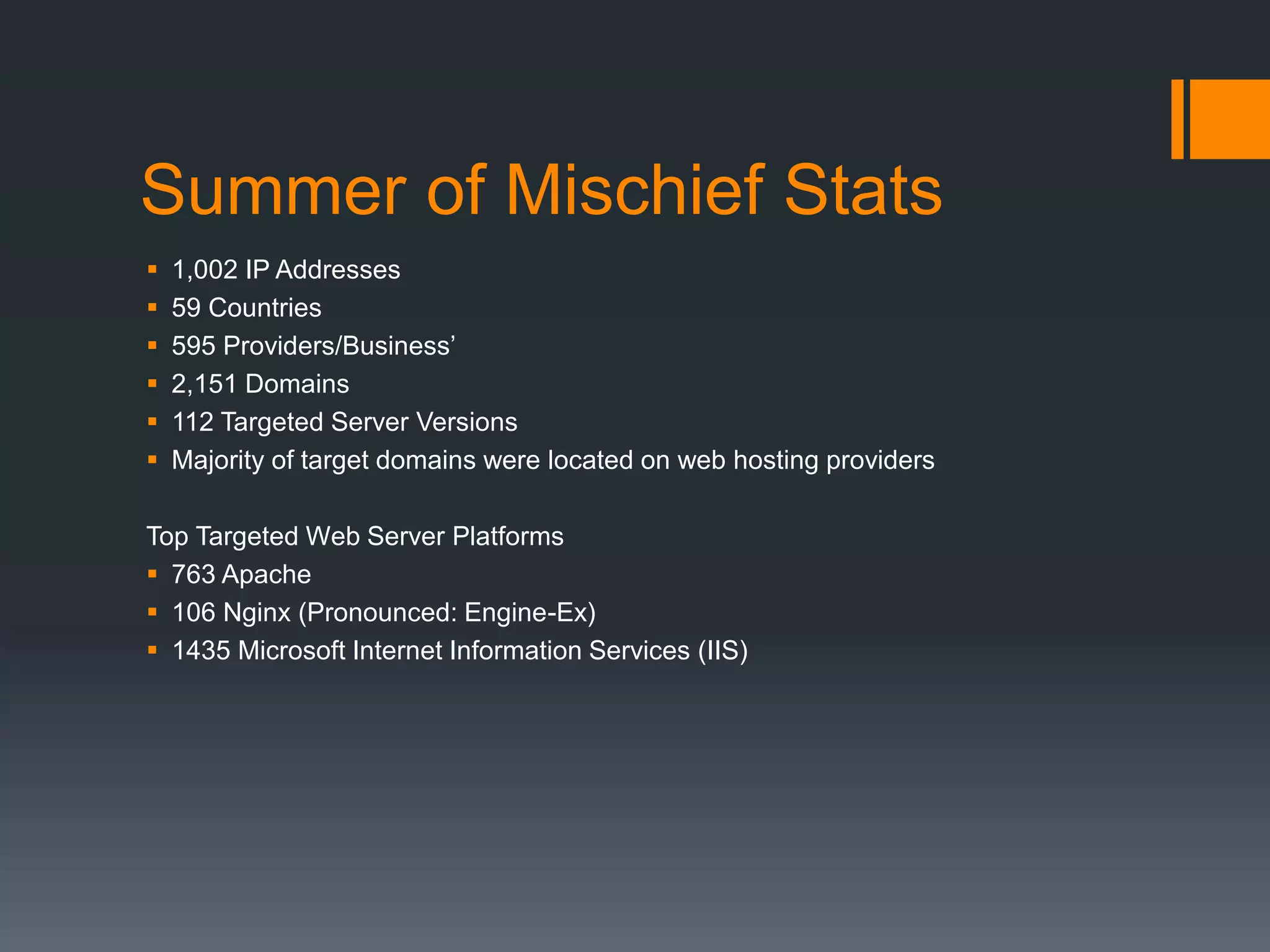
Summer of Mischief Stats
 1,002 IP Addresses
 59 Countries
 595 Providers/Business’
 2,151 Domains
 112 Targeted Server Versions
 Majority of target domains were located on web hosting providers
Top Targeted Web Server Platforms
 763 Apache
 106 Nginx (Pronounced: Engine-Ex)
 1435 Microsoft Internet Information Services (IIS)
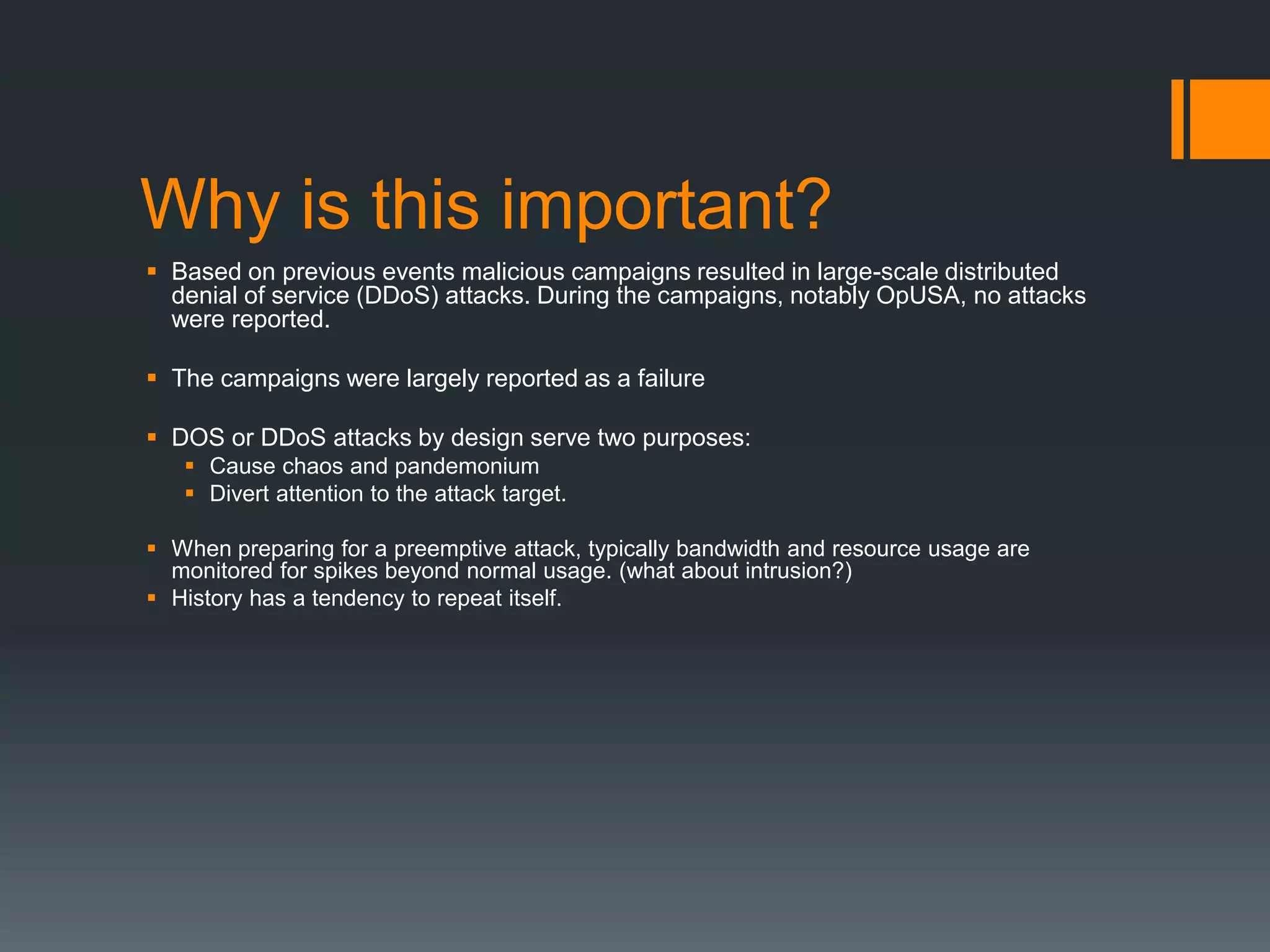
Why is this important?
 Based on previous events malicious campaigns resulted in large-scale distributed
denial of service (DDoS) attacks. During the campaigns, notably OpUSA, no attacks
were reported.
 The campaigns were largely reported as a failure
 DOS or DDoS attacks by design serve two purposes:
 Cause chaos and pandemonium
 Divert attention to the attack target.
 When preparing for a preemptive attack, typically bandwidth and resource usage are
monitored for spikes beyond normal usage. (what about intrusion?)
 History has a tendency to repeat itself.
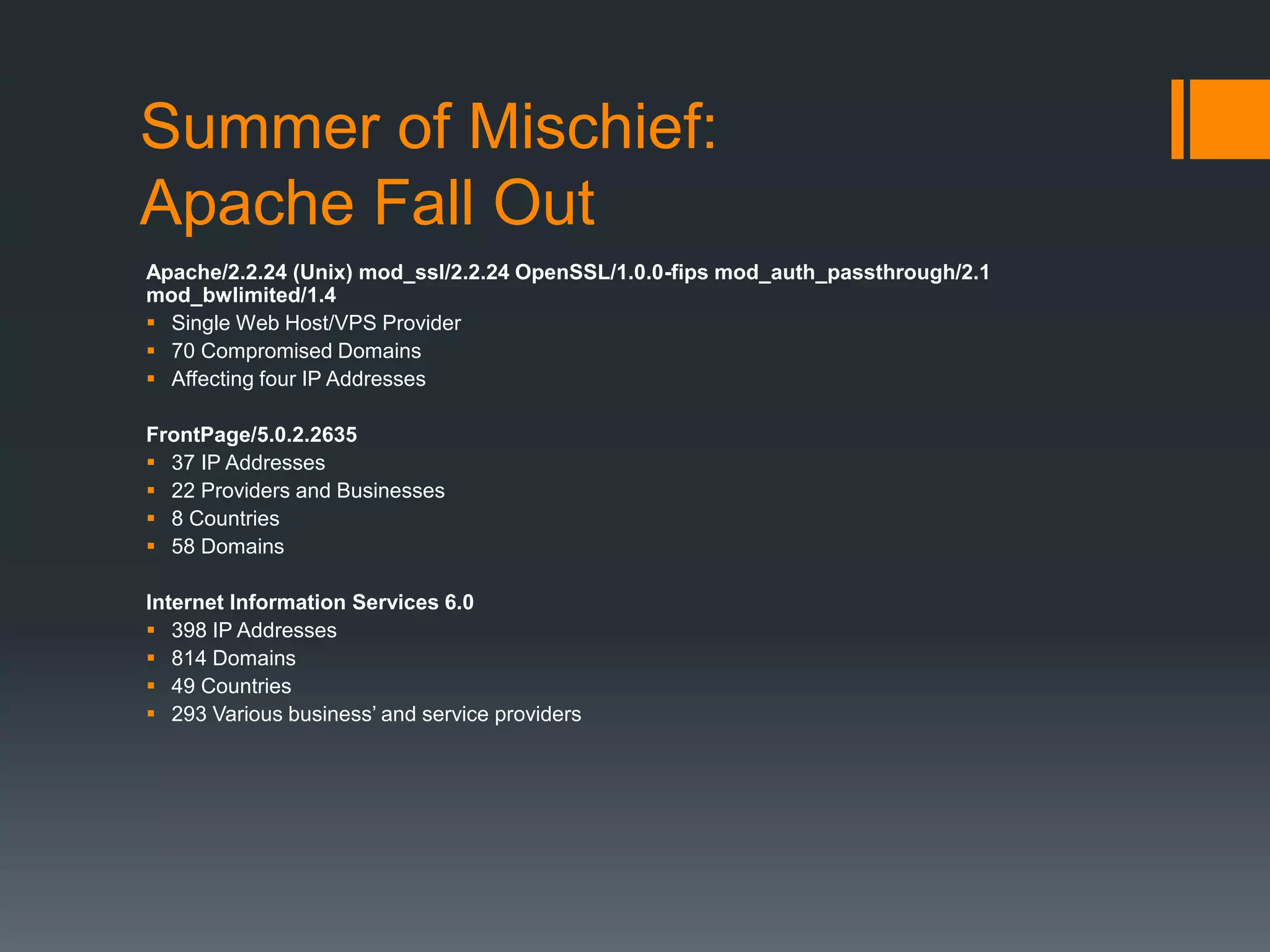
Summer of Mischief:
Apache Fall Out
Apache/2.2.24 (Unix) mod_ssl/2.2.24 OpenSSL/1.0.0-fips mod_auth_passthrough/2.1
mod_bwlimited/1.4
 Single Web Host/VPS Provider
 70 Compromised Domains
 Affecting four IP Addresses
FrontPage/5.0.2.2635
 37 IP Addresses
 22 Providers and Businesses
 8 Countries
 58 Domains
Internet Information Services 6.0
 398 IP Addresses
 814 Domains
 49 Countries
 293 Various business’ and service providers
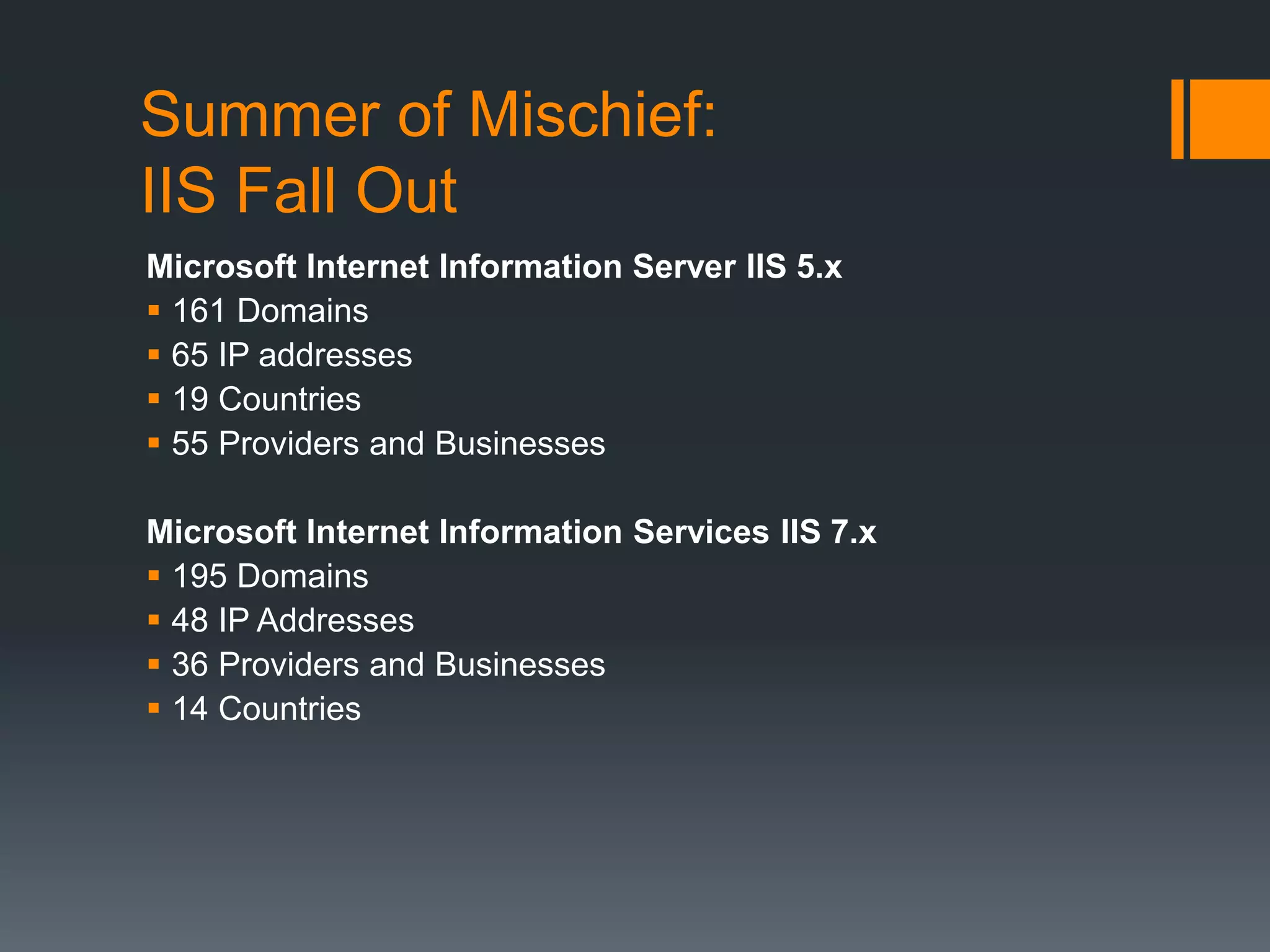
Summer of Mischief:
IIS Fall Out
Microsoft Internet Information Server IIS 5.x
 161 Domains
 65 IP addresses
 19 Countries
 55 Providers and Businesses
Microsoft Internet Information Services IIS 7.x
 195 Domains
 48 IP Addresses
 36 Providers and Businesses
 14 Countries
Summer of Mischief:
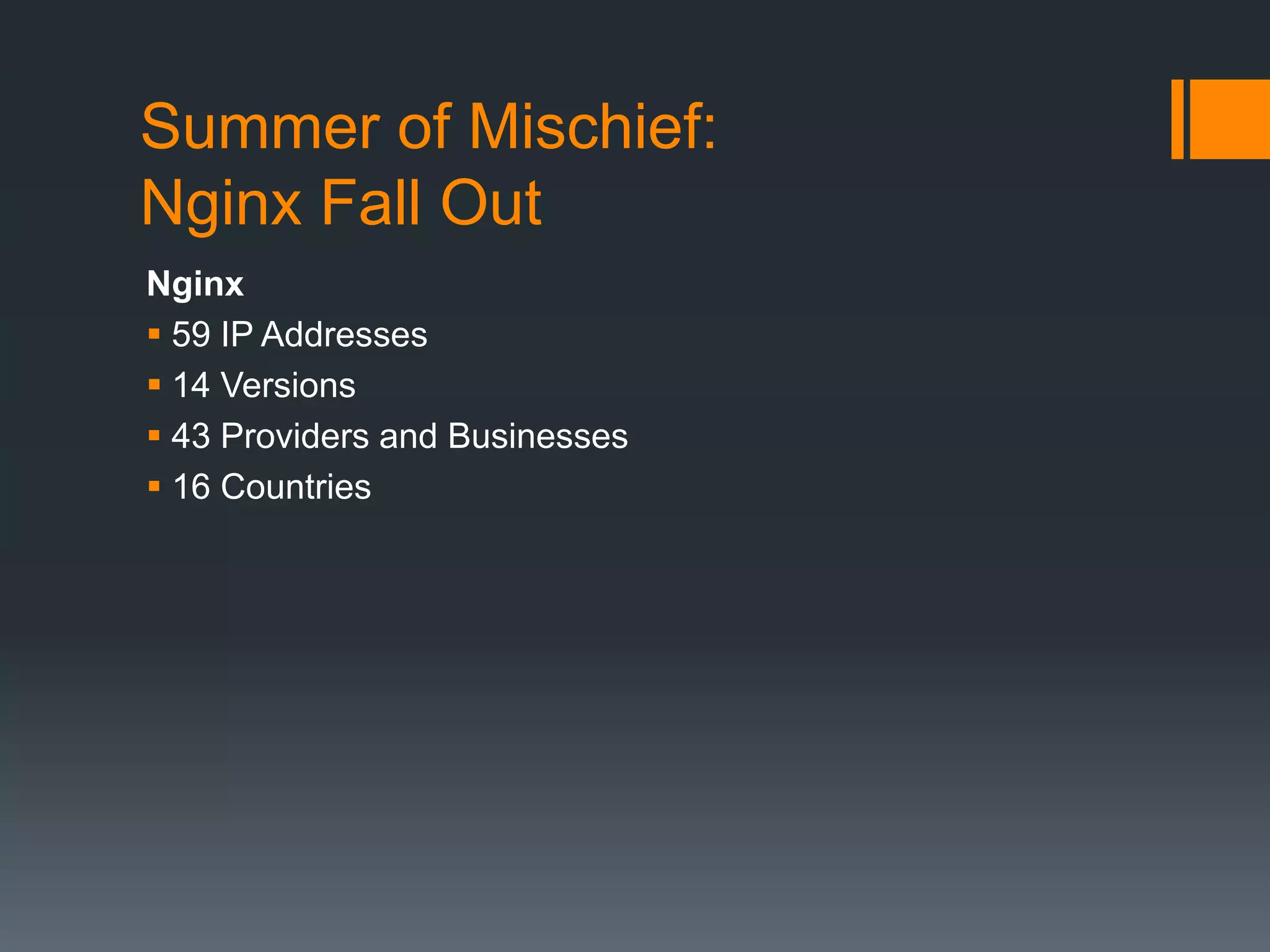
Nginx Fall Out
Nginx
 59 IP Addresses
 14 Versions
 43 Providers and Businesses
 16 Countries
How the malicious actor might
interpret your web server.
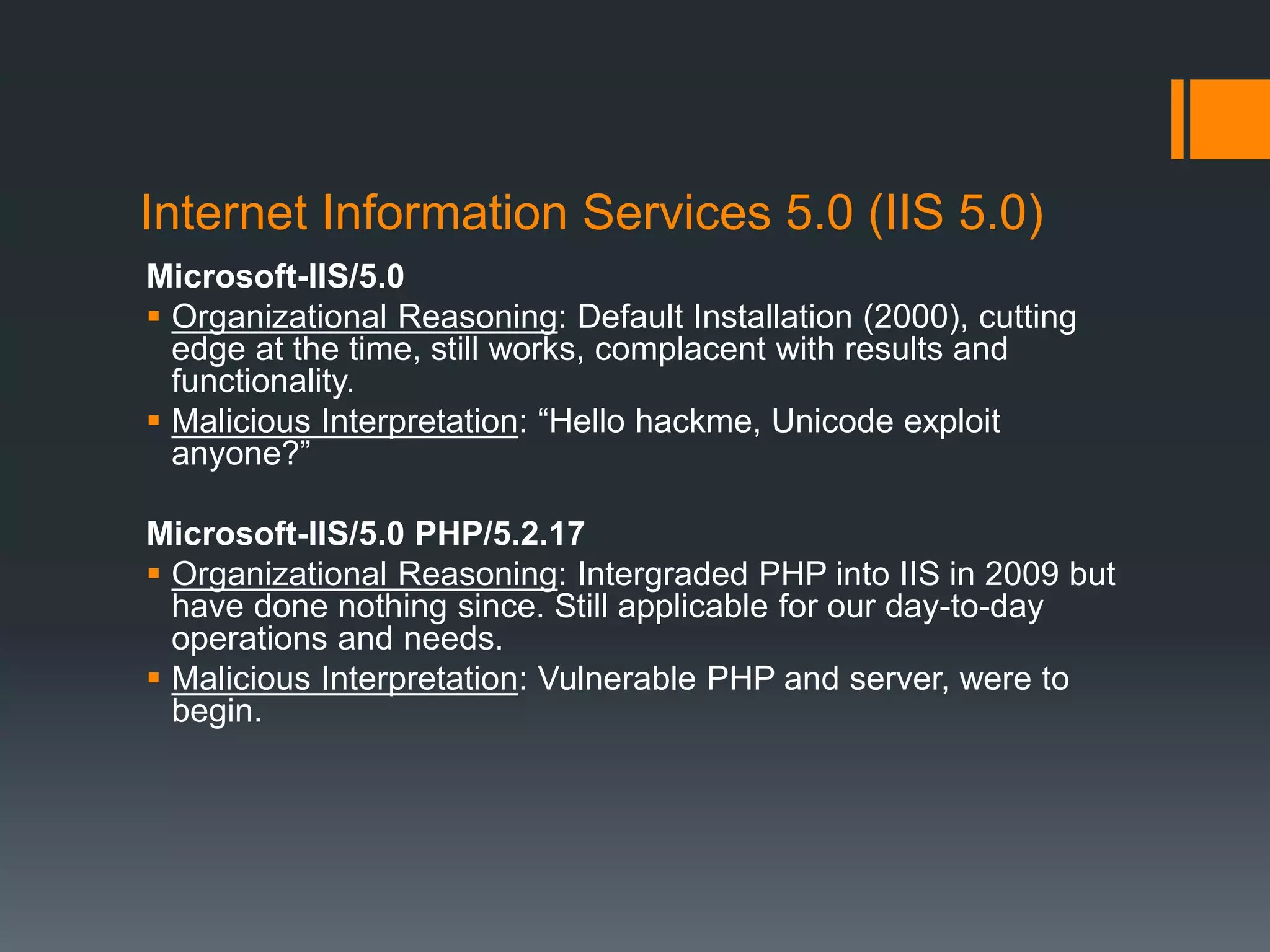
Internet Information Services 5.0 (IIS 5.0)
Microsoft-IIS/5.0
 Organizational Reasoning: Default Installation (2000), cutting
edge at the time, still works, complacent with results and
functionality.
 Malicious Interpretation: “Hello hackme, Unicode exploit
anyone?”
Microsoft-IIS/5.0 PHP/5.2.17
 Organizational Reasoning: Intergraded PHP into IIS in 2009 but
have done nothing since. Still applicable for our day-to-day
operations and needs.
 Malicious Interpretation: Vulnerable PHP and server, were to
begin.
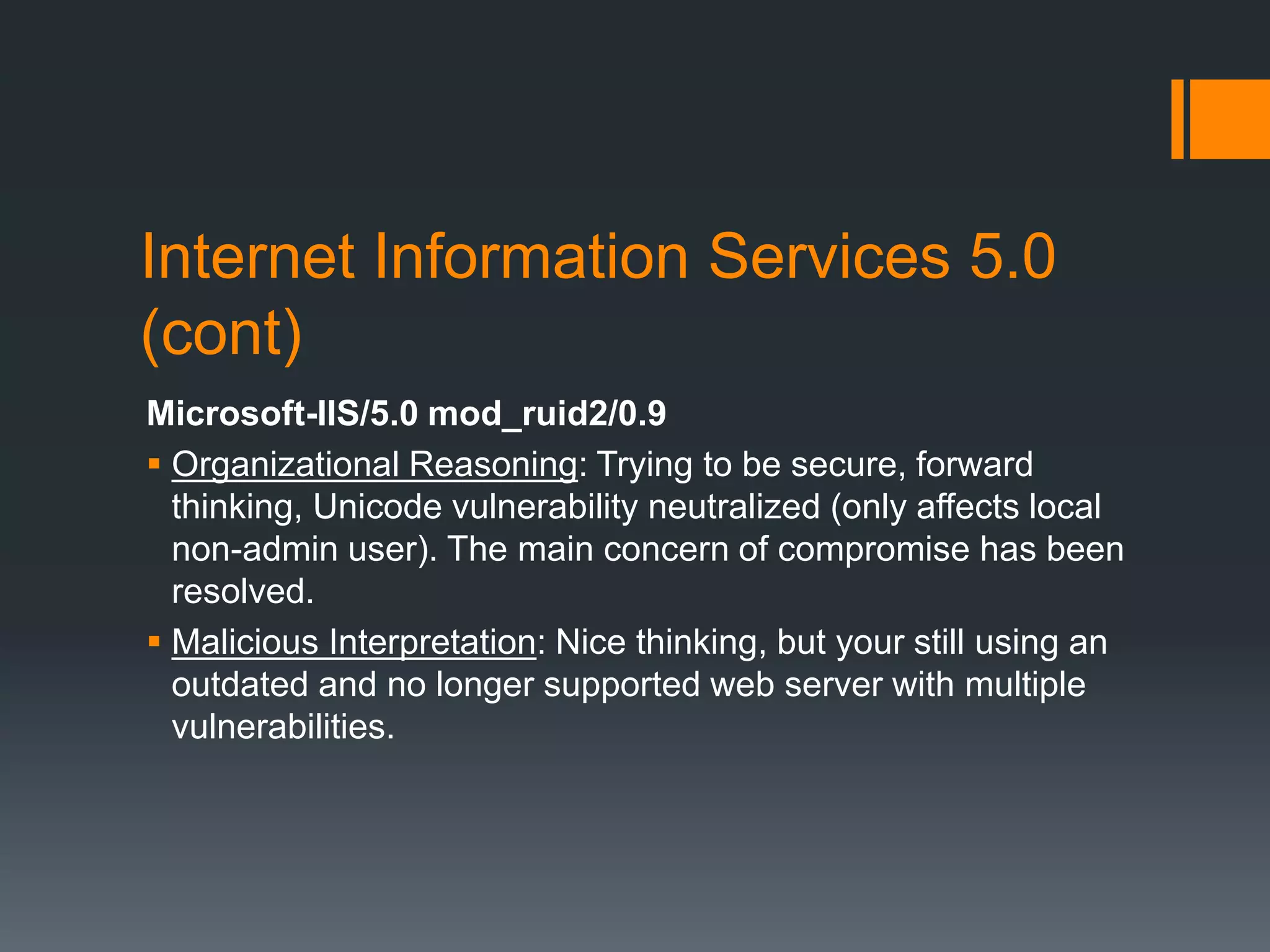
Internet Information Services 5.0
(cont)
Microsoft-IIS/5.0 mod_ruid2/0.9
 Organizational Reasoning: Trying to be secure, forward
thinking, Unicode vulnerability neutralized (only affects local
non-admin user). The main concern of compromise has been
resolved.
 Malicious Interpretation: Nice thinking, but your still using an
outdated and no longer supported web server with multiple
vulnerabilities.
Internet Information Services 6.0
Microsoft-IIS/6.0’
 Organizational Reasoning: Still supported, heavily integrated into our infrastructure. No
need to upgrade at the moment, much more secure and robust then 5.0. It’s been 11
years, still going strong.
 Malicious Interpretation: Still thinking IIS is secure, probably not patched for overflow
and bypass vulnerabilities. Will probably use this server until forced to upgrade. Still
heavily used despite security concerns.
Microsoft-IIS/6.0 PHP/5.2.5
 Organizational Reasoning: In 2003 or there about implemented PHP to push web
content to the next level. Since 2007 we have been happy with the results and
productivity of the server in this configuration. No foreseeable plans to upgrade until
needed.
 Malicious Interpretation: Another example of IIS insecurity, this time with added benefit
of an outdated and vulnerable version of PHP that further extends my exploit potential.
Not as prevalent as the others, but a welcomed addition.
Nginx
Nginx/x.x.x
Organizational Reasoning: Robust, highly configurable and can
be used as a reverse –proxy server. Trendy, its not IIS or Apache.
Malicious Interpretation: So many versions, so many possibilities.
 Have you read the advisories?
 Are you using as standalone server or proxy?
 Are you using uWSGI and Python?
 Did you secure your host?
Your proxy has just become mine, thanks for hosting my malware
distribution domain and C&C domain.
Apache
Apache/2.x.x (Unix) mod_ssl/2.2.17 OpenSSL/0.x.x-fips-rhel5
mod_auth_passthrough/2.1 mod_bwlimited/1.4 FrontPage/5.0.2.2635
 Organizational Reasoning: We must provide quick and proven effective
means for our customers to deliver their content in an expedient,
repeatable, productive manner. The perfect turn-key solution.
 Malicious Interpretation: You are a webhost provider that implemented a
one-solution fits all scenario for your customers sometime in or around
2005. Nothing has been upgraded or patched since, either in fear of
service interruption, lack of oversight, or maybe it cannot be done.
The Naughtiness Factor:
When Webservers Attack
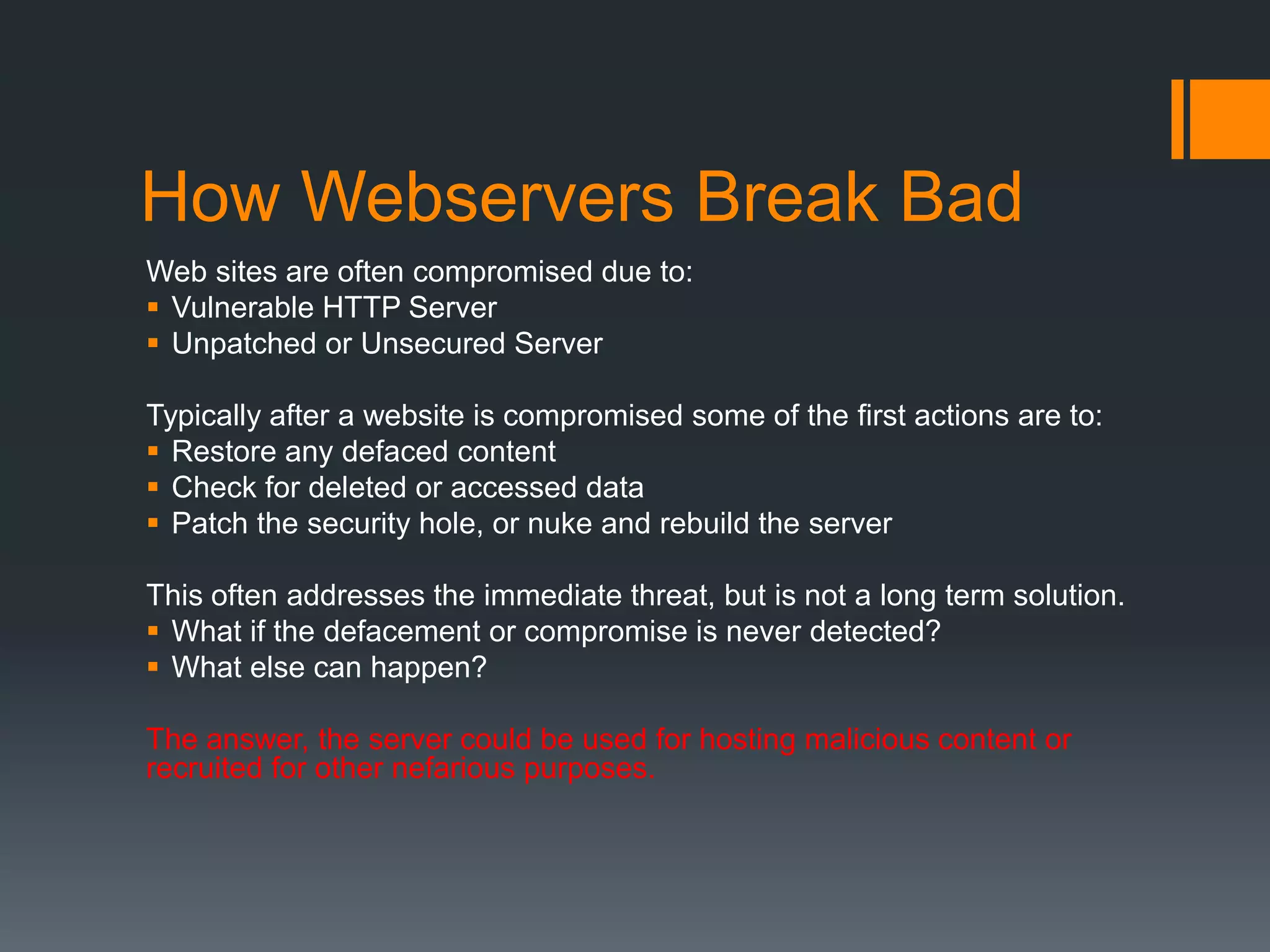
How Webservers Break Bad
Web sites are often compromised due to:
 Vulnerable HTTP Server
 Unpatched or Unsecured Server
Typically after a website is compromised some of the first actions are to:
 Restore any defaced content
 Check for deleted or accessed data
 Patch the security hole, or nuke and rebuild the server
This often addresses the immediate threat, but is not a long term solution.
 What if the defacement or compromise is never detected?
 What else can happen?
The answer, the server could be used for hosting malicious content or
recruited for other nefarious purposes.
Compromised Servers Distributing
Malware
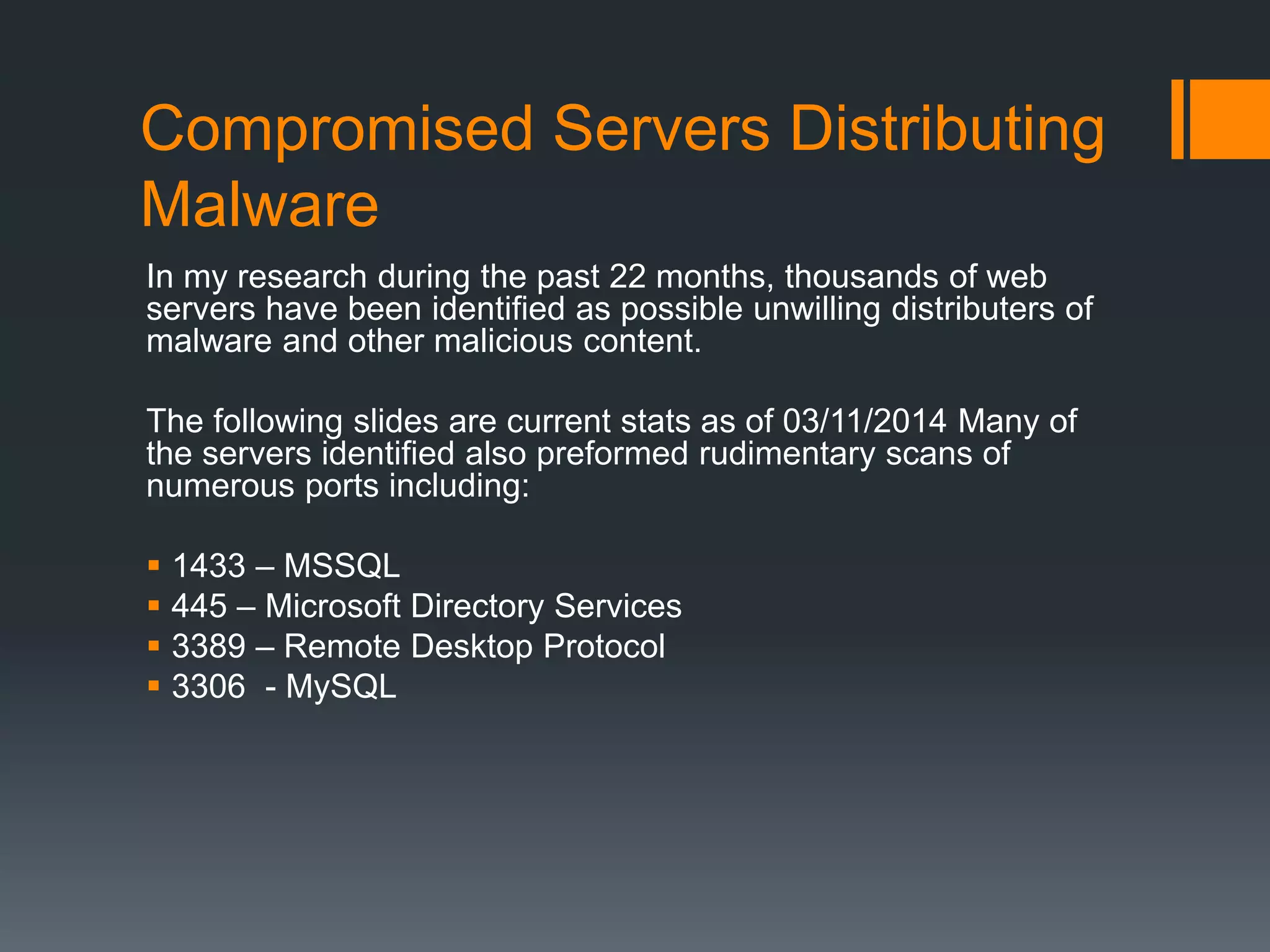
In my research during the past 22 months, thousands of web
servers have been identified as possible unwilling distributers of
malware and other malicious content.
The following slides are current stats as of 03/11/2014 Many of
the servers identified also preformed rudimentary scans of
numerous ports including:
 1433 – MSSQL
 445 – Microsoft Directory Services
 3389 – Remote Desktop Protocol
 3306 - MySQL
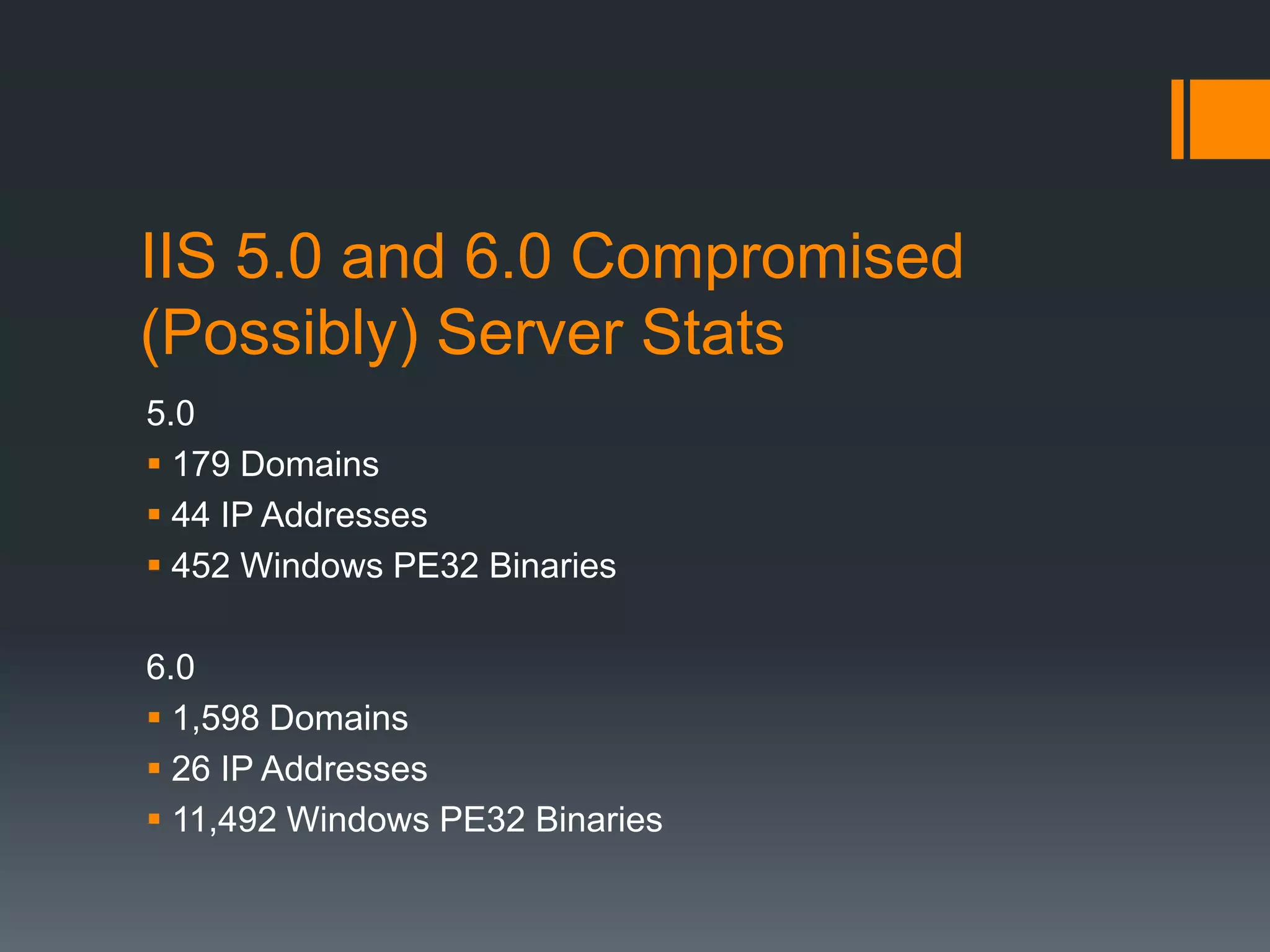
IIS 5.0 and 6.0 Compromised
(Possibly) Server Stats
5.0
 179 Domains
 44 IP Addresses
 452 Windows PE32 Binaries
6.0
 1,598 Domains
 26 IP Addresses
 11,492 Windows PE32 Binaries
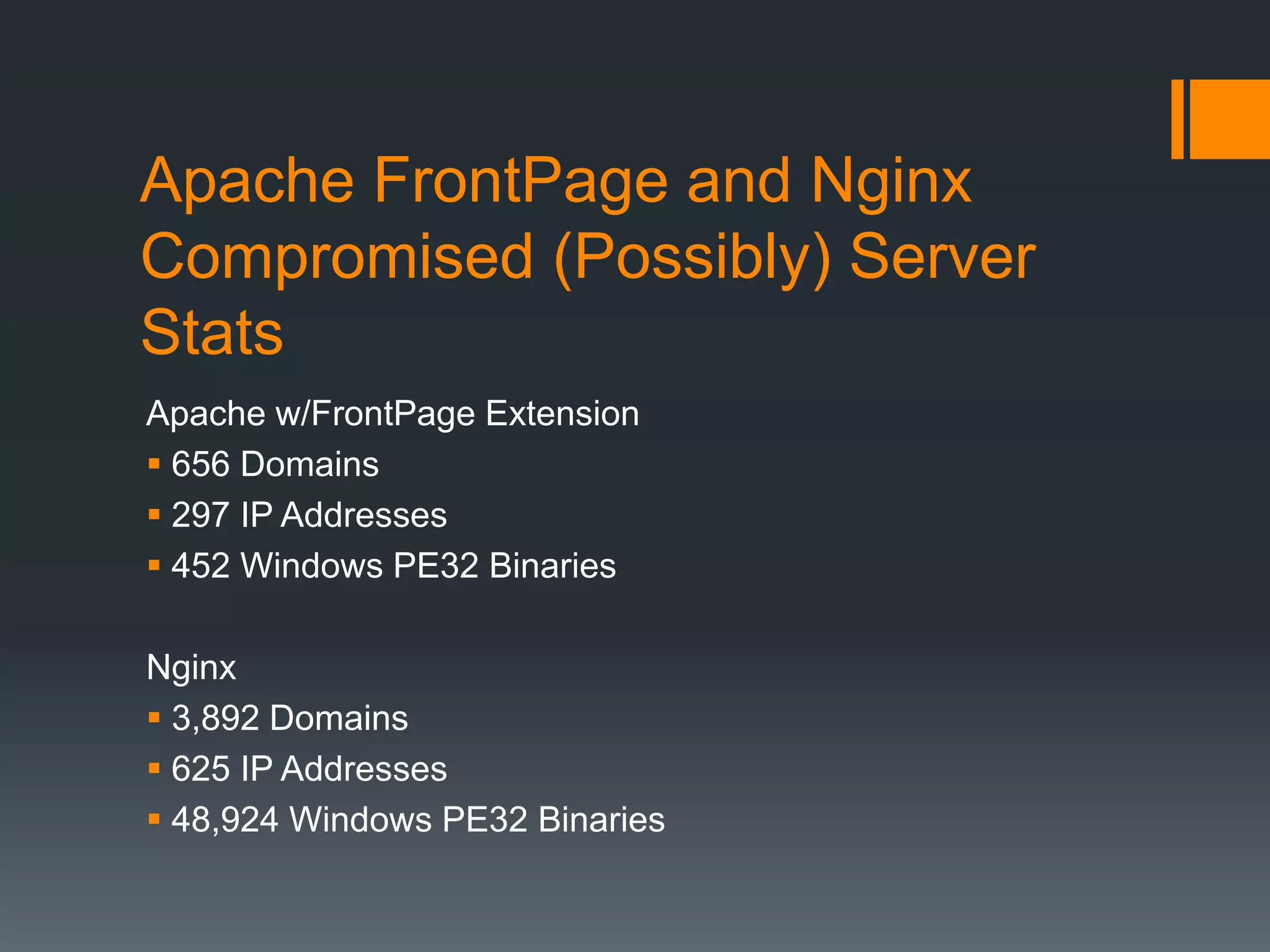
Apache FrontPage and Nginx
Compromised (Possibly) Server
Stats
Apache w/FrontPage Extension
 656 Domains
 297 IP Addresses
 452 Windows PE32 Binaries
Nginx
 3,892 Domains
 625 IP Addresses
 48,924 Windows PE32 Binaries
Remote vs. Local Hosting:
The Good, Bad and the Ugly
The Good, The Bad, The Ugly
The Good
 Less administration costs and time
 Lower internal IT overhead
The Bad
 Not protected by IT security protocol
 Shared hosting
The Ugly
 If one site is compromised, all are at risk
 Security patches may not applied in a timely manner, if ever
A Deeper Look Into Ugly:
Proof of Concept
Once a server is compromised they take on an entirely new threat. Most
providers or companies filter traffic based their acceptable use policy (AUP).
Depending on where the server located on the network or hosted remotely.
Potentially new unwanted services can be introduced. The following slides
demonstrates a non-malicious web application running on a webserver to
process specially crafted requests for geolocation information. Many C&C
servers operate in this manner.
Things to remember:
 No administrator or root permissions are required for ports above 1024
 The application can be written in any number of already installed web
capable languages for example: Python, Ruby, and Node.js
 The application can be written to exploit a local vulnerability for even greater
access
 Incoming and outgoing traffic permitted due flexible or no firewall
implementation.
 Possibly other protocols left unchecked
Theoretical POC: Alternate
Methods of Data Retrieval Using
HTTP and ICMP
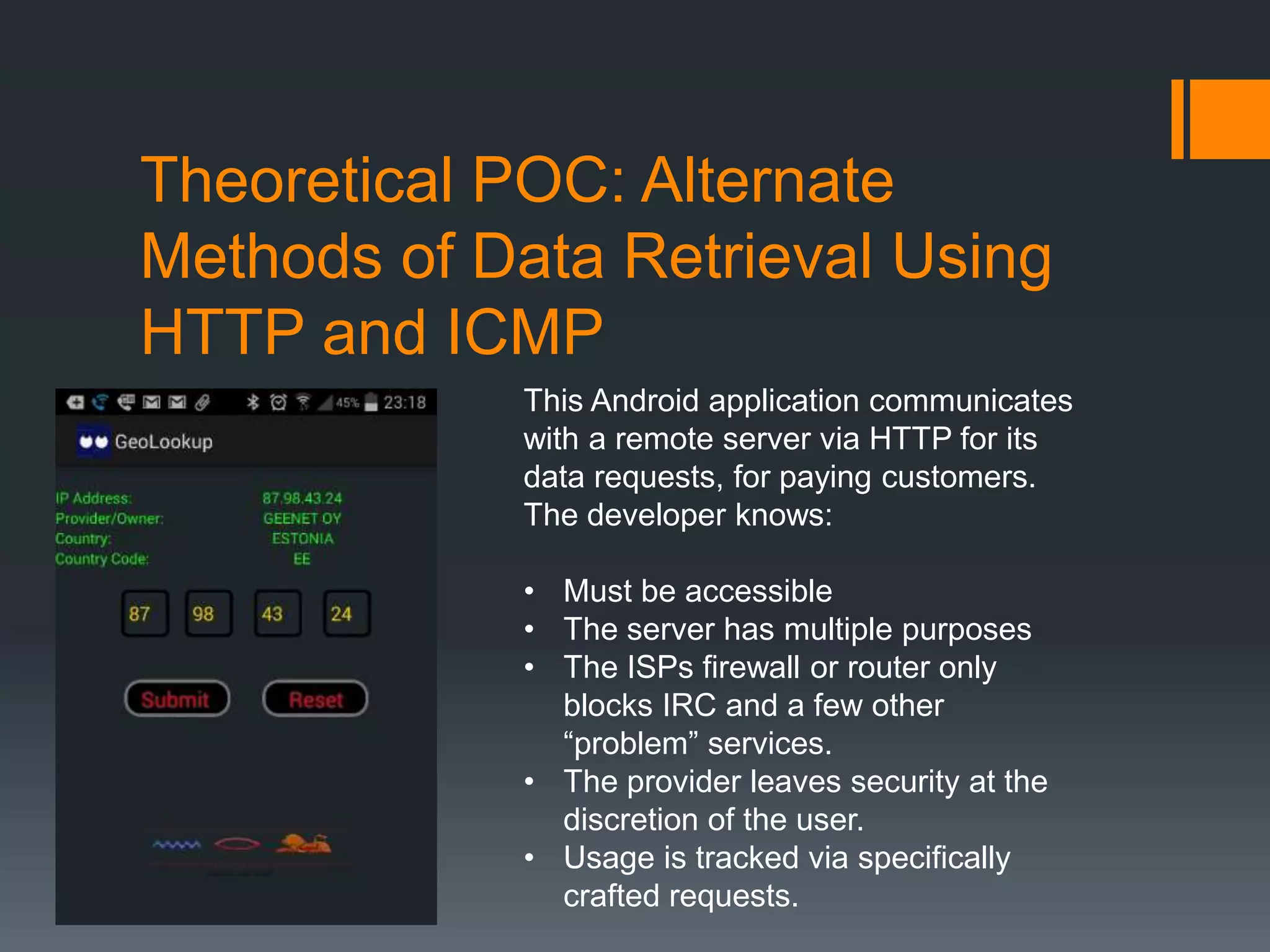
This Android application communicates
with a remote server via HTTP for its
data requests, for paying customers.
The developer knows:
• Must be accessible
• The server has multiple purposes
• The ISPs firewall or router only
blocks IRC and a few other
“problem” services.
• The provider leaves security at the
discretion of the user.
• Usage is tracked via specifically
crafted requests.
Theoretical POC: Alternate
Methods of Data Retrieval Using
HTTP and ICMP
Imagine this host is compromised via vulnerability or obtained
credentials, and the malicious actor uploads code to the server to
steal the data in an unconventional way. By running another
service that queries the same database, using a non-standard
port, that also authenticates requests.
How is this possible?
 Many defenses are stacked to monitor services and not
anomalous port traffic.
 Oversight in the security implementation, we forgot to move the
server behind the firewall.
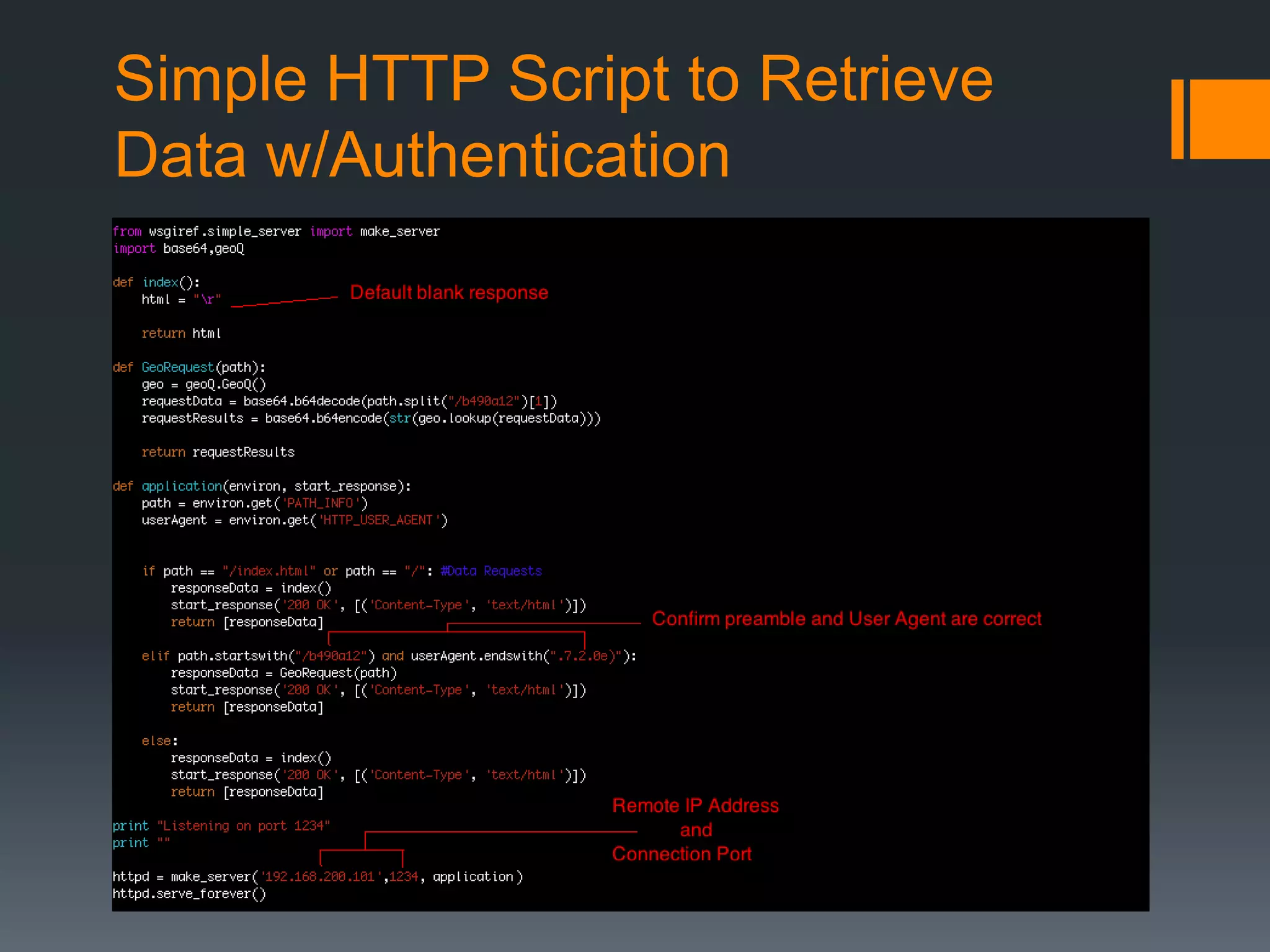
Simple HTTP Script to Retrieve
Data w/Authentication
Daily Double Challenge Question
What if we monitor for malicious services and the host is
behind a firewall? What then smart guy?
 Most networked computers will allow some type of inbound
and outbound communication.
 Firewalls generally follow the same principle.
The question is identifying what is allowed in and out.
For the most part HTTP, DNS and ICMP are safe bets. We will
focus our efforts on ICMP.
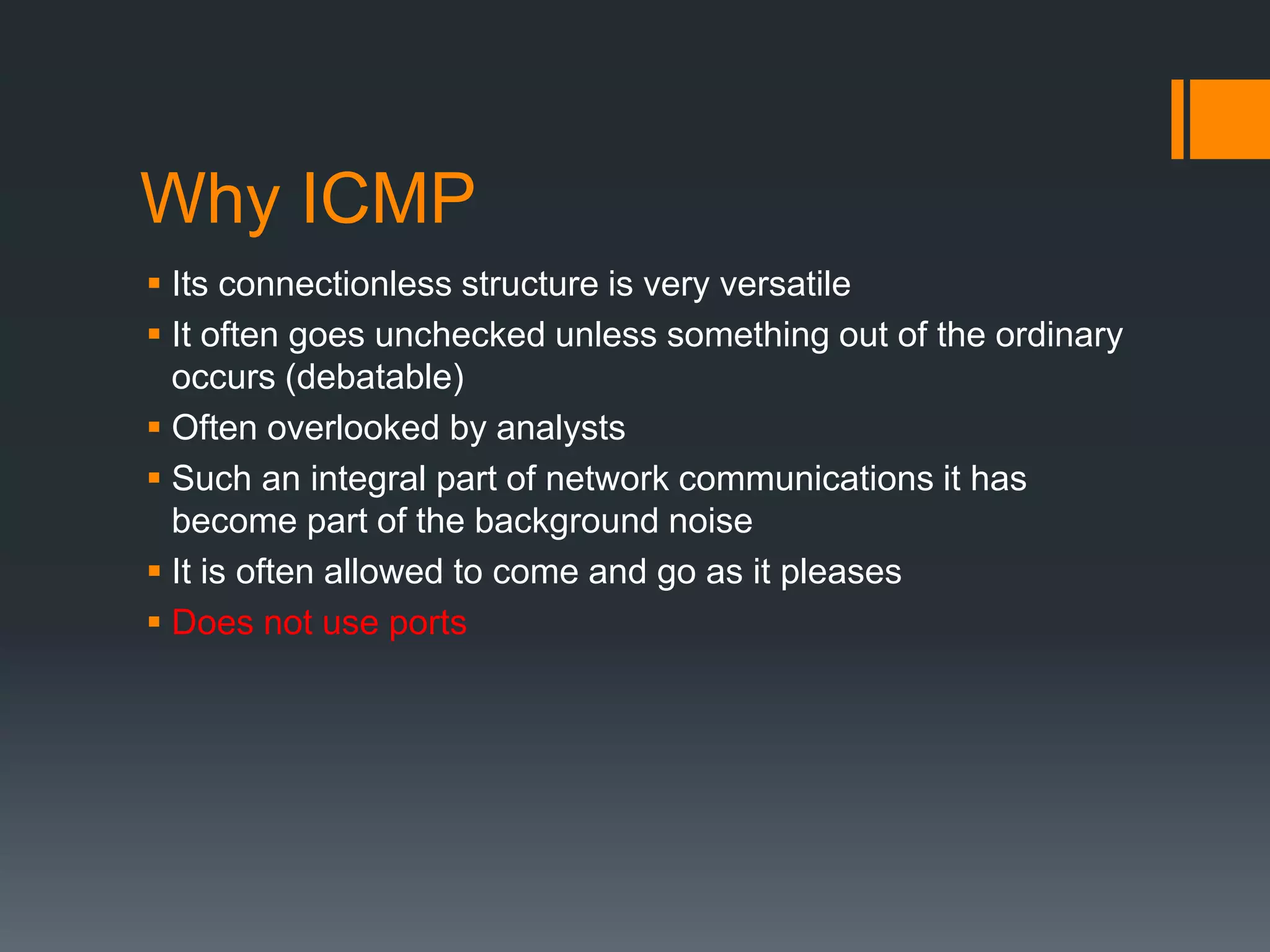
Why ICMP
 Its connectionless structure is very versatile
 It often goes unchecked unless something out of the ordinary
occurs (debatable)
 Often overlooked by analysts
 Such an integral part of network communications it has
become part of the background noise
 It is often allowed to come and go as it pleases
 Does not use ports
Theoretical POC: Alternate
Methods of Data Retrieval Using
HTTP and ICMP
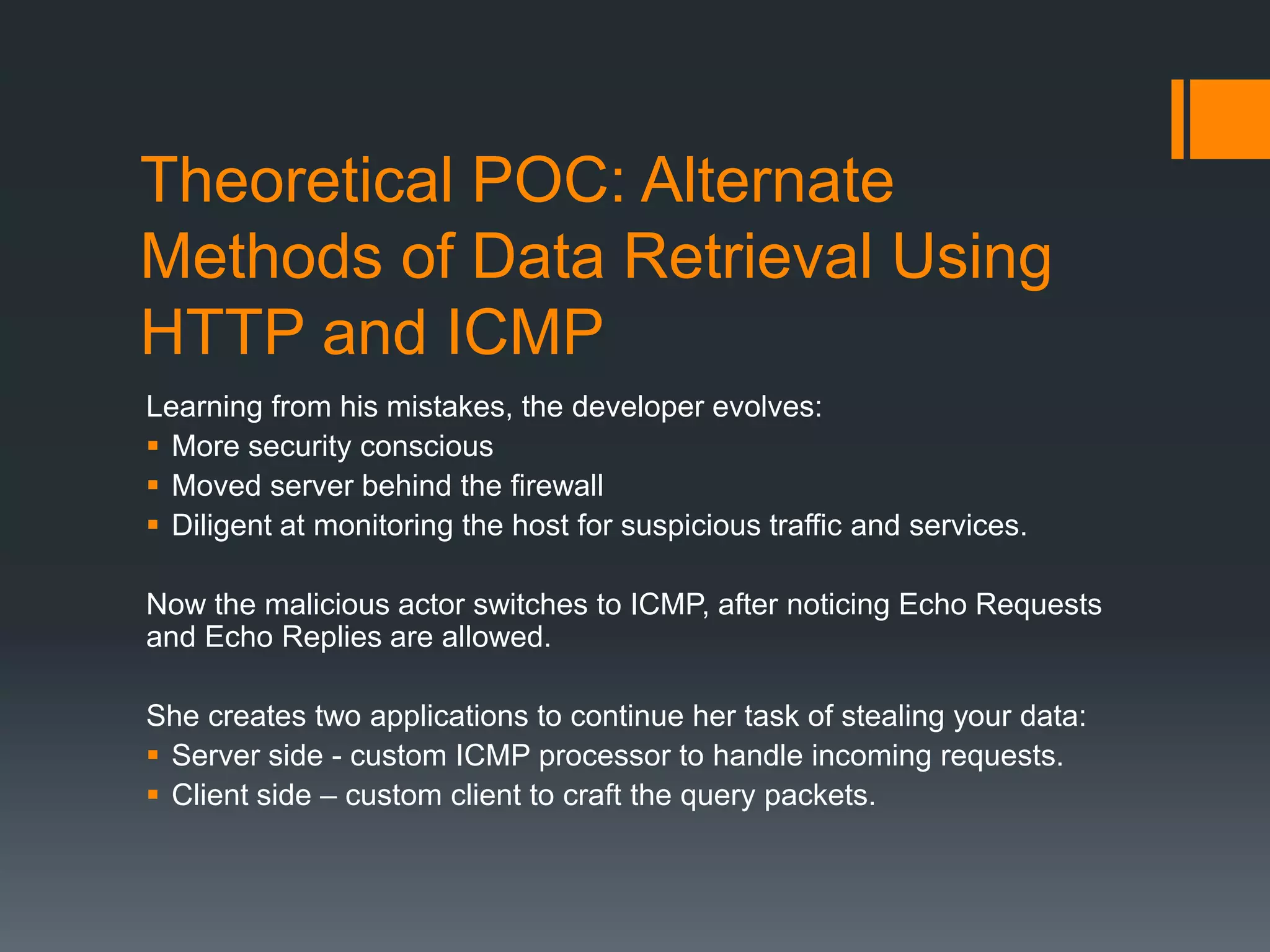
Learning from his mistakes, the developer evolves:
 More security conscious
 Moved server behind the firewall
 Diligent at monitoring the host for suspicious traffic and services.
Now the malicious actor switches to ICMP, after noticing Echo Requests
and Echo Replies are allowed.
She creates two applications to continue her task of stealing your data:
 Server side - custom ICMP processor to handle incoming requests.
 Client side – custom client to craft the query packets.
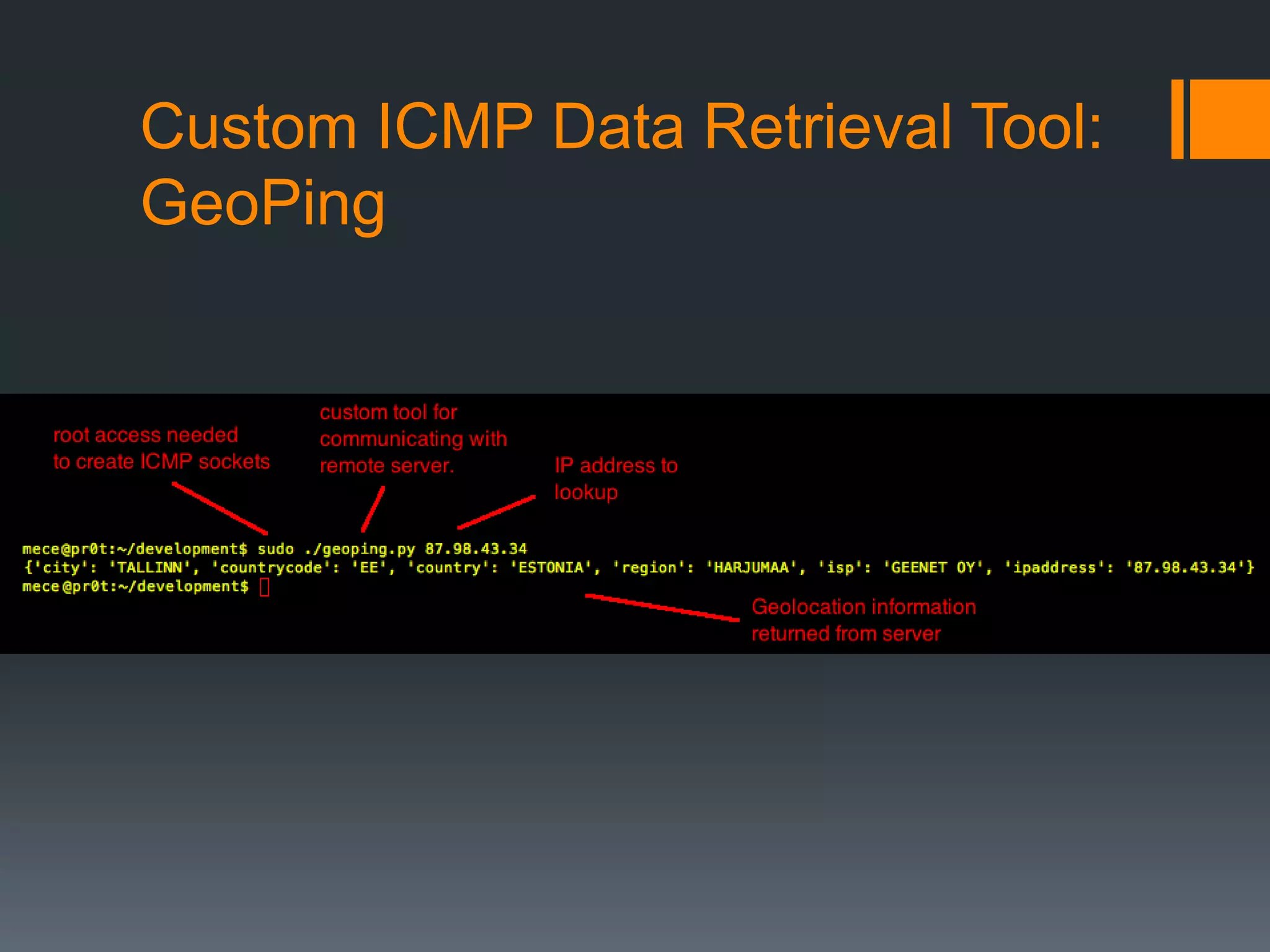
Custom ICMP Data Retrieval Tool:
GeoPing
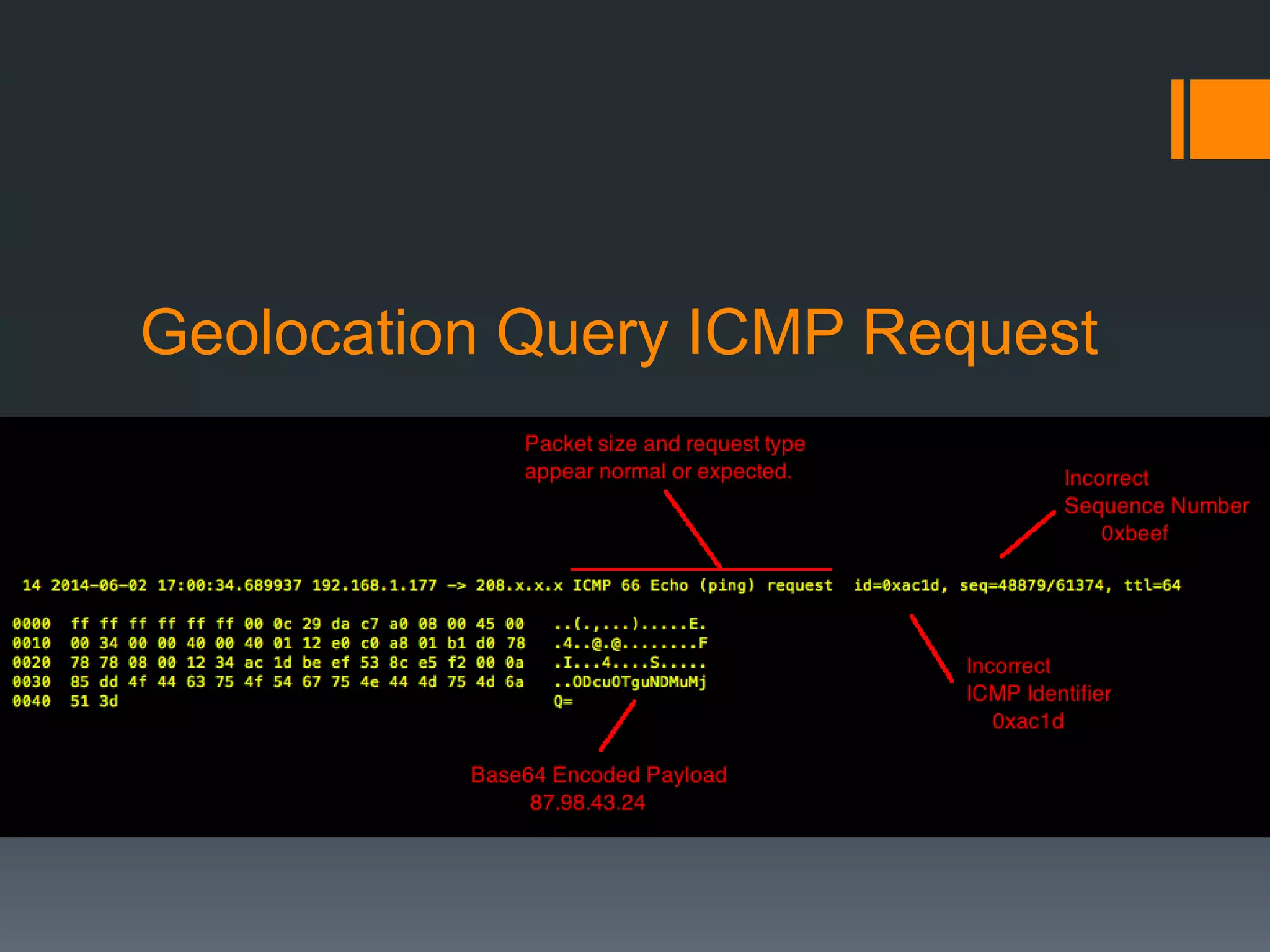
Geolocation Query ICMP Request
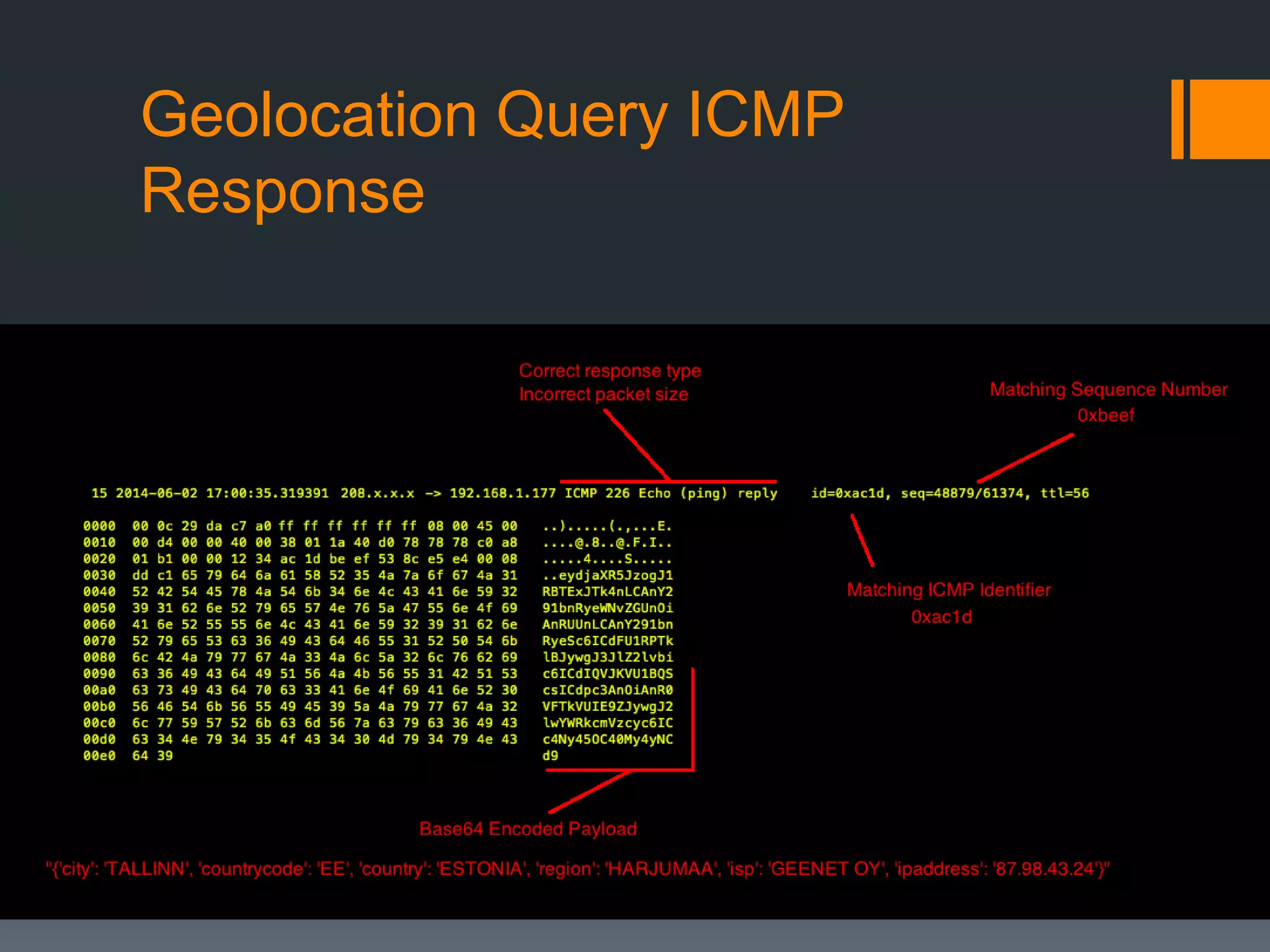
Geolocation Query ICMP
Response
Closing
In this presentation we covered the types of insight a malicious actor can obtain from
identifying header responses. This information is given with every request to a site, unless
specifically modified. We also explored how this information is still actively being exploited
after nearly 15 years since first discovered.
The campaigns revealed, outdated server still present an attractive target Those servers
can then be tasked for other purposes without drawing any attention.
Moving forward there is no 100% solution for hosting web content, there are pros and
cons for local vs. remote, which server to use and which language to implement.
Suggestions and Recommendations
 Keep servers patched and updated
 Upgrade when needed
 Monitor for suspicious applications and connections
 Limit access rights to non-privileged users
 When considering hosting providers, ask about firewall, patch management and update
polices.
 Be diligent in your security practices
Q & A
Contact Information
http://www.n00dle.org
rrcave@n00dle.org
@feedbrain

The Enemy Within: Organizational Insight Through the Eyes of a Webserver

  • 1.
    The Enemy Within: OrganizationalInsight Through the Eyes of a Webserver By Ramece Cave Research Analyst
  • 2.
    Who Am I Startedworking in IT Security in 1999 as a Fraud and Abuse Investigator for UUNET. Held various forensic focused roles. Transitioned into Research and Development in 2009 focusing on the areas of malware analysis, reverse engineering and host and network intrusion detection. Research Interests  Analysis automation and correlation  Covert channel analysis and identification  Threat Intelligence  Protocol Anomalies  Mobile Malware
  • 3.
    Presentation Overview and Objective Thispresentation will cover, the knowledge gained from a webserver and what it can indicate about your security posture. We will review information obtained from various malicious campaigns to illustrate how this information is being applied. Leading up to a POC depicting what can possibly occur on a compromised server. Learning Objectives  Outdated web servers are alive and well, still actively being used.  Outdated services can be indicative of how the rest of the network looks: unpatched and outdated systems, similar passwords etc.  Owning a webserver is not just about defacements anymore, servers are being re-appropriated for other nefarious acts including, industrial espionage.  A compromised server does not have to use standard methods to provide access to proprietary information.
  • 4.
    Presentation Outline  Evolutionof the web server role  Attack roles of web servers  Summer of Mischief  Web Server Cause and Effect (The Naughtiness Factor)  Remote vs. Local Hosting: The Good, The Bad and The Ugly  A Deeper Look Into Ugly: Proof of Concept  Closing  Questions
  • 5.
    Evolution of theWeb Server Role  Late 90s – hosting basic web pages, the idea of a web presence not common.  2000 to 2006 – Web presence is a must, businesses and organizations highly dependent upon web service availability. Key business component.  2007 to Today – Web presence is critical and mandated for survival, down time is unacceptable, can result in a loss of millions of dollars per hour. E-Commerce is now a way of life. We live by the mantra: Make everything faster, better, keep it online, keep it fresh, no matter what.
  • 6.
    Web Server AttackRoles  Usually the victim  Compromises result in defacements or theft of data from attached databases.  Highly coveted and guarded, if this were a game of chess the webserver is the King, and everyone protects the king.
  • 7.
    The Summer ofMischief
  • 8.
    Summer of Mischief:Threat Campaigns Targeted at the US and Other Nations. Staring in the beginning of May, 2013 a string of operations were initiated by various foreign based threat actor groups. Their objective was to disrupt the US banking and economic systems. Three of the campaigns were:  OpUSA  OpPetrol  Op911
  • 9.
    Summer of MischiefStats  1,002 IP Addresses  59 Countries  595 Providers/Business’  2,151 Domains  112 Targeted Server Versions  Majority of target domains were located on web hosting providers Top Targeted Web Server Platforms  763 Apache  106 Nginx (Pronounced: Engine-Ex)  1435 Microsoft Internet Information Services (IIS)
  • 10.
    Why is thisimportant?  Based on previous events malicious campaigns resulted in large-scale distributed denial of service (DDoS) attacks. During the campaigns, notably OpUSA, no attacks were reported.  The campaigns were largely reported as a failure  DOS or DDoS attacks by design serve two purposes:  Cause chaos and pandemonium  Divert attention to the attack target.  When preparing for a preemptive attack, typically bandwidth and resource usage are monitored for spikes beyond normal usage. (what about intrusion?)  History has a tendency to repeat itself.
  • 11.
    Summer of Mischief: ApacheFall Out Apache/2.2.24 (Unix) mod_ssl/2.2.24 OpenSSL/1.0.0-fips mod_auth_passthrough/2.1 mod_bwlimited/1.4  Single Web Host/VPS Provider  70 Compromised Domains  Affecting four IP Addresses FrontPage/5.0.2.2635  37 IP Addresses  22 Providers and Businesses  8 Countries  58 Domains Internet Information Services 6.0  398 IP Addresses  814 Domains  49 Countries  293 Various business’ and service providers
  • 12.
    Summer of Mischief: IISFall Out Microsoft Internet Information Server IIS 5.x  161 Domains  65 IP addresses  19 Countries  55 Providers and Businesses Microsoft Internet Information Services IIS 7.x  195 Domains  48 IP Addresses  36 Providers and Businesses  14 Countries
  • 13.
    Summer of Mischief: NginxFall Out Nginx  59 IP Addresses  14 Versions  43 Providers and Businesses  16 Countries
  • 14.
    How the maliciousactor might interpret your web server.
  • 15.
    Internet Information Services5.0 (IIS 5.0) Microsoft-IIS/5.0  Organizational Reasoning: Default Installation (2000), cutting edge at the time, still works, complacent with results and functionality.  Malicious Interpretation: “Hello hackme, Unicode exploit anyone?” Microsoft-IIS/5.0 PHP/5.2.17  Organizational Reasoning: Intergraded PHP into IIS in 2009 but have done nothing since. Still applicable for our day-to-day operations and needs.  Malicious Interpretation: Vulnerable PHP and server, were to begin.
  • 16.
    Internet Information Services5.0 (cont) Microsoft-IIS/5.0 mod_ruid2/0.9  Organizational Reasoning: Trying to be secure, forward thinking, Unicode vulnerability neutralized (only affects local non-admin user). The main concern of compromise has been resolved.  Malicious Interpretation: Nice thinking, but your still using an outdated and no longer supported web server with multiple vulnerabilities.
  • 17.
    Internet Information Services6.0 Microsoft-IIS/6.0’  Organizational Reasoning: Still supported, heavily integrated into our infrastructure. No need to upgrade at the moment, much more secure and robust then 5.0. It’s been 11 years, still going strong.  Malicious Interpretation: Still thinking IIS is secure, probably not patched for overflow and bypass vulnerabilities. Will probably use this server until forced to upgrade. Still heavily used despite security concerns. Microsoft-IIS/6.0 PHP/5.2.5  Organizational Reasoning: In 2003 or there about implemented PHP to push web content to the next level. Since 2007 we have been happy with the results and productivity of the server in this configuration. No foreseeable plans to upgrade until needed.  Malicious Interpretation: Another example of IIS insecurity, this time with added benefit of an outdated and vulnerable version of PHP that further extends my exploit potential. Not as prevalent as the others, but a welcomed addition.
  • 18.
    Nginx Nginx/x.x.x Organizational Reasoning: Robust,highly configurable and can be used as a reverse –proxy server. Trendy, its not IIS or Apache. Malicious Interpretation: So many versions, so many possibilities.  Have you read the advisories?  Are you using as standalone server or proxy?  Are you using uWSGI and Python?  Did you secure your host? Your proxy has just become mine, thanks for hosting my malware distribution domain and C&C domain.
  • 19.
    Apache Apache/2.x.x (Unix) mod_ssl/2.2.17OpenSSL/0.x.x-fips-rhel5 mod_auth_passthrough/2.1 mod_bwlimited/1.4 FrontPage/5.0.2.2635  Organizational Reasoning: We must provide quick and proven effective means for our customers to deliver their content in an expedient, repeatable, productive manner. The perfect turn-key solution.  Malicious Interpretation: You are a webhost provider that implemented a one-solution fits all scenario for your customers sometime in or around 2005. Nothing has been upgraded or patched since, either in fear of service interruption, lack of oversight, or maybe it cannot be done.
  • 20.
  • 21.
    How Webservers BreakBad Web sites are often compromised due to:  Vulnerable HTTP Server  Unpatched or Unsecured Server Typically after a website is compromised some of the first actions are to:  Restore any defaced content  Check for deleted or accessed data  Patch the security hole, or nuke and rebuild the server This often addresses the immediate threat, but is not a long term solution.  What if the defacement or compromise is never detected?  What else can happen? The answer, the server could be used for hosting malicious content or recruited for other nefarious purposes.
  • 22.
    Compromised Servers Distributing Malware Inmy research during the past 22 months, thousands of web servers have been identified as possible unwilling distributers of malware and other malicious content. The following slides are current stats as of 03/11/2014 Many of the servers identified also preformed rudimentary scans of numerous ports including:  1433 – MSSQL  445 – Microsoft Directory Services  3389 – Remote Desktop Protocol  3306 - MySQL
  • 23.
    IIS 5.0 and6.0 Compromised (Possibly) Server Stats 5.0  179 Domains  44 IP Addresses  452 Windows PE32 Binaries 6.0  1,598 Domains  26 IP Addresses  11,492 Windows PE32 Binaries
  • 24.
    Apache FrontPage andNginx Compromised (Possibly) Server Stats Apache w/FrontPage Extension  656 Domains  297 IP Addresses  452 Windows PE32 Binaries Nginx  3,892 Domains  625 IP Addresses  48,924 Windows PE32 Binaries
  • 25.
    Remote vs. LocalHosting: The Good, Bad and the Ugly
  • 26.
    The Good, TheBad, The Ugly The Good  Less administration costs and time  Lower internal IT overhead The Bad  Not protected by IT security protocol  Shared hosting The Ugly  If one site is compromised, all are at risk  Security patches may not applied in a timely manner, if ever
  • 27.
    A Deeper LookInto Ugly: Proof of Concept Once a server is compromised they take on an entirely new threat. Most providers or companies filter traffic based their acceptable use policy (AUP). Depending on where the server located on the network or hosted remotely. Potentially new unwanted services can be introduced. The following slides demonstrates a non-malicious web application running on a webserver to process specially crafted requests for geolocation information. Many C&C servers operate in this manner. Things to remember:  No administrator or root permissions are required for ports above 1024  The application can be written in any number of already installed web capable languages for example: Python, Ruby, and Node.js  The application can be written to exploit a local vulnerability for even greater access  Incoming and outgoing traffic permitted due flexible or no firewall implementation.  Possibly other protocols left unchecked
  • 28.
    Theoretical POC: Alternate Methodsof Data Retrieval Using HTTP and ICMP This Android application communicates with a remote server via HTTP for its data requests, for paying customers. The developer knows: • Must be accessible • The server has multiple purposes • The ISPs firewall or router only blocks IRC and a few other “problem” services. • The provider leaves security at the discretion of the user. • Usage is tracked via specifically crafted requests.
  • 29.
    Theoretical POC: Alternate Methodsof Data Retrieval Using HTTP and ICMP Imagine this host is compromised via vulnerability or obtained credentials, and the malicious actor uploads code to the server to steal the data in an unconventional way. By running another service that queries the same database, using a non-standard port, that also authenticates requests. How is this possible?  Many defenses are stacked to monitor services and not anomalous port traffic.  Oversight in the security implementation, we forgot to move the server behind the firewall.
  • 30.
    Simple HTTP Scriptto Retrieve Data w/Authentication
  • 31.
    Daily Double ChallengeQuestion What if we monitor for malicious services and the host is behind a firewall? What then smart guy?  Most networked computers will allow some type of inbound and outbound communication.  Firewalls generally follow the same principle. The question is identifying what is allowed in and out. For the most part HTTP, DNS and ICMP are safe bets. We will focus our efforts on ICMP.
  • 32.
    Why ICMP  Itsconnectionless structure is very versatile  It often goes unchecked unless something out of the ordinary occurs (debatable)  Often overlooked by analysts  Such an integral part of network communications it has become part of the background noise  It is often allowed to come and go as it pleases  Does not use ports
  • 33.
    Theoretical POC: Alternate Methodsof Data Retrieval Using HTTP and ICMP Learning from his mistakes, the developer evolves:  More security conscious  Moved server behind the firewall  Diligent at monitoring the host for suspicious traffic and services. Now the malicious actor switches to ICMP, after noticing Echo Requests and Echo Replies are allowed. She creates two applications to continue her task of stealing your data:  Server side - custom ICMP processor to handle incoming requests.  Client side – custom client to craft the query packets.
  • 34.
    Custom ICMP DataRetrieval Tool: GeoPing
  • 35.
  • 36.
  • 37.
    Closing In this presentationwe covered the types of insight a malicious actor can obtain from identifying header responses. This information is given with every request to a site, unless specifically modified. We also explored how this information is still actively being exploited after nearly 15 years since first discovered. The campaigns revealed, outdated server still present an attractive target Those servers can then be tasked for other purposes without drawing any attention. Moving forward there is no 100% solution for hosting web content, there are pros and cons for local vs. remote, which server to use and which language to implement. Suggestions and Recommendations  Keep servers patched and updated  Upgrade when needed  Monitor for suspicious applications and connections  Limit access rights to non-privileged users  When considering hosting providers, ask about firewall, patch management and update polices.  Be diligent in your security practices
  • 38.
    Q & A ContactInformation http://www.n00dle.org rrcave@n00dle.org @feedbrain

Editor's Notes

  • #2  ----- Meeting Notes (6/3/14 15:42) ----- What's with the title? What is "The Enemy Within"? The Enemy Within, is referencing how one of our greatest and most coveted assets can be turned against us. In adverdantly revealing our potentially laxidasical security standpoint. Ultimatley being used against in a campagin to exfiltrate data or be used as a conduit in malicious campagin.
  • #3  ----- Meeting Notes (6/3/14 15:42) ----- Briefly talk about who I am what I do.
  • #4  ----- Meeting Notes (6/3/14 15:42) ----- Explain that we are essentially looking at web banners to identify vulnerabilities to gain unauthorized data. "Hello Ramece, 2001 called, it wants its presentation back". ----- Meeting Notes (6/3/14 15:58) ----- Explain how despite this topic being nothing new, the problem still exists and is still actviely being exploited. Explain if there is anything I want you to take from this presentaion its the following
  • #6 Explain: The C.R.E.A.M principle Cash Rules Everything Around Me The webserver has evolved from “Oh its down, I will get around to it” to “Its been down for 10 minutes, we are losing 10K per minute, I might loose my job”
  • #7 Normally defenses are stacked to protect the most precious assets. If there is the slightest hiccup, all hands are on deck.
  • #9  ----- Meeting Notes (6/3/14 15:58) ----- Explain with the focus of the operations was about. Explain based on history DDOS attacks was a likely attack method.
  • #10  ----- Meeting Notes (6/3/14 15:58) ----- Expalin the top targetted countries were: USA, China Thailand and Italy Microsoft IIS 5.0 was the most targetted webserver
  • #11  ----- Meeting Notes (6/3/14 15:58) ----- Explain, no DOS attacks were publicly disclosed, the campaigns mostly written off as a failure. Howver thousands of domains were targetted and defaced. At least one server, escalated to scanning for other vulnerable services.
  • #12  ----- Meeting Notes (6/3/14 15:58) ----- Explain, many of the exploits shared common vulnerabilities. A majority of the affected domains were remotely hosted.
  • #13  ----- Meeting Notes (6/3/14 15:58) ----- Explain, despite being no longer supported, and highly vulnerable IIS 5.0 is still actively used.
  • #14  ----- Meeting Notes (6/3/14 15:58) ----- Explain, Nginx has its own can of worms, more on that later.
  • #16  ----- Meeting Notes (6/3/14 15:58) ----- Explain, there is arguably no viable excuse for running this server. Any modifications or plugins, simply indicate you cannot or do not want to upgrade. But for some reason you have accepted the risk or blind to the dangers it posses.
  • #18  ----- Meeting Notes (6/3/14 15:58) ----- Explain, again, IIS 6.0 is better, but not by much, indcates were are evolving with the time and want to be forward-thinking in web content development, but we are stuck in a time warp that has us reliving the mid 2000s all over again.
  • #19 Really, really only play with Nginx if you know what your doing.
  • #20 If you’re a webhost, know this configuration is very problematic.
  • #26 Remote and Local hosting have their pros and cons, you have to decide what is most important.
  • #29 Imagine this application is very simular to a product you developed. It is hosted offsite, must have high-availabilty and your users pay a premium or subscription fee for this data. Accept your application uses the standard web service ports.
  • #31 Just like many bots or other command and control mechanisms, this service authenticates using the User-Agent string. If the user-agent does not match a blank response issued to the requester. This could be adapted for any number of purposes, in addition to other safeguards being added. For instance: Redirects Warning banners Profane Messages Malicous Code
  • #34 Show how packets look without the hexdump
  • #35  ----- Meeting Notes (6/3/14 17:10) ----- Data is retrieved using a custom script designed for interacting with the server.