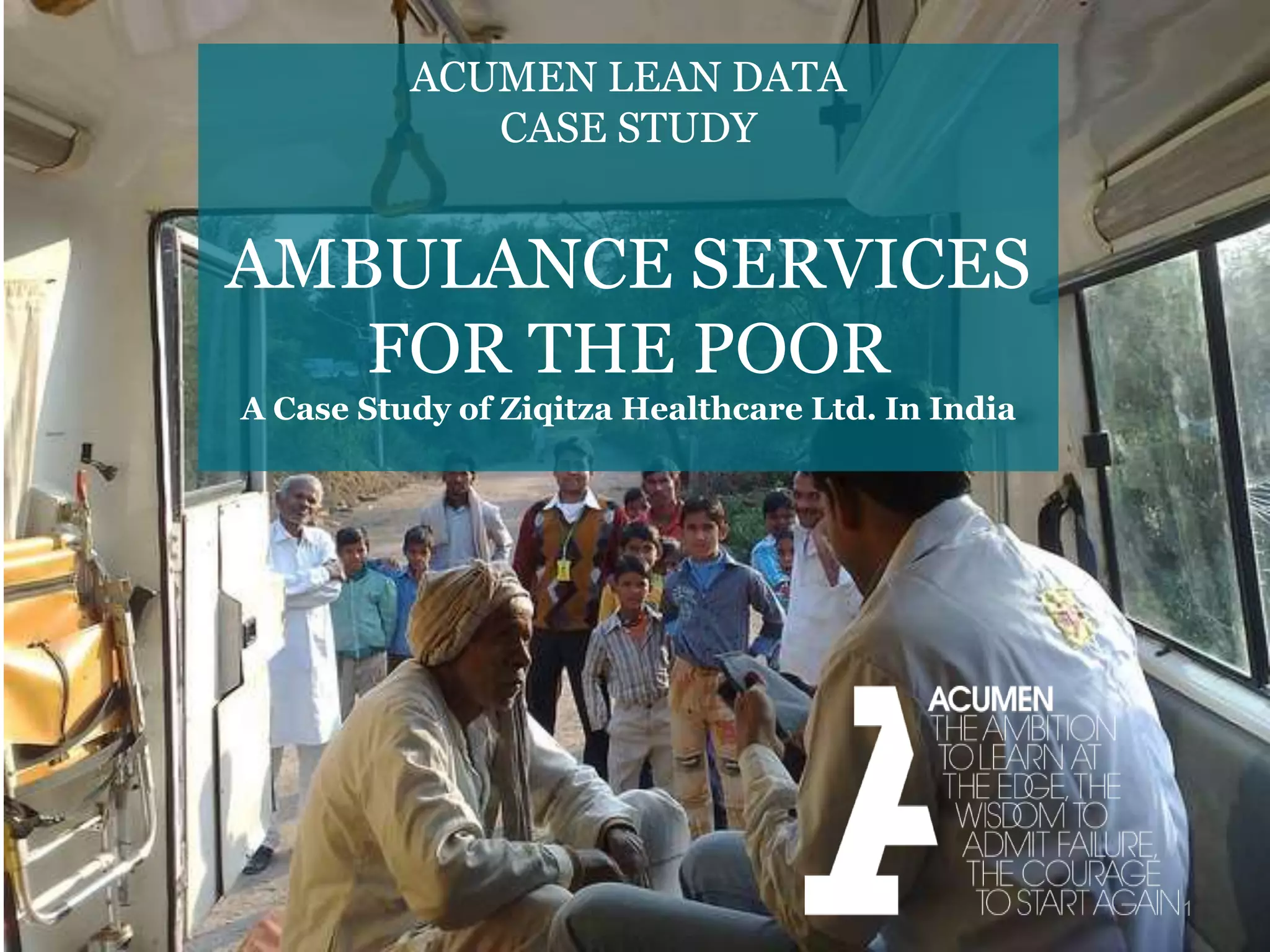
ACUMEN LEAN DATA
CASE STUDY
AMBULANCE SERVICES
FOR THE POOR
A Case Study of Ziqitza Healthcare Ltd. In India
1
Throughout this course, we’ll walk
you through the example of Ziqtza
Healthcare Ltd, an Acumen investee
that is providing ambulance services
in India. In early 2014, Ziqitza
successfully implemented a Lean Data
project to gather new insights about
their customers.
Learn more about Ziqtiza here:
http://acumen.org/investment/zhl/
2Image credit: Noun Project , Mister Pixel. All use, reproduction and distribution of this work is subject to a CC-BY-NC-ND license.
PART 1
3All use, reproduction and distribution of this work is subject to a CC-BY-NC-ND license.
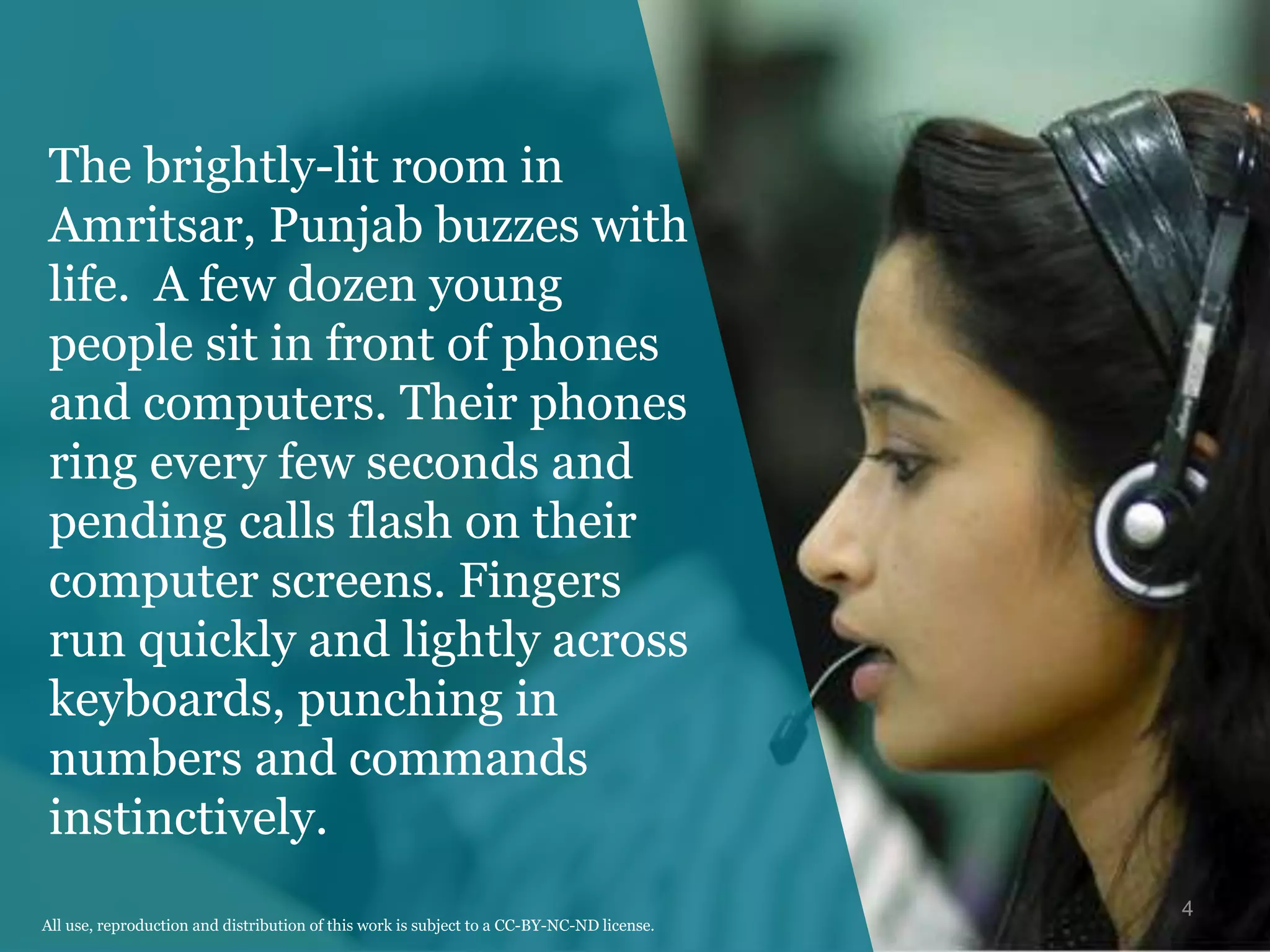
The brightly-lit room in
Amritsar, Punjab buzzes with
life. A few dozen young
people sit in front of phones
and computers. Their phones
ring every few seconds and
pending calls flash on their
computer screens. Fingers
run quickly and lightly across
keyboards, punching in
numbers and commands
instinctively.
4
All use, reproduction and distribution of this work is subject to a CC-BY-NC-ND license.
5
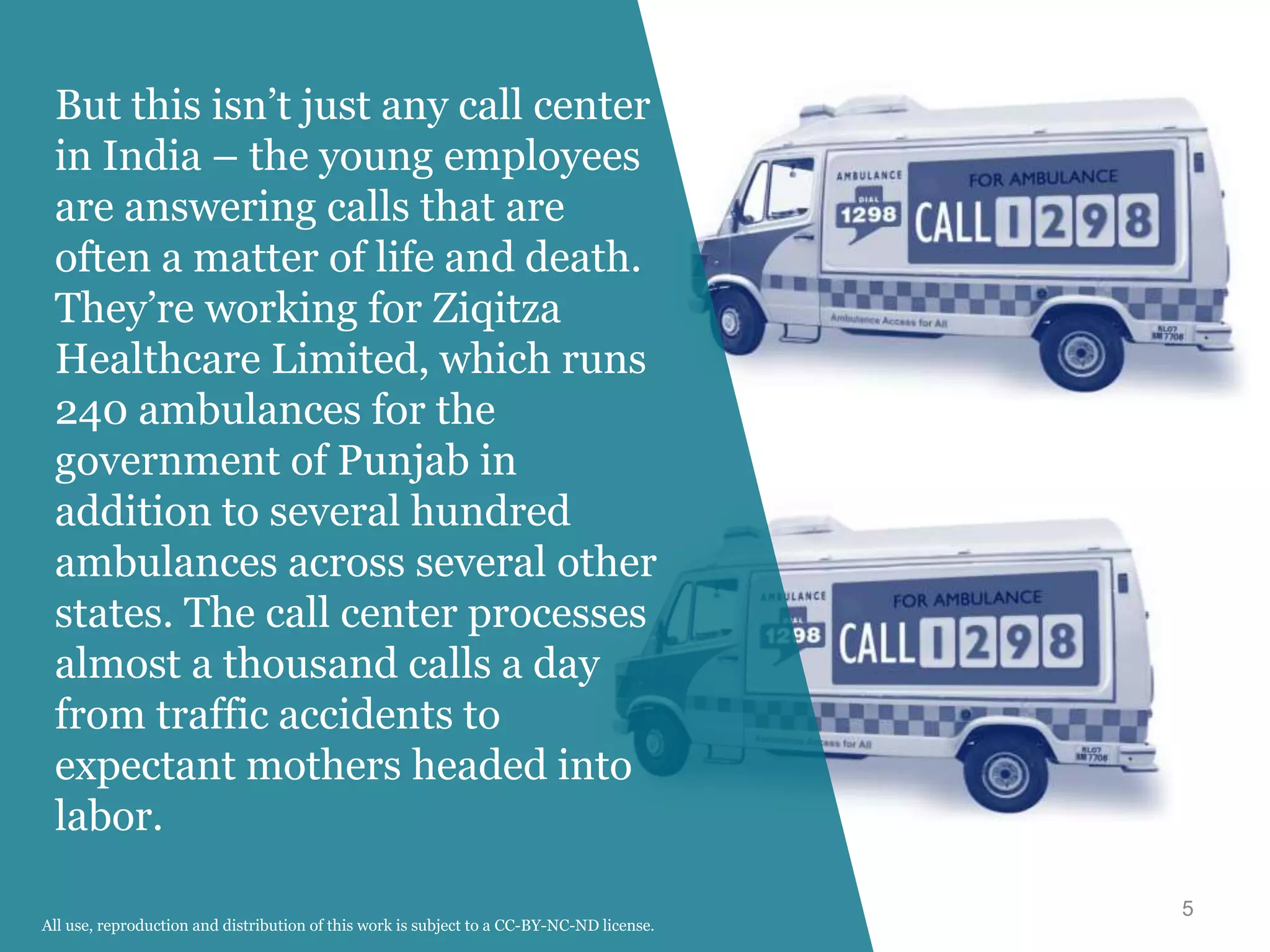
But this isn’t just any call center
in India – the young employees
are answering calls that are
often a matter of life and death.
They’re working for Ziqitza
Healthcare Limited, which runs
240 ambulances for the
government of Punjab in
addition to several hundred
ambulances across several other
states. The call center processes
almost a thousand calls a day
from traffic accidents to
expectant mothers headed into
labor.
All use, reproduction and distribution of this work is subject to a CC-BY-NC-ND license.
6
Watch this short video to learn about Ziqitza and
glimpse the problems it tackles on the streets of India
every day. Click on the link below to watch.
https://www.youtube.com/watch?v=OC7LqVqkrY8
Video produced by GOOD. All use, reproduction and distribution of this work is subject to a CC-BY-NC-ND license.
Image Credit: Noun Project, Anton Outkine. All use, reproduction and distribution of this work is subject to a CC-BY-NC-ND license.
7
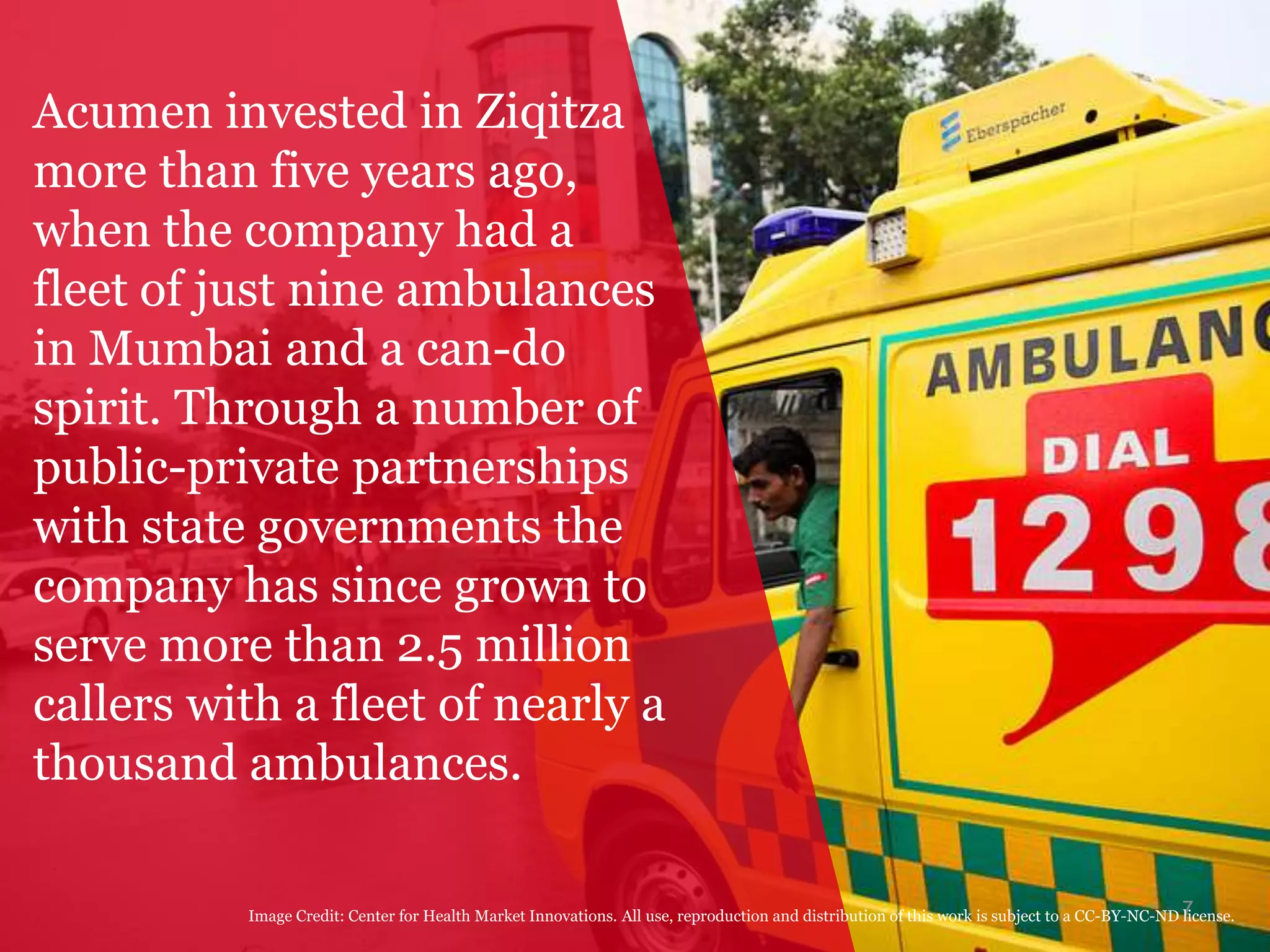
Acumen invested in Ziqitza
more than five years ago,
when the company had a
fleet of just nine ambulances
in Mumbai and a can-do
spirit. Through a number of
public-private partnerships
with state governments the
company has since grown to
serve more than 2.5 million
callers with a fleet of nearly a
thousand ambulances.
Image Credit: Center for Health Market Innovations. All use, reproduction and distribution of this work is subject to a CC-BY-NC-ND license.
8
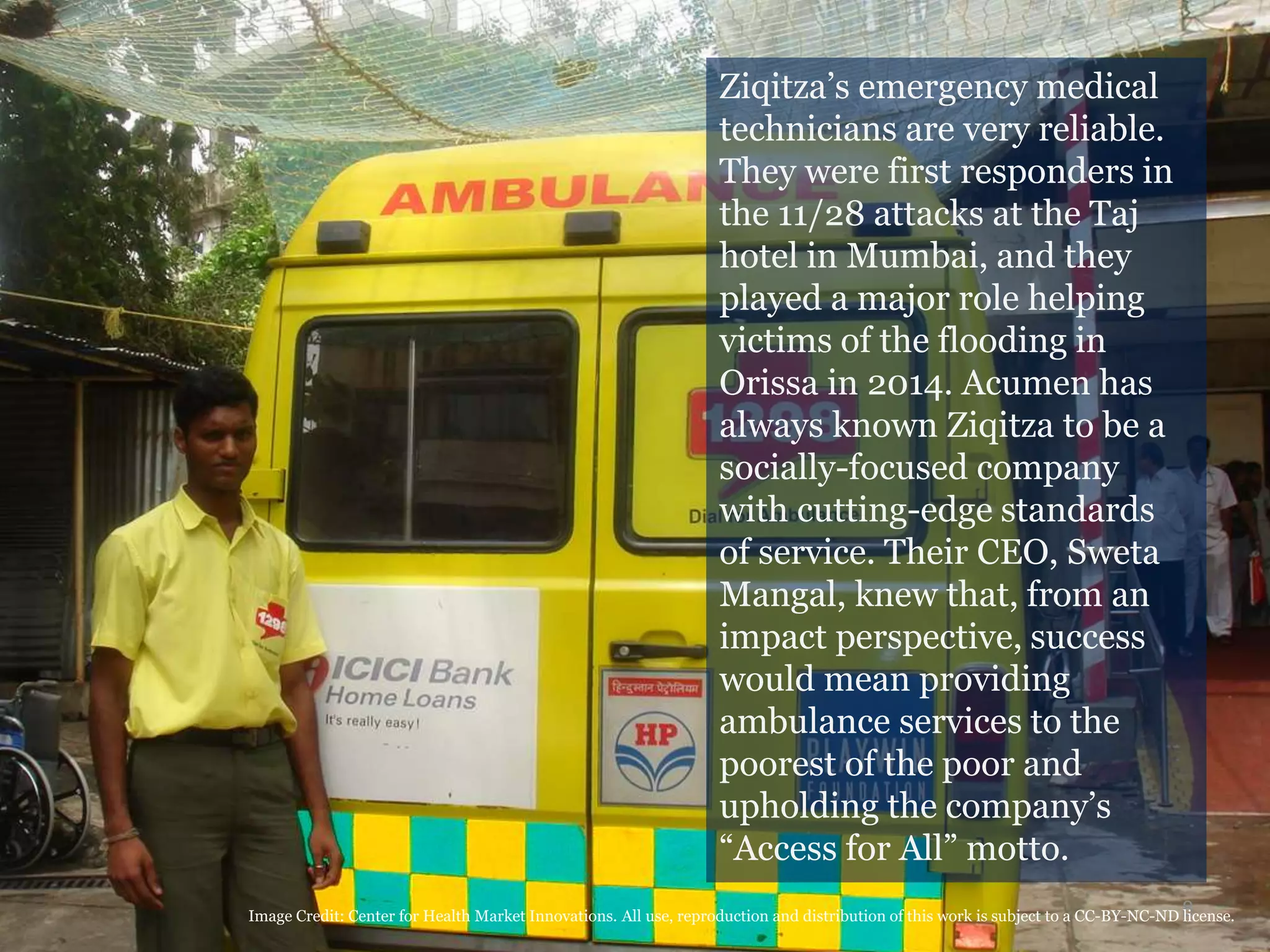
Ziqitza’s emergency medical
technicians are very reliable.
They were first responders in
the 11/28 attacks at the Taj
hotel in Mumbai, and they
played a major role helping
victims of the flooding in
Orissa in 2014. Acumen has
always known Ziqitza to be a
socially-focused company
with cutting-edge standards
of service. Their CEO, Sweta
Mangal, knew that, from an
impact perspective, success
would mean providing
ambulance services to the
poorest of the poor and
upholding the company’s
“Access for All” motto.
Image Credit: Center for Health Market Innovations. All use, reproduction and distribution of this work is subject to a CC-BY-NC-ND license.
However, they did not yet have robust hard
data on who they were serving and whether
they were reaching as far in to poorer
segments of the population as they
intended. Given the company’s social
mission, Sweta was determined to better
understand these questions: she knew
Ziqitza received 3 million calls a year,
deployed 1250 ambulances across 5 states
in India and had an access for all model,
but she didn’t reliably know where and how
they were serving the poorest segments of
the population.
9Image credit: Noun Project , Mister Pixel. All use, reproduction and distribution of this work is subject to a CC-BY-NC-ND license.
10Image credit: Noun Project , Mister Pixel. All use, reproduction and distribution of this work is subject to a CC-BY-NC-ND license.
They had a lot of great
anecdotes, but they didn’t have
the data to answer questions
like:
• Had its services been excluding
those with the fewest alternatives?
• Were its marketing campaigns
succeeding in spreading the
message of universal service?
• In emergencies, like the rush to
hospital for childbirth, were the
very poorest of expectant mothers
actually using Ziqitza’s service?
By the end of this course, you’ll learn the
answers to these questions. But, more
importantly, you’ll learn how Ziqitza
gathered the data to answer these
questions without disrupting normal
company operations or hiring external
surveyors. They found that a Lean Data
approach—like the one we’ll walk you
through in this course—yielded the key
insights the needed to enhance how they
create value for customers.
11All use, reproduction and distribution of this work is subject to a CC-BY-NC-ND license.

Lean Data Case Study 4

  • 1.
    ACUMEN LEAN DATA CASESTUDY AMBULANCE SERVICES FOR THE POOR A Case Study of Ziqitza Healthcare Ltd. In India 1
  • 2.
    Throughout this course,we’ll walk you through the example of Ziqtza Healthcare Ltd, an Acumen investee that is providing ambulance services in India. In early 2014, Ziqitza successfully implemented a Lean Data project to gather new insights about their customers. Learn more about Ziqtiza here: http://acumen.org/investment/zhl/ 2Image credit: Noun Project , Mister Pixel. All use, reproduction and distribution of this work is subject to a CC-BY-NC-ND license.
  • 3.
    PART 1 3All use,reproduction and distribution of this work is subject to a CC-BY-NC-ND license.
  • 4.
    The brightly-lit roomin Amritsar, Punjab buzzes with life. A few dozen young people sit in front of phones and computers. Their phones ring every few seconds and pending calls flash on their computer screens. Fingers run quickly and lightly across keyboards, punching in numbers and commands instinctively. 4 All use, reproduction and distribution of this work is subject to a CC-BY-NC-ND license.
  • 5.
    5 But this isn’tjust any call center in India – the young employees are answering calls that are often a matter of life and death. They’re working for Ziqitza Healthcare Limited, which runs 240 ambulances for the government of Punjab in addition to several hundred ambulances across several other states. The call center processes almost a thousand calls a day from traffic accidents to expectant mothers headed into labor. All use, reproduction and distribution of this work is subject to a CC-BY-NC-ND license.
  • 6.
    6 Watch this shortvideo to learn about Ziqitza and glimpse the problems it tackles on the streets of India every day. Click on the link below to watch. https://www.youtube.com/watch?v=OC7LqVqkrY8 Video produced by GOOD. All use, reproduction and distribution of this work is subject to a CC-BY-NC-ND license. Image Credit: Noun Project, Anton Outkine. All use, reproduction and distribution of this work is subject to a CC-BY-NC-ND license.
  • 7.
    7 Acumen invested inZiqitza more than five years ago, when the company had a fleet of just nine ambulances in Mumbai and a can-do spirit. Through a number of public-private partnerships with state governments the company has since grown to serve more than 2.5 million callers with a fleet of nearly a thousand ambulances. Image Credit: Center for Health Market Innovations. All use, reproduction and distribution of this work is subject to a CC-BY-NC-ND license.
  • 8.
    8 Ziqitza’s emergency medical techniciansare very reliable. They were first responders in the 11/28 attacks at the Taj hotel in Mumbai, and they played a major role helping victims of the flooding in Orissa in 2014. Acumen has always known Ziqitza to be a socially-focused company with cutting-edge standards of service. Their CEO, Sweta Mangal, knew that, from an impact perspective, success would mean providing ambulance services to the poorest of the poor and upholding the company’s “Access for All” motto. Image Credit: Center for Health Market Innovations. All use, reproduction and distribution of this work is subject to a CC-BY-NC-ND license.
  • 9.
    However, they didnot yet have robust hard data on who they were serving and whether they were reaching as far in to poorer segments of the population as they intended. Given the company’s social mission, Sweta was determined to better understand these questions: she knew Ziqitza received 3 million calls a year, deployed 1250 ambulances across 5 states in India and had an access for all model, but she didn’t reliably know where and how they were serving the poorest segments of the population. 9Image credit: Noun Project , Mister Pixel. All use, reproduction and distribution of this work is subject to a CC-BY-NC-ND license.
  • 10.
    10Image credit: NounProject , Mister Pixel. All use, reproduction and distribution of this work is subject to a CC-BY-NC-ND license. They had a lot of great anecdotes, but they didn’t have the data to answer questions like: • Had its services been excluding those with the fewest alternatives? • Were its marketing campaigns succeeding in spreading the message of universal service? • In emergencies, like the rush to hospital for childbirth, were the very poorest of expectant mothers actually using Ziqitza’s service?
  • 11.
    By the endof this course, you’ll learn the answers to these questions. But, more importantly, you’ll learn how Ziqitza gathered the data to answer these questions without disrupting normal company operations or hiring external surveyors. They found that a Lean Data approach—like the one we’ll walk you through in this course—yielded the key insights the needed to enhance how they create value for customers. 11All use, reproduction and distribution of this work is subject to a CC-BY-NC-ND license.