THE E-COMMERCE 
IMPERATIVE ONLINE VERSION 
By: VARUN LUTHRA
INTRODUCTION 
 Change is a constant, but technology is what dictates the pace of 
those changes. 
 This holds true for commercial real estate as much as anything else 
and there is no other property type where change is currently 
playing out so quickly as in the retail arena. 
 The retail marketplace will change more over the next five years 
than it has over the past twenty. 
 These shifts are being entirely driven by the accelerated 
encroachment of e-commerce.
THE RISE OF E-COMMERCE 
 Over the past few years, an average of half a billion new smartphone users 
annually have come online worldwide. 
 Today almost every big company has adopted these technologies to increases 
sales, to make branding all over the globe. 
 Online shopping in India saw a 128% growth in interest from consumers in 2012 
as compared to the previous year, according to a new report. The growth was 
only 40% between 2010 and 2011, said the report compiled by Google and TNS 
Australia. 
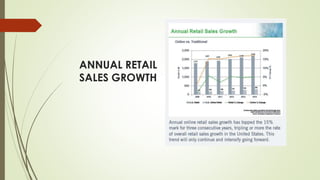
 In the US, as the economy began to emerge from the recession in 2010, the 
trend became clear. While overall retail sales increased by about 5.6% in 2010, 
online sales growth increased by 15.3%.
ANNUAL RETAIL 
SALES GROWTH
REASONS BEHIND THE GROWTH OF E – 
COMMERCE 
 Busy Lifestyle: The lifestyle of people is so busy that they are unable to go to 
the crowded markets every time for shopping. 
 High Disposable Income: With growing job opportunities the income 
sources have also increased. 
 Awareness of Products: People are much more aware nowadays regarding 
the products available in the markets. Because of this reason they feel 
confident while shopping online.
 Rising Computer Educational Level: Due to the efforts of Government and 
Private Educational Institutions in India, computer education is getting new 
horizons. 
 Increased Usage of Internet: With more than 100 million Internet users, the 
country is beginning to achieve a critical mass of users who are familiar with 
web services. In addition, over the past few years, relatively sophisticated 
online travel agents (“OTAs”), such as MakeMyTrip – which started turning 
these initial Web users into Web consumers – have dominated Indian e-commerce.
ESSENTIALS FOR MAKING ONLINE 
SHOPPING EFFECTIVE 
 It must be Secure: Every customer wants to make safe and secure 
transactions while purchasing online. If the website is secure, customers will 
tend to purchase more from it. 
 Appealing and Informative Design of Website: The website which has 
designed for online shopping purpose must be designed in such a way that 
it will attract more and more customers towards it by the offers, patterns, 
quick services etc. 
 Deliver High and Quick Quality Services: One of an important feature to 
make your online shopping websites better than others is to deliver high 
and quick quality services.
AMAZON: THE REAL CATEGORY KILLER 
 While smaller retail chains and independents have long referred to the 
mega-stores of Walmart, Target and countless other hypermart operators as 
category killers, the category killer of the new MIllenia is clearly Amazon. 
 Half direct retail, half internet clearinghouse for thousands of independent 
vendors that sell their goods through their system, Amazon is the e-commerce 
leader. 
 Their total sales volume over the past year is just under $64 billion, with Q2 
sales expected to possibly reach as high as $16.2 billion.
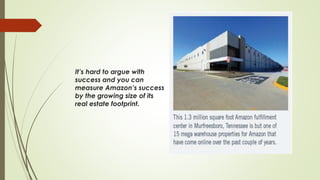
It’s hard to argue with 
success and you can 
measure Amazon’s success 
by the growing size of its 
real estate footprint.
AMAZON’S $2 BILLION INDIA-SPECIFIC 
INVESTMENT A DAY AFTER FLIPKART’S FUNDING 
 Merely a day after India’s largest e-commerce marketplace, Flipkart made 
the official announcement that it has raised US $1 billion, rival and e-commerce 
behemoth Amazon has gone one up by announcing a US $2 
billion India-specific fund. 
 Flipkart’s fund raise is the biggest till date for an Indian company, led by its 
existing investors, Tiger Global and Naspers and including Accel Partners, 
DST Global, ICONIQ Capital, Morgan Stanley Investment Management, and 
Sofina.
INFERENCES
THE TOP 5 TECHNICAL CONSIDERATIONS FOR 
EVALUATIN E-COMMERCE PLATFORMS 
 Scalability: Will the site perform efficiently through traffic peaks and valleys? 
Scalability may be one of the most overused terms in IT marketing. Software 
makers would have you believe that every application ever written was 
destined to be scalable from inception. 
 The Product Catalog: Will today’s catalogue schema meet tomorrow’s 
demands? Your product catalogue is the online repository for every item 
you sell. It has to effectively promote the items you most want to push, and 
simultaneously help your customers find the items they are looking for.
 Business User Control: Will my application directly empower my 
merchandisers, marketing managers, and other business owners? Many IT 
managers long for a world where there are no demanding business users. 
They long for the end of business requests that seemingly come from left 
field, or arrive urgently at the last minute. 
 Reporting and Analytics: Do I have all the features I need to understand my 
online business? Your e-commerce Website stores a treasure trove of 
information about your customers, their behaviour, and their preferences. 
 Integration: How easily can the application integrate with my other 
systems? The e-commerce Website, once a standalone silo, is now a highly 
integrated application that touches many other systems and processes.
CONCLUSION / THE ROAD AHEAD 
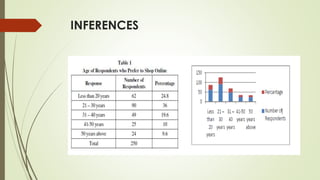
 The research reveals that most of the people who are engaged in making the 
decision of purchasing, are in the age group of 21-30 years. 
 While making the website for online shopping it must be designed in a very 
planned and strategic way. 
 Retail routinely goes through seismic shifts; the rise of the suburban shopping 
mall; the ebb and flow of the department store sector; the emergence of the 
category killers; the ascent (and now the shrinking) of the big boxes. 
 E-commerce is nothing new, but its growth has finally reached a tipping point 
and we are in the midst of one of those seismic shifts. As challenging as this may 
seem, those retailers who see this as an opportunity will be the ones that end up 
on top.
 Meanwhile, owners of industrial properties also need to understand the nature 
of the beast if they want to capitalize on the current wave of demand from 
mega-distribution users. 
 Shopping centre vacancies will continue to fall at a modest rate as overall 
retailer growth plans are up, however, there has been a massive shift in terms of 
who is expanding. 
 The rise of e-commerce has meant stiff competition for mid-priced hard goods 
retailers. Most are focusing their immediate efforts on building their e-commerce 
platforms and are streamlining their bricks and mortar presence. 
 Concepts that don’t, or only minimally compete, with e-commerce is where we 
are seeing some of the strongest bricks and mortar growth. Restaurants lead the 
way, grocery stores are hot (new smaller concepts are expanding though many 
traditional players are contracting) and service related retailers are the 
strongest sectors.
THANK YOU

The e commerce imperative online version

  • 1.
    THE E-COMMERCE IMPERATIVEONLINE VERSION By: VARUN LUTHRA
  • 2.
    INTRODUCTION  Changeis a constant, but technology is what dictates the pace of those changes.  This holds true for commercial real estate as much as anything else and there is no other property type where change is currently playing out so quickly as in the retail arena.  The retail marketplace will change more over the next five years than it has over the past twenty.  These shifts are being entirely driven by the accelerated encroachment of e-commerce.
  • 3.
    THE RISE OFE-COMMERCE  Over the past few years, an average of half a billion new smartphone users annually have come online worldwide.  Today almost every big company has adopted these technologies to increases sales, to make branding all over the globe.  Online shopping in India saw a 128% growth in interest from consumers in 2012 as compared to the previous year, according to a new report. The growth was only 40% between 2010 and 2011, said the report compiled by Google and TNS Australia.  In the US, as the economy began to emerge from the recession in 2010, the trend became clear. While overall retail sales increased by about 5.6% in 2010, online sales growth increased by 15.3%.
  • 4.
  • 5.
    REASONS BEHIND THEGROWTH OF E – COMMERCE  Busy Lifestyle: The lifestyle of people is so busy that they are unable to go to the crowded markets every time for shopping.  High Disposable Income: With growing job opportunities the income sources have also increased.  Awareness of Products: People are much more aware nowadays regarding the products available in the markets. Because of this reason they feel confident while shopping online.
  • 6.
     Rising ComputerEducational Level: Due to the efforts of Government and Private Educational Institutions in India, computer education is getting new horizons.  Increased Usage of Internet: With more than 100 million Internet users, the country is beginning to achieve a critical mass of users who are familiar with web services. In addition, over the past few years, relatively sophisticated online travel agents (“OTAs”), such as MakeMyTrip – which started turning these initial Web users into Web consumers – have dominated Indian e-commerce.
  • 7.
    ESSENTIALS FOR MAKINGONLINE SHOPPING EFFECTIVE  It must be Secure: Every customer wants to make safe and secure transactions while purchasing online. If the website is secure, customers will tend to purchase more from it.  Appealing and Informative Design of Website: The website which has designed for online shopping purpose must be designed in such a way that it will attract more and more customers towards it by the offers, patterns, quick services etc.  Deliver High and Quick Quality Services: One of an important feature to make your online shopping websites better than others is to deliver high and quick quality services.
  • 8.
    AMAZON: THE REALCATEGORY KILLER  While smaller retail chains and independents have long referred to the mega-stores of Walmart, Target and countless other hypermart operators as category killers, the category killer of the new MIllenia is clearly Amazon.  Half direct retail, half internet clearinghouse for thousands of independent vendors that sell their goods through their system, Amazon is the e-commerce leader.  Their total sales volume over the past year is just under $64 billion, with Q2 sales expected to possibly reach as high as $16.2 billion.
  • 9.
    It’s hard toargue with success and you can measure Amazon’s success by the growing size of its real estate footprint.
  • 10.
    AMAZON’S $2 BILLIONINDIA-SPECIFIC INVESTMENT A DAY AFTER FLIPKART’S FUNDING  Merely a day after India’s largest e-commerce marketplace, Flipkart made the official announcement that it has raised US $1 billion, rival and e-commerce behemoth Amazon has gone one up by announcing a US $2 billion India-specific fund.  Flipkart’s fund raise is the biggest till date for an Indian company, led by its existing investors, Tiger Global and Naspers and including Accel Partners, DST Global, ICONIQ Capital, Morgan Stanley Investment Management, and Sofina.
  • 11.
  • 13.
    THE TOP 5TECHNICAL CONSIDERATIONS FOR EVALUATIN E-COMMERCE PLATFORMS  Scalability: Will the site perform efficiently through traffic peaks and valleys? Scalability may be one of the most overused terms in IT marketing. Software makers would have you believe that every application ever written was destined to be scalable from inception.  The Product Catalog: Will today’s catalogue schema meet tomorrow’s demands? Your product catalogue is the online repository for every item you sell. It has to effectively promote the items you most want to push, and simultaneously help your customers find the items they are looking for.
  • 14.
     Business UserControl: Will my application directly empower my merchandisers, marketing managers, and other business owners? Many IT managers long for a world where there are no demanding business users. They long for the end of business requests that seemingly come from left field, or arrive urgently at the last minute.  Reporting and Analytics: Do I have all the features I need to understand my online business? Your e-commerce Website stores a treasure trove of information about your customers, their behaviour, and their preferences.  Integration: How easily can the application integrate with my other systems? The e-commerce Website, once a standalone silo, is now a highly integrated application that touches many other systems and processes.
  • 15.
    CONCLUSION / THEROAD AHEAD  The research reveals that most of the people who are engaged in making the decision of purchasing, are in the age group of 21-30 years.  While making the website for online shopping it must be designed in a very planned and strategic way.  Retail routinely goes through seismic shifts; the rise of the suburban shopping mall; the ebb and flow of the department store sector; the emergence of the category killers; the ascent (and now the shrinking) of the big boxes.  E-commerce is nothing new, but its growth has finally reached a tipping point and we are in the midst of one of those seismic shifts. As challenging as this may seem, those retailers who see this as an opportunity will be the ones that end up on top.
  • 16.
     Meanwhile, ownersof industrial properties also need to understand the nature of the beast if they want to capitalize on the current wave of demand from mega-distribution users.  Shopping centre vacancies will continue to fall at a modest rate as overall retailer growth plans are up, however, there has been a massive shift in terms of who is expanding.  The rise of e-commerce has meant stiff competition for mid-priced hard goods retailers. Most are focusing their immediate efforts on building their e-commerce platforms and are streamlining their bricks and mortar presence.  Concepts that don’t, or only minimally compete, with e-commerce is where we are seeing some of the strongest bricks and mortar growth. Restaurants lead the way, grocery stores are hot (new smaller concepts are expanding though many traditional players are contracting) and service related retailers are the strongest sectors.
  • 17.

Editor's Notes

  • #3 Over the next few years, the overwhelming majority of new retail development will in fact—be industrial. And the overwhelming majority of new industrial development will in fact—be retail.
  • #6 The customers prefer to shop in a relaxed environment at their own convenience. Because of high spending power, customers are willingly able to pay for the products online.
  • #7 People are much more aware regarding the tools and techniques of computers.
  • #8 Secure Sockets Layer (SSL) is a standard security technology for establishing an encrypted link between the web server and a browser. The content of the website must be understandable. The processing on the website must be quick in regards of payments, home delivery services etc.