THE DIGITAL CHALLENGE 2 March 2010 Nick Poole  CEO Collections Trust
“ Technology may change, people don’t..”
What do you want to do? Who are you doing it for? What is the best way of doing it with the resources at your disposal? Technology for its own sake is worse than no technology at all Going back to first principles...
Digital opportunities
Collections cover everything from physical objects to born-digital and digitised material They include knowledge and organisational records which must be managed as an asset The skills we need to manage Digital collections? Curatorship, conservation, documentation  “ Digitisation is acquisition by scanner” 1. Collections are no longer just physical
Technology is good at large-scale repetition It can provide a low-cost way of reaching a large number of people It can’t replace having something useful/interesting to say Technology can be the medium, but rarely the message Digital marketing should only ever be one part of a well-conceived Marketing Strategy Your audience are more likely habitual mobile phone users than Internet surfers 2. Technology for Marketing
A new generation of Internet services are educating the public in a different kind of social interaction Consumers are used to having a  relationship  with the services they use They expect the right to have a voice, and if you let them talk  to  you, it’s likely they’ll also talk  about  you The online environment can be anonymous and hence more welcoming If someone comes into your museum and tells you a story about something in your collections, what would you do with it? Would you replace the label? 3. Technology for Engagement
Your museum is a Small/Medium Enterprise Technology can make a good process more efficient It can also make a bad process worse Your management records (personnel, finance, meeting minutes) are as much a part of the knowledge  of your organisation as the catalogue Silos of information are unhealthy 4. Technology for Management
How will you ensure that your Digital service is here in 7 years time? What are the new models emerging from the Digital environment? Freenomics – the principle that when technology enters a market, it reduces costs to the point at which prices tend towards free The transactional content industry is struggling We aren’t at a scale where content or advertising are real options We’re really dependent on downstream, non-economic ROI 5. Digital Business Models
Digitisation has been a priority for much of the past 10 years A digital asset without a delivery channel is a liability Digitising something and putting it on the web does not result in access Again, it’s about first principles What are you trying to do, who for and what is the best mechanism for reaching them? 6. From Digitisation to Digital services
The consumer is not looking for museum websites They are, however, looking at consumer sites, price comparison sites, travel planning sites, Government, e-commerce, social networking, online TV-on-demand and Google We need to go to where the punter is We need to understand that their expectations of quality and usability are forged in online supermarkets and iTunes – this is what your searchable collections database is competing with. 7. Working with Consumer behaviour
Many (most) online models only work at scale Many (most) cultural institutions don’t have the reach to operate at this scale Working together, shared services, collaboration and aggregation are vital Working with established media brands and using other organisations’ market share is key The aim is to work with the web, not against it 7. Working at web scale
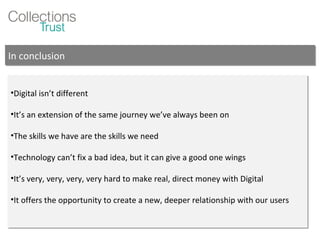
Digital isn’t different It’s an extension of the same journey we’ve always been on The skills we have are the skills we need Technology can’t fix a bad idea, but it can give a good one wings It’s very, very, very, very hard to make real, direct money with Digital It offers the opportunity to create a new, deeper relationship with our users In conclusion

The Digitial Challenge, Museums Galleries Scotland event

  • 1.
    THE DIGITAL CHALLENGE2 March 2010 Nick Poole CEO Collections Trust
  • 2.
    “ Technology maychange, people don’t..”
  • 3.
    What do youwant to do? Who are you doing it for? What is the best way of doing it with the resources at your disposal? Technology for its own sake is worse than no technology at all Going back to first principles...
  • 4.
  • 5.
    Collections cover everythingfrom physical objects to born-digital and digitised material They include knowledge and organisational records which must be managed as an asset The skills we need to manage Digital collections? Curatorship, conservation, documentation “ Digitisation is acquisition by scanner” 1. Collections are no longer just physical
  • 6.
    Technology is goodat large-scale repetition It can provide a low-cost way of reaching a large number of people It can’t replace having something useful/interesting to say Technology can be the medium, but rarely the message Digital marketing should only ever be one part of a well-conceived Marketing Strategy Your audience are more likely habitual mobile phone users than Internet surfers 2. Technology for Marketing
  • 7.
    A new generationof Internet services are educating the public in a different kind of social interaction Consumers are used to having a relationship with the services they use They expect the right to have a voice, and if you let them talk to you, it’s likely they’ll also talk about you The online environment can be anonymous and hence more welcoming If someone comes into your museum and tells you a story about something in your collections, what would you do with it? Would you replace the label? 3. Technology for Engagement
  • 8.
    Your museum isa Small/Medium Enterprise Technology can make a good process more efficient It can also make a bad process worse Your management records (personnel, finance, meeting minutes) are as much a part of the knowledge of your organisation as the catalogue Silos of information are unhealthy 4. Technology for Management
  • 9.
    How will youensure that your Digital service is here in 7 years time? What are the new models emerging from the Digital environment? Freenomics – the principle that when technology enters a market, it reduces costs to the point at which prices tend towards free The transactional content industry is struggling We aren’t at a scale where content or advertising are real options We’re really dependent on downstream, non-economic ROI 5. Digital Business Models
  • 10.
    Digitisation has beena priority for much of the past 10 years A digital asset without a delivery channel is a liability Digitising something and putting it on the web does not result in access Again, it’s about first principles What are you trying to do, who for and what is the best mechanism for reaching them? 6. From Digitisation to Digital services
  • 11.
    The consumer isnot looking for museum websites They are, however, looking at consumer sites, price comparison sites, travel planning sites, Government, e-commerce, social networking, online TV-on-demand and Google We need to go to where the punter is We need to understand that their expectations of quality and usability are forged in online supermarkets and iTunes – this is what your searchable collections database is competing with. 7. Working with Consumer behaviour
  • 12.
    Many (most) onlinemodels only work at scale Many (most) cultural institutions don’t have the reach to operate at this scale Working together, shared services, collaboration and aggregation are vital Working with established media brands and using other organisations’ market share is key The aim is to work with the web, not against it 7. Working at web scale
  • 13.
    Digital isn’t differentIt’s an extension of the same journey we’ve always been on The skills we have are the skills we need Technology can’t fix a bad idea, but it can give a good one wings It’s very, very, very, very hard to make real, direct money with Digital It offers the opportunity to create a new, deeper relationship with our users In conclusion