Road to Digital Transformation
“This presentation is part of faculty development program on digital transformation in education”
Biju Shoolapani
@bijushoolapani
https://www.linkedin.com/in/bijushoolapani/
1
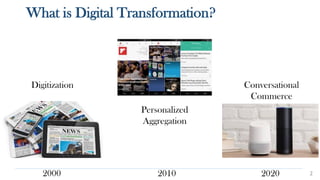
What is Digital Transformation?
2
Digitization
Personalized
Aggregation
Conversational
Commerce
2000 2010 2020
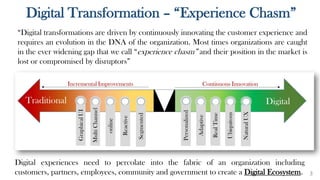
Digital Transformation – “Experience Chasm”
“Digital transformations are driven by continuously innovating the customer experience and
requires an evolution in the DNA of the organization. Most times organizations are caught
in the ever widening gap that we call “experience chasm” and their position in the market is
lost or compromised by disruptors”
Digital experiences need to percolate into the fabric of an organization including
customers, partners, employees, community and government to create a Digital Ecosystem. 3
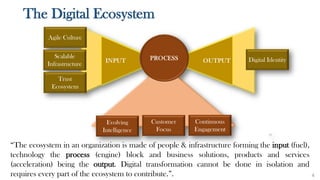
The Digital Ecosystem
“The ecosystem in an organization is made of people & infrastructure forming the input (fuel),
technology the process (engine) block and business solutions, products and services
(acceleration) being the output. Digital transformation cannot be done in isolation and
requires every part of the ecosystem to contribute.”. 4
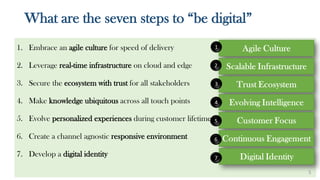
1. Embrace an agile culture for speed of delivery
2. Leverage real-time infrastructure on cloud and edge
3. Secure the ecosystem with trust for all stakeholders
4. Make knowledge ubiquitous across all touch points
5. Evolve personalized experiences during customer lifetime
6. Create a channel agnostic responsive environment
7. Develop a digital identity
What are the seven steps to “be digital”
7
6
5
4
3
2
1
5
Step 1 - Embrace an agile culture
6
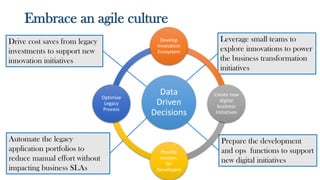
Embrace an agile culture
Drive cost saves from legacy
investments to support new
innovation initiatives
Leverage small teams to
explore innovations to power
the business transformation
initiatives
Prepare the development
and ops functions to support
new digital initiatives
Automate the legacy
application portfolios to
reduce manual effort without
impacting business SLAs
Data
Driven
Decisions
Develop
Innovation
Ecosystem
Create new
digital
business
Initiatives
Provide
environ.
for
Developers
Optimize
Legacy
Process
Step 2 - Leverage scalable infrastructure
8
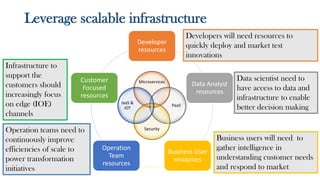
Leverage scalable infrastructure
Developer
resources
Data Analyst
resources
Business User
resources
Operation
Team
resources
Customer
Focused
resources
Infrastructure to
support the
customers should
increasingly focus
on edge (IOE)
channels
Data scientist need to
have access to data and
infrastructure to enable
better decision making
Developers will need resources to
quickly deploy and market test
innovations
Business users will need to
gather intelligence in
understanding customer needs
and respond to market
Operation teams need to
continuously improve
efficiencies of scale to
power transformation
initiatives
Microservices
PaaS
Security
IaaS &
IOT
Step 3 - Secure the ecosystem with trust
10
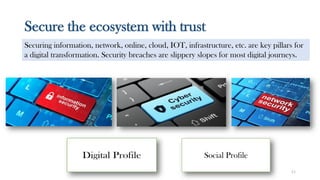
Secure the ecosystem with trust
Securing information, network, online, cloud, IOT, infrastructure, etc. are key pillars for
a digital transformation. Security breaches are slippery slopes for most digital journeys.
11
Step 4 – Evolving Intelligence
12
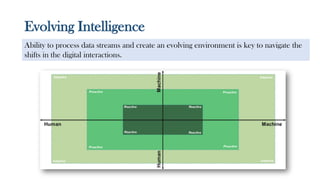
Evolving Intelligence
Ability to process data streams and create an evolving environment is key to navigate the
shifts in the digital interactions.
Step 5 – Customer Focus
14
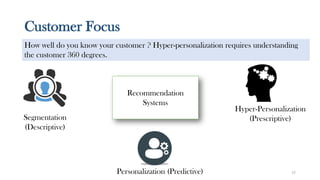
Customer Focus
How well do you know your customer ? Hyper-personalization requires understanding
the customer 360 degrees.
Segmentation
(Descriptive)
Personalization (Predictive)
Hyper-Personalization
(Prescriptive)
15
Step 6 – Continuous Engagement
16
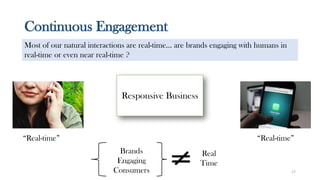
Continuous Engagement
“Real-time” “Real-time”
Brands
Engaging
Consumers
Real
Time
Most of our natural interactions are real-time… are brands engaging with humans in
real-time or even near real-time ?
17
18
Step 7 – Digital Identity @ Edge
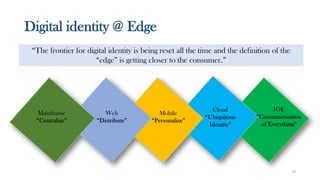
Digital identity @ Edge
“The frontier for digital identity is being reset all the time and the definition of the
“edge” is getting closer to the consumer.”
19
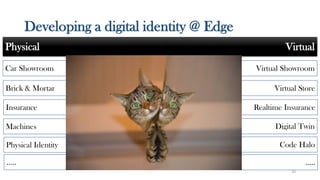
Physical Identity Code Halo
Machines Digital Twin
Realtime InsuranceInsurance
Virtual StoreBrick & Mortar
Virtual Showroom
Developing a digital identity @ Edge
Physical Virtual
Car Showroom
….. …..
20
21
Framework for Academic Institutions
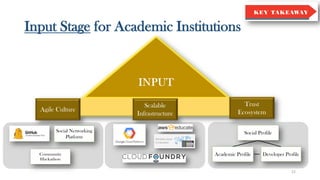
Input Stage for Academic Institutions
22
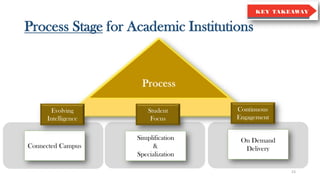
Process Stage for Academic Institutions
23
Thank you
24
Digital Identity & future of Academic
Institutions is with YOU…
Biju Shoolapani
@bijushoolapani
https://www.linkedin.com/in/bijushoolapani/

A methodology for Digital Transformation in Enterprises

  • 1.
    Road to DigitalTransformation “This presentation is part of faculty development program on digital transformation in education” Biju Shoolapani @bijushoolapani https://www.linkedin.com/in/bijushoolapani/ 1
  • 2.
    What is DigitalTransformation? 2 Digitization Personalized Aggregation Conversational Commerce 2000 2010 2020
  • 3.
    Digital Transformation –“Experience Chasm” “Digital transformations are driven by continuously innovating the customer experience and requires an evolution in the DNA of the organization. Most times organizations are caught in the ever widening gap that we call “experience chasm” and their position in the market is lost or compromised by disruptors” Digital experiences need to percolate into the fabric of an organization including customers, partners, employees, community and government to create a Digital Ecosystem. 3
  • 4.
    The Digital Ecosystem “Theecosystem in an organization is made of people & infrastructure forming the input (fuel), technology the process (engine) block and business solutions, products and services (acceleration) being the output. Digital transformation cannot be done in isolation and requires every part of the ecosystem to contribute.”. 4
  • 5.
    1. Embrace anagile culture for speed of delivery 2. Leverage real-time infrastructure on cloud and edge 3. Secure the ecosystem with trust for all stakeholders 4. Make knowledge ubiquitous across all touch points 5. Evolve personalized experiences during customer lifetime 6. Create a channel agnostic responsive environment 7. Develop a digital identity What are the seven steps to “be digital” 7 6 5 4 3 2 1 5
  • 6.
    Step 1 -Embrace an agile culture 6
  • 7.
    Embrace an agileculture Drive cost saves from legacy investments to support new innovation initiatives Leverage small teams to explore innovations to power the business transformation initiatives Prepare the development and ops functions to support new digital initiatives Automate the legacy application portfolios to reduce manual effort without impacting business SLAs Data Driven Decisions Develop Innovation Ecosystem Create new digital business Initiatives Provide environ. for Developers Optimize Legacy Process
  • 8.
    Step 2 -Leverage scalable infrastructure 8
  • 9.
    Leverage scalable infrastructure Developer resources DataAnalyst resources Business User resources Operation Team resources Customer Focused resources Infrastructure to support the customers should increasingly focus on edge (IOE) channels Data scientist need to have access to data and infrastructure to enable better decision making Developers will need resources to quickly deploy and market test innovations Business users will need to gather intelligence in understanding customer needs and respond to market Operation teams need to continuously improve efficiencies of scale to power transformation initiatives Microservices PaaS Security IaaS & IOT
  • 10.
    Step 3 -Secure the ecosystem with trust 10
  • 11.
    Secure the ecosystemwith trust Securing information, network, online, cloud, IOT, infrastructure, etc. are key pillars for a digital transformation. Security breaches are slippery slopes for most digital journeys. 11
  • 12.
    Step 4 –Evolving Intelligence 12
  • 13.
    Evolving Intelligence Ability toprocess data streams and create an evolving environment is key to navigate the shifts in the digital interactions.
  • 14.
    Step 5 –Customer Focus 14
  • 15.
    Customer Focus How welldo you know your customer ? Hyper-personalization requires understanding the customer 360 degrees. Segmentation (Descriptive) Personalization (Predictive) Hyper-Personalization (Prescriptive) 15
  • 16.
    Step 6 –Continuous Engagement 16
  • 17.
    Continuous Engagement “Real-time” “Real-time” Brands Engaging Consumers Real Time Mostof our natural interactions are real-time… are brands engaging with humans in real-time or even near real-time ? 17
  • 18.
    18 Step 7 –Digital Identity @ Edge
  • 19.
    Digital identity @Edge “The frontier for digital identity is being reset all the time and the definition of the “edge” is getting closer to the consumer.” 19
  • 20.
    Physical Identity CodeHalo Machines Digital Twin Realtime InsuranceInsurance Virtual StoreBrick & Mortar Virtual Showroom Developing a digital identity @ Edge Physical Virtual Car Showroom ….. ….. 20
  • 21.
  • 22.
    Input Stage forAcademic Institutions 22
  • 23.
    Process Stage forAcademic Institutions 23
  • 24.
    Thank you 24 Digital Identity& future of Academic Institutions is with YOU… Biju Shoolapani @bijushoolapani https://www.linkedin.com/in/bijushoolapani/