1© 2019 IDERA, Inc. All rights reserved.
HUMAN FACTORS IN DATA GOVERNANCE
AUGUST 20, 2019
Ron Huizenga
Senior Product Manager, Enterprise Architecture & Modeling
@DataAviator
2© 2016 IDERA, Inc. All rights reserved. Proprietary and confidential. 2© 2019 IDERA, Inc. All rights reserved.
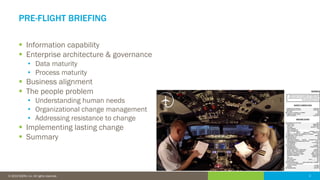
PRE-FLIGHT BRIEFING
▪ Information capability
▪ Enterprise architecture & governance
• Data maturity
• Process maturity
▪ Business alignment
▪ The people problem
• Understanding human needs
• Organizational change management
• Addressing resistance to change
▪ Implementing lasting change
▪ Summary
3© 2016 IDERA, Inc. All rights reserved. Proprietary and confidential. 3© 2019 IDERA, Inc. All rights reserved.
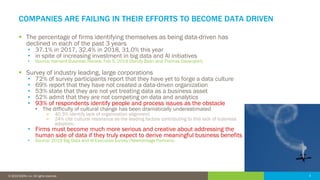
COMPANIES ARE FAILING IN THEIR EFFORTS TO BECOME DATA DRIVEN
▪ The percentage of firms identifying themselves as being data-driven has
declined in each of the past 3 years
• 37.1% in 2017, 32.4% in 2018, 31.0% this year
• in spite of increasing investment in big data and AI initiatives
• Source: Harvard Business Review, Feb 5, 2019 (Randy Bean and Thomas Davenport)
▪ Survey of industry leading, large corporations
• 72% of survey participants report that they have yet to forge a data culture
• 69% report that they have not created a data-driven organization
• 53% state that they are not yet treating data as a business asset
• 52% admit that they are not competing on data and analytics
• 93% of respondents identify people and process issues as the obstacle
• The difficulty of cultural change has been dramatically underestimated
− 40.3% identify lack of organization alignment
− 24% cite cultural resistance as the leading factors contributing to this lack of business
adoption.
• Firms must become much more serious and creative about addressing the
human side of data if they truly expect to derive meaningful business benefits
• Source: 2019 Big Data and AI Executive Survey (NewVantage Partners)
4© 2016 IDERA, Inc. All rights reserved. Proprietary and confidential. 4© 2019 IDERA, Inc. All rights reserved.
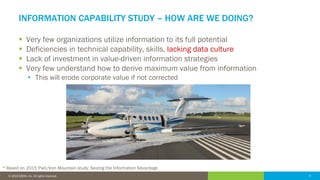
INFORMATION CAPABILITY STUDY – HOW ARE WE DOING?
▪ Very few organizations utilize information to its full potential
▪ Deficiencies in technical capability, skills, lacking data culture
▪ Lack of investment in value-driven information strategies
▪ Very few understand how to derive maximum value from information
• This will erode corporate value if not corrected
* Based on 2015 PwC/Iron Mountain study: Seizing the Information Advantage
5© 2019 IDERA, Inc. All rights reserved.
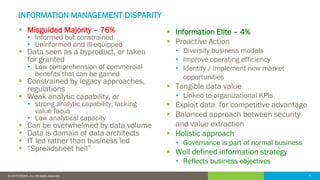
INFORMATION MANAGEMENT DISPARITY
▪ Misguided Majority – 76%
• Informed but constrained
• Uninformed and ill-equipped
▪ Data seen as a byproduct, or taken
for granted
• Low comprehension of commercial
benefits that can be gained
▪ Constrained by legacy approaches,
regulations
▪ Weak analytic capability, or
• strong analytic capability, lacking
value focus
• Low analytical capacity
▪ Can be overwhelmed by data volume
▪ Data is domain of data architects
▪ IT led rather than business led
▪ “Spreadsheet hell”
▪ Information Elite – 4%
▪ Proactive Action
• Diversify business models
• Improve operating efficiency
• Identify / implement new market
opportunities
▪ Tangible data value
• Linked to organizational KPIs
▪ Exploit data for competitive advantage
▪ Balanced approach between security
and value extraction
▪ Holistic approach
• Governance is part of normal business
▪ Well defined information strategy
• Reflects business objectives
6© 2016 IDERA, Inc. All rights reserved. Proprietary and confidential. 6© 2019 IDERA, Inc. All rights reserved.
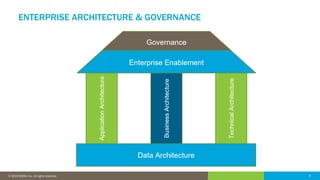
ENTERPRISE ARCHITECTURE & GOVERNANCE
7© 2016 IDERA, Inc. All rights reserved. Proprietary and confidential. 7© 2019 IDERA, Inc. All rights reserved.
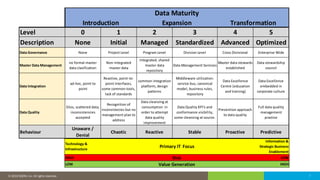
Technology &
Infrastructure
Information &
Strategic Business
Enablement
HIGH LOW
LOW HIGHValue Generation
Primary IT Focus
Risk
Level 0 1 2 3 4 5
Description None Initial Managed Standardized Advanced Optimized
Data Governance None Project Level Program Level Division Level Cross Divisional Enterprise Wide
Master Data Management
no formal master
data clasification
Non-integrated
master data
Integrated, shared
master data
repository
Data Management Services
Master data stewards
established
Data stewardship
council
Data Integration
ad-hoc, point to
point
Reactive, point-to-
point interfaces,
some common tools,
lack of standards
common integration
platform, design
patterns
Middleware utilization:
service bus, canonical
model, business rules,
repository
Data Excellence
Centre (education
and training)
Data Excellence
embedded in
corporate culture
Data Quality
Silos, scattered data,
inconsistencies
accepted
Recognition of
inconsistecies but no
management plan to
address
Data cleansing at
consumption in
order to attempt
data quality
improvement
Data Quality KPI's and
conformance visibility,
some cleansing at source.
Prevention approach
to data quality
Full data quality
management
practice
Behaviour
Unaware /
Denial
Chaotic Reactive Stable Proactive Predictive
Data Maturity
Introduction Expansion Transformation
8© 2016 IDERA, Inc. All rights reserved. Proprietary and confidential. 8© 2019 IDERA, Inc. All rights reserved.
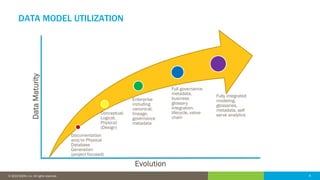
DATA MODEL UTILIZATION
Documentation
and/or Physical
Database
Generation
(project focused)
Conceptual,
Logical,
Physical
(Design)
Enterprise
including
canonical,
lineage,
governance
metadata
Full governance
metadata,
business
glossary
integration,
lifecycle, value-
chain
Fully integrated
modeling,
glossaries,
metadata, self
serve analytics
DataMaturity
Evolution
9© 2016 IDERA, Inc. All rights reserved. Proprietary and confidential. 9© 2019 IDERA, Inc. All rights reserved.
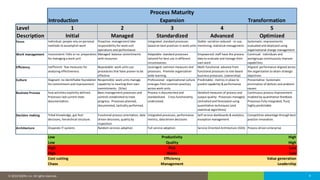
Low Productivity High
Low Quality High
High Risk Low
High Waste Low
Cost cutting Efficiency Value generation
Chaos Management Leadership
Introduction Expansion Transformation
Level 1 2 3 4 5
Description Initial Managed Standardized Advanced Optimized
Focus Individual: people rely on personal
methods to accomplish work
Proactive: management take
responsibility for work unit
operations and performance
Integrated: standard processes
based on best practices in work units
Stable: variation reduced - re-use,
mentoring, statistical management
Systematic: improvements
evaluated and deployed using
organizational change management
Work management Inconsistent: little or no preparation
for managing a work unit
Managed: balance commitments
with resources
Adaptable: standard processes
tailored for best use in different
circumstances
Empowered: staff have the process
data to evaluate and manage their
own work
Continual: individuals and
workgroups continuously improve
capabilities
Efficiency Inefficient: few measures for
analyzing effectiveness
Repeatable: work units use
procedures that have proven to be
effective
Leveraged: common measures and
processes. Promote organization
wide learning.
Multi-functional: advance from
functional processes to role based
business processes. (ownership)
Aligned: performance aligned across
the organization to attain strategic
objectives
Culture Stagnant: no identifiable foundation
for commitment and improvement
Responsible: work units manage
capability to meeting their own
commitments. (Silos)
Professional: organizational culture
emerges from common practices
across work units
Predictable: metrics in place to
predict capability & performance
Preventative: Systematic
elimination of defects and problem
causes
Business Process Few activities explicitly defined.
Processes lack current state
documentation.
Basic management processes and
controls established to track
progress. Processes planned,
documented, tactically performed.
Process is documented and
standardized. Cross functionality
understood.
Detailed measures of process and
output quality. Processes managed,
controlled and forecasted using
quantitative techniques (and
statistical algorithms)
Continuous process improvement
enabled by quantitative feedback.
Processes fully integrated, fluid,
highly predictable
Decision making Tribal Knowledge, gut-feel
decisions, hierarchical structure.
Functional process orientation, data
driven decisions, quality by
inspection
Integrated processes, performance
metrics, data driven decisions
Self service dashboards & analytics,
exception management
Competitive advantage through best
practice innovation.
Architecture Disparate IT systems Random services adoption Full service adoption Service Oriented Architecture (SOA) Process driven enterprise
Process Maturity
10© 2016 IDERA, Inc. All rights reserved. Proprietary and confidential. 10© 2019 IDERA, Inc. All rights reserved.
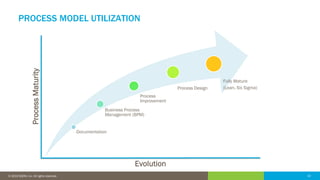
PROCESS MODEL UTILIZATION
Documentation
Business Process
Management (BPM)
Process
Improvement
Process Design
Fully Mature
(Lean, Six Sigma)
ProcessMaturity
Evolution
11© 2016 IDERA, Inc. All rights reserved. Proprietary and confidential. 11© 2019 IDERA, Inc. All rights reserved.
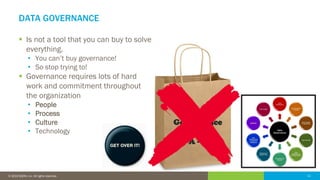
DATA GOVERNANCE
▪ Is not a tool that you can buy to solve
everything.
• You can’t buy governance!
• So stop trying to!
▪ Governance requires lots of hard
work and commitment throughout
the organization
• People
• Process
• Culture
• Technology
Data
Governance
Solution
A - Z
12© 2016 IDERA, Inc. All rights reserved. Proprietary and confidential. 12© 2019 IDERA, Inc. All rights reserved.
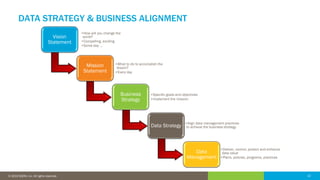
DATA STRATEGY & BUSINESS ALIGNMENT
Vision
Statement
•How will you change the
world?
•Compelling, exciting
•Some day …
Mission
Statement
•What to do to accomplish the
dream?
•Every day
Business
Strategy
•Specific goals and objectives
•Implement the mission
Data Strategy
•Align data management practices
to achieve the business strategy
Data
Management
•Deliver, control, protect and enhance
data value
•Plans, policies, programs, practices
13© 2019 IDERA, Inc. All rights reserved.
FIRST AND FOREMOST, IT’S A PEOPLE PROBLEM
▪ We need to overcome human nature
• 92% of the 17 million people that try
to quit smoking each year fail.
• 95% of people who lose weight fail to
keep it off long term.
• 88% of people who set New Year’s
resolutions fail at their attempt.
• Only 10% of the population has
specific, well-defined goals, but even
then,
• seven out of the ten of those people
reach their goals only 50% of the time
▪ Two forces that motivate people:
• Avoid pain
• Gain pleasure
▪ This causes the ‘yo-yo’ pattern in some
people
• they go back and forth between taking
action to create change and losing their
drive to take any action at all.
▪ Change is never a matter of ability, it’s
a matter of motivation.
Some wisdom from Tony Robbins:
14© 2016 IDERA, Inc. All rights reserved. Proprietary and confidential. 14© 2019 IDERA, Inc. All rights reserved.
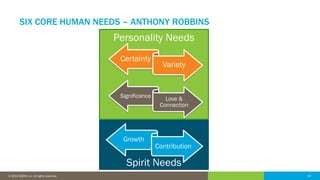
Spirit Needs
Personality Needs
SIX CORE HUMAN NEEDS – ANTHONY ROBBINS
Certainty
Variety
Significance Love &
Connection
Growth
Contribution
15© 2016 IDERA, Inc. All rights reserved. Proprietary and confidential. 15© 2019 IDERA, Inc. All rights reserved.
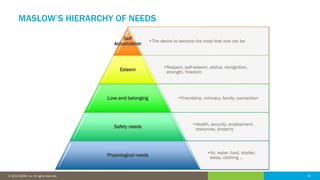
MASLOW’S HIERARCHY OF NEEDS
•The desire to become the most that one can be
Self
Actualization
•Respect, self-esteem, status, recognition,
strength, freedomEsteem
•Friendship, intimacy, family, connectionLove and belonging
•Health, security, employment,
resources, propertySafety needs
•Air, water, food, shelter,
sleep, clothing …Physiological needs
16© 2016 IDERA, Inc. All rights reserved. Proprietary and confidential. 16© 2019 IDERA, Inc. All rights reserved.
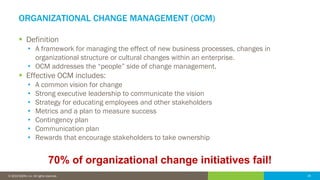
ORGANIZATIONAL CHANGE MANAGEMENT (OCM)
▪ Definition
• A framework for managing the effect of new business processes, changes in
organizational structure or cultural changes within an enterprise.
• OCM addresses the “people” side of change management.
▪ Effective OCM includes:
• A common vision for change
• Strong executive leadership to communicate the vision
• Strategy for educating employees and other stakeholders
• Metrics and a plan to measure success
• Contingency plan
• Communication plan
• Rewards that encourage stakeholders to take ownership
70% of organizational change initiatives fail!
17© 2016 IDERA, Inc. All rights reserved. Proprietary and confidential. 17© 2019 IDERA, Inc. All rights reserved.
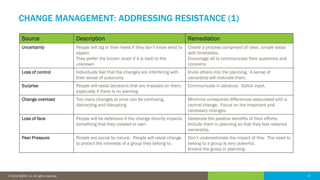
Source Description Remediation
Uncertainty People will dig in their heels if they don’t know what to
expect
They prefer the known (even if it is bad) to the
unknown
Create a process comprised of clear, simple steps
with timetables.
Encourage all to communicate their questions and
concerns
Loss of control Individuals feel that the changes are interfering with
their sense of autonomy
Invite others into the planning. A sense of
ownership will motivate them.
Surprise People will resist decisions that are imposed on them,
especially if there is no warning.
Communicate in advance. Solicit input.
Change overload Too many changes at once can be confusing,
distracting and disrupting
Minimize unrequired differences associated with a
central change. Focus on the important and
necessary changes.
Loss of face People will be defensive if the change directly impacts
something that they created or own.
Celebrate the positive benefits of their efforts.
Include them in planning so that they feel retained
ownership.
Peer Pressure People are social by nature. People will resist change
to protect the interests of a group they belong to.
Don’t underestimate the impact of this. The need to
belong to a group is very powerful.
Involve the group in planning.
CHANGE MANAGEMENT: ADDRESSING RESISTANCE (1)
18© 2016 IDERA, Inc. All rights reserved. Proprietary and confidential. 18© 2019 IDERA, Inc. All rights reserved.
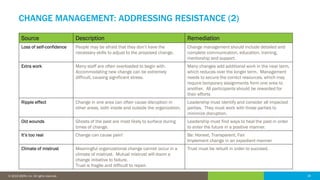
Source Description Remediation
Loss of self-confidence People may be afraid that they don’t have the
necessary skills to adjust to the proposed change.
Change management should include detailed and
complete communication, education, training,
mentorship and support.
Extra work Many staff are often overloaded to begin with.
Accommodating new change can be extremely
difficult, causing significant stress.
Many changes add additional work in the near term,
which reduces over the longer term. Management
needs to secure the correct resources, which may
require temporary assignments form one area to
another. All participants should be rewarded for
their efforts
Ripple effect Change in one area can often cause disruption in
other areas, both inside and outside the organization.
Leadership must identify and consider all impacted
parties. They must work with those parties to
minimize disruption.
Old wounds Ghosts of the past are most likely to surface during
times of change.
Leadership must find ways to heal the past in order
to enter the future in a positive manner.
It’s too real Change can cause pain! Be: Honest, Transparent, Fair
Implement change in an expedient manner
Climate of mistrust Meaningful organizational change cannot occur in a
climate of mistrust. Mutual mistrust will doom a
change initiative to failure.
Trust is fragile and difficult to repair.
Trust must be rebuilt in order to succeed.
CHANGE MANAGEMENT: ADDRESSING RESISTANCE (2)
19© 2016 IDERA, Inc. All rights reserved. Proprietary and confidential. 19© 2019 IDERA, Inc. All rights reserved.
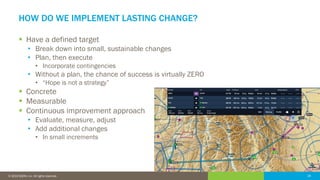
HOW DO WE IMPLEMENT LASTING CHANGE?
▪ Have a defined target
• Break down into small, sustainable changes
• Plan, then execute
• Incorporate contingencies
• Without a plan, the chance of success is virtually ZERO
• “Hope is not a strategy”
▪ Concrete
▪ Measurable
▪ Continuous improvement approach
• Evaluate, measure, adjust
• Add additional changes
• In small increments
20© 2016 IDERA, Inc. All rights reserved. Proprietary and confidential. 20© 2019 IDERA, Inc. All rights reserved.
FINAL APPROACH
▪ Data governance is hard work
▪ Information capability in organizations is poor (and declining!)
• This directly impacts data governance efforts.
▪ Organizations that are successful with governance:
• Have higher data maturity
• Have higher process maturity
• Achieve alignment between
• Business strategy
− Vision, mission, goals
• Data Strategy
• Data governance
▪ Implement lasting change
• Quantifiable metrics to measure success
21© 2016 IDERA, Inc. All rights reserved. Proprietary and confidential. 21© 2019 IDERA, Inc. All rights reserved.
POST FLIGHT DE-BRIEF
▪ We must address the human side of the equation, rather than chasing
technology
• Understand what motivates people
• Overcome resistance to change
▪ Organizational change management
• Common vision
• Strong leadership
• Create a climate of trust
• Remove uncertainty
• Teamwork
• Education
• Rewards
▪ Communicate and facilitate!
22© 2016 IDERA, Inc. All rights reserved. Proprietary and confidential. 22© 2019 IDERA, Inc. All rights reserved.
THANKS!
Any questions?
You can find me at:
ron.huizenga@idera.com
@DataAviator

Human Factors in Data Governance

  • 1.
    1© 2019 IDERA,Inc. All rights reserved. HUMAN FACTORS IN DATA GOVERNANCE AUGUST 20, 2019 Ron Huizenga Senior Product Manager, Enterprise Architecture & Modeling @DataAviator
  • 2.
    2© 2016 IDERA,Inc. All rights reserved. Proprietary and confidential. 2© 2019 IDERA, Inc. All rights reserved. PRE-FLIGHT BRIEFING ▪ Information capability ▪ Enterprise architecture & governance • Data maturity • Process maturity ▪ Business alignment ▪ The people problem • Understanding human needs • Organizational change management • Addressing resistance to change ▪ Implementing lasting change ▪ Summary
  • 3.
    3© 2016 IDERA,Inc. All rights reserved. Proprietary and confidential. 3© 2019 IDERA, Inc. All rights reserved. COMPANIES ARE FAILING IN THEIR EFFORTS TO BECOME DATA DRIVEN ▪ The percentage of firms identifying themselves as being data-driven has declined in each of the past 3 years • 37.1% in 2017, 32.4% in 2018, 31.0% this year • in spite of increasing investment in big data and AI initiatives • Source: Harvard Business Review, Feb 5, 2019 (Randy Bean and Thomas Davenport) ▪ Survey of industry leading, large corporations • 72% of survey participants report that they have yet to forge a data culture • 69% report that they have not created a data-driven organization • 53% state that they are not yet treating data as a business asset • 52% admit that they are not competing on data and analytics • 93% of respondents identify people and process issues as the obstacle • The difficulty of cultural change has been dramatically underestimated − 40.3% identify lack of organization alignment − 24% cite cultural resistance as the leading factors contributing to this lack of business adoption. • Firms must become much more serious and creative about addressing the human side of data if they truly expect to derive meaningful business benefits • Source: 2019 Big Data and AI Executive Survey (NewVantage Partners)
  • 4.
    4© 2016 IDERA,Inc. All rights reserved. Proprietary and confidential. 4© 2019 IDERA, Inc. All rights reserved. INFORMATION CAPABILITY STUDY – HOW ARE WE DOING? ▪ Very few organizations utilize information to its full potential ▪ Deficiencies in technical capability, skills, lacking data culture ▪ Lack of investment in value-driven information strategies ▪ Very few understand how to derive maximum value from information • This will erode corporate value if not corrected * Based on 2015 PwC/Iron Mountain study: Seizing the Information Advantage
  • 5.
    5© 2019 IDERA,Inc. All rights reserved. INFORMATION MANAGEMENT DISPARITY ▪ Misguided Majority – 76% • Informed but constrained • Uninformed and ill-equipped ▪ Data seen as a byproduct, or taken for granted • Low comprehension of commercial benefits that can be gained ▪ Constrained by legacy approaches, regulations ▪ Weak analytic capability, or • strong analytic capability, lacking value focus • Low analytical capacity ▪ Can be overwhelmed by data volume ▪ Data is domain of data architects ▪ IT led rather than business led ▪ “Spreadsheet hell” ▪ Information Elite – 4% ▪ Proactive Action • Diversify business models • Improve operating efficiency • Identify / implement new market opportunities ▪ Tangible data value • Linked to organizational KPIs ▪ Exploit data for competitive advantage ▪ Balanced approach between security and value extraction ▪ Holistic approach • Governance is part of normal business ▪ Well defined information strategy • Reflects business objectives
  • 6.
    6© 2016 IDERA,Inc. All rights reserved. Proprietary and confidential. 6© 2019 IDERA, Inc. All rights reserved. ENTERPRISE ARCHITECTURE & GOVERNANCE
  • 7.
    7© 2016 IDERA,Inc. All rights reserved. Proprietary and confidential. 7© 2019 IDERA, Inc. All rights reserved. Technology & Infrastructure Information & Strategic Business Enablement HIGH LOW LOW HIGHValue Generation Primary IT Focus Risk Level 0 1 2 3 4 5 Description None Initial Managed Standardized Advanced Optimized Data Governance None Project Level Program Level Division Level Cross Divisional Enterprise Wide Master Data Management no formal master data clasification Non-integrated master data Integrated, shared master data repository Data Management Services Master data stewards established Data stewardship council Data Integration ad-hoc, point to point Reactive, point-to- point interfaces, some common tools, lack of standards common integration platform, design patterns Middleware utilization: service bus, canonical model, business rules, repository Data Excellence Centre (education and training) Data Excellence embedded in corporate culture Data Quality Silos, scattered data, inconsistencies accepted Recognition of inconsistecies but no management plan to address Data cleansing at consumption in order to attempt data quality improvement Data Quality KPI's and conformance visibility, some cleansing at source. Prevention approach to data quality Full data quality management practice Behaviour Unaware / Denial Chaotic Reactive Stable Proactive Predictive Data Maturity Introduction Expansion Transformation
  • 8.
    8© 2016 IDERA,Inc. All rights reserved. Proprietary and confidential. 8© 2019 IDERA, Inc. All rights reserved. DATA MODEL UTILIZATION Documentation and/or Physical Database Generation (project focused) Conceptual, Logical, Physical (Design) Enterprise including canonical, lineage, governance metadata Full governance metadata, business glossary integration, lifecycle, value- chain Fully integrated modeling, glossaries, metadata, self serve analytics DataMaturity Evolution
  • 9.
    9© 2016 IDERA,Inc. All rights reserved. Proprietary and confidential. 9© 2019 IDERA, Inc. All rights reserved. Low Productivity High Low Quality High High Risk Low High Waste Low Cost cutting Efficiency Value generation Chaos Management Leadership Introduction Expansion Transformation Level 1 2 3 4 5 Description Initial Managed Standardized Advanced Optimized Focus Individual: people rely on personal methods to accomplish work Proactive: management take responsibility for work unit operations and performance Integrated: standard processes based on best practices in work units Stable: variation reduced - re-use, mentoring, statistical management Systematic: improvements evaluated and deployed using organizational change management Work management Inconsistent: little or no preparation for managing a work unit Managed: balance commitments with resources Adaptable: standard processes tailored for best use in different circumstances Empowered: staff have the process data to evaluate and manage their own work Continual: individuals and workgroups continuously improve capabilities Efficiency Inefficient: few measures for analyzing effectiveness Repeatable: work units use procedures that have proven to be effective Leveraged: common measures and processes. Promote organization wide learning. Multi-functional: advance from functional processes to role based business processes. (ownership) Aligned: performance aligned across the organization to attain strategic objectives Culture Stagnant: no identifiable foundation for commitment and improvement Responsible: work units manage capability to meeting their own commitments. (Silos) Professional: organizational culture emerges from common practices across work units Predictable: metrics in place to predict capability & performance Preventative: Systematic elimination of defects and problem causes Business Process Few activities explicitly defined. Processes lack current state documentation. Basic management processes and controls established to track progress. Processes planned, documented, tactically performed. Process is documented and standardized. Cross functionality understood. Detailed measures of process and output quality. Processes managed, controlled and forecasted using quantitative techniques (and statistical algorithms) Continuous process improvement enabled by quantitative feedback. Processes fully integrated, fluid, highly predictable Decision making Tribal Knowledge, gut-feel decisions, hierarchical structure. Functional process orientation, data driven decisions, quality by inspection Integrated processes, performance metrics, data driven decisions Self service dashboards & analytics, exception management Competitive advantage through best practice innovation. Architecture Disparate IT systems Random services adoption Full service adoption Service Oriented Architecture (SOA) Process driven enterprise Process Maturity
  • 10.
    10© 2016 IDERA,Inc. All rights reserved. Proprietary and confidential. 10© 2019 IDERA, Inc. All rights reserved. PROCESS MODEL UTILIZATION Documentation Business Process Management (BPM) Process Improvement Process Design Fully Mature (Lean, Six Sigma) ProcessMaturity Evolution
  • 11.
    11© 2016 IDERA,Inc. All rights reserved. Proprietary and confidential. 11© 2019 IDERA, Inc. All rights reserved. DATA GOVERNANCE ▪ Is not a tool that you can buy to solve everything. • You can’t buy governance! • So stop trying to! ▪ Governance requires lots of hard work and commitment throughout the organization • People • Process • Culture • Technology Data Governance Solution A - Z
  • 12.
    12© 2016 IDERA,Inc. All rights reserved. Proprietary and confidential. 12© 2019 IDERA, Inc. All rights reserved. DATA STRATEGY & BUSINESS ALIGNMENT Vision Statement •How will you change the world? •Compelling, exciting •Some day … Mission Statement •What to do to accomplish the dream? •Every day Business Strategy •Specific goals and objectives •Implement the mission Data Strategy •Align data management practices to achieve the business strategy Data Management •Deliver, control, protect and enhance data value •Plans, policies, programs, practices
  • 13.
    13© 2019 IDERA,Inc. All rights reserved. FIRST AND FOREMOST, IT’S A PEOPLE PROBLEM ▪ We need to overcome human nature • 92% of the 17 million people that try to quit smoking each year fail. • 95% of people who lose weight fail to keep it off long term. • 88% of people who set New Year’s resolutions fail at their attempt. • Only 10% of the population has specific, well-defined goals, but even then, • seven out of the ten of those people reach their goals only 50% of the time ▪ Two forces that motivate people: • Avoid pain • Gain pleasure ▪ This causes the ‘yo-yo’ pattern in some people • they go back and forth between taking action to create change and losing their drive to take any action at all. ▪ Change is never a matter of ability, it’s a matter of motivation. Some wisdom from Tony Robbins:
  • 14.
    14© 2016 IDERA,Inc. All rights reserved. Proprietary and confidential. 14© 2019 IDERA, Inc. All rights reserved. Spirit Needs Personality Needs SIX CORE HUMAN NEEDS – ANTHONY ROBBINS Certainty Variety Significance Love & Connection Growth Contribution
  • 15.
    15© 2016 IDERA,Inc. All rights reserved. Proprietary and confidential. 15© 2019 IDERA, Inc. All rights reserved. MASLOW’S HIERARCHY OF NEEDS •The desire to become the most that one can be Self Actualization •Respect, self-esteem, status, recognition, strength, freedomEsteem •Friendship, intimacy, family, connectionLove and belonging •Health, security, employment, resources, propertySafety needs •Air, water, food, shelter, sleep, clothing …Physiological needs
  • 16.
    16© 2016 IDERA,Inc. All rights reserved. Proprietary and confidential. 16© 2019 IDERA, Inc. All rights reserved. ORGANIZATIONAL CHANGE MANAGEMENT (OCM) ▪ Definition • A framework for managing the effect of new business processes, changes in organizational structure or cultural changes within an enterprise. • OCM addresses the “people” side of change management. ▪ Effective OCM includes: • A common vision for change • Strong executive leadership to communicate the vision • Strategy for educating employees and other stakeholders • Metrics and a plan to measure success • Contingency plan • Communication plan • Rewards that encourage stakeholders to take ownership 70% of organizational change initiatives fail!
  • 17.
    17© 2016 IDERA,Inc. All rights reserved. Proprietary and confidential. 17© 2019 IDERA, Inc. All rights reserved. Source Description Remediation Uncertainty People will dig in their heels if they don’t know what to expect They prefer the known (even if it is bad) to the unknown Create a process comprised of clear, simple steps with timetables. Encourage all to communicate their questions and concerns Loss of control Individuals feel that the changes are interfering with their sense of autonomy Invite others into the planning. A sense of ownership will motivate them. Surprise People will resist decisions that are imposed on them, especially if there is no warning. Communicate in advance. Solicit input. Change overload Too many changes at once can be confusing, distracting and disrupting Minimize unrequired differences associated with a central change. Focus on the important and necessary changes. Loss of face People will be defensive if the change directly impacts something that they created or own. Celebrate the positive benefits of their efforts. Include them in planning so that they feel retained ownership. Peer Pressure People are social by nature. People will resist change to protect the interests of a group they belong to. Don’t underestimate the impact of this. The need to belong to a group is very powerful. Involve the group in planning. CHANGE MANAGEMENT: ADDRESSING RESISTANCE (1)
  • 18.
    18© 2016 IDERA,Inc. All rights reserved. Proprietary and confidential. 18© 2019 IDERA, Inc. All rights reserved. Source Description Remediation Loss of self-confidence People may be afraid that they don’t have the necessary skills to adjust to the proposed change. Change management should include detailed and complete communication, education, training, mentorship and support. Extra work Many staff are often overloaded to begin with. Accommodating new change can be extremely difficult, causing significant stress. Many changes add additional work in the near term, which reduces over the longer term. Management needs to secure the correct resources, which may require temporary assignments form one area to another. All participants should be rewarded for their efforts Ripple effect Change in one area can often cause disruption in other areas, both inside and outside the organization. Leadership must identify and consider all impacted parties. They must work with those parties to minimize disruption. Old wounds Ghosts of the past are most likely to surface during times of change. Leadership must find ways to heal the past in order to enter the future in a positive manner. It’s too real Change can cause pain! Be: Honest, Transparent, Fair Implement change in an expedient manner Climate of mistrust Meaningful organizational change cannot occur in a climate of mistrust. Mutual mistrust will doom a change initiative to failure. Trust is fragile and difficult to repair. Trust must be rebuilt in order to succeed. CHANGE MANAGEMENT: ADDRESSING RESISTANCE (2)
  • 19.
    19© 2016 IDERA,Inc. All rights reserved. Proprietary and confidential. 19© 2019 IDERA, Inc. All rights reserved. HOW DO WE IMPLEMENT LASTING CHANGE? ▪ Have a defined target • Break down into small, sustainable changes • Plan, then execute • Incorporate contingencies • Without a plan, the chance of success is virtually ZERO • “Hope is not a strategy” ▪ Concrete ▪ Measurable ▪ Continuous improvement approach • Evaluate, measure, adjust • Add additional changes • In small increments
  • 20.
    20© 2016 IDERA,Inc. All rights reserved. Proprietary and confidential. 20© 2019 IDERA, Inc. All rights reserved. FINAL APPROACH ▪ Data governance is hard work ▪ Information capability in organizations is poor (and declining!) • This directly impacts data governance efforts. ▪ Organizations that are successful with governance: • Have higher data maturity • Have higher process maturity • Achieve alignment between • Business strategy − Vision, mission, goals • Data Strategy • Data governance ▪ Implement lasting change • Quantifiable metrics to measure success
  • 21.
    21© 2016 IDERA,Inc. All rights reserved. Proprietary and confidential. 21© 2019 IDERA, Inc. All rights reserved. POST FLIGHT DE-BRIEF ▪ We must address the human side of the equation, rather than chasing technology • Understand what motivates people • Overcome resistance to change ▪ Organizational change management • Common vision • Strong leadership • Create a climate of trust • Remove uncertainty • Teamwork • Education • Rewards ▪ Communicate and facilitate!
  • 22.
    22© 2016 IDERA,Inc. All rights reserved. Proprietary and confidential. 22© 2019 IDERA, Inc. All rights reserved. THANKS! Any questions? You can find me at: ron.huizenga@idera.com @DataAviator