HIMALAYA MOUNTAINS
PHYSIOGRAPHIC DIVISION OF INDIA
CONTENT
 WHAT IS HIMALAYAS ?
 HOW IS HIMALAYAS FORMED ?
 LONGITUDINAL DIVISIONS OF HIMALAYAS
 HIMADRI/ GREAT HIMALAYAS
 HIMACHAL/ LESSER HIMALAYAS
 SHIWALIK
 DIVISIONS OF HIMALAYAS FROM WEST TO EAST
 END
WHAT IS HIMALAYA?
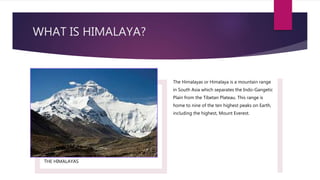
THE HIMALAYAS
The Himalayas or Himalaya is a mountain range
in South Asia which separates the Indo-Gangetic
Plain from the Tibetan Plateau. This range is
home to nine of the ten highest peaks on Earth,
including the highest, Mount Everest.
HOW IS HIMALAYA FORMED?
• According to the modern theory
of plate tectonics, its formation is a
result of a continental collision or
orogeny along the convergent
boundary between the Indo-
Australian Plate and the Eurasian
Plate
FORMATION
• The Himalayan range is one of the
youngest mountain ranges on the
planet and consists mostly of
uplifted sedimentary and
metamorphic rock…
ABOUT
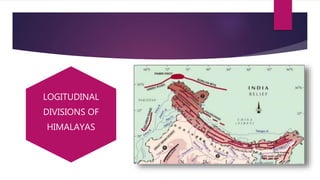
LOGITUDINAL
DIVISIONS OF
HIMALAYAS
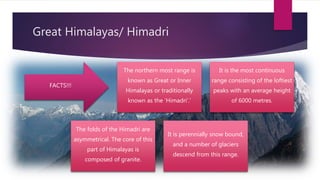
Great Himalayas/ Himadri
FACTS!!!
The northern most range is
known as Great or Inner
Himalayas or traditionally
known as the ‘Himadri’.’
It is the most continuous
range consisting of the loftiest
peaks with an average height
of 6000 metres.
The folds of the Himadri are
asymmetrical. The core of this
part of Himalayas is
composed of granite.
It is perennially snow bound,
and a number of glaciers
descend from this range.
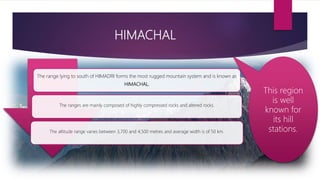
HIMACHAL
The range lying to south of HIMADRI forms the most rugged mountain system and is known as
HIMACHAL.
The ranges are mainly composed of highly compressed rocks and altered rocks.
The altitude range varies between 3,700 and 4,500 metres and average width is of 50 km.
This region
is well
known for
its hill
stations.
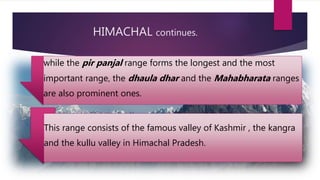
HIMACHAL continues.
while the pir panjal range forms the longest and the most
important range, the dhaula dhar and the Mahabharata ranges
are also prominent ones.
This range consists of the famous valley of Kashmir , the kangra
and the kullu valley in Himachal Pradesh.
SHIWALIK
The Shiwalik Hills is a mountain range of the
outer Himalayas also known as MANAK
PARBAT In ancient times .
This range is from Indus and ends close to the Brahmaputra with a gap of 90
kilometer between the Teesta and Raidak rivers in Assam. The width of the
Shiwalik hills varies from 10 to 50 kilometer their average elevation is 1500 to
2000 meter.
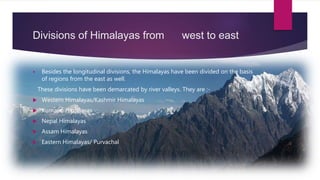
Divisions of Himalayas from west to east
 Besides the longitudinal divisions, the Himalayas have been divided on the basis
of regions from the east as well.
These divisions have been demarcated by river valleys. They are :-
 Western Himalayas/Kashmir Himalayas
 Kumaon Himalayas
 Nepal Himalayas
 Assam Himalayas
 Eastern Himalayas/ Purvachal
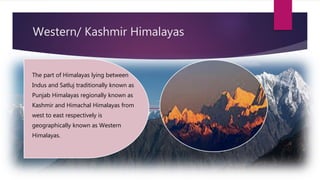
Western/ Kashmir Himalayas
The part of Himalayas lying between
Indus and Satluj traditionally known as
Punjab Himalayas regionally known as
Kashmir and Himachal Himalayas from
west to east respectively is
geographically known as Western
Himalayas.
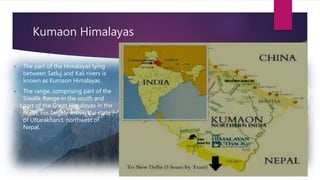
Kumaon Himalayas
• The part of the Himalayas lying
between Satluj and Kali rivers is
known as Kumaon Himalayas.
• The range, comprising part of the
Siwalik Range in the south and
part of the Great Himalayas in the
north, lies largely within the state
of Uttarakhand, northwest of
Nepal.
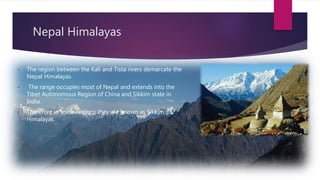
Nepal Himalayas
• The region between the Kali and Tista rivers demarcate the
Nepal Himalayas.
• The range occupies most of Nepal and extends into the
Tibet Autonomous Region of China and Sikkim state in
India.
• Therefore in some regions they are known as Sikkim
Himalayas.
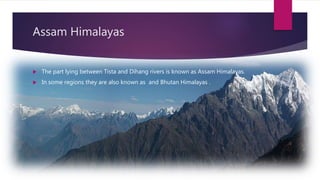
Assam Himalayas
 The part lying between Tista and Dihang rivers is known as Assam Himalayas.
 In some regions they are also known as and Bhutan Himalayas .
Eastern Himalayas
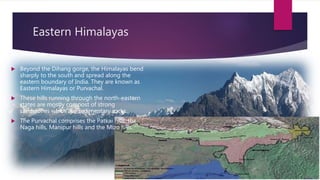
 Beyond the Dihang gorge, the Himalayas bend
sharply to the south and spread along the
eastern boundary of India. They are known as
Eastern Himalayas or Purvachal.
 These hills running through the north-eastern
states are mostly compost of strong
sandstones which are sedimentary rocks.
 The Purvachal comprises the Patkai hills, the
Naga hills, Manipur hills and the Mizo hills.
THANK YOU
MADE
BY:
MEHUL
PULKIT
SHUBHODEEP
NEERAJ
ANKIT A
ANKIT K

Himalaya mountains

  • 1.
  • 2.
    CONTENT  WHAT ISHIMALAYAS ?  HOW IS HIMALAYAS FORMED ?  LONGITUDINAL DIVISIONS OF HIMALAYAS  HIMADRI/ GREAT HIMALAYAS  HIMACHAL/ LESSER HIMALAYAS  SHIWALIK  DIVISIONS OF HIMALAYAS FROM WEST TO EAST  END
  • 3.
    WHAT IS HIMALAYA? THEHIMALAYAS The Himalayas or Himalaya is a mountain range in South Asia which separates the Indo-Gangetic Plain from the Tibetan Plateau. This range is home to nine of the ten highest peaks on Earth, including the highest, Mount Everest.
  • 4.
    HOW IS HIMALAYAFORMED? • According to the modern theory of plate tectonics, its formation is a result of a continental collision or orogeny along the convergent boundary between the Indo- Australian Plate and the Eurasian Plate FORMATION • The Himalayan range is one of the youngest mountain ranges on the planet and consists mostly of uplifted sedimentary and metamorphic rock… ABOUT
  • 5.
  • 6.
    Great Himalayas/ Himadri FACTS!!! Thenorthern most range is known as Great or Inner Himalayas or traditionally known as the ‘Himadri’.’ It is the most continuous range consisting of the loftiest peaks with an average height of 6000 metres. The folds of the Himadri are asymmetrical. The core of this part of Himalayas is composed of granite. It is perennially snow bound, and a number of glaciers descend from this range.
  • 7.
    HIMACHAL The range lyingto south of HIMADRI forms the most rugged mountain system and is known as HIMACHAL. The ranges are mainly composed of highly compressed rocks and altered rocks. The altitude range varies between 3,700 and 4,500 metres and average width is of 50 km. This region is well known for its hill stations.
  • 8.
    HIMACHAL continues. while thepir panjal range forms the longest and the most important range, the dhaula dhar and the Mahabharata ranges are also prominent ones. This range consists of the famous valley of Kashmir , the kangra and the kullu valley in Himachal Pradesh.
  • 9.
    SHIWALIK The Shiwalik Hillsis a mountain range of the outer Himalayas also known as MANAK PARBAT In ancient times . This range is from Indus and ends close to the Brahmaputra with a gap of 90 kilometer between the Teesta and Raidak rivers in Assam. The width of the Shiwalik hills varies from 10 to 50 kilometer their average elevation is 1500 to 2000 meter.
  • 10.
    Divisions of Himalayasfrom west to east  Besides the longitudinal divisions, the Himalayas have been divided on the basis of regions from the east as well. These divisions have been demarcated by river valleys. They are :-  Western Himalayas/Kashmir Himalayas  Kumaon Himalayas  Nepal Himalayas  Assam Himalayas  Eastern Himalayas/ Purvachal
  • 11.
    Western/ Kashmir Himalayas Thepart of Himalayas lying between Indus and Satluj traditionally known as Punjab Himalayas regionally known as Kashmir and Himachal Himalayas from west to east respectively is geographically known as Western Himalayas.
  • 12.
    Kumaon Himalayas • Thepart of the Himalayas lying between Satluj and Kali rivers is known as Kumaon Himalayas. • The range, comprising part of the Siwalik Range in the south and part of the Great Himalayas in the north, lies largely within the state of Uttarakhand, northwest of Nepal.
  • 13.
    Nepal Himalayas • Theregion between the Kali and Tista rivers demarcate the Nepal Himalayas. • The range occupies most of Nepal and extends into the Tibet Autonomous Region of China and Sikkim state in India. • Therefore in some regions they are known as Sikkim Himalayas.
  • 14.
    Assam Himalayas  Thepart lying between Tista and Dihang rivers is known as Assam Himalayas.  In some regions they are also known as and Bhutan Himalayas .
  • 15.
    Eastern Himalayas  Beyondthe Dihang gorge, the Himalayas bend sharply to the south and spread along the eastern boundary of India. They are known as Eastern Himalayas or Purvachal.  These hills running through the north-eastern states are mostly compost of strong sandstones which are sedimentary rocks.  The Purvachal comprises the Patkai hills, the Naga hills, Manipur hills and the Mizo hills.
  • 16.

Editor's Notes

  • #5 The Himalayan range is one of the youngest mountain ranges on the planet and consists mostly of uplifted sedimentary and metamorphic rock… According to the modern theory of plate tectonics, its formation is a result of a continental collision or orogeny along the convergent boundary between the Indo-Australian Plate and the Eurasian Plate
  • #7 The northern most range is known as Great or Inner Himalayas or traditionally known as the ‘Himadri’.’ It is the most continuous range consisting of the loftiest peaks with an average height of 6000 metres. The folds of the Himadri are asymmetrical. The core of this part of Himalayas is composed of granite. It is perennially snow bound, and a number of glaciers descend from this range.
  • #8 The range lying to south of HIMADRI forms the most rugged mountain system and is known as HIMACHAL. The ranges are mainly composed of highly compressed rocks and altered rocks. The altitude range varies between 3,700 and 4,500 metres and average width is of 50 km. while the pir panjal range forms the longest and the most important range, the dhaula dhar and the Mahabharata ranges are also prominent ones. This range consists of the famous valley of Kashmir , the kangra and the kullu valley in Himachal Pradesh. This region is well known for its hill stations.
  • #9 while the pir panjal range forms the longest and the most important range, the dhaula dhar and the Mahabharata ranges are also prominent ones. This range consists of the famous valley of Kashmir , the kangra and the kullu valley in Himachal Pradesh. This region is well known for its hill stations.
  • #10 The Shiwalik Hills is a mountain range of the outer Himalayas also known as MANAK PARBAT In ancient times . This range is from Indus and ends close to the Brahmaputra with a gap of 90 kilometer between the Teesta and Raidak rivers in Assam. The width of the Shiwalik hills varies from 10 to 50 kilometer their average elevation is 1500 to 2000 meter.
  • #17 MADE BY: MEHUL ANKIT ADHIKARI ANKIT KUMAR PULKIT SINGHAL NEERAJ NEGI SHUBHODEEP MONDAL