The Culture Map:
What I Learned.
Iqbal Abdullah
2019.04.26 • LearnDay #8
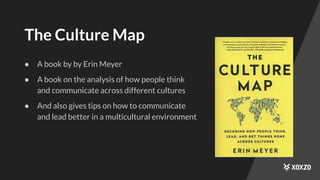
● A book by by Erin Meyer
● A book on the analysis of how people think
and communicate across different cultures
● And also gives tips on how to communicate
and lead better in a multicultural environment
The Culture Map
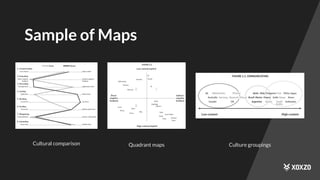
Sample of Maps
Cultural comparison Quadrant maps Culture groupings
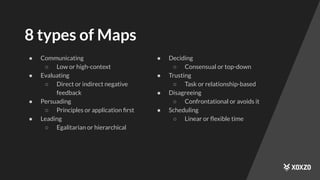
8 types of Maps
● Communicating
○ Low or high-context
● Evaluating
○ Direct or indirect negative
feedback
● Persuading
○ Principles or application first
● Leading
○ Egalitarian or hierarchical
● Deciding
○ Consensual or top-down
● Trusting
○ Task or relationship-based
● Disagreeing
○ Confrontational or avoids it
● Scheduling
○ Linear or flexible time
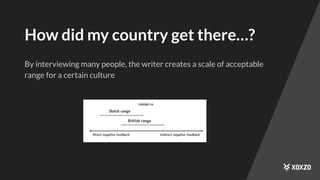
How did my country get there…?
By interviewing many people, the writer creates a scale of acceptable
range for a certain culture
01 Communicating: Telling it
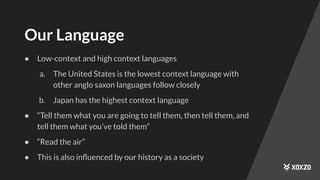
Our Language
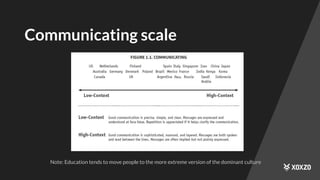
● Low-context and high context languages
a. The United States is the lowest context language with
other anglo saxon languages follow closely
b. Japan has the highest context language
● “Tell them what you are going to tell them, then tell them, and
tell them what you’ve told them”
● “Read the air”
● This is also influenced by our history as a society
Communicating scale
Note: Education tends to move people to the more extreme version of the dominant culture
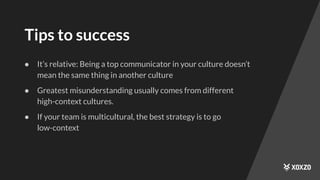
Tips to success
● It’s relative: Being a top communicator in your culture doesn’t
mean the same thing in another culture
● Greatest misunderstanding usually comes from different
high-context cultures.
● If your team is multicultural, the best strategy is to go
low-context
02 Evaluating: Polite or plain rude?
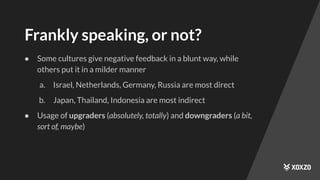
Frankly speaking, or not?
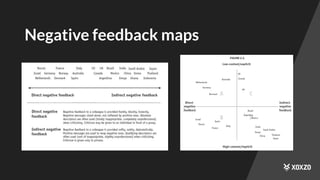
● Some cultures give negative feedback in a blunt way, while
others put it in a milder manner
a. Israel, Netherlands, Germany, Russia are most direct
b. Japan, Thailand, Indonesia are most indirect
● Usage of upgraders (absolutely, totally) and downgraders (a bit,
sort of, maybe)
Negative feedback maps
Tips to success
● Politeness is in the eye of the beholder: You will need time to
understand what “polite” is in the culture you are trying to work
with.
● When working with cultures more direct than you, DON’T try to
be like them: You can over do it. Just put it up a notch.
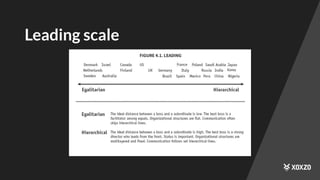
03 Leading: What is a leader?
The concept of power distance
● Geert Hofstede developed the concept of power distance
a. Ex. Netherlands, Australia has different power distances
compared to China (taking the bike to work example)
● The differences in the power distance are influenced by how
history panned out (Roman empire vs Vikings, teachings of
Confucius, or Protestants vs. Catholics)
Leading scale
Tips to success
● In today’s global business environment, you’ll need to lead in
both egalitarian and hierarchical styles to do well.
● Observe, and follow small symbolic steps your other team
members do (i.e usage of titles at work)
● If you work with a more hierarchical culture, ask for permission
first before going to the source
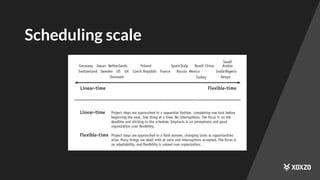
04 Scheduling: How we look at time
2 types of time: Linear and Flexible
● 2 different cultures, monochronic (M-time) and polychronic
(P-time)
● M-time cultures see time as concrete and tangible, while P-time
cultures see it as flexible
● “Evergreen Tree” in India
● M-time cultures value predictability, P-time cultures value
flexibility
Scheduling scale
Tips to success
● One culture will look at the other culture and think: “How
inefficient they are!”
● The key is to work flexibly and with an open-mind: Frame
switching
● But if you lead a cross cultural team, you’ll need to create a team
culture that everyone understands and has agreed to.
So, what did I learn?
● We all are influenced by our language and culture on how we communicate,
interact and lead
● Personalities are also taken into account, but culture is overarching
● How effective we communicate, lead or schedule is a relative thing: Not
only how you do it, it’s how the other party understands it
● There is no right or wrong when it comes to culture or language
● And I think we should go one step further by defining our own team culture
Questions?
Thank You !
iqbal@xoxzo.com

The Culture Map - LearnDay@Xoxzo #8

  • 1.
    The Culture Map: WhatI Learned. Iqbal Abdullah 2019.04.26 • LearnDay #8
  • 2.
    ● A bookby by Erin Meyer ● A book on the analysis of how people think and communicate across different cultures ● And also gives tips on how to communicate and lead better in a multicultural environment The Culture Map
  • 3.
    Sample of Maps Culturalcomparison Quadrant maps Culture groupings
  • 4.
    8 types ofMaps ● Communicating ○ Low or high-context ● Evaluating ○ Direct or indirect negative feedback ● Persuading ○ Principles or application first ● Leading ○ Egalitarian or hierarchical ● Deciding ○ Consensual or top-down ● Trusting ○ Task or relationship-based ● Disagreeing ○ Confrontational or avoids it ● Scheduling ○ Linear or flexible time
  • 5.
    How did mycountry get there…? By interviewing many people, the writer creates a scale of acceptable range for a certain culture
  • 6.
  • 7.
    Our Language ● Low-contextand high context languages a. The United States is the lowest context language with other anglo saxon languages follow closely b. Japan has the highest context language ● “Tell them what you are going to tell them, then tell them, and tell them what you’ve told them” ● “Read the air” ● This is also influenced by our history as a society
  • 8.
    Communicating scale Note: Educationtends to move people to the more extreme version of the dominant culture
  • 9.
    Tips to success ●It’s relative: Being a top communicator in your culture doesn’t mean the same thing in another culture ● Greatest misunderstanding usually comes from different high-context cultures. ● If your team is multicultural, the best strategy is to go low-context
  • 10.
    02 Evaluating: Politeor plain rude?
  • 11.
    Frankly speaking, ornot? ● Some cultures give negative feedback in a blunt way, while others put it in a milder manner a. Israel, Netherlands, Germany, Russia are most direct b. Japan, Thailand, Indonesia are most indirect ● Usage of upgraders (absolutely, totally) and downgraders (a bit, sort of, maybe)
  • 12.
  • 13.
    Tips to success ●Politeness is in the eye of the beholder: You will need time to understand what “polite” is in the culture you are trying to work with. ● When working with cultures more direct than you, DON’T try to be like them: You can over do it. Just put it up a notch.
  • 14.
    03 Leading: Whatis a leader?
  • 15.
    The concept ofpower distance ● Geert Hofstede developed the concept of power distance a. Ex. Netherlands, Australia has different power distances compared to China (taking the bike to work example) ● The differences in the power distance are influenced by how history panned out (Roman empire vs Vikings, teachings of Confucius, or Protestants vs. Catholics)
  • 16.
  • 17.
    Tips to success ●In today’s global business environment, you’ll need to lead in both egalitarian and hierarchical styles to do well. ● Observe, and follow small symbolic steps your other team members do (i.e usage of titles at work) ● If you work with a more hierarchical culture, ask for permission first before going to the source
  • 18.
    04 Scheduling: Howwe look at time
  • 19.
    2 types oftime: Linear and Flexible ● 2 different cultures, monochronic (M-time) and polychronic (P-time) ● M-time cultures see time as concrete and tangible, while P-time cultures see it as flexible ● “Evergreen Tree” in India ● M-time cultures value predictability, P-time cultures value flexibility
  • 20.
  • 21.
    Tips to success ●One culture will look at the other culture and think: “How inefficient they are!” ● The key is to work flexibly and with an open-mind: Frame switching ● But if you lead a cross cultural team, you’ll need to create a team culture that everyone understands and has agreed to.
  • 22.
    So, what didI learn? ● We all are influenced by our language and culture on how we communicate, interact and lead ● Personalities are also taken into account, but culture is overarching ● How effective we communicate, lead or schedule is a relative thing: Not only how you do it, it’s how the other party understands it ● There is no right or wrong when it comes to culture or language ● And I think we should go one step further by defining our own team culture
  • 23.
  • 24.