WHAT
IS
CULTURE?
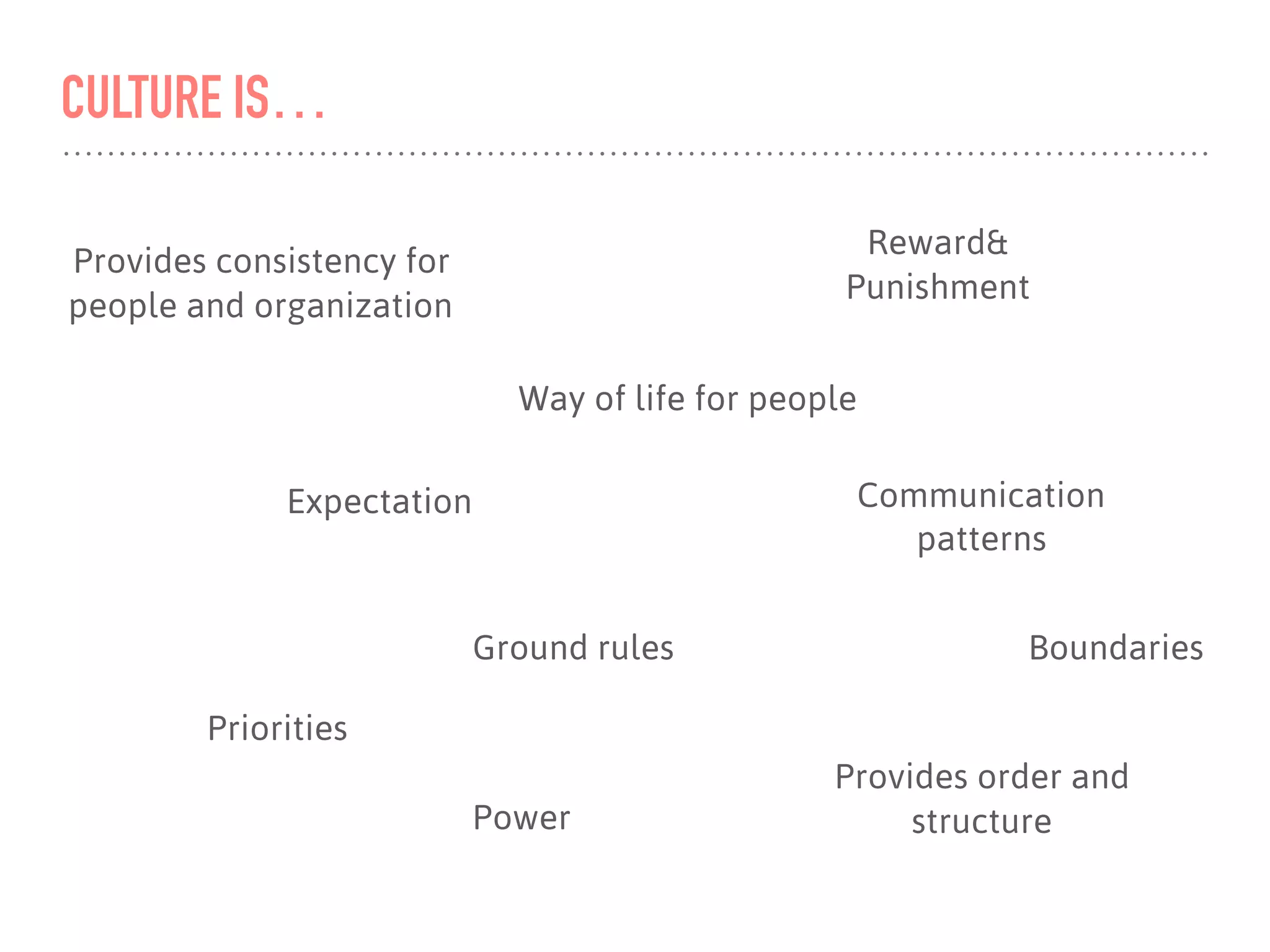
CULTURE IS…
Provides consistency for
people and organization
Provides order and
structure
Way of life for people
Ground rules Boundaries
Communication
patterns
Reward&
Punishment
Expectation
Priorities
Power
SCHNEIDER CULTURE MODEL
William Schneider has been working
as a consultant psychologist for more than
40 years with different companies.
Schneider describes the culture as the answer of
“How we do things around here to succeed?”
question.
SCHNEIDER CULTURE MODEL
• No one culture type is better than another. They only have strengths and
weaknesses.
• Depending on the type of work, one type of culture may be a better fit.
• Companies typically have a dominant culture with aspects from other cultures.
This is fine as long as those aspects serve the dominant culture.
• Different departments or groups may have different cultures. (e.g. development
vs. operations)
• Differences can lead to conflict.
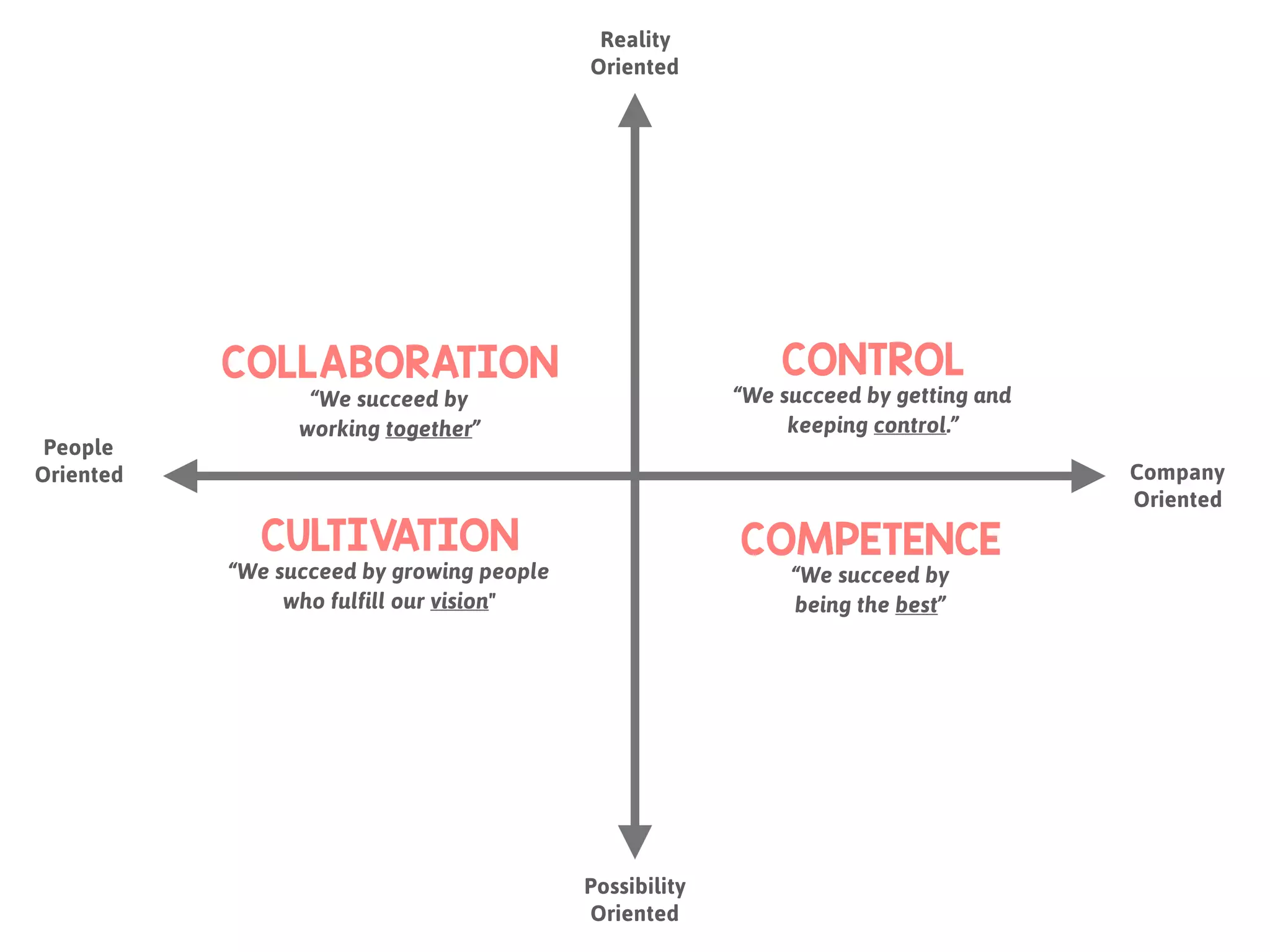
SCHNEIDER CULTURE MODEL - 4 CULTURE TYPES
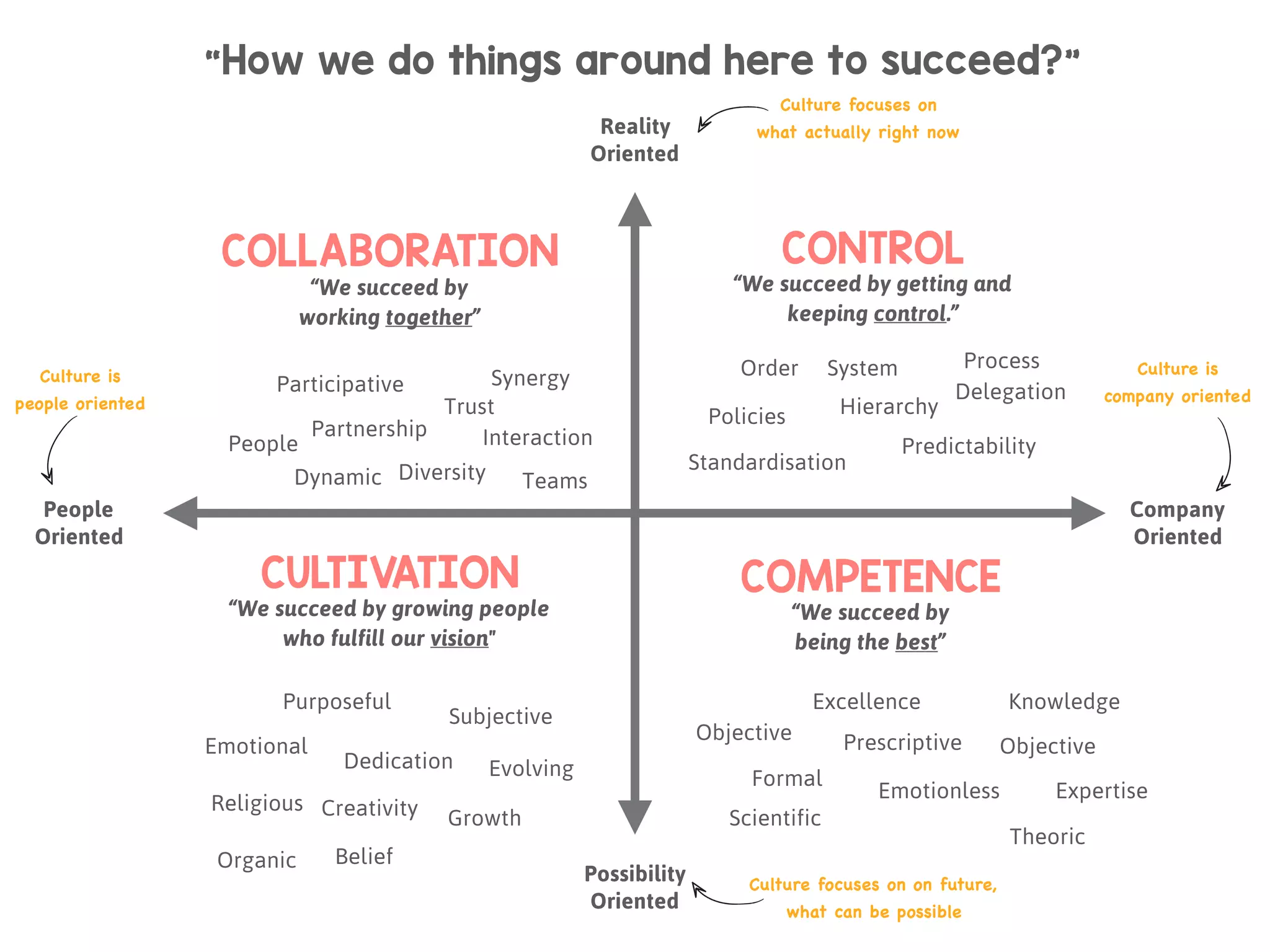
Control cultures (COMPANY/REALITY oriented) are process-driven; the org’s
success depends on data, processes, etc. Many energy, aviation, defense
companies are control cultures. Control cultures want no competition – they
want to be the only game in town. Leaders manage the work; control cultures are
command-and-control, hierarchical. Examples: The military, police, Exxon.
Collaboration cultures (PEOPLE/REALITY oriented) – people work together
toward a shared goal. Here you’ll find “working managers” – everyone rolls up
their sleeves. Relationships are key to getting things accomplished. Google is an
example, though also has cultivation culture elements.
Cultivation Cultures (PEOPLE/POSSIBILITY oriented) are often centered around a
greater mission; examples include religious organizations, non-profits, social
impact organizations. Leaders remove obstacles that impede attaining the org’s
mission. Examples – Zappos, Doctors Without Borders.
Competence Cultures (COMPANY/POSSIBILITY oriented) are innovative
(possibility) and are utilize the best talent to bring ideas to bear. This culture is
about being the best and winning – best product, most market share, etc. Leaders
are results-driven and will hire and fire to do what needs to be done. Examples:
Deloitte, Apple.
People fulfill roles;
the workers are critical
to the company’s goals.
People
Oriented
Company
Oriented
Company as a collective 
knows how to achieve its goals
– emphasizes work roles over workers.
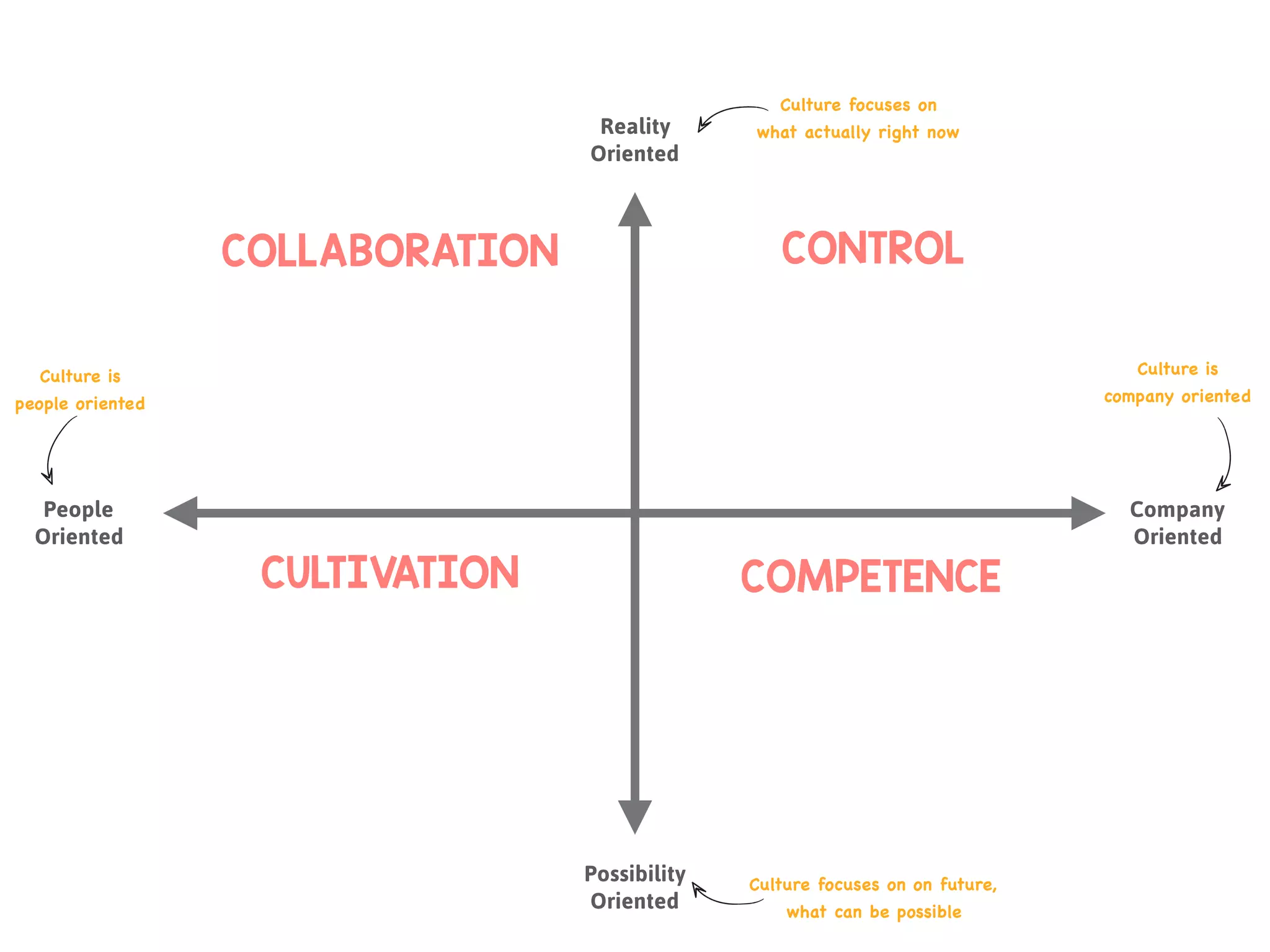
COLLABORATION CONTROL
COMPETENCECULTIVATION
Horizontal Axis considers what
the organization pays attention to. 
People fulfill roles; 

the workers are critical 

to the company’s goals.

People
Oriented
Company
Oriented
Reality
Oriented
Possibility
Oriented
Company as a collective 

knows how to achieve its goals 

– emphasizes work roles over workers.
Company prefers the concrete-tangible facts, data.
Ambiguity is to be resolved, not tolerated.
Rely on actual experience, not theory.
What can be seen, heard, touched, measured.
Company prefers possibility:
What can be.
Ideas, possibilities, change is necessary.
COLLABORATION CONTROL
COMPETENCECULTIVATION
Vertical Axis how the company
makes decisions,
forms judgments.
Culture is 

people oriented
People
Oriented
Company
Oriented
Reality
Oriented
Possibility
Oriented
Culture is 

company oriented
Culture focuses on 

what actually right now
Culture focuses on on future, 

what can be possible
COLLABORATION CONTROL
COMPETENCECULTIVATION
Culture is 

people oriented
People
Oriented
Company
Oriented
Reality
Oriented
Possibility
Oriented
“How we do things around here to succeed?”
Culture is 

company oriented
Culture focuses on 

what actually right now
Culture focuses on on future, 

what can be possible
COLLABORATION CONTROL
COMPETENCECULTIVATION
“We succeed by
working together”
People
Diversity
Trust
Teams
Synergy
InteractionPartnership
Dynamic
Participative
“We succeed by getting and
keeping control.”
Policies Hierarchy
Predictability
ProcessOrder
Standardisation
System
Delegation
“We succeed by growing people
who fulfill our vision"
Purposeful
Dedication
Creativity
Emotional
Subjective
Growth
Evolving
Religious
BeliefOrganic
“We succeed by
being the best”
Objective
Objective
Emotionless
Prescriptive
Formal
Expertise
KnowledgeExcellence
Scientific
Theoric
OFFICES AROUND THE WORLD
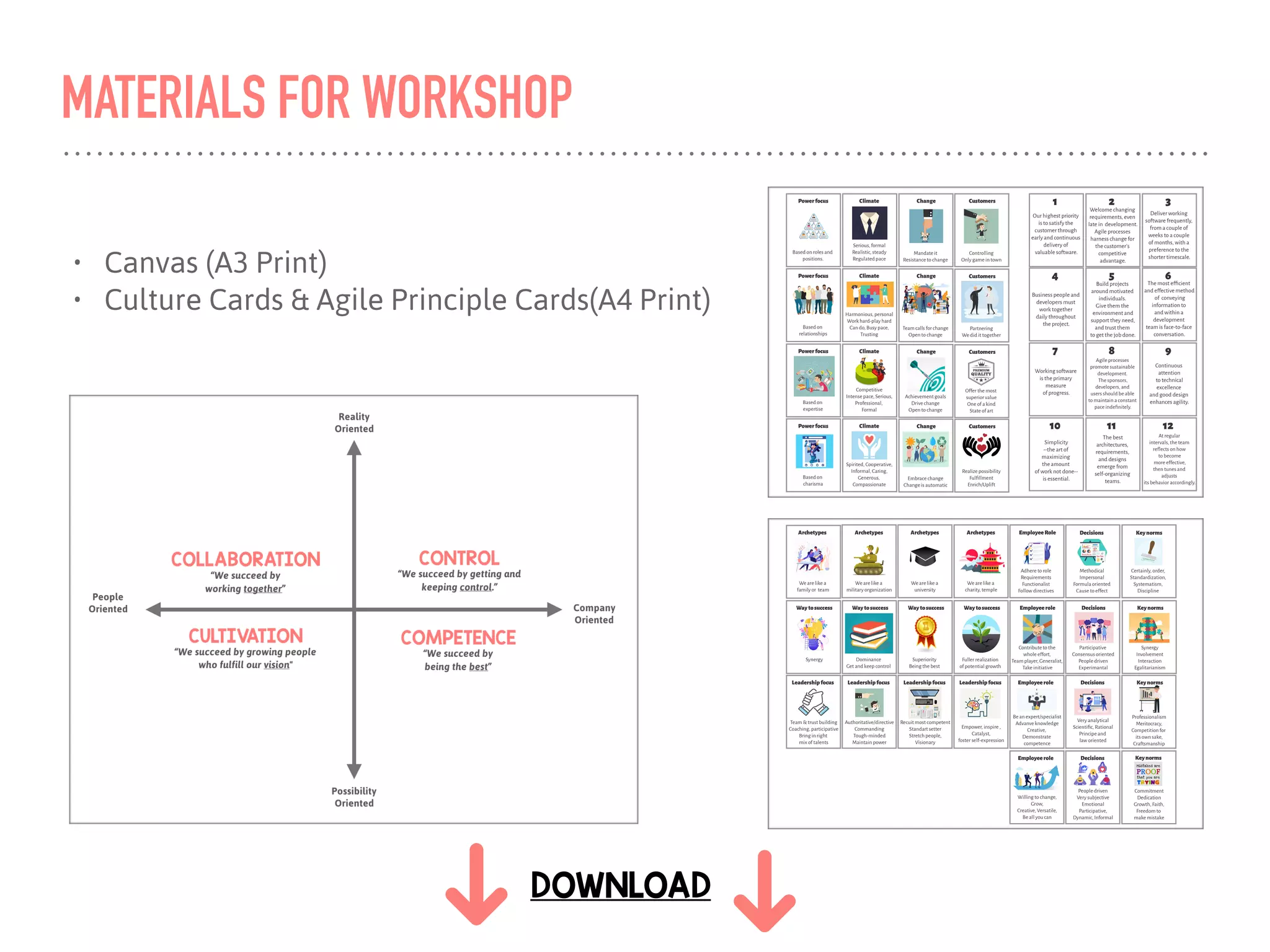
MATERIALS FOR WORKSHOP
• Canvas (A3 Print)
• Culture Cards & Agile Principle Cards(A4 Print)
DOWNLOAD
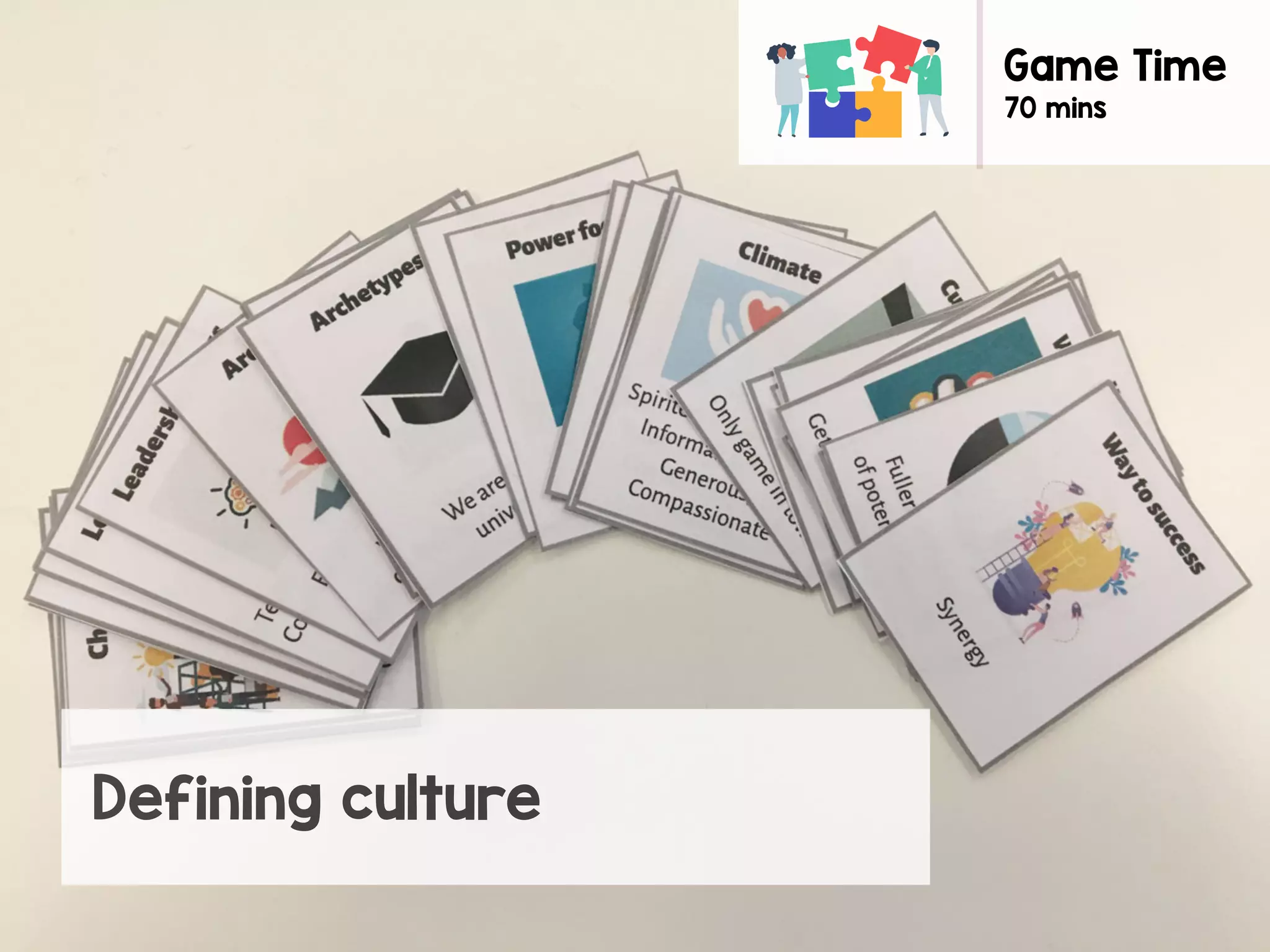
Defining culture
Game Time
70 mins
Round 1
10 mins
Define culture with cards on
Schneider Culture model
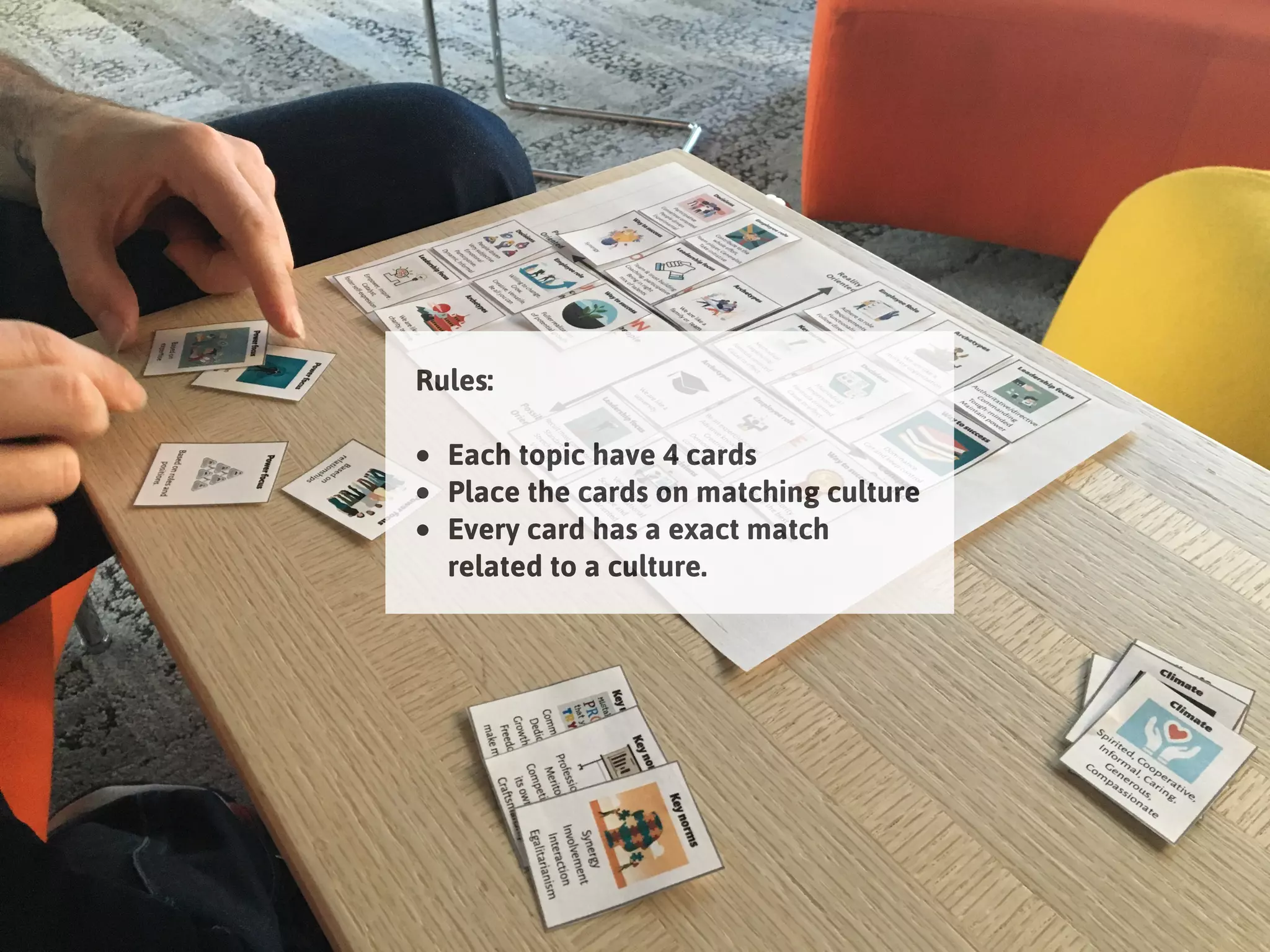
Rules:
• Each topic have 4 cards
• Place the cards on matching culture
• Every card has a exact match
related to a culture.
People
Oriented Company
Oriented
Reality
Oriented
Possibility
Oriented
COLLABORATION CONTROL
COMPETENCECULTIVATION
“We succeed by
working together”
“We succeed by getting and
keeping control.”
“We succeed by growing people
who fulfill our vision"
“We succeed by
being the best”
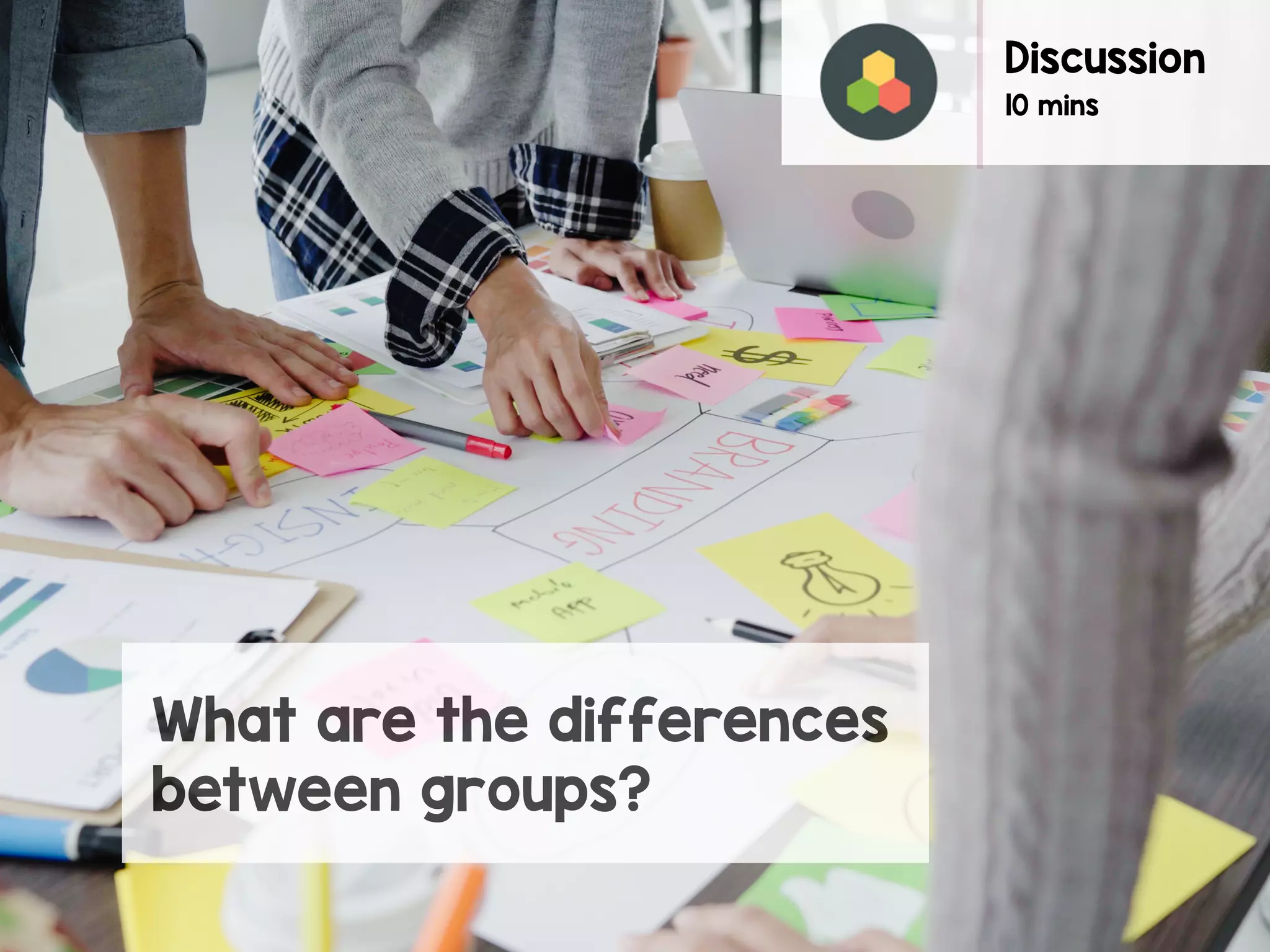
Discussion
10 mins
What are the differences
between groups?
Map “12 Agile Principles” cards on
Schneider Culture Model.
Round 2
10 mins
Rules:
• Place the cards on matching culture
• Agile Principle cards are open to
interpretation.
• The cards can be placed at the
intersection of the axes.
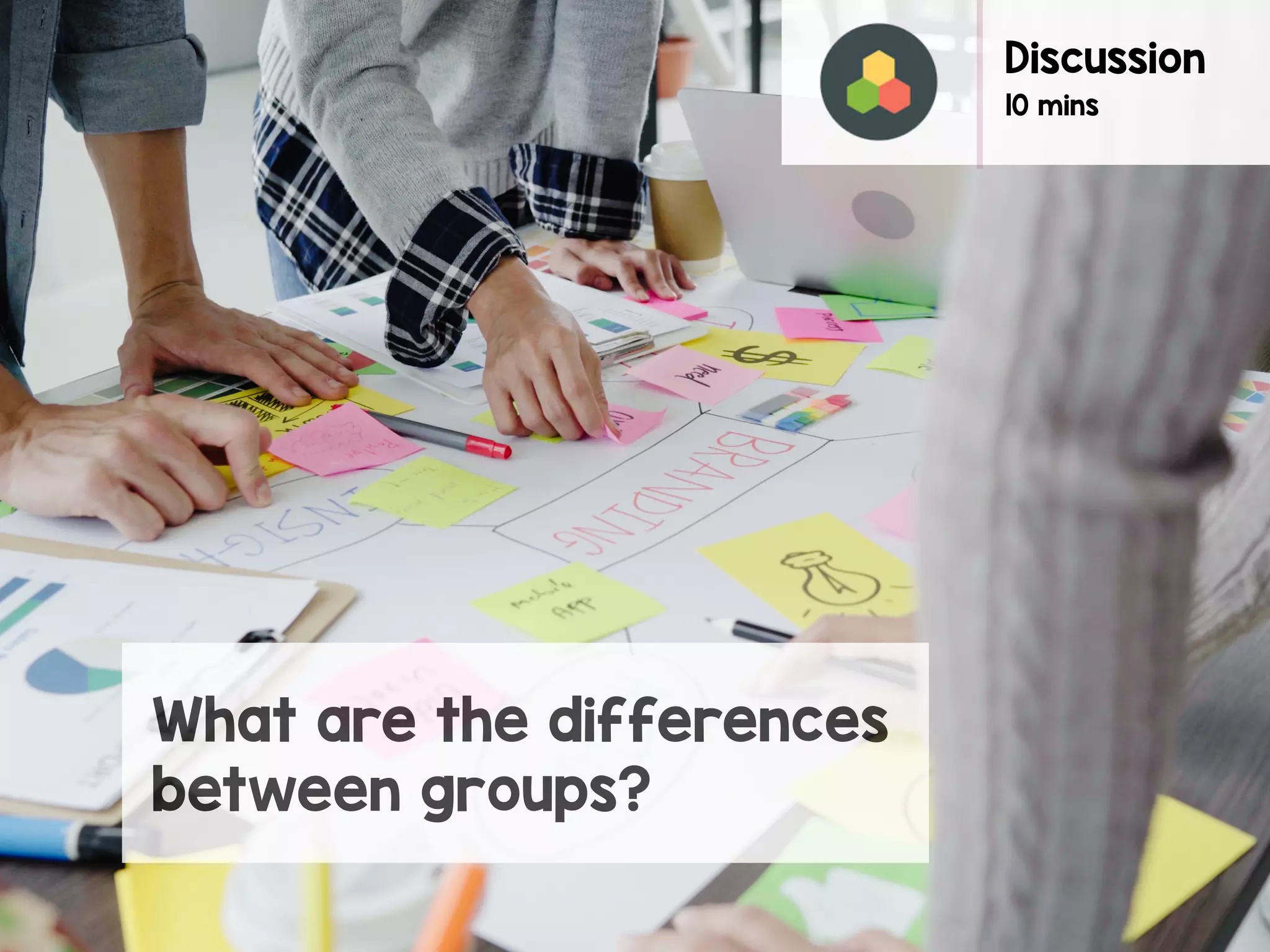
Discussion
10 mins
What are the differences
between groups?
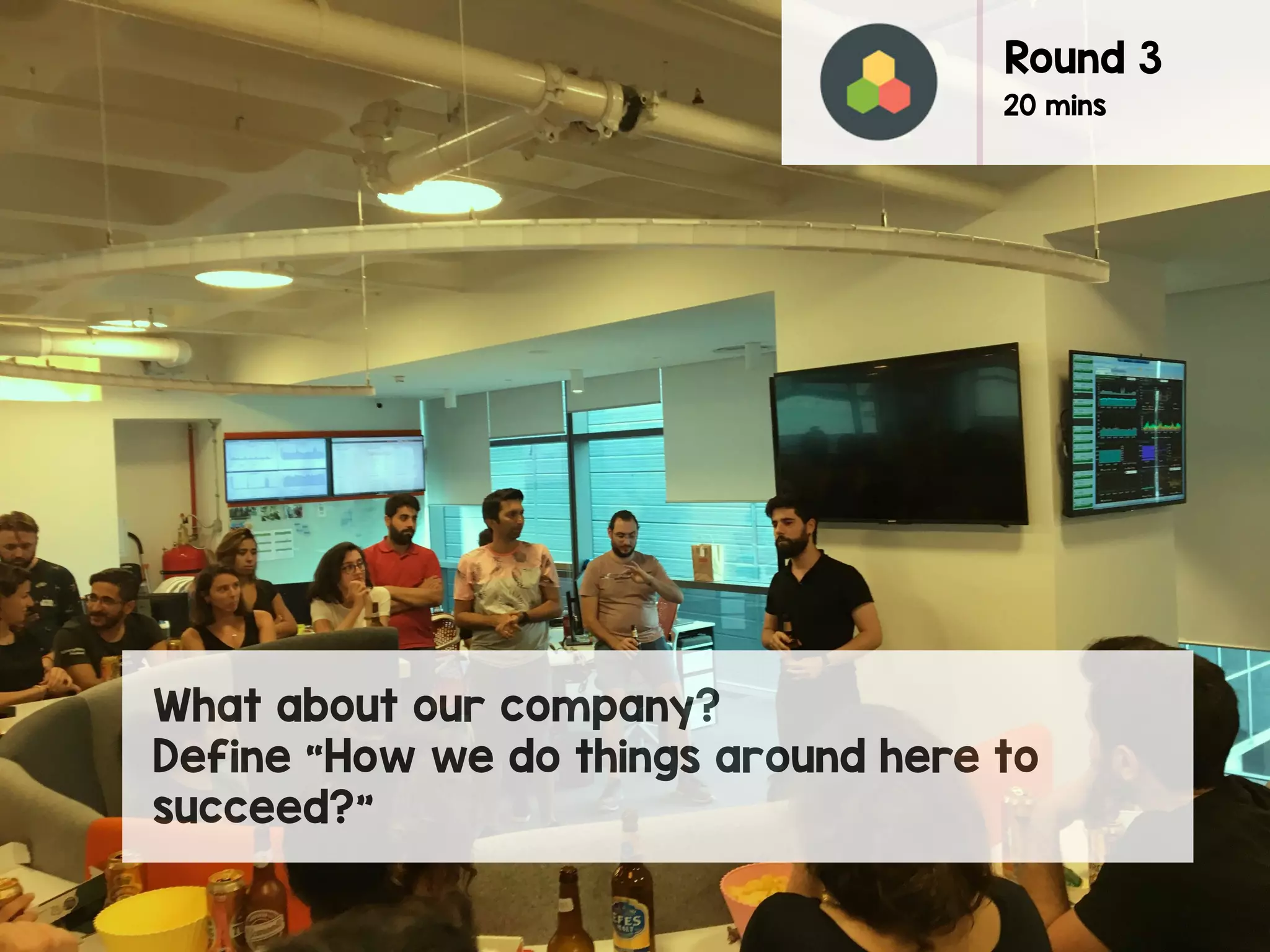
What about our company?
Define “How we do things around here to
succeed?”
Round 3
20 mins
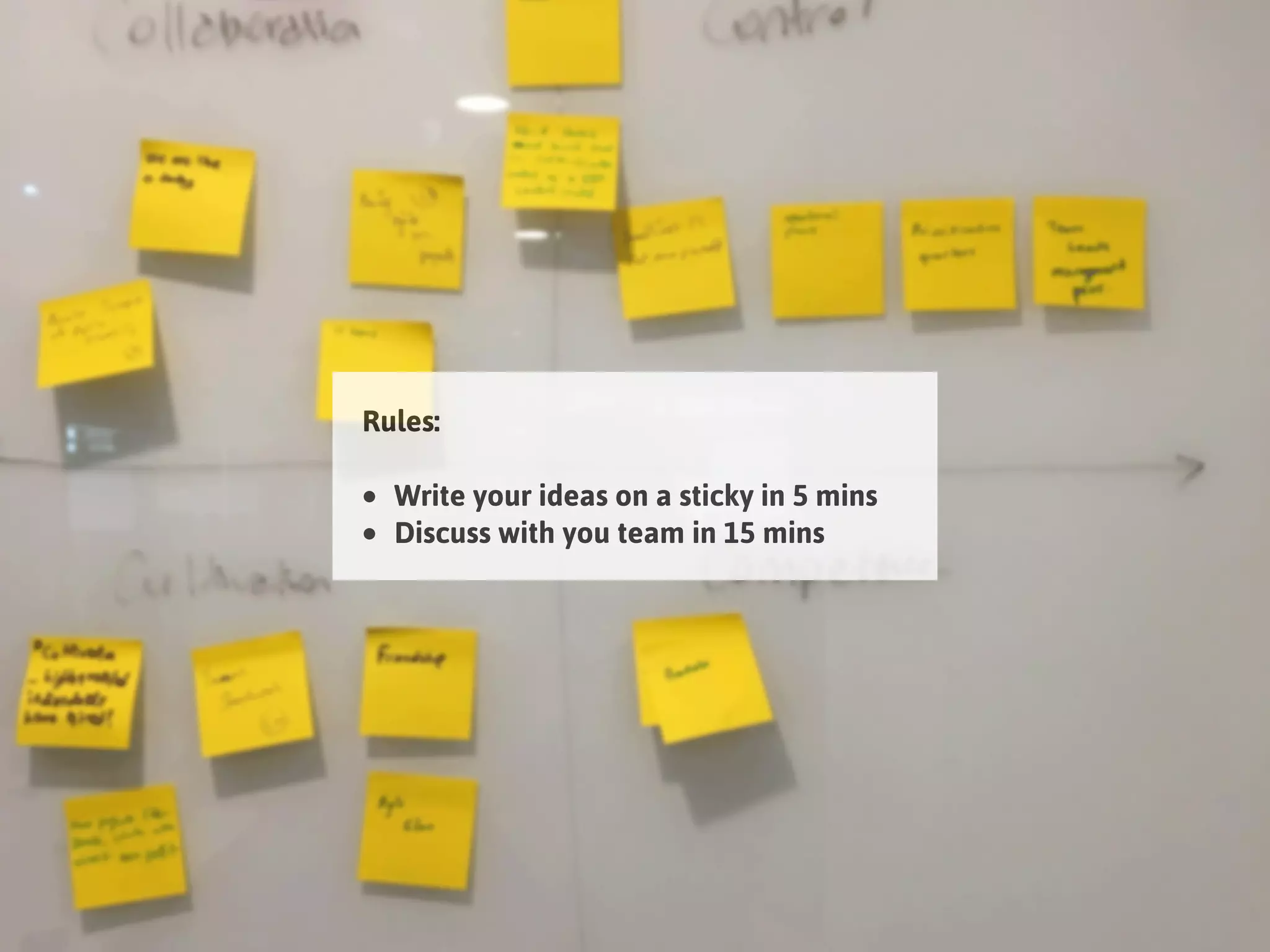
Rules:
• Write your ideas on a sticky in 5 mins
• Discuss with you team in 15 mins
As a change agent what could be your
next step to get closer to Agile Culture?
Round 4
10 mins
Rules:
• Based on previous round, focus on
topics and discuss your suggestions.
RESOURCES
๏https://www.slideshare.net/nbatsios/making-your-culture-work
๏https://www.tintup.com/blog/startup-company-culture-how-do-you-define-it/
๏https://www.slideshare.net/petebehrens/the-culture-of-agility
๏https://www.linkedin.com/pulse/using-schneider-culture-model-successful-agile-
patary-pmp-csm-cssgb/
๏http://www.congruentpaths.com/resources-tools/culture-assessment-schneider-
model-old/
๏http://www.yilmazcihan.com/download/scrum-master-gelisim-programi-
kitapcigi/
๏https://www.freepik.com/tirachardz
๏https://www.freepik.com/mindandi
๏Icons: https://www.freepik.com/

Schneider Culture Model combined with Agile Principles

  • 1.
  • 2.
    CULTURE IS… Provides consistencyfor people and organization Provides order and structure Way of life for people Ground rules Boundaries Communication patterns Reward& Punishment Expectation Priorities Power
  • 3.
    SCHNEIDER CULTURE MODEL WilliamSchneider has been working as a consultant psychologist for more than 40 years with different companies. Schneider describes the culture as the answer of “How we do things around here to succeed?” question.
  • 4.
    SCHNEIDER CULTURE MODEL •No one culture type is better than another. They only have strengths and weaknesses. • Depending on the type of work, one type of culture may be a better fit. • Companies typically have a dominant culture with aspects from other cultures. This is fine as long as those aspects serve the dominant culture. • Different departments or groups may have different cultures. (e.g. development vs. operations) • Differences can lead to conflict.
  • 5.
    SCHNEIDER CULTURE MODEL- 4 CULTURE TYPES Control cultures (COMPANY/REALITY oriented) are process-driven; the org’s success depends on data, processes, etc. Many energy, aviation, defense companies are control cultures. Control cultures want no competition – they want to be the only game in town. Leaders manage the work; control cultures are command-and-control, hierarchical. Examples: The military, police, Exxon. Collaboration cultures (PEOPLE/REALITY oriented) – people work together toward a shared goal. Here you’ll find “working managers” – everyone rolls up their sleeves. Relationships are key to getting things accomplished. Google is an example, though also has cultivation culture elements. Cultivation Cultures (PEOPLE/POSSIBILITY oriented) are often centered around a greater mission; examples include religious organizations, non-profits, social impact organizations. Leaders remove obstacles that impede attaining the org’s mission. Examples – Zappos, Doctors Without Borders. Competence Cultures (COMPANY/POSSIBILITY oriented) are innovative (possibility) and are utilize the best talent to bring ideas to bear. This culture is about being the best and winning – best product, most market share, etc. Leaders are results-driven and will hire and fire to do what needs to be done. Examples: Deloitte, Apple.
  • 6.
    People fulfill roles; theworkers are critical to the company’s goals. People Oriented Company Oriented Company as a collective  knows how to achieve its goals – emphasizes work roles over workers. COLLABORATION CONTROL COMPETENCECULTIVATION Horizontal Axis considers what the organization pays attention to. 
  • 7.
    People fulfill roles; the workers are critical to the company’s goals. People Oriented Company Oriented Reality Oriented Possibility Oriented Company as a collective  knows how to achieve its goals – emphasizes work roles over workers. Company prefers the concrete-tangible facts, data. Ambiguity is to be resolved, not tolerated. Rely on actual experience, not theory. What can be seen, heard, touched, measured. Company prefers possibility: What can be. Ideas, possibilities, change is necessary. COLLABORATION CONTROL COMPETENCECULTIVATION Vertical Axis how the company makes decisions, forms judgments.
  • 8.
    Culture is peopleoriented People Oriented Company Oriented Reality Oriented Possibility Oriented Culture is company oriented Culture focuses on what actually right now Culture focuses on on future, what can be possible COLLABORATION CONTROL COMPETENCECULTIVATION
  • 9.
    Culture is peopleoriented People Oriented Company Oriented Reality Oriented Possibility Oriented “How we do things around here to succeed?” Culture is company oriented Culture focuses on what actually right now Culture focuses on on future, what can be possible COLLABORATION CONTROL COMPETENCECULTIVATION “We succeed by working together” People Diversity Trust Teams Synergy InteractionPartnership Dynamic Participative “We succeed by getting and keeping control.” Policies Hierarchy Predictability ProcessOrder Standardisation System Delegation “We succeed by growing people who fulfill our vision" Purposeful Dedication Creativity Emotional Subjective Growth Evolving Religious BeliefOrganic “We succeed by being the best” Objective Objective Emotionless Prescriptive Formal Expertise KnowledgeExcellence Scientific Theoric
  • 10.
  • 11.
    MATERIALS FOR WORKSHOP •Canvas (A3 Print) • Culture Cards & Agile Principle Cards(A4 Print) DOWNLOAD
  • 12.
  • 13.
    Round 1 10 mins Defineculture with cards on Schneider Culture model
  • 14.
    Rules: • Each topichave 4 cards • Place the cards on matching culture • Every card has a exact match related to a culture.
  • 15.
    People Oriented Company Oriented Reality Oriented Possibility Oriented COLLABORATION CONTROL COMPETENCECULTIVATION “Wesucceed by working together” “We succeed by getting and keeping control.” “We succeed by growing people who fulfill our vision" “We succeed by being the best”
  • 16.
    Discussion 10 mins What arethe differences between groups?
  • 17.
    Map “12 AgilePrinciples” cards on Schneider Culture Model. Round 2 10 mins
  • 18.
    Rules: • Place thecards on matching culture • Agile Principle cards are open to interpretation. • The cards can be placed at the intersection of the axes.
  • 19.
    Discussion 10 mins What arethe differences between groups?
  • 20.
    What about ourcompany? Define “How we do things around here to succeed?” Round 3 20 mins
  • 21.
    Rules: • Write yourideas on a sticky in 5 mins • Discuss with you team in 15 mins
  • 22.
    As a changeagent what could be your next step to get closer to Agile Culture? Round 4 10 mins
  • 23.
    Rules: • Based onprevious round, focus on topics and discuss your suggestions.
  • 24.