The Control of Microbial Growth
The types of microorganism or microbes:
• Bacteria
• Viruses
• Fungi
• Algea
• Protozoa
Can’t see with
naked eye
How to control microbial growth?
Damage to the lipids or
proteins of the plasma
membrane by
antimicrobial agents causes
cellular contents to leak into
the surrounding medium and
interferes with the growth of
the cell.
Tortora & Friends, 2019
Bacteria are sometimes thought of as
“little bags of enzymes.” Enzymes,
which are primarily protein, are vital to
all cellular activities.
The enzymes shape is maintained by
chemical bonds. These bonds, such as
hydrogenn and covalent bonds, can be
attacked by certain chemicals.
Tortora & Friends, 2019
How to control microbial growth:
• Damage to the lipids or proteins of the plasma membrane
• Attack enzyme chemical bonds
What methods can we use to control the
growth of microorganism?
Microbial Control Methods
Physical methods Chemical Methods
Mechanical
removable Methods
Heat Radiation
Lowering or raising the temperature can kill
the microbes.
Tortora & Friends, 2019.
At temperatures of ordinary refrigerators (0–7°C), the
metabolic rate of most microbes is so reduced that they
cannot reproduce or synthesize to toxins. Pathogenic
bacteria generally will not grow at refrigerator
temperatures.
Tortora & Friends, 2019.
Microbial Control Methods
Physical methods Chemical Methods
Mechanical
removable Methods
Heat Radiation
Microbial Control Methods
Physical methods Chemical Methods
Mechanical
removable Methods
Heat Radiation
Microbial Control Methods
Physical methods Chemical Methods
Mechanical
removable Methods
Dry Moist
Incineration Dry oven
Heat Radiation
Sterilization Sterilization
Sterilization: The complete removal or destruction
of all variable microorganisms. Used on inanimate
objects.
Incineration
Dry oven
Microbial Control Methods
Physical methods Chemical Methods
Mechanical
removable Methods
Dry Moist
Steam Under
pressure
Boiling water,
hot water,
Pasteurization
Incineration Dry oven
Heat Radiation
Sterilization Sterilization
Sterilization
Disinfection
Disinfection: the destruction of removal of
vegetative pathogens but not bacterial endospores
usually used only on inanimate objects.
Sterilization: The complete removal or destruction
of all variable microorganisms. Used on inanimate
objects.
Microbial Control Methods
Physical methods Chemical Methods
Mechanical
removable Methods
Dry Moist
Steam Under
pressure
Boiling water,
hot water,
Pasteurization
Incineration Dry oven
Heat Radiation
Sterilization Sterilization
Sterilization
Disinfection
Disinfection: the destruction of removal of
vegetative pathogens but not bacterial endospores
usually used only on inanimate objects.
Sterilization: The complete removal or destruction
of all variable microorganisms. Used on inanimate
objects.
Steam Under pressure
Steam, especially dry (highly superheated) steam,
may be used for antimicrobial cleaning even to the
levels of sterilization. Steam is a non-toxic
antimicrobial agent.
Microbial Control Methods
Physical methods Chemical Methods
Mechanical
removable Methods
Dry Moist
Steam Under
pressure
Boiling water,
hot water,
Pasteurization
Incineration Dry oven
Heat Radiation
Sterilization Sterilization
Sterilization
Disinfection
Disinfection: the destruction of removal of
vegetative pathogens but not bacterial endospores
usually used only on inanimate objects.
Sterilization: The complete removal or destruction
of all variable microorganisms. Used on inanimate
objects.
Antisepsis: Chemical applied to body surfaces to
destroy or inhibit vegetative pathogens.
Pasteurization or pasteurisation is a process in which
packaged and non-packaged foods are treated with mild
heat, usually to less than 100 °C, to eliminate pathogens
and extend shelf life.
Pasteurization
An example of pasteurisation is in the treatment of milk.
Most milk pasteurization today uses temperatures of at least
72°C, but for only 15 seconds. This treatment, known as high-
temperature short-time (HTST) pasteurization, is applied as the
milk flows continuously past a heat exchanger. In addition to
killing pathogens, HTST pasteurization lowers total bacterial
counts, so the milk keeps well under refrigeration
Tortora & Friends, 2019
Microbial Control Methods
Physical methods Chemical Methods
Mechanical
removable Methods
Dry Moist
Steam Under
pressure
Boiling water,
hot water,
Pasteurization
Incineration Dry oven
Heat Radiation
Sterilization Sterilization
Sterilization
Disinfection
Disinfection: the destruction of removal of
vegetative pathogens but not bacterial endospores
usually used only on inanimate objects.
Sterilization: The complete removal or destruction
of all variable microorganisms. Used on inanimate
objects.
Radiation has various effects on cells, depending on its
wavelength, intensity, and duration. Radiation that kills
microorganisms (sterilizing radiation) is of two types:
ionizing and nonionizing.
Tortora & Friends, 2019
Microbial Control Methods
Physical methods Chemical Methods
Mechanical
removable Methods
Dry Moist
Steam Under
pressure
Boiling water,
hot water,
Pasteurization
Incineration Dry oven
Heat Radiation
Sterilization Sterilization
Sterilization
Disinfection
Disinfection: the destruction of removal of
vegetative pathogens but not bacterial endospores
usually used only on inanimate objects.
Sterilization: The complete removal or destruction
of all variable microorganisms. Used on inanimate
objects.
Microbial Control Methods
Physical methods Chemical Methods
Mechanical
removable Methods
Dry Moist
Steam Under
pressure
Boiling water,
hot water,
Pasteurization
Incineration Dry oven
Heat Radiation
Ionizing Nonionizing
X ray, Catode,
and Gamma
UV
Sterilization Sterilization
Sterilization
Disinfection
Sterilization
Disinfection
Disinfection: the destruction of removal of
vegetative pathogens but not bacterial endospores
usually used only on inanimate objects.
Sterilization: The complete removal or destruction
of all variable microorganisms. Used on inanimate
objects.
The deference of Ionizing radiation and
Nonionizing radiation:
• Ionizing radiation—gamma rays, X rays, and high-energy
electron beams—has a wavelength shorter than that of nonionizing
radiation, less than about 1 nm. Therefore, it carries much
more energy.
• Nonionizing radiation has a wavelength longer than that
of ionizing radiation, usually greater than about 1 nm. The best
example of nonionizing radiation is ultraviolet (UV) light.
Tortora & Friends, 2019
Microbial Control Methods
Physical methods Chemical Methods
Mechanical
removable Methods
Dry Moist
Steam Under
pressure
Boiling water,
hot water,
Pasteurization
Incineration Dry oven
Heat Radiation
Ionizing Nonionizing
X ray, Catode,
and Gamma
UV
Filtration
Sterilization Sterilization
Sterilization
Disinfection
Sterilization
Disinfection
Disinfection: the destruction of removal of
vegetative pathogens but not bacterial endospores
usually used only on inanimate objects.
Sterilization: The complete removal or destruction
of all variable microorganisms. Used on inanimate
objects.
Antisepsis: Chemical applied to body surfaces to
destroy or inhibit vegetative pathogens.
Filtration, the process in which solid particles in a liquidor
gaseous fluidare removed by the use of a filter medium that
permits the fluid to pass through but retains the solid particles.
Either the clarified fluid or the solid particles removed from the
fluid may be the desired product.
www.britannica.com/science/filtration-chemistry
Microbial Control Methods
Physical methods Chemical Methods
Mechanical
removable Methods
Dry Moist
Steam Under
pressure
Boiling water,
hot water,
Pasteurization
Incineration Dry oven
Heat Radiation
Ionizing Nonionizing
X ray, Catode,
and Gamma
UV
Filtration
Sterilization Sterilization
Sterilization
Disinfection
Sterilization
Disinfection
Disinfection: the destruction of removal of
vegetative pathogens but not bacterial endospores
usually used only on inanimate objects.
Sterilization: The complete removal or destruction
of all variable microorganisms. Used on inanimate
objects.
Microbial Control Methods
Physical methods Chemical Methods
Mechanical
removable Methods
Dry Moist
Steam Under
pressure
Boiling water,
hot water,
Pasteurization
Incineration Dry oven
Heat Radiation
Ionizing Nonionizing
X ray, Catode,
and Gamma
UV
Filtration
Air Liquid
Sterilization Sterilization
Sterilization
Disinfection
Sterilization
Disinfection
Disinfection Sterilization
Disinfection: the destruction of removal of
vegetative pathogens but not bacterial endospores
usually used only on inanimate objects.
Sterilization: The complete removal or destruction
of all variable microorganisms. Used on inanimate
objects.
Soap has little value as an antiseptic,
but it does have an important
function in the mechanical removal
of microbes through scrubbing.
Tortora & Friends, 2019
Microbial Control Methods
Physical methods Chemical Methods
Mechanical
removable Methods
Dry Moist
Steam Under
pressure
Boiling water,
hot water,
Pasteurization
Incineration Dry oven
Heat Radiation
Ionizing Nonionizing
X ray, Catode,
and Gamma
UV
Filtration
Air Liquid
Gas Liquid
Unimate Inunimate
Disinfection
Sterilization Sterilization
Sterilization
Disinfection
Sterilization
Disinfection
Disinfection Sterilization
Antisepsis
Sterilization
Disinfection: the destruction of removal of
vegetative pathogens but not bacterial endospores
usually used only on inanimate objects.
Sterilization: The complete removal or destruction
of all variable microorganisms. Used on inanimate
objects.
Antisepsis: Chemical applied to body surfaces to
destroy or inhibit vegetative pathogens.
Alcohols make up another group of chemicals commonly used as
disinfectants and antiseptics. They work by rapidly denaturing proteins,
which inhibits cell metabolism, and by disrupting membranes, which
leads to cell lysis. Once denatured, the proteins may potentially refold if
enough water is present in the solution. Alcohols are typically used at
concentrations of about 70% aqueous solution and, in fact, work better in
aqueous solutions than 100% alcohol solutions.
Using Chemicals to Control Microorganisms | Microbiology (lumenlearning.com)
Other chemicals commonly used for disinfection are the
halogens iodine, chlorine, and fluorine. Iodine works by
oxidizing cellular components, including sulfur-containing
amino acids, nucleotides, and fatty acids, and destabilizing the
macromolecules that contain these molecules. It is often used
as a topical tincture, but it may cause staining or skin irritation.
Using Chemicals to Control Microorganisms | Microbiology (lumenlearning.com)

the control of microbial growth

  • 1.
    The Control ofMicrobial Growth
  • 2.
    The types ofmicroorganism or microbes: • Bacteria • Viruses • Fungi • Algea • Protozoa Can’t see with naked eye
  • 3.
    How to controlmicrobial growth?
  • 4.
    Damage to thelipids or proteins of the plasma membrane by antimicrobial agents causes cellular contents to leak into the surrounding medium and interferes with the growth of the cell. Tortora & Friends, 2019
  • 5.
    Bacteria are sometimesthought of as “little bags of enzymes.” Enzymes, which are primarily protein, are vital to all cellular activities. The enzymes shape is maintained by chemical bonds. These bonds, such as hydrogenn and covalent bonds, can be attacked by certain chemicals. Tortora & Friends, 2019
  • 6.
    How to controlmicrobial growth: • Damage to the lipids or proteins of the plasma membrane • Attack enzyme chemical bonds
  • 7.
    What methods canwe use to control the growth of microorganism?
  • 8.
    Microbial Control Methods Physicalmethods Chemical Methods Mechanical removable Methods Heat Radiation
  • 9.
    Lowering or raisingthe temperature can kill the microbes. Tortora & Friends, 2019.
  • 10.
    At temperatures ofordinary refrigerators (0–7°C), the metabolic rate of most microbes is so reduced that they cannot reproduce or synthesize to toxins. Pathogenic bacteria generally will not grow at refrigerator temperatures. Tortora & Friends, 2019.
  • 11.
    Microbial Control Methods Physicalmethods Chemical Methods Mechanical removable Methods Heat Radiation
  • 12.
    Microbial Control Methods Physicalmethods Chemical Methods Mechanical removable Methods Heat Radiation
  • 13.
    Microbial Control Methods Physicalmethods Chemical Methods Mechanical removable Methods Dry Moist Incineration Dry oven Heat Radiation Sterilization Sterilization Sterilization: The complete removal or destruction of all variable microorganisms. Used on inanimate objects.
  • 14.
  • 15.
  • 16.
    Microbial Control Methods Physicalmethods Chemical Methods Mechanical removable Methods Dry Moist Steam Under pressure Boiling water, hot water, Pasteurization Incineration Dry oven Heat Radiation Sterilization Sterilization Sterilization Disinfection Disinfection: the destruction of removal of vegetative pathogens but not bacterial endospores usually used only on inanimate objects. Sterilization: The complete removal or destruction of all variable microorganisms. Used on inanimate objects.
  • 17.
    Microbial Control Methods Physicalmethods Chemical Methods Mechanical removable Methods Dry Moist Steam Under pressure Boiling water, hot water, Pasteurization Incineration Dry oven Heat Radiation Sterilization Sterilization Sterilization Disinfection Disinfection: the destruction of removal of vegetative pathogens but not bacterial endospores usually used only on inanimate objects. Sterilization: The complete removal or destruction of all variable microorganisms. Used on inanimate objects.
  • 18.
    Steam Under pressure Steam,especially dry (highly superheated) steam, may be used for antimicrobial cleaning even to the levels of sterilization. Steam is a non-toxic antimicrobial agent.
  • 19.
    Microbial Control Methods Physicalmethods Chemical Methods Mechanical removable Methods Dry Moist Steam Under pressure Boiling water, hot water, Pasteurization Incineration Dry oven Heat Radiation Sterilization Sterilization Sterilization Disinfection Disinfection: the destruction of removal of vegetative pathogens but not bacterial endospores usually used only on inanimate objects. Sterilization: The complete removal or destruction of all variable microorganisms. Used on inanimate objects. Antisepsis: Chemical applied to body surfaces to destroy or inhibit vegetative pathogens.
  • 20.
    Pasteurization or pasteurisationis a process in which packaged and non-packaged foods are treated with mild heat, usually to less than 100 °C, to eliminate pathogens and extend shelf life.
  • 21.
  • 22.
    An example ofpasteurisation is in the treatment of milk. Most milk pasteurization today uses temperatures of at least 72°C, but for only 15 seconds. This treatment, known as high- temperature short-time (HTST) pasteurization, is applied as the milk flows continuously past a heat exchanger. In addition to killing pathogens, HTST pasteurization lowers total bacterial counts, so the milk keeps well under refrigeration Tortora & Friends, 2019
  • 23.
    Microbial Control Methods Physicalmethods Chemical Methods Mechanical removable Methods Dry Moist Steam Under pressure Boiling water, hot water, Pasteurization Incineration Dry oven Heat Radiation Sterilization Sterilization Sterilization Disinfection Disinfection: the destruction of removal of vegetative pathogens but not bacterial endospores usually used only on inanimate objects. Sterilization: The complete removal or destruction of all variable microorganisms. Used on inanimate objects.
  • 24.
    Radiation has variouseffects on cells, depending on its wavelength, intensity, and duration. Radiation that kills microorganisms (sterilizing radiation) is of two types: ionizing and nonionizing. Tortora & Friends, 2019
  • 25.
    Microbial Control Methods Physicalmethods Chemical Methods Mechanical removable Methods Dry Moist Steam Under pressure Boiling water, hot water, Pasteurization Incineration Dry oven Heat Radiation Sterilization Sterilization Sterilization Disinfection Disinfection: the destruction of removal of vegetative pathogens but not bacterial endospores usually used only on inanimate objects. Sterilization: The complete removal or destruction of all variable microorganisms. Used on inanimate objects.
  • 26.
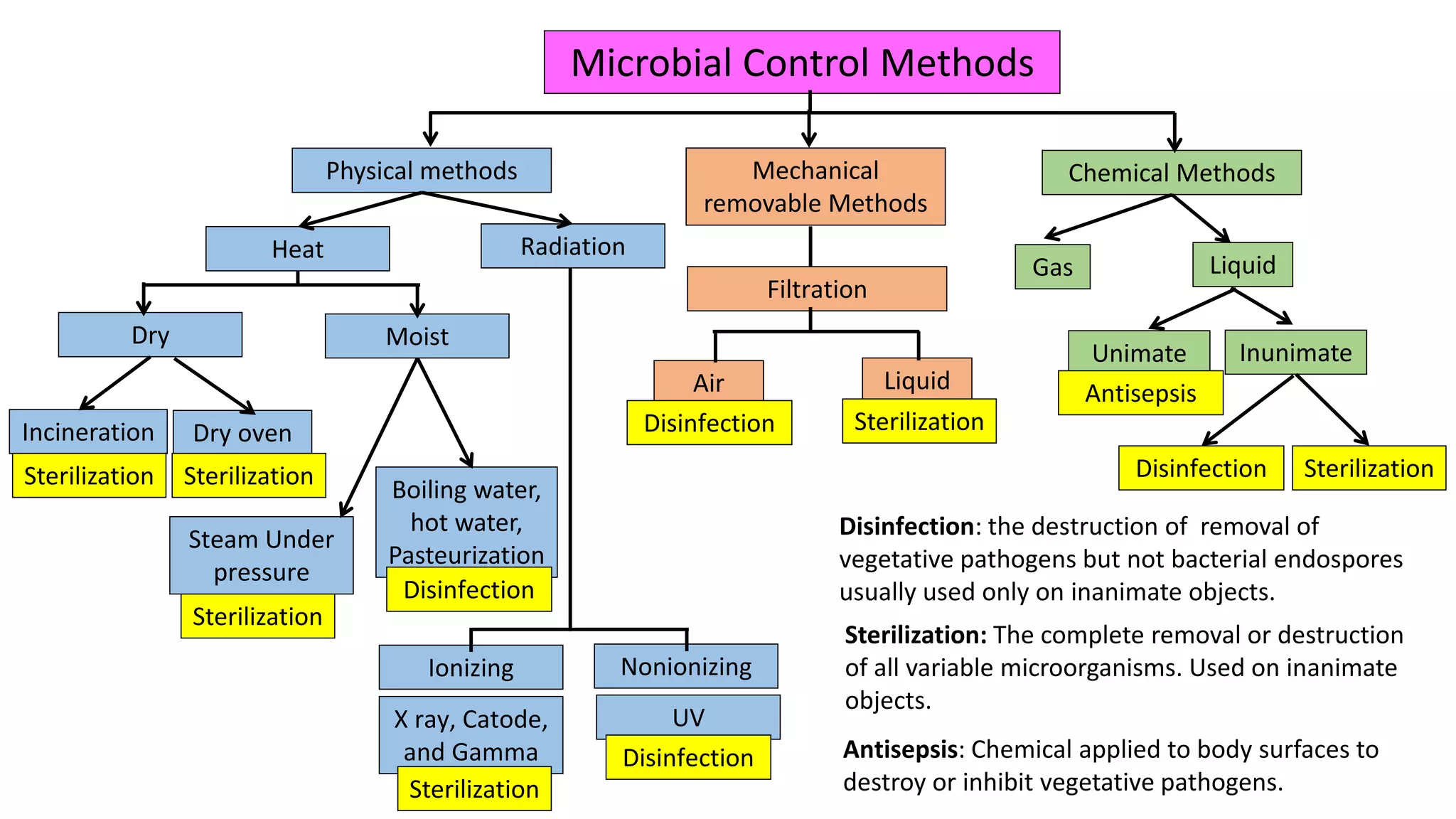
    Microbial Control Methods Physicalmethods Chemical Methods Mechanical removable Methods Dry Moist Steam Under pressure Boiling water, hot water, Pasteurization Incineration Dry oven Heat Radiation Ionizing Nonionizing X ray, Catode, and Gamma UV Sterilization Sterilization Sterilization Disinfection Sterilization Disinfection Disinfection: the destruction of removal of vegetative pathogens but not bacterial endospores usually used only on inanimate objects. Sterilization: The complete removal or destruction of all variable microorganisms. Used on inanimate objects.
  • 27.
    The deference ofIonizing radiation and Nonionizing radiation: • Ionizing radiation—gamma rays, X rays, and high-energy electron beams—has a wavelength shorter than that of nonionizing radiation, less than about 1 nm. Therefore, it carries much more energy. • Nonionizing radiation has a wavelength longer than that of ionizing radiation, usually greater than about 1 nm. The best example of nonionizing radiation is ultraviolet (UV) light. Tortora & Friends, 2019
  • 29.
    Microbial Control Methods Physicalmethods Chemical Methods Mechanical removable Methods Dry Moist Steam Under pressure Boiling water, hot water, Pasteurization Incineration Dry oven Heat Radiation Ionizing Nonionizing X ray, Catode, and Gamma UV Filtration Sterilization Sterilization Sterilization Disinfection Sterilization Disinfection Disinfection: the destruction of removal of vegetative pathogens but not bacterial endospores usually used only on inanimate objects. Sterilization: The complete removal or destruction of all variable microorganisms. Used on inanimate objects. Antisepsis: Chemical applied to body surfaces to destroy or inhibit vegetative pathogens.
  • 30.
    Filtration, the processin which solid particles in a liquidor gaseous fluidare removed by the use of a filter medium that permits the fluid to pass through but retains the solid particles. Either the clarified fluid or the solid particles removed from the fluid may be the desired product. www.britannica.com/science/filtration-chemistry
  • 31.
    Microbial Control Methods Physicalmethods Chemical Methods Mechanical removable Methods Dry Moist Steam Under pressure Boiling water, hot water, Pasteurization Incineration Dry oven Heat Radiation Ionizing Nonionizing X ray, Catode, and Gamma UV Filtration Sterilization Sterilization Sterilization Disinfection Sterilization Disinfection Disinfection: the destruction of removal of vegetative pathogens but not bacterial endospores usually used only on inanimate objects. Sterilization: The complete removal or destruction of all variable microorganisms. Used on inanimate objects.
  • 32.
    Microbial Control Methods Physicalmethods Chemical Methods Mechanical removable Methods Dry Moist Steam Under pressure Boiling water, hot water, Pasteurization Incineration Dry oven Heat Radiation Ionizing Nonionizing X ray, Catode, and Gamma UV Filtration Air Liquid Sterilization Sterilization Sterilization Disinfection Sterilization Disinfection Disinfection Sterilization Disinfection: the destruction of removal of vegetative pathogens but not bacterial endospores usually used only on inanimate objects. Sterilization: The complete removal or destruction of all variable microorganisms. Used on inanimate objects.
  • 33.
    Soap has littlevalue as an antiseptic, but it does have an important function in the mechanical removal of microbes through scrubbing. Tortora & Friends, 2019
  • 34.
    Microbial Control Methods Physicalmethods Chemical Methods Mechanical removable Methods Dry Moist Steam Under pressure Boiling water, hot water, Pasteurization Incineration Dry oven Heat Radiation Ionizing Nonionizing X ray, Catode, and Gamma UV Filtration Air Liquid Gas Liquid Unimate Inunimate Disinfection Sterilization Sterilization Sterilization Disinfection Sterilization Disinfection Disinfection Sterilization Antisepsis Sterilization Disinfection: the destruction of removal of vegetative pathogens but not bacterial endospores usually used only on inanimate objects. Sterilization: The complete removal or destruction of all variable microorganisms. Used on inanimate objects. Antisepsis: Chemical applied to body surfaces to destroy or inhibit vegetative pathogens.
  • 35.
    Alcohols make upanother group of chemicals commonly used as disinfectants and antiseptics. They work by rapidly denaturing proteins, which inhibits cell metabolism, and by disrupting membranes, which leads to cell lysis. Once denatured, the proteins may potentially refold if enough water is present in the solution. Alcohols are typically used at concentrations of about 70% aqueous solution and, in fact, work better in aqueous solutions than 100% alcohol solutions. Using Chemicals to Control Microorganisms | Microbiology (lumenlearning.com)
  • 36.
    Other chemicals commonlyused for disinfection are the halogens iodine, chlorine, and fluorine. Iodine works by oxidizing cellular components, including sulfur-containing amino acids, nucleotides, and fatty acids, and destabilizing the macromolecules that contain these molecules. It is often used as a topical tincture, but it may cause staining or skin irritation. Using Chemicals to Control Microorganisms | Microbiology (lumenlearning.com)