The Computer Science Ontology:
A Large-Scale Taxonomy of Research Areas
Angelo A. Salatino, Thiviyan Thanapalasingam, Andrea Mannocci, Francesco Osborne,
Enrico Motta
@angelosalatino
Knowledge Media Institute
The Open University
United Kingdom
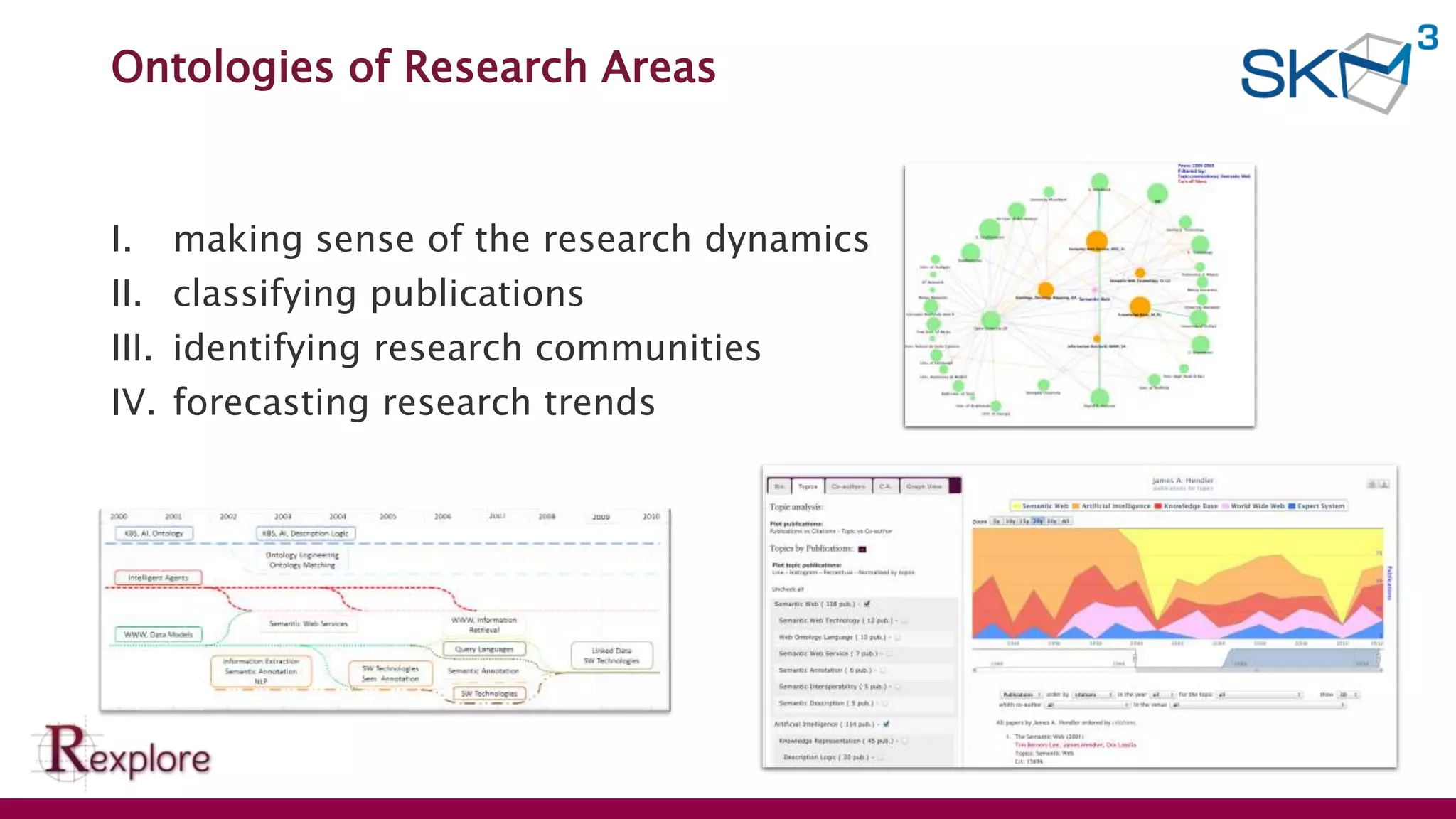
Ontologies of Research Areas
I. making sense of the research dynamics
II. classifying publications
III. identifying research communities
IV. forecasting research trends
Ontologies and Taxonomies of Research Areas
Mathematics Subject
Classification – MSC2010
Physics and Astronomy
Classification Scheme
(PACS)
JEL Classification
System
Library of Congress
Classification (LCC)
Computing
Classification System
(CCS)
The Computer Science Ontology
• Ontology of research areas, automatically generated using
Klink-2* algorithm, on a dataset of 16 million publications
mainly in Computer Science
• Current version of CSO includes 14K topics and 143K
relationships
• Main roots include Computer Science, Linguistic,
Mathematics, Geometry, Semantics and so on.
*Francesco Osborne, and Enrico Motta. "Klink-2: integrating multiple web sources to generate
semantic topic networks." In ISWC 2015, Bethlehem, PA (USA).
Data Model
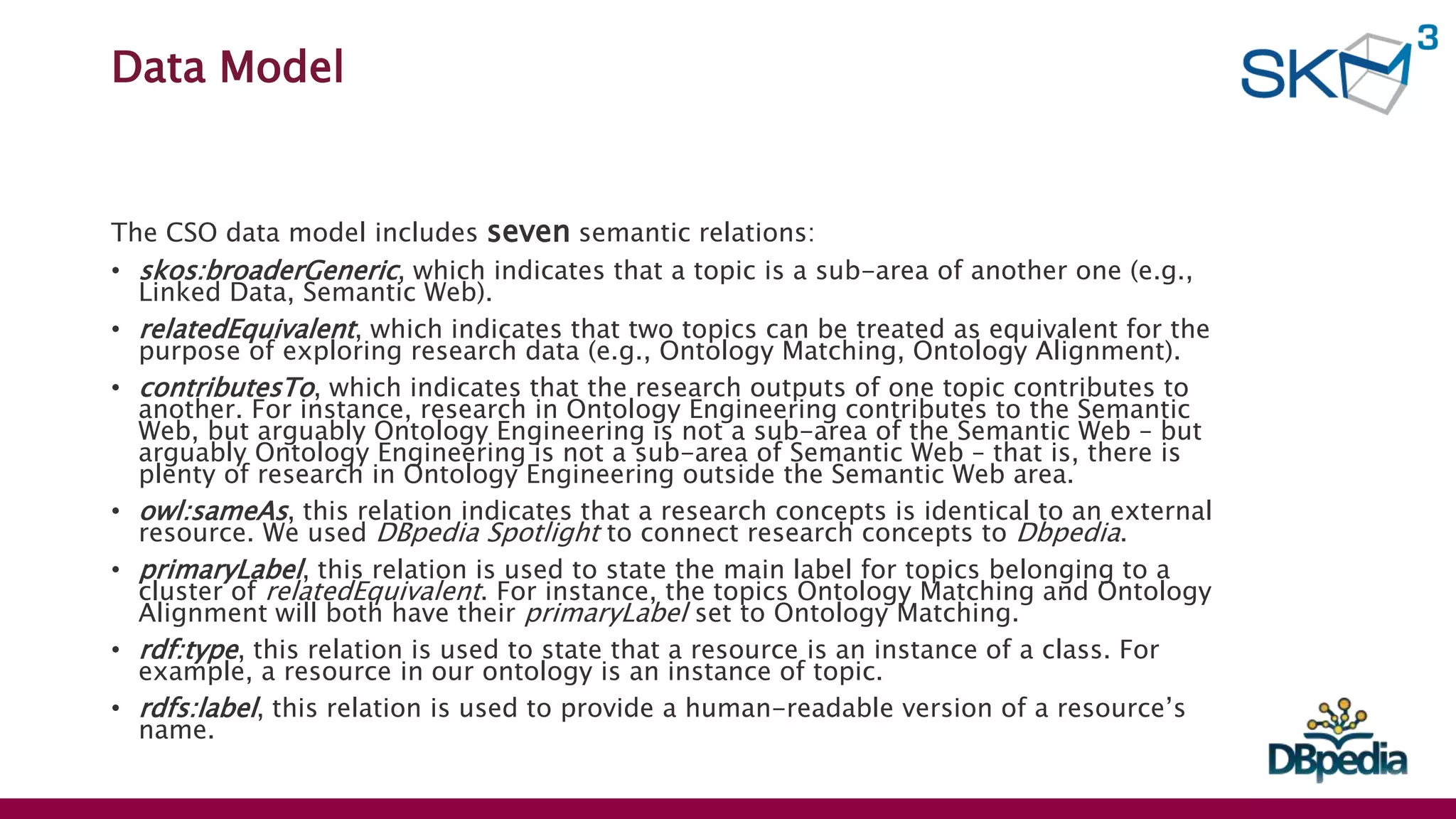
The CSO data model includes seven semantic relations:
• skos:broaderGeneric, which indicates that a topic is a sub-area of another one (e.g.,
Linked Data, Semantic Web).
• relatedEquivalent, which indicates that two topics can be treated as equivalent for the
purpose of exploring research data (e.g., Ontology Matching, Ontology Alignment).
• contributesTo, which indicates that the research outputs of one topic contributes to
another. For instance, research in Ontology Engineering contributes to the Semantic
Web, but arguably Ontology Engineering is not a sub-area of the Semantic Web – but
arguably Ontology Engineering is not a sub-area of Semantic Web – that is, there is
plenty of research in Ontology Engineering outside the Semantic Web area.
• owl:sameAs, this relation indicates that a research concepts is identical to an external
resource. We used DBpedia Spotlight to connect research concepts to Dbpedia.
• primaryLabel, this relation is used to state the main label for topics belonging to a
cluster of relatedEquivalent. For instance, the topics Ontology Matching and Ontology
Alignment will both have their primaryLabel set to Ontology Matching.
• rdf:type, this relation is used to state that a resource is an instance of a class. For
example, a resource in our ontology is an instance of topic.
• rdfs:label, this relation is used to provide a human-readable version of a resource’s
name.
CSO Generation
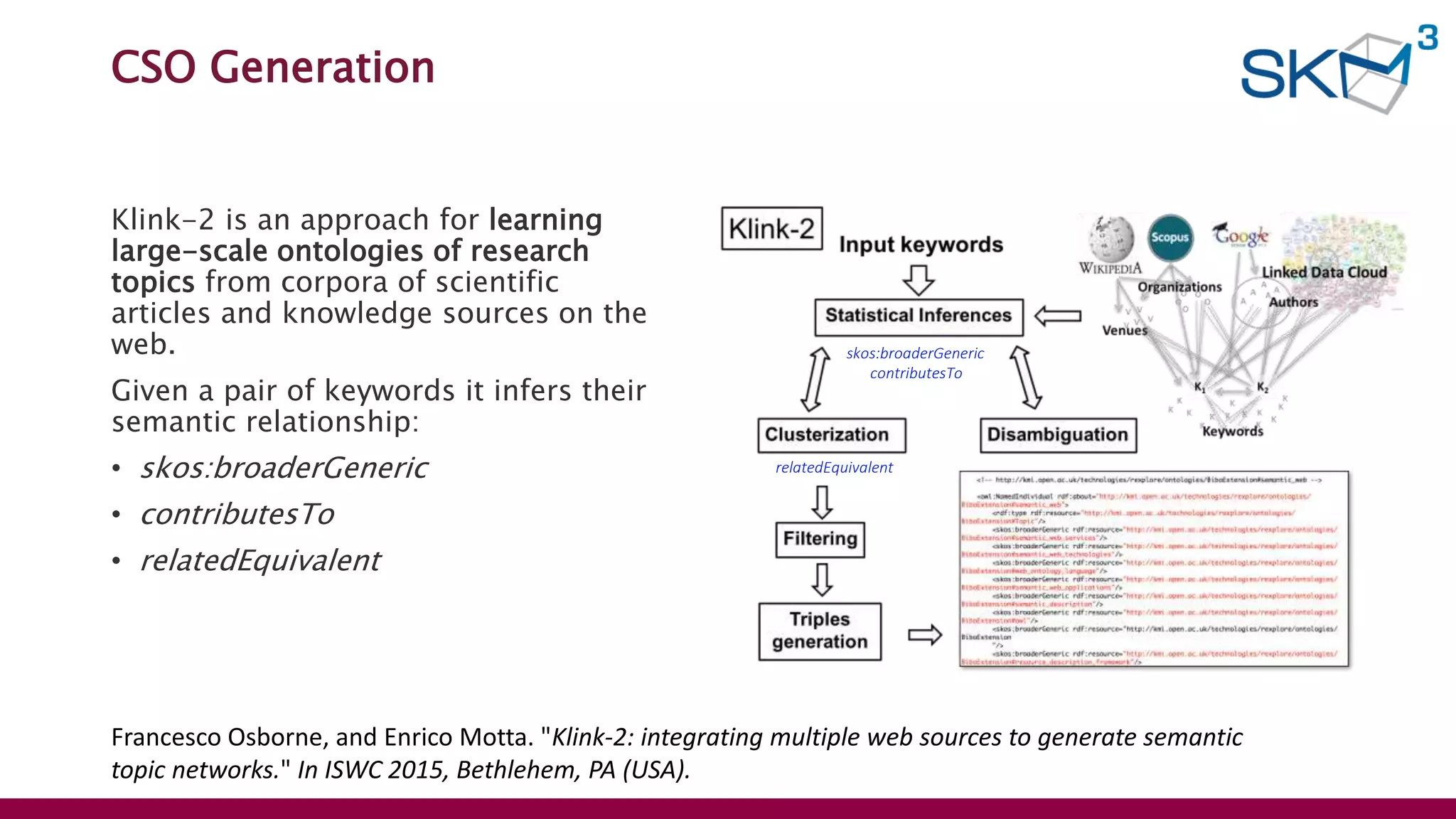
Klink-2 is an approach for learning
large-scale ontologies of research
topics from corpora of scientific
articles and knowledge sources on the
web.
Given a pair of keywords it infers their
semantic relationship:
• skos:broaderGeneric
• contributesTo
• relatedEquivalent
Francesco Osborne, and Enrico Motta. "Klink-2: integrating multiple web sources to generate semantic
topic networks." In ISWC 2015, Bethlehem, PA (USA).
relatedEquivalent
skos:broaderGeneric
contributesTo
In brief
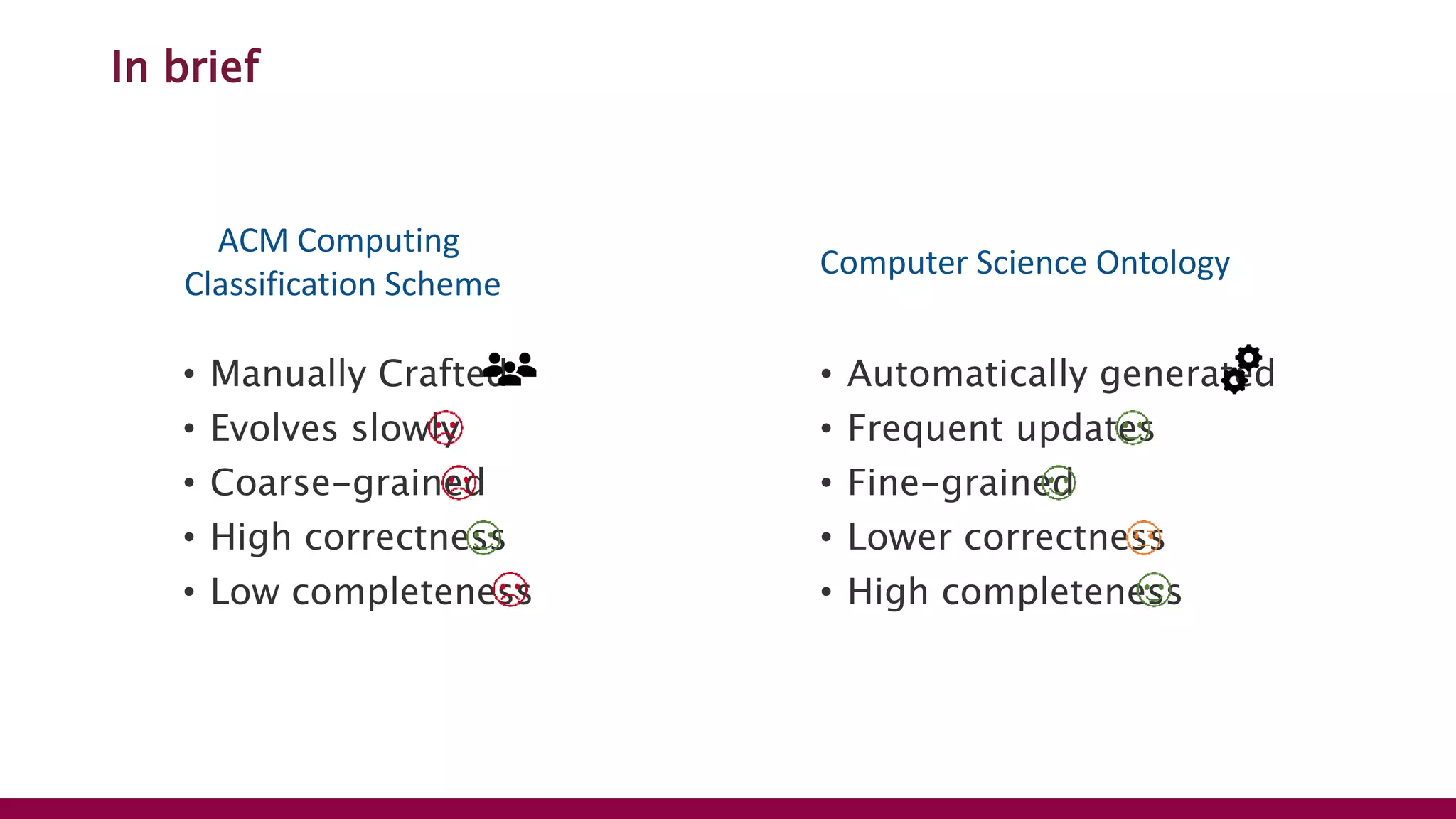
• Manually Crafted
• Evolves slowly
• Coarse-grained
• High correctness
• Low completeness
• Automatically generated
• Frequent updates
• Fine-grained
• Lower correctness
• High completeness
ACM Computing
Classification Scheme
Computer Science Ontology
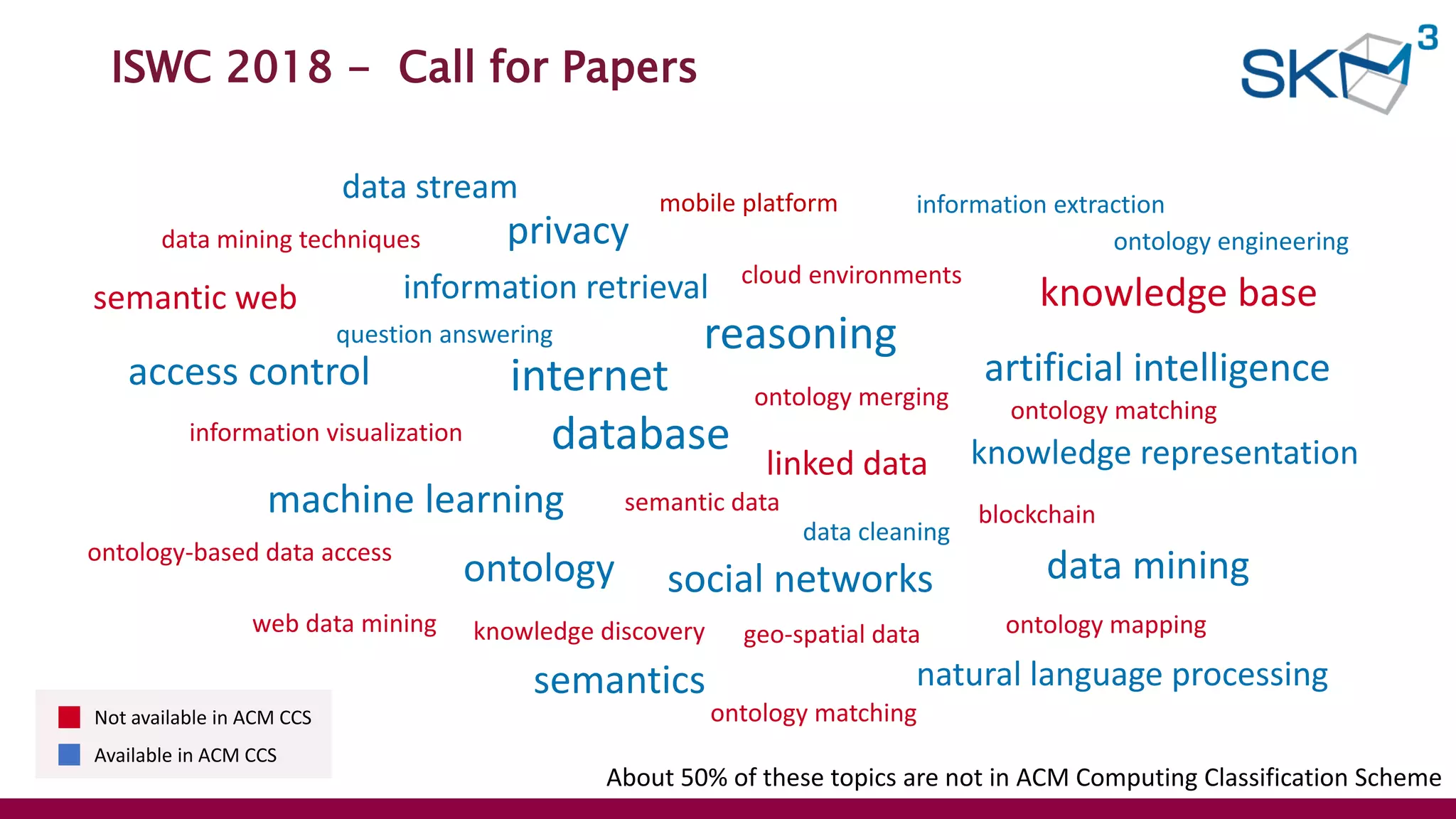
ISWC 2018 - Call for Papers
database
internet
reasoning
knowledge base
artificial intelligenceaccess control
social networks data miningontology
machine learning
semantics
privacy
knowledge representation
natural language processing
semantic web
data stream
information retrieval
ontology-based data access
web data mining
cloud environments
information visualization
mobile platform
ontology merging
ontology matching
geo-spatial data
data cleaning
semantic data blockchain
ontology mapping
ontology engineering
question answering
linked data
data mining techniques
knowledge discovery
information extraction
About 50% of these topics are not in ACM Computing Classification Scheme
ontology matching
Not available in ACM CCS
Available in ACM CCS
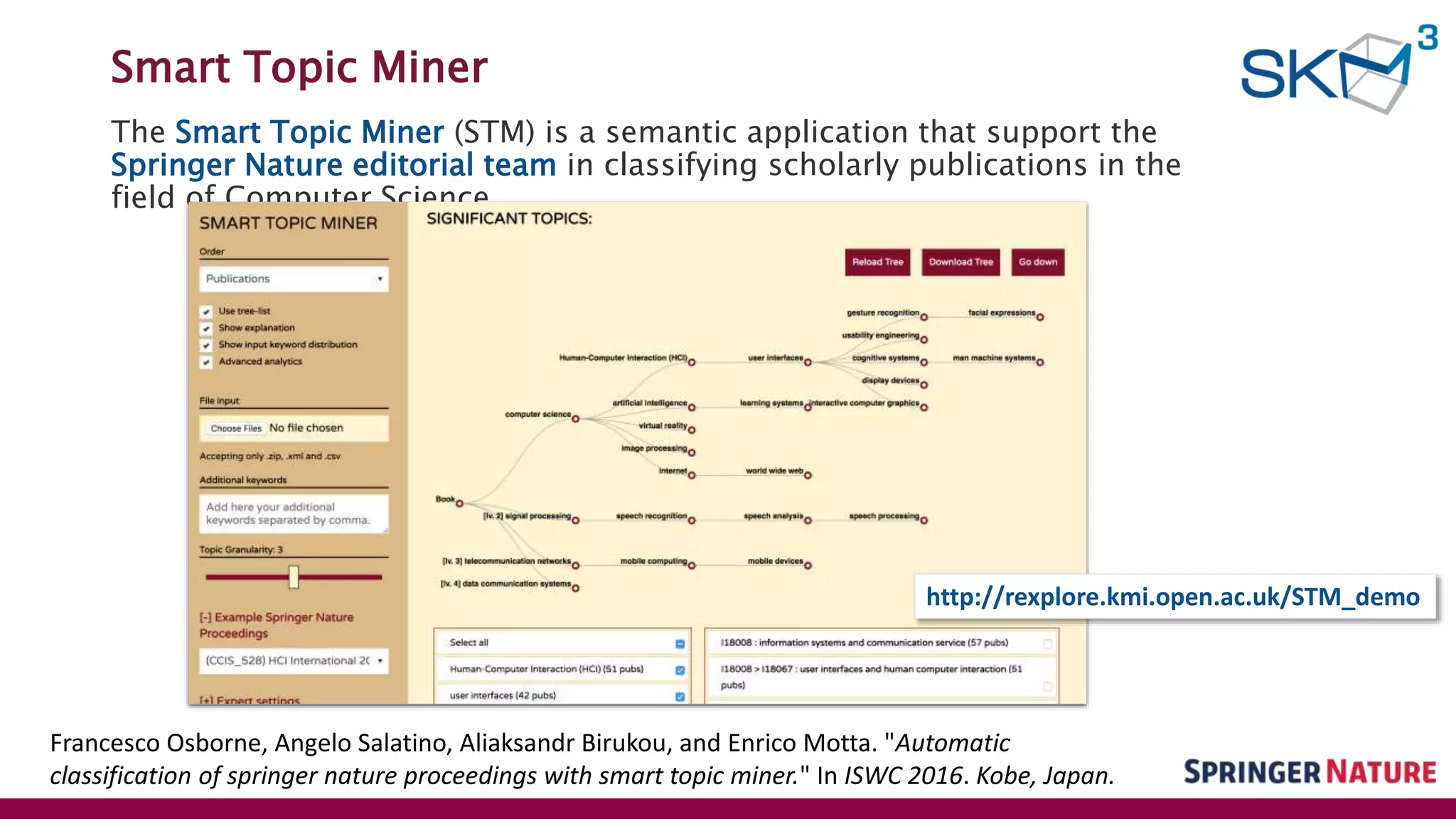
Smart Topic Miner
The Smart Topic Miner (STM) is a semantic application that support the
Springer Nature editorial team in classifying scholarly publications in the
field of Computer Science.
Francesco Osborne, Angelo Salatino, Aliaksandr Birukou, and Enrico Motta. "Automatic
classification of springer nature proceedings with smart topic miner." In ISWC 2016. Kobe, Japan.
http://rexplore.kmi.open.ac.uk/STM_demo
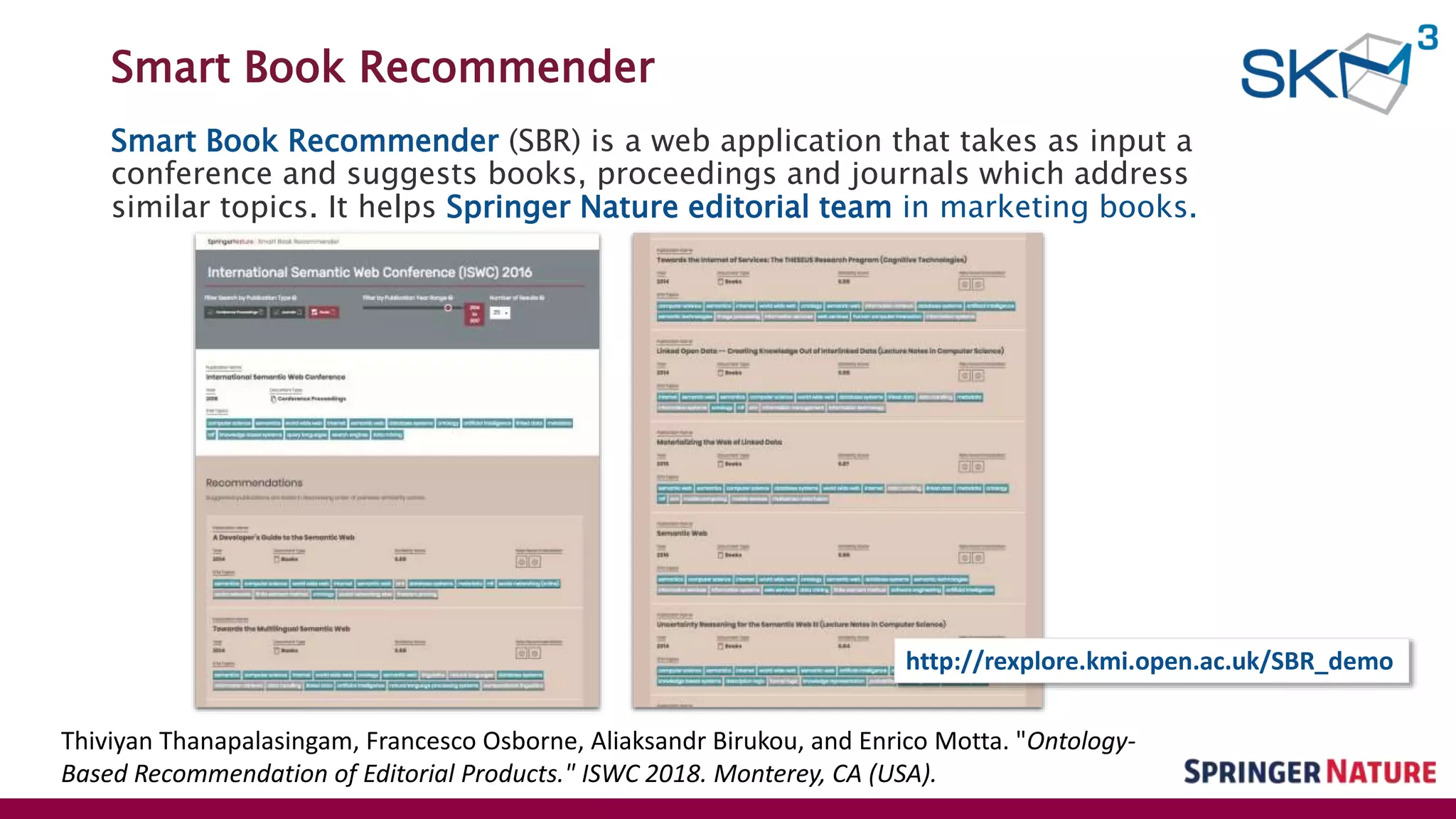
Smart Book Recommender
Smart Book Recommender (SBR) is a web application that takes as input a
conference and suggests books, proceedings and journals which address
similar topics. It helps Springer Nature editorial team in marketing books.
Thiviyan Thanapalasingam, Francesco Osborne, Aliaksandr Birukou, and Enrico Motta. "Ontology-
Based Recommendation of Editorial Products." ISWC 2018. Monterey, CA (USA).
http://rexplore.kmi.open.ac.uk/SBR_demo
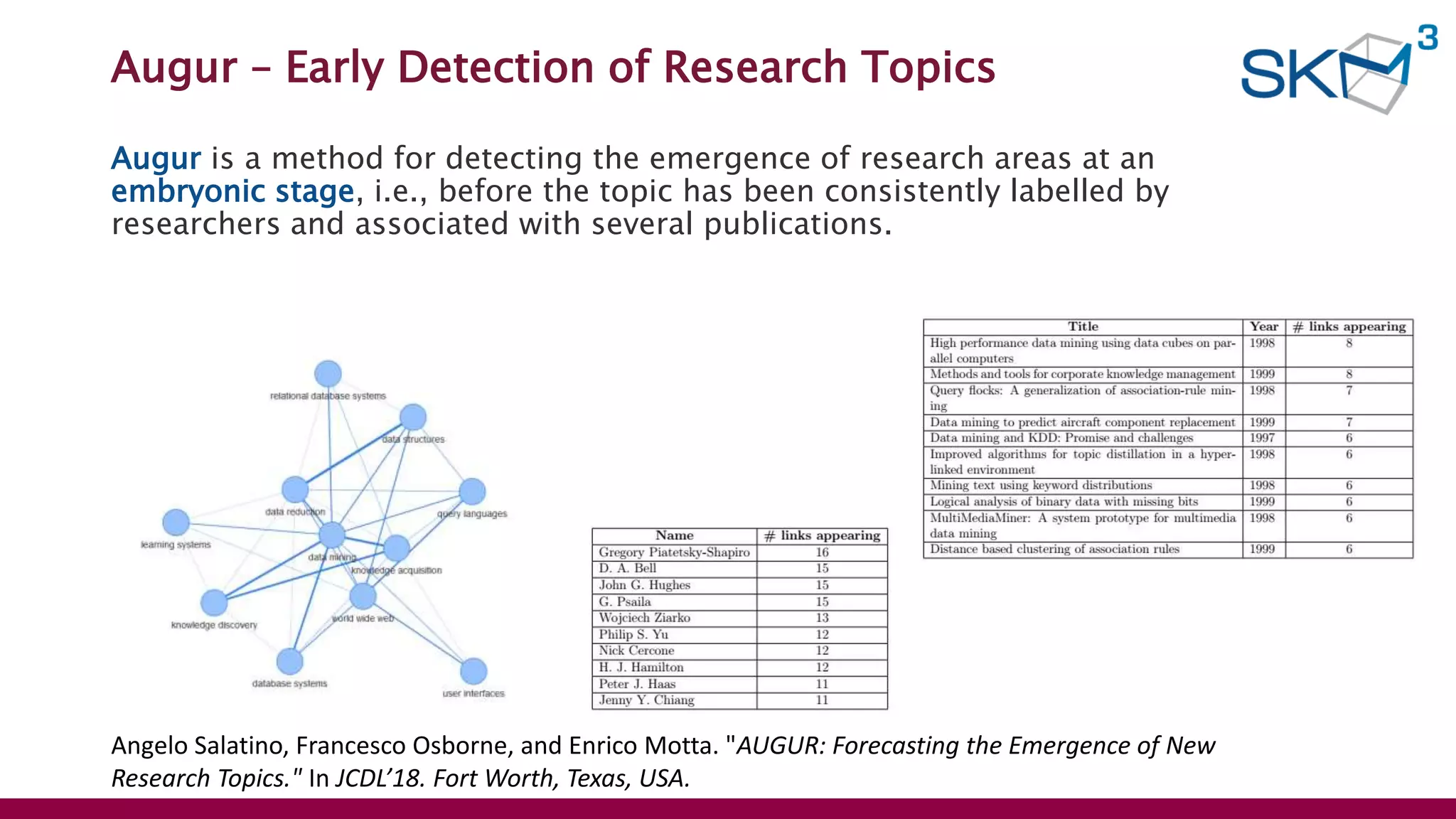
Augur – Early Detection of Research Topics
Augur is a method for detecting the emergence of research areas at an
embryonic stage, i.e., before the topic has been consistently labelled by
researchers and associated with several publications.
Angelo Salatino, Francesco Osborne, and Enrico Motta. "AUGUR: Forecasting the Emergence of New
Research Topics." In JCDL’18. Fort Worth, Texas, USA.
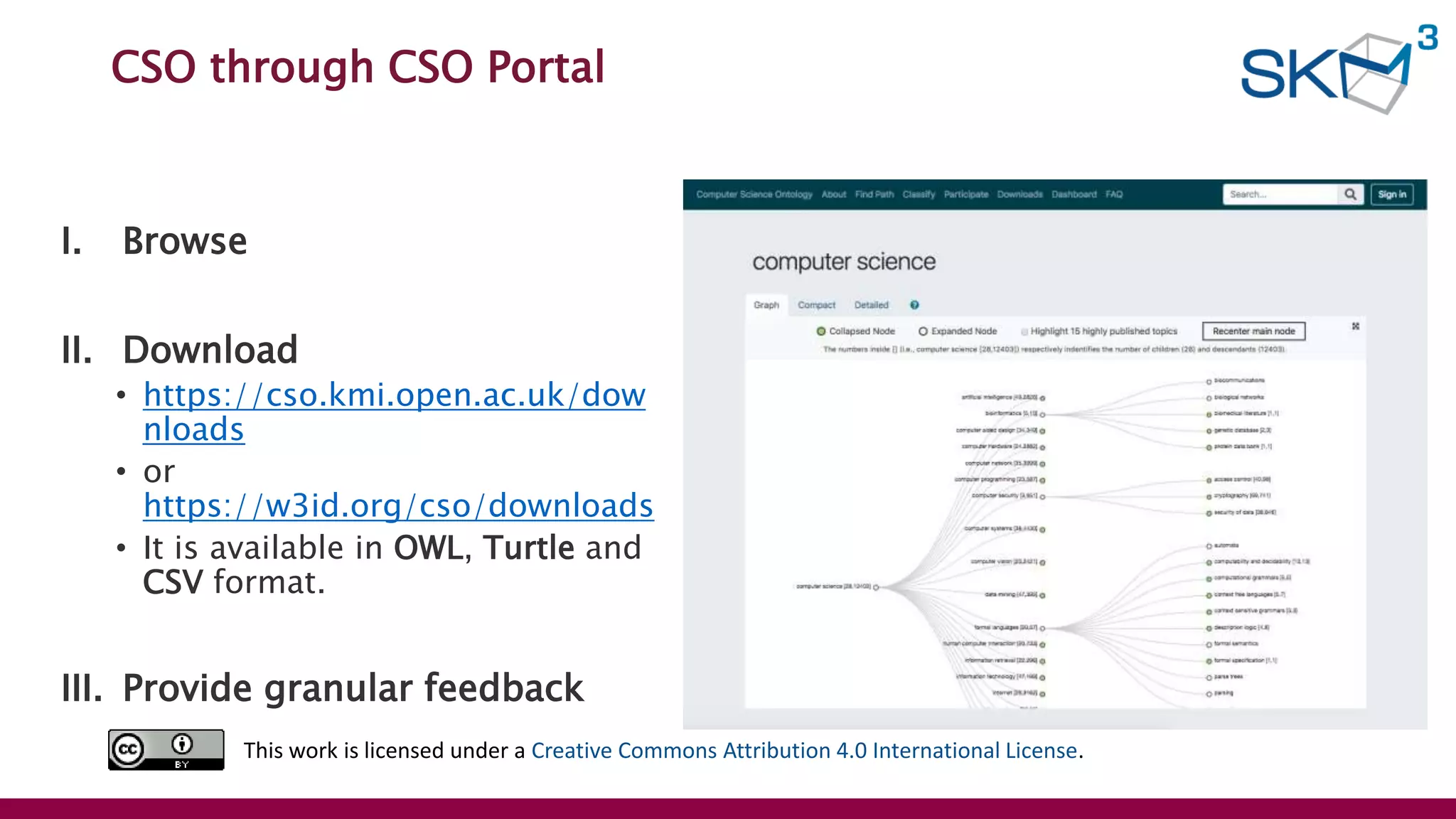
CSO through CSO Portal
I. Browse
II. Download
• https://cso.kmi.open.ac.uk/dow
nloads
• or
https://w3id.org/cso/downloads
• It is available in OWL, Turtle and
CSV format.
III. Provide granular feedback
This work is licensed under a Creative Commons Attribution 4.0 International License.
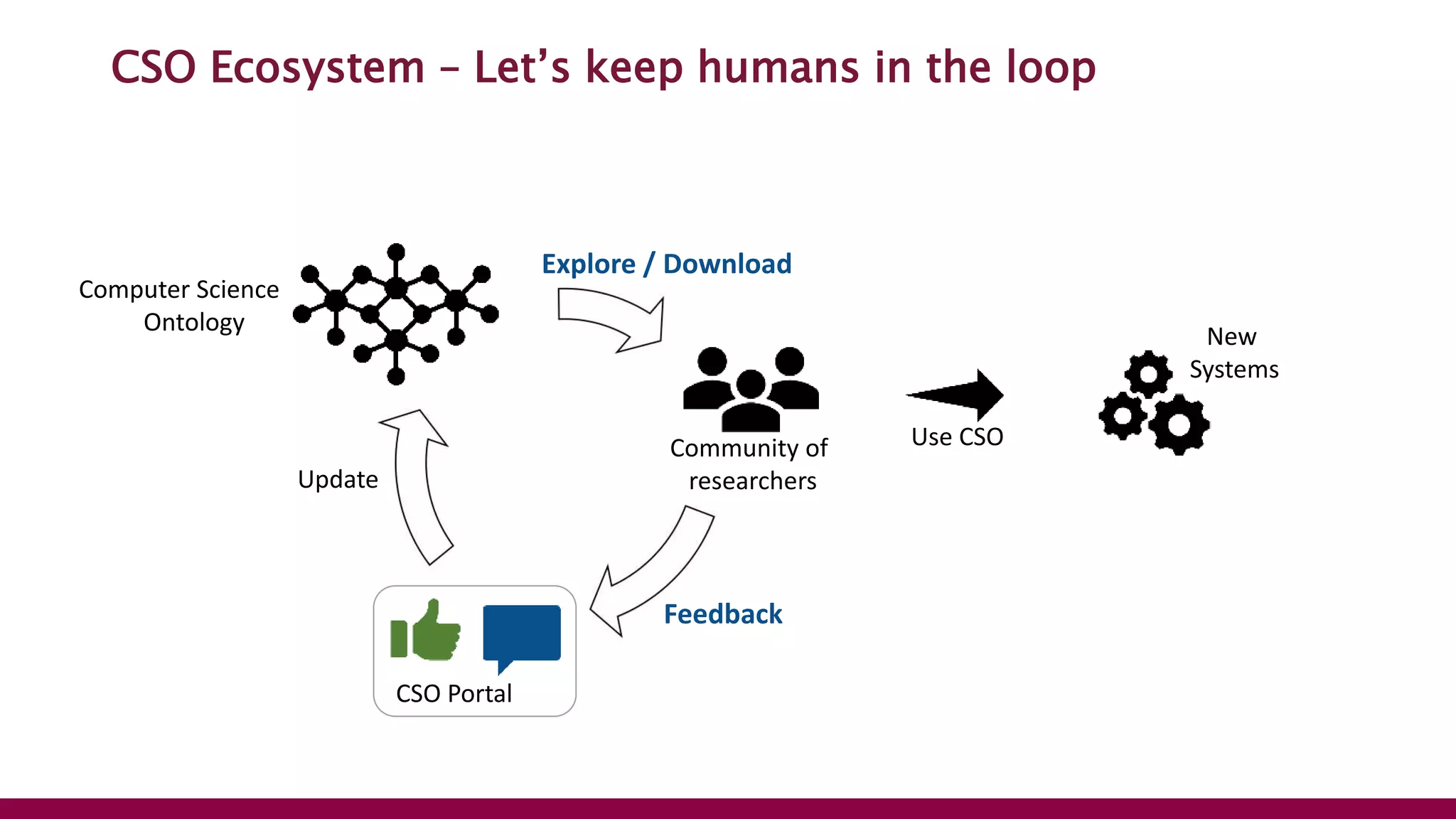
CSO Ecosystem – Let’s keep humans in the loop
New
Systems
Use CSO
Feedback
Explore / Download
Computer Science
Ontology
Update
CSO Portal
Community of
researchers
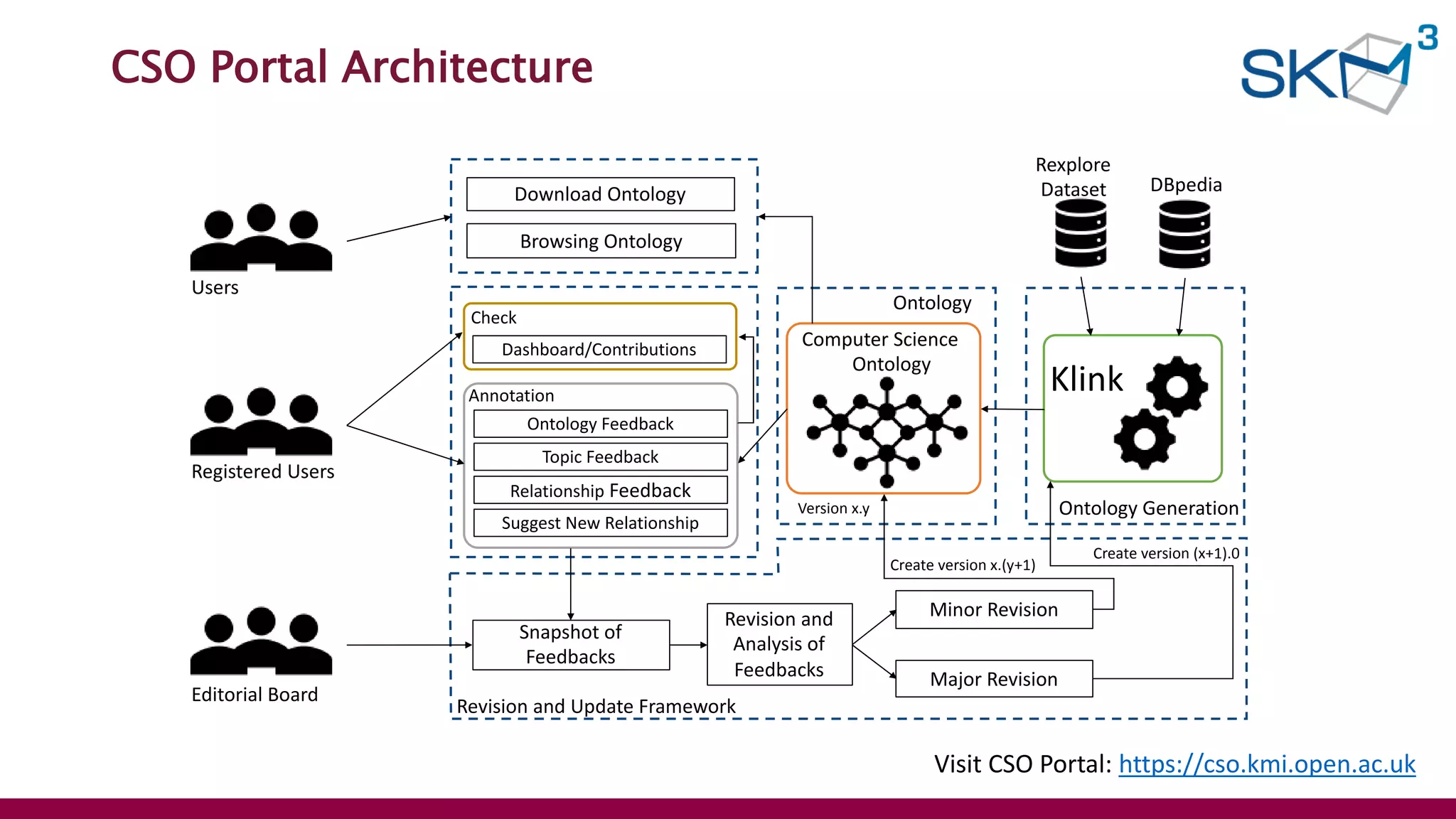
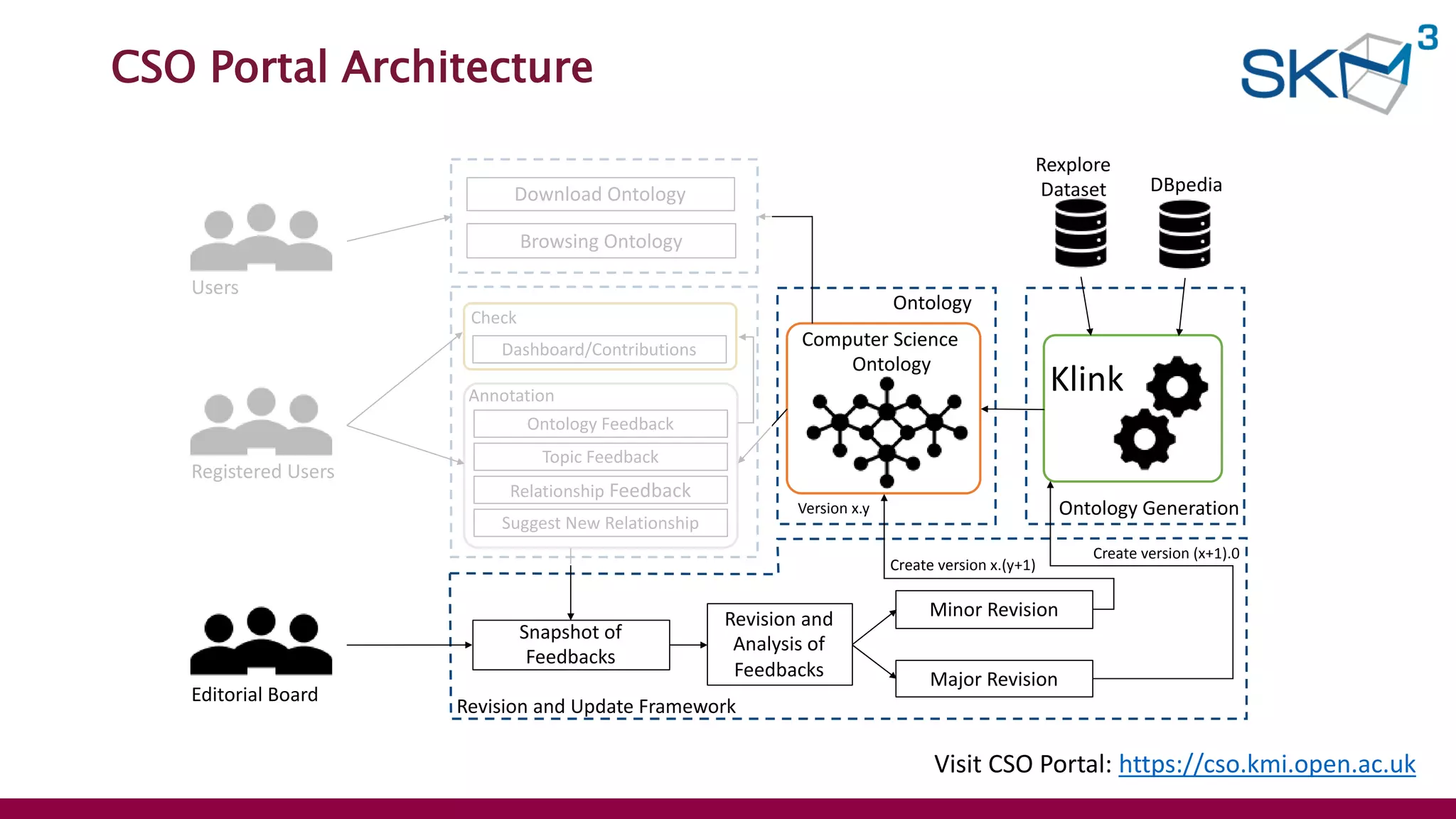
CSO Portal Architecture
Visit CSO Portal: https://cso.kmi.open.ac.uk
Registered Users
Editorial Board
Rexplore
Dataset DBpedia
Klink
Computer Science
Ontology
Ontology Feedback
Topic Feedback
Relationship Feedback
Suggest New Relationship
Version x.y
Snapshot of
Feedbacks
Revision and
Analysis of
Feedbacks
Minor Revision
Major Revision
Create version x.(y+1)
Create version (x+1).0
Revision and Update Framework
Annotation
Ontology
Browsing Ontology
Users
Ontology Generation
Download Ontology
Check
Dashboard/Contributions
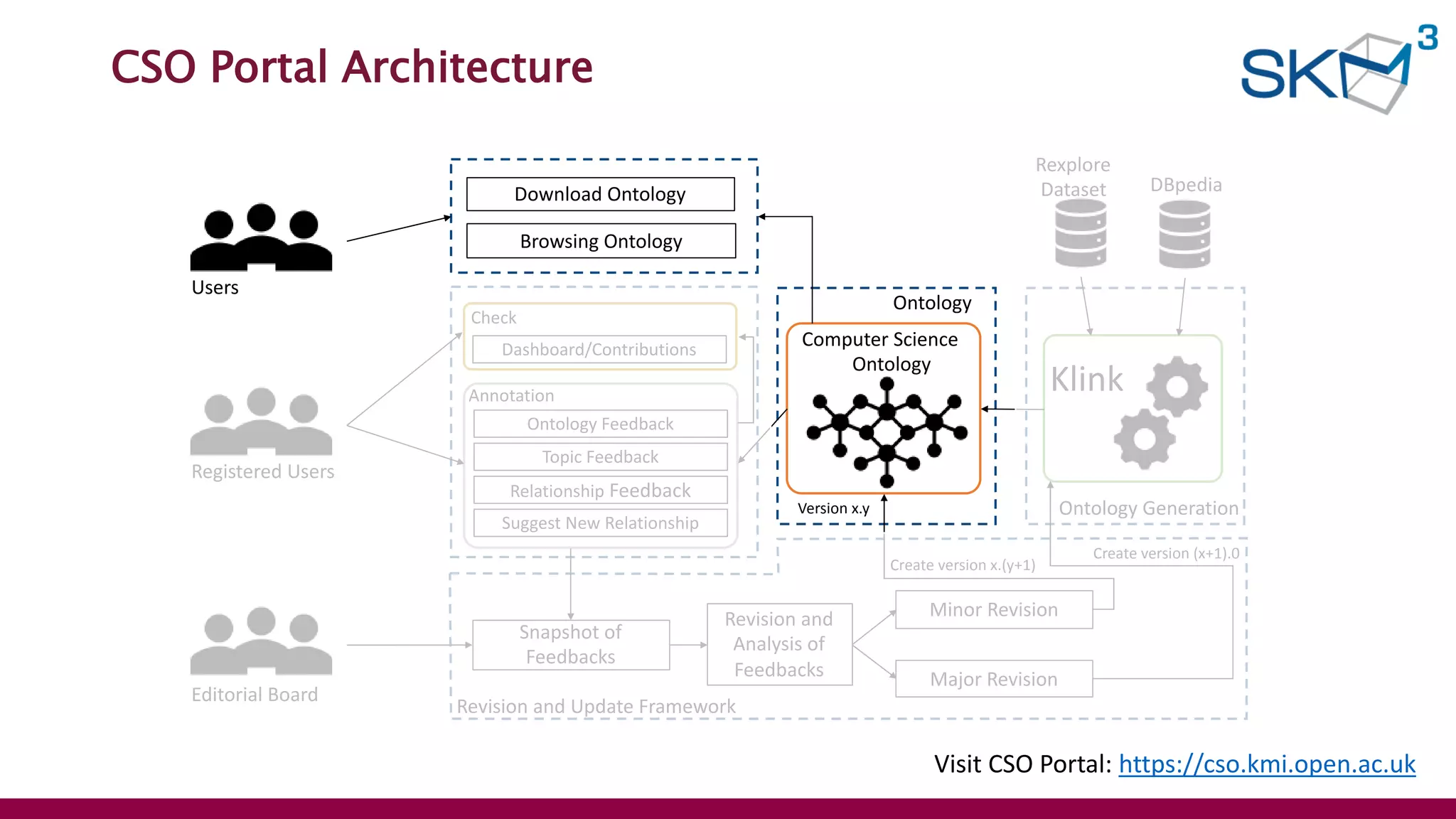
CSO Portal Architecture
Visit CSO Portal: https://cso.kmi.open.ac.uk
Registered Users
Editorial Board
Rexplore
Dataset DBpedia
Klink
Computer Science
Ontology
Ontology Feedback
Topic Feedback
Relationship Feedback
Suggest New Relationship
Version x.y
Snapshot of
Feedbacks
Revision and
Analysis of
Feedbacks
Minor Revision
Major Revision
Create version x.(y+1)
Create version (x+1).0
Revision and Update Framework
Annotation
Ontology
Browsing Ontology
Users
Ontology Generation
Download Ontology
Check
Dashboard/Contributions
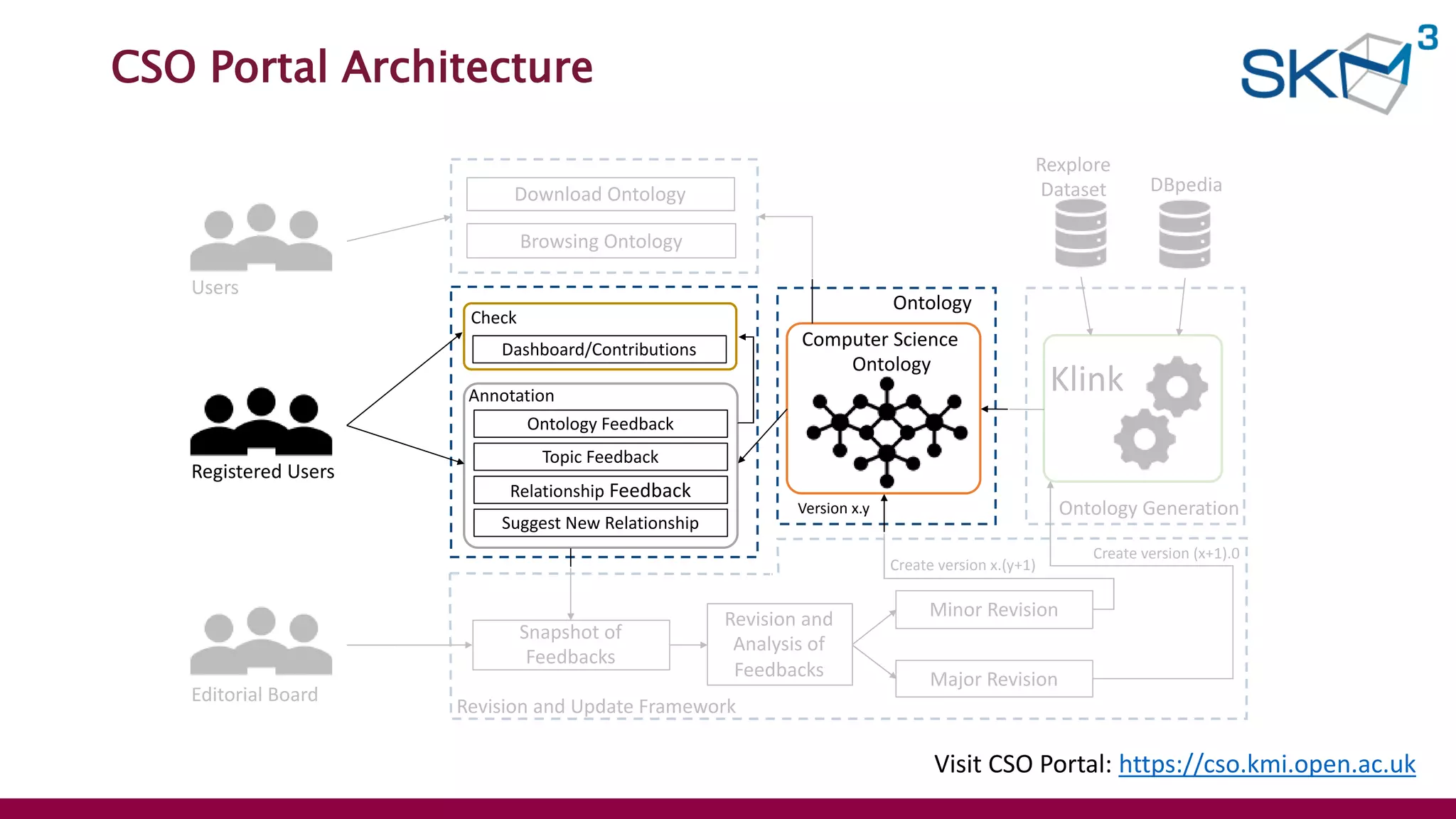
CSO Portal Architecture
Visit CSO Portal: https://cso.kmi.open.ac.uk
Registered Users
Editorial Board
Rexplore
Dataset DBpedia
Klink
Computer Science
Ontology
Ontology Feedback
Topic Feedback
Relationship Feedback
Suggest New Relationship
Version x.y
Snapshot of
Feedbacks
Revision and
Analysis of
Feedbacks
Minor Revision
Major Revision
Create version x.(y+1)
Create version (x+1).0
Revision and Update Framework
Annotation
Ontology
Browsing Ontology
Users
Ontology Generation
Download Ontology
Check
Dashboard/Contributions
CSO Portal Architecture
Visit CSO Portal: https://cso.kmi.open.ac.uk
Registered Users
Editorial Board
Rexplore
Dataset DBpedia
Klink
Computer Science
Ontology
Ontology Feedback
Topic Feedback
Relationship Feedback
Suggest New Relationship
Version x.y
Snapshot of
Feedbacks
Revision and
Analysis of
Feedbacks
Minor Revision
Major Revision
Create version x.(y+1)
Create version (x+1).0
Revision and Update Framework
Annotation
Ontology
Browsing Ontology
Users
Ontology Generation
Download Ontology
Check
Dashboard/Contributions
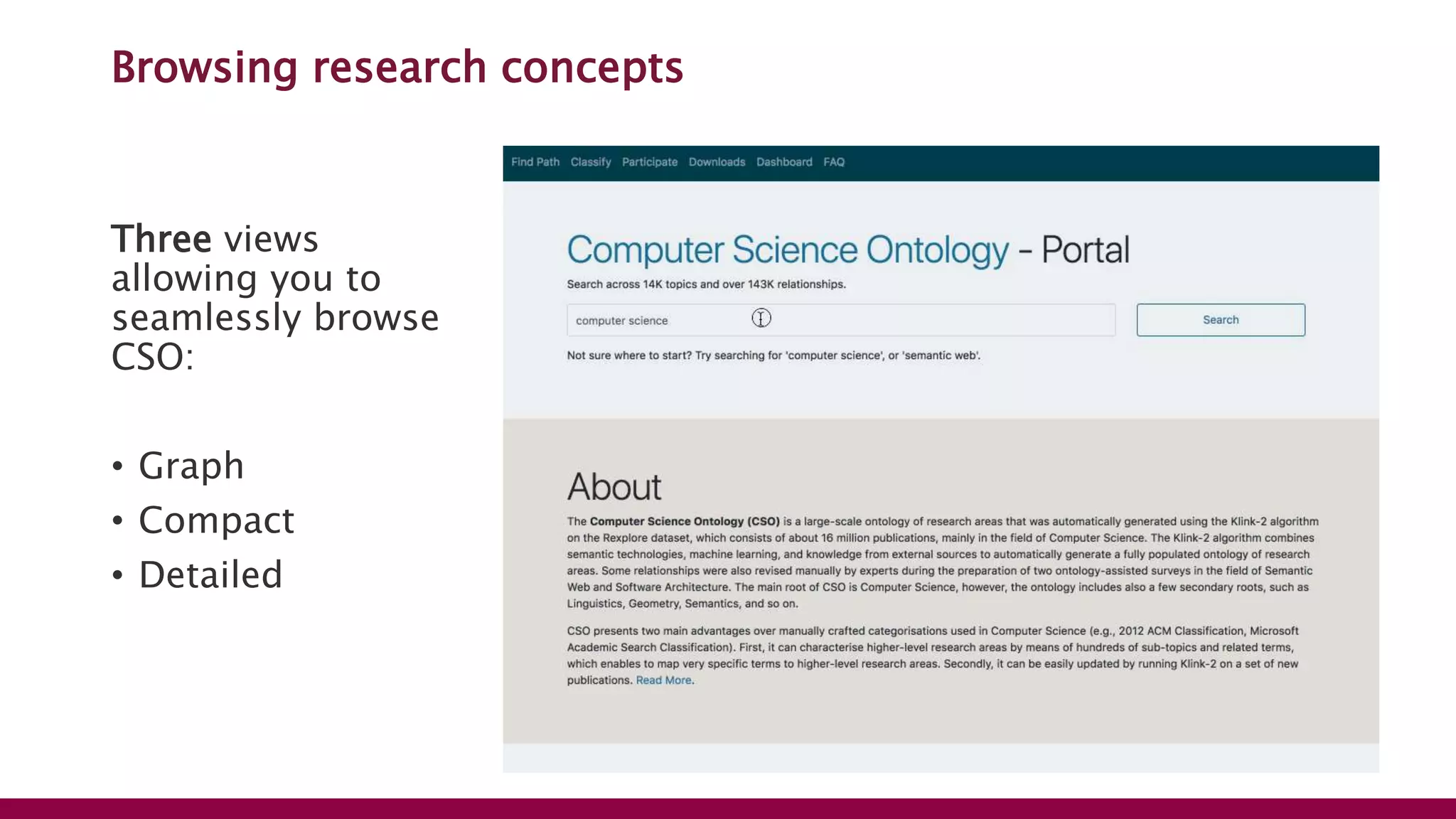
Browsing research concepts
Three views
allowing you to
seamlessly browse
CSO:
• Graph
• Compact
• Detailed
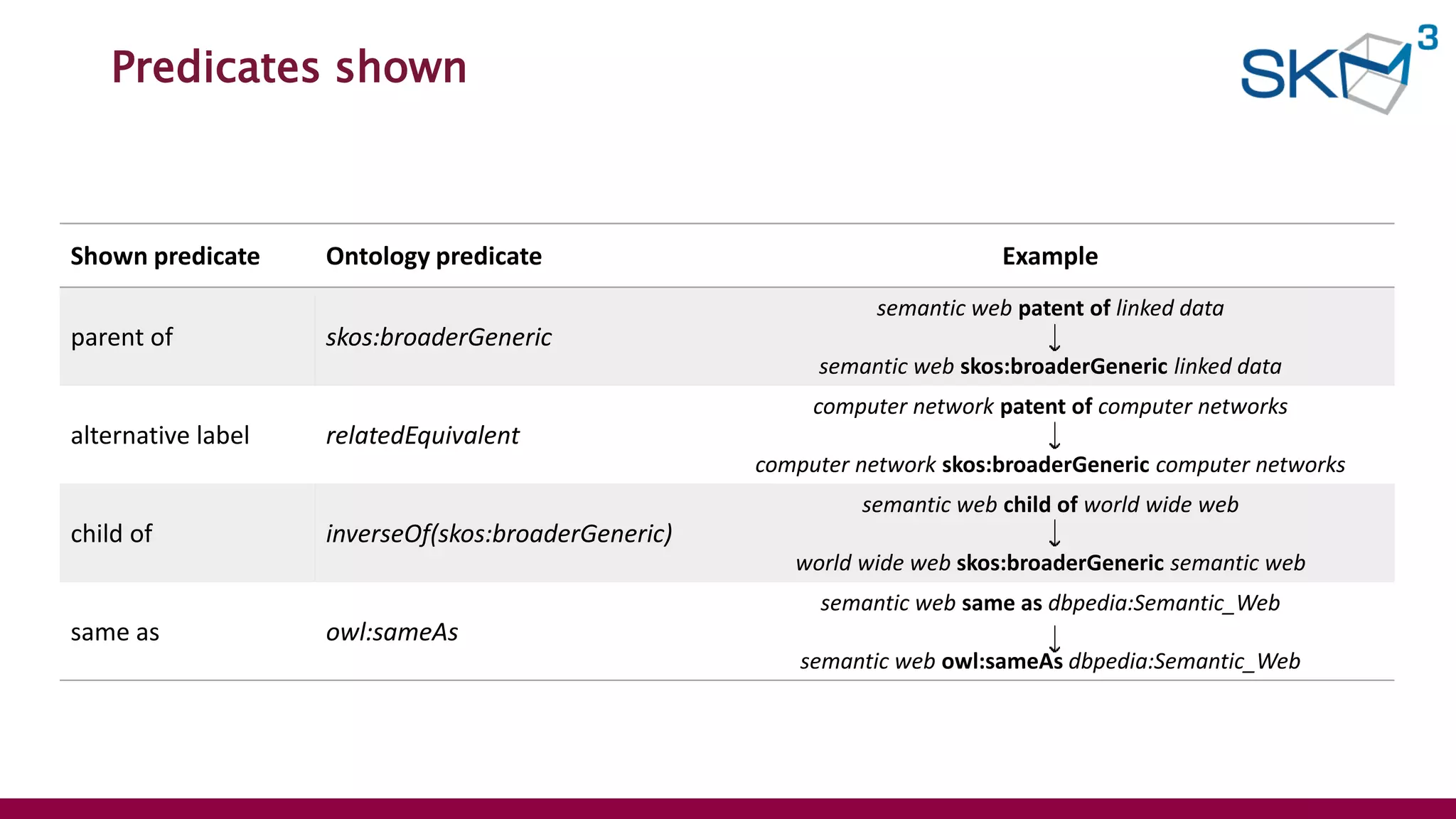
Predicates shown
Shown predicate Ontology predicate Example
parent of skos:broaderGeneric
semantic web patent of linked data
semantic web skos:broaderGeneric linked data
alternative label relatedEquivalent
computer network patent of computer networks
computer network skos:broaderGeneric computer networks
child of inverseOf(skos:broaderGeneric)
semantic web child of world wide web
world wide web skos:broaderGeneric semantic web
same as owl:sameAs
semantic web same as dbpedia:Semantic_Web
semantic web owl:sameAs dbpedia:Semantic_Web
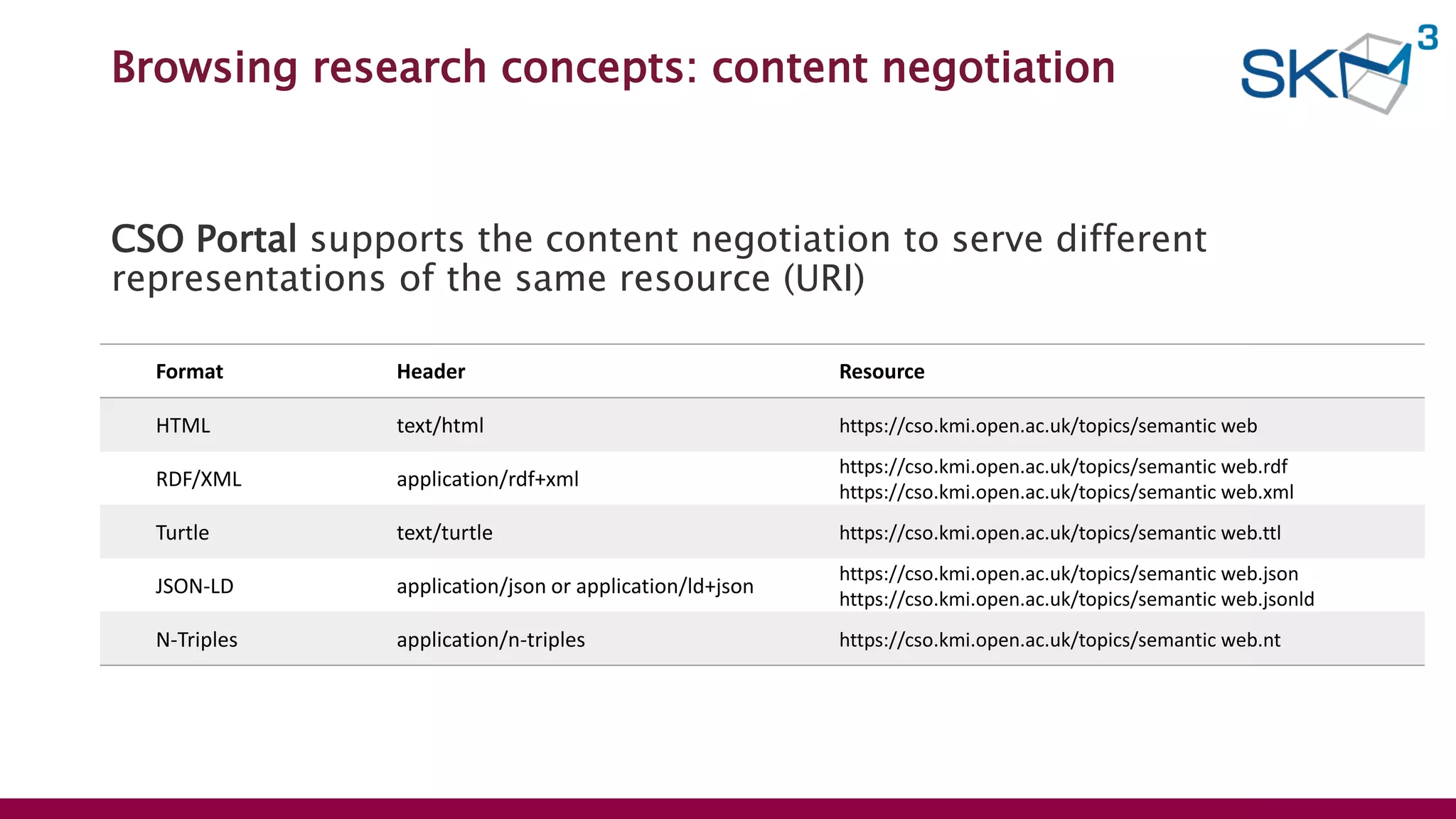
Browsing research concepts: content negotiation
Format Header Resource
HTML text/html https://cso.kmi.open.ac.uk/topics/semantic web
RDF/XML application/rdf+xml
https://cso.kmi.open.ac.uk/topics/semantic web.rdf
https://cso.kmi.open.ac.uk/topics/semantic web.xml
Turtle text/turtle https://cso.kmi.open.ac.uk/topics/semantic web.ttl
JSON-LD application/json or application/ld+json
https://cso.kmi.open.ac.uk/topics/semantic web.json
https://cso.kmi.open.ac.uk/topics/semantic web.jsonld
N-Triples application/n-triples https://cso.kmi.open.ac.uk/topics/semantic web.nt
CSO Portal supports the content negotiation to serve different
representations of the same resource (URI)
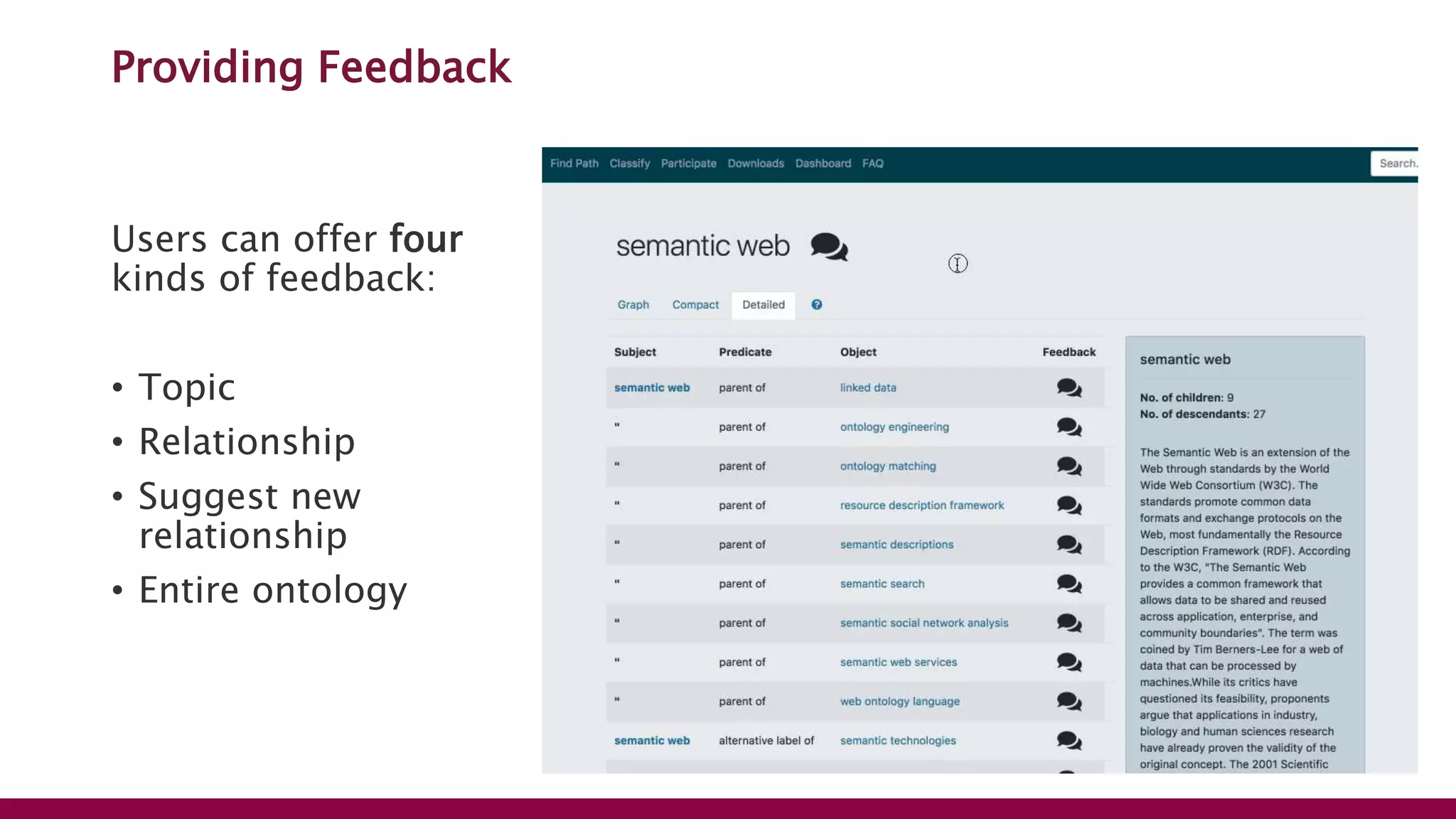
Providing Feedback
Users can offer four
kinds of feedback:
• Topic
• Relationship
• Suggest new
relationship
• Entire ontology
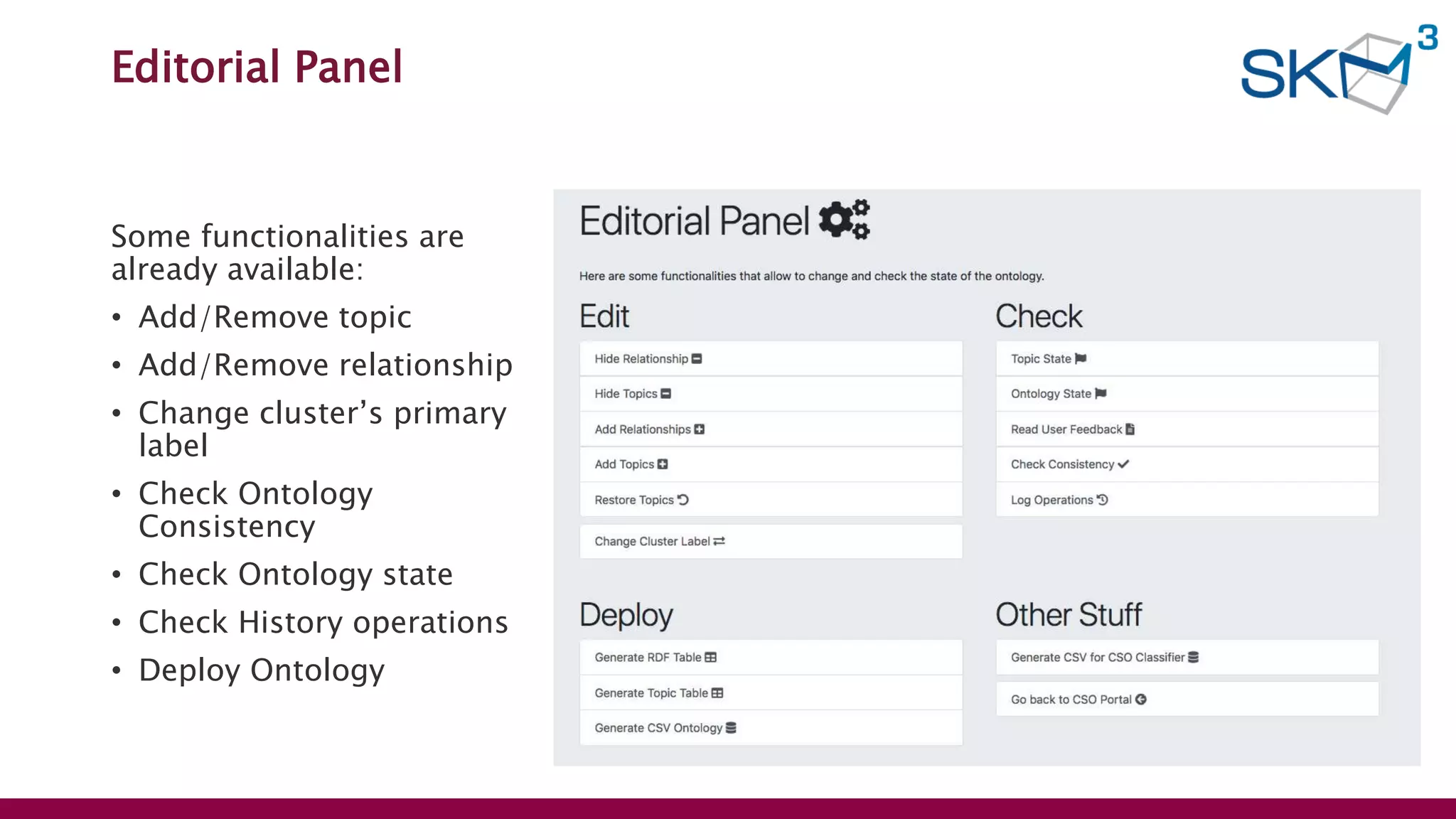
Editorial Panel
Some functionalities are
already available:
• Add/Remove topic
• Add/Remove relationship
• Change cluster’s primary
label
• Check Ontology
Consistency
• Check Ontology state
• Check History operations
• Deploy Ontology
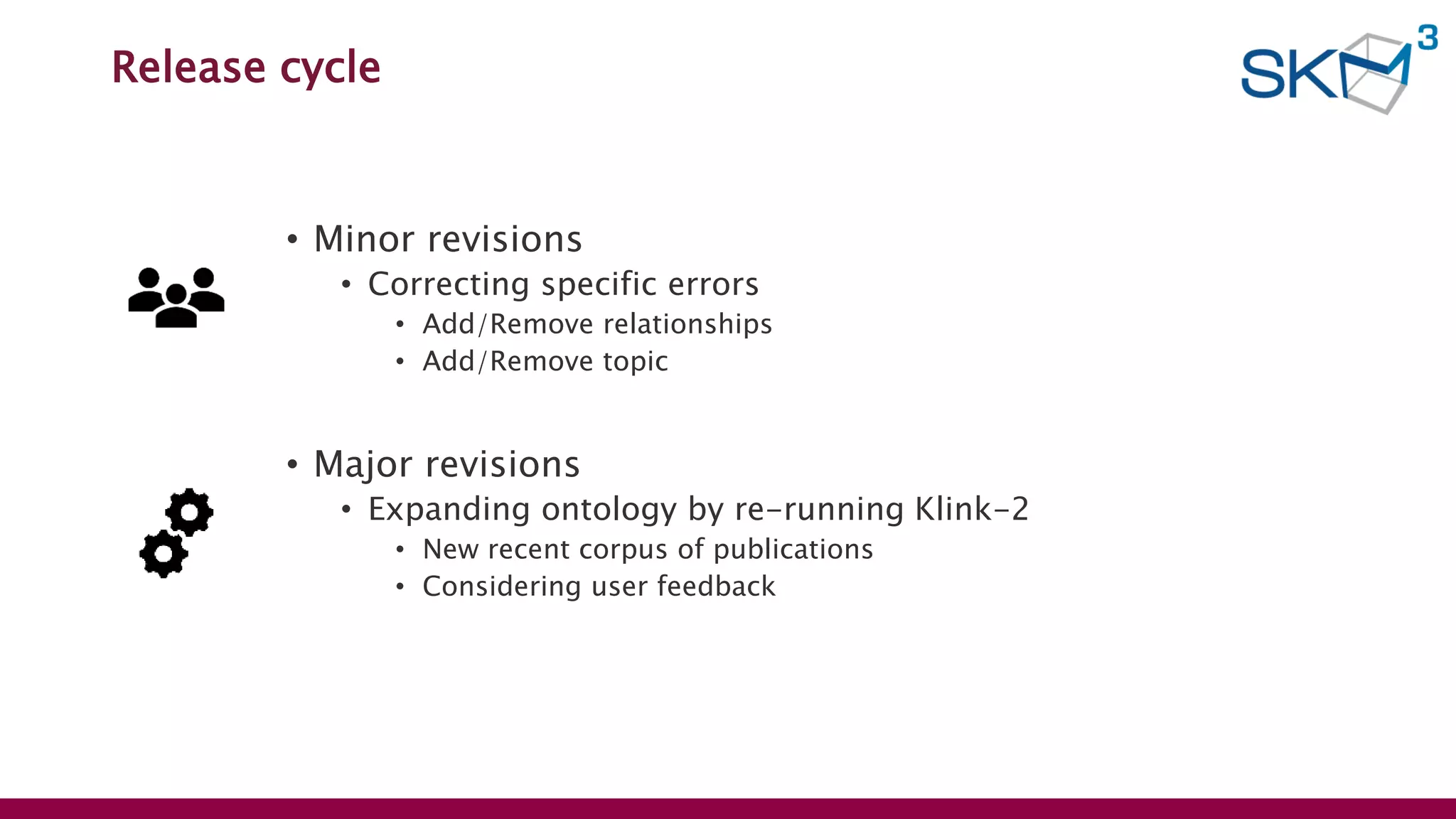
Release cycle
• Minor revisions
• Correcting specific errors
• Add/Remove relationships
• Add/Remove topic
• Major revisions
• Expanding ontology by re-running Klink-2
• New recent corpus of publications
• Considering user feedback
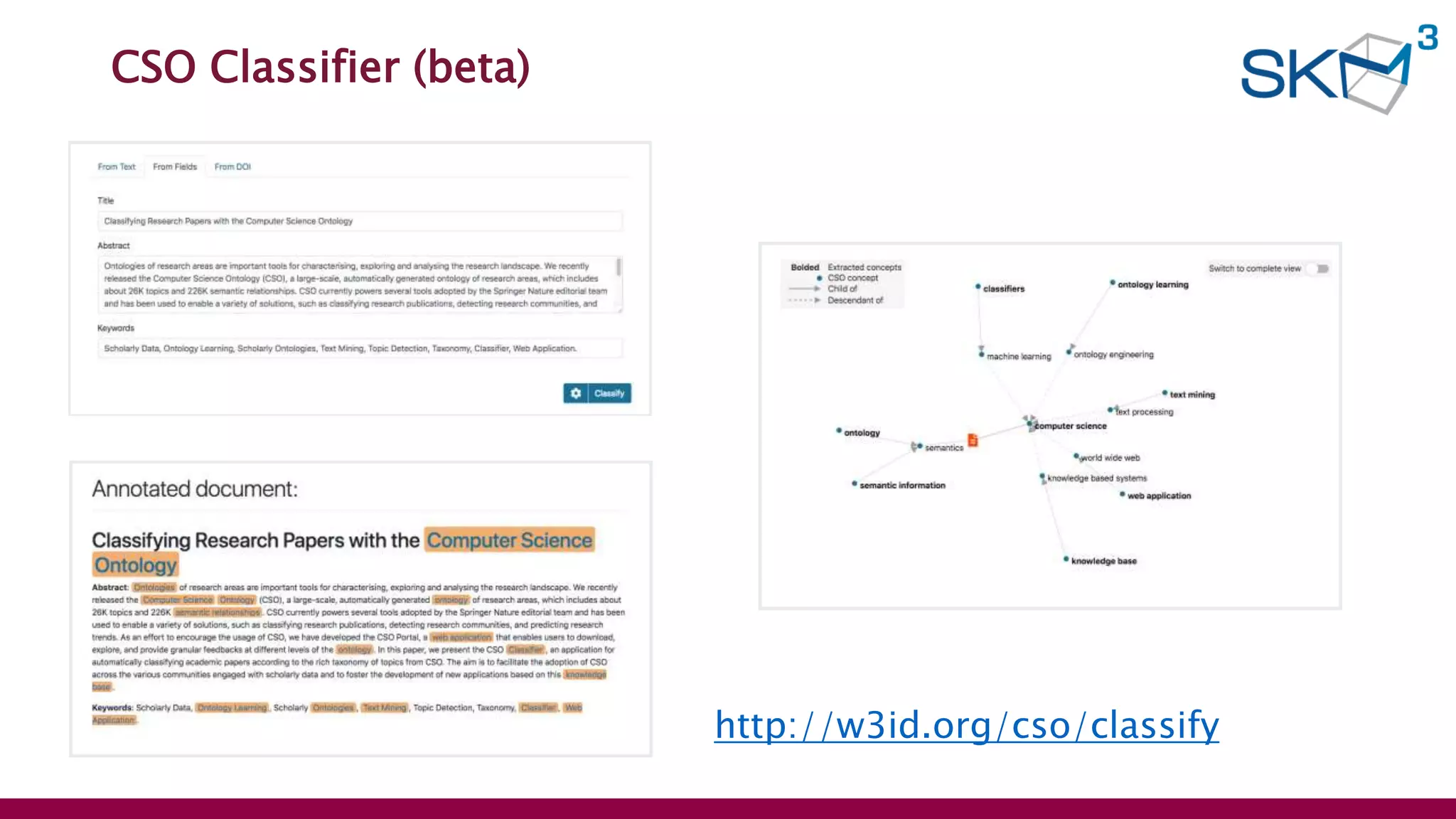
CSO Classifier (beta)
http://w3id.org/cso/classify
Future Work
• Currently we are working on Klink v3.0
• Extract further information from abstracts
• Can take into account the feedback gathered through the portal
• We plan to release ontologies in other fields of Science
• Engineering
• Medicine
• Producing external links to other resources
• E.g., mapping to other available taxonomies
• Developing new features for the CSO Portal
• Relevant papers and authors associated to each research topic
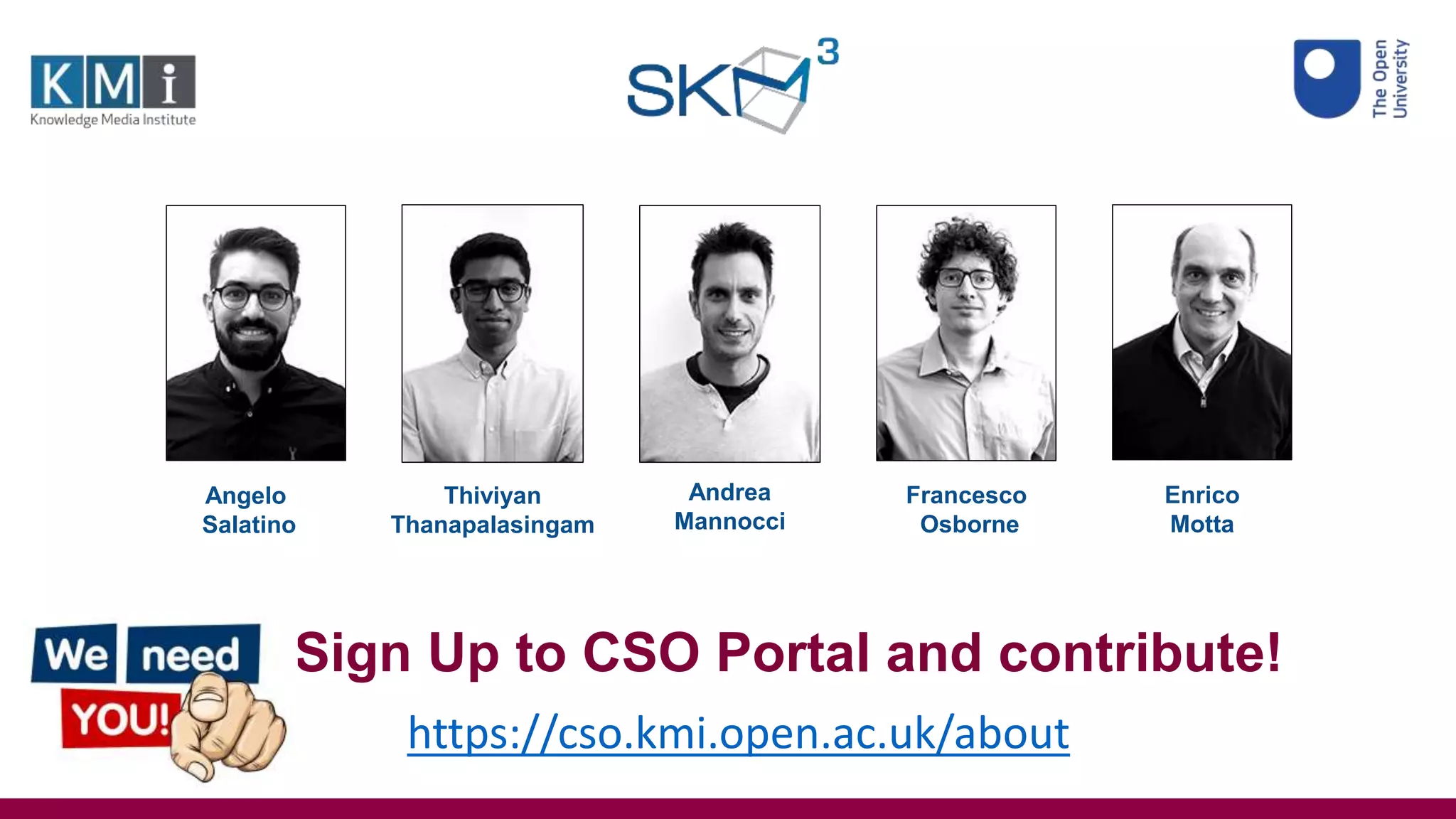
Angelo
Salatino
Thiviyan
Thanapalasingam
Andrea
Mannocci
Francesco
Osborne
Enrico
Motta
https://cso.kmi.open.ac.uk/about
Sign Up to CSO Portal and contribute!

The Computer Science Ontology: A Large-Scale Taxonomy of Research Areas

  • 1.
    The Computer ScienceOntology: A Large-Scale Taxonomy of Research Areas Angelo A. Salatino, Thiviyan Thanapalasingam, Andrea Mannocci, Francesco Osborne, Enrico Motta @angelosalatino Knowledge Media Institute The Open University United Kingdom
  • 2.
    Ontologies of ResearchAreas I. making sense of the research dynamics II. classifying publications III. identifying research communities IV. forecasting research trends
  • 3.
    Ontologies and Taxonomiesof Research Areas Mathematics Subject Classification – MSC2010 Physics and Astronomy Classification Scheme (PACS) JEL Classification System Library of Congress Classification (LCC) Computing Classification System (CCS)
  • 4.
    The Computer ScienceOntology • Ontology of research areas, automatically generated using Klink-2* algorithm, on a dataset of 16 million publications mainly in Computer Science • Current version of CSO includes 14K topics and 143K relationships • Main roots include Computer Science, Linguistic, Mathematics, Geometry, Semantics and so on. *Francesco Osborne, and Enrico Motta. "Klink-2: integrating multiple web sources to generate semantic topic networks." In ISWC 2015, Bethlehem, PA (USA).
  • 5.
    Data Model The CSOdata model includes seven semantic relations: • skos:broaderGeneric, which indicates that a topic is a sub-area of another one (e.g., Linked Data, Semantic Web). • relatedEquivalent, which indicates that two topics can be treated as equivalent for the purpose of exploring research data (e.g., Ontology Matching, Ontology Alignment). • contributesTo, which indicates that the research outputs of one topic contributes to another. For instance, research in Ontology Engineering contributes to the Semantic Web, but arguably Ontology Engineering is not a sub-area of the Semantic Web – but arguably Ontology Engineering is not a sub-area of Semantic Web – that is, there is plenty of research in Ontology Engineering outside the Semantic Web area. • owl:sameAs, this relation indicates that a research concepts is identical to an external resource. We used DBpedia Spotlight to connect research concepts to Dbpedia. • primaryLabel, this relation is used to state the main label for topics belonging to a cluster of relatedEquivalent. For instance, the topics Ontology Matching and Ontology Alignment will both have their primaryLabel set to Ontology Matching. • rdf:type, this relation is used to state that a resource is an instance of a class. For example, a resource in our ontology is an instance of topic. • rdfs:label, this relation is used to provide a human-readable version of a resource’s name.
  • 6.
    CSO Generation Klink-2 isan approach for learning large-scale ontologies of research topics from corpora of scientific articles and knowledge sources on the web. Given a pair of keywords it infers their semantic relationship: • skos:broaderGeneric • contributesTo • relatedEquivalent Francesco Osborne, and Enrico Motta. "Klink-2: integrating multiple web sources to generate semantic topic networks." In ISWC 2015, Bethlehem, PA (USA). relatedEquivalent skos:broaderGeneric contributesTo
  • 7.
    In brief • ManuallyCrafted • Evolves slowly • Coarse-grained • High correctness • Low completeness • Automatically generated • Frequent updates • Fine-grained • Lower correctness • High completeness ACM Computing Classification Scheme Computer Science Ontology
  • 8.
    ISWC 2018 -Call for Papers database internet reasoning knowledge base artificial intelligenceaccess control social networks data miningontology machine learning semantics privacy knowledge representation natural language processing semantic web data stream information retrieval ontology-based data access web data mining cloud environments information visualization mobile platform ontology merging ontology matching geo-spatial data data cleaning semantic data blockchain ontology mapping ontology engineering question answering linked data data mining techniques knowledge discovery information extraction About 50% of these topics are not in ACM Computing Classification Scheme ontology matching Not available in ACM CCS Available in ACM CCS
  • 9.
    Smart Topic Miner TheSmart Topic Miner (STM) is a semantic application that support the Springer Nature editorial team in classifying scholarly publications in the field of Computer Science. Francesco Osborne, Angelo Salatino, Aliaksandr Birukou, and Enrico Motta. "Automatic classification of springer nature proceedings with smart topic miner." In ISWC 2016. Kobe, Japan. http://rexplore.kmi.open.ac.uk/STM_demo
  • 10.
    Smart Book Recommender SmartBook Recommender (SBR) is a web application that takes as input a conference and suggests books, proceedings and journals which address similar topics. It helps Springer Nature editorial team in marketing books. Thiviyan Thanapalasingam, Francesco Osborne, Aliaksandr Birukou, and Enrico Motta. "Ontology- Based Recommendation of Editorial Products." ISWC 2018. Monterey, CA (USA). http://rexplore.kmi.open.ac.uk/SBR_demo
  • 11.
    Augur – EarlyDetection of Research Topics Augur is a method for detecting the emergence of research areas at an embryonic stage, i.e., before the topic has been consistently labelled by researchers and associated with several publications. Angelo Salatino, Francesco Osborne, and Enrico Motta. "AUGUR: Forecasting the Emergence of New Research Topics." In JCDL’18. Fort Worth, Texas, USA.
  • 12.
    CSO through CSOPortal I. Browse II. Download • https://cso.kmi.open.ac.uk/dow nloads • or https://w3id.org/cso/downloads • It is available in OWL, Turtle and CSV format. III. Provide granular feedback This work is licensed under a Creative Commons Attribution 4.0 International License.
  • 13.
    CSO Ecosystem –Let’s keep humans in the loop New Systems Use CSO Feedback Explore / Download Computer Science Ontology Update CSO Portal Community of researchers
  • 14.
    CSO Portal Architecture VisitCSO Portal: https://cso.kmi.open.ac.uk Registered Users Editorial Board Rexplore Dataset DBpedia Klink Computer Science Ontology Ontology Feedback Topic Feedback Relationship Feedback Suggest New Relationship Version x.y Snapshot of Feedbacks Revision and Analysis of Feedbacks Minor Revision Major Revision Create version x.(y+1) Create version (x+1).0 Revision and Update Framework Annotation Ontology Browsing Ontology Users Ontology Generation Download Ontology Check Dashboard/Contributions
  • 15.
    CSO Portal Architecture VisitCSO Portal: https://cso.kmi.open.ac.uk Registered Users Editorial Board Rexplore Dataset DBpedia Klink Computer Science Ontology Ontology Feedback Topic Feedback Relationship Feedback Suggest New Relationship Version x.y Snapshot of Feedbacks Revision and Analysis of Feedbacks Minor Revision Major Revision Create version x.(y+1) Create version (x+1).0 Revision and Update Framework Annotation Ontology Browsing Ontology Users Ontology Generation Download Ontology Check Dashboard/Contributions
  • 16.
    CSO Portal Architecture VisitCSO Portal: https://cso.kmi.open.ac.uk Registered Users Editorial Board Rexplore Dataset DBpedia Klink Computer Science Ontology Ontology Feedback Topic Feedback Relationship Feedback Suggest New Relationship Version x.y Snapshot of Feedbacks Revision and Analysis of Feedbacks Minor Revision Major Revision Create version x.(y+1) Create version (x+1).0 Revision and Update Framework Annotation Ontology Browsing Ontology Users Ontology Generation Download Ontology Check Dashboard/Contributions
  • 17.
    CSO Portal Architecture VisitCSO Portal: https://cso.kmi.open.ac.uk Registered Users Editorial Board Rexplore Dataset DBpedia Klink Computer Science Ontology Ontology Feedback Topic Feedback Relationship Feedback Suggest New Relationship Version x.y Snapshot of Feedbacks Revision and Analysis of Feedbacks Minor Revision Major Revision Create version x.(y+1) Create version (x+1).0 Revision and Update Framework Annotation Ontology Browsing Ontology Users Ontology Generation Download Ontology Check Dashboard/Contributions
  • 18.
    Browsing research concepts Threeviews allowing you to seamlessly browse CSO: • Graph • Compact • Detailed
  • 19.
    Predicates shown Shown predicateOntology predicate Example parent of skos:broaderGeneric semantic web patent of linked data semantic web skos:broaderGeneric linked data alternative label relatedEquivalent computer network patent of computer networks computer network skos:broaderGeneric computer networks child of inverseOf(skos:broaderGeneric) semantic web child of world wide web world wide web skos:broaderGeneric semantic web same as owl:sameAs semantic web same as dbpedia:Semantic_Web semantic web owl:sameAs dbpedia:Semantic_Web
  • 20.
    Browsing research concepts:content negotiation Format Header Resource HTML text/html https://cso.kmi.open.ac.uk/topics/semantic web RDF/XML application/rdf+xml https://cso.kmi.open.ac.uk/topics/semantic web.rdf https://cso.kmi.open.ac.uk/topics/semantic web.xml Turtle text/turtle https://cso.kmi.open.ac.uk/topics/semantic web.ttl JSON-LD application/json or application/ld+json https://cso.kmi.open.ac.uk/topics/semantic web.json https://cso.kmi.open.ac.uk/topics/semantic web.jsonld N-Triples application/n-triples https://cso.kmi.open.ac.uk/topics/semantic web.nt CSO Portal supports the content negotiation to serve different representations of the same resource (URI)
  • 21.
    Providing Feedback Users canoffer four kinds of feedback: • Topic • Relationship • Suggest new relationship • Entire ontology
  • 22.
    Editorial Panel Some functionalitiesare already available: • Add/Remove topic • Add/Remove relationship • Change cluster’s primary label • Check Ontology Consistency • Check Ontology state • Check History operations • Deploy Ontology
  • 23.
    Release cycle • Minorrevisions • Correcting specific errors • Add/Remove relationships • Add/Remove topic • Major revisions • Expanding ontology by re-running Klink-2 • New recent corpus of publications • Considering user feedback
  • 24.
  • 25.
    Future Work • Currentlywe are working on Klink v3.0 • Extract further information from abstracts • Can take into account the feedback gathered through the portal • We plan to release ontologies in other fields of Science • Engineering • Medicine • Producing external links to other resources • E.g., mapping to other available taxonomies • Developing new features for the CSO Portal • Relevant papers and authors associated to each research topic
  • 26.

Editor's Notes

  • #20 To enhance the user experience and to make this portal also available of non semantic web savvy, we renamed the main predicated in a more user friendly way.