THE COMPUTER
By:Kristine Mae Sahali
DEFINITION
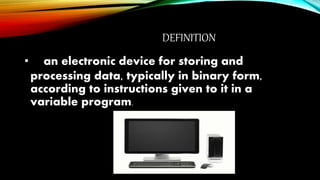
• an electronic device for storing and
processing data, typically in binary form,
according to instructions given to it in a
variable program.
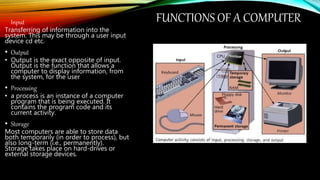
FUNCTIONS OF A COMPUTERInput
Transferring of information into the
system. This may be through a user input
device cd etc.
• Output
• Output is the exact opposite of input.
Output is the function that allows a
computer to display information, from
the system, for the user
• Processing
• a process is an instance of a computer
program that is being executed. It
contains the program code and its
current activity.
• Storage
Most computers are able to store data
both temporarily (in order to process), but
also long-term (i.e., permanently).
Storage takes place on hard-drives or
external storage devices.
INPUT DEVICES
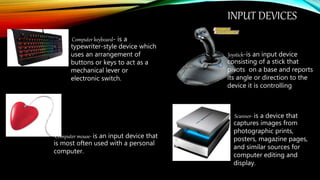
Computer keyboard- is a
typewriter-style device which
uses an arrangement of
buttons or keys to act as a
mechanical lever or
electronic switch.
Computer mouse- is an input device that
is most often used with a personal
computer.
Joystick-is an input device
consisting of a stick that
pivots on a base and reports
its angle or direction to the
device it is controlling
Scanner- is a device that
captures images from
photographic prints,
posters, magazine pages,
and similar sources for
computer editing and
display.
PROCESSING DEVICE
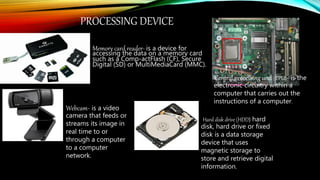
Memory card reader- is a device for
accessing the data on a memory card
such as a Comp-actFlash (CF), Secure
Digital (SD) or MultiMediaCard (MMC).
Central processing unit (CPU)- is the
electronic circuitry within a
computer that carries out the
instructions of a computer.
Webcam- is a video
camera that feeds or
streams its image in
real time to or
through a computer
to a computer
network.
Hard disk drive (HDD) hard
disk, hard drive or fixed
disk is a data storage
device that uses
magnetic storage to
store and retrieve digital
information.
STORAGE DEVICES
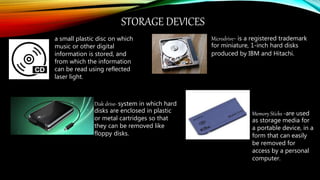
a small plastic disc on which
music or other digital
information is stored, and
from which the information
can be read using reflected
laser light.
Disk drive- system in which hard
disks are enclosed in plastic
or metal cartridges so that
they can be removed like
floppy disks.
Microdrive- is a registered trademark
for miniature, 1-inch hard disks
produced by IBM and Hitachi.
Memory Sticks -are used
as storage media for
a portable device, in a
form that can easily
be removed for
access by a personal
computer.
OUTPUT DEVICES
.
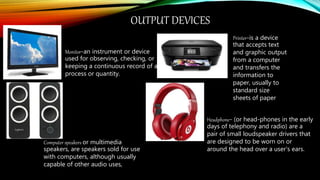
Monitor-an instrument or device
used for observing, checking, or
keeping a continuous record of a
process or quantity.
Computer speakers or multimedia
speakers, are speakers sold for use
with computers, although usually
capable of other audio uses,
Printer-is a device
that accepts text
and graphic output
from a computer
and transfers the
information to
paper, usually to
standard size
sheets of paper
Headphone- (or head-phones in the early
days of telephony and radio) are a
pair of small loudspeaker drivers that
are designed to be worn on or
around the head over a user's ears.
TYPES OF COMPUTER
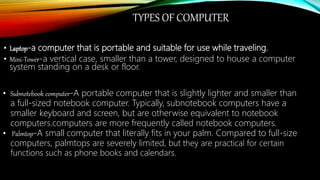
• Laptop-a computer that is portable and suitable for use while traveling.
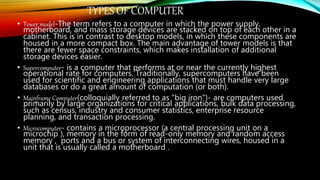
• Mini-Tower-a vertical case, smaller than a tower, designed to house a computer
system standing on a desk or floor.
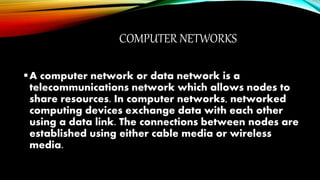
• Subnotebook computer-A portable computer that is slightly lighter and smaller than
a full-sized notebook computer. Typically, subnotebook computers have a
smaller keyboard and screen, but are otherwise equivalent to notebook
computers.computers are more frequently called notebook computers.
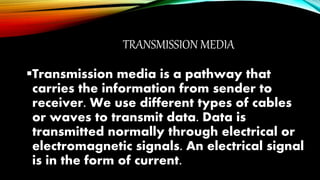
• Palmtop-A small computer that literally fits in your palm. Compared to full-size
computers, palmtops are severely limited, but they are practical for certain
functions such as phone books and calendars.
TYPES OF COMPUTER
• Tower model-The term refers to a computer in which the power supply,
motherboard, and mass storage devices are stacked on top of each other in a
cabinet. This is in contrast to desktop models, in which these components are
housed in a more compact box. The main advantage of tower models is that
there are fewer space constraints, which makes installation of additional
storage devices easier.
• Supercomputer- is a computer that performs at or near the currently highest
operational rate for computers. Traditionally, supercomputers have been
used for scientific and engineering applications that must handle very large
databases or do a great amount of computation (or both).
• Mainframe Computer(colloquially referred to as "big iron")- are computers used
primarily by large organizations for critical applications, bulk data processing,
such as census, industry and consumer statistics, enterprise resource
planning, and transaction processing.
• Microcomputer- contains a microprocessor (a central processing unit on a
microchip ), memory in the form of read-only memory and random access
memory , ports and a bus or system of interconnecting wires, housed in a
unit that is usually called a motherboard .
COMPUTER NETWORKS
A computer network or data network is a
telecommunications network which allows nodes to
share resources. In computer networks, networked
computing devices exchange data with each other
using a data link. The connections between nodes are
established using either cable media or wireless
media.
TRANSMISSION MEDIA
Transmission media is a pathway that
carries the information from sender to
receiver. We use different types of cables
or waves to transmit data. Data is
transmitted normally through electrical or
electromagnetic signals. An electrical signal
is in the form of current.
TYPES OF TRANSMISSION MEDIA
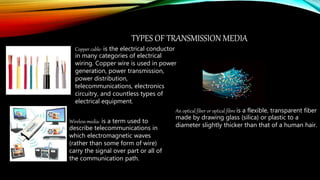
Copper cable- is the electrical conductor
in many categories of electrical
wiring. Copper wire is used in power
generation, power transmission,
power distribution,
telecommunications, electronics
circuitry, and countless types of
electrical equipment.
Wireless media- is a term used to
describe telecommunications in
which electromagnetic waves
(rather than some form of wire)
carry the signal over part or all of
the communication path.
An optical fiber or optical fibre is a flexible, transparent fiber
made by drawing glass (silica) or plastic to a
diameter slightly thicker than that of a human hair.
TYPES OF COMPUTER NETWORKS
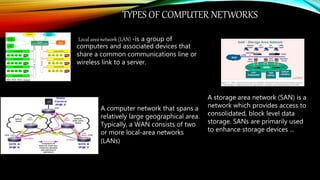
Local area network (LAN) -is a group of
computers and associated devices that
share a common communications line or
wireless link to a server.
A computer network that spans a
relatively large geographical area.
Typically, a WAN consists of two
or more local-area networks
(LANs)
A storage area network (SAN) is a
network which provides access to
consolidated, block level data
storage. SANs are primarily used
to enhance storage devices ...
MAJOR PARTS OF A COMPUTER
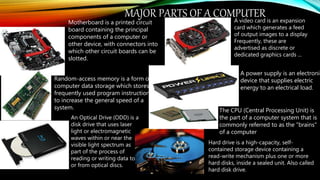
Motherboard is a printed circuit
board containing the principal
components of a computer or
other device, with connectors into
which other circuit boards can be
slotted.
Hard drive is a high-capacity, self-
contained storage device containing a
read-write mechanism plus one or more
hard disks, inside a sealed unit. Also called
hard disk drive.
Random-access memory is a form of
computer data storage which stores
frequently used program instructions
to increase the general speed of a
system.
A video card is an expansion
card which generates a feed
of output images to a display
Frequently, these are
advertised as discrete or
dedicated graphics cards ...
A power supply is an electronic
device that supplies electric
energy to an electrical load.
An Optical Drive (ODD) is a
disk drive that uses laser
light or electromagnetic
waves within or near the
visible light spectrum as
part of the process of
reading or writing data to
or from optical discs.
The CPU (Central Processing Unit) is
the part of a computer system that is
commonly referred to as the "brains"
of a computer
COMPUTER PARTS AND LABEL
•
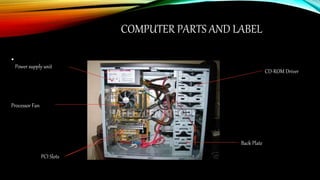
Power supply unit
Processor Fan
CD-ROM Driver
PCI Slots
Back Plate
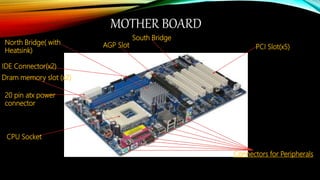
MOTHER BOARD
North Bridge( with
Heatsink)
PCI Slot(x5)
South Bridge
AGP Slot
IDE Connector(x2)
CPU Socket
Connectors for Peripherals
Dram memory slot (x2)
20 pin atx power
connector

The Computer

  • 1.
  • 2.
    DEFINITION • an electronicdevice for storing and processing data, typically in binary form, according to instructions given to it in a variable program.
  • 3.
    FUNCTIONS OF ACOMPUTERInput Transferring of information into the system. This may be through a user input device cd etc. • Output • Output is the exact opposite of input. Output is the function that allows a computer to display information, from the system, for the user • Processing • a process is an instance of a computer program that is being executed. It contains the program code and its current activity. • Storage Most computers are able to store data both temporarily (in order to process), but also long-term (i.e., permanently). Storage takes place on hard-drives or external storage devices.
  • 4.
    INPUT DEVICES Computer keyboard-is a typewriter-style device which uses an arrangement of buttons or keys to act as a mechanical lever or electronic switch. Computer mouse- is an input device that is most often used with a personal computer. Joystick-is an input device consisting of a stick that pivots on a base and reports its angle or direction to the device it is controlling Scanner- is a device that captures images from photographic prints, posters, magazine pages, and similar sources for computer editing and display.
  • 5.
    PROCESSING DEVICE Memory cardreader- is a device for accessing the data on a memory card such as a Comp-actFlash (CF), Secure Digital (SD) or MultiMediaCard (MMC). Central processing unit (CPU)- is the electronic circuitry within a computer that carries out the instructions of a computer. Webcam- is a video camera that feeds or streams its image in real time to or through a computer to a computer network. Hard disk drive (HDD) hard disk, hard drive or fixed disk is a data storage device that uses magnetic storage to store and retrieve digital information.
  • 6.
    STORAGE DEVICES a smallplastic disc on which music or other digital information is stored, and from which the information can be read using reflected laser light. Disk drive- system in which hard disks are enclosed in plastic or metal cartridges so that they can be removed like floppy disks. Microdrive- is a registered trademark for miniature, 1-inch hard disks produced by IBM and Hitachi. Memory Sticks -are used as storage media for a portable device, in a form that can easily be removed for access by a personal computer.
  • 7.
    OUTPUT DEVICES . Monitor-an instrumentor device used for observing, checking, or keeping a continuous record of a process or quantity. Computer speakers or multimedia speakers, are speakers sold for use with computers, although usually capable of other audio uses, Printer-is a device that accepts text and graphic output from a computer and transfers the information to paper, usually to standard size sheets of paper Headphone- (or head-phones in the early days of telephony and radio) are a pair of small loudspeaker drivers that are designed to be worn on or around the head over a user's ears.
  • 8.
    TYPES OF COMPUTER •Laptop-a computer that is portable and suitable for use while traveling. • Mini-Tower-a vertical case, smaller than a tower, designed to house a computer system standing on a desk or floor. • Subnotebook computer-A portable computer that is slightly lighter and smaller than a full-sized notebook computer. Typically, subnotebook computers have a smaller keyboard and screen, but are otherwise equivalent to notebook computers.computers are more frequently called notebook computers. • Palmtop-A small computer that literally fits in your palm. Compared to full-size computers, palmtops are severely limited, but they are practical for certain functions such as phone books and calendars.
  • 9.
    TYPES OF COMPUTER •Tower model-The term refers to a computer in which the power supply, motherboard, and mass storage devices are stacked on top of each other in a cabinet. This is in contrast to desktop models, in which these components are housed in a more compact box. The main advantage of tower models is that there are fewer space constraints, which makes installation of additional storage devices easier. • Supercomputer- is a computer that performs at or near the currently highest operational rate for computers. Traditionally, supercomputers have been used for scientific and engineering applications that must handle very large databases or do a great amount of computation (or both). • Mainframe Computer(colloquially referred to as "big iron")- are computers used primarily by large organizations for critical applications, bulk data processing, such as census, industry and consumer statistics, enterprise resource planning, and transaction processing. • Microcomputer- contains a microprocessor (a central processing unit on a microchip ), memory in the form of read-only memory and random access memory , ports and a bus or system of interconnecting wires, housed in a unit that is usually called a motherboard .
  • 10.
    COMPUTER NETWORKS A computernetwork or data network is a telecommunications network which allows nodes to share resources. In computer networks, networked computing devices exchange data with each other using a data link. The connections between nodes are established using either cable media or wireless media.
  • 11.
    TRANSMISSION MEDIA Transmission mediais a pathway that carries the information from sender to receiver. We use different types of cables or waves to transmit data. Data is transmitted normally through electrical or electromagnetic signals. An electrical signal is in the form of current.
  • 12.
    TYPES OF TRANSMISSIONMEDIA Copper cable- is the electrical conductor in many categories of electrical wiring. Copper wire is used in power generation, power transmission, power distribution, telecommunications, electronics circuitry, and countless types of electrical equipment. Wireless media- is a term used to describe telecommunications in which electromagnetic waves (rather than some form of wire) carry the signal over part or all of the communication path. An optical fiber or optical fibre is a flexible, transparent fiber made by drawing glass (silica) or plastic to a diameter slightly thicker than that of a human hair.
  • 13.
    TYPES OF COMPUTERNETWORKS Local area network (LAN) -is a group of computers and associated devices that share a common communications line or wireless link to a server. A computer network that spans a relatively large geographical area. Typically, a WAN consists of two or more local-area networks (LANs) A storage area network (SAN) is a network which provides access to consolidated, block level data storage. SANs are primarily used to enhance storage devices ...
  • 14.
    MAJOR PARTS OFA COMPUTER Motherboard is a printed circuit board containing the principal components of a computer or other device, with connectors into which other circuit boards can be slotted. Hard drive is a high-capacity, self- contained storage device containing a read-write mechanism plus one or more hard disks, inside a sealed unit. Also called hard disk drive. Random-access memory is a form of computer data storage which stores frequently used program instructions to increase the general speed of a system. A video card is an expansion card which generates a feed of output images to a display Frequently, these are advertised as discrete or dedicated graphics cards ... A power supply is an electronic device that supplies electric energy to an electrical load. An Optical Drive (ODD) is a disk drive that uses laser light or electromagnetic waves within or near the visible light spectrum as part of the process of reading or writing data to or from optical discs. The CPU (Central Processing Unit) is the part of a computer system that is commonly referred to as the "brains" of a computer
  • 15.
    COMPUTER PARTS ANDLABEL • Power supply unit Processor Fan CD-ROM Driver PCI Slots Back Plate
  • 16.
    MOTHER BOARD North Bridge(with Heatsink) PCI Slot(x5) South Bridge AGP Slot IDE Connector(x2) CPU Socket Connectors for Peripherals Dram memory slot (x2) 20 pin atx power connector