The Child StudyThe descriptive review of a childPresented By: Lillian Vania, MEd				November 10, 2010
Williamstown Community Preschool					November 10, 2010Name:2 hours: Observation, Assessment, and Planning for Individual NeedPresenter: Lillian Vania, MEdThe Child StudyThe descriptive review of a child
How have we arrived at this point?A brief review…Observation and Assessment:We observe to learn about the whole child.
The environment affects how, when, where, and what we observe.
We observe to provide information for assessment.
The end result:
Understanding of the whole child
Assessment and Evaluation
Communication with parents and caregivers
Understanding your Audience:
Perspective 1: The Arena
How you are viewed by others and what you know about yourself.
Friendly, approachable, patient, sociable, professional, hardworking, adaptable, dependable, skilled, multi-talented, educated
Perspective 2: The Blind Spot
How you view parents: what you know, but they do not know about themselves
Needy, rushed, lack of interest in teacher expertise, tunnel vision, unrealistic demands, defensive, lack of disciplineWhat is a child study?Exploring the descriptive review process. Historical Perspective:
This is approach was developed at the Prospect School in North Bennington, Vermont.
The  teachers of Prospect School were committed to an examination of the children through observing, recording, and describing what happened in the classrooms on a daily and continuing basis.
The goal was simple: to have those observations fold directly into practice.

The Child Study Power Point Presentation 11 10 2010

  • 1.
    The Child StudyThedescriptive review of a childPresented By: Lillian Vania, MEd November 10, 2010
  • 2.
    Williamstown Community Preschool November10, 2010Name:2 hours: Observation, Assessment, and Planning for Individual NeedPresenter: Lillian Vania, MEdThe Child StudyThe descriptive review of a child
  • 3.
    How have wearrived at this point?A brief review…Observation and Assessment:We observe to learn about the whole child.
  • 4.
    The environment affectshow, when, where, and what we observe.
  • 5.
    We observe toprovide information for assessment.
  • 6.
  • 7.
  • 8.
  • 9.
  • 10.
  • 11.
  • 12.
    How you areviewed by others and what you know about yourself.
  • 13.
    Friendly, approachable, patient,sociable, professional, hardworking, adaptable, dependable, skilled, multi-talented, educated
  • 14.
  • 15.
    How you viewparents: what you know, but they do not know about themselves
  • 16.
    Needy, rushed, lackof interest in teacher expertise, tunnel vision, unrealistic demands, defensive, lack of disciplineWhat is a child study?Exploring the descriptive review process. Historical Perspective:
  • 17.
    This is approachwas developed at the Prospect School in North Bennington, Vermont.
  • 18.
    The teachersof Prospect School were committed to an examination of the children through observing, recording, and describing what happened in the classrooms on a daily and continuing basis.
  • 19.
    The goal wassimple: to have those observations fold directly into practice.
  • 20.
    This process cameabout because teachers were trying to answer the following questions:How could a teacher both teach and observe?How would she/ he keep track of all that happened in a day?What would the format look like?The following answers came about over a period of time:Each teacher could develop their own format. Yet there was a standard: the writing was to be descriptive which in practice means to stay clear of judgmental language.The school closed it’s doors in June of 1991 due to financial woes.
  • 21.
    Patricia Carini, afounder of the school & teacher at the school, wrote a book: From A Different Angle.
  • 22.
    This book isthe reference point and guide to this workshop.What is a child study?Exploring the descriptive review process.The Elements:Participants and their rolesPreparing for the reviewSetting the stageFramework of the reviewReflection of the process
  • 23.
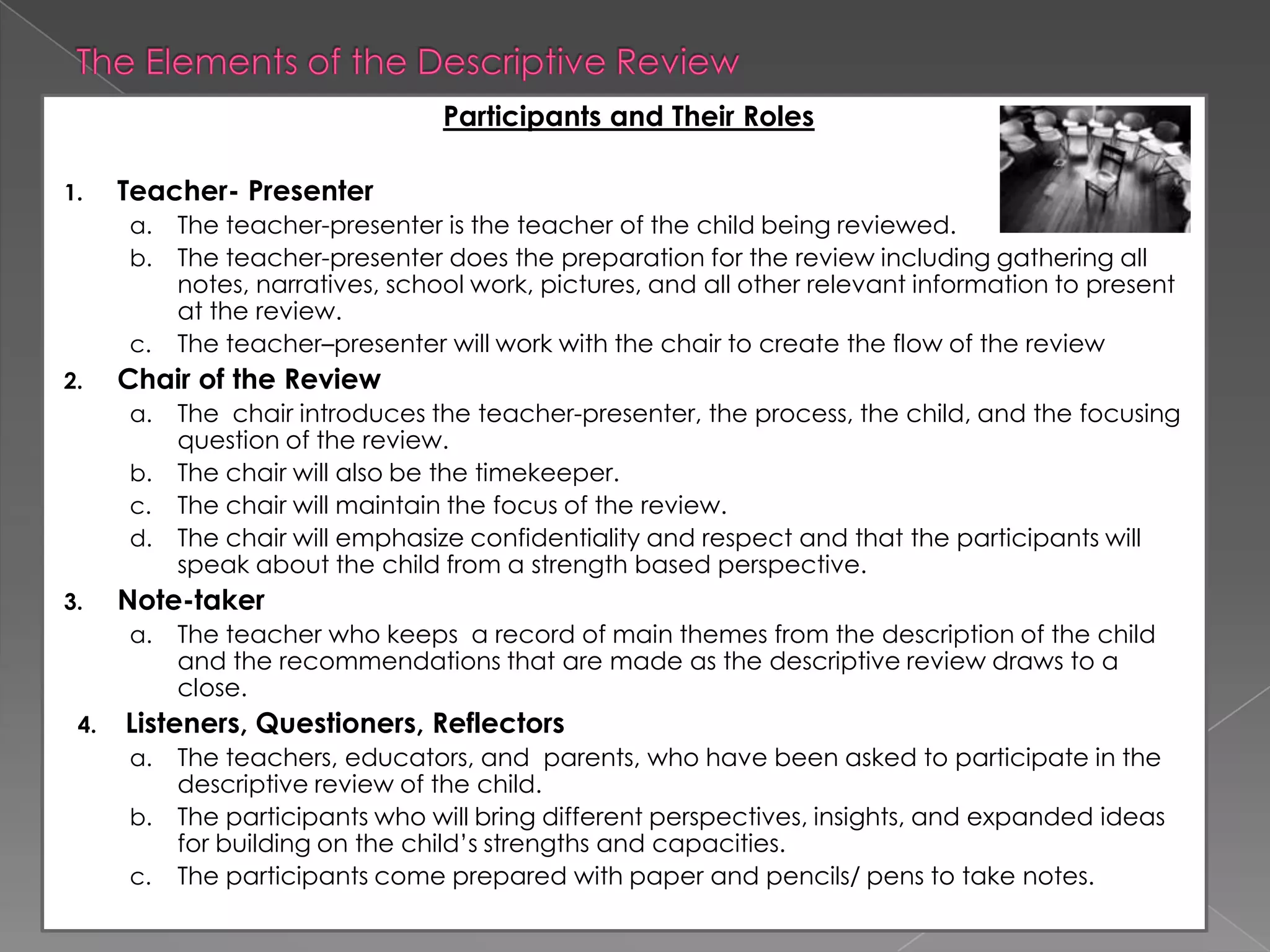
    The Elements ofthe Descriptive ReviewParticipants and Their RolesTeacher- PresenterThe teacher-presenter is the teacher of the child being reviewed. The teacher-presenter does the preparation for the review including gathering all notes, narratives, school work, pictures, and all other relevant information to present at the review. The teacher–presenter will work with the chair to create the flow of the reviewChair of the ReviewThe chair introduces the teacher-presenter, the process, the child, and the focusing question of the review. The chair will also be the timekeeper.The chair will maintain the focus of the review.The chair will emphasize confidentiality and respect and that the participants will speak about the child from a strength based perspective.Note-takerThe teacher who keeps a record of main themes from the description of the child and the recommendations that are made as the descriptive review draws to a close.Listeners, Questioners, ReflectorsThe teachers, educators, and parents, who have been asked to participate in the descriptive review of the child. The participants who will bring different perspectives, insights, and expanded ideas for building on the child’s strengths and capacities.The participants come prepared with paper and pencils/ pens to take notes.
  • 24.
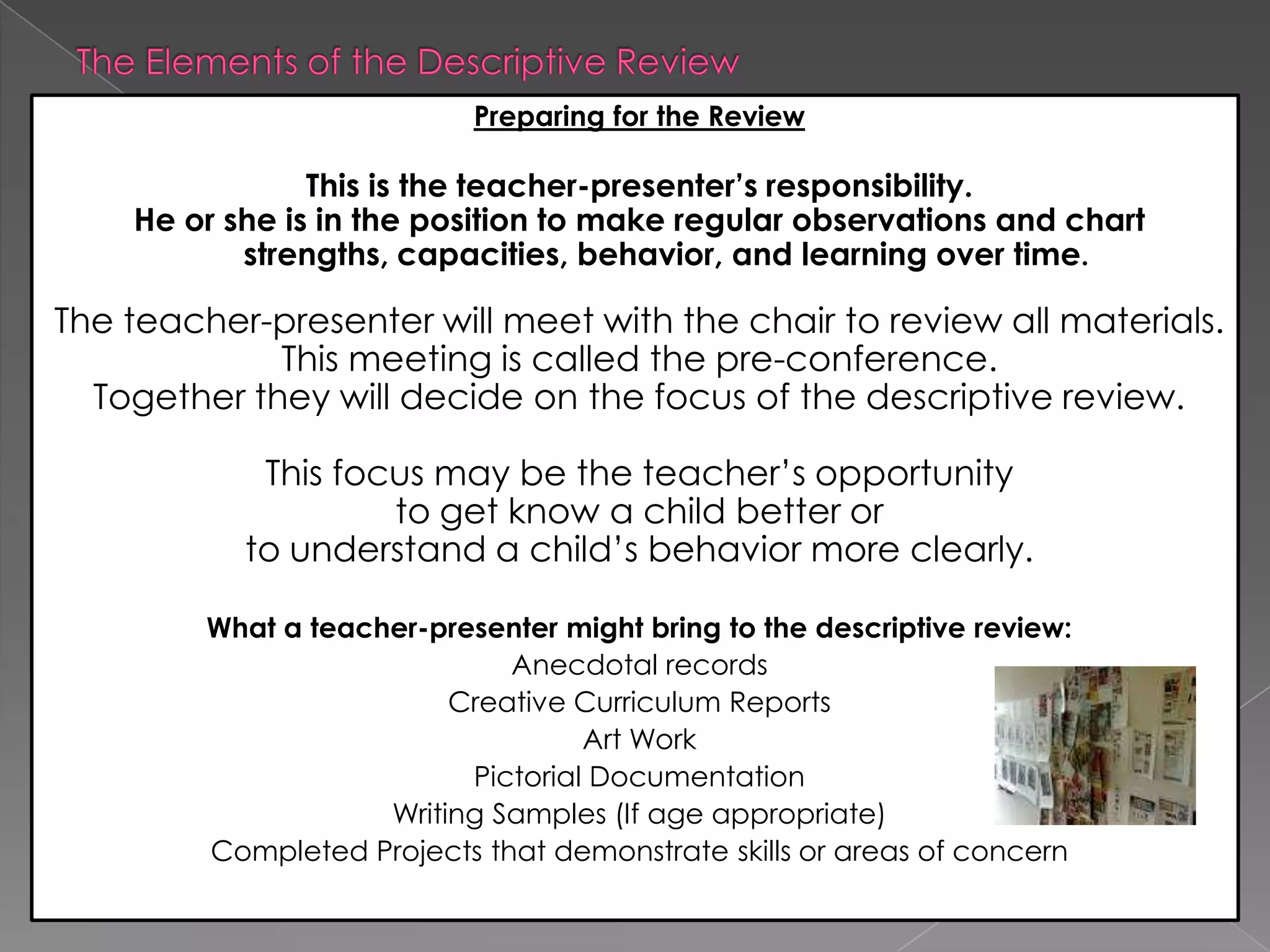
    The Elements ofthe Descriptive ReviewPreparing for the ReviewThis is the teacher-presenter’s responsibility. He or she is in the position to make regular observations and chart strengths, capacities, behavior, and learning over time.The teacher-presenter will meet with the chair to review all materials. This meeting is called the pre-conference.Together they will decide on the focus of the descriptive review.This focus may be the teacher’s opportunityto get know a child better or to understand a child’s behavior more clearly.What a teacher-presenter might bring to the descriptive review:Anecdotal recordsCreative Curriculum ReportsArt WorkPictorial DocumentationWriting Samples (If age appropriate)Completed Projects that demonstrate skills or areas of concern
  • 25.
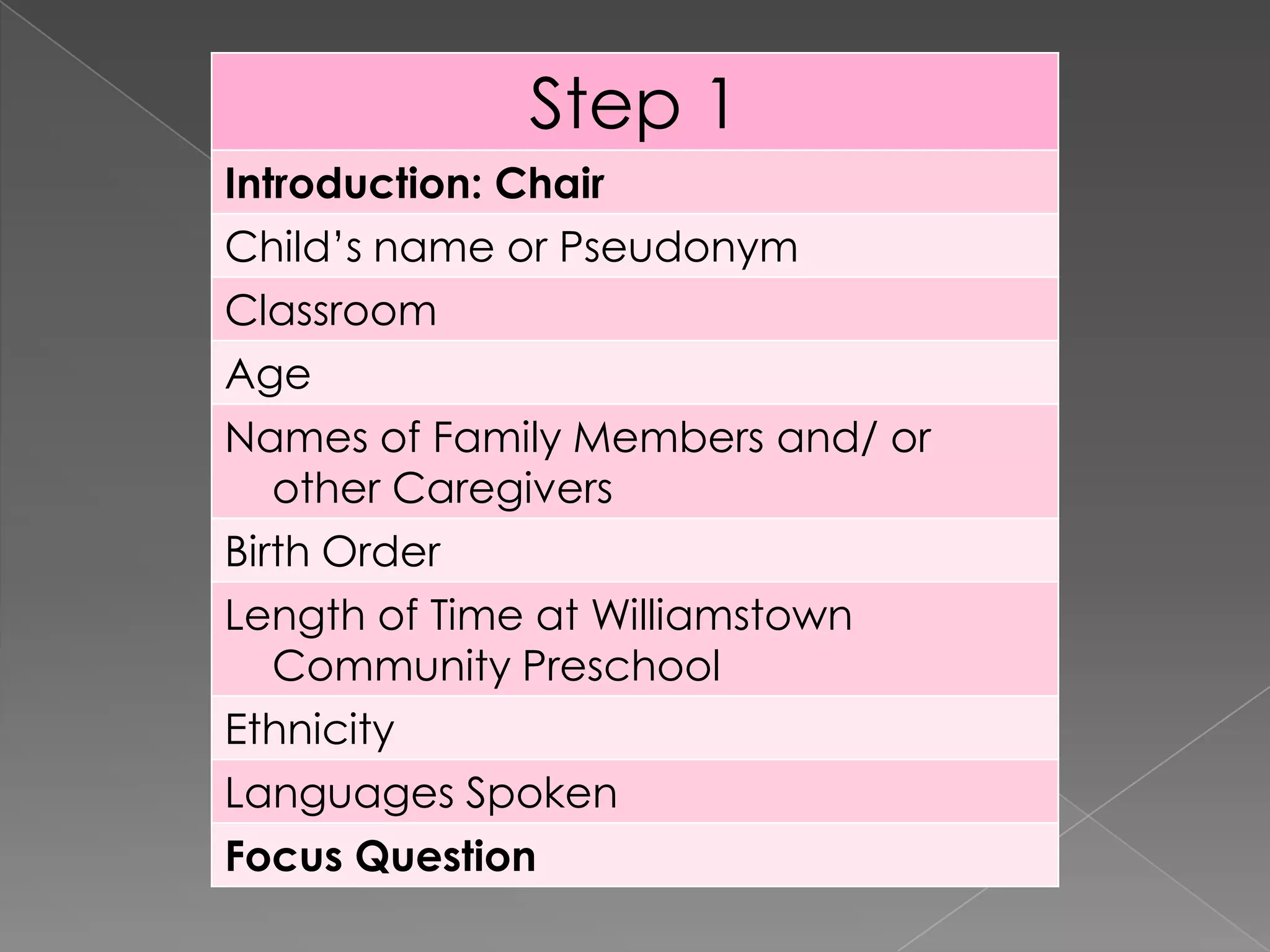
    The Elements ofthe Descriptive Review Setting the StageThis is the chair’s responsibility. The chair will:Set up the physical space to conduct the descriptive review.Introduce the teacher-presenter, the process, the child, and the focusing question.Participants are introduced if more than the usual staff members are presentThe process can be outlined in a handout.The following information is given about the child:Pseudonym, if appropriate
  • 26.
  • 27.
  • 28.
    Names of familymembers and other caregivers
  • 29.
  • 30.
    Length of timeat Williamstown Community Preschool
  • 31.
  • 32.
    Languages spokenThe focusingquestion:After reading the question the teacher-presenter takes over
  • 33.
    Focus Question:How canI capture what I need to discover about this child?Remember: Questions should be strength based!
  • 35.
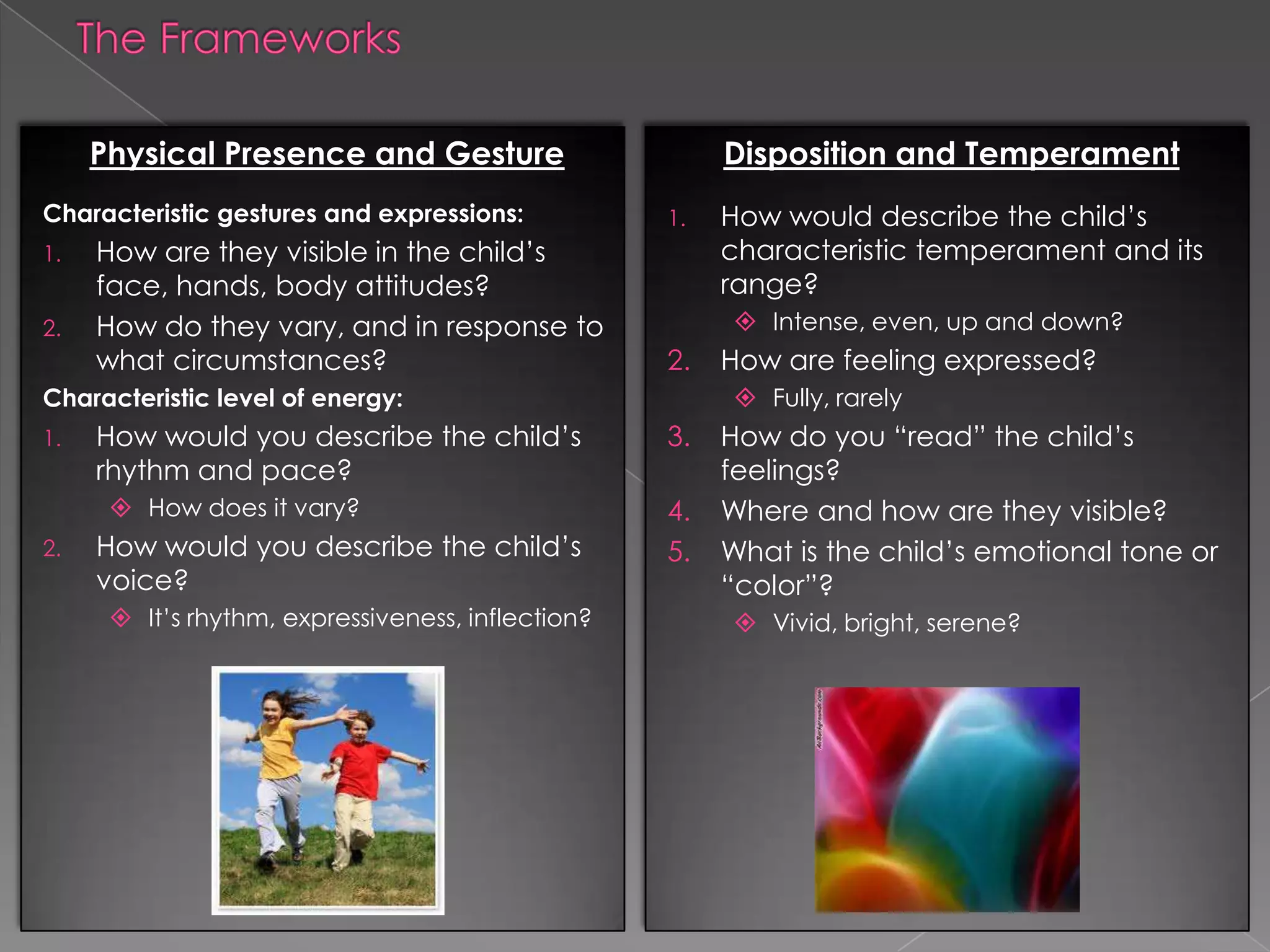
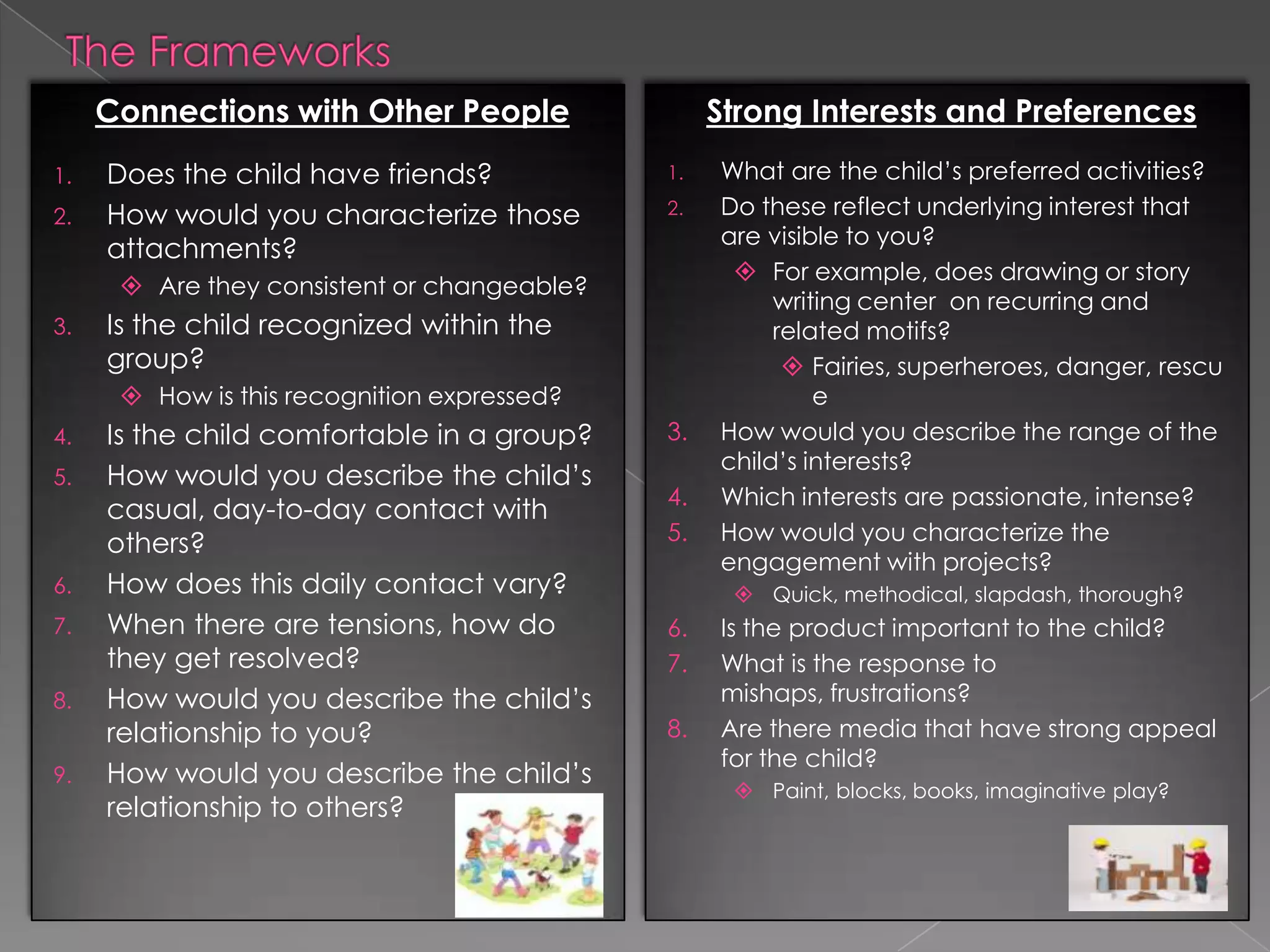
    The FrameworksPhysical Presenceand GestureCharacteristic gestures and expressions:How are they visible in the child’s face, hands, body attitudes?How do they vary, and in response to what circumstances?Characteristic level of energy:How would you describe the child’s rhythm and pace?How does it vary?How would you describe the child’s voice?It’s rhythm, expressiveness, inflection?Disposition and TemperamentHow would describe the child’s characteristic temperament and its range?Intense, even, up and down?How are feeling expressed?Fully, rarelyHow do you “read” the child’s feelings?Where and how are they visible?What is the child’s emotional tone or “color”?Vivid, bright, serene?The FrameworksConnections with Other PeopleDoes the child have friends?How would you characterize those attachments?Are they consistent or changeable?Is the child recognized within the group?How is this recognition expressed?Is the child comfortable in a group?How would you describe the child’s casual, day-to-day contact with others?How does this daily contact vary?When there are tensions, how do they get resolved?How would you describe the child’s relationship to you?How would you describe the child’s relationship to others?Strong Interests and PreferencesWhat are the child’s preferred activities?Do these reflect underlying interest that are visible to you?For example, does drawing or story writing center on recurring and related motifs?
  • 36.
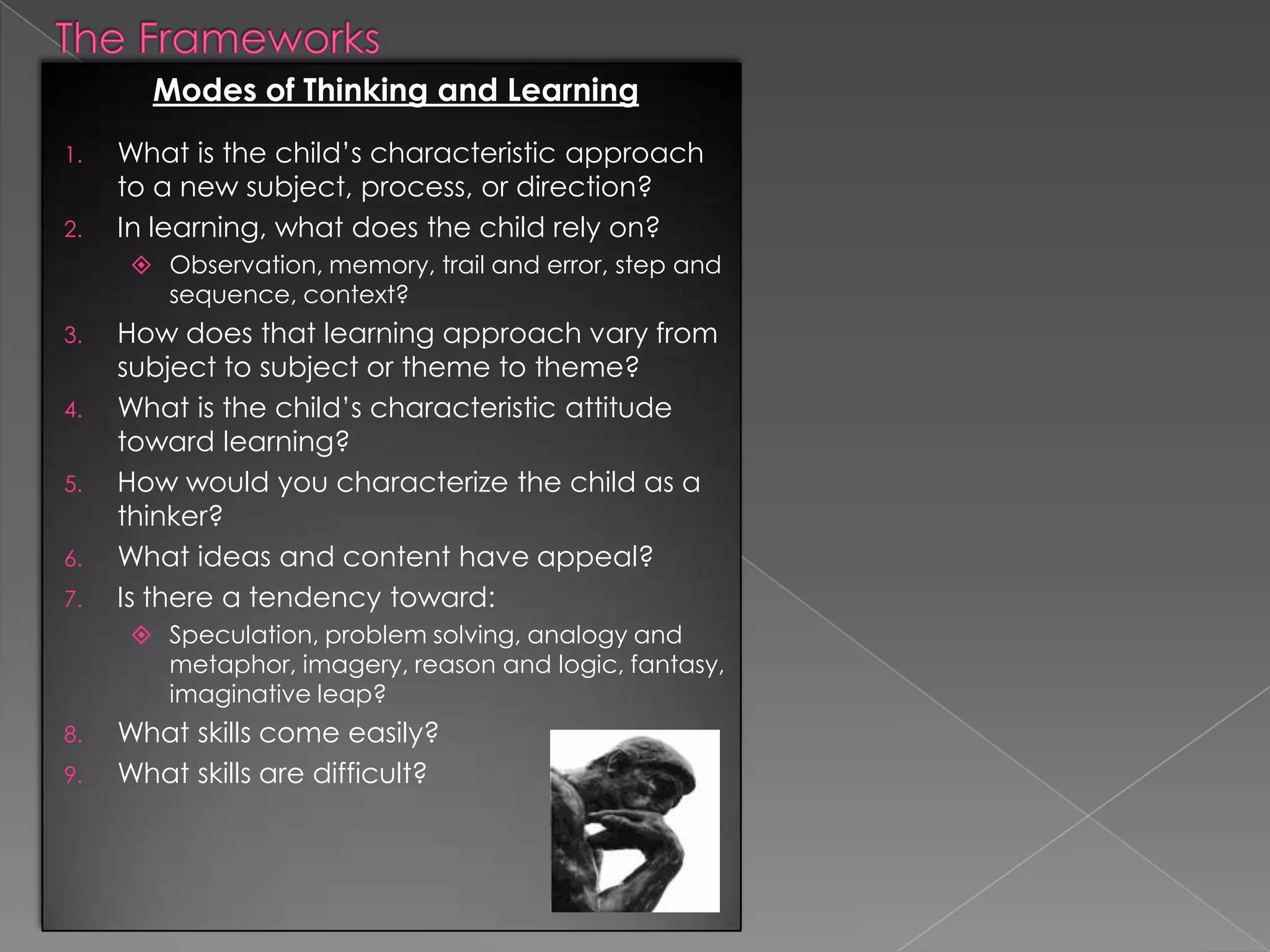
    Fairies, superheroes, danger,rescueHow would you describe the range of the child’s interests?Which interests are passionate, intense?How would you characterize the engagement with projects?Quick, methodical, slapdash, thorough?Is the product important to the child?What is the response to mishaps, frustrations?Are there media that have strong appeal for the child?Paint, blocks, books, imaginative play?The FrameworksModes of Thinking and LearningWhat is the child’s characteristic approach to a new subject, process, or direction?In learning, what does the child rely on?Observation, memory, trail and error, step and sequence, context?How does that learning approach vary from subject to subject or theme to theme?What is the child’s characteristic attitude toward learning?How would you characterize the child as a thinker?What ideas and content have appeal?Is there a tendency toward:Speculation, problem solving, analogy and metaphor, imagery, reason and logic, fantasy, imaginative leap?What skills come easily?What skills are difficult?
  • 37.
    Next StepsAt thispoint, the teacher-presenter sits back from the group, listens and takes notes. This round of the protocol is intended to be descriptive rather than evaluative.
  • 38.
    Participants practice reflectivelistening by restating something specific from the teacher-presenter’s description that seems important.
  • 39.
    Participants are notto analyze, interpret, or explain the information at this point in the protocol.
  • 40.
    NOTE: This maycreate some discomfort. It is quite possible that participants will hear things the teacher-presenter did not intend. This is perfectly acceptable and potentially educative. Questions asked by the ChairClarifying Questions then Probing QuestionsWhat are your burning questions? What do you need answered so you can continue with this process?Based on what you heard, what are this child’s particular strengths?What did you hear (or not hear) that stands out as significant? (Be as specific as possible.)This opens up multiple perspectives and generates new information that may enhance the teacher’s insights, expectations, or approach.After the facilitator restates the focusing questions, participants discuss what they have heard and offer recommendations.
  • 41.
    RecommendationsThe recommendations shouldfocus on:Implications for classroom practiceHow to deepen a child’s strengths and interests (not to change the child) How to support and enhance the child’s school experience. They may be drawn from both the foregoing description and participants’ own experiences and knowledge of other children; they may contradictor build on each other. They serve as a resource for all present.
  • 42.
    Teacher-Presenter Response Theteacher-presenter rejoins the group and responds to the discussion byspeaking to the comments/questions/suggestions that he or she found particularly intriguing.The teacher-presenter may share any new insights he or she has gained.Debrief, The Closing of the ReviewThe chair asks participants to reflect on the discussion by responding to the prompt: How has our/your thinking changed as a result of this process?The chair leads a debrief of this experience in both content and process.
  • 43.
    Teaching is notjust a job. It is a human service, and it must be thought of as a mission.Dr. Ralph Tyler

Editor's Notes

  • #9 Place the information about the child into the grid. See handout.
  • #12 Show a map of classroom, show a schedule