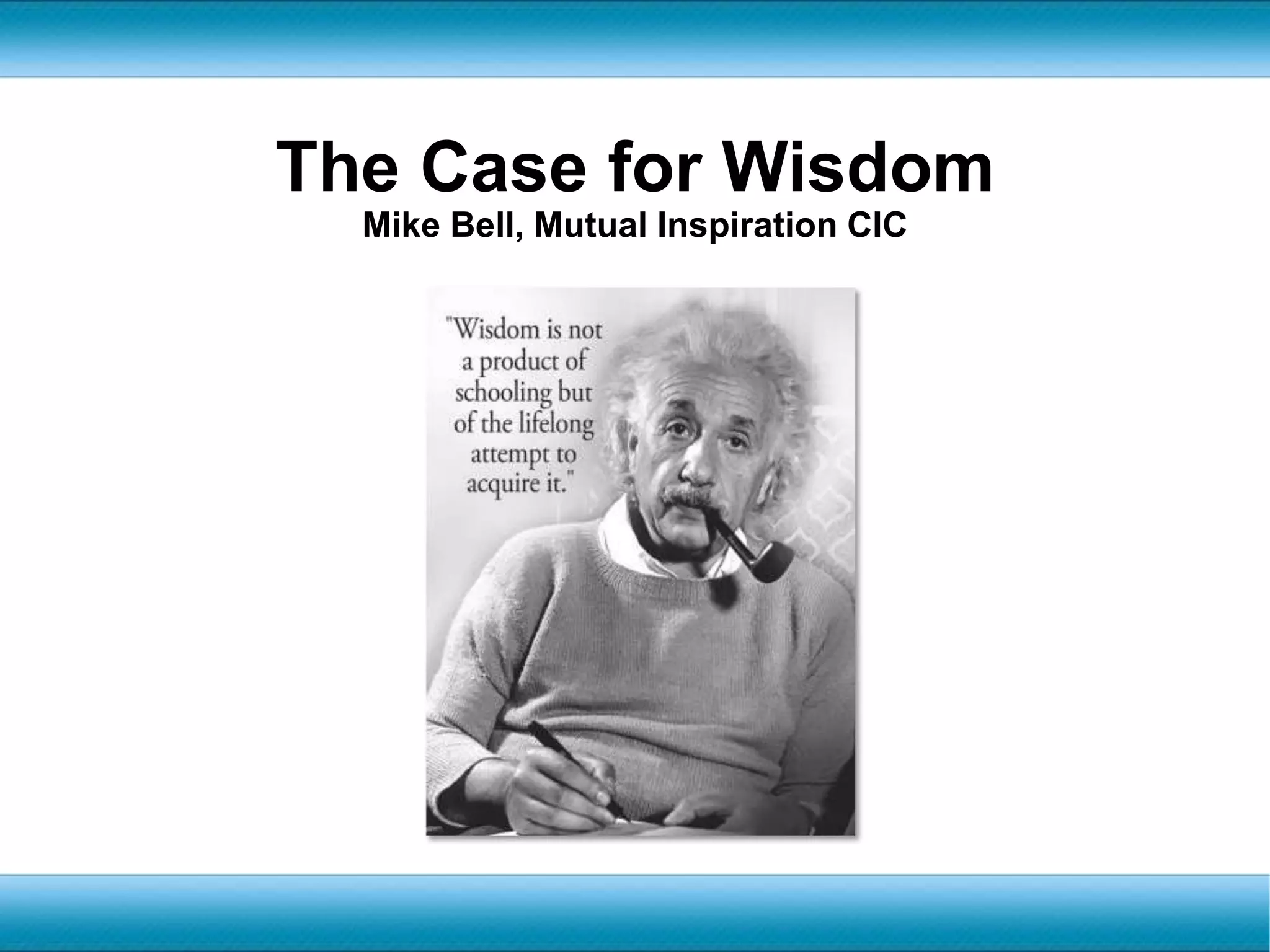
The Case for WisdomMike Bell, Mutual Inspiration CIC
What is Wisdom? "Wisdom is a state of the human mind characterized by profound understanding and deep insight.  “Wherever it exists, wisdom shows itself as a perception of the relativity and relationships among things. “It is an awareness of wholeness that does not lose sight of particularity or concreteness, or of the intricacies of interrelationships.” Joseph W. Meeker
Why is Wisdom important?
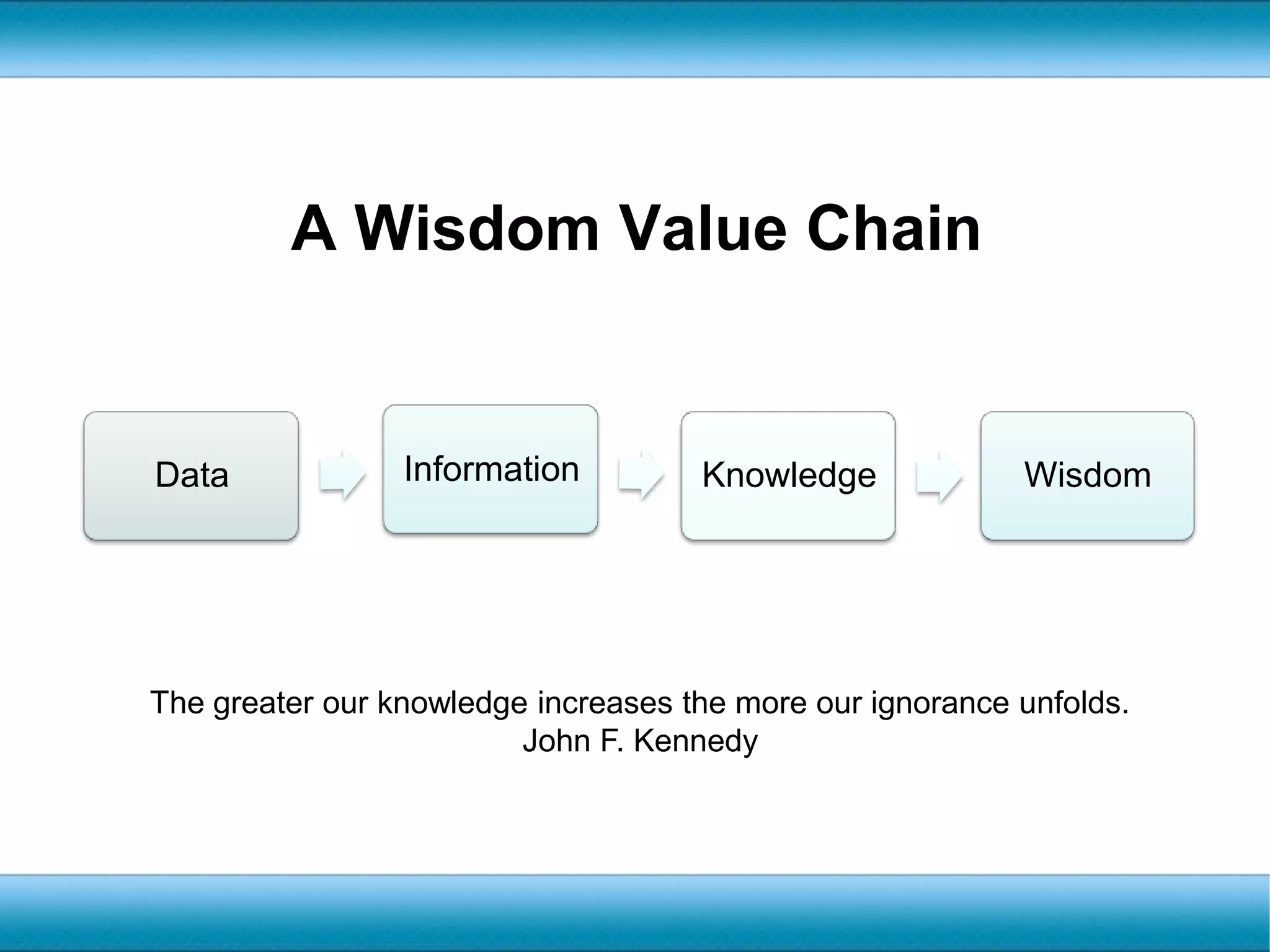
A Wisdom Value ChainThe greater our knowledge increases the more our ignorance unfolds. John F. Kennedy
"In an increasingly dynamic, interdependent and unpredictable world, it is simply no longer possible for anyone to figure it all out at the top“Peter Senge, The Fifth Discipline
“Many change programmes fail – and the traditional assessment of failure is 75% of the attempts – often because they do not take into account that they are working with a living system and not a machine.” Prof Keith Grint, 2008
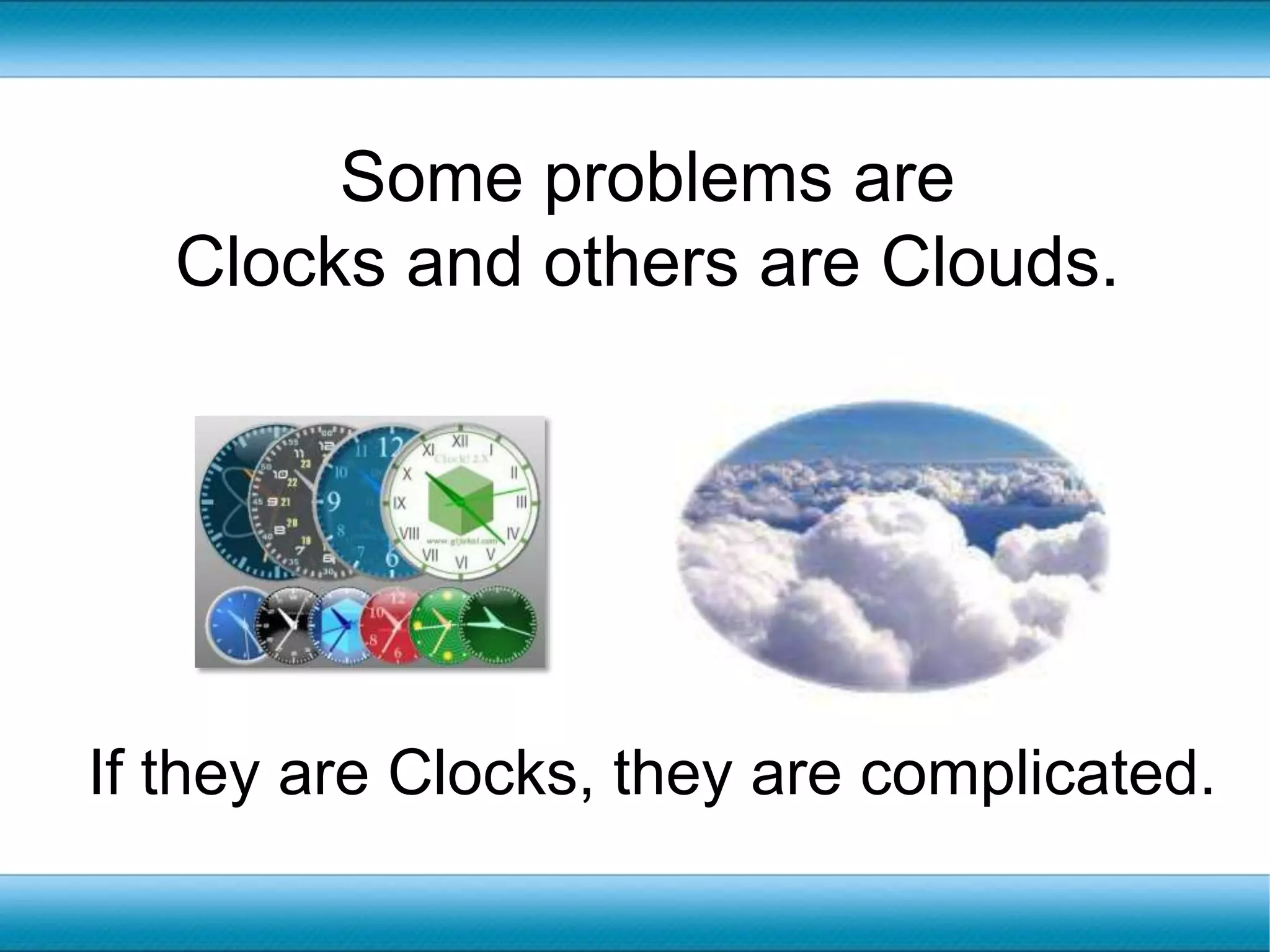
Some problems are Clocks and others are Clouds.If they are Clocks, they are complicated.
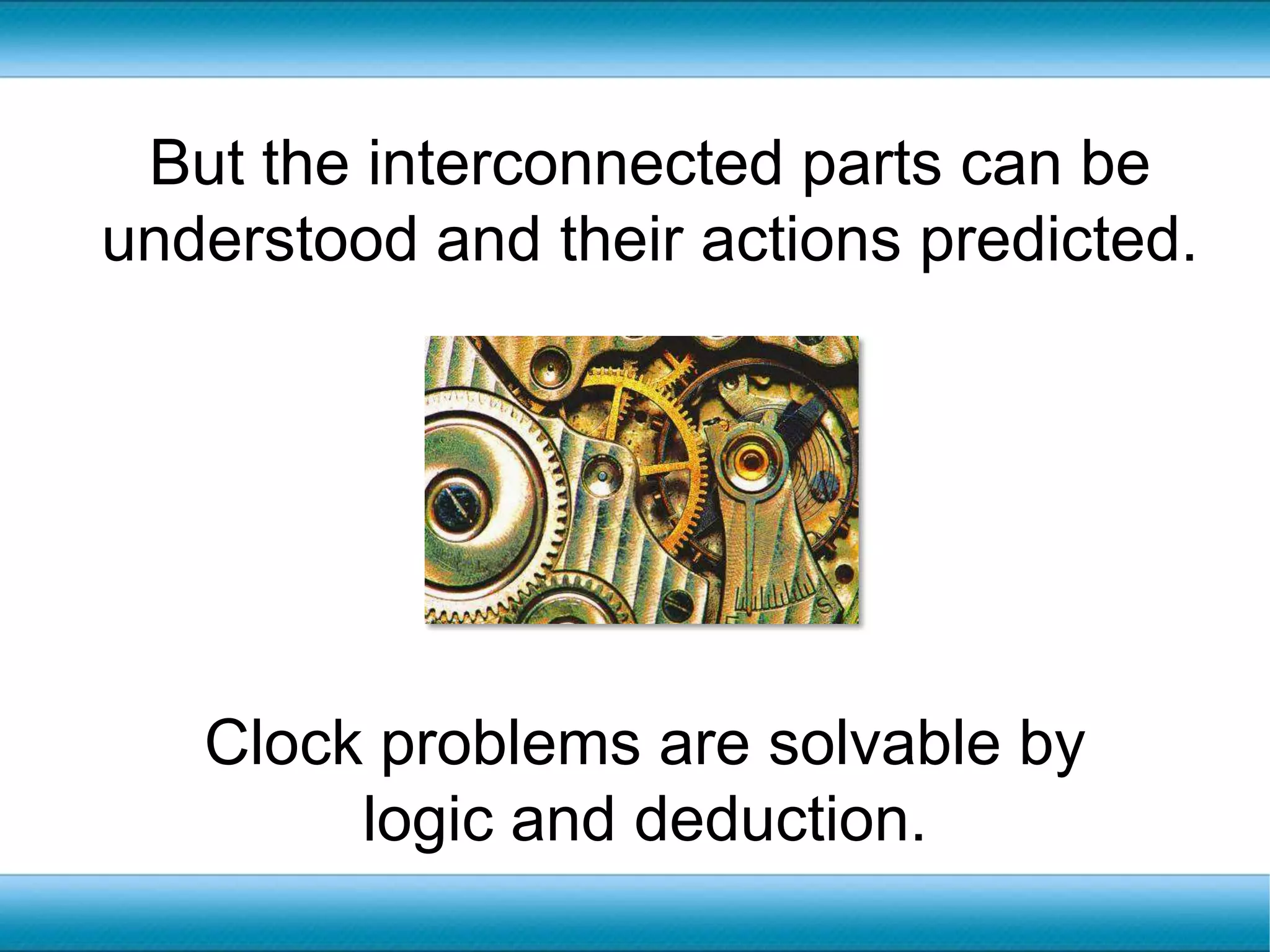
But the interconnected parts can be understood and their actions predicted. Clock problems are solvable by logic and deduction.
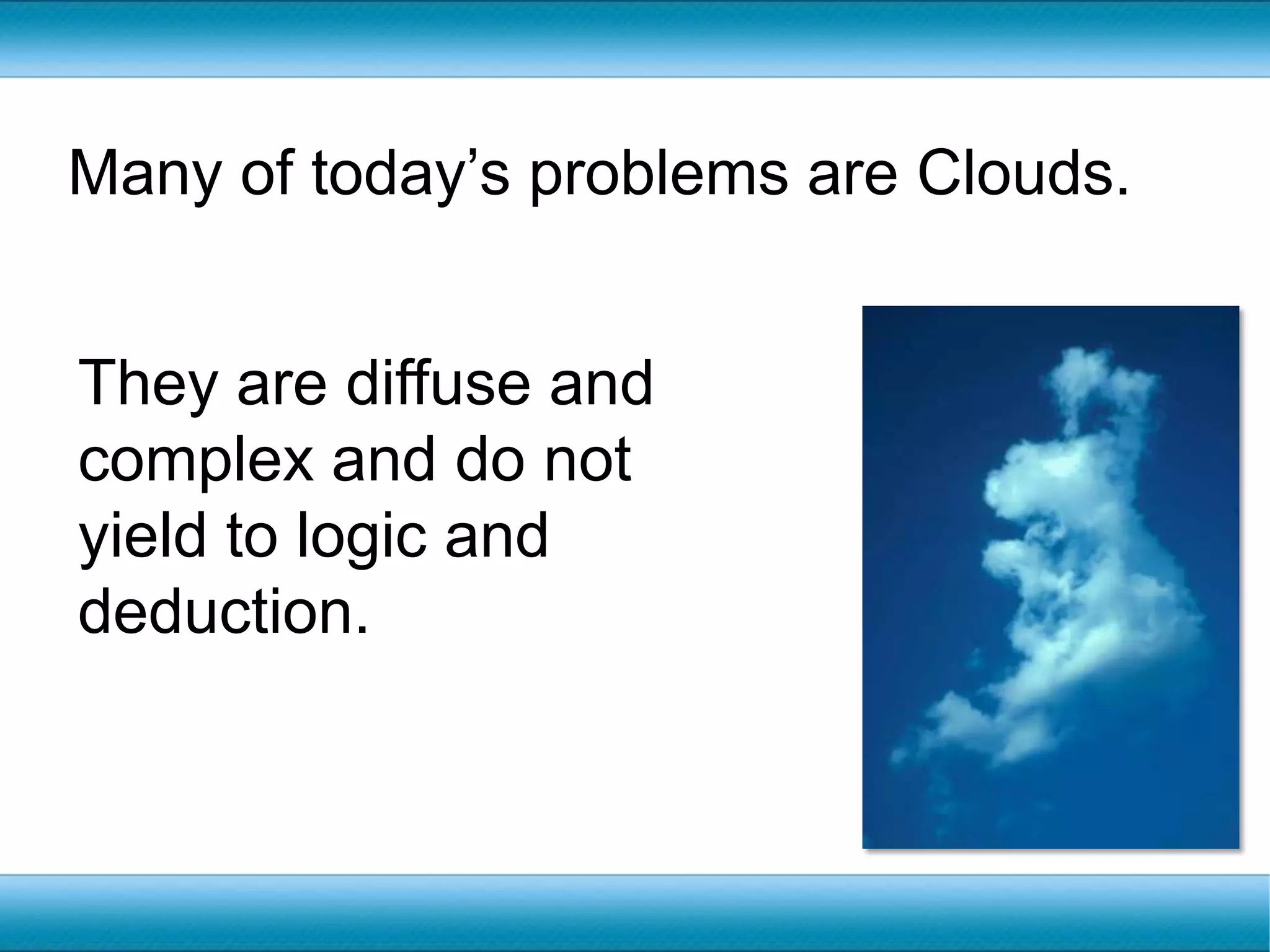
Many of today’s problems are Clouds.They are diffuse and complex and do not yield to logic and deduction.
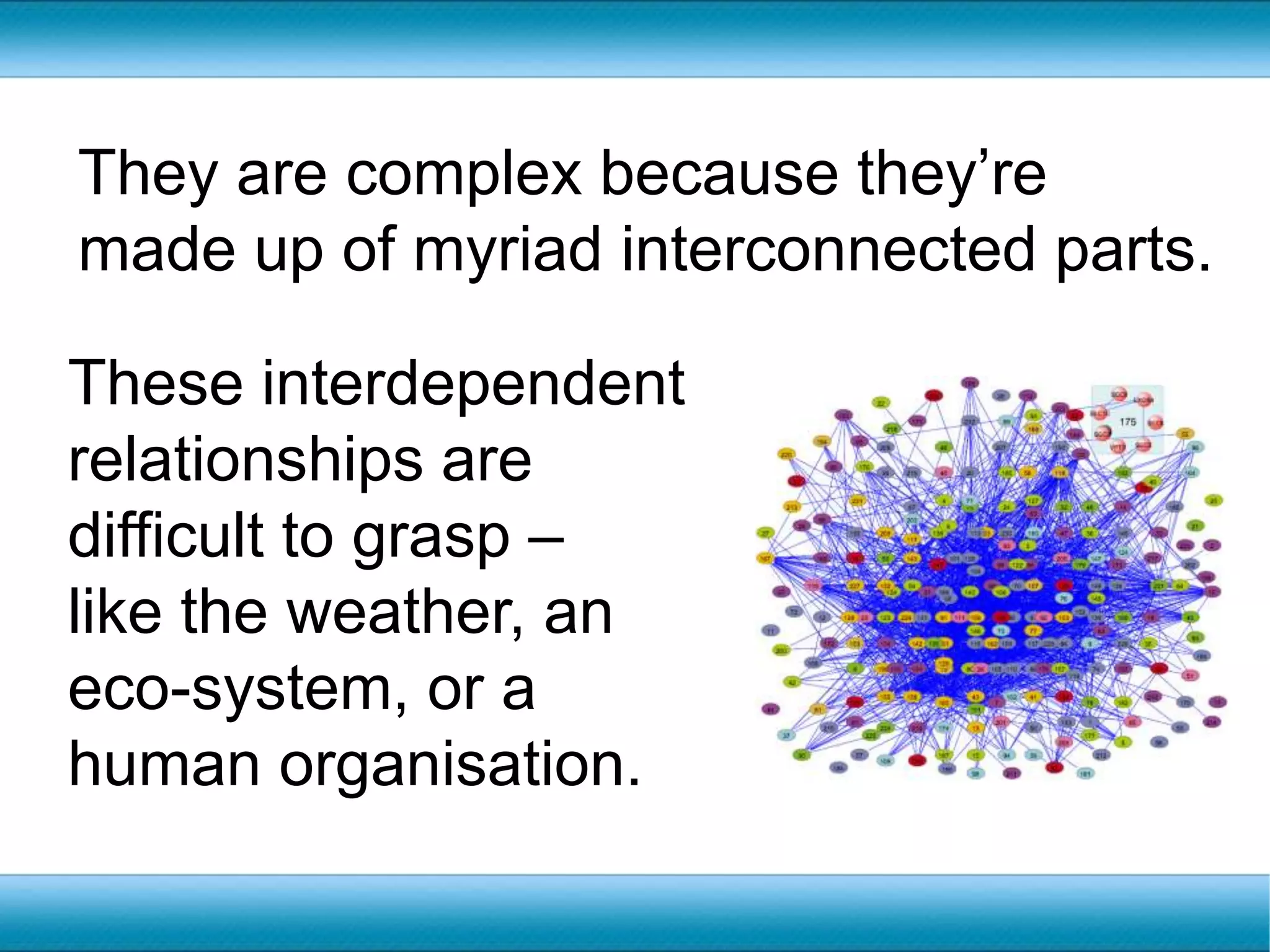
They are complex because they’re made up of myriad interconnected parts.These interdependent relationships are difficult to grasp – like the weather, an eco-system, or a human organisation.
Complex problems, when they involve people, are adaptive.  As people learn they change, and then what appeared to work yesterday may not work today.
Complex problems require creativity and innovation, and diverse groups are the best source of these.
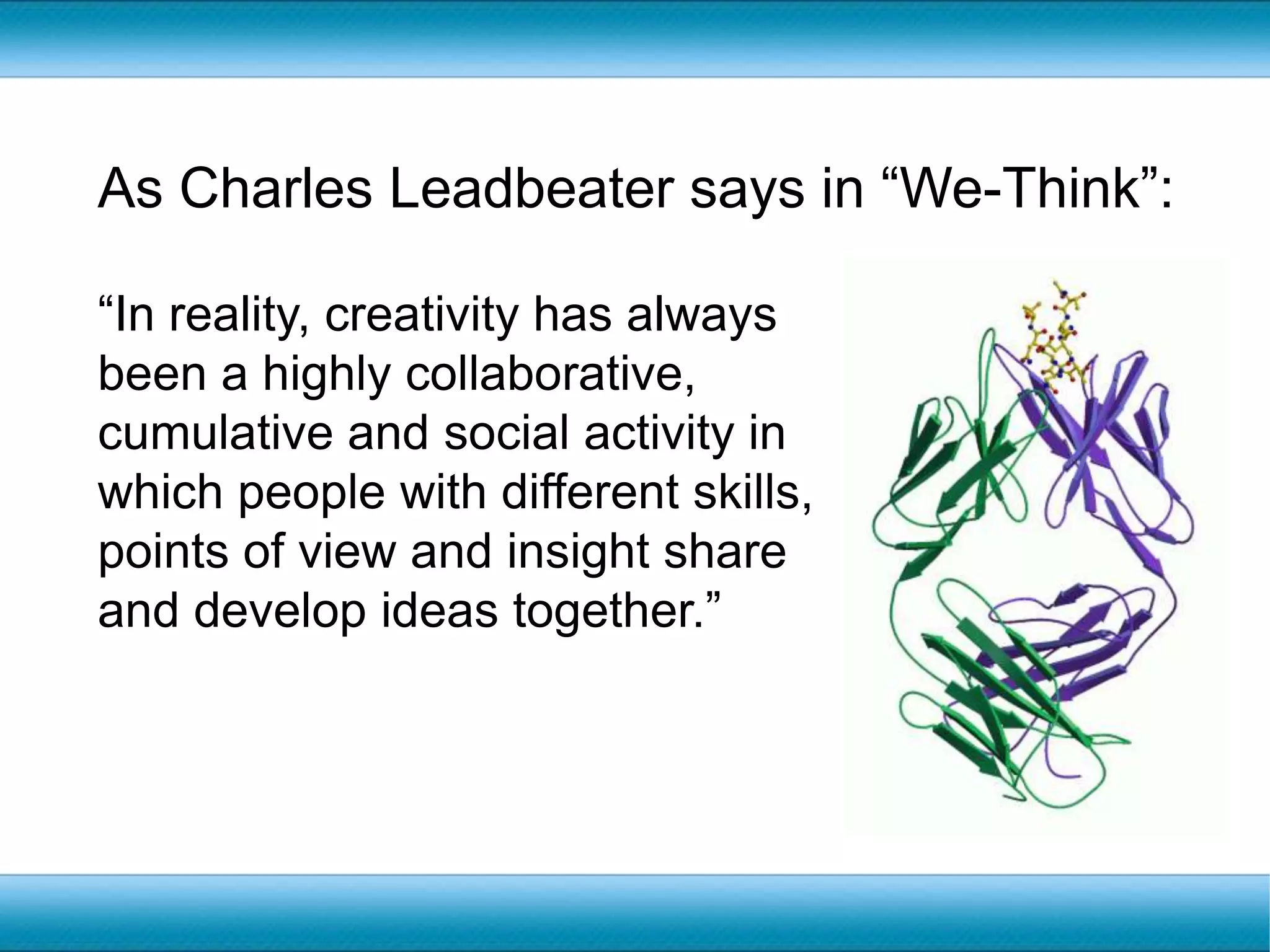
As Charles Leadbeater says in “We-Think”:“In reality, creativity has always been a highly collaborative, cumulative and social activity in which people with different skills, points of view and insight share and develop ideas together.”
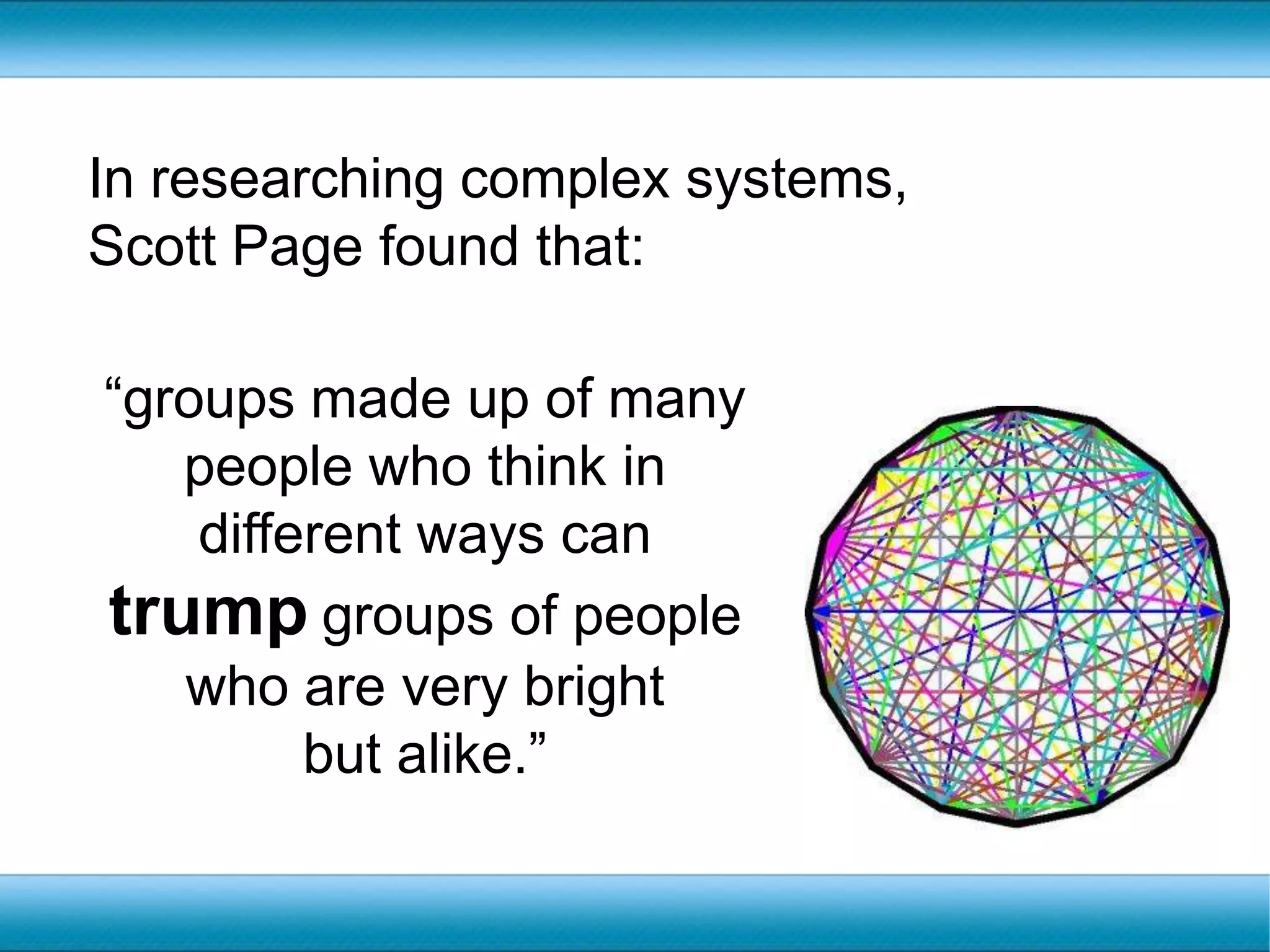
In researching complex systems, Scott Page found that:“groups made up of many people who think in different ways can trumpgroups of people who are very bright but alike.”
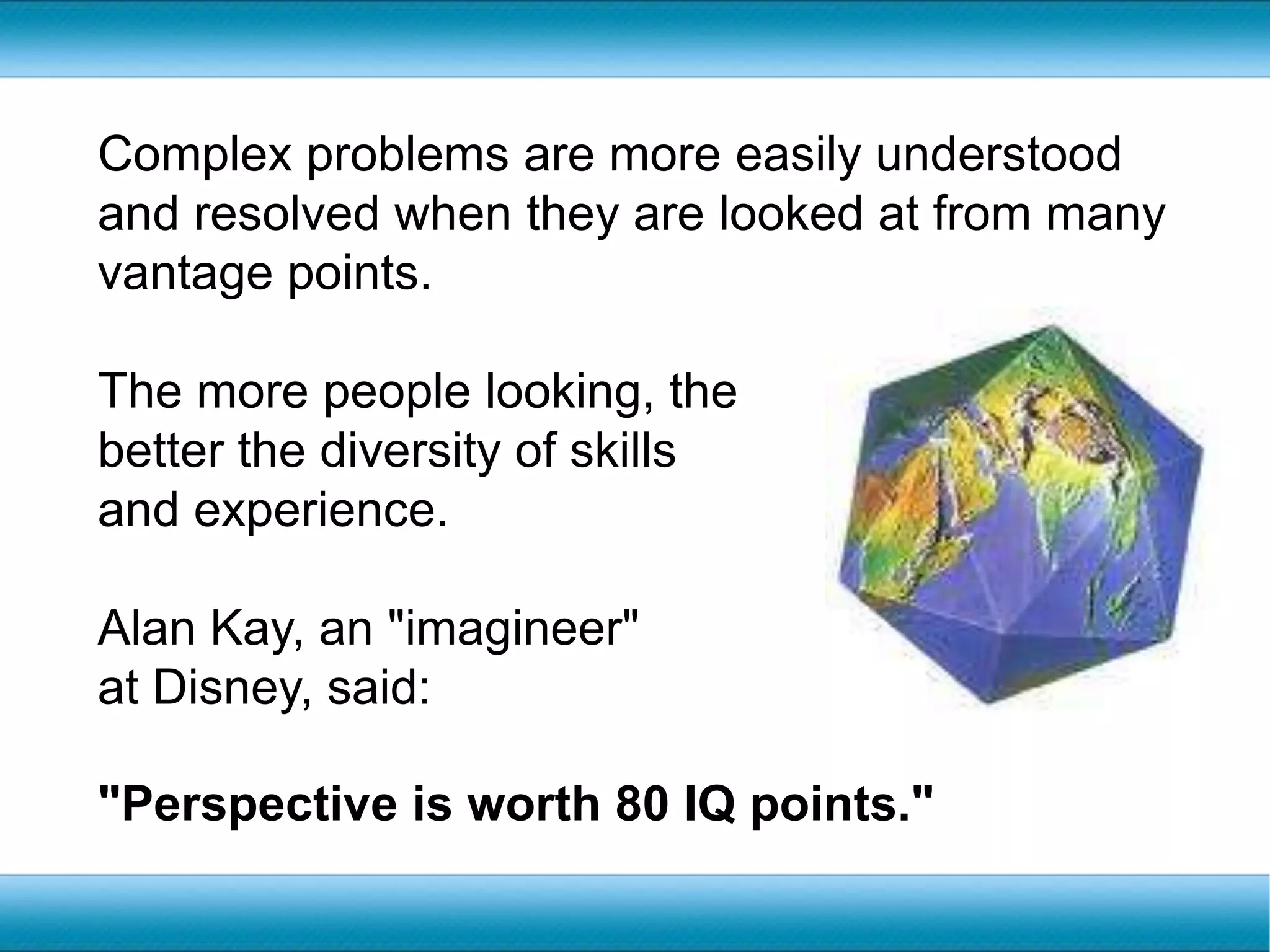
Complex problems are more easily understood and resolved when they are looked at from many vantage points. The more people looking, the better the diversity of skills and experience. Alan Kay, an "imagineer" at Disney, said:"Perspective is worth 80 IQ points."
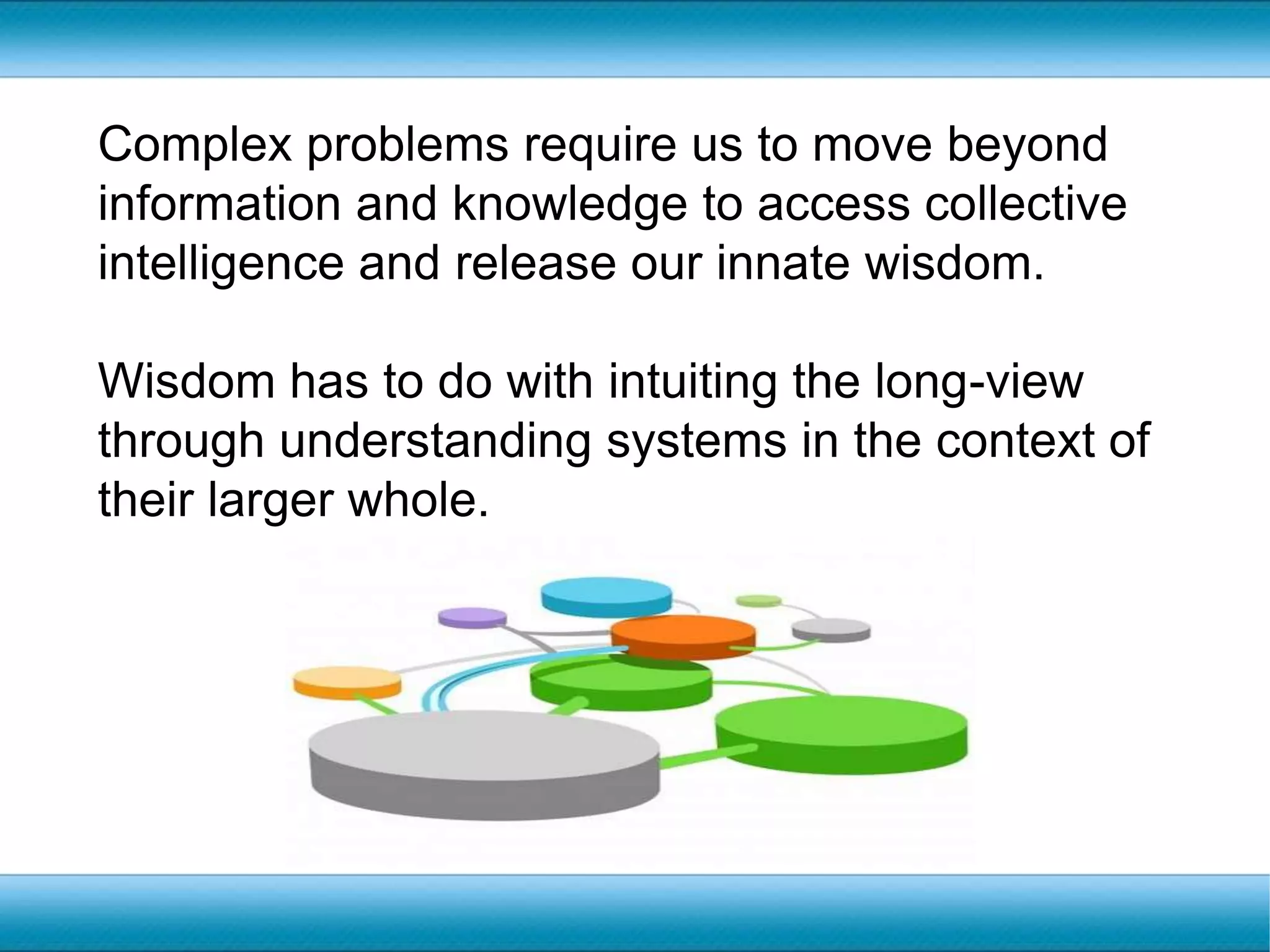
Complex problems require us to move beyond information and knowledge to access collective intelligence and release our innate wisdom.Wisdom has to do with intuiting the long-view through understanding systems in the context of their larger whole.
Wisdom is also to do with acting in resonance with what is known to be true and lasting.Only wisdom can guide effective decisions in how we work with challenging issues in the conditions of what Doug Engelbart calls:"complexity multiplied by urgency"
In the Wisdom of Crowds, James Surowiecki says:“Groups do not need to be dominated by exceptionally intelligent people to be smart. “Even if most of the people within the group are not especially well informed or rational, it can still reach a collectively wise decision.”
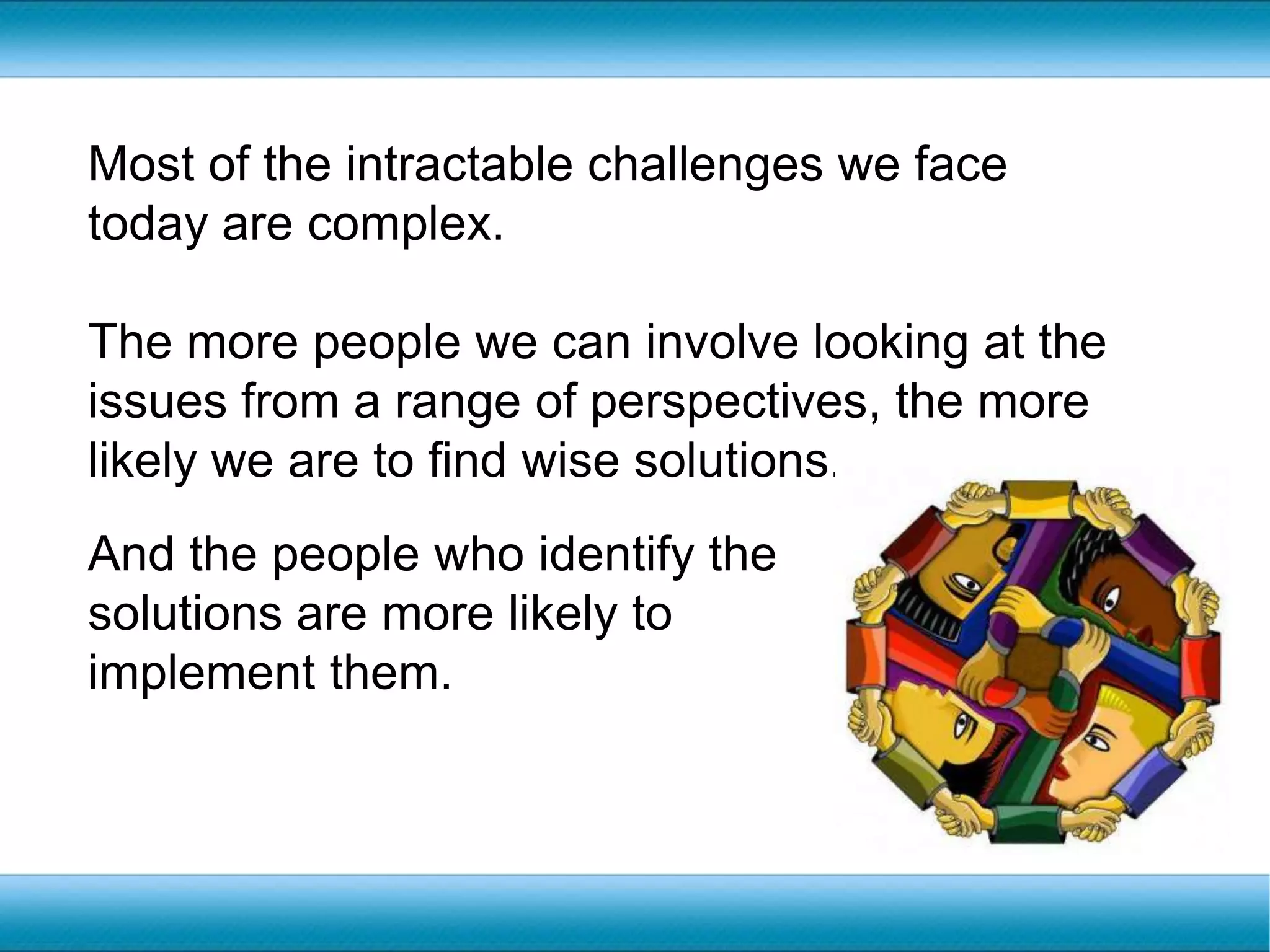
Most of the intractable challenges we face today are complex. The more people we can involve looking at the issues from a range of perspectives, the more likely we are to find wise solutions.And the people who identify the solutions are more likely to implement them.
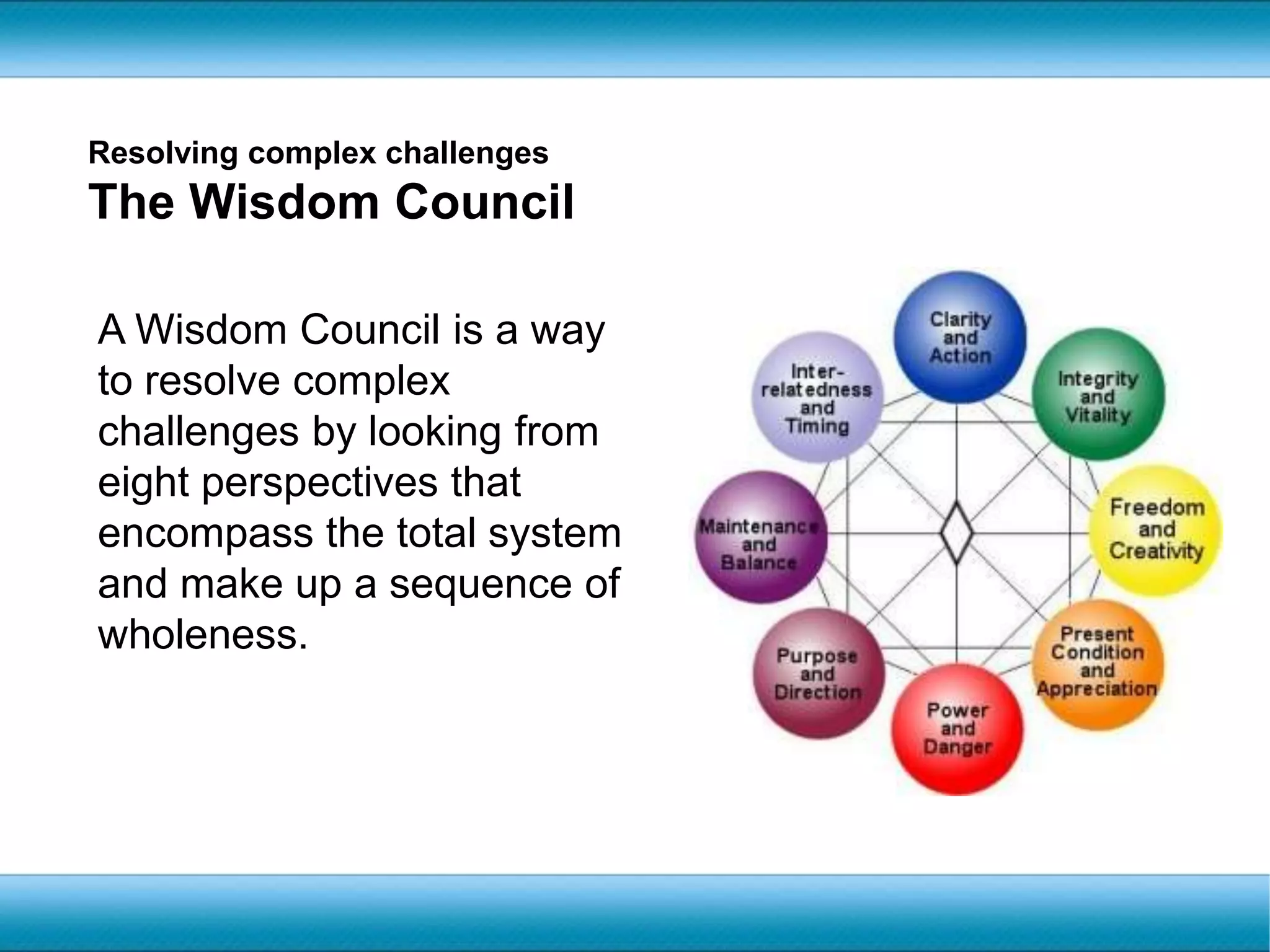
Resolving complex challengesThe Wisdom CouncilA Wisdom Council is a way to resolve complex challenges by looking from eight perspectives that encompass the total system and make up a sequence of wholeness.
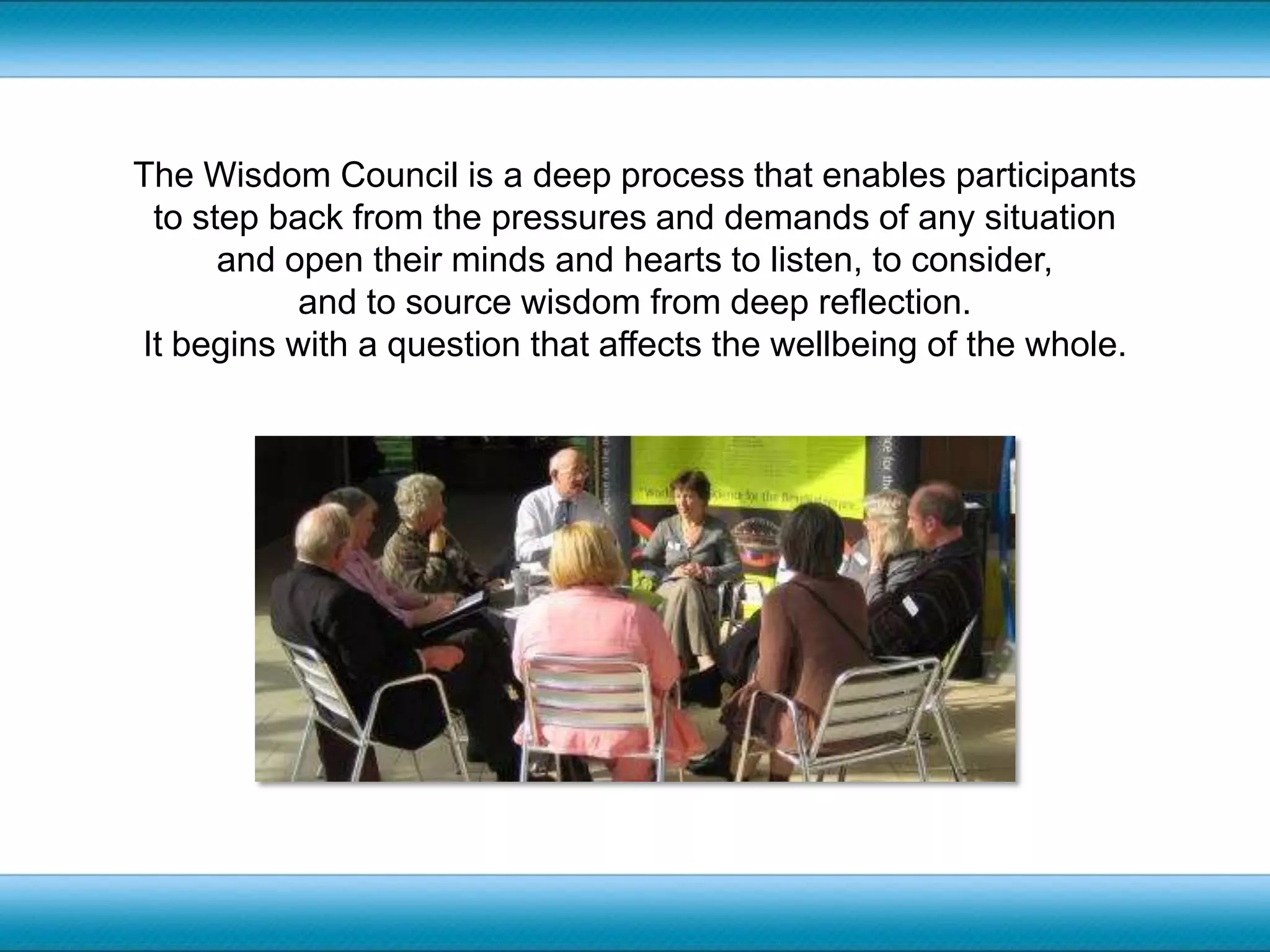
The Wisdom Council is a deep process that enables participants to step back from the pressures and demands of any situation and open their minds and hearts to listen, to consider, and to source wisdom from deep reflection. It begins with a question that affects the wellbeing of the whole.
"I am impressed with the Wisdom Council process.It is simple yet profound."Bob Johansen, President, Institute for the Future
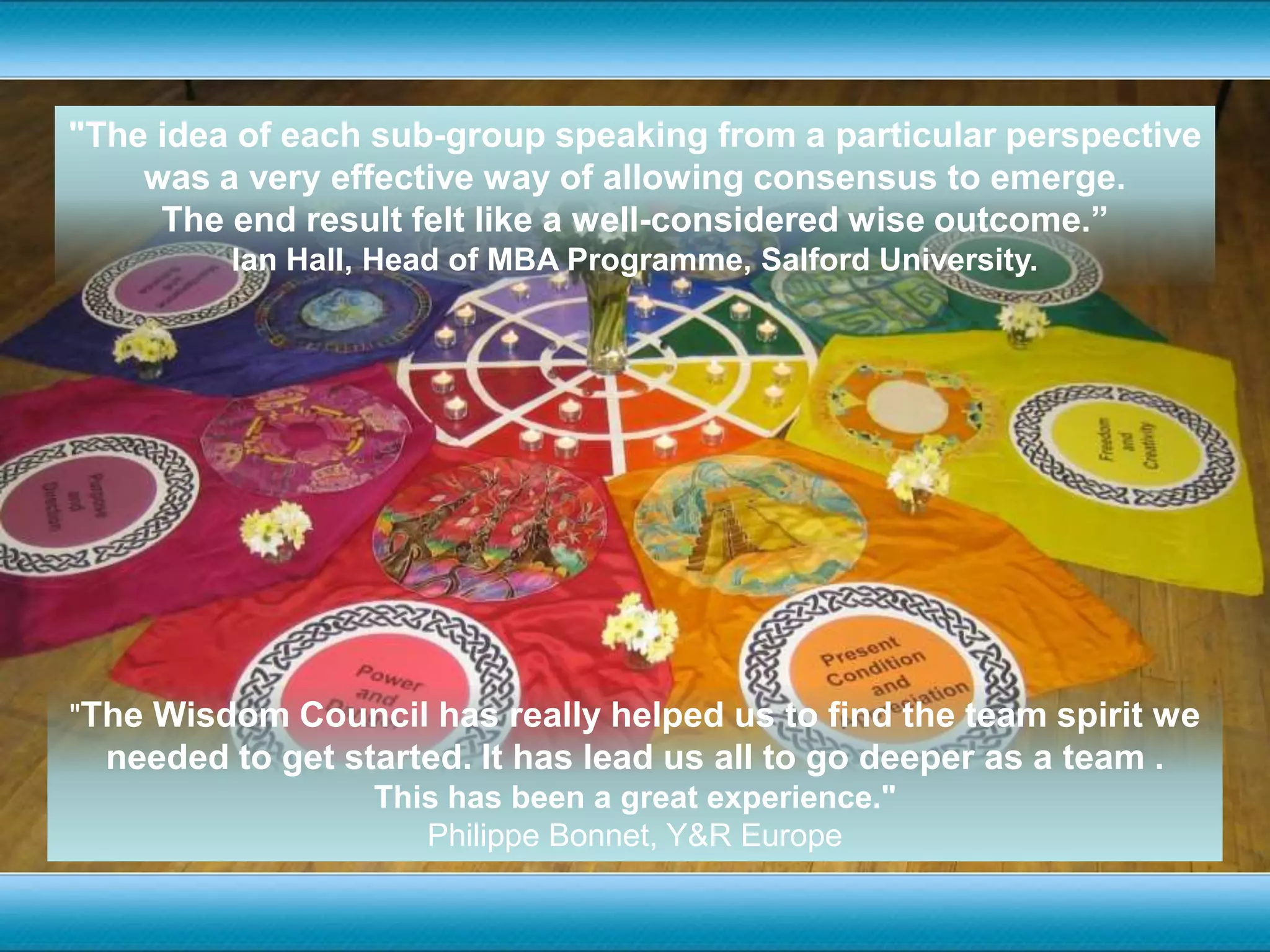
"The idea of each sub-group speaking from a particular perspective was a very effective way of allowing consensus to emerge. The end result felt like a well-considered wise outcome.”Ian Hall, Head of MBA Programme, Salford University."The Wisdom Council has really helped us to find the team spirit we needed to get started. It has lead us all to go deeper as a team . This has been a great experience."Philippe Bonnet, Y&R Europe
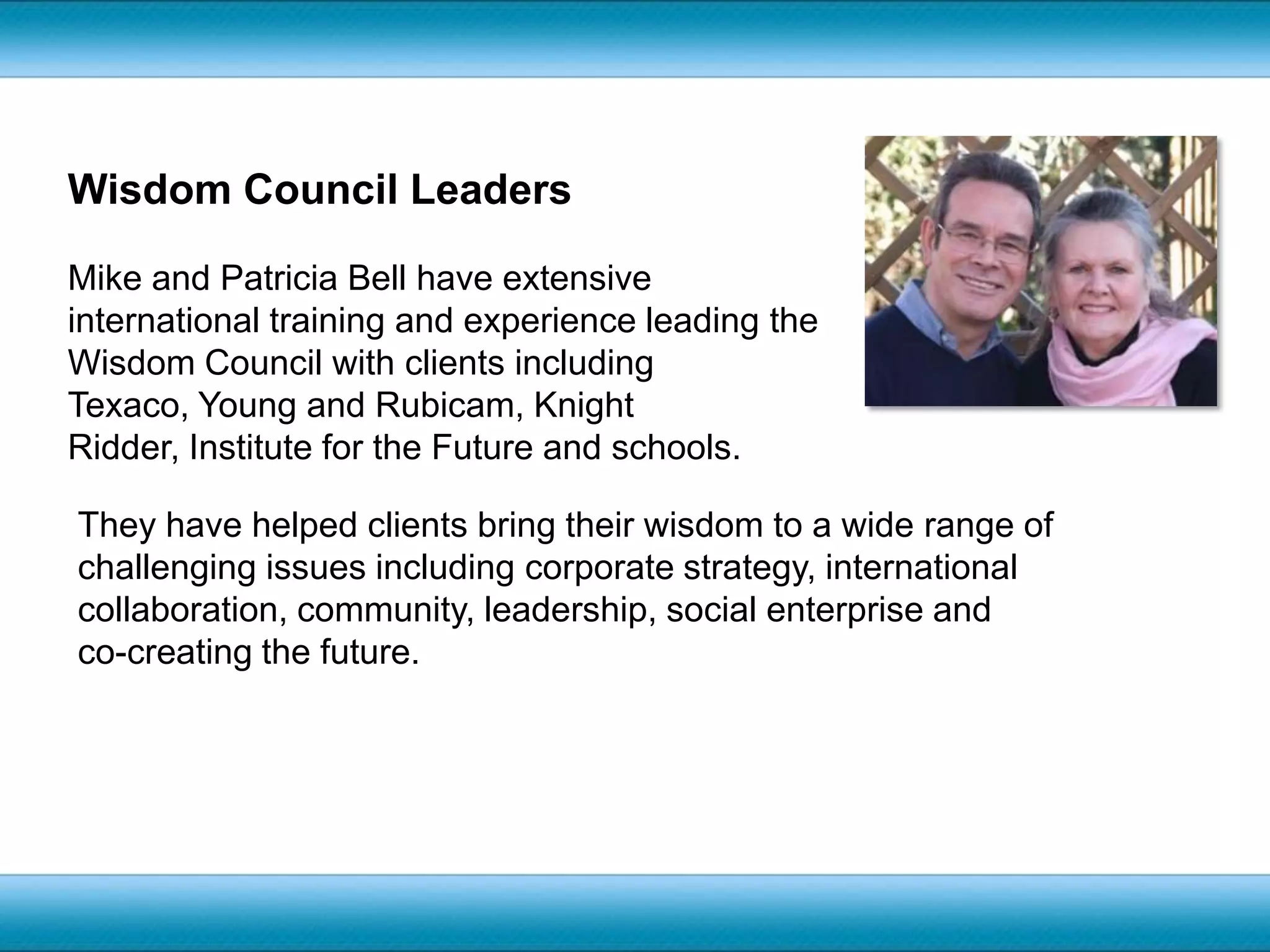
Wisdom Council LeadersMike and Patricia Bell have extensive international training and experience leading the Wisdom Council with clients including Texaco, Young and Rubicam, Knight Ridder, Institute for the Future and schools. They have helped clients bring their wisdom to a wide range of challenging issues including corporate strategy, international collaboration, community, leadership, social enterprise and co-creating the future.
“If you try and take a cat apart to see how it works, the first thing you have on your hands is a non-working cat.”Douglas Adamswww.mutualinspiration.co.uk/WisdomCouncil

The Case for Wisdom

  • 1.
    The Case forWisdomMike Bell, Mutual Inspiration CIC
  • 2.
    What is Wisdom? "Wisdomis a state of the human mind characterized by profound understanding and deep insight.  “Wherever it exists, wisdom shows itself as a perception of the relativity and relationships among things. “It is an awareness of wholeness that does not lose sight of particularity or concreteness, or of the intricacies of interrelationships.” Joseph W. Meeker
  • 3.
    Why is Wisdomimportant?
  • 4.
    A Wisdom ValueChainThe greater our knowledge increases the more our ignorance unfolds. John F. Kennedy
  • 5.
    "In an increasinglydynamic, interdependent and unpredictable world, it is simply no longer possible for anyone to figure it all out at the top“Peter Senge, The Fifth Discipline
  • 6.
    “Many change programmesfail – and the traditional assessment of failure is 75% of the attempts – often because they do not take into account that they are working with a living system and not a machine.” Prof Keith Grint, 2008
  • 7.
    Some problems areClocks and others are Clouds.If they are Clocks, they are complicated.
  • 8.
    But the interconnectedparts can be understood and their actions predicted. Clock problems are solvable by logic and deduction.
  • 9.
    Many of today’sproblems are Clouds.They are diffuse and complex and do not yield to logic and deduction.
  • 10.
    They are complexbecause they’re made up of myriad interconnected parts.These interdependent relationships are difficult to grasp – like the weather, an eco-system, or a human organisation.
  • 11.
    Complex problems, whenthey involve people, are adaptive. As people learn they change, and then what appeared to work yesterday may not work today.
  • 12.
    Complex problems requirecreativity and innovation, and diverse groups are the best source of these.
  • 13.
    As Charles Leadbeatersays in “We-Think”:“In reality, creativity has always been a highly collaborative, cumulative and social activity in which people with different skills, points of view and insight share and develop ideas together.”
  • 14.
    In researching complexsystems, Scott Page found that:“groups made up of many people who think in different ways can trumpgroups of people who are very bright but alike.”
  • 15.
    Complex problems aremore easily understood and resolved when they are looked at from many vantage points. The more people looking, the better the diversity of skills and experience. Alan Kay, an "imagineer" at Disney, said:"Perspective is worth 80 IQ points."
  • 16.
    Complex problems requireus to move beyond information and knowledge to access collective intelligence and release our innate wisdom.Wisdom has to do with intuiting the long-view through understanding systems in the context of their larger whole.
  • 17.
    Wisdom is alsoto do with acting in resonance with what is known to be true and lasting.Only wisdom can guide effective decisions in how we work with challenging issues in the conditions of what Doug Engelbart calls:"complexity multiplied by urgency"
  • 18.
    In the Wisdomof Crowds, James Surowiecki says:“Groups do not need to be dominated by exceptionally intelligent people to be smart. “Even if most of the people within the group are not especially well informed or rational, it can still reach a collectively wise decision.”
  • 19.
    Most of theintractable challenges we face today are complex. The more people we can involve looking at the issues from a range of perspectives, the more likely we are to find wise solutions.And the people who identify the solutions are more likely to implement them.
  • 20.
    Resolving complex challengesTheWisdom CouncilA Wisdom Council is a way to resolve complex challenges by looking from eight perspectives that encompass the total system and make up a sequence of wholeness.
  • 21.
    The Wisdom Councilis a deep process that enables participants to step back from the pressures and demands of any situation and open their minds and hearts to listen, to consider, and to source wisdom from deep reflection. It begins with a question that affects the wellbeing of the whole.
  • 22.
    "I am impressedwith the Wisdom Council process.It is simple yet profound."Bob Johansen, President, Institute for the Future
  • 23.
    "The idea ofeach sub-group speaking from a particular perspective was a very effective way of allowing consensus to emerge. The end result felt like a well-considered wise outcome.”Ian Hall, Head of MBA Programme, Salford University."The Wisdom Council has really helped us to find the team spirit we needed to get started. It has lead us all to go deeper as a team . This has been a great experience."Philippe Bonnet, Y&R Europe
  • 24.
    Wisdom Council LeadersMikeand Patricia Bell have extensive international training and experience leading the Wisdom Council with clients including Texaco, Young and Rubicam, Knight Ridder, Institute for the Future and schools. They have helped clients bring their wisdom to a wide range of challenging issues including corporate strategy, international collaboration, community, leadership, social enterprise and co-creating the future.
  • 25.
    “If you tryand take a cat apart to see how it works, the first thing you have on your hands is a non-working cat.”Douglas Adamswww.mutualinspiration.co.uk/WisdomCouncil