Complexity, Collaboration & Learning While Doing
Not all Issues are Alike Simple Issues Straightforward, ends and means are clearly evident, problem solving is recipe-like and easily replicable, no special expertise is required, experimentation is possible although there is little need for it and there is high confidence of success. Eg. Baking a cake. Complicated Issues Ends may be clear but the means are less so, requiring a process among experts to define. Many logically connected elements. Experts lay out a narrow path for success that has little tolerance for experimentation but high confidence in success if all the right experts have been brought together. The process is transferable to other similar circumstances if followed exactly. Eg. Building a bridge. Complex ‘Wicked’ Issues Uncertainty is high because both ends and means are unclear and must be learned simultaneously. Issue elements may be unknown or unknowable and may evolve over time. Solutions require the construction of positive relationships in order to share multiple perspectives and contributions. Experience is no guarantee of success. Solutions may be optimized for a given moment but are imperfect or incomplete. Each situation is unique and solutions are rarely transportable. Eg. Transforming a community.
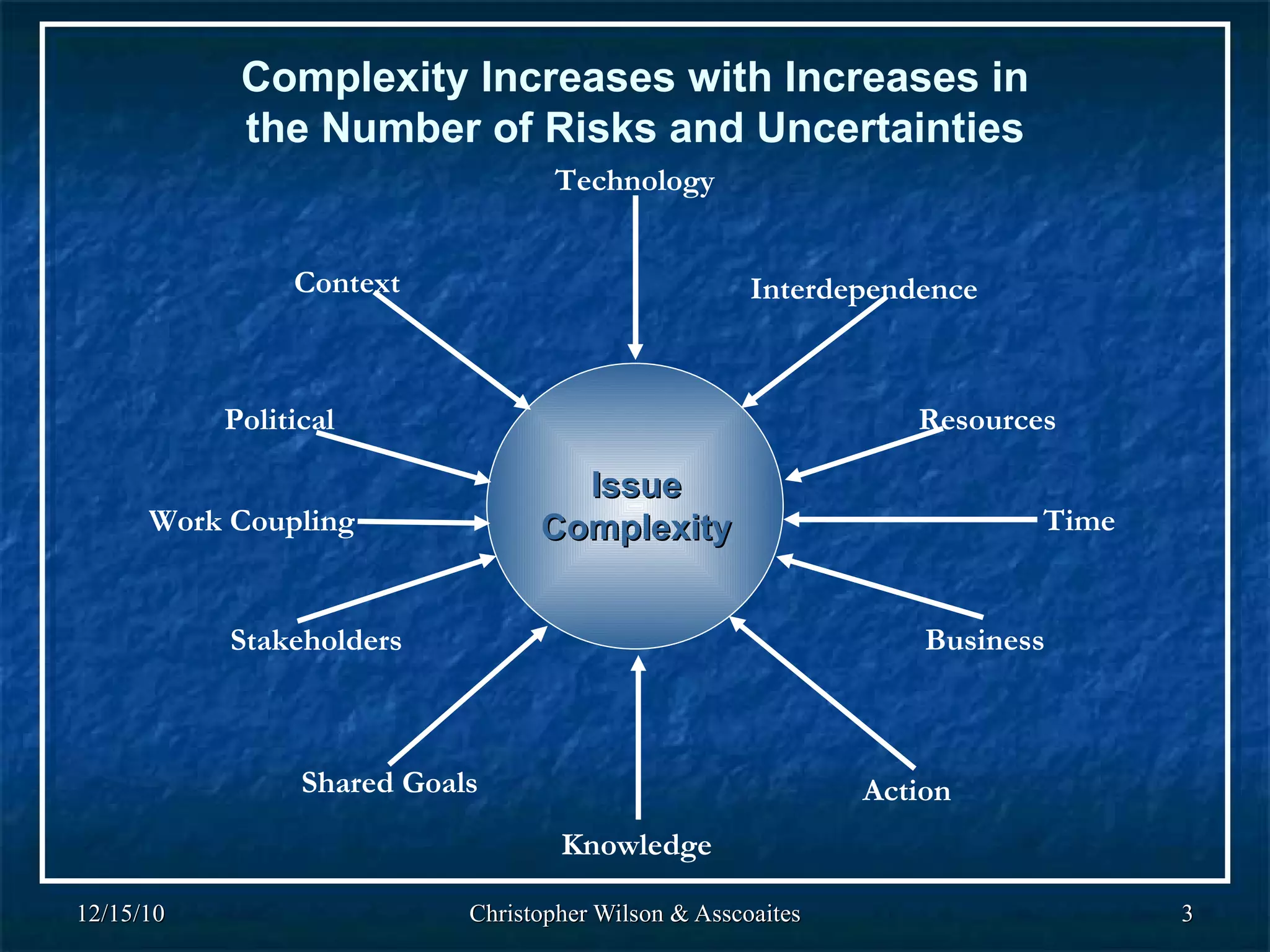
Complexity Increases with Increases in the Number of Risks and Uncertainties Work Coupling Time Issue Complexity Context Technology Resources Business Action Interdependence Political Stakeholders Knowledge Shared Goals
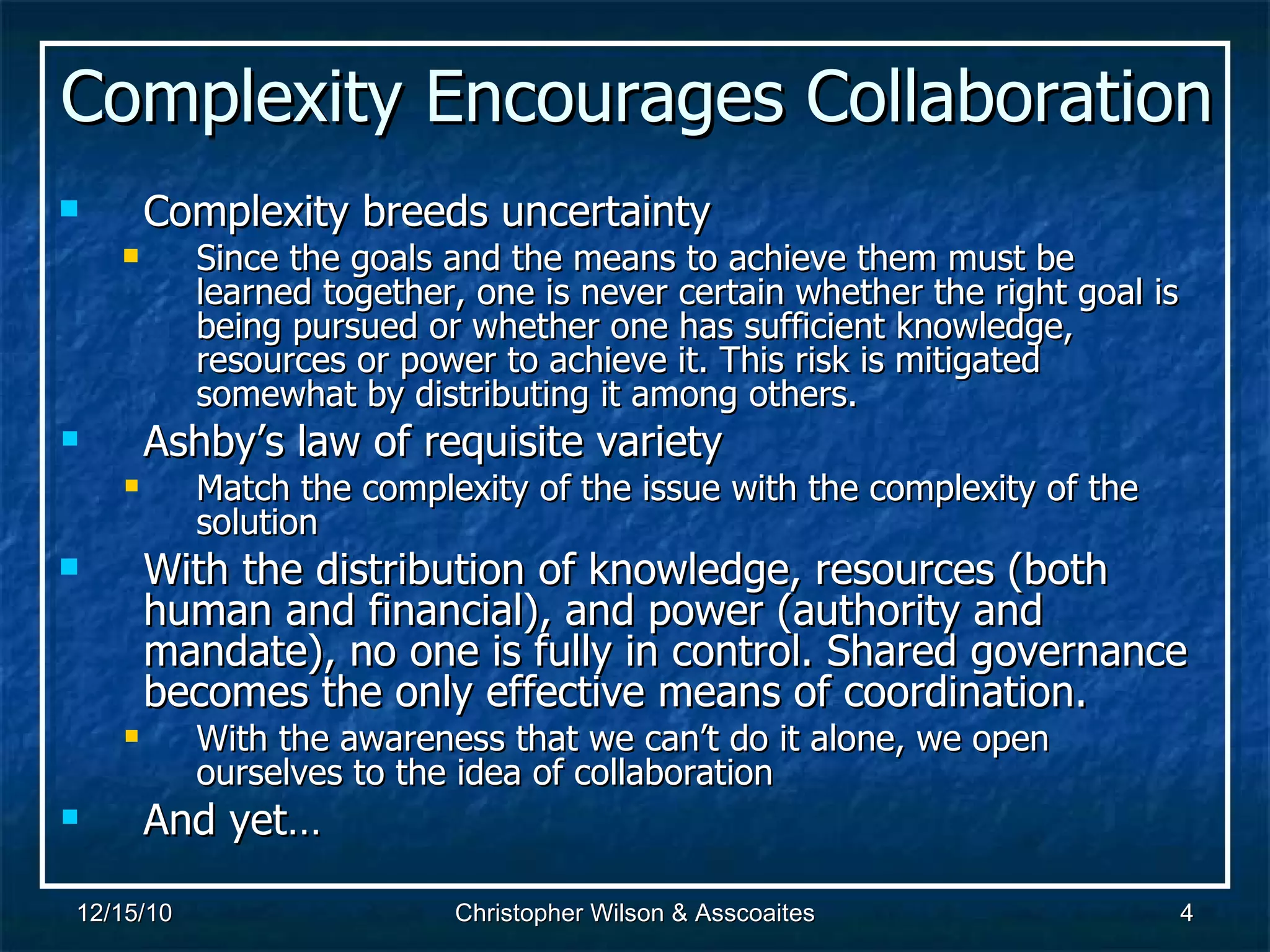
Complexity Encourages Collaboration Complexity breeds uncertainty Since the goals and the means to achieve them must be learned together, one is never certain whether the right goal is being pursued or whether one has sufficient knowledge, resources or power to achieve it. This risk is mitigated somewhat by distributing it among others. Ashby’s law of requisite variety Match the complexity of the issue with the complexity of the solution With the distribution of knowledge, resources (both human and financial), and power (authority and mandate), no one is fully in control. Shared governance becomes the only effective means of coordination. With the awareness that we can’t do it alone, we open ourselves to the idea of collaboration And yet…
A Practitioner’s View of Collaboration “ Collaboration is an unnatural act between non-consenting adults.” “ We all say we want to collaborate, but what we really mean is that we want to continue doing things as we have always done them while others change to fit what we are doing.” Former US Surgeon General, Jocelyn Elders
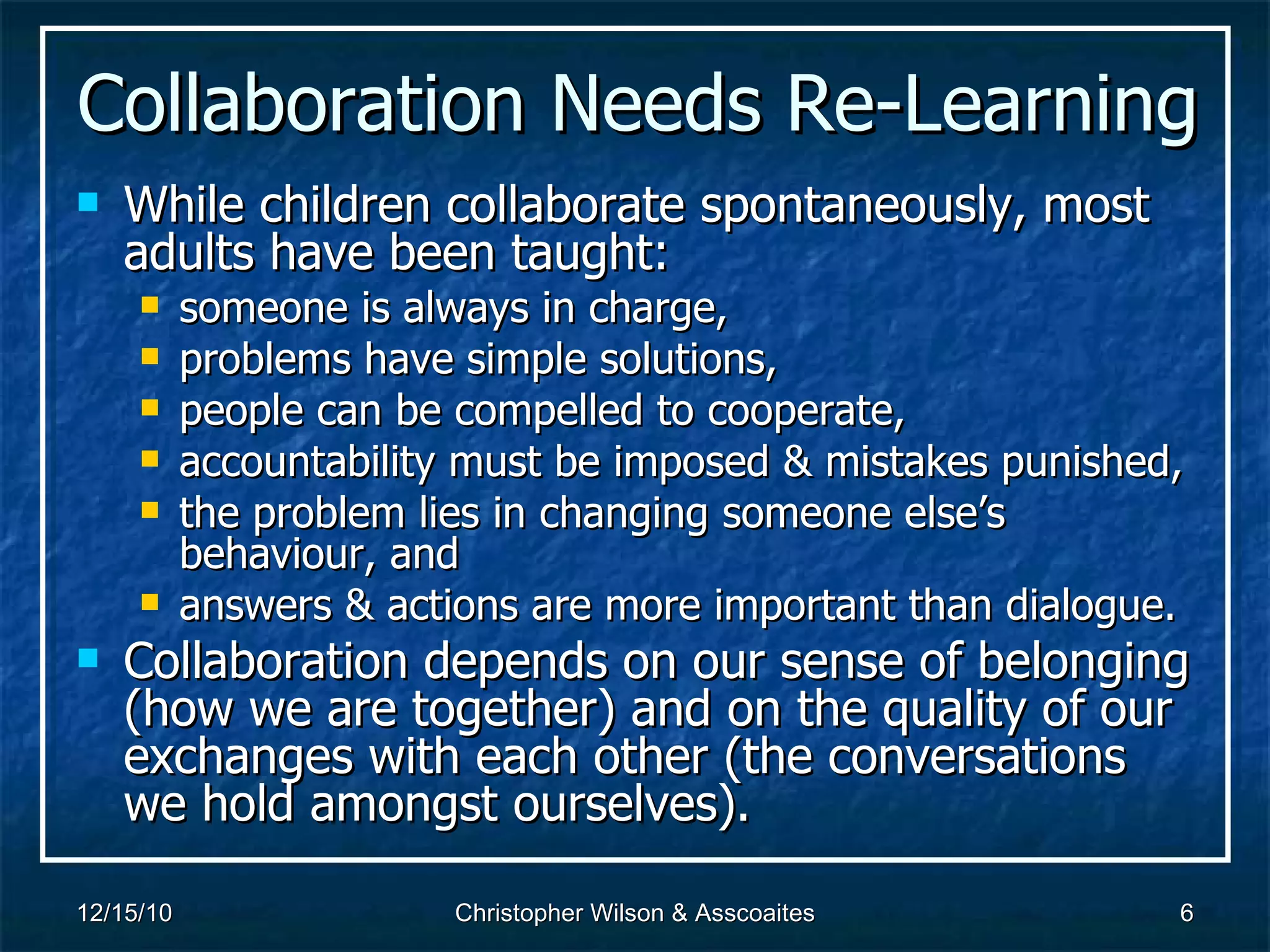
Collaboration Needs Re-Learning While children collaborate spontaneously, most adults have been taught:  someone is always in charge,  problems have simple solutions, people can be compelled to cooperate, accountability must be imposed & mistakes punished, the problem lies in changing someone else’s behaviour, and answers & actions are more important than dialogue. Collaboration depends on our sense of belonging (how we are together) and on the quality of our exchanges with each other (the conversations we hold amongst ourselves).
Practices That Make It Work Socialization practices Pre-collaboration, getting to possibility, purpose, modicum of trust Design Practices Structuring the process w/o structuring the outcome Engagement Practices Empowerment, personalizing, building ownership & commitment Trust practices Building confidence, re-affirming trustworthiness & moral contracting
Practices That Make It Work (cont’d) Governance practices Purpose, principles, people, concepts, structure & processes Working to consensus & multiple accountabilities Operational Practices Appropriate & fair sharing of risks, rewards & workload Learning practices Developing common language Learning while doing & double loop learning Information practices Satisfying learning, contingent cooperation & multiple accountabilities
Collaboration is a process of … Building trusted relationships Bringing into existence shared possibility Reconciling the metaphors which guide our various experiences & knowledge, leading to discovery and shared innovation  Heuristic (trial & error) learning by doing Demonstrating our value to each other Community building & creating a sense of belonging
Collaboration Leads To…  Effective dissemination and exchange of information, Knowledge collaboration   and frame reconciliation, Collective learning,  Shared ownership and decision making,  Rigorous feedback & accountability, Innovation, Shared commitment, The development of new resources, and most importantly The effective and efficient implementation of collaborative endeavours.
At Christopher Wilson & Associates Let Us Help You To Collaborate…   To forge better results To build a future you want to live into To create a nourishing community  And a place of belonging
Thank you Christopher Wilson & Associates PO Box 62024 Ottawa, ON K1C 7H8 [email_address] Tel: 613-355-6505

Complexity, risk and collaboration

  • 1.
    Complexity, Collaboration &Learning While Doing
  • 2.
    Not all Issuesare Alike Simple Issues Straightforward, ends and means are clearly evident, problem solving is recipe-like and easily replicable, no special expertise is required, experimentation is possible although there is little need for it and there is high confidence of success. Eg. Baking a cake. Complicated Issues Ends may be clear but the means are less so, requiring a process among experts to define. Many logically connected elements. Experts lay out a narrow path for success that has little tolerance for experimentation but high confidence in success if all the right experts have been brought together. The process is transferable to other similar circumstances if followed exactly. Eg. Building a bridge. Complex ‘Wicked’ Issues Uncertainty is high because both ends and means are unclear and must be learned simultaneously. Issue elements may be unknown or unknowable and may evolve over time. Solutions require the construction of positive relationships in order to share multiple perspectives and contributions. Experience is no guarantee of success. Solutions may be optimized for a given moment but are imperfect or incomplete. Each situation is unique and solutions are rarely transportable. Eg. Transforming a community.
  • 3.
    Complexity Increases withIncreases in the Number of Risks and Uncertainties Work Coupling Time Issue Complexity Context Technology Resources Business Action Interdependence Political Stakeholders Knowledge Shared Goals
  • 4.
    Complexity Encourages CollaborationComplexity breeds uncertainty Since the goals and the means to achieve them must be learned together, one is never certain whether the right goal is being pursued or whether one has sufficient knowledge, resources or power to achieve it. This risk is mitigated somewhat by distributing it among others. Ashby’s law of requisite variety Match the complexity of the issue with the complexity of the solution With the distribution of knowledge, resources (both human and financial), and power (authority and mandate), no one is fully in control. Shared governance becomes the only effective means of coordination. With the awareness that we can’t do it alone, we open ourselves to the idea of collaboration And yet…
  • 5.
    A Practitioner’s Viewof Collaboration “ Collaboration is an unnatural act between non-consenting adults.” “ We all say we want to collaborate, but what we really mean is that we want to continue doing things as we have always done them while others change to fit what we are doing.” Former US Surgeon General, Jocelyn Elders
  • 6.
    Collaboration Needs Re-LearningWhile children collaborate spontaneously, most adults have been taught: someone is always in charge, problems have simple solutions, people can be compelled to cooperate, accountability must be imposed & mistakes punished, the problem lies in changing someone else’s behaviour, and answers & actions are more important than dialogue. Collaboration depends on our sense of belonging (how we are together) and on the quality of our exchanges with each other (the conversations we hold amongst ourselves).
  • 7.
    Practices That MakeIt Work Socialization practices Pre-collaboration, getting to possibility, purpose, modicum of trust Design Practices Structuring the process w/o structuring the outcome Engagement Practices Empowerment, personalizing, building ownership & commitment Trust practices Building confidence, re-affirming trustworthiness & moral contracting
  • 8.
    Practices That MakeIt Work (cont’d) Governance practices Purpose, principles, people, concepts, structure & processes Working to consensus & multiple accountabilities Operational Practices Appropriate & fair sharing of risks, rewards & workload Learning practices Developing common language Learning while doing & double loop learning Information practices Satisfying learning, contingent cooperation & multiple accountabilities
  • 9.
    Collaboration is aprocess of … Building trusted relationships Bringing into existence shared possibility Reconciling the metaphors which guide our various experiences & knowledge, leading to discovery and shared innovation Heuristic (trial & error) learning by doing Demonstrating our value to each other Community building & creating a sense of belonging
  • 10.
    Collaboration Leads To… Effective dissemination and exchange of information, Knowledge collaboration and frame reconciliation, Collective learning, Shared ownership and decision making, Rigorous feedback & accountability, Innovation, Shared commitment, The development of new resources, and most importantly The effective and efficient implementation of collaborative endeavours.
  • 11.
    At Christopher Wilson& Associates Let Us Help You To Collaborate… To forge better results To build a future you want to live into To create a nourishing community And a place of belonging
  • 12.
    Thank you ChristopherWilson & Associates PO Box 62024 Ottawa, ON K1C 7H8 [email_address] Tel: 613-355-6505

Editor's Notes

  • #5 Ashby’s law of requisite variety Specifically it says that the number of states of its control mechanism must be greater than or equal to the number of states in the system being controlled. This means that to govern any complex issue, the governing system must be as least as complex as the system being governed. No linear, single line of accountability for complex problems. By their very nature complex issues demand complex governance structures usually involving multiple accountabilities that are both horizontal and vertical.