Spotlight on Innovation Mr. Adam Walz, M.Ed., PDI Ninth House Mrs. Véronique-Sophie Bounaud, Axa  May 18 th , 2010
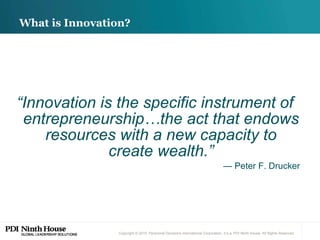
What is Innovation? “ Innovation is the specific instrument of entrepreneurship…the act that endows resources with a new capacity to create wealth.” —  Peter F. Drucker
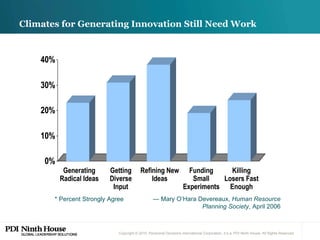
Climates for Generating Innovation Still Need Work  —  Mary O’Hara Devereaux,  Human Resource Planning Society , April 2006 * Percent Strongly Agree
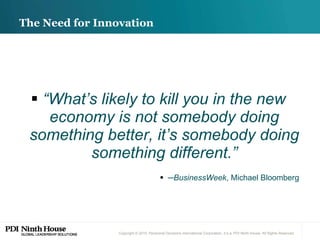
The Need for Innovation “ What’s likely to kill you in the new economy is not somebody doing something better, it’s somebody doing something different.” ─ BusinessWeek , Michael Bloomberg
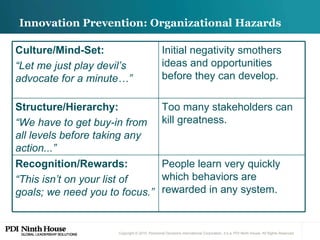
Innovation Prevention: Organizational Hazards  People learn very quickly which behaviors are rewarded in any system. Recognition/Rewards:   “ This isn’t on your list of goals; we need you to focus.” Too many stakeholders can kill greatness.  Structure/Hierarchy:  “ We have to get buy-in from all levels before taking any action...” Initial negativity smothers ideas and opportunities before they can develop. Culture/Mind-Set:   “ Let me just play devil’s advocate for a minute…”
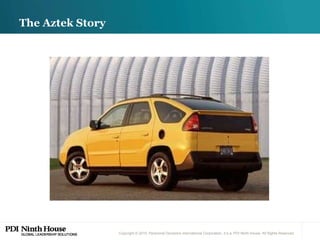
The Aztek Story
Barriers to Innovation What are your organization’s biggest challenges to innovating?
Three Specific Questions What makes innovators different from other employees? How can we increase our workforce’s innovative capacity? How can enterprise 2.0 tools support the people-side of innovation?
What makes innovators different  from other employees? Innovators have developed and honed a strong set of discovery skills.
 
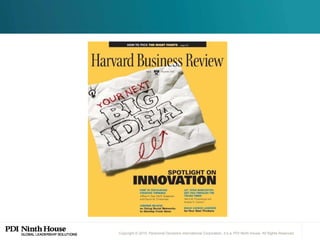
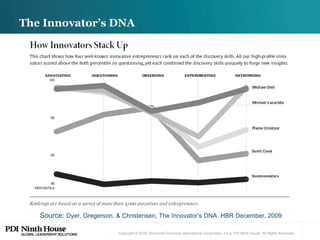
The Innovator’s DNA Source:  Dyer, Gregerson, & Christensen, The Innovator’s DNA. HBR December, 2009
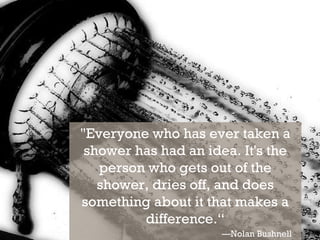
"Everyone who has ever taken a shower has had an idea. It's the person who gets out of the shower, dries off, and does something about it that makes a difference.“ — Nolan Bushnell
How can we increase our workforce’s innovative capacity? 1. Engage the masses  2. Adopt innovation-friendly practices 2. Leverage individual differences 3. Align talent to your innovation cycles
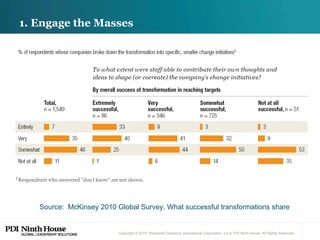
1. Engage the Masses Source:  McKinsey 2010 Global Survey. What successful transformations share
2. Adopt Innovation-Friendly Practices Dress code:  “You must wear clothes”. An organization that is flat, transparent, and non-hierarchical. A company-wide rule that allows developers to devote 20% of their time to any project they choose. “ Keep the bozos out” and reward people who make a difference. Source: Gary Hamel, “Management à la Google,” WSJ, April 26, 2006.
ROWE – “Results-Only Work Environment” Productivity is up an average 35% in departments that have switched  Factoid: It wasn't imposed from the top down.  Created CultureRx – subsidiary to help other companies go clockless. Next Challenge: Implement ROWE in stores. 2. Adopt Innovation-Friendly Practices Source: Michelle Conlin, “Smashing the Clock,” BusinessWeek, December, 2006.
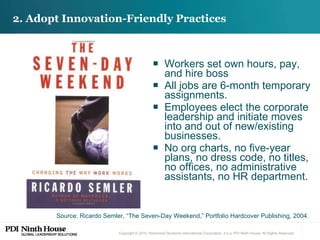
Workers set own hours, pay, and hire boss All jobs are 6-month temporary assignments. Employees elect the corporate leadership and initiate moves into and out of new/existing businesses. No org charts, no five-year plans, no dress code, no titles, no offices, no administrative assistants, no HR department. 2. Adopt Innovation-Friendly Practices Source: Ricardo Semler, “The Seven-Day Weekend,” Portfolio Hardcover Publishing, 2004.
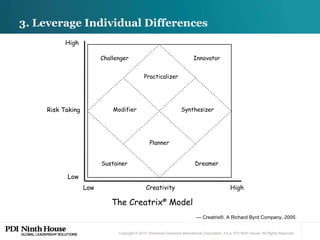
3. Leverage Individual Differences High Risk Taking Low High Low Creativity Challenger Innovator Practicalizer Sustainer Modifier Synthesizer Planner Dreamer The Creatrix ®  Model —  Creatrix®. A Richard Byrd Company, 2005.
Know what  YOU  are good at.
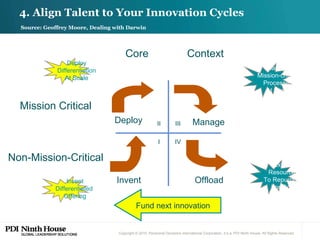
4. Align Talent to Your Innovation Cycles  Source: Geoffrey Moore, Dealing with Darwin Core Context Mission Critical Non-Mission-Critical Manage Mission-critical Processes At Scale Extract Resources To Repurpose For Core Invent Differentiated  Offering Deploy Differentiation At Scale IV III II I Deploy Invent Offload Manage Fund next innovation
How can enterprise 2.0 tools support the people-side of innovation? Enterprise 2.0 tools are capable of creating greater transparency, knowledge-sharing, community, and accountability.
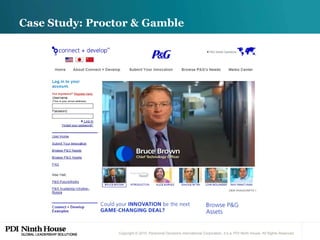
Case Study: Proctor & Gamble
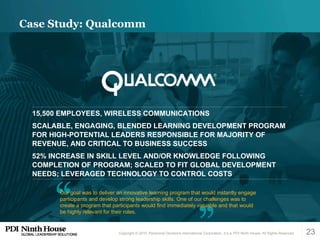
Case Study: Qualcomm  Our goal was to deliver an innovative learning program that would instantly engage participants and develop strong leadership skills. One of our challenges was to create a program that participants would find immediately valuable and that would be highly relevant for their roles. 15,500 EMPLOYEES, WIRELESS COMMUNICATIONS SCALABLE, ENGAGING, BLENDED LEARNING DEVELOPMENT PROGRAM FOR HIGH-POTENTIAL LEADERS RESPONSIBLE FOR MAJORITY OF REVENUE, AND CRITICAL TO BUSINESS SUCCESS 52% INCREASE IN SKILL LEVEL AND/OR KNOWLEDGE FOLLOWING COMPLETION OF PROGRAM; SCALED TO FIT GLOBAL DEVELOPMENT NEEDS; LEVERAGED TECHNOLOGY TO CONTROL COSTS
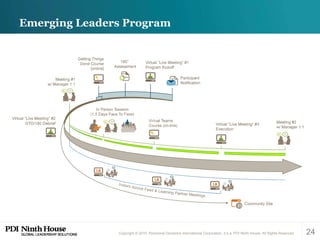
Emerging Leaders Program
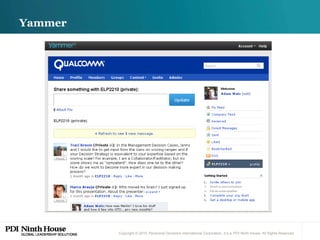
Yammer
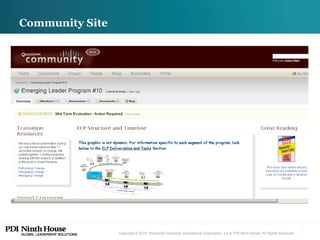
Community Site
Questions / Comments?

Spotlight on Innovation

  • 1.
    Spotlight on InnovationMr. Adam Walz, M.Ed., PDI Ninth House Mrs. Véronique-Sophie Bounaud, Axa May 18 th , 2010
  • 2.
    What is Innovation?“ Innovation is the specific instrument of entrepreneurship…the act that endows resources with a new capacity to create wealth.” — Peter F. Drucker
  • 3.
    Climates for GeneratingInnovation Still Need Work — Mary O’Hara Devereaux, Human Resource Planning Society , April 2006 * Percent Strongly Agree
  • 4.
    The Need forInnovation “ What’s likely to kill you in the new economy is not somebody doing something better, it’s somebody doing something different.” ─ BusinessWeek , Michael Bloomberg
  • 5.
    Innovation Prevention: OrganizationalHazards People learn very quickly which behaviors are rewarded in any system. Recognition/Rewards: “ This isn’t on your list of goals; we need you to focus.” Too many stakeholders can kill greatness. Structure/Hierarchy: “ We have to get buy-in from all levels before taking any action...” Initial negativity smothers ideas and opportunities before they can develop. Culture/Mind-Set: “ Let me just play devil’s advocate for a minute…”
  • 6.
  • 7.
    Barriers to InnovationWhat are your organization’s biggest challenges to innovating?
  • 8.
    Three Specific QuestionsWhat makes innovators different from other employees? How can we increase our workforce’s innovative capacity? How can enterprise 2.0 tools support the people-side of innovation?
  • 9.
    What makes innovatorsdifferent from other employees? Innovators have developed and honed a strong set of discovery skills.
  • 10.
  • 11.
    The Innovator’s DNASource: Dyer, Gregerson, & Christensen, The Innovator’s DNA. HBR December, 2009
  • 12.
    "Everyone who hasever taken a shower has had an idea. It's the person who gets out of the shower, dries off, and does something about it that makes a difference.“ — Nolan Bushnell
  • 13.
    How can weincrease our workforce’s innovative capacity? 1. Engage the masses 2. Adopt innovation-friendly practices 2. Leverage individual differences 3. Align talent to your innovation cycles
  • 14.
    1. Engage theMasses Source: McKinsey 2010 Global Survey. What successful transformations share
  • 15.
    2. Adopt Innovation-FriendlyPractices Dress code: “You must wear clothes”. An organization that is flat, transparent, and non-hierarchical. A company-wide rule that allows developers to devote 20% of their time to any project they choose. “ Keep the bozos out” and reward people who make a difference. Source: Gary Hamel, “Management à la Google,” WSJ, April 26, 2006.
  • 16.
    ROWE – “Results-OnlyWork Environment” Productivity is up an average 35% in departments that have switched Factoid: It wasn't imposed from the top down. Created CultureRx – subsidiary to help other companies go clockless. Next Challenge: Implement ROWE in stores. 2. Adopt Innovation-Friendly Practices Source: Michelle Conlin, “Smashing the Clock,” BusinessWeek, December, 2006.
  • 17.
    Workers set ownhours, pay, and hire boss All jobs are 6-month temporary assignments. Employees elect the corporate leadership and initiate moves into and out of new/existing businesses. No org charts, no five-year plans, no dress code, no titles, no offices, no administrative assistants, no HR department. 2. Adopt Innovation-Friendly Practices Source: Ricardo Semler, “The Seven-Day Weekend,” Portfolio Hardcover Publishing, 2004.
  • 18.
    3. Leverage IndividualDifferences High Risk Taking Low High Low Creativity Challenger Innovator Practicalizer Sustainer Modifier Synthesizer Planner Dreamer The Creatrix ® Model — Creatrix®. A Richard Byrd Company, 2005.
  • 19.
    Know what YOU are good at.
  • 20.
    4. Align Talentto Your Innovation Cycles Source: Geoffrey Moore, Dealing with Darwin Core Context Mission Critical Non-Mission-Critical Manage Mission-critical Processes At Scale Extract Resources To Repurpose For Core Invent Differentiated Offering Deploy Differentiation At Scale IV III II I Deploy Invent Offload Manage Fund next innovation
  • 21.
    How can enterprise2.0 tools support the people-side of innovation? Enterprise 2.0 tools are capable of creating greater transparency, knowledge-sharing, community, and accountability.
  • 22.
  • 23.
    Case Study: Qualcomm Our goal was to deliver an innovative learning program that would instantly engage participants and develop strong leadership skills. One of our challenges was to create a program that participants would find immediately valuable and that would be highly relevant for their roles. 15,500 EMPLOYEES, WIRELESS COMMUNICATIONS SCALABLE, ENGAGING, BLENDED LEARNING DEVELOPMENT PROGRAM FOR HIGH-POTENTIAL LEADERS RESPONSIBLE FOR MAJORITY OF REVENUE, AND CRITICAL TO BUSINESS SUCCESS 52% INCREASE IN SKILL LEVEL AND/OR KNOWLEDGE FOLLOWING COMPLETION OF PROGRAM; SCALED TO FIT GLOBAL DEVELOPMENT NEEDS; LEVERAGED TECHNOLOGY TO CONTROL COSTS
  • 24.
  • 25.
  • 26.
  • 27.

Editor's Notes

  • #2 © 2008 PDI Ninth House. All rights reserved. Editable. See appendix for examples.
  • #24 © 2008 PDI Ninth House. All rights reserved.
  • #25 © 2008 PDI Ninth House. All rights reserved.