CHAPTER 12
THE STRUGGLE CONTINUES

THE HONGKONG JUNTA

THE RELIEF OF PRIMO DE RIVERA

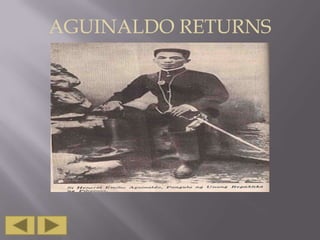
AGUINALDO RETURNS

THE SPANISH AMERICAN WAR

THE STRUGGLE CONTINUES

THE BATTLE OF MANILA BAY

THE SIEGE OF MANILA

AGUINALDO GOES TO SINGAPORE

THE SECRET AGREEMENT

THE INTERVIEW WITH PRATT

THE MOCK BATTLE OF MANILA

AGUINALDO AND WILDMAN

AMERICAN TERMS
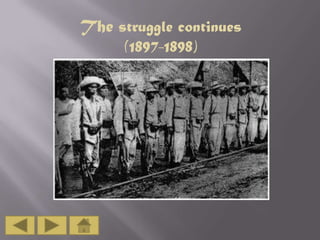
The struggle continues
(1897-1898)
Governor General Primo de
Rivera’s success in the
battlefield of Cavite over
Aguinaldo’s forces could have
ended the Revolution.
Instead a truce agreed upon,
apparently an attempt on both
sides to recover from their
losses and resume fighting
later.
Some Filipinos, in fact,
continued to engaged the
Spanish forces and established
a temporary government like the
Makabulos “Republic” in
Tarlac.
Even before the Filipinos could recover
from the battles of 1896, General Emilio
Aguinaldo, as the recognized leader of
the Filipinos in exile in Hongkong and at
Home, negotiated the situation with the
Americans to delay confrontation with an
obviously more powerful country.
But the united states misled Aguinaldo to
believe that the Americans came as an ally
of the Filipinos in their fight to end
Spanish rule in the country. But in the
end, the Filipinos fears and suspicious
proved to be true. The American came to
stay and eventually took over as the new
colonial master.
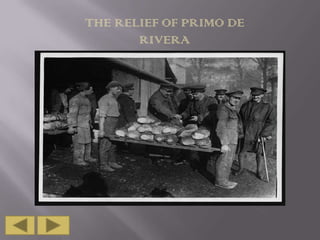
THE RELIEF OF PRIMO DE
RIVERA
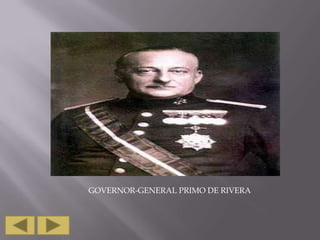
GOVERNOR-GENERAL
PRIMO de RIVERA’s success in
stopping the bloodshed was highly praised in
spain. The queen of Spain, who was reigning for
her son, rewarded him with the Grand Cross of
San Fernando and a pension of about P10,000.
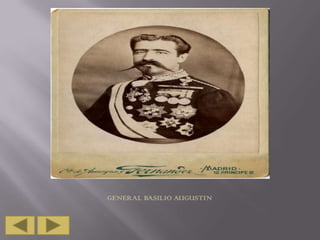
GENERAL BASILIO
AUGUSTIN sent as governor-general to
succeed Primo de Rivera.
GENERAL BASILIO AUGUSTIN
Primo de Rivera knew the Philippines very
well because he had serve previously as
Governor of the country from 1880 to 1883.
With the possibility of a war between the
united states and Spain, Governor Primo de
Rivera would have been a wise choice to
govern the archipelago since he knew the
Filipinos well.
GOVERNOR-GENERAL PRIMO DE RIVERA
On April 9, 1898, General
Augustine arrived in
Manila and the following day
Primo de Rivera turned over
the reins of government to
him.
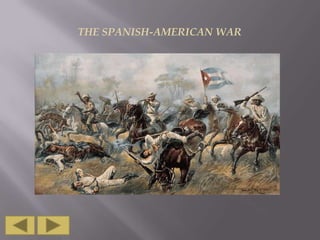
THE SPANISH-AMERICAN WAR
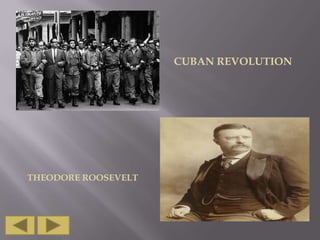
The Cuban revolution had won the sympathy
of the Americans because the latter had big
investments in Cuba which they did not want
to be destroyed. Some in influential
Americans, Theodore Roosevelt, wanted
war with Spain so that the American navy
could expand. In 1897, he became Assistant
Secretary of the Navy.
CUBAN REVOLUTION

THEODORE ROOSEVELT
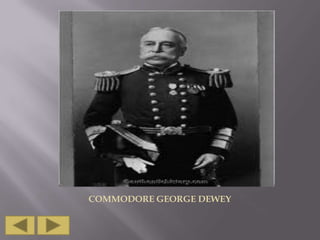
Roosevelt worked for the appointment
of Commodore George Dewey as
commander of the American Asiatic
Squadron. On February 25, 1898,
Roosevelt told Dewey to make
Hongkong, which was very near in
Manila, as his base of operations.
COMMODORE GEORGE DEWEY
On February 15,1898, the American
battleship, USS MAINE
exploded at Havana Harbor in Cuba.
Spain was blamed for the mishap.
More two hundred American sailors
and officers died. So on April
25,1989, the Congress of the United
States formally declared war on Spain.
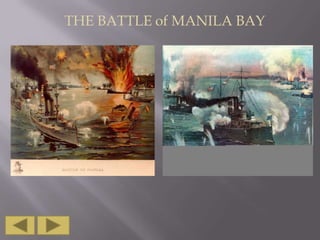
THE BATTLE of MANILA BAY
Dewey received a message by cable
from the Secretary of War. It said:
“War has commenced between the
United States and Spain. Proceed
particularly against the Spanish fleet.
You must capture vessels or destroy.
Use utmost endeavor.
Dewey ordered his fleet to sail for
Manila Bay. Quietly, his fleet
entered the bay in the early morning
hours of May 1, 1898. The Spanish
batteries in Corregidor were too late
in detecting passage of the fleet.
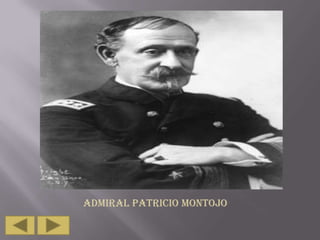
Spanish squadron, commanded by
Admiral Patricio Montojo, was
waiting near Sangley Point, Cavite.
ADMIRAL PATRICIO MONTOJO
Montojo was watching
Dewey’s course as he entered
Manila Bay. Dewey spotted
the Spanish ships and ordered
his fleet to turn back and sail
toward Cavite. Standing on the
bridge of the flagship USS
Olympia.
AGUINALDO GOES TO SINGAPORE
It was early on April of 1898 when
rumors has already reached Manila
that war between Spain and the
United States was to be declared any
time. Isabelo Artacho, one of the
plagiarists of the Cuban
Constitution, went to Hongkong and
demanded Aguinaldo to divide the
P400,000 indemnity that was given
by the colonial government to the
rebels.
To avoid a scandal, Aguinaldo
was advised by Felipe
Agoncillo to leave Hongkong.
Two companions, Gregorio
Del Pilar and Jose Leyba,
Aguinaldo left for Singapore.
THE INTERVIEW WITH PRATT
Aguinaldo and his companions arrived
in Singapore on April 23, 1898. An
Englishman, Howard Bray, who had
lived in the Philippines for a long time,
came to visit Aguinaldo. Aguinaldo
came to Singapore incognito. Pratt
made all the arrangements for
Aguinaldo’s return to Hongkong.
FELIPE AGONCILLO
AGUINALDO AND WILDMAN
On April
26, 1898, Aguinaldo and his
companions sailed for
Hongkong. Dewey had already
left for Manila when
Aguinaldo arrived in the
Brirish colony.
The American consul at
Hongkong, Rounseville Wildman,
told him that Dewey had left
instructions for the return of
Aguinaldo to the Philippines.
Aguinaldo should established a
government like that of the United
States.
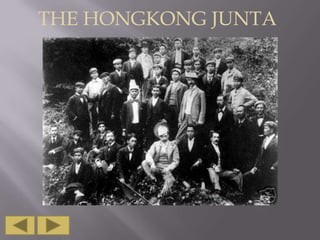
THE HONGKONG JUNTA
When Dewey won the Battle
of Manila Bay and News
about it reached all parts of the
world, the Filipino patriots in
Hongkong met to discuss the
steps to be taken to take over the
Philippines.
Aguinaldo told the Junta that the
situation in the Philippines was
very serious and sought their
opinions over the matter. There was
an exchange of points of view and
the Junta unanimously decided that
Aguinaldo should return to the
Philippines.
AGUINALDO RETURNS
Aguinaldo accepted the Junta’s decision,
for he had faith and confidence in its
members. Members of Junta, were Felipe
Agoncillo as President with Doroteo
Lopez as secretary; Teodoro Santico,
Anastacio Francisco, Mariano Llanera,
Miguel Malvar, Andres Garchitorena,
Severo Buenaventura, Maximo Kabigting,
Faustino Lichauco, and Antonio
Montenegro.
On May 17, 1898, Aguinaldo
boarded the American revenue
cutter McCulloch, which was
bound for Manila. The ship
arrived in Manila Bay two
days later.
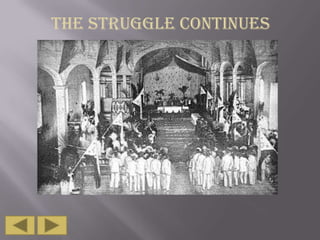
THE STRUGGLE CONTINUES
When Aguinaldo had finished disembarking
the war equipment which were purchased in
Hongkong, Filipino rebels came to pay him a
visit. On May 21, Aguinaldo issued a
proclamtion saying that, “ Everything appears
favorable for attaining independence … I urge
that we strive to unite our efforts, and let us
fire our hearts with the idea of vindicating
our country. Many nations are on our side.”
The end of May, Aguinaldo’s armed
forces had captured about 5,000
prisoners. Town after town, in Cavite and
Morong, fell into the hands of the
Filipino rebels. In
Pampanga, Laguna, Batangas, Bulacan
, Nueva Ecija, Tayabas, Bataan and
Camarines, the people were up in arms
against Spain.
June 1898, practically the whole of
Luzon, with the exception of the Port
of Cavite, which was in American
hands, and the City of Manila, which
was under the Spaniards, was in the
hands of the Filipino rebels. On June
12,1898, Aguinaldo signed the
Proclamation of the Philippine
Independence in Kawit, Cavite.
THE SIEGE OF MANILA
The defeat of the Spanish fleet
discouraged the Spanish officials in
the City to prevent the Filipino
population from siding with
Aguinaldo, Governor-General Basilio
Augustin issued a circular saying that
the unity of the Philippines and its
liberties lay with Spain.
The Filipino rebels besieged
Manila, which was then called
Intramuros or the Walled City.
Dewey could not deploy troops in
Manila because he did not have
enough soldiers aboard the battleship.
THE SECRET AGREEMENT
In June and July, however, American
troops arrived in Manila Bay. They
landed in Paranaque and encamped south of
Pasay. General Arthur MacArthur,
believed that they could fight the Spaniards.
Governor was ready to surrender to the
Americans, but the government of Spain
did not like this. He was relieved of his
duty and was succeeded by General Fermin
Jaudenes.
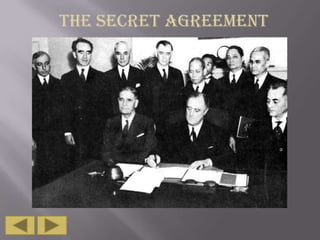
Jaudenes believed that the
Spanish position was very
weak. He entered into a secret
agreement with Dewey and
General Wesley Meritt.
THE MOCK BATTLE OF MANILA
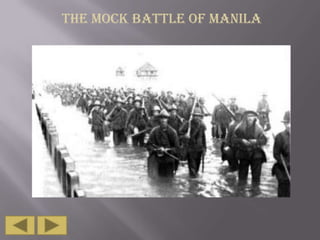
It was August 13, 1898, there
was a downpour because the rainy
season had arrived. The American
soldiers walked quietly towards the
walls of the city in preparation for
the “battle”.
When the firing started, the
Filipino soldiers advanced.
General Meritt ordered
General Francis V. Greene
to stop the Filipinos.
THE AMERICAN TERMS
At five o’clock in the afternoon of
August 13, the Spanish governor-general
agreed to sign the surrender document.
Meanwhile, in Washington, D.C., the
protocol of peace was signed by the
representatives of Spain and the United
States. According to this protocol, both
nations would appoint not more than five
commissioners each.
These commissioners were to meet on
October 1, 1898 in Paris, France to discuss
the terms of peace treaty. On August
12, Washington time, President William
McKinley of the United States issued a
proclamation ordering that “all military
operation was cabled to General Meritt in
Manila. However because Dewey cut the
cable linking in Manila with the outside
world after the battle of Manila Bay.
Meritt received the proclamation
on August 16, three days after the
mock battle of Manila. The
Americans who had promised
friendship and alliance to
Aguinaldo’s forces had taken over
the Philippines.
Submitted By:

JOANA MARIE R. PEREZ

&

JUDECEL CLAVERIA

Chapter 12 The Struggle Continues (1897-1898)

  • 1.
    CHAPTER 12 THE STRUGGLECONTINUES THE HONGKONG JUNTA THE RELIEF OF PRIMO DE RIVERA AGUINALDO RETURNS THE SPANISH AMERICAN WAR THE STRUGGLE CONTINUES THE BATTLE OF MANILA BAY THE SIEGE OF MANILA AGUINALDO GOES TO SINGAPORE THE SECRET AGREEMENT THE INTERVIEW WITH PRATT THE MOCK BATTLE OF MANILA AGUINALDO AND WILDMAN AMERICAN TERMS
  • 2.
  • 3.
    Governor General Primode Rivera’s success in the battlefield of Cavite over Aguinaldo’s forces could have ended the Revolution.
  • 4.
    Instead a truceagreed upon, apparently an attempt on both sides to recover from their losses and resume fighting later.
  • 5.
    Some Filipinos, infact, continued to engaged the Spanish forces and established a temporary government like the Makabulos “Republic” in Tarlac.
  • 6.
    Even before theFilipinos could recover from the battles of 1896, General Emilio Aguinaldo, as the recognized leader of the Filipinos in exile in Hongkong and at Home, negotiated the situation with the Americans to delay confrontation with an obviously more powerful country.
  • 7.
    But the unitedstates misled Aguinaldo to believe that the Americans came as an ally of the Filipinos in their fight to end Spanish rule in the country. But in the end, the Filipinos fears and suspicious proved to be true. The American came to stay and eventually took over as the new colonial master.
  • 8.
    THE RELIEF OFPRIMO DE RIVERA
  • 9.
    GOVERNOR-GENERAL PRIMO de RIVERA’ssuccess in stopping the bloodshed was highly praised in spain. The queen of Spain, who was reigning for her son, rewarded him with the Grand Cross of San Fernando and a pension of about P10,000. GENERAL BASILIO AUGUSTIN sent as governor-general to succeed Primo de Rivera.
  • 10.
  • 11.
    Primo de Riveraknew the Philippines very well because he had serve previously as Governor of the country from 1880 to 1883. With the possibility of a war between the united states and Spain, Governor Primo de Rivera would have been a wise choice to govern the archipelago since he knew the Filipinos well.
  • 12.
  • 13.
    On April 9,1898, General Augustine arrived in Manila and the following day Primo de Rivera turned over the reins of government to him.
  • 14.
  • 15.
    The Cuban revolutionhad won the sympathy of the Americans because the latter had big investments in Cuba which they did not want to be destroyed. Some in influential Americans, Theodore Roosevelt, wanted war with Spain so that the American navy could expand. In 1897, he became Assistant Secretary of the Navy.
  • 16.
  • 17.
    Roosevelt worked forthe appointment of Commodore George Dewey as commander of the American Asiatic Squadron. On February 25, 1898, Roosevelt told Dewey to make Hongkong, which was very near in Manila, as his base of operations.
  • 18.
  • 19.
    On February 15,1898,the American battleship, USS MAINE exploded at Havana Harbor in Cuba. Spain was blamed for the mishap. More two hundred American sailors and officers died. So on April 25,1989, the Congress of the United States formally declared war on Spain.
  • 20.
    THE BATTLE ofMANILA BAY
  • 21.
    Dewey received amessage by cable from the Secretary of War. It said: “War has commenced between the United States and Spain. Proceed particularly against the Spanish fleet. You must capture vessels or destroy. Use utmost endeavor.
  • 22.
    Dewey ordered hisfleet to sail for Manila Bay. Quietly, his fleet entered the bay in the early morning hours of May 1, 1898. The Spanish batteries in Corregidor were too late in detecting passage of the fleet. Spanish squadron, commanded by Admiral Patricio Montojo, was waiting near Sangley Point, Cavite.
  • 23.
  • 24.
    Montojo was watching Dewey’scourse as he entered Manila Bay. Dewey spotted the Spanish ships and ordered his fleet to turn back and sail toward Cavite. Standing on the bridge of the flagship USS Olympia.
  • 25.
  • 26.
    It was earlyon April of 1898 when rumors has already reached Manila that war between Spain and the United States was to be declared any time. Isabelo Artacho, one of the plagiarists of the Cuban Constitution, went to Hongkong and demanded Aguinaldo to divide the P400,000 indemnity that was given by the colonial government to the rebels.
  • 28.
    To avoid ascandal, Aguinaldo was advised by Felipe Agoncillo to leave Hongkong. Two companions, Gregorio Del Pilar and Jose Leyba, Aguinaldo left for Singapore.
  • 29.
  • 30.
    Aguinaldo and hiscompanions arrived in Singapore on April 23, 1898. An Englishman, Howard Bray, who had lived in the Philippines for a long time, came to visit Aguinaldo. Aguinaldo came to Singapore incognito. Pratt made all the arrangements for Aguinaldo’s return to Hongkong.
  • 31.
  • 32.
  • 33.
    On April 26, 1898,Aguinaldo and his companions sailed for Hongkong. Dewey had already left for Manila when Aguinaldo arrived in the Brirish colony.
  • 34.
    The American consulat Hongkong, Rounseville Wildman, told him that Dewey had left instructions for the return of Aguinaldo to the Philippines. Aguinaldo should established a government like that of the United States.
  • 35.
  • 36.
    When Dewey wonthe Battle of Manila Bay and News about it reached all parts of the world, the Filipino patriots in Hongkong met to discuss the steps to be taken to take over the Philippines.
  • 37.
    Aguinaldo told theJunta that the situation in the Philippines was very serious and sought their opinions over the matter. There was an exchange of points of view and the Junta unanimously decided that Aguinaldo should return to the Philippines.
  • 38.
  • 39.
    Aguinaldo accepted theJunta’s decision, for he had faith and confidence in its members. Members of Junta, were Felipe Agoncillo as President with Doroteo Lopez as secretary; Teodoro Santico, Anastacio Francisco, Mariano Llanera, Miguel Malvar, Andres Garchitorena, Severo Buenaventura, Maximo Kabigting, Faustino Lichauco, and Antonio Montenegro.
  • 40.
    On May 17,1898, Aguinaldo boarded the American revenue cutter McCulloch, which was bound for Manila. The ship arrived in Manila Bay two days later.
  • 41.
  • 42.
    When Aguinaldo hadfinished disembarking the war equipment which were purchased in Hongkong, Filipino rebels came to pay him a visit. On May 21, Aguinaldo issued a proclamtion saying that, “ Everything appears favorable for attaining independence … I urge that we strive to unite our efforts, and let us fire our hearts with the idea of vindicating our country. Many nations are on our side.”
  • 43.
    The end ofMay, Aguinaldo’s armed forces had captured about 5,000 prisoners. Town after town, in Cavite and Morong, fell into the hands of the Filipino rebels. In Pampanga, Laguna, Batangas, Bulacan , Nueva Ecija, Tayabas, Bataan and Camarines, the people were up in arms against Spain.
  • 44.
    June 1898, practicallythe whole of Luzon, with the exception of the Port of Cavite, which was in American hands, and the City of Manila, which was under the Spaniards, was in the hands of the Filipino rebels. On June 12,1898, Aguinaldo signed the Proclamation of the Philippine Independence in Kawit, Cavite.
  • 45.
  • 46.
    The defeat ofthe Spanish fleet discouraged the Spanish officials in the City to prevent the Filipino population from siding with Aguinaldo, Governor-General Basilio Augustin issued a circular saying that the unity of the Philippines and its liberties lay with Spain.
  • 47.
    The Filipino rebelsbesieged Manila, which was then called Intramuros or the Walled City. Dewey could not deploy troops in Manila because he did not have enough soldiers aboard the battleship.
  • 48.
  • 49.
    In June andJuly, however, American troops arrived in Manila Bay. They landed in Paranaque and encamped south of Pasay. General Arthur MacArthur, believed that they could fight the Spaniards. Governor was ready to surrender to the Americans, but the government of Spain did not like this. He was relieved of his duty and was succeeded by General Fermin Jaudenes.
  • 50.
    Jaudenes believed thatthe Spanish position was very weak. He entered into a secret agreement with Dewey and General Wesley Meritt.
  • 51.
    THE MOCK BATTLEOF MANILA
  • 52.
    It was August13, 1898, there was a downpour because the rainy season had arrived. The American soldiers walked quietly towards the walls of the city in preparation for the “battle”.
  • 53.
    When the firingstarted, the Filipino soldiers advanced. General Meritt ordered General Francis V. Greene to stop the Filipinos.
  • 54.
  • 55.
    At five o’clockin the afternoon of August 13, the Spanish governor-general agreed to sign the surrender document. Meanwhile, in Washington, D.C., the protocol of peace was signed by the representatives of Spain and the United States. According to this protocol, both nations would appoint not more than five commissioners each.
  • 56.
    These commissioners wereto meet on October 1, 1898 in Paris, France to discuss the terms of peace treaty. On August 12, Washington time, President William McKinley of the United States issued a proclamation ordering that “all military operation was cabled to General Meritt in Manila. However because Dewey cut the cable linking in Manila with the outside world after the battle of Manila Bay.
  • 57.
    Meritt received theproclamation on August 16, three days after the mock battle of Manila. The Americans who had promised friendship and alliance to Aguinaldo’s forces had taken over the Philippines.
  • 58.
    Submitted By: JOANA MARIER. PEREZ & JUDECEL CLAVERIA