Entropy Rate and Profitability
      of Technical Analysis:
       Experiments on the
       NYSE US 100 Stocks

Nicolas NAVET – INRIA
France
nnavet@loria.fr

Shu-Heng CHEN – AIECON/NCCU
Shu-
Taiwan
chchen@nccu.edu.tw

CIEF2007 - 07/22/2007
                                                 1


                   Outline

Entropy Rate : uncertainty remaining in the
next information produced given knowledge of
the past   measure of predictability

Questions :
  Do stocks exhibit differing entropy rates?
  Does low entropy imply profitability of TA?

Methodology :
   NYSE US 100 Stocks – daily data – 2000-2006
                                      2000-
   TA rules induced using Genetic Programming

                                                 2


                                                     1
Estimating entropy

Active field of research in neuroscience
Maximum-likehood (“Plug-in”):
     construct an n-th order Markov chain
     not suited to capture long/medium term
     dependencies
Compression-based techniques :
     Lempel-Ziv algorithm, Context-Tree Weighting
     Lempel-               Context-
     Fast convergence rate – suited to long/medium
     term dependencies


                                                    3


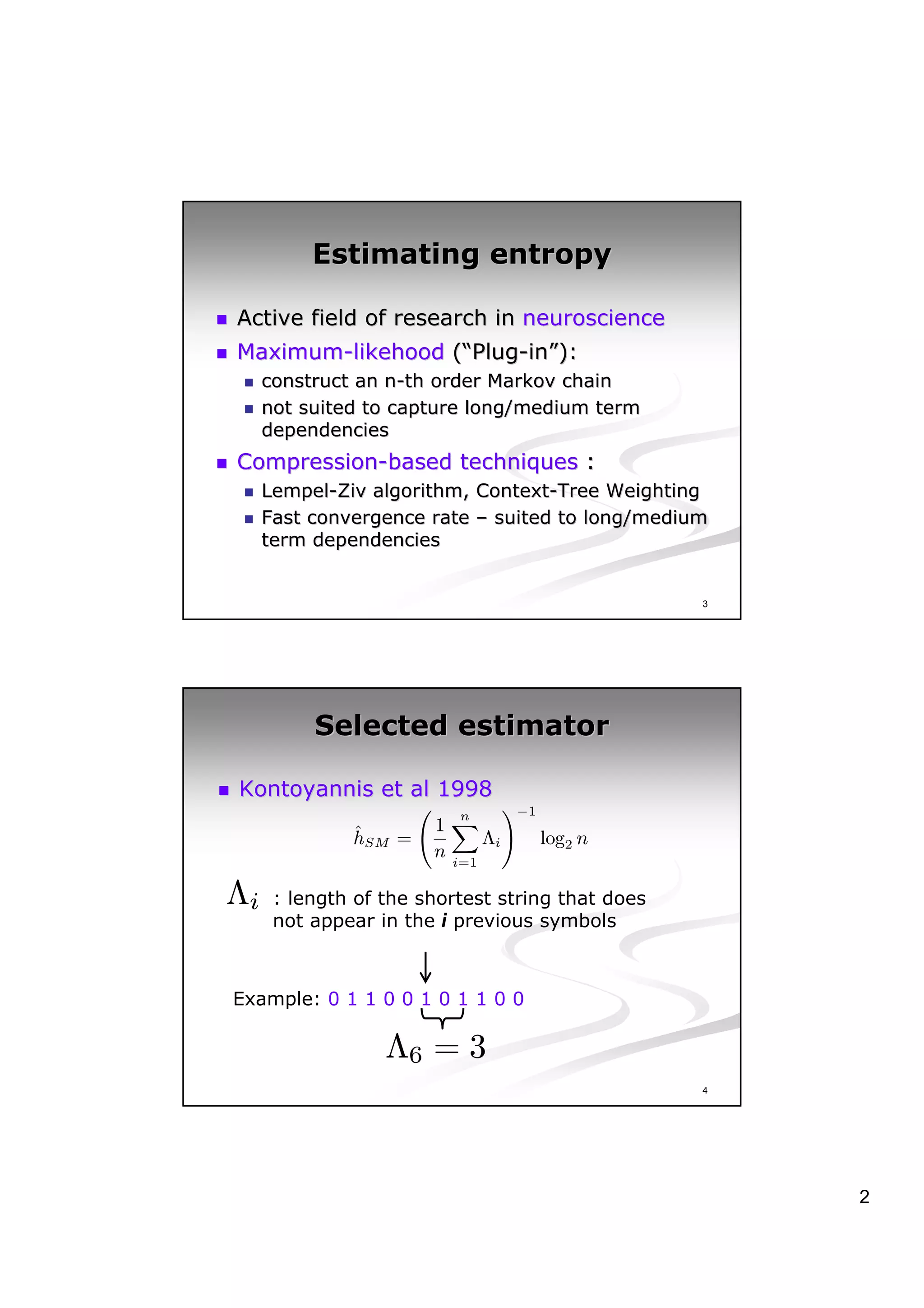
          Selected estimator

Kontoyannis et al 1998
                      Ã      n
                                     !−1
              ˆ           1X
              hSM =             Λi         log2 n
                          n i=1

Λi    : length of the shortest string that does
      not appear in the i previous symbols


Example: 0 1 1 0 0 1 0 1 1 0 0

                  Λ6 = 3
                                                    4


                                                        2
Performance of the estimator

Experiments :
  Uniformly distributed r.v. in {1,2,..,8} –
                        r.v.
                          P
  theoretical entropy = − 8 1/8 log2 p = 3 b.p.c.
                             i=1

  Boost C++ random generator
  Sample of size 10000
               ˆ
               hSM = 2.96
                                        ˆ
  Note 1 : with sample of size 100000, hSM ≥ 2.99
  Note 2 : with standard C rand() function and
                      ˆ
sample size = 10000, hSM = 2.77

                                                    5


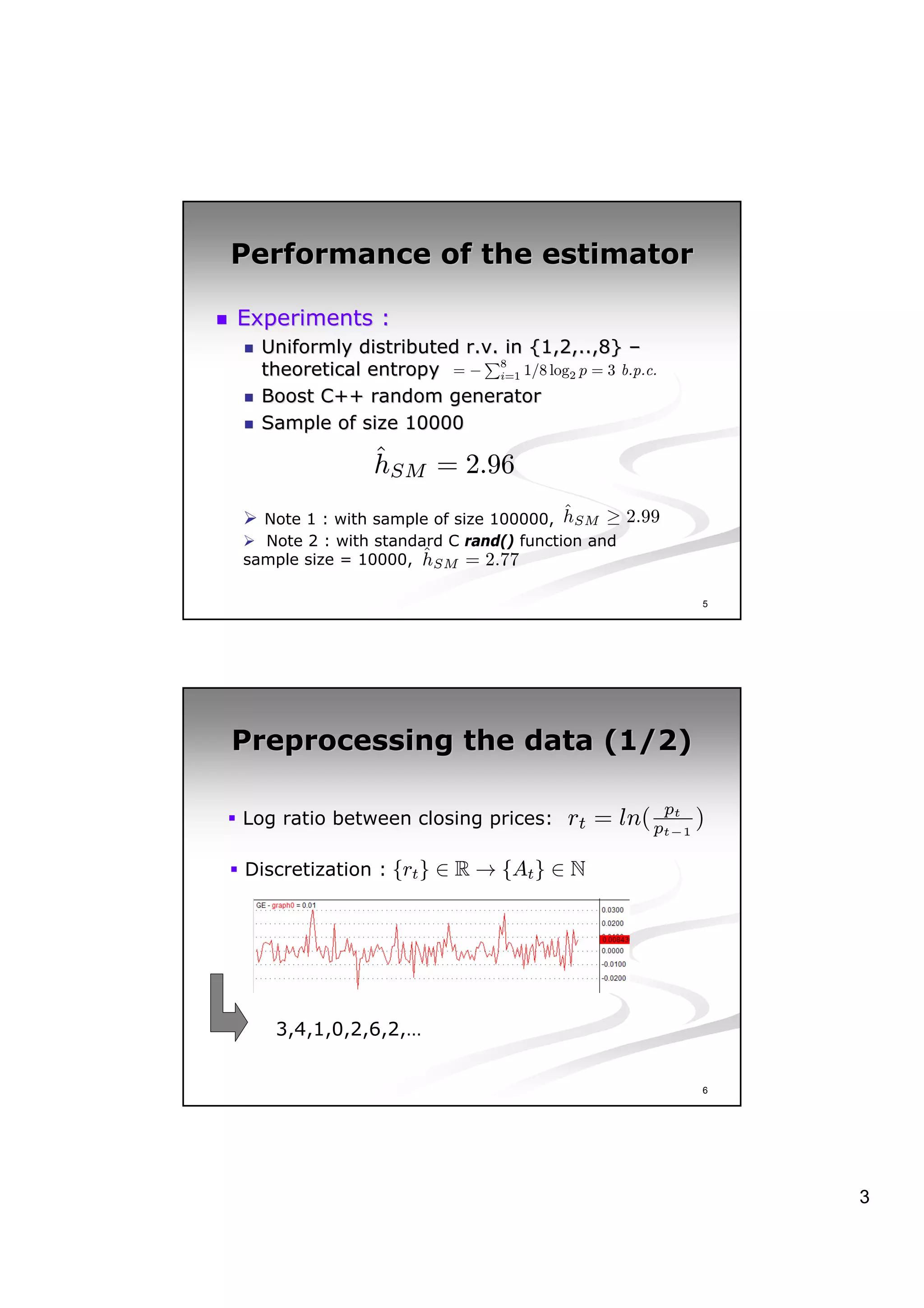
Preprocessing the data (1/2)

                                                pt
Log ratio between closing prices:     rt = ln( pt−1 )

Discretization : {rt } ∈ R → {At } ∈ N


   3,4,1,0,2,6,2,…


                                                    6


                                                        3
Preprocessing the data (2/2)
  Discretization is tricky – 2 problems:
      How many bins? (size of the alphabet)
      How many values in each bin?

  Guidelines : maximize entropy with a number of
bins in link with the sample size

 Here :
     alphabet of size 8
     same number of values in each bin
   (“homogenous partitioning”)
                                                                                                       7


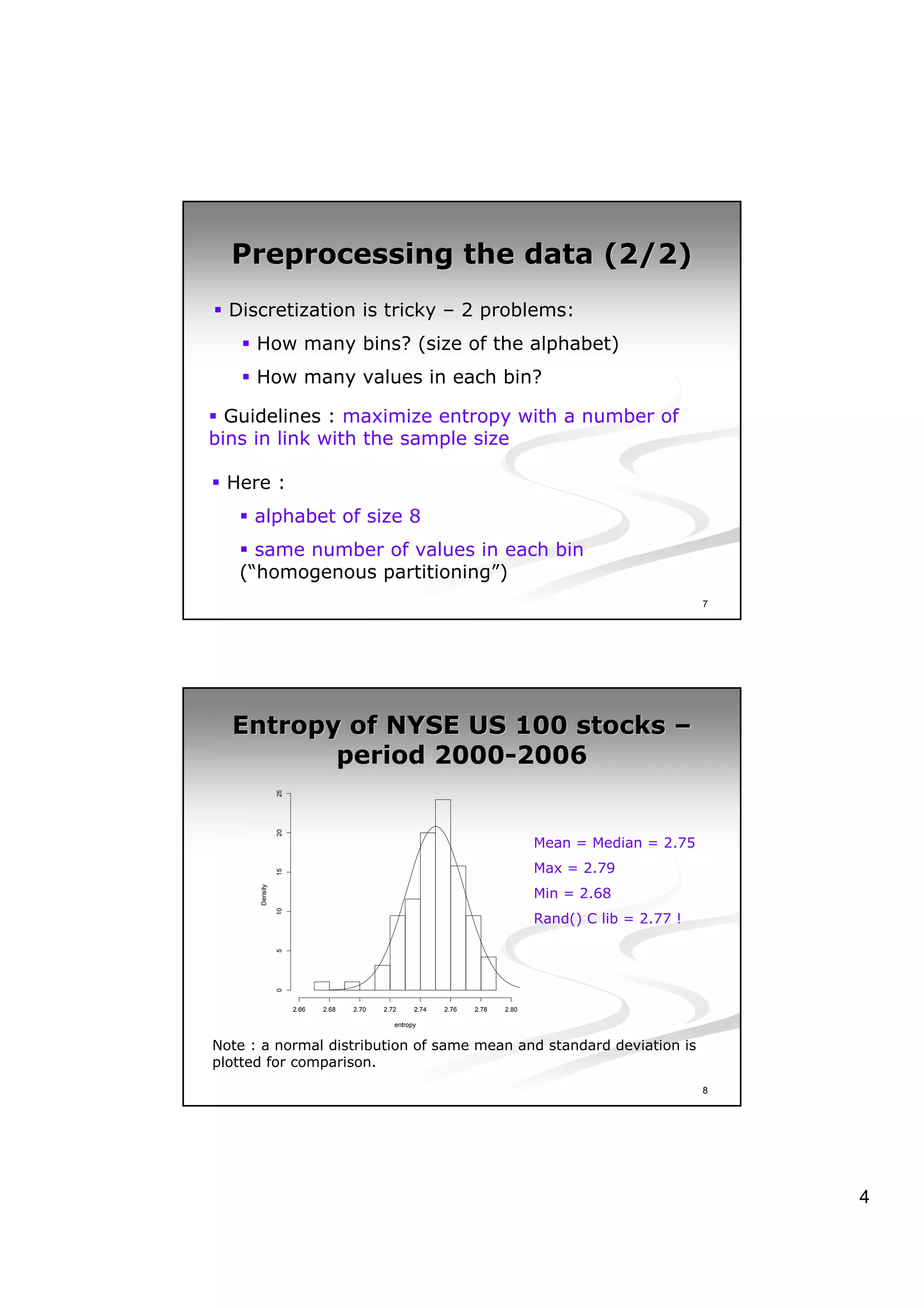
  Entropy of NYSE US 100 stocks –
         period 2000-2006
                25
                20


                                                                               Mean = Median = 2.75
                                                                               Max = 2.79
                15


                                                                               Min = 2.68
      Density

                10


                                                                               Rand() C lib = 2.77 !
                5
                0


                     2.66   2.68   2.70   2.72     2.74   2.76   2.78   2.80

                                             entropy


Note : a normal distribution of same mean and standard deviation is
plotted for comparison.
                                                                                                       8


                                                                                                           4
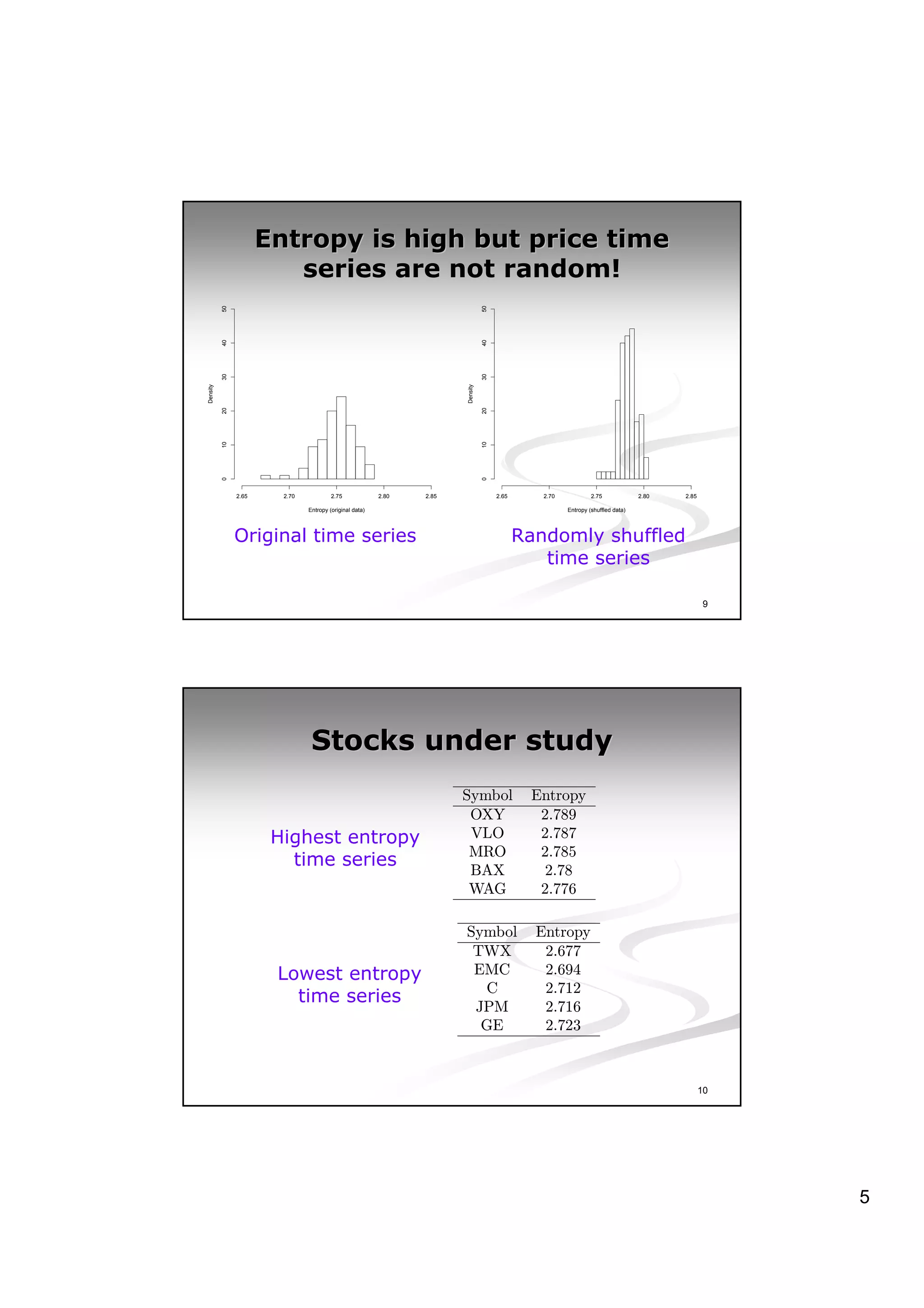
Entropy is high but price time
                         series are not random!
          50


                                                                                 50
          40


                                                                                 40
          30


                                                                                 30
Density


                                                                       Density
          20


                                                                                 20
          10


                                                                                 10
          0


                                                                                 0

               2.65     2.70            2.75             2.80   2.85                  2.65      2.70            2.75             2.80   2.85

                               Entropy (original data)                                                 Entropy (shuffled data)


               Original time series                                                          Randomly shuffled
                                                                                                time series

                                                                                                                                               9


                                Stocks under study
                                                                       Symbol                 Entropy
                                                                        OXY                    2.789
                       Highest entropy                                  VLO                    2.787
                                                                        MRO                    2.785
                         time series
                                                                        BAX                     2.78
                                                                        WAG                    2.776

                                                                       Symbol                  Entropy
                                                                        TWX                     2.677
                       Lowest entropy                                   EMC                     2.694
                                                                         C                      2.712
                         time series                                    JPM                     2.716
                                                                         GE                     2.723


                                                                                                                                               10


                                                                                                                                                    5
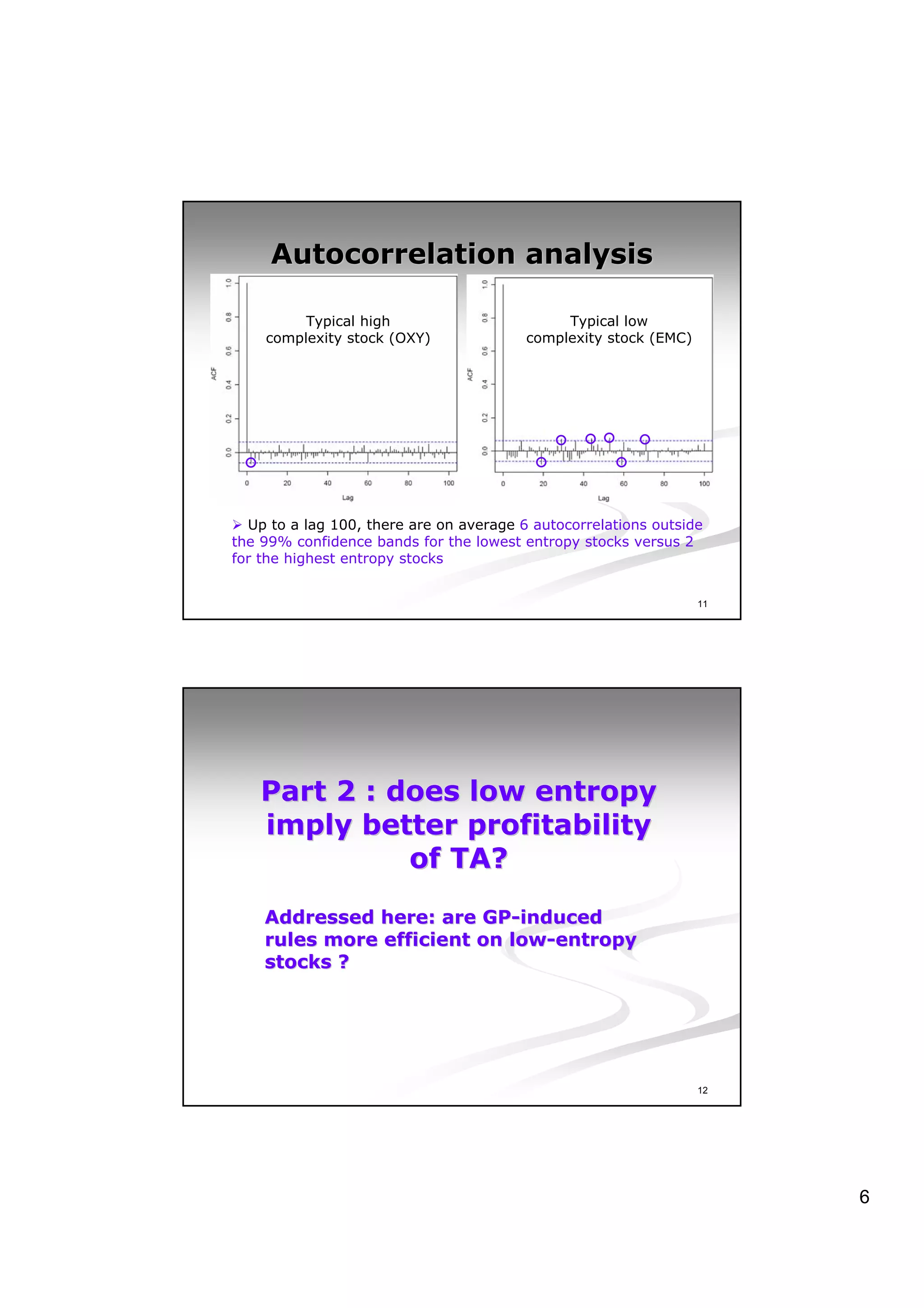
Autocorrelation analysis

         Typical high                         Typical low
    complexity stock (OXY)               complexity stock (EMC)


  Up to a lag 100, there are on average 6 autocorrelations outside
the 99% confidence bands for the lowest entropy stocks versus 2
for the highest entropy stocks


                                                                  11


    Part 2 : does low entropy
    imply better profitability
              of TA?
    Addressed here: are GP-induced
                          GP-
    rules more efficient on low-entropy
                            low-
    stocks ?


                                                                  12


                                                                       6
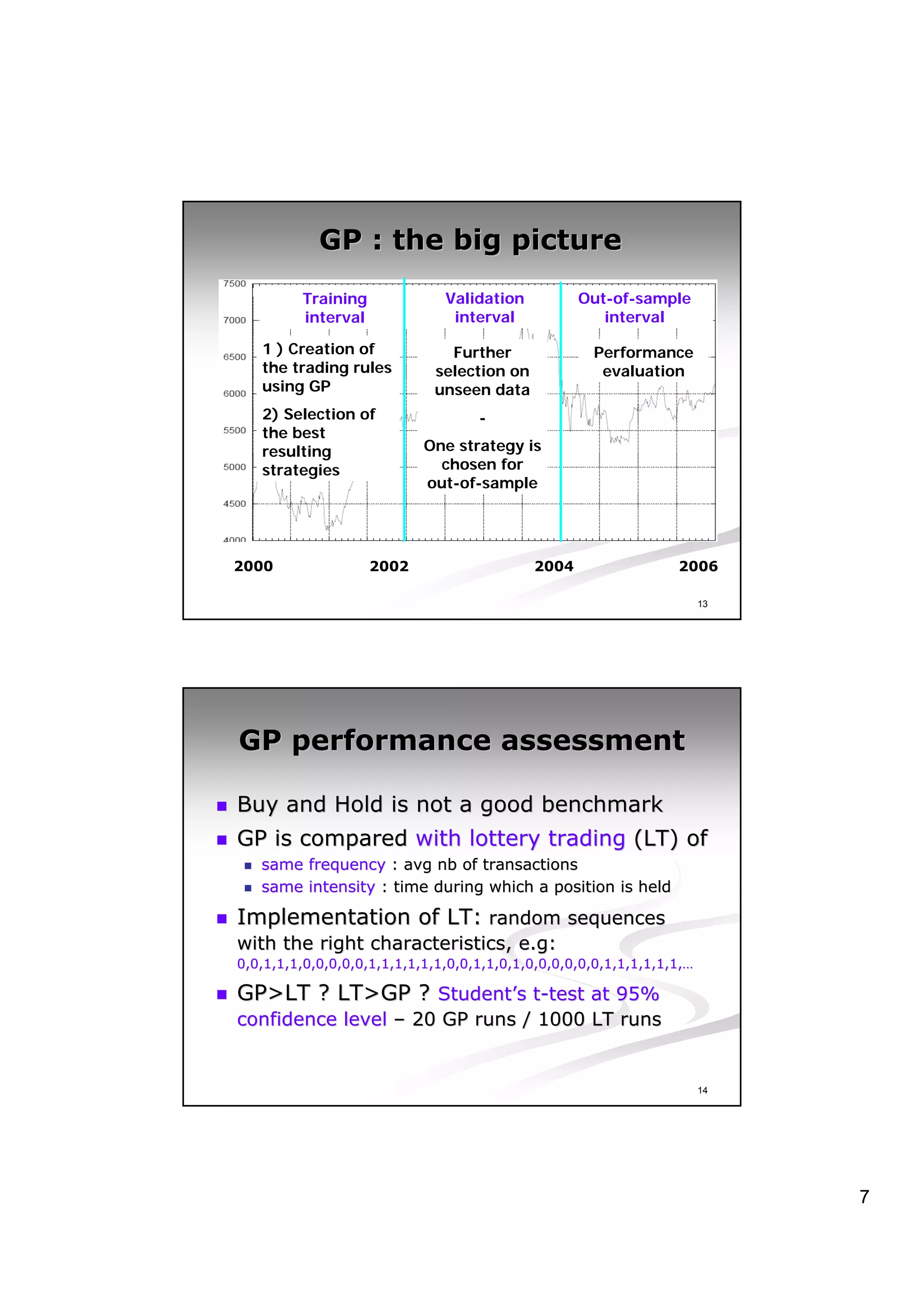
GP : the big picture
         Training              Validation          Out-of-sample
         interval               interval              interval

   1 ) Creation of             Further               Performance
   the trading rules         selection on             evaluation
   using GP                  unseen data
   2) Selection of                  -
   the best
   resulting                One strategy is
   strategies                 chosen for
                            out-of-sample


2000                2002                    2004                  2006

                                                                        13


GP performance assessment

Buy and Hold is not a good benchmark
GP is compared with lottery trading (LT) of
   same frequency : avg nb of transactions
   same intensity : time during which a position is held

Implementation of LT: random sequences
with the right characteristics, e.g:
                                e.g:
0,0,1,1,1,0,0,0,0,0,1,1,1,1,1,1,0,0,1,1,0,1,0,0,0,0,0,0,1,1,1,1,1,1,…
0,0,1,1,1,0,0,0,0,0,1,1,1,1,1,1,0,0,1,1,0,1,0,0,0,0,0,0,1,1,1,1,1,1,…

GP>LT ? LT>GP ? Student’s t-test at 95%
                          t-
confidence level – 20 GP runs / 1000 LT runs


                                                                        14


                                                                             7
Experimental setup
Data preprocessed with 100-days MA
Trading systems:
  Entry (long): GP induced rule with a classical
  set of functions / terminals
  Exit:
    Stop loss : 5%
    Profit target : 10%
    90-days stop
     90-
Fitness: net return - Initial equity: 100K$
- position sizing : 100%

                                                         15


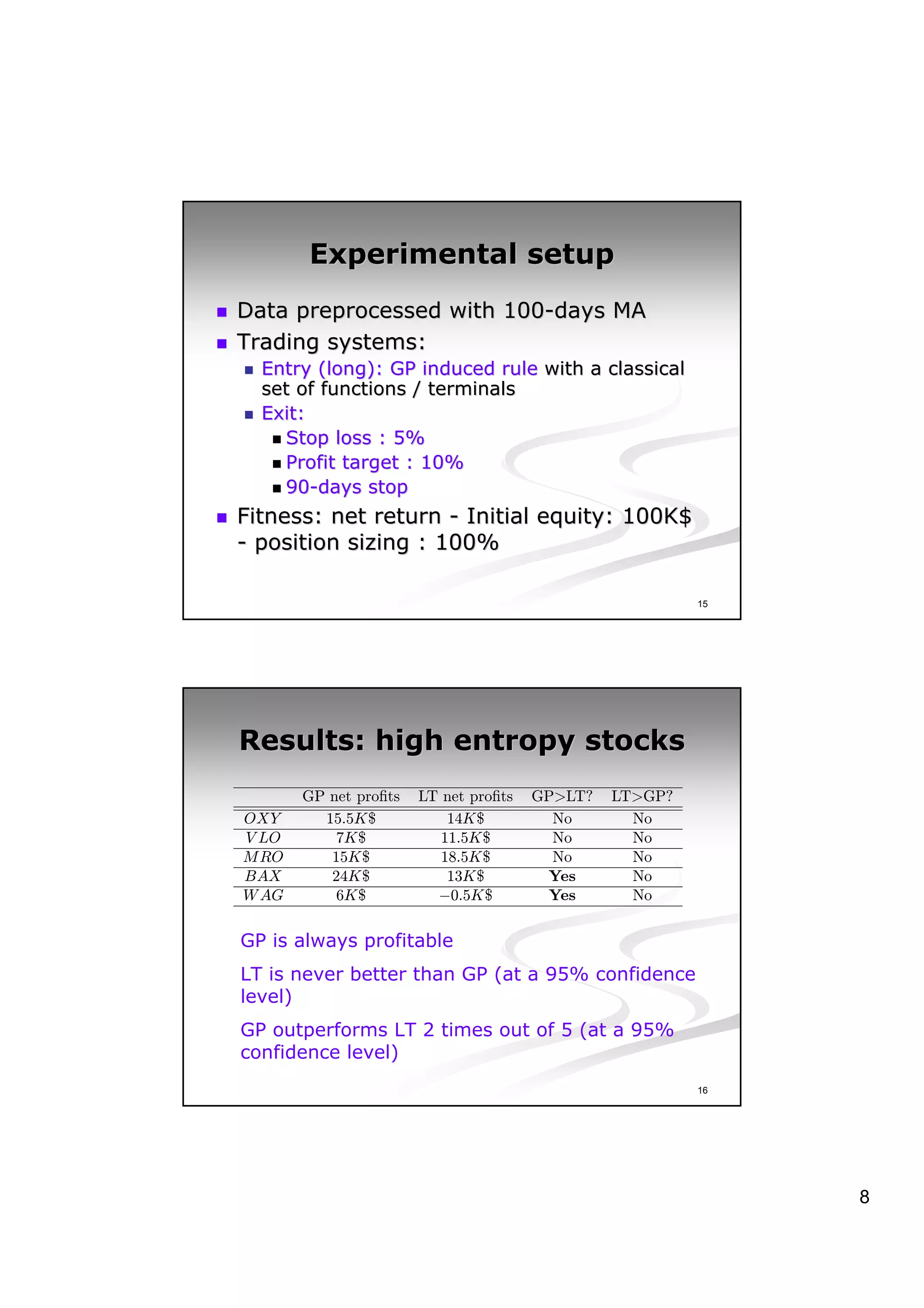
Results: high entropy stocks
       GP net profits   LT net profits   GP>LT?   LT>GP?
OXY      15.5K$            14K$          No       No
V LO       7K$            11.5K$         No       No
M RO      15K$            18.5K$         No       No
BAX       24K$             13K$         Yes       No
W AG       6K$           −0.5K$         Yes       No


GP is always profitable
LT is never better than GP (at a 95% confidence
level)
GP outperforms LT 2 times out of 5 (at a 95%
confidence level)
                                                         16


                                                              8
Results: low entropy stocks
          GP net profits     LT net profits   GP>LT?    LT>GP?
  TWX        −9K$             −1.5K$          No        Yes
  EM C      −16.5K$            −11K$          No        Yes
    C        15K$              18.5K$         No        No
  JP M        6K$               10K$          No        No
   GE       −0.5K$              0.5K$         No        No

 GP is never better than LT (at a 95% confidence
 level)
 LT outperforms GP 2 times out of 5 (at a 95%
 confidence level)


                                                                   17


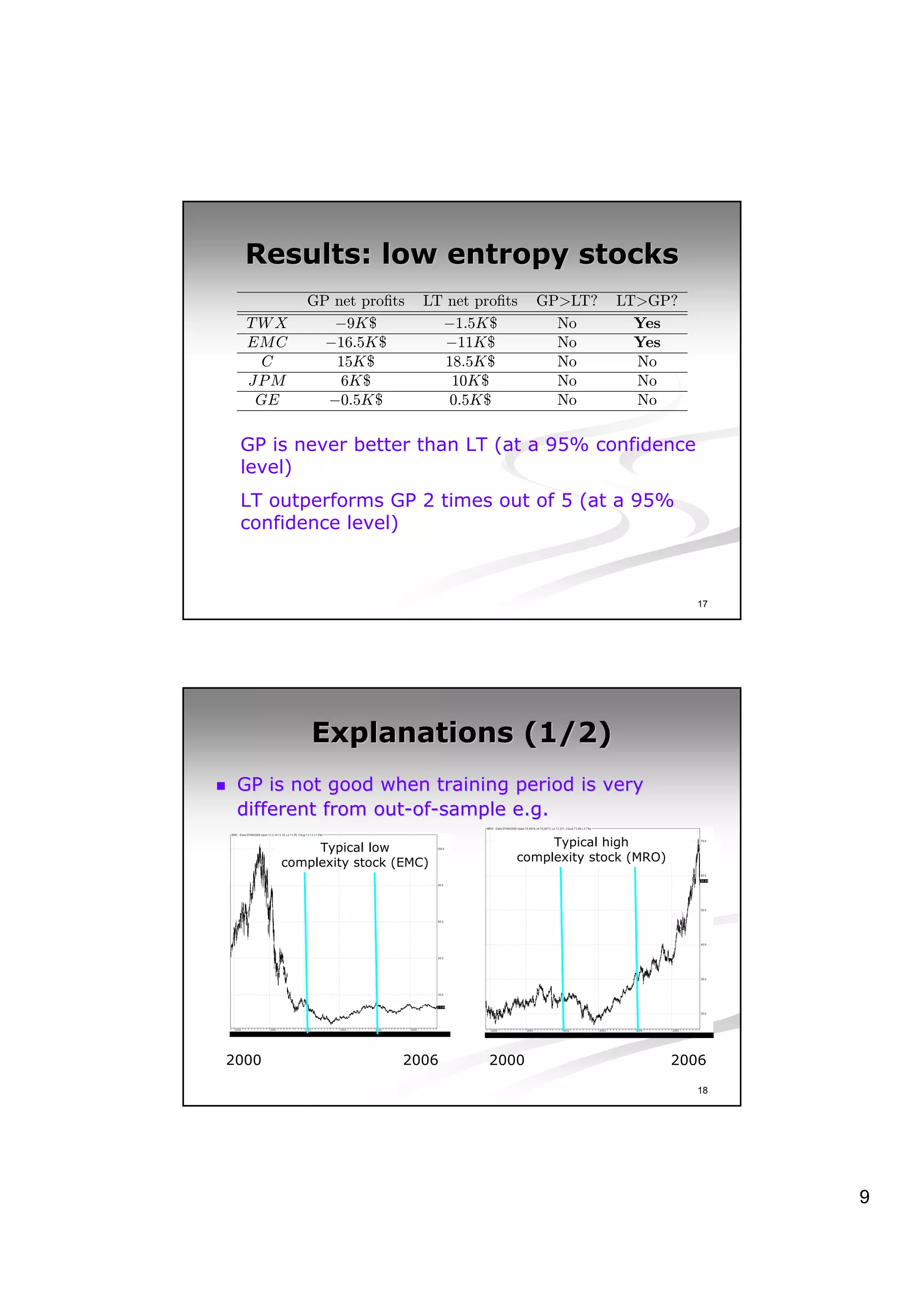
           Explanations (1/2)
 GP is not good when training period is very
 different from out-of-sample e.g.
                out- of-
            Typical low                      Typical high
       complexity stock (EMC)           complexity stock (MRO)


2000                     2006        2000                        2006

                                                                   18


                                                                        9
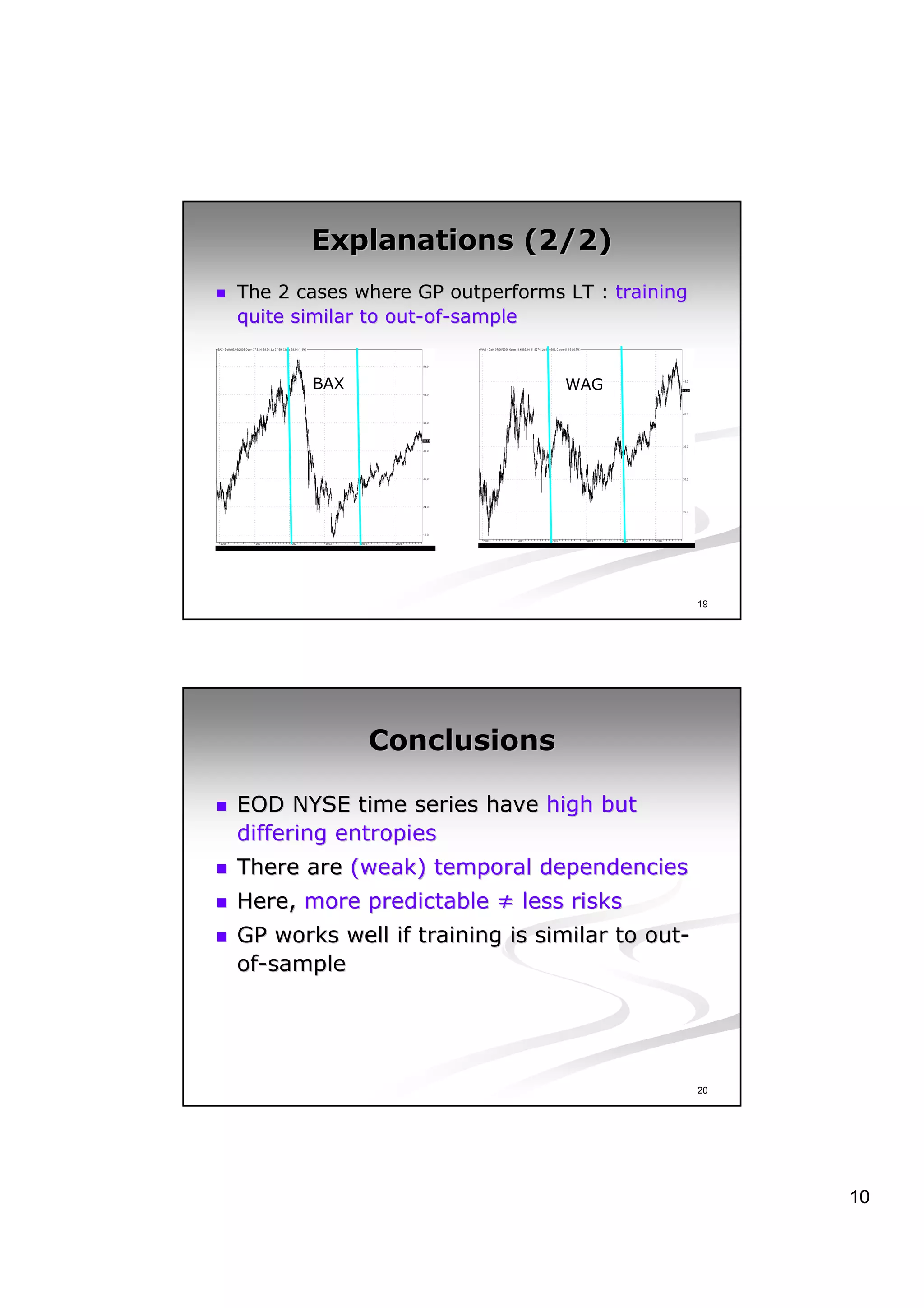
Explanations (2/2)
The 2 cases where GP outperforms LT : training
quite similar to out-of-sample
                 out- of-


       BAX                       WAG


                                                 19


             Conclusions

EOD NYSE time series have high but
differing entropies
There are (weak) temporal dependencies
Here, more predictable ≠ less risks
GP works well if training is similar to out-
of-sample


                                                 20


                                                      10
Perspectives

Higher predictability level can be observed
at intraday timeframe (what about higher
timeframes?)
Experiments needed with stocks less
similar than the ones from NYSE US 100
Predictability tells us about the existence
of temporal patterns – but how easy /
difficult to discover them ??


                                              21


                                      ?
                                              22


                                                   11

Cief2007 nn shc_slides

  • 1.
    Entropy Rate andProfitability of Technical Analysis: Experiments on the NYSE US 100 Stocks Nicolas NAVET – INRIA France nnavet@loria.fr Shu-Heng CHEN – AIECON/NCCU Shu- Taiwan chchen@nccu.edu.tw CIEF2007 - 07/22/2007 1 Outline Entropy Rate : uncertainty remaining in the next information produced given knowledge of the past measure of predictability Questions : Do stocks exhibit differing entropy rates? Does low entropy imply profitability of TA? Methodology : NYSE US 100 Stocks – daily data – 2000-2006 2000- TA rules induced using Genetic Programming 2 1
  • 2.
    Estimating entropy Active fieldof research in neuroscience Maximum-likehood (“Plug-in”): construct an n-th order Markov chain not suited to capture long/medium term dependencies Compression-based techniques : Lempel-Ziv algorithm, Context-Tree Weighting Lempel- Context- Fast convergence rate – suited to long/medium term dependencies 3 Selected estimator Kontoyannis et al 1998 Ã n !−1 ˆ 1X hSM = Λi log2 n n i=1 Λi : length of the shortest string that does not appear in the i previous symbols Example: 0 1 1 0 0 1 0 1 1 0 0 Λ6 = 3 4 2
  • 3.
    Performance of theestimator Experiments : Uniformly distributed r.v. in {1,2,..,8} – r.v. P theoretical entropy = − 8 1/8 log2 p = 3 b.p.c. i=1 Boost C++ random generator Sample of size 10000 ˆ hSM = 2.96 ˆ Note 1 : with sample of size 100000, hSM ≥ 2.99 Note 2 : with standard C rand() function and ˆ sample size = 10000, hSM = 2.77 5 Preprocessing the data (1/2) pt Log ratio between closing prices: rt = ln( pt−1 ) Discretization : {rt } ∈ R → {At } ∈ N 3,4,1,0,2,6,2,… 6 3
  • 4.
    Preprocessing the data(2/2) Discretization is tricky – 2 problems: How many bins? (size of the alphabet) How many values in each bin? Guidelines : maximize entropy with a number of bins in link with the sample size Here : alphabet of size 8 same number of values in each bin (“homogenous partitioning”) 7 Entropy of NYSE US 100 stocks – period 2000-2006 25 20 Mean = Median = 2.75 Max = 2.79 15 Min = 2.68 Density 10 Rand() C lib = 2.77 ! 5 0 2.66 2.68 2.70 2.72 2.74 2.76 2.78 2.80 entropy Note : a normal distribution of same mean and standard deviation is plotted for comparison. 8 4
  • 5.
    Entropy is highbut price time series are not random! 50 50 40 40 30 30 Density Density 20 20 10 10 0 0 2.65 2.70 2.75 2.80 2.85 2.65 2.70 2.75 2.80 2.85 Entropy (original data) Entropy (shuffled data) Original time series Randomly shuffled time series 9 Stocks under study Symbol Entropy OXY 2.789 Highest entropy VLO 2.787 MRO 2.785 time series BAX 2.78 WAG 2.776 Symbol Entropy TWX 2.677 Lowest entropy EMC 2.694 C 2.712 time series JPM 2.716 GE 2.723 10 5
  • 6.
    Autocorrelation analysis Typical high Typical low complexity stock (OXY) complexity stock (EMC) Up to a lag 100, there are on average 6 autocorrelations outside the 99% confidence bands for the lowest entropy stocks versus 2 for the highest entropy stocks 11 Part 2 : does low entropy imply better profitability of TA? Addressed here: are GP-induced GP- rules more efficient on low-entropy low- stocks ? 12 6
  • 7.
    GP : thebig picture Training Validation Out-of-sample interval interval interval 1 ) Creation of Further Performance the trading rules selection on evaluation using GP unseen data 2) Selection of - the best resulting One strategy is strategies chosen for out-of-sample 2000 2002 2004 2006 13 GP performance assessment Buy and Hold is not a good benchmark GP is compared with lottery trading (LT) of same frequency : avg nb of transactions same intensity : time during which a position is held Implementation of LT: random sequences with the right characteristics, e.g: e.g: 0,0,1,1,1,0,0,0,0,0,1,1,1,1,1,1,0,0,1,1,0,1,0,0,0,0,0,0,1,1,1,1,1,1,… 0,0,1,1,1,0,0,0,0,0,1,1,1,1,1,1,0,0,1,1,0,1,0,0,0,0,0,0,1,1,1,1,1,1,… GP>LT ? LT>GP ? Student’s t-test at 95% t- confidence level – 20 GP runs / 1000 LT runs 14 7
  • 8.
    Experimental setup Data preprocessedwith 100-days MA Trading systems: Entry (long): GP induced rule with a classical set of functions / terminals Exit: Stop loss : 5% Profit target : 10% 90-days stop 90- Fitness: net return - Initial equity: 100K$ - position sizing : 100% 15 Results: high entropy stocks GP net profits LT net profits GP>LT? LT>GP? OXY 15.5K$ 14K$ No No V LO 7K$ 11.5K$ No No M RO 15K$ 18.5K$ No No BAX 24K$ 13K$ Yes No W AG 6K$ −0.5K$ Yes No GP is always profitable LT is never better than GP (at a 95% confidence level) GP outperforms LT 2 times out of 5 (at a 95% confidence level) 16 8
  • 9.
    Results: low entropystocks GP net profits LT net profits GP>LT? LT>GP? TWX −9K$ −1.5K$ No Yes EM C −16.5K$ −11K$ No Yes C 15K$ 18.5K$ No No JP M 6K$ 10K$ No No GE −0.5K$ 0.5K$ No No GP is never better than LT (at a 95% confidence level) LT outperforms GP 2 times out of 5 (at a 95% confidence level) 17 Explanations (1/2) GP is not good when training period is very different from out-of-sample e.g. out- of- Typical low Typical high complexity stock (EMC) complexity stock (MRO) 2000 2006 2000 2006 18 9
  • 10.
    Explanations (2/2) The 2cases where GP outperforms LT : training quite similar to out-of-sample out- of- BAX WAG 19 Conclusions EOD NYSE time series have high but differing entropies There are (weak) temporal dependencies Here, more predictable ≠ less risks GP works well if training is similar to out- of-sample 20 10
  • 11.
    Perspectives Higher predictability levelcan be observed at intraday timeframe (what about higher timeframes?) Experiments needed with stocks less similar than the ones from NYSE US 100 Predictability tells us about the existence of temporal patterns – but how easy / difficult to discover them ?? 21 ? 22 11