
The Business Plan:
Creating and Starting the
Venture
Prepared by:
Prof. Seyed Ali Fallahchay
Planning As Part of the Business Operation
Planning is a process that never ends for a business. It is
extremely important in the early stages of any new venture
when the entrepreneur will need to prepare a preliminary
business plan.
The plan will become finalized as the entrepreneur has a better
sense of the market, the product and services to be marketed,
the management team, and the financial needs of the venture.
Plan may be short-term or long-term, or they may be strategic or
operational. Plans will also differ in scope depending on the type
of business or the anticipated size of the start-up operation.
Even though they may serve different functions, all these plans
have one important purpose: to provide guideline and structure
to management in a rapidly changing market environment.
What is the Business Plan?
Business Plan – Written document describing all relevant
internal and external elements and strategies for starting a new
venture.
It is often an integration of functional plans such as marketing,
finance, manufacturing, and human resources.
Scope and Value of the Business Plan – Who Reads the
Plan?
The Business Plan may be read by employees, investors, bankers,
venture capitalists, suppliers, customers, advisors, and
consultants.
There are three perspectives that should be considered in
preparing the plan.
• First is the perspective of the entrepreneur. The entrepreneur
must be able to clearly articulate what the venture is all
about.
• Second is the marketing perspective. Entrepreneur must try to
view their business through eyes of their customer.
• Third, the entrepreneur should try to view his or her business
through the eyes of the investor.
The depth and detail in the business plan depend on the size and
scope of the proposed new venture.
The size of the market, competition, and potential growth also
affect the scope of the business plan.
The business plan is valuable to the entrepreneur, potential
investors, or even new personnel, who are trying to familiarized
themselves with the venture, its goals, and objectives. The
business plan is important to these people because:
• It helps determine the viability of the venture in a designated
market.
• It provides guidance to the entrepreneur in organizing his or
her planning activities.
• It serves as an important tool in helping to obtain financing.
Presenting The Plan
It doesn't matter how compelling your business plan is if the
reader starts with a negative impression. A shopworn plan reeks
of failure from the get-go. Make sure the cosmetics are right:
Clean paper, crisp font, clear pictures and a professional (no
colloquial) presentation go a long way toward securing a fair
reading or hearing of your business plan.
As always, when preparing your plan, keep your audience in
mind. Businesslike is almost always best as a fallback decision on
how to make a good first impression. Also ask in advance if the
recipient wants a hard copy or an e-copy of your plan. In the
digital age, we want to give people what they want.
Once you’ve prepared your plan for presentation, you need to
put it in front of the right people. There are six steps for doing
so:
1. Obtain leads and referrals. Find names, addresses and phone
numbers of the type of investors you wish to target. Ask people
you know for referrals. Network as much as possible.
2. Research your target. Learn as much as possible about how
much money people have to invest, industries they’re interested
in and other requirements. Search venture capital directories,
Who’s Who, news articles, websites and similar sources.
3. Make your pitch. First, email or mail an introductory letter to
your target letting them know you have a plan you'd like to send.
Sending unsolicited, unanticipated business plans with a mere
cover letter won't typically get your plan read. Not only are most
people too busy to read whatever comes across their desk or
lands in their inboxes, they also don't want to be sued someday
for “stealing your ideas,” even if they never read your plan.
A letter of introduction is your way of asking them if they'd be
interested in reading your business plan. Within the letter,
explain why you've selected them and what you have to offer, in
a brief compelling manner.
You should also explain generally what you’re looking for—an
investor, a loan, a long-term supplier relationship or something
else. Often this will be obvious from the circumstances. If you’ve
received a personal referral, you’ll want to include who gave you
the referral very early on, probably in the first sentence following
the salutation. Never underestimate the power of a personal
referral from a friend, colleague or acquaintance. It may not land
you an investor, but it gets your foot in the door. When emailing
the individual, you might put the referral in the subject line.
In a world of “who you know” and the power of networking,
many of the people you'll be sending your plan to will be
referred by others. In some cases, you may even have some
personal connection to the person other than a referral. For
instance, perhaps you once met this individual while networking
or worked together at a company or organization.
Finally, in the letter of introduction, you may want to detail the
terms under which you're presenting your plan. For instance, you
may say that you're not submitting the plan to any other
investor. Or you may explicitly point out that you're currently
seeking financing from a number of sources, including this one. If
there's a deadline for responding to your plan, if you wish to
stress that the plan is confidential and must be returned to you,
or if you'd like to ask the recipient to pass it on to someone else
who may be interested, this is the place to do so. Somewhere
between sending the introductory letter and sending the plan—
if the person agrees to see it—is where you can email a non-
disclosure agreement if you plan to include one.
If you don't hear from them within a week or so, send a follow-
up email, and try once more about two weeks later (in case they
were out of town or swamped with other work). If this doesn’t
produce a meeting, look elsewhere.
4. Try to meet people in person. Despite the fact that we're
living in a text, email and conference-call age, you should still try
to meet your recipient face to face, especially if you're seeking
any type of funding. It’s very hard to get such a commitment
through a few texts or by email. Skype may work, but meeting in
person for a major financial commitment is best. If they want to
keep all communication electronic, then follow their lead.
5. Defuse objections. Although you may think you’ve answered
everything in your plan, you haven’t. Prepare a list of possible
objections—potential competitors, hard-to-buttress assumptions
and the like—that your investor may raise. Then prepare cogent
answers. Have friends, co-workers and your team play devil’s
advocate and provide every possible objection or ask tough
question, then formulate your answers.
6. Get a commitment. You won’t get an investment unless you
ask for it. When all objections have been answered, be ready to
offer one last concession—“If I give your representative a board
seat, can we do this today?”—and go for the close.
Operations Information Needs
The relevance of a feasibility study of the manufacturing
operations depends on the nature of the business. Most of the
information needed can be obtained through direct contact with
the appropriate source. The entrepreneur may need information
on the following:
• Location. The company’s location and its accessibility to
customers, suppliers, and distributors need to be determined.
• Manufacturing Operations. Basic machine and assembly
operations need to be identified, as well as whether any of
these operations would be subcontracted and by whom.
• Raw materials. The raw materials needed and suppliers’
name, addresses, and costs should be determined.
• Equipment. The equipment needed should be listed, with its
cost and whether it will be purchased or leased.
• Labor Skills. Each unique skills needed, the number of
personnel in each skill, pay rate, and an assessment of where
and how these skills will be obtained should be determined.
• Space. The total amount of space needed should be
determined, including whether the space will be owned or
leased.
• Overhead. Each item needed to support manufacturing – such
as tools, supplies, utilities, and salaries – should be
determined.
• Most of the above information should be incorporated
directly into the business plan. Each item may require some
research, but each is necessary to those who will assess the
business plan and consider funding the proposal.
Writing The Business Plan
It should be comprehensive enough to give any potential
investor a complete picture and understanding of the new
venture and will help the entrepreneur clarify his or her thinking
about business.
Many entrepreneurs incorrectly estimate the length of time that
an effective plan will take to prepare. Once the process has
begun, however, the entrepreneur will realize that it is invaluable
in sorting out the business functions of a new venture.
Introductory Page
This is the title or cover page that provides a brief summary of
the business plan’s contents.
The introductory page should contain the following:
• The name and address of the company.
• The name of the entrepreneur(s), telephone number, fax
number, e-mail address, and website address if available.
• A paragraph describing the company and the nature of the
business.
• The amount of financing needed. The entrepreneur may offer
a package, that is, stock, debt, and so on. How ever, many
venture capitalists prefer to structure this package in their
own way.
• A statement of the confidentiality of the report. This is for
security purposes and is important for the entrepreneur.
Executive Summary
The executive summary should stimulate the interest of the
potential investor. This is a very important section of the
business plan and should not be taken lightly by the
entrepreneur since the investor uses the summary to determine
if the entire business plan is worth reading.
Executive summary should address a number of issues or
questions that anyone picking up the written plan for the first
time would want to know. For example:
• What is the business concept or model?
• How is this business concept or model unique?
• Who are the individuals starting this business?
• How will they make money and how much?
If the new venture has a strong growth plan and in five years
expects to be positioned for an initial public offering then the
executive summary should also include an exit strategy.
If the venture is not initially expecting this kind of growth, the
entrepreneurs should avoid any discussion of an exit strategy in
the executive summary.
This section is only meant to highlight key factors and provide a
motivation to the person holding the plan to read it in its
entirely.
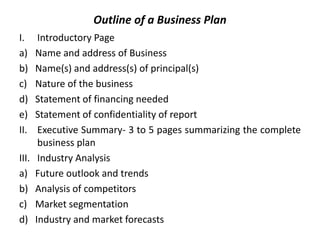
Outline of a Business Plan
I. Introductory Page
a) Name and address of Business
b) Name(s) and address(s) of principal(s)
c) Nature of the business
d) Statement of financing needed
e) Statement of confidentiality of report
II. Executive Summary- 3 to 5 pages summarizing the complete
business plan
III. Industry Analysis
a) Future outlook and trends
b) Analysis of competitors
c) Market segmentation
d) Industry and market forecasts
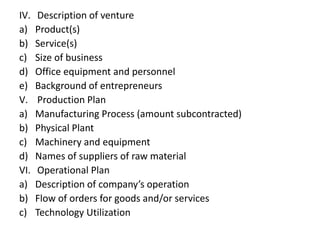
IV. Description of venture
a) Product(s)
b) Service(s)
c) Size of business
d) Office equipment and personnel
e) Background of entrepreneurs
V. Production Plan
a) Manufacturing Process (amount subcontracted)
b) Physical Plant
c) Machinery and equipment
d) Names of suppliers of raw material
VI. Operational Plan
a) Description of company’s operation
b) Flow of orders for goods and/or services
c) Technology Utilization
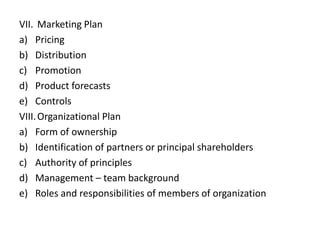
VII. Marketing Plan
a) Pricing
b) Distribution
c) Promotion
d) Product forecasts
e) Controls
VIII.Organizational Plan
a) Form of ownership
b) Identification of partners or principal shareholders
c) Authority of principles
d) Management – team background
e) Roles and responsibilities of members of organization
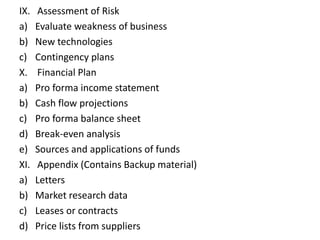
IX. Assessment of Risk
a) Evaluate weakness of business
b) New technologies
c) Contingency plans
X. Financial Plan
a) Pro forma income statement
b) Cash flow projections
c) Pro forma balance sheet
d) Break-even analysis
e) Sources and applications of funds
XI. Appendix (Contains Backup material)
a) Letters
b) Market research data
c) Leases or contracts
d) Price lists from suppliers
Environmental and Industry Analysis
Environmental Analysis – Assessment of external uncontrollable
variables that may impact the business plan.
To introduce the variables you consider important you can see
how they will influence the decisions you have to make or the
decisions the consumers make.
Environmental conditions to consider:
• Economic
• Cultural
• Social
• Technology
• Legal concerns
• Demographic
• Political
• Religious
Industry analysis – Reviews Industry trends and competitive
strategies.
2 Industrial factors to consider:
• Industry demand
• Competition
The last part of this section should focus on the specific market,
which would include such information as who the customer is
and what the business environment is like in the specific market
and geographic area where the venture will compete.
Description of Venture
Description of the Venture – Provides complete overview of
product(s), services, and operations of new venture.
This section should begin with the mission statement or
company mission of the new venture. This statement basically
describes the nature of the business and what the entrepreneur
hopes to accomplish with the business. After the mission
statement a number of important factors that provide a clear
description and understanding of the business venture should be
discussed. Key elements are the product(s) or service(s), the
location and size of the business, the personnel and office
equipment that will be needed, the background of the
entrepreneur(s), and history of the venture.
Location of any business may be vital to its success, particularly if
the business is retail or involves a service.
Production Plan
Production Plan – Details how product(s) will be manufactured.
If the new venture is a manufacturing operation, a Production
plan is necessary. This plan should describe the complete
manufacturing process. If some or all of the manufacturing
process is to be subcontracted, the plan should describe the
subcontractor(s), including location, reasons for selection, costs,
and any contracts that have been completed. If the
manufacturing is to be carried out in whole or in part by the
entrepreneur, he or she will need to describe the physical plant
layout; the machinery and equipment needed to perform the
manufacturing operations; raw materials and suppliers’ names,
addresses, and terms, costs of manufacturing; and any future
capital equipment needs.
Operation Plan
This section describes the flow of goods and services from
production to the customer. It might include inventory or storage
of manufactured products, shipping, inventory control
procedures, and customer support services.
It is important to note here that the major distinction between
services and manufactured goods is services involve intangible
performances. This implies they cannot be touched seen, tasted,
heard, or felt in the same manner as manufactured products.
Marketing Plan
Marketing plan – Describes market conditions and strategy
related to how products and services will be distributed, priced,
and promoted.
Marketing research evidence to support any of the critical
marketing decision strategies as well as for forecasting sales
should be described in this section. Specific forecasts for
product(s) or service(s) are indicated in order to project
profitability of the venture.
Organizational Plan
Organizational Plan – Describes form of ownership and lines of
authority and responsibility of members of new venture.
It describe the venture’s form of ownership – that is,
proprietorship, partnership, or corporation. If the venture is a
partnership, the term of the partnership should be included. If
the venture is a corporation, it is important to detail the shares
of stock authorized, share options, as well as names, addresses,
and resumes of directors and officers of the corporation.
It is helpful to provide an organization chart indicating the line of
authority and the responsibilities of the members of the
organization.
Assessment of Risk
Assessment of risk – identifies potential hazards and alternative
strategies to meet business plan goals and objectives.
It is important that the entrepreneur make a assessment of risk
in the following manner. First, the entrepreneur should indicate
the potential risks to the new venture. Next should be a
discussion of what might happen if these risks become reality.
Finally, the entrepreneur should discuss the strategy that will be
employed to either prevent, minimize, or respond to the risks
should they occur. Major risks for a new venture could result
from a competitor’s reaction: weaknesses in the marketing,
production, or management team; and new advance technology
that might render the new product obsolete.
Financial Plan
Financial plan – projections of key financial data that determine
economic feasibility and necessary financial investment
commitment.
Generally , three financial areas are discussed in this section of
the business plan. First, the entrepreneur should summarize the
forecasted sales and appropriate expenses for at least the first
three years, with the first year’s projections provided monthly. It
includes the forecasted sales, cost of goods sold, and the general
and administrative expenses. Net profit after taxes can then be
projected by estimating income taxes.
The second major area of financial information needed is cash
flow figures for three years, with the first year’s projections
provided monthly. Remember that sales may be irregular, and
receipts from customers may also be spread out, thus
necessitating the borrowing of short-term capital to meet fixed
expenses such as salaries and utilities.
The last financial item is the projected balance sheet. This shows
the financial condition of the business at a specific time. It
summarizes the assets of a business, its liabilities, the
investment of the entrepreneur and any partners, and retained
earnings(or cumulative losses).
Appendix
It generally contains any backup material that is not necessary in
the text of the document. Reference to any of the documents in
the appendix should be made in the plan itself.
Letters from customers, distributors, or subcontractors are
examples of information that should be included in the
appendix. Any documentation of information- that is, secondary
data or primary research data used to support plan decisions –
should also be included.
Leases, contracts, or any types of agreements that have been
initiated may also be included in the appendix.
Finally, price lists from suppliers and competitors may be added.
Measuring Plan Progress
During the introductory phases of the start-up, the entrepreneur
should determine the points at which decisions should be made
as to whether the goals or objectives are on schedule. Typically,
the business plan projections will be made on a 12 month
schedule.
A brief description of each control elements is given below:
• Inventory control. By controlling inventory, the firm can
ensure maximum service to the customer. The faster the firm
gets back its investment in raw materials and finished goods,
the faster that capital can be reinvested to meet additional
customer needs.
• Production control. Compare the cost figures estimated in the
business plan with day-to-day operation costs. This will help
to control the machine time, worker hours, process time,
delay time, and downtime cost.
• Quality Control. This will depend on the type of production
system but is designed to make sure that the product preform
satisfactorily.
• Sales Control. Information on units, specific product sold,
price of sales, meeting of delivery dates, and credit terms is
useful to get a good perspective of the sales of the new
venture. In addition, an effective collection system for
accounts receivable should be set up to avoid aging of
accounts and bad debts.
• Disbursements. The new venture should also control the
amount of money paid out. All bills should be reviewed to
determine how much is being disbursed and for what
purpose.
Why Some Business Plans Fail
Generally a poorly prepared business plan can be blamed on one
or more of the following factors:
• Goals set by entrepreneur are unreasonable.
• Goals are not measurable.
• The entrepreneur has not made a total commitment to the
business or to the family.
• The entrepreneur has no experience in the planned business.
• The entrepreneur has no sense of potential threats or
weaknesses to the business.
• No customer need was established for the proposed product
or service.

The business plan

  • 1.
    The Business Plan: Creatingand Starting the Venture Prepared by: Prof. Seyed Ali Fallahchay
  • 2.
    Planning As Partof the Business Operation Planning is a process that never ends for a business. It is extremely important in the early stages of any new venture when the entrepreneur will need to prepare a preliminary business plan. The plan will become finalized as the entrepreneur has a better sense of the market, the product and services to be marketed, the management team, and the financial needs of the venture. Plan may be short-term or long-term, or they may be strategic or operational. Plans will also differ in scope depending on the type of business or the anticipated size of the start-up operation. Even though they may serve different functions, all these plans have one important purpose: to provide guideline and structure to management in a rapidly changing market environment.
  • 3.
    What is theBusiness Plan? Business Plan – Written document describing all relevant internal and external elements and strategies for starting a new venture. It is often an integration of functional plans such as marketing, finance, manufacturing, and human resources.
  • 4.
    Scope and Valueof the Business Plan – Who Reads the Plan? The Business Plan may be read by employees, investors, bankers, venture capitalists, suppliers, customers, advisors, and consultants. There are three perspectives that should be considered in preparing the plan. • First is the perspective of the entrepreneur. The entrepreneur must be able to clearly articulate what the venture is all about. • Second is the marketing perspective. Entrepreneur must try to view their business through eyes of their customer. • Third, the entrepreneur should try to view his or her business through the eyes of the investor.
  • 5.
    The depth anddetail in the business plan depend on the size and scope of the proposed new venture. The size of the market, competition, and potential growth also affect the scope of the business plan. The business plan is valuable to the entrepreneur, potential investors, or even new personnel, who are trying to familiarized themselves with the venture, its goals, and objectives. The business plan is important to these people because: • It helps determine the viability of the venture in a designated market. • It provides guidance to the entrepreneur in organizing his or her planning activities. • It serves as an important tool in helping to obtain financing.
  • 6.
    Presenting The Plan Itdoesn't matter how compelling your business plan is if the reader starts with a negative impression. A shopworn plan reeks of failure from the get-go. Make sure the cosmetics are right: Clean paper, crisp font, clear pictures and a professional (no colloquial) presentation go a long way toward securing a fair reading or hearing of your business plan. As always, when preparing your plan, keep your audience in mind. Businesslike is almost always best as a fallback decision on how to make a good first impression. Also ask in advance if the recipient wants a hard copy or an e-copy of your plan. In the digital age, we want to give people what they want. Once you’ve prepared your plan for presentation, you need to put it in front of the right people. There are six steps for doing so:
  • 7.
    1. Obtain leadsand referrals. Find names, addresses and phone numbers of the type of investors you wish to target. Ask people you know for referrals. Network as much as possible. 2. Research your target. Learn as much as possible about how much money people have to invest, industries they’re interested in and other requirements. Search venture capital directories, Who’s Who, news articles, websites and similar sources. 3. Make your pitch. First, email or mail an introductory letter to your target letting them know you have a plan you'd like to send. Sending unsolicited, unanticipated business plans with a mere cover letter won't typically get your plan read. Not only are most people too busy to read whatever comes across their desk or lands in their inboxes, they also don't want to be sued someday for “stealing your ideas,” even if they never read your plan.
  • 8.
    A letter ofintroduction is your way of asking them if they'd be interested in reading your business plan. Within the letter, explain why you've selected them and what you have to offer, in a brief compelling manner. You should also explain generally what you’re looking for—an investor, a loan, a long-term supplier relationship or something else. Often this will be obvious from the circumstances. If you’ve received a personal referral, you’ll want to include who gave you the referral very early on, probably in the first sentence following the salutation. Never underestimate the power of a personal referral from a friend, colleague or acquaintance. It may not land you an investor, but it gets your foot in the door. When emailing the individual, you might put the referral in the subject line.
  • 9.
    In a worldof “who you know” and the power of networking, many of the people you'll be sending your plan to will be referred by others. In some cases, you may even have some personal connection to the person other than a referral. For instance, perhaps you once met this individual while networking or worked together at a company or organization. Finally, in the letter of introduction, you may want to detail the terms under which you're presenting your plan. For instance, you may say that you're not submitting the plan to any other investor. Or you may explicitly point out that you're currently seeking financing from a number of sources, including this one. If there's a deadline for responding to your plan, if you wish to stress that the plan is confidential and must be returned to you, or if you'd like to ask the recipient to pass it on to someone else who may be interested, this is the place to do so. Somewhere between sending the introductory letter and sending the plan— if the person agrees to see it—is where you can email a non- disclosure agreement if you plan to include one.
  • 10.
    If you don'thear from them within a week or so, send a follow- up email, and try once more about two weeks later (in case they were out of town or swamped with other work). If this doesn’t produce a meeting, look elsewhere. 4. Try to meet people in person. Despite the fact that we're living in a text, email and conference-call age, you should still try to meet your recipient face to face, especially if you're seeking any type of funding. It’s very hard to get such a commitment through a few texts or by email. Skype may work, but meeting in person for a major financial commitment is best. If they want to keep all communication electronic, then follow their lead.
  • 11.
    5. Defuse objections.Although you may think you’ve answered everything in your plan, you haven’t. Prepare a list of possible objections—potential competitors, hard-to-buttress assumptions and the like—that your investor may raise. Then prepare cogent answers. Have friends, co-workers and your team play devil’s advocate and provide every possible objection or ask tough question, then formulate your answers. 6. Get a commitment. You won’t get an investment unless you ask for it. When all objections have been answered, be ready to offer one last concession—“If I give your representative a board seat, can we do this today?”—and go for the close.
  • 12.
    Operations Information Needs Therelevance of a feasibility study of the manufacturing operations depends on the nature of the business. Most of the information needed can be obtained through direct contact with the appropriate source. The entrepreneur may need information on the following: • Location. The company’s location and its accessibility to customers, suppliers, and distributors need to be determined. • Manufacturing Operations. Basic machine and assembly operations need to be identified, as well as whether any of these operations would be subcontracted and by whom. • Raw materials. The raw materials needed and suppliers’ name, addresses, and costs should be determined.
  • 13.
    • Equipment. Theequipment needed should be listed, with its cost and whether it will be purchased or leased. • Labor Skills. Each unique skills needed, the number of personnel in each skill, pay rate, and an assessment of where and how these skills will be obtained should be determined. • Space. The total amount of space needed should be determined, including whether the space will be owned or leased. • Overhead. Each item needed to support manufacturing – such as tools, supplies, utilities, and salaries – should be determined. • Most of the above information should be incorporated directly into the business plan. Each item may require some research, but each is necessary to those who will assess the business plan and consider funding the proposal.
  • 14.
    Writing The BusinessPlan It should be comprehensive enough to give any potential investor a complete picture and understanding of the new venture and will help the entrepreneur clarify his or her thinking about business. Many entrepreneurs incorrectly estimate the length of time that an effective plan will take to prepare. Once the process has begun, however, the entrepreneur will realize that it is invaluable in sorting out the business functions of a new venture.
  • 15.
    Introductory Page This isthe title or cover page that provides a brief summary of the business plan’s contents. The introductory page should contain the following: • The name and address of the company. • The name of the entrepreneur(s), telephone number, fax number, e-mail address, and website address if available. • A paragraph describing the company and the nature of the business. • The amount of financing needed. The entrepreneur may offer a package, that is, stock, debt, and so on. How ever, many venture capitalists prefer to structure this package in their own way. • A statement of the confidentiality of the report. This is for security purposes and is important for the entrepreneur.
  • 16.
    Executive Summary The executivesummary should stimulate the interest of the potential investor. This is a very important section of the business plan and should not be taken lightly by the entrepreneur since the investor uses the summary to determine if the entire business plan is worth reading. Executive summary should address a number of issues or questions that anyone picking up the written plan for the first time would want to know. For example: • What is the business concept or model? • How is this business concept or model unique? • Who are the individuals starting this business? • How will they make money and how much?
  • 17.
    If the newventure has a strong growth plan and in five years expects to be positioned for an initial public offering then the executive summary should also include an exit strategy. If the venture is not initially expecting this kind of growth, the entrepreneurs should avoid any discussion of an exit strategy in the executive summary. This section is only meant to highlight key factors and provide a motivation to the person holding the plan to read it in its entirely.
  • 18.
    Outline of aBusiness Plan I. Introductory Page a) Name and address of Business b) Name(s) and address(s) of principal(s) c) Nature of the business d) Statement of financing needed e) Statement of confidentiality of report II. Executive Summary- 3 to 5 pages summarizing the complete business plan III. Industry Analysis a) Future outlook and trends b) Analysis of competitors c) Market segmentation d) Industry and market forecasts
  • 19.
    IV. Description ofventure a) Product(s) b) Service(s) c) Size of business d) Office equipment and personnel e) Background of entrepreneurs V. Production Plan a) Manufacturing Process (amount subcontracted) b) Physical Plant c) Machinery and equipment d) Names of suppliers of raw material VI. Operational Plan a) Description of company’s operation b) Flow of orders for goods and/or services c) Technology Utilization
  • 20.
    VII. Marketing Plan a)Pricing b) Distribution c) Promotion d) Product forecasts e) Controls VIII.Organizational Plan a) Form of ownership b) Identification of partners or principal shareholders c) Authority of principles d) Management – team background e) Roles and responsibilities of members of organization
  • 21.
    IX. Assessment ofRisk a) Evaluate weakness of business b) New technologies c) Contingency plans X. Financial Plan a) Pro forma income statement b) Cash flow projections c) Pro forma balance sheet d) Break-even analysis e) Sources and applications of funds XI. Appendix (Contains Backup material) a) Letters b) Market research data c) Leases or contracts d) Price lists from suppliers
  • 22.
    Environmental and IndustryAnalysis Environmental Analysis – Assessment of external uncontrollable variables that may impact the business plan. To introduce the variables you consider important you can see how they will influence the decisions you have to make or the decisions the consumers make. Environmental conditions to consider: • Economic • Cultural • Social • Technology • Legal concerns • Demographic • Political • Religious
  • 23.
    Industry analysis –Reviews Industry trends and competitive strategies. 2 Industrial factors to consider: • Industry demand • Competition The last part of this section should focus on the specific market, which would include such information as who the customer is and what the business environment is like in the specific market and geographic area where the venture will compete.
  • 24.
    Description of Venture Descriptionof the Venture – Provides complete overview of product(s), services, and operations of new venture. This section should begin with the mission statement or company mission of the new venture. This statement basically describes the nature of the business and what the entrepreneur hopes to accomplish with the business. After the mission statement a number of important factors that provide a clear description and understanding of the business venture should be discussed. Key elements are the product(s) or service(s), the location and size of the business, the personnel and office equipment that will be needed, the background of the entrepreneur(s), and history of the venture. Location of any business may be vital to its success, particularly if the business is retail or involves a service.
  • 25.
    Production Plan Production Plan– Details how product(s) will be manufactured. If the new venture is a manufacturing operation, a Production plan is necessary. This plan should describe the complete manufacturing process. If some or all of the manufacturing process is to be subcontracted, the plan should describe the subcontractor(s), including location, reasons for selection, costs, and any contracts that have been completed. If the manufacturing is to be carried out in whole or in part by the entrepreneur, he or she will need to describe the physical plant layout; the machinery and equipment needed to perform the manufacturing operations; raw materials and suppliers’ names, addresses, and terms, costs of manufacturing; and any future capital equipment needs.
  • 26.
    Operation Plan This sectiondescribes the flow of goods and services from production to the customer. It might include inventory or storage of manufactured products, shipping, inventory control procedures, and customer support services. It is important to note here that the major distinction between services and manufactured goods is services involve intangible performances. This implies they cannot be touched seen, tasted, heard, or felt in the same manner as manufactured products.
  • 27.
    Marketing Plan Marketing plan– Describes market conditions and strategy related to how products and services will be distributed, priced, and promoted. Marketing research evidence to support any of the critical marketing decision strategies as well as for forecasting sales should be described in this section. Specific forecasts for product(s) or service(s) are indicated in order to project profitability of the venture.
  • 28.
    Organizational Plan Organizational Plan– Describes form of ownership and lines of authority and responsibility of members of new venture. It describe the venture’s form of ownership – that is, proprietorship, partnership, or corporation. If the venture is a partnership, the term of the partnership should be included. If the venture is a corporation, it is important to detail the shares of stock authorized, share options, as well as names, addresses, and resumes of directors and officers of the corporation. It is helpful to provide an organization chart indicating the line of authority and the responsibilities of the members of the organization.
  • 29.
    Assessment of Risk Assessmentof risk – identifies potential hazards and alternative strategies to meet business plan goals and objectives. It is important that the entrepreneur make a assessment of risk in the following manner. First, the entrepreneur should indicate the potential risks to the new venture. Next should be a discussion of what might happen if these risks become reality. Finally, the entrepreneur should discuss the strategy that will be employed to either prevent, minimize, or respond to the risks should they occur. Major risks for a new venture could result from a competitor’s reaction: weaknesses in the marketing, production, or management team; and new advance technology that might render the new product obsolete.
  • 30.
    Financial Plan Financial plan– projections of key financial data that determine economic feasibility and necessary financial investment commitment. Generally , three financial areas are discussed in this section of the business plan. First, the entrepreneur should summarize the forecasted sales and appropriate expenses for at least the first three years, with the first year’s projections provided monthly. It includes the forecasted sales, cost of goods sold, and the general and administrative expenses. Net profit after taxes can then be projected by estimating income taxes. The second major area of financial information needed is cash flow figures for three years, with the first year’s projections provided monthly. Remember that sales may be irregular, and receipts from customers may also be spread out, thus necessitating the borrowing of short-term capital to meet fixed expenses such as salaries and utilities.
  • 31.
    The last financialitem is the projected balance sheet. This shows the financial condition of the business at a specific time. It summarizes the assets of a business, its liabilities, the investment of the entrepreneur and any partners, and retained earnings(or cumulative losses).
  • 32.
    Appendix It generally containsany backup material that is not necessary in the text of the document. Reference to any of the documents in the appendix should be made in the plan itself. Letters from customers, distributors, or subcontractors are examples of information that should be included in the appendix. Any documentation of information- that is, secondary data or primary research data used to support plan decisions – should also be included. Leases, contracts, or any types of agreements that have been initiated may also be included in the appendix. Finally, price lists from suppliers and competitors may be added.
  • 33.
    Measuring Plan Progress Duringthe introductory phases of the start-up, the entrepreneur should determine the points at which decisions should be made as to whether the goals or objectives are on schedule. Typically, the business plan projections will be made on a 12 month schedule. A brief description of each control elements is given below: • Inventory control. By controlling inventory, the firm can ensure maximum service to the customer. The faster the firm gets back its investment in raw materials and finished goods, the faster that capital can be reinvested to meet additional customer needs. • Production control. Compare the cost figures estimated in the business plan with day-to-day operation costs. This will help to control the machine time, worker hours, process time, delay time, and downtime cost.
  • 34.
    • Quality Control.This will depend on the type of production system but is designed to make sure that the product preform satisfactorily. • Sales Control. Information on units, specific product sold, price of sales, meeting of delivery dates, and credit terms is useful to get a good perspective of the sales of the new venture. In addition, an effective collection system for accounts receivable should be set up to avoid aging of accounts and bad debts. • Disbursements. The new venture should also control the amount of money paid out. All bills should be reviewed to determine how much is being disbursed and for what purpose.
  • 35.
    Why Some BusinessPlans Fail Generally a poorly prepared business plan can be blamed on one or more of the following factors: • Goals set by entrepreneur are unreasonable. • Goals are not measurable. • The entrepreneur has not made a total commitment to the business or to the family. • The entrepreneur has no experience in the planned business. • The entrepreneur has no sense of potential threats or weaknesses to the business. • No customer need was established for the proposed product or service.