Exploring the use of signals in the venture emergence of new
technology-based firms
20th ICE Conference – IEEE TMC Europe Conference
23-25 June 2014, Bergamo, Italy
Ferran Giones (fgiones@salleurl.edu)
Dr. Francesc Miralles (fmiralles@salleurl.edu)
Agenda
1. Introduction
2. Literature Review
3. Method & Data
4. Results
5. Discussion and implications
6. Conclusions
2
1. Introduction
• Promising technology-based firms (NTBF) often seen to
struggle in their product or service commercialization (Gans &
Stern 2003).
• Venture emergence is dependent on the ability to make the new
venture operational –> activate sales (Dimov 2010)
• Managing technology resources to produce valuable products
requires a market orientation:
• From technology as a resource, to technology as quality signal.
• Introduce demand-side view to traditional resource-based
view (Priem et al. 211) to explore the signals that could
influence on new technology-based ventures emergence.
3
2. Literature review (I)
• Technology Entrepreneurship (Hsu 2008)
• Opportunity exploitation requires technology commercialization.
• Uncertainty regarding new venture products reduces survival options
(Shepherd et al. 2000).
• Resource-based view on Technology Entrepreneurship:
• Unclear influence of Human and Social Capital on venture emergence
(Dimov 2010, Tornikoski 2007).
• Limited impact of resources on the venture performance (West &
Noel 2009).
• Limited understanding on the role of customer and market
interactions, despite prior research proposals for a socio-
constructivist perspectives (Wood & McKinley 2010).
4
2. Literature review (II)
• Introduce demand-side view (Priem et al. 2011)
• Heterogeneous demand -> need to create value before capture.
• Focus on factors that reduce customer uncertainty regarding the
quality of the product/service.
• Using an information perspective (Stiglitz 1985):
• Information assymmetry: producer – buyer (uncertainty).
• Propose to observe the actions (observed as signals) that convey
information on “quality” of the venture and products (signaling
theory) to explain performance (Connely et al. 2010).
• How do technology-based ventures (NTBFs) use signals? Does
it influence on the venture emergence process?
5
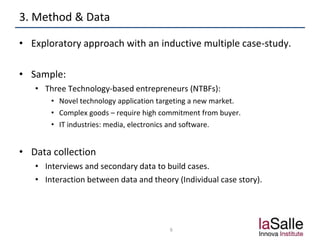
3. Method & Data
• Exploratory approach with an inductive multiple case-study.
• Sample:
• Three Technology-based entrepreneurs (NTBFs):
• Novel technology application targeting a new market.
• Complex goods – require high commitment from buyer.
• IT industries: media, electronics and software.
• Data collection
• Interviews and secondary data to build cases.
• Interaction between data and theory (Individual case story).
6
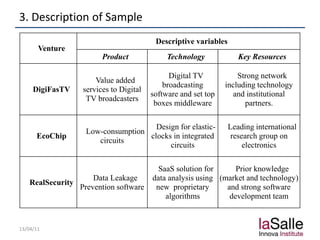
3. Description of Sample
13/04/11
Venture
Descriptive variables
Product Technology Key Resources
DigiFasTV
Value added
services to Digital
TV broadcasters
Digital TV
broadcasting
software and set top
boxes middleware
Strong network
including technology
and institutional
partners.
EcoChip
Low-consumption
circuits
Design for elastic-
clocks in integrated
circuits
Leading international
research group on
electronics
RealSecurity
Data Leakage
Prevention software
SaaS solution for
data analysis using
new proprietary
algorithms
Prior knowledge
(market and technology)
and strong software
development team
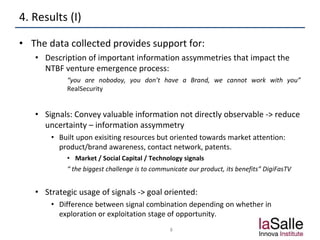
4. Results (I)
• The data collected provides support for:
• Description of important information assymmetries that impact the
NTBF venture emergence process:
“you are nobodoy, you don’t have a Brand, we cannot work with you”
RealSecurity
• Signals: Convey valuable information not directly observable -> reduce
uncertainty – information assymmetry
• Built upon exisiting resources but oriented towards market attention:
product/brand awareness, contact network, patents.
• Market / Social Capital / Technology signals
“ the biggest challenge is to communicate our product, its benefits” DigiFasTV
• Strategic usage of signals -> goal oriented:
• Difference between signal combination depending on whether in
exploration or exploitation stage of opportunity.
8
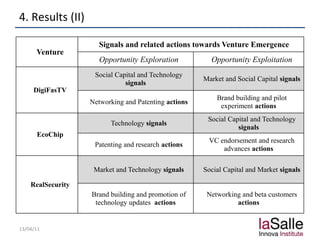
4. Results (II)
13/04/11
Venture
Signals and related actions towards Venture Emergence
Opportunity Exploration Opportunity Exploitation
DigiFasTV
Social Capital and Technology
signals
Market and Social Capital signals
Networking and Patenting actions
Brand building and pilot
experiment actions
EcoChip
Technology signals
Social Capital and Technology
signals
Patenting and research actions
VC endorsement and research
advances actions
RealSecurity
Market and Technology signals Social Capital and Market signals
Brand building and promotion of
technology updates actions
Networking and beta customers
actions
5. Discussion and implications
• Findings provide support for the introduction of complementary
theoretical perspectives to RBV on venture emergence.
• Insights link with innovation and new product development literature
(Frischammar et al. 2012).
• Provide evidences of the impact of social interactions during opportunity
development (Wood & McKinley 2010).
• Further research could advance in the understanding on signal selection
and signal portfolios by entrepreneurs to address market uncertainty.
• Implications:
• Identification of alternative factors that have an effect on the NTBF’s venture
emergence process.
• Contribution to further integration between marketing and entrepreneurship
literature.
• Provide guidelines on factors influencing venture emergence to entrepreneurs,
investors and stakeholders.
10
6. Conclusions
• New technology-based firms venture emergence can not be
explained solely by studying the resources.
• The technology commercialization challenge can be described as an
information assymmetry problem.
• Signals that convey information on the “quality”, help to mitigate
uncertainty and favour the early sales -> venture emergence.
• Data shows that different type of signals are used, and that they
could be adjusted depending on the opportunity development
stage.
• Evidence of the research opportunities related to the introduction
of demand-side view: marketing & entrepreneurship theories.
11

Exploring the use of signals in the venture emergence of new technology-based firms

  • 1.
    Exploring the useof signals in the venture emergence of new technology-based firms 20th ICE Conference – IEEE TMC Europe Conference 23-25 June 2014, Bergamo, Italy Ferran Giones (fgiones@salleurl.edu) Dr. Francesc Miralles (fmiralles@salleurl.edu)
  • 2.
    Agenda 1. Introduction 2. LiteratureReview 3. Method & Data 4. Results 5. Discussion and implications 6. Conclusions 2
  • 3.
    1. Introduction • Promisingtechnology-based firms (NTBF) often seen to struggle in their product or service commercialization (Gans & Stern 2003). • Venture emergence is dependent on the ability to make the new venture operational –> activate sales (Dimov 2010) • Managing technology resources to produce valuable products requires a market orientation: • From technology as a resource, to technology as quality signal. • Introduce demand-side view to traditional resource-based view (Priem et al. 211) to explore the signals that could influence on new technology-based ventures emergence. 3
  • 4.
    2. Literature review(I) • Technology Entrepreneurship (Hsu 2008) • Opportunity exploitation requires technology commercialization. • Uncertainty regarding new venture products reduces survival options (Shepherd et al. 2000). • Resource-based view on Technology Entrepreneurship: • Unclear influence of Human and Social Capital on venture emergence (Dimov 2010, Tornikoski 2007). • Limited impact of resources on the venture performance (West & Noel 2009). • Limited understanding on the role of customer and market interactions, despite prior research proposals for a socio- constructivist perspectives (Wood & McKinley 2010). 4
  • 5.
    2. Literature review(II) • Introduce demand-side view (Priem et al. 2011) • Heterogeneous demand -> need to create value before capture. • Focus on factors that reduce customer uncertainty regarding the quality of the product/service. • Using an information perspective (Stiglitz 1985): • Information assymmetry: producer – buyer (uncertainty). • Propose to observe the actions (observed as signals) that convey information on “quality” of the venture and products (signaling theory) to explain performance (Connely et al. 2010). • How do technology-based ventures (NTBFs) use signals? Does it influence on the venture emergence process? 5
  • 6.
    3. Method &Data • Exploratory approach with an inductive multiple case-study. • Sample: • Three Technology-based entrepreneurs (NTBFs): • Novel technology application targeting a new market. • Complex goods – require high commitment from buyer. • IT industries: media, electronics and software. • Data collection • Interviews and secondary data to build cases. • Interaction between data and theory (Individual case story). 6
  • 7.
    3. Description ofSample 13/04/11 Venture Descriptive variables Product Technology Key Resources DigiFasTV Value added services to Digital TV broadcasters Digital TV broadcasting software and set top boxes middleware Strong network including technology and institutional partners. EcoChip Low-consumption circuits Design for elastic- clocks in integrated circuits Leading international research group on electronics RealSecurity Data Leakage Prevention software SaaS solution for data analysis using new proprietary algorithms Prior knowledge (market and technology) and strong software development team
  • 8.
    4. Results (I) •The data collected provides support for: • Description of important information assymmetries that impact the NTBF venture emergence process: “you are nobodoy, you don’t have a Brand, we cannot work with you” RealSecurity • Signals: Convey valuable information not directly observable -> reduce uncertainty – information assymmetry • Built upon exisiting resources but oriented towards market attention: product/brand awareness, contact network, patents. • Market / Social Capital / Technology signals “ the biggest challenge is to communicate our product, its benefits” DigiFasTV • Strategic usage of signals -> goal oriented: • Difference between signal combination depending on whether in exploration or exploitation stage of opportunity. 8
  • 9.
    4. Results (II) 13/04/11 Venture Signalsand related actions towards Venture Emergence Opportunity Exploration Opportunity Exploitation DigiFasTV Social Capital and Technology signals Market and Social Capital signals Networking and Patenting actions Brand building and pilot experiment actions EcoChip Technology signals Social Capital and Technology signals Patenting and research actions VC endorsement and research advances actions RealSecurity Market and Technology signals Social Capital and Market signals Brand building and promotion of technology updates actions Networking and beta customers actions
  • 10.
    5. Discussion andimplications • Findings provide support for the introduction of complementary theoretical perspectives to RBV on venture emergence. • Insights link with innovation and new product development literature (Frischammar et al. 2012). • Provide evidences of the impact of social interactions during opportunity development (Wood & McKinley 2010). • Further research could advance in the understanding on signal selection and signal portfolios by entrepreneurs to address market uncertainty. • Implications: • Identification of alternative factors that have an effect on the NTBF’s venture emergence process. • Contribution to further integration between marketing and entrepreneurship literature. • Provide guidelines on factors influencing venture emergence to entrepreneurs, investors and stakeholders. 10
  • 11.
    6. Conclusions • Newtechnology-based firms venture emergence can not be explained solely by studying the resources. • The technology commercialization challenge can be described as an information assymmetry problem. • Signals that convey information on the “quality”, help to mitigate uncertainty and favour the early sales -> venture emergence. • Data shows that different type of signals are used, and that they could be adjusted depending on the opportunity development stage. • Evidence of the research opportunities related to the introduction of demand-side view: marketing & entrepreneurship theories. 11