slidesmania.com
Biology, brain & Behaviour
- consciousness, sensation, perception
(Part 1)
1
slidesmania.com
table of contents
Nervous System
Endocrine System
Brain
slidesmania.com
NERVOUS SYSTEM
3
slidesmania.com
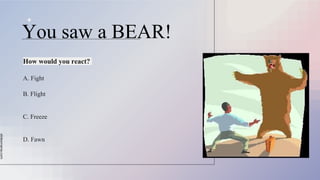
Imagine this scenario, you're walking
alone in a thick jungle, admiring the
beautiful surroundings, when all of a
sudden...
4
slidesmania.com
You saw a BEAR!
How would you react?
A. Fight
B. Flight
C. Freeze
D. Fawn
slidesmania.com
Your choice will influence
1. Central Nervous System
2. Peripheral Nervous System
6
slidesmania.com
7
slidesmania.com
8
slidesmania.com
What happened?
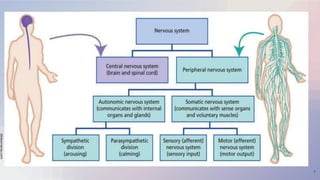
● Your Central Nervous System will process how the bear is a threat, send signals to your
muscle to run, fight, stand still.
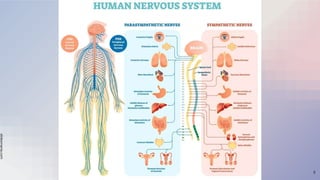
● Your Peripheral Nervous system (Autonomic Nervous System; Sympathetic nerves), will
increase your heartbeat, demand your body to take action against the threat.
● Your body will go on survival mode, you lose appetite, your breath shorter, less control of
your bladder, feeling thirsty until you brain tells you, you’re free from the threat
9
slidesmania.com
What happened after?
● After the bear is out of sight, your Peripheral Nervous System (Autonomic;
Parasympathetic Nervous System) will be activated.
● You will feel hungry, sleepy, your heartbeats beat slower, your body will go on relax mode
10
slidesmania.com
For example
● You have exam at noon, in the morning you will be more likely to feel less hungry, stomach
ache, restless because your Sympathetic Nerves are activated
● How to relax? You need to activate your Parasympathetic Nerves
○ One of the easy way using Deep Breathing and Progressive Muscle Relaxation (PMR)
○ Deep Breathing (https://www.youtube.com/watch?v=j-1n3KJR1I8)
○ PMR (https://www.youtube.com/watch?v=ClqPtWzozXs)
11
slidesmania.com
Kahoot
12
slidesmania.com
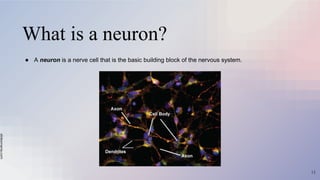
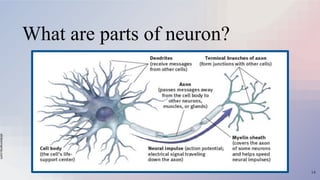
What is a neuron?
● A neuron is a nerve cell that is the basic building block of the nervous system.
13
slidesmania.com
What are parts of neuron?
14
slidesmania.com
How do they communicate?
● https://www.youtube.com/watch?v=hGDvvUNU-cw
15
slidesmania.com
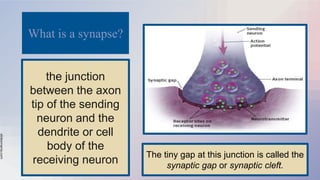
What is a synapse?
the junction
between the axon
tip of the sending
neuron and the
dendrite or cell
body of the
receiving neuron
The tiny gap at this junction is called the
synaptic gap or synaptic cleft.
slidesmania.com
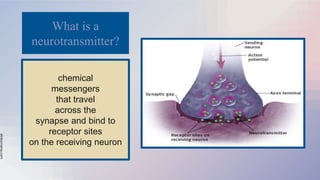
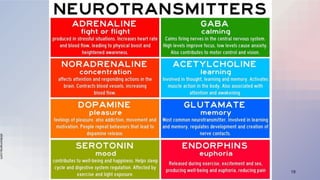
What is a
neurotransmitter?
chemical
messengers
that travel
across the
synapse and bind to
receptor sites
on the receiving neuron
slidesmania.com
18
slidesmania.com
Endocrine System
19
slidesmania.com
Video
● https://www.youtube.com/watch?v=PvuHB9XYENQ
20
slidesmania.com
The Endocrine System
● Controlled by the Hypothalamus
● Helps coordinate and integrate complex psychological reactions
● Endocrine glands secrete hormones into the bloodstream. It is much slower than the nervous
system.
● Hormones are chemical substances (similar in function to neurotransmitters) that help regulate
bodily activities.
21
slidesmania.com
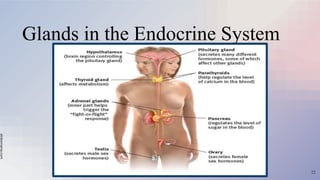
Glands in the Endocrine System
22
slidesmania.com
Brain
23
slidesmania.com
Video
● https://www.youtube.com/watch?v=pRFXSjkpKWA
24
slidesmania.com
25
slidesmania.com
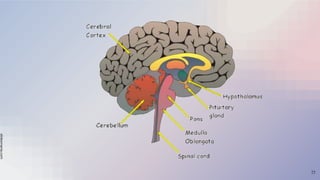
The Brain
CEREBRUM
● The cerebrum is the largest part of your brain and makes up about 80% of its mass. It is
divided into two halves, or cerebral hemispheres. Each half takes information from, and
control muscles of the opposite side of the body. Your Cerebrum is also the centre of your
intelligence, memory, speech and consciousness. The outer layer, called the cerebral cortex,
is folded and grooved, and is made up of billions of nerve cells, known as grey matter. Inside
this is the thick white matter of the cerebrum, made up of connecting fibres.
CEREBELLUM
● The cerebellum, which means 'little brain', is found behind the brain stem. It has two folded
and grooved halves which are responsible for co-ordinated body movements, posture and
balance. The outer layer, or cortex, contains nerve cell, or grey matter, and under this run their
fibres, in the white matter.
26
slidesmania.com
The Brain
SPINAL CORD
● The spinal cord is a column of nerve tissue about 45 cm in length and as thick as a finger. It is
protected by a column of bones called vertebrae that form the spine. The spinal cord and the
brain make up the central nervous system, and together they control most of your body's
activities. The 31 pairs of spinal nerves, which fan out from the spinal cord, form the
peripheral nervous system. These provide the main links between your brain and the rest
of your body.
MEDULLA OBLONGATA
● The medulla oblongata is the lowest part of the brain stem, next to the spinal cord. It is only
2.5 cm long. Nerve fibres cross over here, so that one side of your brain receives information
from the opposite side of your body. The medulla oblongata is also the control centre for a
number of vital body functions. These include: pacing of your heartbeat, controlling blood
vessels & blood pressure, and setting the rate and depth of your breathing.
27
slidesmania.com
The Brain
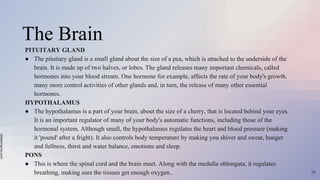
PITUITARY GLAND
● The pituitary gland is a small gland about the size of a pea, which is attached to the underside of the
brain. It is made up of two halves, or lobes. The gland releases many important chemicals, called
hormones into your blood stream. One hormone for example, affects the rate of your body's growth.
many more control activities of other glands and, in turn, the release of many other essential
hormones.
HYPOTHALAMUS
● The hypothalamus is a part of your brain, about the size of a cherry, that is located behind your eyes.
It is an important regulator of many of your body's automatic functions, including those of the
hormonal system. Although small, the hypothalamus regulates the heart and blood pressure (making
it 'pound' after a fright). It also controls body temperature by making you shiver and sweat, hunger
and fullness, thirst and water balance, emotions and sleep.
PONS
● This is where the spinal cord and the brain meet. Along with the medulla oblongata, it regulates
breathing, making sure the tissues get enough oxygen.. 28
slidesmania.com
thank you!
Do you have any questions?
29

Biology, brain and behaviour (for foundation students)

  • 1.
    slidesmania.com Biology, brain &Behaviour - consciousness, sensation, perception (Part 1) 1
  • 2.
    slidesmania.com table of contents NervousSystem Endocrine System Brain
  • 3.
  • 4.
    slidesmania.com Imagine this scenario,you're walking alone in a thick jungle, admiring the beautiful surroundings, when all of a sudden... 4
  • 5.
    slidesmania.com You saw aBEAR! How would you react? A. Fight B. Flight C. Freeze D. Fawn
  • 6.
    slidesmania.com Your choice willinfluence 1. Central Nervous System 2. Peripheral Nervous System 6
  • 7.
  • 8.
  • 9.
    slidesmania.com What happened? ● YourCentral Nervous System will process how the bear is a threat, send signals to your muscle to run, fight, stand still. ● Your Peripheral Nervous system (Autonomic Nervous System; Sympathetic nerves), will increase your heartbeat, demand your body to take action against the threat. ● Your body will go on survival mode, you lose appetite, your breath shorter, less control of your bladder, feeling thirsty until you brain tells you, you’re free from the threat 9
  • 10.
    slidesmania.com What happened after? ●After the bear is out of sight, your Peripheral Nervous System (Autonomic; Parasympathetic Nervous System) will be activated. ● You will feel hungry, sleepy, your heartbeats beat slower, your body will go on relax mode 10
  • 11.
    slidesmania.com For example ● Youhave exam at noon, in the morning you will be more likely to feel less hungry, stomach ache, restless because your Sympathetic Nerves are activated ● How to relax? You need to activate your Parasympathetic Nerves ○ One of the easy way using Deep Breathing and Progressive Muscle Relaxation (PMR) ○ Deep Breathing (https://www.youtube.com/watch?v=j-1n3KJR1I8) ○ PMR (https://www.youtube.com/watch?v=ClqPtWzozXs) 11
  • 12.
  • 13.
    slidesmania.com What is aneuron? ● A neuron is a nerve cell that is the basic building block of the nervous system. 13
  • 14.
  • 15.
    slidesmania.com How do theycommunicate? ● https://www.youtube.com/watch?v=hGDvvUNU-cw 15
  • 16.
    slidesmania.com What is asynapse? the junction between the axon tip of the sending neuron and the dendrite or cell body of the receiving neuron The tiny gap at this junction is called the synaptic gap or synaptic cleft.
  • 17.
    slidesmania.com What is a neurotransmitter? chemical messengers thattravel across the synapse and bind to receptor sites on the receiving neuron
  • 18.
  • 19.
  • 20.
  • 21.
    slidesmania.com The Endocrine System ●Controlled by the Hypothalamus ● Helps coordinate and integrate complex psychological reactions ● Endocrine glands secrete hormones into the bloodstream. It is much slower than the nervous system. ● Hormones are chemical substances (similar in function to neurotransmitters) that help regulate bodily activities. 21
  • 22.
    slidesmania.com Glands in theEndocrine System 22
  • 23.
  • 24.
  • 25.
  • 26.
    slidesmania.com The Brain CEREBRUM ● Thecerebrum is the largest part of your brain and makes up about 80% of its mass. It is divided into two halves, or cerebral hemispheres. Each half takes information from, and control muscles of the opposite side of the body. Your Cerebrum is also the centre of your intelligence, memory, speech and consciousness. The outer layer, called the cerebral cortex, is folded and grooved, and is made up of billions of nerve cells, known as grey matter. Inside this is the thick white matter of the cerebrum, made up of connecting fibres. CEREBELLUM ● The cerebellum, which means 'little brain', is found behind the brain stem. It has two folded and grooved halves which are responsible for co-ordinated body movements, posture and balance. The outer layer, or cortex, contains nerve cell, or grey matter, and under this run their fibres, in the white matter. 26
  • 27.
    slidesmania.com The Brain SPINAL CORD ●The spinal cord is a column of nerve tissue about 45 cm in length and as thick as a finger. It is protected by a column of bones called vertebrae that form the spine. The spinal cord and the brain make up the central nervous system, and together they control most of your body's activities. The 31 pairs of spinal nerves, which fan out from the spinal cord, form the peripheral nervous system. These provide the main links between your brain and the rest of your body. MEDULLA OBLONGATA ● The medulla oblongata is the lowest part of the brain stem, next to the spinal cord. It is only 2.5 cm long. Nerve fibres cross over here, so that one side of your brain receives information from the opposite side of your body. The medulla oblongata is also the control centre for a number of vital body functions. These include: pacing of your heartbeat, controlling blood vessels & blood pressure, and setting the rate and depth of your breathing. 27
  • 28.
    slidesmania.com The Brain PITUITARY GLAND ●The pituitary gland is a small gland about the size of a pea, which is attached to the underside of the brain. It is made up of two halves, or lobes. The gland releases many important chemicals, called hormones into your blood stream. One hormone for example, affects the rate of your body's growth. many more control activities of other glands and, in turn, the release of many other essential hormones. HYPOTHALAMUS ● The hypothalamus is a part of your brain, about the size of a cherry, that is located behind your eyes. It is an important regulator of many of your body's automatic functions, including those of the hormonal system. Although small, the hypothalamus regulates the heart and blood pressure (making it 'pound' after a fright). It also controls body temperature by making you shiver and sweat, hunger and fullness, thirst and water balance, emotions and sleep. PONS ● This is where the spinal cord and the brain meet. Along with the medulla oblongata, it regulates breathing, making sure the tissues get enough oxygen.. 28
  • 29.
    slidesmania.com thank you! Do youhave any questions? 29