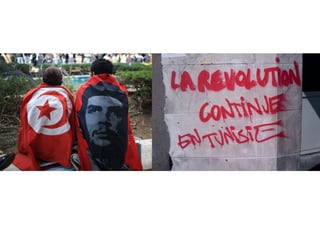
The Arab Spring
Finding the Value of Social
Engagement through Social
Media and the Political
Revolution that ‘sharing’ has
incited.
The ‘Arab Spring’ was an outburst of revolutionary insurgence that sprang forth in the
Arab world on December of 2010.

It was catalyzed by 3 significant events.

1.  17th of December 2010 – an educated Tunisian fruit seller, Mohammed Bouazizi, sets himself
on fire in protest to having his wares confiscated and being assaulted by a municipal official.

2.

Enraged Tunisians afflicted by the same suppressed problems take to the streets in massive
protests, triggering the Tunisian uprising.

3.

Under the protection of the army, the protest movement that begins in Sidi Bouzid swells to
become a nationwide phenomenon, with Tunisians eventually ousting their President, Zine El
Abidine Ben Ali out of office on January 15, 2011.
The ‘Arab Spring’ was an outburst of revolutionary insurgence that sprang forth in the
Arab world on December of 2010. It started with the self - immolation of Mohd Bouzazi, an
educated fruit seller vexed with the corruption that prevailed in the administrative system.

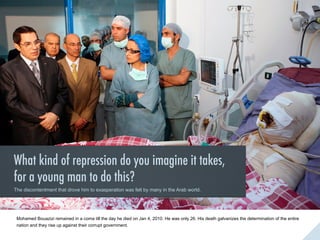
Mohamed Bouazizi remained in a coma till the day he died on Jan 4, 2010. He was only 26. His death galvanizes the determination of the entire
nation and they rise up against their corrupt government.
Oppression and injustice in the Middle East and North Africa have resulted in people revolting against
their governments for years, but in small groups which soon faded off. After the the self - immolation of
Mohd Bouzazi, enraged Tunisians afflicted by the same suppressed problems take to the streets in
massive protests, triggering the Tunisian uprising.
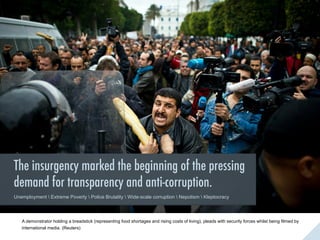
The street protests marked the beginning of the pressing
demand for transparency and anti-corruption.
Unemployment  Extreme Poverty  Police Brutality  Wide-scale corruption  Nepotism  Kleptocracy

A demonstrator holding a breadstick (representing food shortages and rising costs of living), pleads with security forces whilst being filmed by
international media. (Reuters)
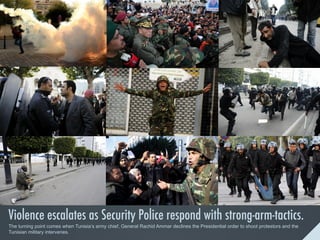
Violence escalates as Security Police respond with strong-arm-tactics.
The turning point comes when Tunisia’s army chief, General Rachid Ammar declines the Presidential order to shoot protestors and the
Tunisian military intervenes.
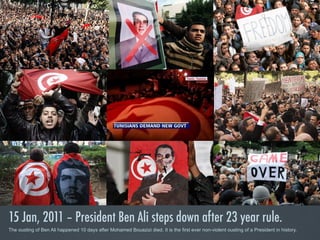
15 Jan, 2011 – President Ben Ali steps down after 23 year rule.
The ousting of Ben Ali happened 10 days after Mohamed Bouazizi died. It is the first ever non-violent ousting of a President in history.
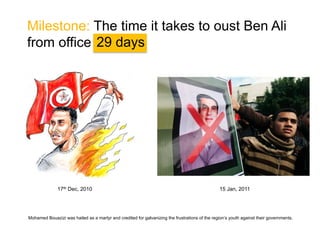
Milestone: The time it takes to oust Ben Ali
from office 29 days

17th Dec, 2010

15 Jan, 2011

Mohamed Bouazizi was hailed as a martyr and credited for galvanizing the frustrations of the region’s youth against their governments.
The unrest spread like a wild fire, especially on social media platforms like twitter,
facebook and youtube, bringing people together in civil resistance….

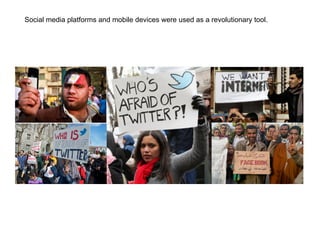
Social media platforms and mobile devices were used as a revolutionary tool to spread the word about the revolution.
…. and resulted in great changes across the Middle East and North Africa in a very short
period of time.

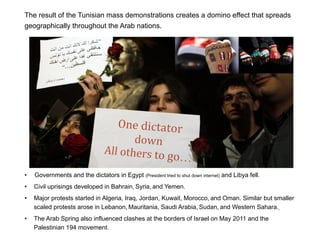
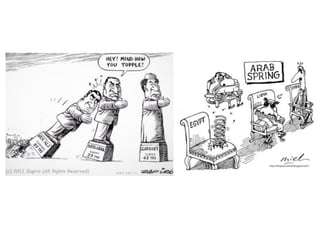
Change spread throughout the Middle East and North Africa, like a domino effect, with the world as a stage, calling to question the actions
of political rulers.
• 

Governments and the dictators in Egypt (President tried to shut down internet) and Libya fell.

• 

Civil uprisings developed in Bahrain, Syria, and Yemen.

• 

Major protests started in Algeria, Iraq, Jordan, Kuwait, Morocco, and Oman. Similar but
smaller scaled protests arose in Lebanon, Mauritania, Saudi Arabia, Sudan, and Western
Sahara.

• 

The Arab Spring also influenced clashes at the borders of Israel on May 2011 and the
Palestinian 194 movement.
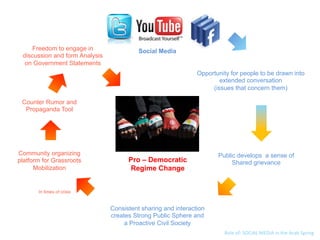
Freedom to engage in
discussion and form Analysis
on Government Statements

Social Media
Opportunity for people to be drawn into
extended conversation
(issues that concern them)

Counter Rumor and
Propaganda Tool

Community organizing
platform for Grassroots
Mobilization

Pro – Democratic
Regime Change

Public develops a sense of
Shared grievance

In times of crisis

Consistent sharing and interaction
creates Strong Public Sphere and
a Proactive Civil Society
Role	
  of:	
  SOCIAL	
  MEDIA	
  in	
  the	
  Arab	
  Spring	
  
Tunisia: Example of Social Media
Innovation used as a Revolutionary Tool.
• 

Twitter played an important role initial role in Tunisia for much of December.

• 

As the revolution gathered steam, Facebook became the main organizing tool for protests and
sharing videos.

• 

People in Europe would migrate those videos to Posterous, subsequently uploading them unto
Youtube, and sharing them via Twitter.

• 

Hackerspace nawaat.org aggregated these videos as soon as they went up.

• 

Global audiences tuned in to Al Jazeera (Qatar-based satellite channel) for livestreams and
dependable information.

• 

All these services worked together on top of the platform that the Internet provided.
Egypt: Example of Social Media Innovation
used as a Revolutionary Tool.
• 

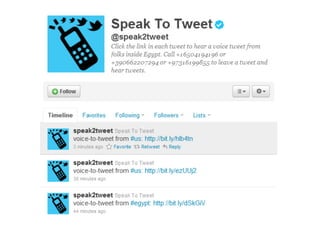
When Egypt’s President tried to shut down the internet, Google and Twitter worked together to
build a speak-to-tweet service.

• 

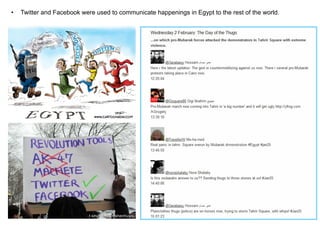
Twitter and Facebook were used to communicate happenings in Egypt to the rest of the world.

• 

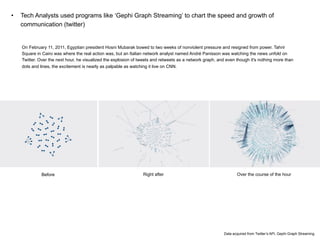
Tech Analysts used programs like ‘Gephi Graph Streaming’ to chart the speed and growth of
communication (twitter)
• 

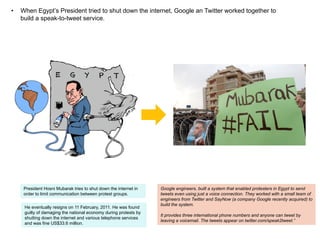
When Egypt’s President tried to shut down the internet, Google an Twitter worked together to
build a speak-to-tweet service.

President Hosni Mubarak tries to shut down the internet in
order to limit communication between protest groups.
He eventually resigns on 11 February, 2011. He was found
guilty of damaging the national economy during protests by
shutting down the internet and various telephone services
and was fine US$33.6 million.

Google engineers, built a system that enabled protesters in Egypt to send
tweets even using just a voice connection. They worked with a small team of
engineers from Twitter and SayNow (a company Google recently acquired) to
build the system.
It provides three international phone numbers and anyone can tweet by
leaving a voicemail. The tweets appear on twitter.com/speak2tweet.”
• 

Twitter and Facebook were used to communicate happenings in Egypt to the rest of the world.
• 

Tech Analysts used programs like ‘Gephi Graph Streaming’ to chart the speed and growth of
communication (twitter)

On February 11, 2011, Egyptian president Hosni Mubarak bowed to two weeks of nonviolent pressure and resigned from power. Tahrir
Square in Cairo was where the real action was, but an Italian network analyst named André Panisson was watching the news unfold on
Twitter. Over the next hour, he visualized the explosion of tweets and retweets as a network graph, and even though it's nothing more than
dots and lines, the excitement is nearly as palpable as watching it live on CNN.

Before

Right after

Over the course of the hour

Data acquired from Twitter’s API, Gephi Graph Streaming
The Arab people’s desire to emancipate themselves from oppression and corrupt
government culminates in a ‘tipping point’ that traverses the issue of morality.

• 

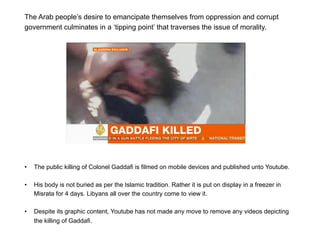
The public killing of Colonel Gaddafi is filmed on mobile devices and published unto Youtube.

• 

His body is not buried as per the Islamic tradition. Rather it is put on display in a freezer in
Misrata for 4 days. Libyans all over the country come to view it.

• 

Despite its graphic content, Youtube has not made any move to remove any videos depicting
the killing of Gaddafi.
Conclusion: A revolution like this puts the spotlight on dictators and leaders who,
through the existence of social media as a platform for shared grievance, will
eventually be called to be held accountable for their actions.

• 

It was deeply-rooted problems that drove Mohamed Bouazizi to self-immolation. Although he
was hailed as a martyr, his sacrifice and self-immolation was very extreme.

• 

Singaporeans have recently experienced similar feedback with regards to Singapore’s
parliamentary elections. When such ignorance exists and carries on, the suppressed emotions
are automatically vented via social media.

• 

The power of social media lies in the ability to share emotions across different spectrums. The
strength that the oppressed find, can be catalysts to incite revolutionary change.

• 

Social media also promotes the idea of no-censorship and self-broadcasting. However in doing
so, we have traversed a moral dilemma. Was the filming and publication of the killing of Gaddafi
and the participation of NATO, right or wrong?

• 

‘Those who make peaceful revolution impossible will make violent revolution inevitable’.
John F. Kennedy
Social Change and The Arab Spring

Social Change and The Arab Spring

  • 1.
    The Arab Spring Findingthe Value of Social Engagement through Social Media and the Political Revolution that ‘sharing’ has incited.
  • 2.
    The ‘Arab Spring’was an outburst of revolutionary insurgence that sprang forth in the Arab world on December of 2010. It was catalyzed by 3 significant events. 1.  17th of December 2010 – an educated Tunisian fruit seller, Mohammed Bouazizi, sets himself on fire in protest to having his wares confiscated and being assaulted by a municipal official. 2. Enraged Tunisians afflicted by the same suppressed problems take to the streets in massive protests, triggering the Tunisian uprising. 3. Under the protection of the army, the protest movement that begins in Sidi Bouzid swells to become a nationwide phenomenon, with Tunisians eventually ousting their President, Zine El Abidine Ben Ali out of office on January 15, 2011.
  • 3.
    The ‘Arab Spring’was an outburst of revolutionary insurgence that sprang forth in the Arab world on December of 2010. It started with the self - immolation of Mohd Bouzazi, an educated fruit seller vexed with the corruption that prevailed in the administrative system. Mohamed Bouazizi remained in a coma till the day he died on Jan 4, 2010. He was only 26. His death galvanizes the determination of the entire nation and they rise up against their corrupt government.
  • 4.
    Oppression and injusticein the Middle East and North Africa have resulted in people revolting against their governments for years, but in small groups which soon faded off. After the the self - immolation of Mohd Bouzazi, enraged Tunisians afflicted by the same suppressed problems take to the streets in massive protests, triggering the Tunisian uprising.
  • 5.
    The street protestsmarked the beginning of the pressing demand for transparency and anti-corruption. Unemployment Extreme Poverty Police Brutality Wide-scale corruption Nepotism Kleptocracy A demonstrator holding a breadstick (representing food shortages and rising costs of living), pleads with security forces whilst being filmed by international media. (Reuters)
  • 6.
    Violence escalates asSecurity Police respond with strong-arm-tactics. The turning point comes when Tunisia’s army chief, General Rachid Ammar declines the Presidential order to shoot protestors and the Tunisian military intervenes.
  • 7.
    15 Jan, 2011– President Ben Ali steps down after 23 year rule. The ousting of Ben Ali happened 10 days after Mohamed Bouazizi died. It is the first ever non-violent ousting of a President in history.
  • 8.
    Milestone: The timeit takes to oust Ben Ali from office 29 days 17th Dec, 2010 15 Jan, 2011 Mohamed Bouazizi was hailed as a martyr and credited for galvanizing the frustrations of the region’s youth against their governments.
  • 9.
    The unrest spreadlike a wild fire, especially on social media platforms like twitter, facebook and youtube, bringing people together in civil resistance…. Social media platforms and mobile devices were used as a revolutionary tool to spread the word about the revolution.
  • 10.
    …. and resultedin great changes across the Middle East and North Africa in a very short period of time. Change spread throughout the Middle East and North Africa, like a domino effect, with the world as a stage, calling to question the actions of political rulers.
  • 11.
    •  Governments and thedictators in Egypt (President tried to shut down internet) and Libya fell. •  Civil uprisings developed in Bahrain, Syria, and Yemen. •  Major protests started in Algeria, Iraq, Jordan, Kuwait, Morocco, and Oman. Similar but smaller scaled protests arose in Lebanon, Mauritania, Saudi Arabia, Sudan, and Western Sahara. •  The Arab Spring also influenced clashes at the borders of Israel on May 2011 and the Palestinian 194 movement.
  • 12.
    Freedom to engagein discussion and form Analysis on Government Statements Social Media Opportunity for people to be drawn into extended conversation (issues that concern them) Counter Rumor and Propaganda Tool Community organizing platform for Grassroots Mobilization Pro – Democratic Regime Change Public develops a sense of Shared grievance In times of crisis Consistent sharing and interaction creates Strong Public Sphere and a Proactive Civil Society Role  of:  SOCIAL  MEDIA  in  the  Arab  Spring  
  • 13.
    Tunisia: Example ofSocial Media Innovation used as a Revolutionary Tool. •  Twitter played an important role initial role in Tunisia for much of December. •  As the revolution gathered steam, Facebook became the main organizing tool for protests and sharing videos. •  People in Europe would migrate those videos to Posterous, subsequently uploading them unto Youtube, and sharing them via Twitter. •  Hackerspace nawaat.org aggregated these videos as soon as they went up. •  Global audiences tuned in to Al Jazeera (Qatar-based satellite channel) for livestreams and dependable information. •  All these services worked together on top of the platform that the Internet provided.
  • 14.
    Egypt: Example ofSocial Media Innovation used as a Revolutionary Tool. •  When Egypt’s President tried to shut down the internet, Google and Twitter worked together to build a speak-to-tweet service. •  Twitter and Facebook were used to communicate happenings in Egypt to the rest of the world. •  Tech Analysts used programs like ‘Gephi Graph Streaming’ to chart the speed and growth of communication (twitter)
  • 15.
    •  When Egypt’s Presidenttried to shut down the internet, Google an Twitter worked together to build a speak-to-tweet service. President Hosni Mubarak tries to shut down the internet in order to limit communication between protest groups. He eventually resigns on 11 February, 2011. He was found guilty of damaging the national economy during protests by shutting down the internet and various telephone services and was fine US$33.6 million. Google engineers, built a system that enabled protesters in Egypt to send tweets even using just a voice connection. They worked with a small team of engineers from Twitter and SayNow (a company Google recently acquired) to build the system. It provides three international phone numbers and anyone can tweet by leaving a voicemail. The tweets appear on twitter.com/speak2tweet.”
  • 17.
    •  Twitter and Facebookwere used to communicate happenings in Egypt to the rest of the world.
  • 18.
    •  Tech Analysts usedprograms like ‘Gephi Graph Streaming’ to chart the speed and growth of communication (twitter) On February 11, 2011, Egyptian president Hosni Mubarak bowed to two weeks of nonviolent pressure and resigned from power. Tahrir Square in Cairo was where the real action was, but an Italian network analyst named André Panisson was watching the news unfold on Twitter. Over the next hour, he visualized the explosion of tweets and retweets as a network graph, and even though it's nothing more than dots and lines, the excitement is nearly as palpable as watching it live on CNN. Before Right after Over the course of the hour Data acquired from Twitter’s API, Gephi Graph Streaming
  • 19.
    The Arab people’sdesire to emancipate themselves from oppression and corrupt government culminates in a ‘tipping point’ that traverses the issue of morality. •  The public killing of Colonel Gaddafi is filmed on mobile devices and published unto Youtube. •  His body is not buried as per the Islamic tradition. Rather it is put on display in a freezer in Misrata for 4 days. Libyans all over the country come to view it. •  Despite its graphic content, Youtube has not made any move to remove any videos depicting the killing of Gaddafi.
  • 20.
    Conclusion: A revolutionlike this puts the spotlight on dictators and leaders who, through the existence of social media as a platform for shared grievance, will eventually be called to be held accountable for their actions. •  It was deeply-rooted problems that drove Mohamed Bouazizi to self-immolation. Although he was hailed as a martyr, his sacrifice and self-immolation was very extreme. •  Singaporeans have recently experienced similar feedback with regards to Singapore’s parliamentary elections. When such ignorance exists and carries on, the suppressed emotions are automatically vented via social media. •  The power of social media lies in the ability to share emotions across different spectrums. The strength that the oppressed find, can be catalysts to incite revolutionary change. •  Social media also promotes the idea of no-censorship and self-broadcasting. However in doing so, we have traversed a moral dilemma. Was the filming and publication of the killing of Gaddafi and the participation of NATO, right or wrong? •  ‘Those who make peaceful revolution impossible will make violent revolution inevitable’. John F. Kennedy