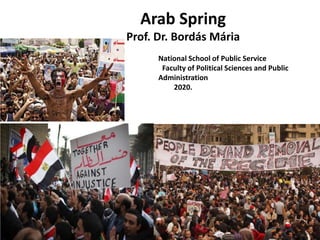
Arab Spring
Prof. Dr. Bordás Mária
National School of Public Service
Departm Faculty of Political Sciences and Public
Administration
2020.
Starting of the Arab Spring
„Jasmine Revolution”
2011: Tunisia - Drama of Mohamed Bouazizi fruit
trader:
- The police confiscated his handcart and goods
- He did not have licence
- Bouazizi went to regional authority to protest, but
the public servants did not pay any attention to him
- He burned himself
Further Events
• Revolted population
• Demonstration in the whole country
• Police could not handle
• Spread to the Arabic world
Reasons of Arab Spring: need for
economic and social reforms
• High unemployment (slipped intellectuals)
• Increasing number of poor
• High prices of foods and fuels
Led to hunger revolts
• Lack of democracy
• Lack of political liberty rights
• High corruption
• Unjust society – privilege of the political elite
Led to democratic revolution
Arab Spring as a New Phenomena
• Was not based on Islamic fundamentalism or radical
Islam
• Democratic movement: demanded democratic
reforms
Consequence:
- The initiative of the young Western-oriented
intellectuals slipped from their hands
- The more organized Islamist groups used the
political situation and began to dominate
Evaluation of Arab Spring (1)
• Arab Winter: it led to a chaos in the Middle East
- Some dictatorships have collapsed, and remained failed
states (Lybia, Yemen and Syria)
- Strengthened terrorist organizations (al-Qaeda in North
Africa and the Arabian Penninsula, and new affiliates of
Muslim Brotherhood in Egypt)
- Development of a new class of fighters who live on
terrorist activities
- Illegal trade of weapons from the uncontrolled weapon
stock
Evaluation of Arab Spring (2)
• Western-type democratic movement happened for
the first time in the Middle East
• Led to democratic development (in Jordan,
Morocco and Algeria the government and the
opposition could make a compromise)
• The revolution win: Tunisia – Islamist political party,
the Ennahda won, but had to resign by the public
pressure, and new election was held – currently
new democratic government
Evaluation of Arab Spring (3)
No change:
• The stable government could crushed the revolt in
Bahrein and Saudi-Arabia
• Mauritania: weak uprising
• Egypt: Islamist Morsi government – military putsch-
new election: antidemocratic new Sisi government
Conclusion:
- The end of the post-colonial period
- Outline of a new order in the Islamic world
- Artificial national state collapses
Relevance of State Efficiency in the Fragile
States
The terrorism and political violence are the highest in
the most fragile states, the most corrupt states, the
less peaceful countries, and the less democratic states
Criteria of Failed States I.
1. Human dimension:
• Demographic pressure
• Massive movement of refuges
• Chronic sustained of human flights
• Violation of human rights
2. Political/government dimension:
•Group grievances
•Lack of legitimacy of government
•Week security apparatus (military and police)
•Rise of factionalized elite
Criteria of Failed States II.
3. Economic dimension:
•Economic recession
•Poverty – economic inequality
•Declining level DGP/capita
•Corruption
4. Public service dimension:
•Inefficient infrastructure
•Epidemics
•Poor health and education
•Inefficient food and water supply
Different measuring of Inefficient versus
Successful states
Failing States Index (Found for Peace Organisation)
Index of Perception of Corruption (Trancparency International)
Global Peace Index (Institute for Economics and Peace)
Terrorism Risk Index (Maplecroft Global Risk Analitics)
Democracy Index (Economist Intelligence Unit)
Global Terrorism Index
Corruption
Democracy
Stable and Predictable Governance
• Scenario: autocratic presidential systems and military
juntas are often changed – military putsches – effort to
legitimize the power – unfair elections – new
constitution – eternal presidency
• Banned political parties, power centralization, lack of
division of branch of state power, no representation of
the social group, unjust redistribution, privileged elite,
poor majority
• Democratic state-institutions, if there are, just
decoration – „illiberal democracy”
Strong and Efficient Governance (1)
• Strong but not brutal military, security and
intelligence
• Coherent jurisdiction
• Respect of human rights
- To handle armed conflicts, terrorism, religious and
ethnic tensions
- To avoid political killing, brutal clashes of revolts,
tortures, illegal imprisonment, cruel punishments,
executions, genocide, etc.
Strong and Efficient Governance (2)
Controlling certain areas:
- Desert
- Tribal areas
- Nomadic territories
- Rocky mountains
Aim: to establish local governments, border check
Public Services
• Serving public goals: involving civil society in
decision-making processes (lobbies, trade unions,
non-profit organizations, etc.)
• Lack of public interest:
- Expropriation of political power by the elite -
exremely high corruption
- Neglecting the country – no development in the
agriculture - on pillar economy – lack of economic
development
- Demoghraphic bloom, water scarcity, poor
infrastructure, welfare, health care, education
Accountability and Transparency
• Open society
• Independent controlling authority
• Free media
Preventing and handling
inside conflicts
• Poverty
• Ethnic, religious, racial conflicts
How to handle them:
- Mediation, reconciliation, compromise
- No way: brutal military attack, police, intelligence or
jurisdiction
Tradition of radical Islam: very difficult to handle,
because they are fanatic! No sufficient means, except
efficient governance
Archbishop Desmond Tutu 2007
„You can never win a war against terror as long as
there are conditions in the world that make people
desperate — poverty, disease, ignorance, etc.”
Conclusion
Lack of state efficiency and intervention of the West are
strenghtening the Radical Islam:
- Poverty, misery, unemployment are hotbed of radical
Islam, because it shows a way to improve this situation
- Radical Islam cannot reach a better governance, but a
brutal dictatorship that is going to descruct the
civilization
- Western intervention cannot see the specialities of the
Islam culture
- Islami world have been disappointed by the West
policies
Questions?

Arab spring 2020

  • 1.
    Arab Spring Prof. Dr.Bordás Mária National School of Public Service Departm Faculty of Political Sciences and Public Administration 2020.
  • 2.
    Starting of theArab Spring „Jasmine Revolution” 2011: Tunisia - Drama of Mohamed Bouazizi fruit trader: - The police confiscated his handcart and goods - He did not have licence - Bouazizi went to regional authority to protest, but the public servants did not pay any attention to him - He burned himself
  • 4.
    Further Events • Revoltedpopulation • Demonstration in the whole country • Police could not handle • Spread to the Arabic world
  • 6.
    Reasons of ArabSpring: need for economic and social reforms • High unemployment (slipped intellectuals) • Increasing number of poor • High prices of foods and fuels Led to hunger revolts • Lack of democracy • Lack of political liberty rights • High corruption • Unjust society – privilege of the political elite Led to democratic revolution
  • 7.
    Arab Spring asa New Phenomena • Was not based on Islamic fundamentalism or radical Islam • Democratic movement: demanded democratic reforms Consequence: - The initiative of the young Western-oriented intellectuals slipped from their hands - The more organized Islamist groups used the political situation and began to dominate
  • 8.
    Evaluation of ArabSpring (1) • Arab Winter: it led to a chaos in the Middle East - Some dictatorships have collapsed, and remained failed states (Lybia, Yemen and Syria) - Strengthened terrorist organizations (al-Qaeda in North Africa and the Arabian Penninsula, and new affiliates of Muslim Brotherhood in Egypt) - Development of a new class of fighters who live on terrorist activities - Illegal trade of weapons from the uncontrolled weapon stock
  • 9.
    Evaluation of ArabSpring (2) • Western-type democratic movement happened for the first time in the Middle East • Led to democratic development (in Jordan, Morocco and Algeria the government and the opposition could make a compromise) • The revolution win: Tunisia – Islamist political party, the Ennahda won, but had to resign by the public pressure, and new election was held – currently new democratic government
  • 10.
    Evaluation of ArabSpring (3) No change: • The stable government could crushed the revolt in Bahrein and Saudi-Arabia • Mauritania: weak uprising • Egypt: Islamist Morsi government – military putsch- new election: antidemocratic new Sisi government Conclusion: - The end of the post-colonial period - Outline of a new order in the Islamic world - Artificial national state collapses
  • 12.
    Relevance of StateEfficiency in the Fragile States The terrorism and political violence are the highest in the most fragile states, the most corrupt states, the less peaceful countries, and the less democratic states
  • 13.
    Criteria of FailedStates I. 1. Human dimension: • Demographic pressure • Massive movement of refuges • Chronic sustained of human flights • Violation of human rights 2. Political/government dimension: •Group grievances •Lack of legitimacy of government •Week security apparatus (military and police) •Rise of factionalized elite
  • 14.
    Criteria of FailedStates II. 3. Economic dimension: •Economic recession •Poverty – economic inequality •Declining level DGP/capita •Corruption 4. Public service dimension: •Inefficient infrastructure •Epidemics •Poor health and education •Inefficient food and water supply
  • 15.
    Different measuring ofInefficient versus Successful states Failing States Index (Found for Peace Organisation) Index of Perception of Corruption (Trancparency International) Global Peace Index (Institute for Economics and Peace) Terrorism Risk Index (Maplecroft Global Risk Analitics) Democracy Index (Economist Intelligence Unit)
  • 16.
  • 18.
  • 19.
  • 20.
    Stable and PredictableGovernance • Scenario: autocratic presidential systems and military juntas are often changed – military putsches – effort to legitimize the power – unfair elections – new constitution – eternal presidency • Banned political parties, power centralization, lack of division of branch of state power, no representation of the social group, unjust redistribution, privileged elite, poor majority • Democratic state-institutions, if there are, just decoration – „illiberal democracy”
  • 21.
    Strong and EfficientGovernance (1) • Strong but not brutal military, security and intelligence • Coherent jurisdiction • Respect of human rights - To handle armed conflicts, terrorism, religious and ethnic tensions - To avoid political killing, brutal clashes of revolts, tortures, illegal imprisonment, cruel punishments, executions, genocide, etc.
  • 22.
    Strong and EfficientGovernance (2) Controlling certain areas: - Desert - Tribal areas - Nomadic territories - Rocky mountains Aim: to establish local governments, border check
  • 23.
    Public Services • Servingpublic goals: involving civil society in decision-making processes (lobbies, trade unions, non-profit organizations, etc.) • Lack of public interest: - Expropriation of political power by the elite - exremely high corruption - Neglecting the country – no development in the agriculture - on pillar economy – lack of economic development - Demoghraphic bloom, water scarcity, poor infrastructure, welfare, health care, education
  • 24.
    Accountability and Transparency •Open society • Independent controlling authority • Free media
  • 25.
    Preventing and handling insideconflicts • Poverty • Ethnic, religious, racial conflicts How to handle them: - Mediation, reconciliation, compromise - No way: brutal military attack, police, intelligence or jurisdiction Tradition of radical Islam: very difficult to handle, because they are fanatic! No sufficient means, except efficient governance
  • 26.
    Archbishop Desmond Tutu2007 „You can never win a war against terror as long as there are conditions in the world that make people desperate — poverty, disease, ignorance, etc.”
  • 27.
    Conclusion Lack of stateefficiency and intervention of the West are strenghtening the Radical Islam: - Poverty, misery, unemployment are hotbed of radical Islam, because it shows a way to improve this situation - Radical Islam cannot reach a better governance, but a brutal dictatorship that is going to descruct the civilization - Western intervention cannot see the specialities of the Islam culture - Islami world have been disappointed by the West policies
  • 28.

Editor's Notes

  • #16 There are recently 5 index made by international organizations that show the measure if a state should be sucessful or not. These are: corruption, peace, terrorism, democracy and failed.
  • #27 The presentation will outline how the ineffficient functions of the state are related to the development of terrorism in North Africa. I totally agree with Tutu: terrorism is closely related to the insufficiency of the state, such as poverty, violation of human rights, poor education and health, racial, ethnic and religious discrimination, etc.