Could you market a globally
           successful app?


                  Kieran Hanrahan

                    October 2012
Part 1: Introduction
•   Welcome
•   What is an App?
•   Why build an App?
•   What are the most popular Types of App?
•   How does this affect me?
•   Ideation
•   Handsets and Operating Systems
•   Q&A
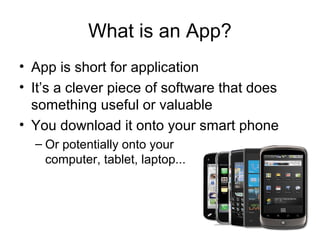
What is an App?
• App is short for application
• It’s a clever piece of software that does
  something useful or valuable
• You download it onto your smart phone
  – Or potentially onto your
    computer, tablet, laptop...
Why?
• Apps have a global market
  – Potential for massive growth


• Low entry level barriers to this market
  – Cheap to prototype
  – Cheap to develop
  – Cheap to deliver
  – Cheap to promote… well sometimes!
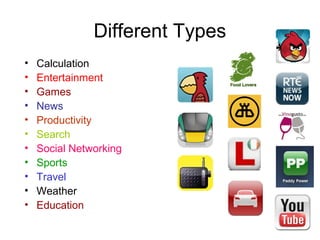
Different Types
•   Calculation
•   Entertainment
•   Games
•   News
•   Productivity
•   Search
•   Social Networking
•   Sports
•   Travel
•   Weather
•   Education
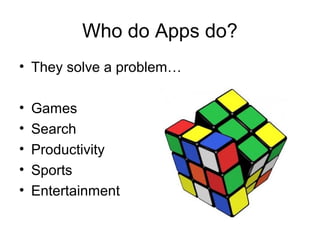
Who do Apps do?
• They solve a problem…

•   Games
•   Search
•   Productivity
•   Sports
•   Entertainment
Do Apps Make Money?

• Most don’t…

• Some do… a bit

• Every so often, one goes viral and
the developer becomes a millionaire
Yes, it IS worth billions already and its growing…

Yes, it will transform most industries, especially if you
sell consumer goods or services to the public

Do you need an app?
   Perhaps.
   It depends on what you want to achieve…

   A better question for some people might be…
   whose app should I be using?
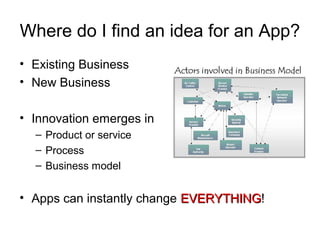
Where do I find an idea for an App?
• Existing Business
• New Business

• Innovation emerges in
  – Product or service
  – Process
  – Business model


• Apps can instantly change EVERYTHING!
                            EVERYTHING
The Market
• Global market
  – Segmented by
     • Language
     • Culture
     • Marketing Opportunities


• Smart phones : key factors
  – Operating systems
  – Market penetration
  – Third party control of market places
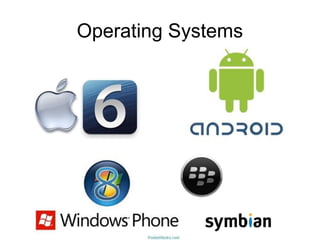
Operating Systems
Why are OS so important
• In order to access the whole market, you
  need to build apps which work under each
  of the operating systems – although it is
  enough to build just one and see how it
  goes before building it in the others…

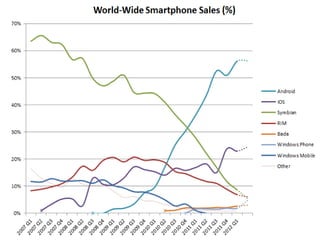
• Android, IOS and Microsoft dominate.

• RIM is in trouble, Symbian is now defunct.
Part 2: The Market
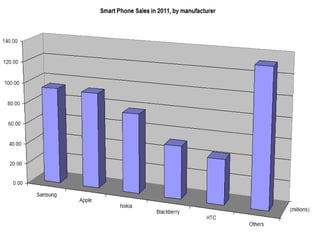
• Handset Sales Statistics
  – Smart phone market penetration
  – An introduction to Virality
     • Virality Coefficient
     • Metcalfe’s Law
  – Download statistics and analysis

• The Impact of Language & Culture
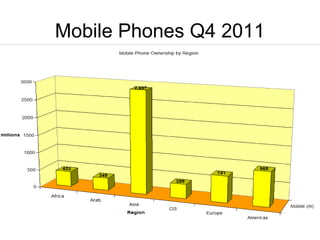
Mobile Phones Q4 2011
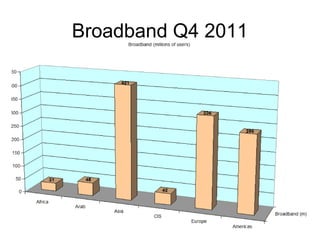
Broadband Q4 2011
Broadband Access

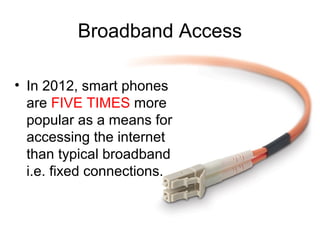
• In 2012, smart phones
  are FIVE TIMES more
  popular as a means for
  accessing the internet
  than typical broadband
  i.e. fixed connections.
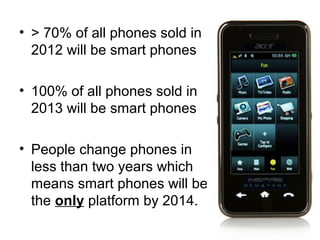
• > 70% of all phones sold in
  2012 will be smart phones

• 100% of all phones sold in
  2013 will be smart phones

• People change phones in
  less than two years which
  means smart phones will be
  the only platform by 2014.
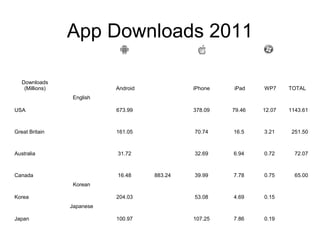
App Downloads 2011

   Downloads
    (Millions)              Android            iPhone   iPad    WP7     TOTAL
                 English

USA                         673.99             378.09   79.46   12.07   1143.61


Great Britain               161.05             70.74    16.5    3.21     251.50


Australia                   31.72              32.69    6.94    0.72      72.07


Canada                      16.48     883.24   39.99    7.78    0.75      65.00
                  Korean

Korea                       204.03             53.08    4.69    0.15
                 Japanese

Japan                       100.97             107.25   7.86    0.19
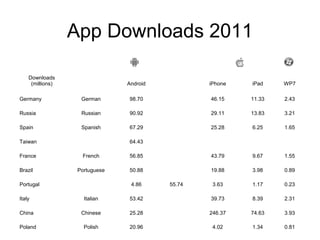
App Downloads 2011

    Downloads
     (millions)                 Android           iPhone   iPad    WP7

Germany             German      98.70             46.15    11.33   2.43

Russia              Russian     90.92             29.11    13.83   3.21

Spain               Spanish     67.29             25.28    6.25    1.65

Taiwan                          64.43

France              French      56.85             43.79    9.67    1.55

Brazil             Portuguese   50.88             19.88    3.98    0.89

Portugal                         4.86     55.74    3.63    1.17    0.23

Italy                Italian    53.42             39.73    8.39    2.31

China               Chinese     25.28             246.37   74.63   3.93

Poland               Polish     20.96              4.02    1.34    0.81
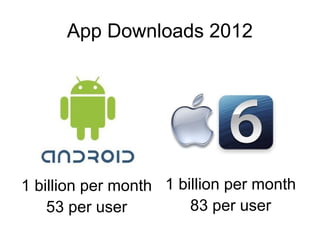
App Downloads 2012


1 billion per month 1 billion per month
    53 per user         83 per user
Channels to Market
• Direct

• Marketplaces
  –   Apple
  –   Android
  –   Microsoft
  –   Other


• Embedded on handsets (pre-sold)
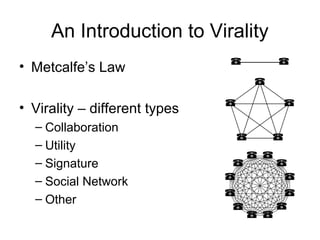
An Introduction to Virality
• Metcalfe’s Law

• Virality – different types
  – Collaboration
  – Utility
  – Signature
  – Social Network
  – Other
The Importance of Virality
• Virality reduces your marketing costs.

• Virality encourages users to use your app
  and encourage others to use your app…

• Virality is fundamental to the design of the
  app and the business model. You can not
  have enough Virality in any business!
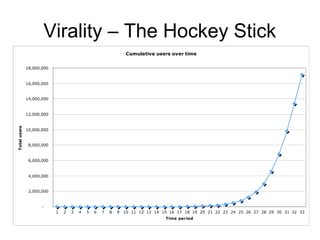
Virality – The Hockey Stick
                                                               Cumulative users over time


              18,000,000


              16,000,000


              14,000,000


              12,000,000
Total users


              10,000,000


               8,000,000


               6,000,000


               4,000,000


               2,000,000


                     -
                           1   2   3   4   5   6   7   8   9   10 11 12 13 14 15 16 17 18 19 20 21 22 23 24 25 26 27 28 29 30 31 32 33
                                                                               Time period
Virality – The Hockey Stick
• Regardless of the number of initial users,
  regardless of the time it takes for them to
  “infect” others, the path your user uptake
  or app download will take will always be in
  the shape of a hockey stick.

• Complex maths formulae can now predict
  this and are crucial to any business plan.
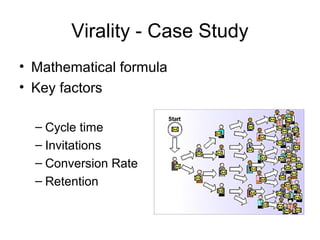
Virality - Case Study
• Mathematical formula
• Key factors

  – Cycle time
  – Invitations
  – Conversion Rate
  – Retention
Virality Factors
• Cycle Time
     • How long it take for someone to download, use,
       like and start to recommend the app to others
• Invitations
     • How many invitations they deliver to friends and
       members of their network (address book)
• Conversion Rate
     • How many of the invitations lead to downloads
• Retention
     • How many of the people keep and use the app.
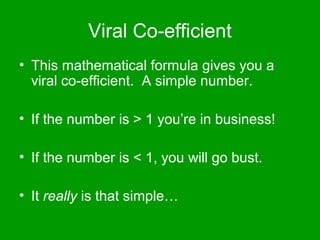
Viral Co-efficient
• This mathematical formula gives you a
  viral co-efficient. A simple number.

• If the number is > 1 you’re in business!

• If the number is < 1, you will go bust.

• It really is that simple…
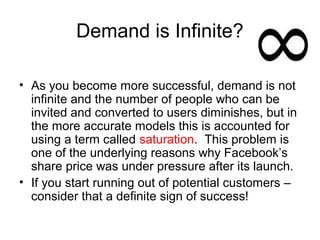
Demand is Infinite?

• As you become more successful, demand is not
  infinite and the number of people who can be
  invited and converted to users diminishes, but in
  the more accurate models this is accounted for
  using a term called saturation. This problem is
  one of the underlying reasons why Facebook’s
  share price was under pressure after its launch.
• If you start running out of potential customers –
  consider that a definite sign of success!
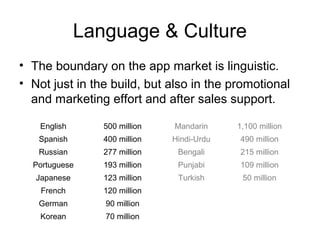
Language & Culture
• The boundary on the app market is linguistic.
• Not just in the build, but also in the promotional
  and marketing effort and after sales support.

    English      500 million   Mandarin     1,100 million
   Spanish       400 million   Hindi-Urdu   490 million
   Russian       277 million    Bengali     215 million
  Portuguese     193 million    Punjabi     109 million
   Japanese      123 million    Turkish      50 million
    French       120 million
   German        90 million
    Korean       70 million
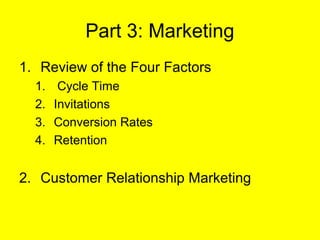
Part 3: Marketing
1. Review of the Four Factors
  1.    Cycle Time
  2.   Invitations
  3.   Conversion Rates
  4.   Retention


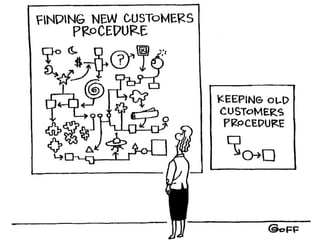
2. Customer Relationship Marketing
Cycle Time
• We can describe cycle time as how long it
  take for someone to download, use, like
  and start to recommend the app to others

• Make this as SHORT as possible.
• How?

• Look at the Freemium business model
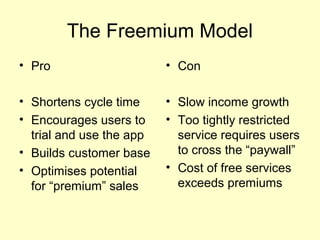
The Freemium Model
• Pro                     • Con

• Shortens cycle time     • Slow income growth
• Encourages users to     • Too tightly restricted
  trial and use the app     service requires users
• Builds customer base      to cross the “paywall”
• Optimises potential     • Cost of free services
  for “premium” sales       exceeds premiums
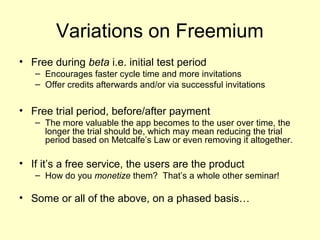
Variations on Freemium
• Free during beta i.e. initial test period
   – Encourages faster cycle time and more invitations
   – Offer credits afterwards and/or via successful invitations


• Free trial period, before/after payment
   – The more valuable the app becomes to the user over time, the
     longer the trial should be, which may mean reducing the trial
     period based on Metcalfe’s Law or even removing it altogether.

• If it’s a free service, the users are the product
   – How do you monetize them? That’s a whole other seminar!

• Some or all of the above, on a phased basis…
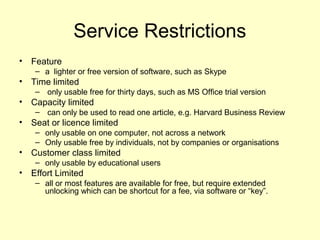
Service Restrictions
• Feature
    – a lighter or free version of software, such as Skype
• Time limited
    – only usable free for thirty days, such as MS Office trial version
• Capacity limited
    – can only be used to read one article, e.g. Harvard Business Review
• Seat or licence limited
    – only usable on one computer, not across a network
    – Only usable free by individuals, not by companies or organisations
• Customer class limited
    – only usable by educational users
• Effort Limited
    – all or most features are available for free, but require extended
      unlocking which can be shortcut for a fee, via software or “key”.
Trust


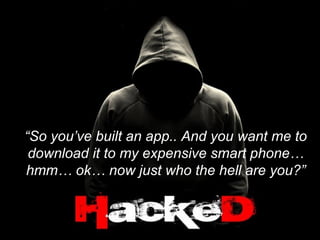
“So you’ve built an app.. And you want me to
 download it to my expensive smart phone…
hmm… ok… now just who the hell are you?”
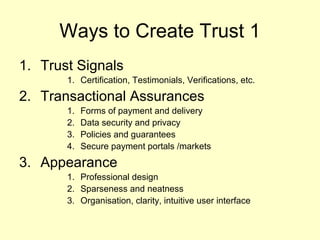
Ways to Create Trust 1
1. Trust Signals
       1. Certification, Testimonials, Verifications, etc.

2. Transactional Assurances
       1.   Forms of payment and delivery
       2.   Data security and privacy
       3.   Policies and guarantees
       4.   Secure payment portals /markets

3. Appearance
       1. Professional design
       2. Sparseness and neatness
       3. Organisation, clarity, intuitive user interface
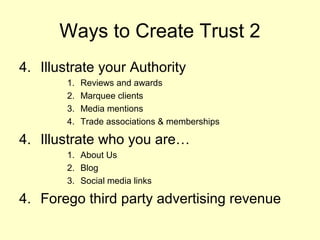
Ways to Create Trust 2
4. Illustrate your Authority
        1.   Reviews and awards
        2.   Marquee clients
        3.   Media mentions
        4.   Trade associations & memberships

4. Illustrate who you are…
        1. About Us
        2. Blog
        3. Social media links

4. Forego third party advertising revenue
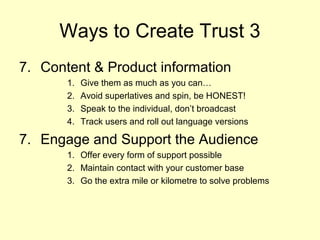
Ways to Create Trust 3
7. Content & Product information
       1.   Give them as much as you can…
       2.   Avoid superlatives and spin, be HONEST!
       3.   Speak to the individual, don’t broadcast
       4.   Track users and roll out language versions

7. Engage and Support the Audience
       1. Offer every form of support possible
       2. Maintain contact with your customer base
       3. Go the extra mile or kilometre to solve problems
Reducing Cycle Time
• We can describe cycle time as how long it
  take for someone to download, use, like
  and start to recommend the app to others

• Download speed
• Intuitive user focused design
• No bugs!
Invitations
• Invitation is many invitations users deliver
  to friends and people in their network(s)

•   What role does reciprocity play?
•   Do you use incentives? What type?
•   Do you restrict them to create scarcity?
•   How valuable is your app?
•   Do you offer one-to-one or one-to-many?
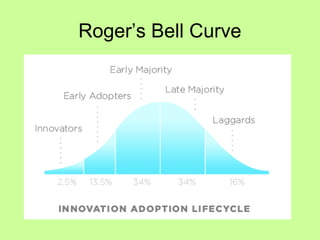
Roger’s Bell Curve
Invitations
• Link your invitation strategy to promotion
  and marketing, including all possible PR
  and similar opportunities, on and off-line.

•   Who is your target audience?
•   How can you communicate with them?
•   Will peer-to-peer invitations work?
•   How do you avoid spam-like issues?
Conversion Rate
• What do the new users think and feel?
     • Consider using split tests for different offers
     • Does this data change your business strategy?
     • Would variations on freemium be a better option?


• Use third party paying customer reviews
     • What feedback are you getting on your app?


• Compare converted versus non-users
     • Can you track them across your website?
     • How does their behaviour differ and what does this tell you?
Retention
• Does the app serve a useful long term
  purpose or will it be just a fad?

• Currently it is estimated that 26% of all
  downloaded apps are discarded.


                Yes, the background image is of a net!
Retention
• Situational Intelligence
      • www.flurry.com
      • basic version is free
•   Utility
•   Upgrades
•   Additional Functionality
•   Customer Relationship Marketing
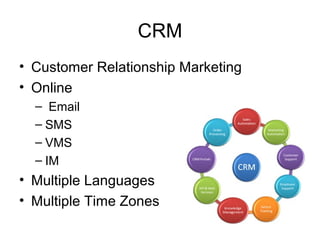
CRM
• Customer Relationship Marketing
• Online
  – Email
  – SMS
  – VMS
  – IM
• Multiple Languages
• Multiple Time Zones
Part 4: Funding Your App
• Why A Funding Plan & Stream is Key
  – Proof of Concept
  – Proof of Model
  – Growth: Cost v Revenue
  – Source of Funds / Standard “Plays”
• Cost Structures
• Revenue Streams & Monetization
Market Entry
• Whilst building an app is relatively cheap
  and getting up on the main markets is a
  relatively simple process, you will then be
  competing for attention with one gazillion
  other apps. More than 90% of your funds
  will inevitably be spent on promotion, in all
  its many forms, both online and traditional.

         Getting in is easy.
         Getting noticed isn’t.
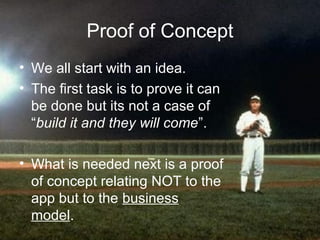
Proof of Concept
• We all start with an idea.
• The first task is to prove it can
  be done but its not a case of
  “build it and they will come”.

• What is needed next is a proof
  of concept relating NOT to the
  app but to the business
  model.
Proof of Model
• Aside from the mechanics of just how viral
  your app is and how rapidly you can grow
  the user base, the key is revenue streams.

• How many streams have you got?
• How much will they deliver?
• How has performance mapped against
  your initial targets and assumptions?
Proof of Model
• How are you projecting growth?

• When do you reach breakeven?
     • Bear in mind that these can be displayed in terms
       of user numbers rather than a specific timeline.
• When do you start to make a profit?
• What is the cost of acquisition per user?
• What is the revenue per user?
Avoiding Bootstrapping
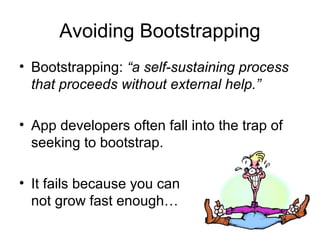
• Bootstrapping: “a self-sustaining process
  that proceeds without external help.”

• App developers often fall into the trap of
  seeking to bootstrap.

• It fails because you can
  not grow fast enough…
Avoid Bootstrapping
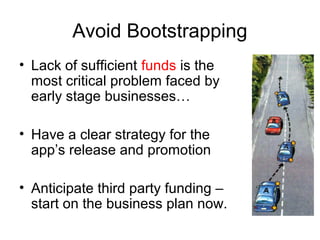
• Lack of sufficient funds is the
  most critical problem faced by
  early stage businesses…

• Have a clear strategy for the
  app’s release and promotion

• Anticipate third party funding –
  start on the business plan now.
Revenue Streams
• Purchase
     • Higher risk of piracy and copying of your app
     • Lower user growth rate
• Donation:
     • It builds the love but… love don’t buy you money!
• Freemium
     • The basic Apps is free but people pay for the extras.
• Advertising Supported
     • Dominated by gaming / entertainment apps
     • eCPM, CTR and Global Fill Rate (GFR)
     • Generalised or Specialist Niche promotion
Funding Pathways
• 1st round
   – Personal & Sweat Equity
   – Family / Friends / Co-Developers


• 2nd round
   – Business Angel
   – R&TD or similar Grant Aid


• 3rd round
   – Venture Capital / Acquisition
And finally…

180 million reasons why you might look
    at developing just one little app…
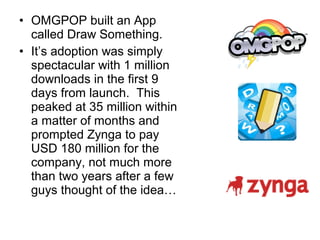
• OMGPOP built an App
  called Draw Something.
• It’s adoption was simply
  spectacular with 1 million
  downloads in the first 9
  days from launch. This
  peaked at 35 million within
  a matter of months and
  prompted Zynga to pay
  USD 180 million for the
  company, not much more
  than two years after a few
  guys thought of the idea…
The End
• Solve a problem and you have a business.

• Solve a common problem and you have a
  potentially far bigger business.

• Only five billion phones out there…

• Imagine if everyone wanted your app!
•   Kieran Hanrahan
•   kieran@tknlgy.eu
•   @TKNLGY
•   + 353 (0)87 2212 369 GMT

The app market 2012

  • 1.
    Could you marketa globally successful app? Kieran Hanrahan October 2012
  • 2.
    Part 1: Introduction • Welcome • What is an App? • Why build an App? • What are the most popular Types of App? • How does this affect me? • Ideation • Handsets and Operating Systems • Q&A
  • 3.
    What is anApp? • App is short for application • It’s a clever piece of software that does something useful or valuable • You download it onto your smart phone – Or potentially onto your computer, tablet, laptop...
  • 4.
    Why? • Apps havea global market – Potential for massive growth • Low entry level barriers to this market – Cheap to prototype – Cheap to develop – Cheap to deliver – Cheap to promote… well sometimes!
  • 5.
    Different Types • Calculation • Entertainment • Games • News • Productivity • Search • Social Networking • Sports • Travel • Weather • Education
  • 6.
    Who do Appsdo? • They solve a problem… • Games • Search • Productivity • Sports • Entertainment
  • 7.
    Do Apps MakeMoney? • Most don’t… • Some do… a bit • Every so often, one goes viral and the developer becomes a millionaire
  • 8.
    Yes, it ISworth billions already and its growing… Yes, it will transform most industries, especially if you sell consumer goods or services to the public Do you need an app? Perhaps. It depends on what you want to achieve… A better question for some people might be… whose app should I be using?
  • 9.
    Where do Ifind an idea for an App? • Existing Business • New Business • Innovation emerges in – Product or service – Process – Business model • Apps can instantly change EVERYTHING! EVERYTHING
  • 10.
    The Market • Globalmarket – Segmented by • Language • Culture • Marketing Opportunities • Smart phones : key factors – Operating systems – Market penetration – Third party control of market places
  • 11.
  • 13.
    Why are OSso important • In order to access the whole market, you need to build apps which work under each of the operating systems – although it is enough to build just one and see how it goes before building it in the others… • Android, IOS and Microsoft dominate. • RIM is in trouble, Symbian is now defunct.
  • 14.
    Part 2: TheMarket • Handset Sales Statistics – Smart phone market penetration – An introduction to Virality • Virality Coefficient • Metcalfe’s Law – Download statistics and analysis • The Impact of Language & Culture
  • 15.
  • 16.
  • 17.
    Broadband Access • In2012, smart phones are FIVE TIMES more popular as a means for accessing the internet than typical broadband i.e. fixed connections.
  • 18.
    • > 70%of all phones sold in 2012 will be smart phones • 100% of all phones sold in 2013 will be smart phones • People change phones in less than two years which means smart phones will be the only platform by 2014.
  • 20.
    App Downloads 2011 Downloads (Millions) Android iPhone iPad WP7 TOTAL English USA 673.99 378.09 79.46 12.07 1143.61 Great Britain 161.05 70.74 16.5 3.21 251.50 Australia 31.72 32.69 6.94 0.72 72.07 Canada 16.48 883.24 39.99 7.78 0.75 65.00 Korean Korea 204.03 53.08 4.69 0.15 Japanese Japan 100.97 107.25 7.86 0.19
  • 21.
    App Downloads 2011 Downloads (millions) Android iPhone iPad WP7 Germany German 98.70 46.15 11.33 2.43 Russia Russian 90.92 29.11 13.83 3.21 Spain Spanish 67.29 25.28 6.25 1.65 Taiwan 64.43 France French 56.85 43.79 9.67 1.55 Brazil Portuguese 50.88 19.88 3.98 0.89 Portugal 4.86 55.74 3.63 1.17 0.23 Italy Italian 53.42 39.73 8.39 2.31 China Chinese 25.28 246.37 74.63 3.93 Poland Polish 20.96 4.02 1.34 0.81
  • 22.
    App Downloads 2012 1billion per month 1 billion per month 53 per user 83 per user
  • 23.
    Channels to Market •Direct • Marketplaces – Apple – Android – Microsoft – Other • Embedded on handsets (pre-sold)
  • 24.
    An Introduction toVirality • Metcalfe’s Law • Virality – different types – Collaboration – Utility – Signature – Social Network – Other
  • 25.
    The Importance ofVirality • Virality reduces your marketing costs. • Virality encourages users to use your app and encourage others to use your app… • Virality is fundamental to the design of the app and the business model. You can not have enough Virality in any business!
  • 26.
    Virality – TheHockey Stick Cumulative users over time 18,000,000 16,000,000 14,000,000 12,000,000 Total users 10,000,000 8,000,000 6,000,000 4,000,000 2,000,000 - 1 2 3 4 5 6 7 8 9 10 11 12 13 14 15 16 17 18 19 20 21 22 23 24 25 26 27 28 29 30 31 32 33 Time period
  • 27.
    Virality – TheHockey Stick • Regardless of the number of initial users, regardless of the time it takes for them to “infect” others, the path your user uptake or app download will take will always be in the shape of a hockey stick. • Complex maths formulae can now predict this and are crucial to any business plan.
  • 28.
    Virality - CaseStudy • Mathematical formula • Key factors – Cycle time – Invitations – Conversion Rate – Retention
  • 29.
    Virality Factors • CycleTime • How long it take for someone to download, use, like and start to recommend the app to others • Invitations • How many invitations they deliver to friends and members of their network (address book) • Conversion Rate • How many of the invitations lead to downloads • Retention • How many of the people keep and use the app.
  • 30.
    Viral Co-efficient • Thismathematical formula gives you a viral co-efficient. A simple number. • If the number is > 1 you’re in business! • If the number is < 1, you will go bust. • It really is that simple…
  • 31.
    Demand is Infinite? •As you become more successful, demand is not infinite and the number of people who can be invited and converted to users diminishes, but in the more accurate models this is accounted for using a term called saturation. This problem is one of the underlying reasons why Facebook’s share price was under pressure after its launch. • If you start running out of potential customers – consider that a definite sign of success!
  • 32.
    Language & Culture •The boundary on the app market is linguistic. • Not just in the build, but also in the promotional and marketing effort and after sales support. English 500 million Mandarin 1,100 million Spanish 400 million Hindi-Urdu 490 million Russian 277 million Bengali 215 million Portuguese 193 million Punjabi 109 million Japanese 123 million Turkish 50 million French 120 million German 90 million Korean 70 million
  • 33.
    Part 3: Marketing 1.Review of the Four Factors 1. Cycle Time 2. Invitations 3. Conversion Rates 4. Retention 2. Customer Relationship Marketing
  • 34.
    Cycle Time • Wecan describe cycle time as how long it take for someone to download, use, like and start to recommend the app to others • Make this as SHORT as possible. • How? • Look at the Freemium business model
  • 35.
    The Freemium Model •Pro • Con • Shortens cycle time • Slow income growth • Encourages users to • Too tightly restricted trial and use the app service requires users • Builds customer base to cross the “paywall” • Optimises potential • Cost of free services for “premium” sales exceeds premiums
  • 36.
    Variations on Freemium •Free during beta i.e. initial test period – Encourages faster cycle time and more invitations – Offer credits afterwards and/or via successful invitations • Free trial period, before/after payment – The more valuable the app becomes to the user over time, the longer the trial should be, which may mean reducing the trial period based on Metcalfe’s Law or even removing it altogether. • If it’s a free service, the users are the product – How do you monetize them? That’s a whole other seminar! • Some or all of the above, on a phased basis…
  • 37.
    Service Restrictions • Feature – a lighter or free version of software, such as Skype • Time limited – only usable free for thirty days, such as MS Office trial version • Capacity limited – can only be used to read one article, e.g. Harvard Business Review • Seat or licence limited – only usable on one computer, not across a network – Only usable free by individuals, not by companies or organisations • Customer class limited – only usable by educational users • Effort Limited – all or most features are available for free, but require extended unlocking which can be shortcut for a fee, via software or “key”.
  • 38.
    Trust “So you’ve builtan app.. And you want me to download it to my expensive smart phone… hmm… ok… now just who the hell are you?”
  • 40.
    Ways to CreateTrust 1 1. Trust Signals 1. Certification, Testimonials, Verifications, etc. 2. Transactional Assurances 1. Forms of payment and delivery 2. Data security and privacy 3. Policies and guarantees 4. Secure payment portals /markets 3. Appearance 1. Professional design 2. Sparseness and neatness 3. Organisation, clarity, intuitive user interface
  • 41.
    Ways to CreateTrust 2 4. Illustrate your Authority 1. Reviews and awards 2. Marquee clients 3. Media mentions 4. Trade associations & memberships 4. Illustrate who you are… 1. About Us 2. Blog 3. Social media links 4. Forego third party advertising revenue
  • 42.
    Ways to CreateTrust 3 7. Content & Product information 1. Give them as much as you can… 2. Avoid superlatives and spin, be HONEST! 3. Speak to the individual, don’t broadcast 4. Track users and roll out language versions 7. Engage and Support the Audience 1. Offer every form of support possible 2. Maintain contact with your customer base 3. Go the extra mile or kilometre to solve problems
  • 44.
    Reducing Cycle Time •We can describe cycle time as how long it take for someone to download, use, like and start to recommend the app to others • Download speed • Intuitive user focused design • No bugs!
  • 46.
    Invitations • Invitation ismany invitations users deliver to friends and people in their network(s) • What role does reciprocity play? • Do you use incentives? What type? • Do you restrict them to create scarcity? • How valuable is your app? • Do you offer one-to-one or one-to-many?
  • 47.
  • 48.
    Invitations • Link yourinvitation strategy to promotion and marketing, including all possible PR and similar opportunities, on and off-line. • Who is your target audience? • How can you communicate with them? • Will peer-to-peer invitations work? • How do you avoid spam-like issues?
  • 50.
    Conversion Rate • Whatdo the new users think and feel? • Consider using split tests for different offers • Does this data change your business strategy? • Would variations on freemium be a better option? • Use third party paying customer reviews • What feedback are you getting on your app? • Compare converted versus non-users • Can you track them across your website? • How does their behaviour differ and what does this tell you?
  • 52.
    Retention • Does theapp serve a useful long term purpose or will it be just a fad? • Currently it is estimated that 26% of all downloaded apps are discarded. Yes, the background image is of a net!
  • 53.
    Retention • Situational Intelligence • www.flurry.com • basic version is free • Utility • Upgrades • Additional Functionality • Customer Relationship Marketing
  • 54.
    CRM • Customer RelationshipMarketing • Online – Email – SMS – VMS – IM • Multiple Languages • Multiple Time Zones
  • 55.
    Part 4: FundingYour App • Why A Funding Plan & Stream is Key – Proof of Concept – Proof of Model – Growth: Cost v Revenue – Source of Funds / Standard “Plays” • Cost Structures • Revenue Streams & Monetization
  • 56.
    Market Entry • Whilstbuilding an app is relatively cheap and getting up on the main markets is a relatively simple process, you will then be competing for attention with one gazillion other apps. More than 90% of your funds will inevitably be spent on promotion, in all its many forms, both online and traditional. Getting in is easy. Getting noticed isn’t.
  • 57.
    Proof of Concept •We all start with an idea. • The first task is to prove it can be done but its not a case of “build it and they will come”. • What is needed next is a proof of concept relating NOT to the app but to the business model.
  • 58.
    Proof of Model •Aside from the mechanics of just how viral your app is and how rapidly you can grow the user base, the key is revenue streams. • How many streams have you got? • How much will they deliver? • How has performance mapped against your initial targets and assumptions?
  • 59.
    Proof of Model •How are you projecting growth? • When do you reach breakeven? • Bear in mind that these can be displayed in terms of user numbers rather than a specific timeline. • When do you start to make a profit? • What is the cost of acquisition per user? • What is the revenue per user?
  • 60.
    Avoiding Bootstrapping • Bootstrapping:“a self-sustaining process that proceeds without external help.” • App developers often fall into the trap of seeking to bootstrap. • It fails because you can not grow fast enough…
  • 61.
    Avoid Bootstrapping • Lackof sufficient funds is the most critical problem faced by early stage businesses… • Have a clear strategy for the app’s release and promotion • Anticipate third party funding – start on the business plan now.
  • 62.
    Revenue Streams • Purchase • Higher risk of piracy and copying of your app • Lower user growth rate • Donation: • It builds the love but… love don’t buy you money! • Freemium • The basic Apps is free but people pay for the extras. • Advertising Supported • Dominated by gaming / entertainment apps • eCPM, CTR and Global Fill Rate (GFR) • Generalised or Specialist Niche promotion
  • 63.
    Funding Pathways • 1stround – Personal & Sweat Equity – Family / Friends / Co-Developers • 2nd round – Business Angel – R&TD or similar Grant Aid • 3rd round – Venture Capital / Acquisition
  • 64.
    And finally… 180 millionreasons why you might look at developing just one little app…
  • 65.
    • OMGPOP builtan App called Draw Something. • It’s adoption was simply spectacular with 1 million downloads in the first 9 days from launch. This peaked at 35 million within a matter of months and prompted Zynga to pay USD 180 million for the company, not much more than two years after a few guys thought of the idea…
  • 66.
    The End • Solvea problem and you have a business. • Solve a common problem and you have a potentially far bigger business. • Only five billion phones out there… • Imagine if everyone wanted your app!
  • 67.
    Kieran Hanrahan • kieran@tknlgy.eu • @TKNLGY • + 353 (0)87 2212 369 GMT

Editor's Notes

  • #9 Yes Its worth billions already and its growing No But it can transform your industry Maybe It depends on what you want to achieve… A better questions is who pays!