Background:
 A moist broadleaf forest
(in the Amazon Basin of South America)
 Total area of Amazon Basin :
7 million square km²
( the forest itself occupies 5.5 million km²)
 located within 9 nations: Brazil (with 60% of the
rainforest), Colombia, Peru, Venezuela, Ecuador,
Bolivia, Guyana, Suriname, and French Guiana.
 The Amazon represents over half of the planet's
remaining rainforests and comprises the largest
and most species-rich tract of tropical rainforest
in the world.
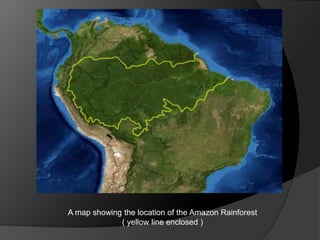
A map showing the location of the Amazon Rainforest
( yellow line enclosed )
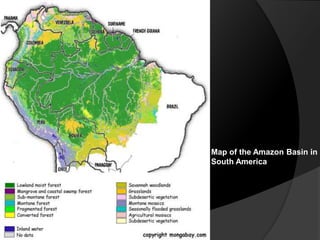
Map of the Amazon Basin in
South America
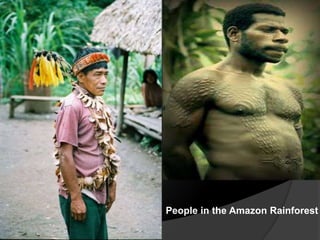
People in the Amazon Rainforest
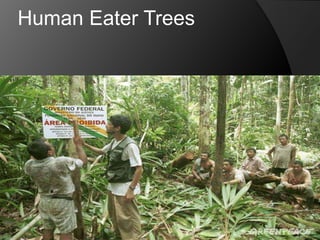
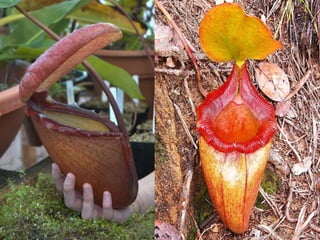
Human Eater Trees
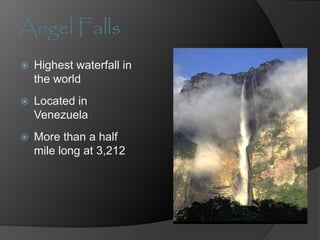
Angel Falls
 Highest waterfall in
the world
 Located in
Venezuela
 More than a half
mile long at 3,212
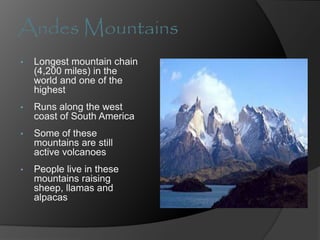
Andes Mountains
• Longest mountain chain
(4,200 miles) in the
world and one of the
highest
• Runs along the west
coast of South America
• Some of these
mountains are still
active volcanoes
• People live in these
mountains raising
sheep, llamas and
alpacas
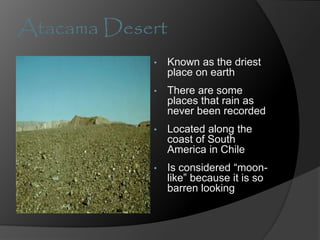
Atacama Desert
• Known as the driest
place on earth
• There are some
places that rain as
never been recorded
• Located along the
coast of South
America in Chile
• Is considered “moon-
like” because it is so
barren looking
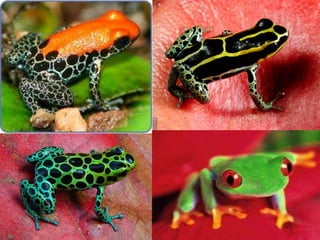
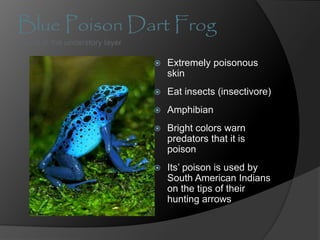
Blue Poison Dart Frog
Found in the understory layer
 Extremely poisonous
skin
 Eat insects (insectivore)
 Amphibian
 Bright colors warn
predators that it is
poison
 Its’ poison is used by
South American Indians
on the tips of their
hunting arrows
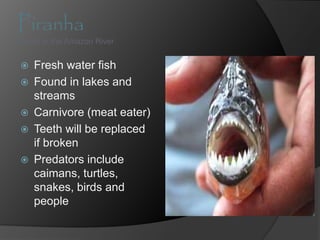
Piranha
Found in the Amazon River
 Fresh water fish
 Found in lakes and
streams
 Carnivore (meat eater)
 Teeth will be replaced
if broken
 Predators include
caimans, turtles,
snakes, birds and
people
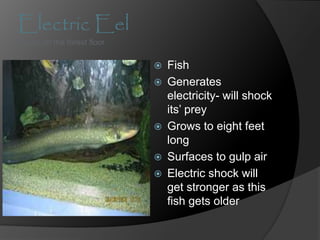
Electric Eel
Found on the forest floor
 Fish
 Generates
electricity- will shock
its’ prey
 Grows to eight feet
long
 Surfaces to gulp air
 Electric shock will
get stronger as this
fish gets older
Deforestation in the Amazon:
 Deforestation :
forested areas converse to non-forested areas.
 The main sources of deforestation in the
Amazon are human settlement and
development of the land
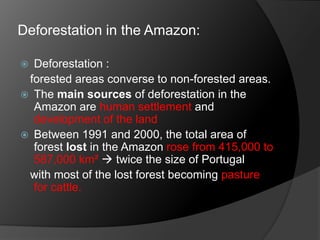
 Between 1991 and 2000, the total area of
forest lost in the Amazon rose from 415,000 to
587,000 km²  twice the size of Portugal
with most of the lost forest becoming pasture
for cattle.
Today
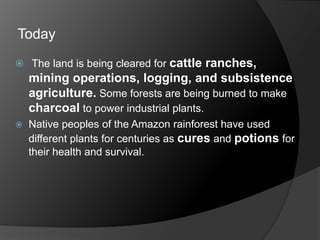
 The land is being cleared for cattle ranches,
mining operations, logging, and subsistence
agriculture. Some forests are being burned to make
charcoal to power industrial plants.
 Native peoples of the Amazon rainforest have used
different plants for centuries as cures and potions for
their health and survival.
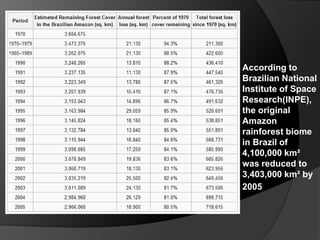
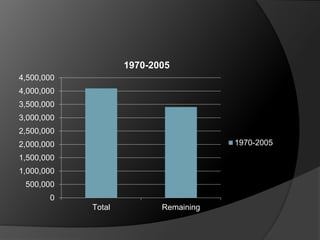
According to
Brazilian National
Institute of Space
Research(INPE),
the original
Amazon
rainforest biome
in Brazil of
4,100,000 km²
was reduced to
3,403,000 km² by
2005
Sales
Remaining
Forest
Deforest
0
500,000
1,000,000
1,500,000
2,000,000
2,500,000
3,000,000
3,500,000
4,000,000
4,500,000
Total Remaining
1970-2005
1970-2005
Consequences of deforestation in
the Amazon
 http://www.voice-online.co.uk/content.php?show=9770
AMAZON DEFORESTATION CAUSES HURRICANE
The Caribbean could be vulnerable to increased hurricane activity if deforestation of the
Amazon rainforest is not stopped
 Working with religious leaders, scientists and politicians, Lelei LeLaulu, the president of
Counterpart International, spoke on the effects that deforestation of the Amazon could
have in the Caribbean, and the gulf states of America and Mexico.
 He said: “The scientists are telling us forest deforestation of the Amazon leads to a
failure if forest transpiration, the forest pumps, leaving heat in the southern north
Atlantic which in turn gives birth to more extreme hurricanes in the Caribbean.”
 Currently, more than one fifth of the Amazon rainforest has been destroyed and,
according to a Brazilian congressional committee, the Amazon is vanishing at a rate of
52,000 square kilometres per year(20,000 miles per year). With these figures, the
rainforest would be completely destroyed by the year 2050.
 LeLaulu said: “ We are now able to explain why the sea temperature of the southern
north Atlantic has been rising, giving birth to more extreme hurricanes which ravage the
Caribbean and north America.”
The amazon rainforest

The amazon rainforest

  • 2.
    Background:  A moistbroadleaf forest (in the Amazon Basin of South America)  Total area of Amazon Basin : 7 million square km² ( the forest itself occupies 5.5 million km²)  located within 9 nations: Brazil (with 60% of the rainforest), Colombia, Peru, Venezuela, Ecuador, Bolivia, Guyana, Suriname, and French Guiana.  The Amazon represents over half of the planet's remaining rainforests and comprises the largest and most species-rich tract of tropical rainforest in the world.
  • 3.
    A map showingthe location of the Amazon Rainforest ( yellow line enclosed )
  • 4.
    Map of theAmazon Basin in South America
  • 6.
    People in theAmazon Rainforest
  • 7.
  • 9.
    Angel Falls  Highestwaterfall in the world  Located in Venezuela  More than a half mile long at 3,212
  • 10.
    Andes Mountains • Longestmountain chain (4,200 miles) in the world and one of the highest • Runs along the west coast of South America • Some of these mountains are still active volcanoes • People live in these mountains raising sheep, llamas and alpacas
  • 11.
    Atacama Desert • Knownas the driest place on earth • There are some places that rain as never been recorded • Located along the coast of South America in Chile • Is considered “moon- like” because it is so barren looking
  • 14.
    Blue Poison DartFrog Found in the understory layer  Extremely poisonous skin  Eat insects (insectivore)  Amphibian  Bright colors warn predators that it is poison  Its’ poison is used by South American Indians on the tips of their hunting arrows
  • 15.
    Piranha Found in theAmazon River  Fresh water fish  Found in lakes and streams  Carnivore (meat eater)  Teeth will be replaced if broken  Predators include caimans, turtles, snakes, birds and people
  • 16.
    Electric Eel Found onthe forest floor  Fish  Generates electricity- will shock its’ prey  Grows to eight feet long  Surfaces to gulp air  Electric shock will get stronger as this fish gets older
  • 18.
    Deforestation in theAmazon:  Deforestation : forested areas converse to non-forested areas.  The main sources of deforestation in the Amazon are human settlement and development of the land  Between 1991 and 2000, the total area of forest lost in the Amazon rose from 415,000 to 587,000 km²  twice the size of Portugal with most of the lost forest becoming pasture for cattle.
  • 19.
    Today  The landis being cleared for cattle ranches, mining operations, logging, and subsistence agriculture. Some forests are being burned to make charcoal to power industrial plants.  Native peoples of the Amazon rainforest have used different plants for centuries as cures and potions for their health and survival.
  • 20.
    According to Brazilian National Instituteof Space Research(INPE), the original Amazon rainforest biome in Brazil of 4,100,000 km² was reduced to 3,403,000 km² by 2005 Sales Remaining Forest Deforest
  • 21.
  • 22.
    Consequences of deforestationin the Amazon  http://www.voice-online.co.uk/content.php?show=9770 AMAZON DEFORESTATION CAUSES HURRICANE The Caribbean could be vulnerable to increased hurricane activity if deforestation of the Amazon rainforest is not stopped  Working with religious leaders, scientists and politicians, Lelei LeLaulu, the president of Counterpart International, spoke on the effects that deforestation of the Amazon could have in the Caribbean, and the gulf states of America and Mexico.  He said: “The scientists are telling us forest deforestation of the Amazon leads to a failure if forest transpiration, the forest pumps, leaving heat in the southern north Atlantic which in turn gives birth to more extreme hurricanes in the Caribbean.”  Currently, more than one fifth of the Amazon rainforest has been destroyed and, according to a Brazilian congressional committee, the Amazon is vanishing at a rate of 52,000 square kilometres per year(20,000 miles per year). With these figures, the rainforest would be completely destroyed by the year 2050.  LeLaulu said: “ We are now able to explain why the sea temperature of the southern north Atlantic has been rising, giving birth to more extreme hurricanes which ravage the Caribbean and north America.”

Editor's Notes

  • #10 Angel Falls located in Venezuela is the tallest waterfall in the world. It is 3,212 feet. You would have to stack 64 Ferryway Schools on top of each other to be as tall as this waterfall.
  • #11 Let’s take a hike through the Andes Mountains! This is the longest mountain chain in the world. What do I mean by that? A mountain chain has many mountains next to each other in a long line. This mountain chain runs along the west coast of South America from the top all the way to the bottom of Chile. Some of the mountains located in this mountain chain are volcanoes that are still active. As we are hiking through these mountains, we may see people living here in these mountains. We may also see llamas, alpacas and even sheep that these mountain people raise and take care of. We might even see a spectacled bear in our travels during our hike in these mountains, so let’s stay together and not wander off!
  • #12 We have now come to the Atacama Desert in our adventure through South America. This landmark is known as the driest place on earth with some areas of the desert not getting any rainfall at all! This desert is located in Chile, the long, skinny country on the west coast of South America. Look for Chile on the map in the library. Some people think this desert looks like the moon because there are no trees or grasses, just rocks and sand. Wouldn’t want to get lost out here! Let’s continue on our journey. The next place we are going to visit is full of animals, plants, rain and trees. Can you guess where we are headed?
  • #15 Look up in that tree! It is a blue poison dart frog. Beautiful color, isn’t it? Beautiful, but very poisonous. The bright colors of the poison dart frog will warn predators not to eat it because the predator will become very sick. The poison dart frog is considered an insectivore (eats insects). A cool fact about this amphibian is that the poison is used by the Indians of South America. They put it on the end of their hunting arrows to help them in their hunting.
  • #16 Look at those sharp teeth! This is a piranha fish. Keep your hands inside the boat so they don’t attract these fish. These fish have very sharp teeth and could eat a human hand if they really wanted to, but they won’t. These fish are carnivores (meat eaters) that eat fish, frogs and insects.
  • #17 Check out this animal. It is a long, snake-like fish that generates electricity just like a wall plug does. One shock will not kill an animal, but many shocks can. This fish lives in the Amazon River. It has very tiny scales all over its’ body. It will kill its’ prey by shocking it with 600 volts of electricity-this can stun a man or take down a cow. It eats fish, clams, shrimp and insects. As this fish gets older, the electric shocks get stronger, yet its’ eyesight gets weaker. Even though the electric eel is a fish, it needs to come to the surface and gulp some air every few minutes.