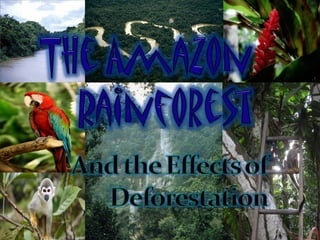
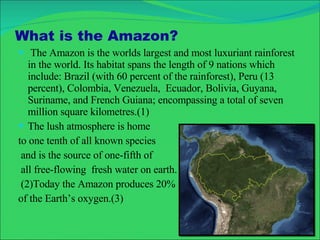
What is the Amazon? The Amazon is the worlds largest and most luxuriant rainforest in the world. Its habitat spans the length of 9 nations which include: Brazil (with 60 percent of the rainforest), Peru (13 percent), Colombia, Venezuela,  Ecuador, Bolivia, Guyana, Suriname, and French Guiana; encompassing a total of seven million square kilometres.(1)  The lush atmosphere is home  to one tenth of all known species and is the source of one-fifth of all free-flowing  fresh water on earth. (2)Today the Amazon produces 20%  of the Earth’s oxygen.(3)
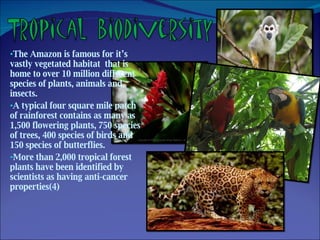
The Amazon is famous for it’s vastly vegetated habitat  that is home to over 10 million different species of plants, animals and insects. A typical four square mile patch of rainforest contains as many as 1,500 flowering plants, 750 species of trees, 400 species of birds and 150 species of butterflies.  More than 2,000 tropical forest plants have been identified by scientists as having anti-cancer properties(4)
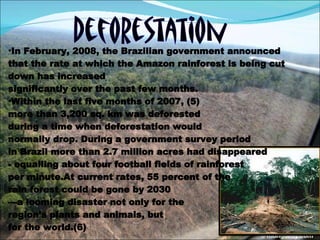
In February, 2008, the Brazilian government announced that the rate at which the Amazon rainforest is being cut down has increased  significantly over the past few months. Within the last five months of 2007, (5) more than 3,200 sq. km was deforested  during a time when deforestation would  normally drop. During a government survey period  in Brazil more than 2.7 million acres had disappeared  - equalling about four football fields of rainforest  per minute.At current rates, 55 percent of the  rain forest could be gone by 2030 — a looming disaster not only for the  region’s plants and animals, but  for the world.(6)


The first thing that can be done to help preserve the diminishing rainforest  is to spread the word and get more and more people involved. The more people willing to help, the louder the voice against deforestation is.  There are multiple organizations  that can be joined, all working to cease the deconstruction of the Amazon. Such campaigns include World Wildlife (WWL), The Rainforest Action Network, Greenpeace and many more. Each are willing to take donations to buy pieces of land and also treat injured animals and parts of the forest.  There are also many hands-on opportunities in which you can visit the rainforest yourself and help out first hand.
 
(1)(4)(graphic slides 1,4, 9)World Wildlife Fund , &quot;World’s largest tropical rain forest and river basin .&quot; 2 Oct 2008 http://www.worldwildlife.org/what/wherewework/amazon/index.html (2)(3) (5)Rainforest, Ben.  Morgan . 1. New York: Dorling Kindersley, 2005.  ( 1 st   and 2 nd  chart info) Nepstad, Daniel. &quot;&quot;Reducing Emissions from Deforestation&quot; 2007 4 Oct 2008 <http://images.google.ca/imgres?imgurl=http://photos.mongabay.com/07/0418_amazon_soy_defor.jpg&imgrefurl=http://news.mongabay.com/2007/0604-nepstad_interview.html (6)(graphics slides 1, 3,6,9) &quot;Save the Rainforest .&quot;  Rainforest Action Network . 23/May/2007. Rainforest Action Network. 2 Oct 2008 <http://www.ran.org/>. (some photos are personal photography)

T07_The AmazonRainforest_0842075

  • 1.
  • 2.
    What is theAmazon? The Amazon is the worlds largest and most luxuriant rainforest in the world. Its habitat spans the length of 9 nations which include: Brazil (with 60 percent of the rainforest), Peru (13 percent), Colombia, Venezuela, Ecuador, Bolivia, Guyana, Suriname, and French Guiana; encompassing a total of seven million square kilometres.(1) The lush atmosphere is home to one tenth of all known species and is the source of one-fifth of all free-flowing fresh water on earth. (2)Today the Amazon produces 20% of the Earth’s oxygen.(3)
  • 3.
    The Amazon isfamous for it’s vastly vegetated habitat that is home to over 10 million different species of plants, animals and insects. A typical four square mile patch of rainforest contains as many as 1,500 flowering plants, 750 species of trees, 400 species of birds and 150 species of butterflies. More than 2,000 tropical forest plants have been identified by scientists as having anti-cancer properties(4)
  • 4.
    In February, 2008,the Brazilian government announced that the rate at which the Amazon rainforest is being cut down has increased significantly over the past few months. Within the last five months of 2007, (5) more than 3,200 sq. km was deforested during a time when deforestation would normally drop. During a government survey period in Brazil more than 2.7 million acres had disappeared - equalling about four football fields of rainforest per minute.At current rates, 55 percent of the rain forest could be gone by 2030 — a looming disaster not only for the region’s plants and animals, but for the world.(6)
  • 5.
  • 6.
  • 7.
  • 8.
    The first thingthat can be done to help preserve the diminishing rainforest is to spread the word and get more and more people involved. The more people willing to help, the louder the voice against deforestation is. There are multiple organizations that can be joined, all working to cease the deconstruction of the Amazon. Such campaigns include World Wildlife (WWL), The Rainforest Action Network, Greenpeace and many more. Each are willing to take donations to buy pieces of land and also treat injured animals and parts of the forest. There are also many hands-on opportunities in which you can visit the rainforest yourself and help out first hand.
  • 9.
  • 10.
    (1)(4)(graphic slides 1,4,9)World Wildlife Fund , &quot;World’s largest tropical rain forest and river basin .&quot; 2 Oct 2008 http://www.worldwildlife.org/what/wherewework/amazon/index.html (2)(3) (5)Rainforest, Ben. Morgan . 1. New York: Dorling Kindersley, 2005. ( 1 st and 2 nd chart info) Nepstad, Daniel. &quot;&quot;Reducing Emissions from Deforestation&quot; 2007 4 Oct 2008 <http://images.google.ca/imgres?imgurl=http://photos.mongabay.com/07/0418_amazon_soy_defor.jpg&imgrefurl=http://news.mongabay.com/2007/0604-nepstad_interview.html (6)(graphics slides 1, 3,6,9) &quot;Save the Rainforest .&quot; Rainforest Action Network . 23/May/2007. Rainforest Action Network. 2 Oct 2008 <http://www.ran.org/>. (some photos are personal photography)