Medieval Period
The Battle of Hastings
to
The War of the Roses
1066-1485
The Battle of Hastings
• In 1066 Edward the Confessor died and the Anglo-
Saxon council of elders (Witanagemot) chose Harold
II as the new King of England
• Duke William of Normandy, cousin of Edward,
claimed that the throne was promised to him by
Edward
• With the support of the church, William invaded
England and defeated Harold II at The Battle of
Hastings. He came to be called William the
Conqueror
• The Norman Conquest brought the era of the Anglo-
Saxons to a close and ushered in the Medieval Period
Medieval Period Society
Was Based On Feudalism
Feudalism was a hierarchy based on the least
powerful swearing allegiance and loyalty,
know as vassalage, to the person in power
above him. It began with the serfs and ended
with the king and the Pope
The feudal system centralized military,
political, and economic power in the Crown
Feudalism
• The Normans divided England into estates, or fiefdoms ruled by
French-speaking barons loyal to the William
• Feudalism was adopted as the system of political organization
– All land and all people belonged to the King
– The king granted large tracts of land to nobles know as barons
• In exchange were bound to be loyal to the king
• Had to raise armies to fight in his battles
• Paid taxes to support his court
• Barons granted land to lesser nobles and required service and support
from them. They in turn had the lowest class of society work the
land.
• A serf could earn freedom by some exceptional service to his lord.
Gradually, a class of freemen grew to include merchants, traders,
laborers, and artisans
• Guilds, first labor unions made up of skilled craftsmen, were formed.
Guilds were the beginning of the middle class.
Feudalism
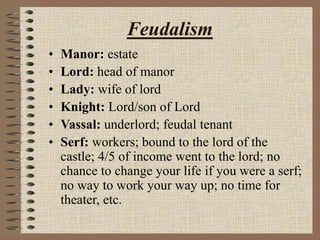
• Manor: estate
• Lord: head of manor
• Lady: wife of lord
• Knight: Lord/son of Lord
• Vassal: underlord; feudal tenant
• Serf: workers; bound to the lord of the
castle; 4/5 of income went to the lord; no
chance to change your life if you were a serf;
no way to work your way up; no time for
theater, etc.
Feudalism
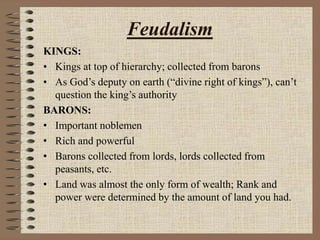
KINGS:
• Kings at top of hierarchy; collected from barons
• As God’s deputy on earth (“divine right of kings”), can’t
question the king’s authority
BARONS:
• Important noblemen
• Rich and powerful
• Barons collected from lords, lords collected from
peasants, etc.
• Land was almost the only form of wealth; Rank and
power were determined by the amount of land you had.
Feudalism
BISHOPS:
• Of the church
• Were often of equal power to barons; had property and
wealth
Fief [feef]: grant of land given directly by the king; in return,
nobelmen gave the king soldiers in wartime.
LORDS (KNIGHTS):
• first and foremost a lord was a knight by profession:
provided men and arms for baron and king.
• Also often raided each others’ properties.
• Chivalry: medieval institution of knighthood; qualities
idealized by knights—bravery, courtesy, honesty
Feudalism
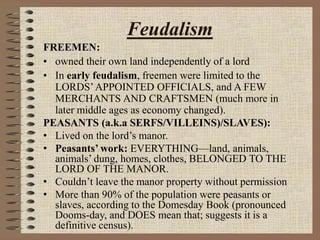
FREEMEN:
• owned their own land independently of a lord
• In early feudalism, freemen were limited to the
LORDS’APPOINTED OFFICIALS, and A FEW
MERCHANTS AND CRAFTSMEN (much more in
later middle ages as economy changed).
PEASANTS (a.k.a SERFS/VILLEINS)/SLAVES):
• Lived on the lord’s manor.
• Peasants’ work: EVERYTHING—land, animals,
animals’ dung, homes, clothes, BELONGED TO THE
LORD OF THE MANOR.
• Couldn’t leave the manor property without permission
• More than 90% of the population were peasants or
slaves, according to the Domesday Book (pronounced
Dooms-day, and DOES mean that; suggests it is a
definitive census).
Guilds
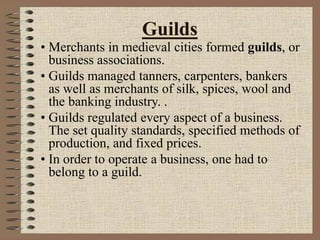
• Merchants in medieval cities formed guilds, or
business associations.
• Guilds managed tanners, carpenters, bankers
as well as merchants of silk, spices, wool and
the banking industry. .
• Guilds regulated every aspect of a business.
The set quality standards, specified methods of
production, and fixed prices.
• In order to operate a business, one had to
belong to a guild.
The Catholic Church
• The head of the church was the Pope
• Most influential and powerful institution in Europe
• Dictated even the most insignificant details of
individuals’ lives
• Participated in Inquisitions
• Controlled intellectual thought until the Renaissance
• Place of power and education
• The church and the crown often collaborated
• Collaboration often caused quarrels. Such a quarrel in
1170 led to the murder of Thomas a Becket the
Archbishop of Canterbury by barons loyal to Henry II
The Catholic Church
• Christianity became the universal faith of almost all of the people of
Europe.
• The Church was often the only way to get an education.
– It also allowed poor people to escape a dreary life and possibly
rise to power.
– Religious workers are called clergy.
– In the Middle Ages, the Pope ruled the Christian Church. Other
clergy included bishops, priests, nuns, and monks.
• Monks: men who lived in monasteries, or small communities of
religious workers.
– devoted their lives to prayer
– Monasteries produced many well-educated men prepared to serve
as administrators for uneducated kings and lords.
– Monks were responsible for keeping the Greek and Latin
“classical” cultures alive. Monks copied books by hand in an era
before the printing press. Though few in number, monks played a
significant role in the Middle Ages.
Thomas a Becket
•St. Thomas of Canterbury (c. 1118 – December 29, 1170)
•Archbishop of Canterbury from 1162 to 1170.
•He is venerated as a saint and martyr by both the Roman
Catholic Church and the Anglican Church.
•He engaged in a conflict with King Henry II over the rights
and privileges of the Church and was assassinated by
followers of the king in Canterbury Cathedral.
Anglo-Norman Literature
• For 200 years following the Conquest, English became a
lower class language in England spoken by the poor and
powerless
• The noble language came to be called Norman French
• Literature written in the English language came to a near
halt
• Between 1066 and 1260 (194 years) most non-Latin
literature was written in Norman French, therefore it
became known as Anglo-Norman literature
• After England lost Normandy, the influence of the French
language rapidly declined and the upper class of England
began to adopt the native language of English
Characteristics of
Anglo-Norman Literature
• Practical
• Consisted of religious tracts meant more for education
than entertainment
• The Normans did import some French entertainment
literature such as:
– Romances
– Fabliaux (a coarsely humorous short story in verse, dealing in a
bluntly realistic manner with stereotyped characters of the middle
class involved in sexual intrigue and obscene pranks (Miller’s
Tale & Reeves Tale)
• Introduced rhymed stanzas (replaced alliteration)
Religious Influence on Literature
• Literature dealt a great deal with religious subjects and
themes
• Surviving works included retellings of
– Biblical stories
– Biographies of saints
– Collections of sermons
– Tracts on the seven deadly sins
– Tracts on the seven cardinal virtues
• Common themes included:
– Memento mori – reminder of death
– Contemptu mundi – contempt for the world
The Seven Deadly Sins
• Pride
• Avarice
• Lechery
• Anger
• Gluttony
• Envy
• Sloth
The Seven Cardinal Virtues
• Prudence
• Temperance
• Fortitude
• Justice
• Faith
• Hope
• Love
The Crusades
The Holy Wars
In the 11th to the 13th century the church
sponsored a series of holy wars to
recapture Jerusalem from the Moslems.
Christians from all over the world
participated in these wars.
What did the Crusades do?
• Depopulated parts of Europe
• Introduced Europe to a more cultured, learned
civilization
• Opened trading routes
• Introduced Europeans to spices and perfumes
• Eventually broke the power of the Catholic church
(helped to) by ushering in the Renaissance
• Many of these crusaders brought back with them to
England Persian love poems, which had a considerable
influence on the literature of the period with it’s idealized
portrait of women.
• It helped to develop literature that idealized such female
figures as The Virgin Mary in religious literature.
After the Crusades
Romance Literature
•The Crusades and devotion to the Virgin Mary influenced the
development of a unique literature known as romance
•Today romance stories are traditionally love stories but in the Medieval
Period romance stories were stories of adventure
•Characterized by:
1. Medieval romance usually idealizes chivalry
2. Medieval romance Idealizes the hero-knight and his noble deeds
3. An important element of the medieval romance is the knight's love for
his lady.
4. The settings of medieval romance tend to be imaginary and vague.
5. Medieval romance derives mystery and suspense from supernatural
elements.
6. Medieval romance uses concealed or disguised identity.
7. Repetition of the mystical number "3." (Repetitions of the number or
multiples of 3)
• Chivalry was a code of conduct based on the process of
becoming a knight.
• The ideals of chivalry improved attitudes toward, but not
the rights of, women
• The code of chivalry included the following virtues:
– Loyalty
– Honesty
– Gentleness
– Faith
– Courtesy
– Skill
– Courage
• Idealization of women and the knight’s faithful service to
them formed the core of courtly love
Chivalry
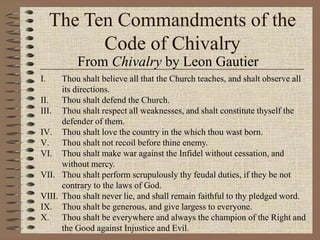
The Ten Commandments of the
Code of Chivalry
From Chivalry by Leon Gautier
I. Thou shalt believe all that the Church teaches, and shalt observe all
its directions.
II. Thou shalt defend the Church.
III. Thou shalt respect all weaknesses, and shalt constitute thyself the
defender of them.
IV. Thou shalt love the country in the which thou wast born.
V. Thou shalt not recoil before thine enemy.
VI. Thou shalt make war against the Infidel without cessation, and
without mercy.
VII. Thou shalt perform scrupulously thy feudal duties, if they be not
contrary to the laws of God.
VIII. Thou shalt never lie, and shall remain faithful to thy pledged word.
IX. Thou shalt be generous, and give largess to everyone.
X. Thou shalt be everywhere and always the champion of the Right and
the Good against Injustice and Evil.
Courtly Love
Courtly love is the code of behavior
between women and their suitors
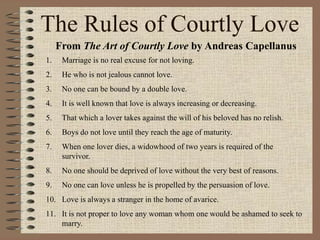
The Rules of Courtly Love
From The Art of Courtly Love by Andreas Capellanus
1. Marriage is no real excuse for not loving.
2. He who is not jealous cannot love.
3. No one can be bound by a double love.
4. It is well known that love is always increasing or decreasing.
5. That which a lover takes against the will of his beloved has no relish.
6. Boys do not love until they reach the age of maturity.
7. When one lover dies, a widowhood of two years is required of the
survivor.
8. No one should be deprived of love without the very best of reasons.
9. No one can love unless he is propelled by the persuasion of love.
10. Love is always a stranger in the home of avarice.
11. It is not proper to love any woman whom one would be ashamed to seek to
marry.
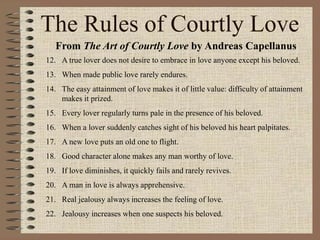
The Rules of Courtly Love
From The Art of Courtly Love by Andreas Capellanus
12. A true lover does not desire to embrace in love anyone except his beloved.
13. When made public love rarely endures.
14. The easy attainment of love makes it of little value: difficulty of attainment
makes it prized.
15. Every lover regularly turns pale in the presence of his beloved.
16. When a lover suddenly catches sight of his beloved his heart palpitates.
17. A new love puts an old one to flight.
18. Good character alone makes any man worthy of love.
19. If love diminishes, it quickly fails and rarely revives.
20. A man in love is always apprehensive.
21. Real jealousy always increases the feeling of love.
22. Jealousy increases when one suspects his beloved.
The Rules of Courtly Love
From The Art of Courtly Love by Andreas Capellanus
23. He whom the thought of love vexes eats and sleeps very little.
24. Every act of a lover ends in the thought of his beloved.
25. A true lover considers nothing good except what he thinks will please his
beloved.
26. Love can deny nothing to love.
27. A lover can never have enough of the solaces of his beloved.
28. A slight presumption causes a lover to suspect his beloved.
29. A man who is vexed by too much passion usually does not love.
30. A true lover is constantly and without intermission possessed by the
thought of his beloved.
31. Nothing forbids one woman being loved by two men or one man by two
women.
Authors and Works of the Middle
Ages
Ballads
• Ballads were composed with music in mind with their
rhythm and meter.
• They were simple narratives written in 4-line stanzas.
• Ballads are poetry of the people and their topics are ones of
everyday life– lost love, death, betrayal, the supernatural
and relationships
• They were meant to entertain and to educate.
Medieval Dramas
•Initially perfromed in churches
•3 types of Medieval Dramas
–Mystery plays: stories from the bible
–Miracle plays: stories of saints’ lives
–Morality plays: represented abstract virtues and
vices as characters
Everyman
A morality play to teach a lesson to its
viewers. It’s about a character named
Everyman who confronts Death and has to
find which of his friends will go with him.
Dante Aligheri
(writes Devine Comedy 1307)
Author of the Devine Comedy which is
comprised of The Inferno, Purgatorio and
Paradisio.
Decameron
Written by Boccaccio, the Decameron 1350’s
is a set of tales principally about love and the
corruption of the clergy. The Decameron is
said to have been an influence on Chaucer
Sir Gawain and the Green Knight
(1375)
A tale about Arthur’s knights and the Round
Table, Sir Gawain accepts the Green Knights
challenge to exchange blows. The story might
really be about redemption and sin.
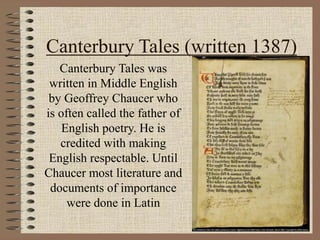
Canterbury Tales (written 1387)
Canterbury Tales was
written in Middle English
by Geoffrey Chaucer who
is often called the father of
English poetry. He is
credited with making
English respectable. Until
Chaucer most literature and
documents of importance
were done in Latin
Political Developments in the
Medieval Period
• Doomsday Book: William the Conqueror had everyone’s personal
property catalogued so he could tax it
• The Magna Carta weakened the political power of the Church and
laid the groundwork for later English constitutional law.
• 100 Years’War (1377-1453): War between France and England–
England claimed the throne of France based on Edward III and Henry
V. The British yeoman now represented England and these small
landowners became a dominant force in a new society
• Joan of Arc: Most famous figure of the 100 Years’ War, Joan of Arc
was a peasant girl who led the French forces against the English–
since the French king was too inept. She claimed that God talked to
her, and she was militarily successful for two years until she was
captured in Burgundy and sold to the English. The English
considered her a “hot potato” so they gave her to an ecclesiastical
court which accused her of witchcraft and eventually burned her at
the stake. She became canonized as a saint in the 20th century
Social and Cultural Changes in
the Medieval Period
• Merchants and artisans organized themselves into guilds
responsible for training apprentices and for regulating
business.
• A middle class of free merchants and tradespeople emerged.
• Bubonic Plague strikes England 1348: Called the Black
Death– estimates say that 10 to fifty percent of Europeans died
of the black death. So many people died that there was a
shortage of labor which eventually helped to bring about the
middle class.
• John Wycliff (c. 1330-1384): finished the first complete
translation of the Bible into English.
• William Caxton (c. 1422-1491): in 1476 introduced to
England the new technology of printing from movable type.
Plague/Black Death:
• Took out 54 million
• 1/3 of population wiped out
• Defining event(s) of the Middle Ages
• Spread by fleas which lived on rats
• A lack of cleanliness added to their vulnerability: crowded with
poor sanitation; ate stale or diseased meat; primitive medicine
(people were often advised to not bathe b/c open skin pores
might let in the disease).
• Highly contagious disease nodules would burst around the area
of the flea bite.
• In 1347, Italian merchant ships returned from the Black Sea,
one of the links along the trade route between Europe and
China. Many of the sailors were already dying of the plague,
and within days the disease had spread from the port cities to
the surrounding countryside. The disease spread as far as
England within a year.
The End of the Medieval Period
The War of the Roses
(1455 – 1485)
• England was torn by civil war between two noble houses.
• The House of Lancaster (red rose crest) fought with the
House of York (white rose crest)
• Lasted 30 years
• Ended with the defeat of Richard III of the House of
Lancaster by Henry Tudor who became King Henry VII.
Battle of Bosworth Field—the
end of the Medieval Period
Henry Tudor and his allies challenge Richard
III and his reluctant allies at Bosworth Field.
Richard is killed at the Battle and the ruling
house of Plantagenet changes to Tudor, the
Medieval Period ends, and the Renaissance is
ushered in

Medieval Period 01.ppt

  • 1.
    Medieval Period The Battleof Hastings to The War of the Roses 1066-1485
  • 2.
    The Battle ofHastings • In 1066 Edward the Confessor died and the Anglo- Saxon council of elders (Witanagemot) chose Harold II as the new King of England • Duke William of Normandy, cousin of Edward, claimed that the throne was promised to him by Edward • With the support of the church, William invaded England and defeated Harold II at The Battle of Hastings. He came to be called William the Conqueror • The Norman Conquest brought the era of the Anglo- Saxons to a close and ushered in the Medieval Period
  • 3.
    Medieval Period Society WasBased On Feudalism Feudalism was a hierarchy based on the least powerful swearing allegiance and loyalty, know as vassalage, to the person in power above him. It began with the serfs and ended with the king and the Pope The feudal system centralized military, political, and economic power in the Crown
  • 4.
    Feudalism • The Normansdivided England into estates, or fiefdoms ruled by French-speaking barons loyal to the William • Feudalism was adopted as the system of political organization – All land and all people belonged to the King – The king granted large tracts of land to nobles know as barons • In exchange were bound to be loyal to the king • Had to raise armies to fight in his battles • Paid taxes to support his court • Barons granted land to lesser nobles and required service and support from them. They in turn had the lowest class of society work the land. • A serf could earn freedom by some exceptional service to his lord. Gradually, a class of freemen grew to include merchants, traders, laborers, and artisans • Guilds, first labor unions made up of skilled craftsmen, were formed. Guilds were the beginning of the middle class.
  • 5.
    Feudalism • Manor: estate •Lord: head of manor • Lady: wife of lord • Knight: Lord/son of Lord • Vassal: underlord; feudal tenant • Serf: workers; bound to the lord of the castle; 4/5 of income went to the lord; no chance to change your life if you were a serf; no way to work your way up; no time for theater, etc.
  • 6.
    Feudalism KINGS: • Kings attop of hierarchy; collected from barons • As God’s deputy on earth (“divine right of kings”), can’t question the king’s authority BARONS: • Important noblemen • Rich and powerful • Barons collected from lords, lords collected from peasants, etc. • Land was almost the only form of wealth; Rank and power were determined by the amount of land you had.
  • 7.
    Feudalism BISHOPS: • Of thechurch • Were often of equal power to barons; had property and wealth Fief [feef]: grant of land given directly by the king; in return, nobelmen gave the king soldiers in wartime. LORDS (KNIGHTS): • first and foremost a lord was a knight by profession: provided men and arms for baron and king. • Also often raided each others’ properties. • Chivalry: medieval institution of knighthood; qualities idealized by knights—bravery, courtesy, honesty
  • 8.
    Feudalism FREEMEN: • owned theirown land independently of a lord • In early feudalism, freemen were limited to the LORDS’APPOINTED OFFICIALS, and A FEW MERCHANTS AND CRAFTSMEN (much more in later middle ages as economy changed). PEASANTS (a.k.a SERFS/VILLEINS)/SLAVES): • Lived on the lord’s manor. • Peasants’ work: EVERYTHING—land, animals, animals’ dung, homes, clothes, BELONGED TO THE LORD OF THE MANOR. • Couldn’t leave the manor property without permission • More than 90% of the population were peasants or slaves, according to the Domesday Book (pronounced Dooms-day, and DOES mean that; suggests it is a definitive census).
  • 9.
    Guilds • Merchants inmedieval cities formed guilds, or business associations. • Guilds managed tanners, carpenters, bankers as well as merchants of silk, spices, wool and the banking industry. . • Guilds regulated every aspect of a business. The set quality standards, specified methods of production, and fixed prices. • In order to operate a business, one had to belong to a guild.
  • 10.
    The Catholic Church •The head of the church was the Pope • Most influential and powerful institution in Europe • Dictated even the most insignificant details of individuals’ lives • Participated in Inquisitions • Controlled intellectual thought until the Renaissance • Place of power and education • The church and the crown often collaborated • Collaboration often caused quarrels. Such a quarrel in 1170 led to the murder of Thomas a Becket the Archbishop of Canterbury by barons loyal to Henry II
  • 11.
    The Catholic Church •Christianity became the universal faith of almost all of the people of Europe. • The Church was often the only way to get an education. – It also allowed poor people to escape a dreary life and possibly rise to power. – Religious workers are called clergy. – In the Middle Ages, the Pope ruled the Christian Church. Other clergy included bishops, priests, nuns, and monks. • Monks: men who lived in monasteries, or small communities of religious workers. – devoted their lives to prayer – Monasteries produced many well-educated men prepared to serve as administrators for uneducated kings and lords. – Monks were responsible for keeping the Greek and Latin “classical” cultures alive. Monks copied books by hand in an era before the printing press. Though few in number, monks played a significant role in the Middle Ages.
  • 12.
    Thomas a Becket •St.Thomas of Canterbury (c. 1118 – December 29, 1170) •Archbishop of Canterbury from 1162 to 1170. •He is venerated as a saint and martyr by both the Roman Catholic Church and the Anglican Church. •He engaged in a conflict with King Henry II over the rights and privileges of the Church and was assassinated by followers of the king in Canterbury Cathedral.
  • 13.
    Anglo-Norman Literature • For200 years following the Conquest, English became a lower class language in England spoken by the poor and powerless • The noble language came to be called Norman French • Literature written in the English language came to a near halt • Between 1066 and 1260 (194 years) most non-Latin literature was written in Norman French, therefore it became known as Anglo-Norman literature • After England lost Normandy, the influence of the French language rapidly declined and the upper class of England began to adopt the native language of English
  • 14.
    Characteristics of Anglo-Norman Literature •Practical • Consisted of religious tracts meant more for education than entertainment • The Normans did import some French entertainment literature such as: – Romances – Fabliaux (a coarsely humorous short story in verse, dealing in a bluntly realistic manner with stereotyped characters of the middle class involved in sexual intrigue and obscene pranks (Miller’s Tale & Reeves Tale) • Introduced rhymed stanzas (replaced alliteration)
  • 15.
    Religious Influence onLiterature • Literature dealt a great deal with religious subjects and themes • Surviving works included retellings of – Biblical stories – Biographies of saints – Collections of sermons – Tracts on the seven deadly sins – Tracts on the seven cardinal virtues • Common themes included: – Memento mori – reminder of death – Contemptu mundi – contempt for the world
  • 16.
    The Seven DeadlySins • Pride • Avarice • Lechery • Anger • Gluttony • Envy • Sloth
  • 17.
    The Seven CardinalVirtues • Prudence • Temperance • Fortitude • Justice • Faith • Hope • Love
  • 18.
    The Crusades The HolyWars In the 11th to the 13th century the church sponsored a series of holy wars to recapture Jerusalem from the Moslems. Christians from all over the world participated in these wars.
  • 19.
    What did theCrusades do? • Depopulated parts of Europe • Introduced Europe to a more cultured, learned civilization • Opened trading routes • Introduced Europeans to spices and perfumes • Eventually broke the power of the Catholic church (helped to) by ushering in the Renaissance • Many of these crusaders brought back with them to England Persian love poems, which had a considerable influence on the literature of the period with it’s idealized portrait of women. • It helped to develop literature that idealized such female figures as The Virgin Mary in religious literature.
  • 20.
    After the Crusades RomanceLiterature •The Crusades and devotion to the Virgin Mary influenced the development of a unique literature known as romance •Today romance stories are traditionally love stories but in the Medieval Period romance stories were stories of adventure •Characterized by: 1. Medieval romance usually idealizes chivalry 2. Medieval romance Idealizes the hero-knight and his noble deeds 3. An important element of the medieval romance is the knight's love for his lady. 4. The settings of medieval romance tend to be imaginary and vague. 5. Medieval romance derives mystery and suspense from supernatural elements. 6. Medieval romance uses concealed or disguised identity. 7. Repetition of the mystical number "3." (Repetitions of the number or multiples of 3)
  • 21.
    • Chivalry wasa code of conduct based on the process of becoming a knight. • The ideals of chivalry improved attitudes toward, but not the rights of, women • The code of chivalry included the following virtues: – Loyalty – Honesty – Gentleness – Faith – Courtesy – Skill – Courage • Idealization of women and the knight’s faithful service to them formed the core of courtly love Chivalry
  • 22.
    The Ten Commandmentsof the Code of Chivalry From Chivalry by Leon Gautier I. Thou shalt believe all that the Church teaches, and shalt observe all its directions. II. Thou shalt defend the Church. III. Thou shalt respect all weaknesses, and shalt constitute thyself the defender of them. IV. Thou shalt love the country in the which thou wast born. V. Thou shalt not recoil before thine enemy. VI. Thou shalt make war against the Infidel without cessation, and without mercy. VII. Thou shalt perform scrupulously thy feudal duties, if they be not contrary to the laws of God. VIII. Thou shalt never lie, and shall remain faithful to thy pledged word. IX. Thou shalt be generous, and give largess to everyone. X. Thou shalt be everywhere and always the champion of the Right and the Good against Injustice and Evil.
  • 23.
    Courtly Love Courtly loveis the code of behavior between women and their suitors
  • 24.
    The Rules ofCourtly Love From The Art of Courtly Love by Andreas Capellanus 1. Marriage is no real excuse for not loving. 2. He who is not jealous cannot love. 3. No one can be bound by a double love. 4. It is well known that love is always increasing or decreasing. 5. That which a lover takes against the will of his beloved has no relish. 6. Boys do not love until they reach the age of maturity. 7. When one lover dies, a widowhood of two years is required of the survivor. 8. No one should be deprived of love without the very best of reasons. 9. No one can love unless he is propelled by the persuasion of love. 10. Love is always a stranger in the home of avarice. 11. It is not proper to love any woman whom one would be ashamed to seek to marry.
  • 25.
    The Rules ofCourtly Love From The Art of Courtly Love by Andreas Capellanus 12. A true lover does not desire to embrace in love anyone except his beloved. 13. When made public love rarely endures. 14. The easy attainment of love makes it of little value: difficulty of attainment makes it prized. 15. Every lover regularly turns pale in the presence of his beloved. 16. When a lover suddenly catches sight of his beloved his heart palpitates. 17. A new love puts an old one to flight. 18. Good character alone makes any man worthy of love. 19. If love diminishes, it quickly fails and rarely revives. 20. A man in love is always apprehensive. 21. Real jealousy always increases the feeling of love. 22. Jealousy increases when one suspects his beloved.
  • 26.
    The Rules ofCourtly Love From The Art of Courtly Love by Andreas Capellanus 23. He whom the thought of love vexes eats and sleeps very little. 24. Every act of a lover ends in the thought of his beloved. 25. A true lover considers nothing good except what he thinks will please his beloved. 26. Love can deny nothing to love. 27. A lover can never have enough of the solaces of his beloved. 28. A slight presumption causes a lover to suspect his beloved. 29. A man who is vexed by too much passion usually does not love. 30. A true lover is constantly and without intermission possessed by the thought of his beloved. 31. Nothing forbids one woman being loved by two men or one man by two women.
  • 27.
    Authors and Worksof the Middle Ages
  • 28.
    Ballads • Ballads werecomposed with music in mind with their rhythm and meter. • They were simple narratives written in 4-line stanzas. • Ballads are poetry of the people and their topics are ones of everyday life– lost love, death, betrayal, the supernatural and relationships • They were meant to entertain and to educate.
  • 29.
    Medieval Dramas •Initially perfromedin churches •3 types of Medieval Dramas –Mystery plays: stories from the bible –Miracle plays: stories of saints’ lives –Morality plays: represented abstract virtues and vices as characters
  • 30.
    Everyman A morality playto teach a lesson to its viewers. It’s about a character named Everyman who confronts Death and has to find which of his friends will go with him. Dante Aligheri (writes Devine Comedy 1307) Author of the Devine Comedy which is comprised of The Inferno, Purgatorio and Paradisio.
  • 31.
    Decameron Written by Boccaccio,the Decameron 1350’s is a set of tales principally about love and the corruption of the clergy. The Decameron is said to have been an influence on Chaucer Sir Gawain and the Green Knight (1375) A tale about Arthur’s knights and the Round Table, Sir Gawain accepts the Green Knights challenge to exchange blows. The story might really be about redemption and sin.
  • 32.
    Canterbury Tales (written1387) Canterbury Tales was written in Middle English by Geoffrey Chaucer who is often called the father of English poetry. He is credited with making English respectable. Until Chaucer most literature and documents of importance were done in Latin
  • 33.
    Political Developments inthe Medieval Period • Doomsday Book: William the Conqueror had everyone’s personal property catalogued so he could tax it • The Magna Carta weakened the political power of the Church and laid the groundwork for later English constitutional law. • 100 Years’War (1377-1453): War between France and England– England claimed the throne of France based on Edward III and Henry V. The British yeoman now represented England and these small landowners became a dominant force in a new society • Joan of Arc: Most famous figure of the 100 Years’ War, Joan of Arc was a peasant girl who led the French forces against the English– since the French king was too inept. She claimed that God talked to her, and she was militarily successful for two years until she was captured in Burgundy and sold to the English. The English considered her a “hot potato” so they gave her to an ecclesiastical court which accused her of witchcraft and eventually burned her at the stake. She became canonized as a saint in the 20th century
  • 34.
    Social and CulturalChanges in the Medieval Period • Merchants and artisans organized themselves into guilds responsible for training apprentices and for regulating business. • A middle class of free merchants and tradespeople emerged. • Bubonic Plague strikes England 1348: Called the Black Death– estimates say that 10 to fifty percent of Europeans died of the black death. So many people died that there was a shortage of labor which eventually helped to bring about the middle class. • John Wycliff (c. 1330-1384): finished the first complete translation of the Bible into English. • William Caxton (c. 1422-1491): in 1476 introduced to England the new technology of printing from movable type.
  • 35.
    Plague/Black Death: • Tookout 54 million • 1/3 of population wiped out • Defining event(s) of the Middle Ages • Spread by fleas which lived on rats • A lack of cleanliness added to their vulnerability: crowded with poor sanitation; ate stale or diseased meat; primitive medicine (people were often advised to not bathe b/c open skin pores might let in the disease). • Highly contagious disease nodules would burst around the area of the flea bite. • In 1347, Italian merchant ships returned from the Black Sea, one of the links along the trade route between Europe and China. Many of the sailors were already dying of the plague, and within days the disease had spread from the port cities to the surrounding countryside. The disease spread as far as England within a year.
  • 36.
    The End ofthe Medieval Period The War of the Roses (1455 – 1485) • England was torn by civil war between two noble houses. • The House of Lancaster (red rose crest) fought with the House of York (white rose crest) • Lasted 30 years • Ended with the defeat of Richard III of the House of Lancaster by Henry Tudor who became King Henry VII.
  • 37.
    Battle of BosworthField—the end of the Medieval Period Henry Tudor and his allies challenge Richard III and his reluctant allies at Bosworth Field. Richard is killed at the Battle and the ruling house of Plantagenet changes to Tudor, the Medieval Period ends, and the Renaissance is ushered in