By Gee Yeon Bae
Castles were for defense, not for comfort The first castles were made of wood. Wood castles could burn easily. By 1100, castles were made of stones.
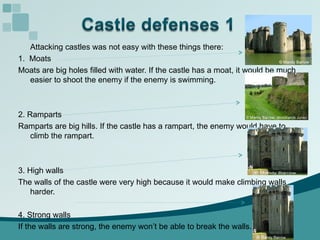
Attacking castles was not easy with these things there: 1.  Moats  Moats are big holes filled with water. If the castle has a moat, it would be much easier to shoot the enemy if the enemy is swimming.  2. Ramparts Ramparts are big hills. If the castle has a rampart, the enemy would have to climb the rampart.  3. High walls The walls of the castle were very high because it would make climbing walls harder. 4. Strong walls If the walls are strong, the enemy won’t be able to break the walls.
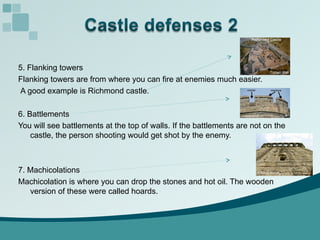
5. Flanking towers Flanking towers are from where you can fire at enemies much easier. A good example is Richmond castle. 6. Battlements You will see battlements at the top of walls. If the battlements are not on the castle, the person shooting would get shot by the enemy. 7. Machicolations Machicolation is where you can drop the stones and hot oil. The wooden version of these were called hoards.
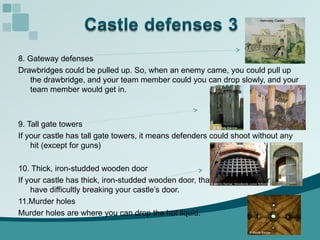
8. Gateway defenses Drawbridges could be pulled up. So, when an enemy came, you could pull up the drawbridge, and your team member could you can drop slowly, and your team member would get in. 9. Tall gate towers If your castle has tall gate towers, it means defenders could shoot without any hit (except for guns)  10. Thick, iron-studded wooden door If your castle has thick, iron-studded wooden door, that means an enemy will have difficultly breaking your castle’s door. 11.Murder holes Murder holes are where you can drop the hot liquid.
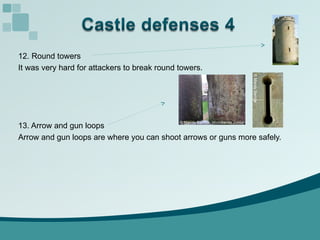
12. Round towers It was very hard for attackers to break round towers. 13. Arrow and gun loops Arrow and gun loops are where you can shoot arrows or guns more safely.
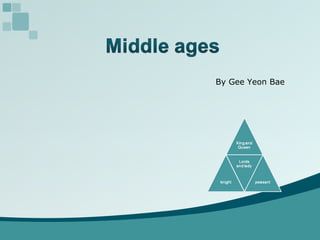
King Kings must be wise and clever because a king is the most powerful person in the kingdom A king’s word was important because he was the most powerful person in the kingdom Queen The Queen was a supporter of the king. A Queen could order the king, and usually the king would listen to her but the king didn’t need to listen to the queen.
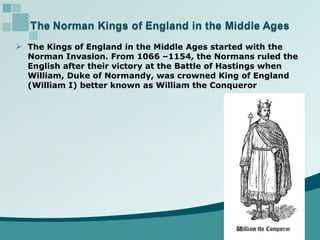
The Kings of England in the Middle Ages started with the  Norman Invasion. From 1066 –1154, the Normans ruled the English after their victory at the Battle of Hastings when  William, Duke of Normandy, was crowned King of England  (William I) better known as William the Conqueror
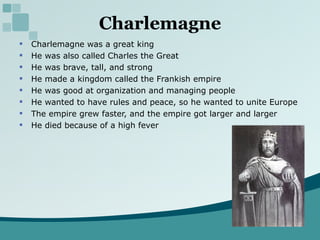
Charlemagne Charlemagne was a great king He was also called Charles the Great He was brave, tall, and strong He made a kingdom called the Frankish empire He was good at organization and managing people He wanted to have rules and peace, so he wanted to unite Europe The empire grew faster, and the empire got larger and larger He died because of a high fever
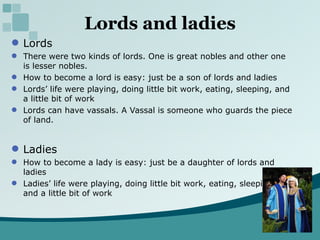
Lords and ladies Lords There were two kinds of lords. One is great nobles and other one is lesser nobles. How to become a lord is easy: just be a son of lords and ladies Lords’ life were playing, doing little bit work, eating, sleeping, and a little bit of work Lords can have vassals. A Vassal is someone who guards the piece of land. Ladies  How to become a lady is easy: just be a daughter of lords and ladies Ladies’ life were playing, doing little bit work, eating, sleeping, and a little bit of work
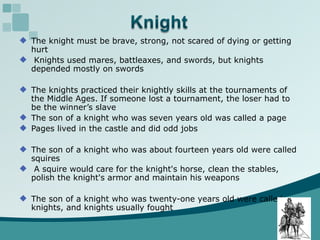
The knight must be brave, strong, not scared of dying or getting hurt Knights used mares, battleaxes, and swords, but knights depended mostly on swords The knights practiced their knightly skills at the tournaments of the Middle Ages. If someone lost a tournament, the loser had to be the winner’s slave The son of a knight who was seven years old was called a page Pages lived in the castle and did odd jobs The son of a knight who was about fourteen years old were called squires A squire would care for the knight's horse, clean the stables,  polish the knight's armor and maintain his weapons The son of a knight who was twenty-one years old were called knights, and knights usually fought
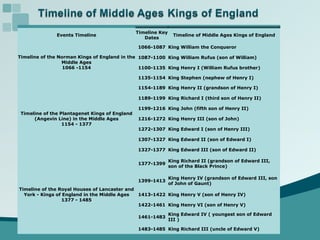
Events Timeline Timeline Key Dates Timeline of Middle Ages Kings of England Timeline of the Norman Kings of England in the Middle Ages 1066 -1154 1066-1087 King William the Conqueror 1087-1100 King William Rufus (son of William)  1100-1135 King Henry I (William Rufus brother) 1135-1154 King Stephen (nephew of Henry I) Timeline of the Plantagenet Kings of England (Angevin Line) in the Middle Ages 1154 - 1377 1154-1189 King Henry II (grandson of Henry I) 1189-1199 King Richard I (third son of Henry II)  1199-1216 King John (fifth son of Henry II) 1216-1272 King Henry III (son of John) 1272-1307 King Edward I (son of Henry III)  1307-1327 King Edward II (son of Edward I) 1327-1377 King Edward III (son of Edward II) Timeline of the Royal Houses of Lancaster and York - Kings of England in the Middle Ages 1377 - 1485 1377-1399 King Richard II (grandson of Edward III, son of the Black Prince) 1399-1413 King Henry IV (grandson of Edward III, son of John of Gaunt)  1413-1422 King Henry V (son of Henry IV) 1422-1461 King Henry VI (son of Henry V) 1461-1483 King Edward IV ( youngest son of Edward III )  1483-1485 King Richard III (uncle of Edward V)
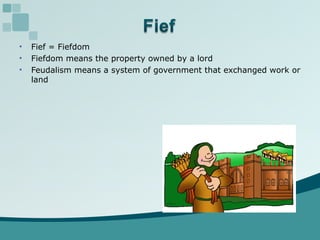
Fief = Fiefdom Fiefdom means the property owned by a lord Feudalism means a system of government that exchanged work or land
Serf and peasant Serf Serfs’ life were almost the same as a peasant’s; the only thing that was different was that a serf wasn’t a free man. Peasant Peasants’ work were farming, weaving, cutting the wood into half Peasants have to make everything themselves.
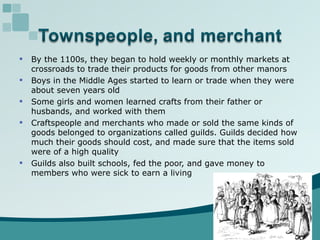
By the 1100s, they began to hold weekly or monthly markets at crossroads to trade their products for goods from other manors Boys in the Middle Ages started to learn or trade when they were about seven years old Some girls and women learned crafts from their father or husbands, and worked with them Craftspeople and merchants who made or sold the same kinds of goods belonged to organizations called guilds. Guilds decided how much their goods should cost, and made sure that the items sold were of a high quality Guilds also built schools, fed the poor, and gave money to members who were sick to earn a living
Information from http://www.middle-ages.org.uk/mid (Internet website) http://www. thefreedictionary .com/  (Internet website) Culture studies booklets My culture studies notebook Pictures from Http://www.google.com/ The End ^_^

The Middle Ages by Gee Yeon

  • 1.
  • 2.
    Castles were fordefense, not for comfort The first castles were made of wood. Wood castles could burn easily. By 1100, castles were made of stones.
  • 3.
    Attacking castles wasnot easy with these things there: 1. Moats Moats are big holes filled with water. If the castle has a moat, it would be much easier to shoot the enemy if the enemy is swimming. 2. Ramparts Ramparts are big hills. If the castle has a rampart, the enemy would have to climb the rampart. 3. High walls The walls of the castle were very high because it would make climbing walls harder. 4. Strong walls If the walls are strong, the enemy won’t be able to break the walls.
  • 4.
    5. Flanking towersFlanking towers are from where you can fire at enemies much easier. A good example is Richmond castle. 6. Battlements You will see battlements at the top of walls. If the battlements are not on the castle, the person shooting would get shot by the enemy. 7. Machicolations Machicolation is where you can drop the stones and hot oil. The wooden version of these were called hoards.
  • 5.
    8. Gateway defensesDrawbridges could be pulled up. So, when an enemy came, you could pull up the drawbridge, and your team member could you can drop slowly, and your team member would get in. 9. Tall gate towers If your castle has tall gate towers, it means defenders could shoot without any hit (except for guns) 10. Thick, iron-studded wooden door If your castle has thick, iron-studded wooden door, that means an enemy will have difficultly breaking your castle’s door. 11.Murder holes Murder holes are where you can drop the hot liquid.
  • 6.
    12. Round towersIt was very hard for attackers to break round towers. 13. Arrow and gun loops Arrow and gun loops are where you can shoot arrows or guns more safely.
  • 7.
    King Kings mustbe wise and clever because a king is the most powerful person in the kingdom A king’s word was important because he was the most powerful person in the kingdom Queen The Queen was a supporter of the king. A Queen could order the king, and usually the king would listen to her but the king didn’t need to listen to the queen.
  • 8.
    The Kings ofEngland in the Middle Ages started with the Norman Invasion. From 1066 –1154, the Normans ruled the English after their victory at the Battle of Hastings when William, Duke of Normandy, was crowned King of England (William I) better known as William the Conqueror
  • 9.
    Charlemagne Charlemagne wasa great king He was also called Charles the Great He was brave, tall, and strong He made a kingdom called the Frankish empire He was good at organization and managing people He wanted to have rules and peace, so he wanted to unite Europe The empire grew faster, and the empire got larger and larger He died because of a high fever
  • 10.
    Lords and ladiesLords There were two kinds of lords. One is great nobles and other one is lesser nobles. How to become a lord is easy: just be a son of lords and ladies Lords’ life were playing, doing little bit work, eating, sleeping, and a little bit of work Lords can have vassals. A Vassal is someone who guards the piece of land. Ladies How to become a lady is easy: just be a daughter of lords and ladies Ladies’ life were playing, doing little bit work, eating, sleeping, and a little bit of work
  • 11.
    The knight mustbe brave, strong, not scared of dying or getting hurt Knights used mares, battleaxes, and swords, but knights depended mostly on swords The knights practiced their knightly skills at the tournaments of the Middle Ages. If someone lost a tournament, the loser had to be the winner’s slave The son of a knight who was seven years old was called a page Pages lived in the castle and did odd jobs The son of a knight who was about fourteen years old were called squires A squire would care for the knight's horse, clean the stables, polish the knight's armor and maintain his weapons The son of a knight who was twenty-one years old were called knights, and knights usually fought
  • 12.
    Events Timeline TimelineKey Dates Timeline of Middle Ages Kings of England Timeline of the Norman Kings of England in the Middle Ages 1066 -1154 1066-1087 King William the Conqueror 1087-1100 King William Rufus (son of William) 1100-1135 King Henry I (William Rufus brother) 1135-1154 King Stephen (nephew of Henry I) Timeline of the Plantagenet Kings of England (Angevin Line) in the Middle Ages 1154 - 1377 1154-1189 King Henry II (grandson of Henry I) 1189-1199 King Richard I (third son of Henry II) 1199-1216 King John (fifth son of Henry II) 1216-1272 King Henry III (son of John) 1272-1307 King Edward I (son of Henry III) 1307-1327 King Edward II (son of Edward I) 1327-1377 King Edward III (son of Edward II) Timeline of the Royal Houses of Lancaster and York - Kings of England in the Middle Ages 1377 - 1485 1377-1399 King Richard II (grandson of Edward III, son of the Black Prince) 1399-1413 King Henry IV (grandson of Edward III, son of John of Gaunt) 1413-1422 King Henry V (son of Henry IV) 1422-1461 King Henry VI (son of Henry V) 1461-1483 King Edward IV ( youngest son of Edward III ) 1483-1485 King Richard III (uncle of Edward V)
  • 13.
    Fief = FiefdomFiefdom means the property owned by a lord Feudalism means a system of government that exchanged work or land
  • 14.
    Serf and peasantSerf Serfs’ life were almost the same as a peasant’s; the only thing that was different was that a serf wasn’t a free man. Peasant Peasants’ work were farming, weaving, cutting the wood into half Peasants have to make everything themselves.
  • 15.
    By the 1100s,they began to hold weekly or monthly markets at crossroads to trade their products for goods from other manors Boys in the Middle Ages started to learn or trade when they were about seven years old Some girls and women learned crafts from their father or husbands, and worked with them Craftspeople and merchants who made or sold the same kinds of goods belonged to organizations called guilds. Guilds decided how much their goods should cost, and made sure that the items sold were of a high quality Guilds also built schools, fed the poor, and gave money to members who were sick to earn a living
  • 16.
    Information from http://www.middle-ages.org.uk/mid(Internet website) http://www. thefreedictionary .com/ (Internet website) Culture studies booklets My culture studies notebook Pictures from Http://www.google.com/ The End ^_^