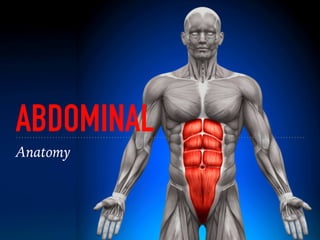
ABDOMINAL
Anatomy
4 ABDOMINAL MUSCLES
Listed deep to superficial:
1. Transversus Abdominus
2. Internal Oblique
3. External Oblique
4. Rectus Abdominus
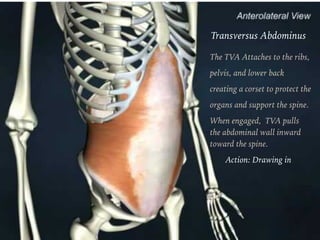
Transversus Abdominus
The TVA Attaches to the ribs,
pelvis, and lower back
creating a corset to protect the
organs and support the spine.
When engaged, TVA pulls 

the abdominal wall inward 

toward the spine.
Action: Drawing in
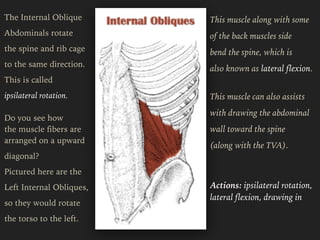
The Internal Oblique
Abdominals rotate
the spine and rib cage
to the same direction.
This is called
ipsilateral rotation.


Do you see how 

the muscle fibers are 

arranged on a upward
diagonal?
Pictured here are the
Left Internal Obliques,
so they would rotate
the torso to the left.
This muscle along with some
of the back muscles side
bend the spine, which is
also known as lateral flexion. 

This muscle can also assists
with drawing the abdominal
wall toward the spine
(along with the TVA).


Actions: ipsilateral rotation,

lateral flexion, drawing in


External Obliques
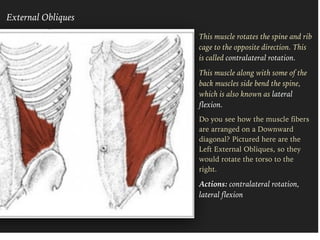
This muscle rotates the spine and rib
cage to the opposite direction. This
is called contralateral rotation.
This muscle along with some of the
back muscles side bend the spine,
which is also known as lateral
flexion.
Do you see how the muscle fibers
are arranged on a Downward
diagonal? Pictured here are the
Left External Obliques, so they
would rotate the torso to the
right.
Actions: contralateral rotation,
lateral flexion
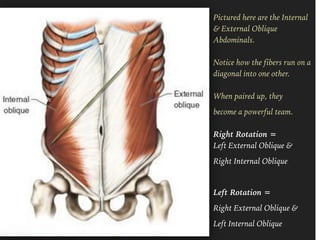
Pictured here are the Internal
& External Oblique
Abdominals. 


Notice how the fibers run on a
diagonal into one other.


When paired up, they
become a powerful team.


Right Rotation =

Left External Oblique &
Right Internal Oblique
Left Rotation =
Right External Oblique &
Left Internal Oblique
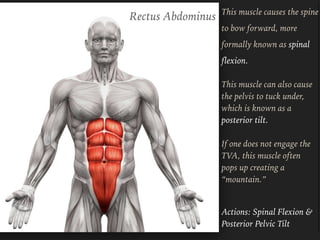
Rectus Abdominus This muscle causes the spine
to bow forward, more
formally known as spinal
flexion. 


This muscle can also cause 

the pelvis to tuck under, 

which is known as a 

posterior tilt. 


If one does not engage the

TVA, this muscle often 

pops up creating a 

“mountain.”
Actions: Spinal Flexion & 

Posterior Pelvic Tilt

The abdominals

  • 1.
  • 2.
    4 ABDOMINAL MUSCLES Listeddeep to superficial: 1. Transversus Abdominus 2. Internal Oblique 3. External Oblique 4. Rectus Abdominus
  • 3.
    Transversus Abdominus The TVAAttaches to the ribs, pelvis, and lower back creating a corset to protect the organs and support the spine. When engaged, TVA pulls 
 the abdominal wall inward 
 toward the spine. Action: Drawing in
  • 4.
    The Internal Oblique Abdominalsrotate the spine and rib cage to the same direction. This is called ipsilateral rotation.
 
 Do you see how 
 the muscle fibers are 
 arranged on a upward diagonal? Pictured here are the Left Internal Obliques, so they would rotate the torso to the left. This muscle along with some of the back muscles side bend the spine, which is also known as lateral flexion. 
 This muscle can also assists with drawing the abdominal wall toward the spine (along with the TVA).
 
 Actions: ipsilateral rotation,
 lateral flexion, drawing in
 

  • 5.
    External Obliques This musclerotates the spine and rib cage to the opposite direction. This is called contralateral rotation. This muscle along with some of the back muscles side bend the spine, which is also known as lateral flexion. Do you see how the muscle fibers are arranged on a Downward diagonal? Pictured here are the Left External Obliques, so they would rotate the torso to the right. Actions: contralateral rotation, lateral flexion
  • 6.
    Pictured here arethe Internal & External Oblique Abdominals. 
 
 Notice how the fibers run on a diagonal into one other.
 
 When paired up, they become a powerful team.
 
 Right Rotation =
 Left External Oblique & Right Internal Oblique Left Rotation = Right External Oblique & Left Internal Oblique
  • 7.
    Rectus Abdominus Thismuscle causes the spine to bow forward, more formally known as spinal flexion. 
 
 This muscle can also cause 
 the pelvis to tuck under, 
 which is known as a 
 posterior tilt. 
 
 If one does not engage the
 TVA, this muscle often 
 pops up creating a 
 “mountain.” Actions: Spinal Flexion & 
 Posterior Pelvic Tilt