Transverse Abdominal
Muscle
Anatomy, Function, and Clinical Importance
Presented by Shah e Saba
IHS Swat
Introduction Abdominis
Muscles
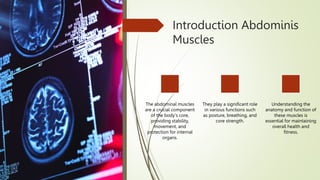
The abdominal muscles
are a crucial component
of the body's core,
providing stability,
movement, and
protection for internal
organs.
They play a significant role
in various functions such
as posture, breathing, and
core strength.
Understanding the
anatomy and function of
these muscles is
essential for maintaining
overall health and
fitness.
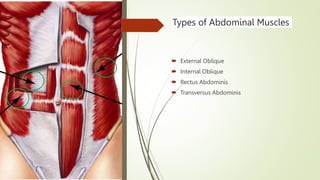
Types of Abdominal Muscles
 External Oblique
 Internal Oblique
 Rectus Abdominis
 Transversus Abdominis
Transversus
Abdominis
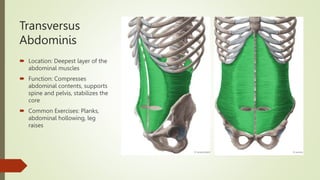
 Location: Deepest layer of the
abdominal muscles
 Function: Compresses
abdominal contents, supports
spine and pelvis, stabilizes the
core
 Common Exercises: Planks,
abdominal hollowing, leg
raises
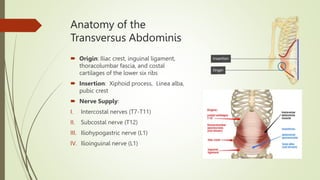
Anatomy of the
Transversus Abdominis
 Origin: Iliac crest, inguinal ligament,
thoracolumbar fascia, and costal
cartilages of the lower six ribs
 Insertion: Xiphoid process, Linea alba,
pubic crest
 Nerve Supply:
I. Intercostal nerves (T7-T11)
II. Subcostal nerve (T12)
III. Iliohypogastric nerve (L1)
IV. Ilioinguinal nerve (L1)
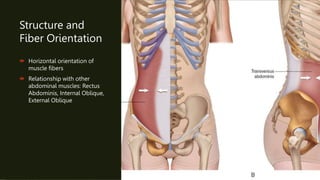
Structure and
Fiber Orientation
 Horizontal orientation of
muscle fibers
 Relationship with other
abdominal muscles: Rectus
Abdominis, Internal Oblique,
External Oblique
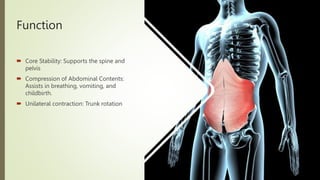
Function
 Core Stability: Supports the spine and
pelvis
 Compression of Abdominal Contents:
Assists in breathing, vomiting, and
childbirth.
 Unilateral contraction: Trunk rotation
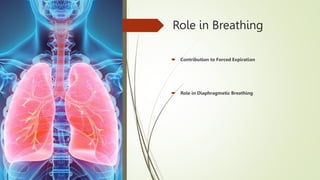
Role in Breathing
 Contribution to Forced Expiration
 Role in Diaphragmatic Breathing
Clinical Significance
 Injury and Weakness: Common issues and
symptoms
 Rehabilitation: Exercises to strengthen the
Transversus Abdominis
 Examples: Planks, abdominal hollowing, leg raises
Transverse abdominal definition and functions

Transverse abdominal definition and functions

  • 1.
    Transverse Abdominal Muscle Anatomy, Function,and Clinical Importance Presented by Shah e Saba IHS Swat
  • 2.
    Introduction Abdominis Muscles The abdominalmuscles are a crucial component of the body's core, providing stability, movement, and protection for internal organs. They play a significant role in various functions such as posture, breathing, and core strength. Understanding the anatomy and function of these muscles is essential for maintaining overall health and fitness.
  • 3.
    Types of AbdominalMuscles  External Oblique  Internal Oblique  Rectus Abdominis  Transversus Abdominis
  • 4.
    Transversus Abdominis  Location: Deepestlayer of the abdominal muscles  Function: Compresses abdominal contents, supports spine and pelvis, stabilizes the core  Common Exercises: Planks, abdominal hollowing, leg raises
  • 5.
    Anatomy of the TransversusAbdominis  Origin: Iliac crest, inguinal ligament, thoracolumbar fascia, and costal cartilages of the lower six ribs  Insertion: Xiphoid process, Linea alba, pubic crest  Nerve Supply: I. Intercostal nerves (T7-T11) II. Subcostal nerve (T12) III. Iliohypogastric nerve (L1) IV. Ilioinguinal nerve (L1)
  • 6.
    Structure and Fiber Orientation Horizontal orientation of muscle fibers  Relationship with other abdominal muscles: Rectus Abdominis, Internal Oblique, External Oblique
  • 7.
    Function  Core Stability:Supports the spine and pelvis  Compression of Abdominal Contents: Assists in breathing, vomiting, and childbirth.  Unilateral contraction: Trunk rotation
  • 8.
    Role in Breathing Contribution to Forced Expiration  Role in Diaphragmatic Breathing
  • 9.
    Clinical Significance  Injuryand Weakness: Common issues and symptoms  Rehabilitation: Exercises to strengthen the Transversus Abdominis  Examples: Planks, abdominal hollowing, leg raises