THE 8 PLANETS
IN OUR SOLAR
SYSTEM
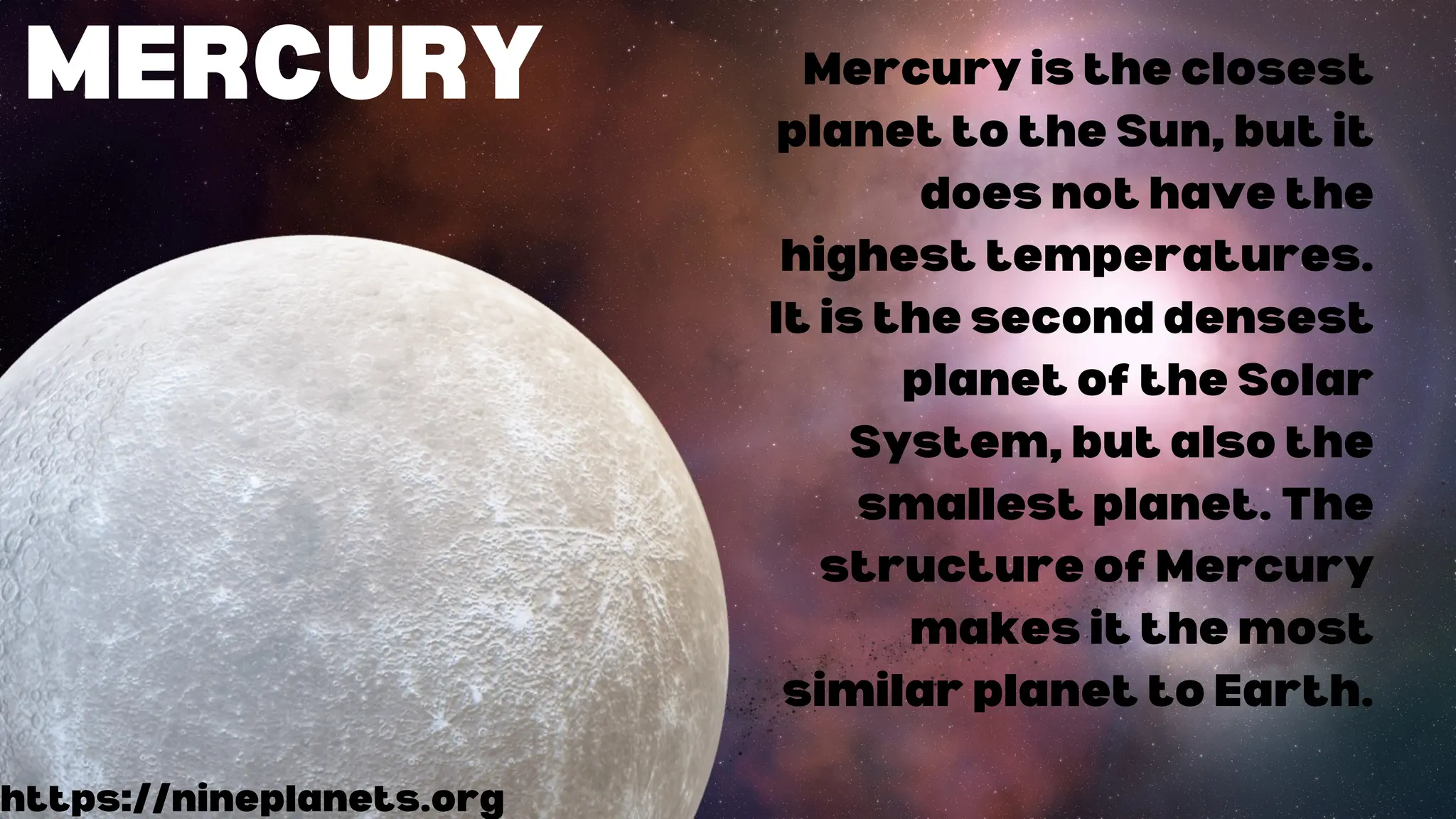
Mercury is the closest
planet to the Sun, but it
does not have the
highest temperatures.
It is the second densest
planet of the Solar
System, but also the
smallest planet. The
structure of Mercury
makes it the most
similar planet to Earth.
https://nineplanets.org
MERCURY
VENUS It's a cloud-swaddled planet
named for a love goddess,
and often called Earth’s twin.
But pull up a bit closer, and
Venus turns hellish. Our
nearest planetary neighbor,
the second planet from the
Sun, has a surface hot
enough to melt lead. The
atmosphere is so thick that,
from the surface, the Sun is
just a smear of light.
https://science.nasa.gov/venus
https://science.nasa.gov/earth/facts
EARTH While Earth is only the fifth
largest planet in the solar
system, it is the only world
in our solar system with
liquid water on the surface.
Just slightly larger than
nearby Venus, Earth is the
biggest of the four planets
closest to the Sun, all of
which are made of rock and
metal.
MARS Mars is a cold
desert world. It is
half the size of
Earth. Mars is
sometimes called
the Red Planet. It's
red because of
rusty iron in the
ground.
https://spaceplace.nasa.gov/all-
about-mars/en/
JUPITER Jupiter has a
long history of
surprising
scientists – all
the way back to
1610 when Galileo
Galilei found the
first moons
beyond Earth.
https://spaceplace.nasa.gov/all-
about-jupiter/en/
SATURN
Saturn is the
sixth planet
from the Sun
and the
second-
largest
planet in our
solar system.
https://science.nasa.gov/saturn/facts
URANUS It was the first
planet found with the
aid of a telescope,
Uranus was
discovered in 1781 by
astronomer William
Herschel, although he
originally thought it
was either a comet or
a star.
https://spaceplace.nasa.gov/
all-about-uranus/en/
NEPTUNE Dark, cold, and
whipped by
supersonic
winds, ice giant
Neptune is the
eighth and most
distant planet in
our solar
system.
https://science.nasa.gov/neptune/
facts

THE 8 PLANETS IN OUR SOLAR SYSTEM.pdf

  • 1.
    THE 8 PLANETS INOUR SOLAR SYSTEM
  • 2.
    Mercury is theclosest planet to the Sun, but it does not have the highest temperatures. It is the second densest planet of the Solar System, but also the smallest planet. The structure of Mercury makes it the most similar planet to Earth. https://nineplanets.org MERCURY
  • 3.
    VENUS It's acloud-swaddled planet named for a love goddess, and often called Earth’s twin. But pull up a bit closer, and Venus turns hellish. Our nearest planetary neighbor, the second planet from the Sun, has a surface hot enough to melt lead. The atmosphere is so thick that, from the surface, the Sun is just a smear of light. https://science.nasa.gov/venus
  • 4.
    https://science.nasa.gov/earth/facts EARTH While Earthis only the fifth largest planet in the solar system, it is the only world in our solar system with liquid water on the surface. Just slightly larger than nearby Venus, Earth is the biggest of the four planets closest to the Sun, all of which are made of rock and metal.
  • 5.
    MARS Mars isa cold desert world. It is half the size of Earth. Mars is sometimes called the Red Planet. It's red because of rusty iron in the ground. https://spaceplace.nasa.gov/all- about-mars/en/
  • 6.
    JUPITER Jupiter hasa long history of surprising scientists – all the way back to 1610 when Galileo Galilei found the first moons beyond Earth. https://spaceplace.nasa.gov/all- about-jupiter/en/
  • 7.
    SATURN Saturn is the sixthplanet from the Sun and the second- largest planet in our solar system. https://science.nasa.gov/saturn/facts
  • 8.
    URANUS It wasthe first planet found with the aid of a telescope, Uranus was discovered in 1781 by astronomer William Herschel, although he originally thought it was either a comet or a star. https://spaceplace.nasa.gov/ all-about-uranus/en/
  • 9.
    NEPTUNE Dark, cold,and whipped by supersonic winds, ice giant Neptune is the eighth and most distant planet in our solar system. https://science.nasa.gov/neptune/ facts