Country presentation
Syria
By
Dr. Muhammad Manhal Alzoubi
Director of Natural Resources Research Administration
ANRR - GCSAR
Country overview
Country overview
because of Syrian Crises, we have problems in our soils, the
priorities in soil to combat these problems:
Soil degradation (soil erosion, forest burning, dust storms, salinity, desertification,
Dune). (NENA Implementation Plan pillar 5: sustainable management and protection
of soil resources).
Soil fertility (because the lack of fertilizers and their high prices).
Fertilizers recommendations: the recommendations of fertilizers are old (sins 1998)
and we will start to update the recommendations. (NENA Implementation Plan pillar 1:
Promote sustainable management of soil resources).
Soil pollution: (by heavy metals, petroleum, OMWW, sewage,…).
Water harvesting (on the farm level) as a priority to combat soil erosion and increasing
soil moisture. (NENA Implementation Plan pillar 5: sustainable management and
protection of soil resources).
Sustainable soil management. (NENA Implementation Plan pillar 3: Promote targeted
soil research and development focusing on identified gaps and priorities).
soil conservation . (NENA Implementation Plan pillar 5)
Dune
Saline water
Sewage
Drainage water
dust storms
salinity
Water harvesting
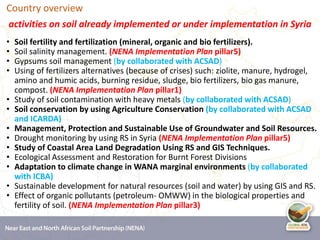
Country overview
activities on soil already implemented or under implementation in Syria
• Soil fertility and fertilization (mineral, organic and bio fertilizers).
• Soil salinity management. (NENA Implementation Plan pillar5)
• Gypsums soil management (by collaborated with ACSAD)
• Using of fertilizers alternatives (because of crises) such: ziolite, manure, hydrogel,
amino and humic acids, burning residue, sludge, bio fertilizers, bio gas manure,
compost. (NENA Implementation Plan pillar1)
• Study of soil contamination with heavy metals (by collaborated with ACSAD)
• Soil conservation by using Agriculture Conservation (by collaborated with ACSAD
and ICARDA)
• Management, Protection and Sustainable Use of Groundwater and Soil Resources.
• Drought monitoring by using RS in Syria (NENA Implementation Plan pillar5)
• Study of Coastal Area Land Degradation Using RS and GIS Techniques.
• Ecological Assessment and Restoration for Burnt Forest Divisions
• Adaptation to climate change in WANA marginal environments (by collaborated
with ICBA)
• Sustainable development for natural resources (soil and water) by using GIS and RS.
• Effect of organic pollutants (petroleum- OMWW) in the biological properties and
fertility of soil. (NENA Implementation Plan pillar3)
sludgecompostforest burning
OMWW Agriculture Conservation
bio gas manure
TWW and soil properties Water harvesting (field farmer)Drainage and soil properties
Main obstacles to the implementation of activities on soil in Syria
In Syria: we have many institutes specialized in soil managements such:
• ANRR, Universities (Soil Departments) and Ministry of Agriculture.
• All of them interests in soil management and research.
• ANRR has a branches in all Syrian Governorates. These branches have
soil lab and research stations (16 soil lab in Syria, 14 soil research
stations, 12 water and irrigation research stations and forests
research station.
Main obstacles to the implementation of activities on soil in Syria
What we need to implement the activates on soil:
• capacity building.
• Modern Soil analyzers.
• Fertilizers alternatives.
• Funding for soil conservation projects.
• Supporting the drought early warning in Syria.
• Supporting of Agricultural Scientific Research
• Expertizing in field of combating soil degradation
Thanks for
your attention
Our soil for our children and new generations
Deer Alzoor
2018

The 4th NENA workshop - Syria

  • 1.
    Country presentation Syria By Dr. MuhammadManhal Alzoubi Director of Natural Resources Research Administration ANRR - GCSAR
  • 2.
  • 4.
    because of SyrianCrises, we have problems in our soils, the priorities in soil to combat these problems: Soil degradation (soil erosion, forest burning, dust storms, salinity, desertification, Dune). (NENA Implementation Plan pillar 5: sustainable management and protection of soil resources). Soil fertility (because the lack of fertilizers and their high prices). Fertilizers recommendations: the recommendations of fertilizers are old (sins 1998) and we will start to update the recommendations. (NENA Implementation Plan pillar 1: Promote sustainable management of soil resources). Soil pollution: (by heavy metals, petroleum, OMWW, sewage,…). Water harvesting (on the farm level) as a priority to combat soil erosion and increasing soil moisture. (NENA Implementation Plan pillar 5: sustainable management and protection of soil resources). Sustainable soil management. (NENA Implementation Plan pillar 3: Promote targeted soil research and development focusing on identified gaps and priorities). soil conservation . (NENA Implementation Plan pillar 5)
  • 5.
    Dune Saline water Sewage Drainage water duststorms salinity Water harvesting
  • 6.
    Country overview activities onsoil already implemented or under implementation in Syria • Soil fertility and fertilization (mineral, organic and bio fertilizers). • Soil salinity management. (NENA Implementation Plan pillar5) • Gypsums soil management (by collaborated with ACSAD) • Using of fertilizers alternatives (because of crises) such: ziolite, manure, hydrogel, amino and humic acids, burning residue, sludge, bio fertilizers, bio gas manure, compost. (NENA Implementation Plan pillar1) • Study of soil contamination with heavy metals (by collaborated with ACSAD) • Soil conservation by using Agriculture Conservation (by collaborated with ACSAD and ICARDA) • Management, Protection and Sustainable Use of Groundwater and Soil Resources. • Drought monitoring by using RS in Syria (NENA Implementation Plan pillar5) • Study of Coastal Area Land Degradation Using RS and GIS Techniques. • Ecological Assessment and Restoration for Burnt Forest Divisions • Adaptation to climate change in WANA marginal environments (by collaborated with ICBA) • Sustainable development for natural resources (soil and water) by using GIS and RS. • Effect of organic pollutants (petroleum- OMWW) in the biological properties and fertility of soil. (NENA Implementation Plan pillar3)
  • 7.
    sludgecompostforest burning OMWW AgricultureConservation bio gas manure TWW and soil properties Water harvesting (field farmer)Drainage and soil properties
  • 8.
    Main obstacles tothe implementation of activities on soil in Syria In Syria: we have many institutes specialized in soil managements such: • ANRR, Universities (Soil Departments) and Ministry of Agriculture. • All of them interests in soil management and research. • ANRR has a branches in all Syrian Governorates. These branches have soil lab and research stations (16 soil lab in Syria, 14 soil research stations, 12 water and irrigation research stations and forests research station.
  • 9.
    Main obstacles tothe implementation of activities on soil in Syria What we need to implement the activates on soil: • capacity building. • Modern Soil analyzers. • Fertilizers alternatives. • Funding for soil conservation projects. • Supporting the drought early warning in Syria. • Supporting of Agricultural Scientific Research • Expertizing in field of combating soil degradation
  • 10.
    Thanks for your attention Oursoil for our children and new generations Deer Alzoor 2018