The Art of Product Management
Sachin Rekhi
@sachinrekhi
www.sachinrekhi.com
Entrepreneur, Product Guy, and Software Engineer
My Product Roles
2005
2007
2008
productivity for database pros
experience music where you want it
(acquired by imeem)
unlimited ad-supported music
My Product Roles
2010
2011
2013
contact management without the work
(acquired by LinkedIn)
the easiest way to stay in touch
the leading social selling solution
LinkedIn Contacts
LinkedIn Sales Navigator
My Product Advising Roles
Here’s What I’ve Learned in the
Past Decade...
What Do Product Managers Do?
Product managers drive the vision, strategy,
design, and execution of their product.
Vision
Strategy
Design
Execution
Vision
Elon Musk, SpaceX
“It is important that
humanity become an
interplanetary species.”
Strategy
Jeff Bezos, Amazon
“Your margin is my
opportunity.”
Design
Steve Jobs, Apple
“You have to work hard
to get your thinking clean
to make it simple.”
Execution
Stewart Butterfield, Slack
“We do it really, really
fucking good.”
Vision
Strategy
Design
Execution
A compelling vision articulates how the world
will be a better place if you succeed
Vision
The Best Format: A Customer-Centric Vision Narrative
“Full sentences are harder to write. They have verbs. The
paragraphs have topic sentences. There is no way to write a six-
page narratively structured memo and not have clear thinking.”
— Jeff Bezos
Vision
Vision Narrative: Amazon.com 1997 Shareholder Letter
“But this is Day 1 for the Internet and, if we execute well, for Amazon.com.
Today, online commerce saves customers money and precious time.
Tomorrow, through personalization, online commerce will accelerate the
very process of discovery. Amazon.com uses the Internet to create real
value for its customers and, by doing so, hopes to create an enduring
franchise, even in established and large markets.”
— Jeff Bezos
Read: Jeff Bezos’ 1997 Amazon.com Shareholder Letter
Vision
Vision Narrative: PayPal Speech in 1999
“The need PayPal answers is monumental. Paper money is an ancient
technology and an inconvenient means of payment. In the twenty-first century,
people need a form of money that's more convenient and secure, something
that can be accessed from anywhere with a PDA or an Internet connection. Of
course, what we're calling 'convenient' for American users will be revolutionary
for the developing world. It will be nearly impossible for corrupt governments
to steal wealth from their people through their old means.”
— Peter Thiel
Read: Peter Thiel’s PayPal Speech in 1999
Vision
Vision Narrative: Apple Introduces the iPhone in 2007
“Most advanced phones are called smart phones. They combine a phone +
email + baby Internet in one device with a plastic little keyboard on them.
The problem is that they are not so smart and not so easy to use. What we
want to do is make a leapfrog product that is way smarter than any mobile
device has ever been and super easy to use. So we’re going to reinvent
the phone. Starting first with a revolutionary user interface.”
— Steve Jobs
Watch: Steve Jobs iPhone Keynote in 2007
Vision
Vision Narrative: Slack Pre-Launch Employee Memo
“That’s why what we’re selling is organizational transformation. The
software just happens to be the part we’re able to build & ship (and the
means for us to get our cut). We’re selling a reduction in information
overload, relief from stress, and a new ability to extract the enormous value
of hitherto useless corporate archives. We’re selling better organizations,
better teams.”
— Stewart Butterfield
Read: Stewart Butterfield’s 2013 Employee Memo: We Don’t Sell Saddles Here
Vision
Vision Narrative: LinkedIn Economic Graph
“LinkedIn’s vision, our dream, is to create economic opportunity for every
member of the global workforce, all 3 billion people in the global
workforce. The way we are going to do that is by developing the world’s
first economic graph. We are going to digitally map the global economy…
and in doing so, the hope is we can lift and transform the global economy.”
— Jeff Weiner
Watch: Jeff Weiner introduces the LinkedIn Economic Graph in 2015
Vision
Communicating The Vision
A vision is valuable only if it inspires the entire team
Vision
Communicating The Vision: The Power of Repetition
Just as it takes 7 impressions to garner a response to a
marketing message, you need to constantly repeat your vision
Vision
Communicating The Vision: The Litmus Test
Ask a team member where the product is ultimately going and
see how often they recite back the vision
Vision
Vision
Strategy
Design
Execution
A compelling strategy details exactly
how you’ll dominate your market
Strategy
A vision should be stable, but your strategy
needs to be iterated on and refined until you
find product/market fit
Strategy
Best Format: Product/Market Fit Hypotheses
Ditch the business plan; instead focus on a
few-page summary that captures each of your
critical product/market fit hypotheses
Strategy
The Product/Market Fit Hypotheses
1. Target Audience
2. Problem You’re Solving
3. Value Propositions
4. Strategic Differentiation
5. Competition
6. Acquisition Strategy
7. Monetization Strategy
8. KPIs
Further reading: A Lean Alternative to a Business Plan: Documenting Your Product/Market Fit Hypotheses
Strategy
1. Target Audience
This is not your pitch deck,
so don’t think about the
broadest possible definition
of your TAM
Instead think of the bullseye
of your very best potential
customers
Further reading: How to Find Your Ideal Customer
Strategy
2. Problem You’re Solving
Is the problem you’re
solving for your customer
a vitamin or a painkiller?
Strategy
3. Value Propositions
Not the feature list, but
instead the promise to your
customer on the value you
will deliver for them
Strategy
4. Strategic Differentiation
Why is your solution 10x
better than the leading
alternatives?
Strategy
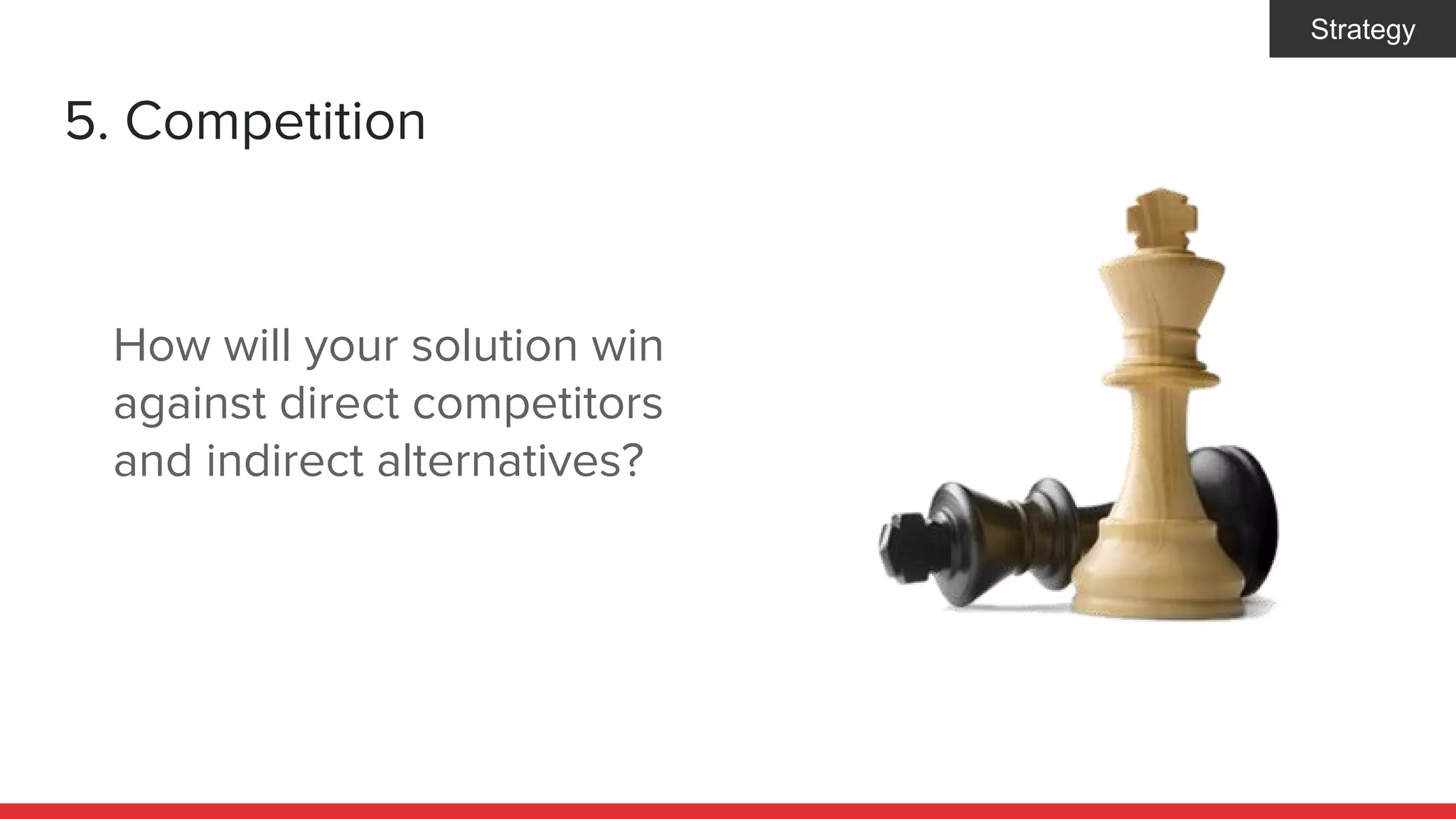
5. Competition
How will your solution win
against direct competitors
and indirect alternatives?
Strategy
6. Acquisition Strategy
How will you find & attract
your potential customers?
And how will you do so
cost-effectively?
Strategy
7. Monetization Strategy
What are your primary and
secondary ways to make money?
Is there strong willingness to pay?
Strategy
8. KPIs
What are the right metrics for you
to know if you are headed in the
right direction?
Strategy
Minimize your dimensions
of innovation
Further reading: The Best Startups Minimize Their Dimensions of Innovation
Strategy
Don’t innovate on ALL dimensions
1. Target Audience
2. Problem You’re Solving
3. Value Propositions
4. Strategic Differentiation
5. Competition
6. Acquisition Strategy
7. Monetization Strategy
8. KPIs
Innovate on a few,
use best practices for
the rest
Strategy
Strategy: Google Maps Leverages Superior Technology
Dimension of Innovation: Strategic Differentiation
Google Maps unseated the ubiquitous MapQuest (which had already become a
verb) largely through a superior product that leveraged early use of technologies
like JavaScript and AJAX to bring the first smooth scrolling and zooming
experience to an online map interface.
Strategy
Strategy: Tesla Takes a Top Down Market Approach
Dimensions of Innovation: Target Audience, Strategic Differentiation
Tesla's primary goal was to commercialize electric vehicles, starting with a premium
sports car aimed at early adopters and then moving as rapidly as possible into
more mainstream vehicles, including sedans and affordable compacts. Tesla first
introduced the Roadster, a high-end luxury sports car in 2008, selling 2,400 units
up until 2012. It then followed it with the broader appeal Model S, a full-sized luxury
sedan in 2012, which has sold more than 100,000 cars globally.
Strategy
Strategy: Venmo Focuses its Digital Wallet on P2P
Dimension of Innovation: Problem You’re Solving
While many of the digital wallet & payment solutions like PayPal were far more
focused on digital commerce and merchant transactions, Venmo decided to solely
focus on the problem of helping individuals make payments amongst each other.
This focus enabled Venmo to create a superior P2P solution compared to any other
provider, ultimately leading to their acquisition by PayPal.
Strategy
Strategy: Evernote Exploits App Store Distribution
Dimension of Innovation: Acquisition Strategy
Evernote grew its user base faster and larger than any prior consumer productivity
tool by taking advantage of distribution on the newly launched iPhone App Store.
Evernote continued to exploit this strategy by being amongst the first to deeply
integrate and launch with each subsequent app store, including Android, Mac,
Windows Mobile, and more. This supported their product strategy by ensuring they
remained the most broadly available cross-platform notes app.
Strategy
Strategy: Zenefits Reinvents The Business Model
Dimension of Innovation: Monetization Strategy
Zenefits built a SaaS HR platform to help businesses manage benefits, payroll,
talent, and more. Instead of leveraging the classic SaaS business model of per-seat
customer pricing, Zenefits gave the software away for free and instead monetized
via benefits providers by acting as an insurance broker.
Strategy
Vision
Strategy
Design
Execution
A compelling design delivers a useful, usable,
and delightful experience to your customers
Design
Delivering a useful & usable product has
proven techniques, but how do you build truly
delightful experiences?
Design
By bringing emotional intelligence to your
product design
Design
Start by falling in love with the problem you
are solving for your target customers
But not… with the solution
Design
Further reading: The Best Product Managers Fall in Love With a Problem
Develop Personas
Personas are fictional characters developed to represent the different
archetypes of users of your product.
A persona typically describes the goals, pain points, behaviors, and psychology
associated with members of a particular segment. To bring them to life a name, a
profile image, and sometimes even a background history are associated with them.
A team usually develops one or more personas to represent the core audience of
users they are optimizing their product for.
Design
Further reading: The Importance of Developing Personas in Product Design
Develop Personas
Sample personas from MailChimp
Design
Increase Exposure Hours
“It's the closest thing we've found to a silver bullet when it comes to
reliably improving the designs teams produce. The solution? Exposure
hours. The number of hours each team member is exposed directly to real
users interacting with the team's designs or the team's competitor's
designs. There is a direct correlation between this exposure and the
improvements we see in the designs that team produces.”
— Jared M. Spool, Founder, User Interface Engineering
Read: Fast Path to a Great UX - Increased Exposure Hours
Design
Deliver delight by adding a desired emotion
dimension to your product design process
Send Confirmation in MailChimp
Design
Delight Through Attention to Detail
Hipchat Slack
vs
Slack sweats the details: Emojis, Onboarding, Animations, Reliable Notifications, Slackbot,
Platform Integrations, Quick Switcher, Keyboard Shortcuts, Attachments, Link Previews, ...
Design
Measure Delight Through Net Promoter Score (NPS)
Read: A Practitioner's Guide to Net Promoter Score (NPS)
Design
High EQ: Facebook Sharing
Facebook not only made the sharing
process frictionless, but more
importantly provided instant social
gratification
Design
Further reading: Bringing Emotional Intelligence to Your Product Design
High EQ: Instagram Filters
Instagram made your mundane photos
share-worthy in seconds with beautiful
photo filters
Design
High EQ: Slack’s Watercooler
Slack brought the classic R&D team
watercooler conversation right into
Slack through common channels like
#fun, #general, #random, #etc
Design
Vision
Strategy
Design
Execution
Relentless execution ultimately determines
whether you’ll make your vision a reality
Execution
Execution isn’t just project management, but
doing whatever it takes to win
Execution
You must also ensure you’re pointing the
team in the right direction
Execution
Execution Loop: Define. Validate. Iterate.
Define
Validate
Iterate
1. Define your hypotheses
2. Validate each hypothesis
3. Iterate based on what you’ve learned
Execution
#1 Goal: Increase execution loop velocity
Execution
Fast iteration requires clear decision rights
Who owns this decision?
But… no shortcut for building shared context
Execution
Establish yourself as the curator, not the
creator of great ideas
Execution
Favor decisions today over decisions tomorrow
The enemy of decision-making is time
Execution
Further reading: The Art of Decision Making as a Product Manager
Reward engineering velocity over elegance
Instead of rewarding teams with elegant
architectural solutions to yesterday’s problems...
Reward teams that are moving fast enough to
solve today’s customer challenges
Execution
Further reading: Solving for the Mythical Man-Month
Invest in Retrospectives
Improve your ability to
accurately forecast (and
ultimately improve)
engineering cost & product
outcome estimates through
post-sprint retrospectives
Execution
Further reading: Design Your Development Process for Learning
Metrics: Learn to Read the Matrix
Build your intuition for metrics
by spending time every day
reviewing a few critical
acquisition, engagement, and
monetization dashboards
Execution
Further reading: 3 Essential Dashboards for Every Product
Enjoyed this presentation?
Subscribe to my weekly essays at
sachinrekhi.com

Th eart of product management

  • 1.
    The Art ofProduct Management Sachin Rekhi @sachinrekhi www.sachinrekhi.com Entrepreneur, Product Guy, and Software Engineer
  • 2.
    My Product Roles 2005 2007 2008 productivityfor database pros experience music where you want it (acquired by imeem) unlimited ad-supported music
  • 3.
    My Product Roles 2010 2011 2013 contactmanagement without the work (acquired by LinkedIn) the easiest way to stay in touch the leading social selling solution LinkedIn Contacts LinkedIn Sales Navigator
  • 4.
  • 5.
    Here’s What I’veLearned in the Past Decade...
  • 6.
    What Do ProductManagers Do?
  • 7.
    Product managers drivethe vision, strategy, design, and execution of their product.
  • 8.
  • 9.
    Vision Elon Musk, SpaceX “Itis important that humanity become an interplanetary species.”
  • 10.
    Strategy Jeff Bezos, Amazon “Yourmargin is my opportunity.”
  • 11.
    Design Steve Jobs, Apple “Youhave to work hard to get your thinking clean to make it simple.”
  • 12.
    Execution Stewart Butterfield, Slack “Wedo it really, really fucking good.”
  • 13.
  • 14.
    A compelling visionarticulates how the world will be a better place if you succeed Vision
  • 15.
    The Best Format:A Customer-Centric Vision Narrative “Full sentences are harder to write. They have verbs. The paragraphs have topic sentences. There is no way to write a six- page narratively structured memo and not have clear thinking.” — Jeff Bezos Vision
  • 16.
    Vision Narrative: Amazon.com1997 Shareholder Letter “But this is Day 1 for the Internet and, if we execute well, for Amazon.com. Today, online commerce saves customers money and precious time. Tomorrow, through personalization, online commerce will accelerate the very process of discovery. Amazon.com uses the Internet to create real value for its customers and, by doing so, hopes to create an enduring franchise, even in established and large markets.” — Jeff Bezos Read: Jeff Bezos’ 1997 Amazon.com Shareholder Letter Vision
  • 17.
    Vision Narrative: PayPalSpeech in 1999 “The need PayPal answers is monumental. Paper money is an ancient technology and an inconvenient means of payment. In the twenty-first century, people need a form of money that's more convenient and secure, something that can be accessed from anywhere with a PDA or an Internet connection. Of course, what we're calling 'convenient' for American users will be revolutionary for the developing world. It will be nearly impossible for corrupt governments to steal wealth from their people through their old means.” — Peter Thiel Read: Peter Thiel’s PayPal Speech in 1999 Vision
  • 18.
    Vision Narrative: AppleIntroduces the iPhone in 2007 “Most advanced phones are called smart phones. They combine a phone + email + baby Internet in one device with a plastic little keyboard on them. The problem is that they are not so smart and not so easy to use. What we want to do is make a leapfrog product that is way smarter than any mobile device has ever been and super easy to use. So we’re going to reinvent the phone. Starting first with a revolutionary user interface.” — Steve Jobs Watch: Steve Jobs iPhone Keynote in 2007 Vision
  • 19.
    Vision Narrative: SlackPre-Launch Employee Memo “That’s why what we’re selling is organizational transformation. The software just happens to be the part we’re able to build & ship (and the means for us to get our cut). We’re selling a reduction in information overload, relief from stress, and a new ability to extract the enormous value of hitherto useless corporate archives. We’re selling better organizations, better teams.” — Stewart Butterfield Read: Stewart Butterfield’s 2013 Employee Memo: We Don’t Sell Saddles Here Vision
  • 20.
    Vision Narrative: LinkedInEconomic Graph “LinkedIn’s vision, our dream, is to create economic opportunity for every member of the global workforce, all 3 billion people in the global workforce. The way we are going to do that is by developing the world’s first economic graph. We are going to digitally map the global economy… and in doing so, the hope is we can lift and transform the global economy.” — Jeff Weiner Watch: Jeff Weiner introduces the LinkedIn Economic Graph in 2015 Vision
  • 21.
    Communicating The Vision Avision is valuable only if it inspires the entire team Vision
  • 22.
    Communicating The Vision:The Power of Repetition Just as it takes 7 impressions to garner a response to a marketing message, you need to constantly repeat your vision Vision
  • 23.
    Communicating The Vision:The Litmus Test Ask a team member where the product is ultimately going and see how often they recite back the vision Vision
  • 24.
  • 25.
    A compelling strategydetails exactly how you’ll dominate your market Strategy
  • 26.
    A vision shouldbe stable, but your strategy needs to be iterated on and refined until you find product/market fit Strategy
  • 27.
    Best Format: Product/MarketFit Hypotheses Ditch the business plan; instead focus on a few-page summary that captures each of your critical product/market fit hypotheses Strategy
  • 28.
    The Product/Market FitHypotheses 1. Target Audience 2. Problem You’re Solving 3. Value Propositions 4. Strategic Differentiation 5. Competition 6. Acquisition Strategy 7. Monetization Strategy 8. KPIs Further reading: A Lean Alternative to a Business Plan: Documenting Your Product/Market Fit Hypotheses Strategy
  • 29.
    1. Target Audience Thisis not your pitch deck, so don’t think about the broadest possible definition of your TAM Instead think of the bullseye of your very best potential customers Further reading: How to Find Your Ideal Customer Strategy
  • 30.
    2. Problem You’reSolving Is the problem you’re solving for your customer a vitamin or a painkiller? Strategy
  • 31.
    3. Value Propositions Notthe feature list, but instead the promise to your customer on the value you will deliver for them Strategy
  • 32.
    4. Strategic Differentiation Whyis your solution 10x better than the leading alternatives? Strategy
  • 33.
    5. Competition How willyour solution win against direct competitors and indirect alternatives? Strategy
  • 34.
    6. Acquisition Strategy Howwill you find & attract your potential customers? And how will you do so cost-effectively? Strategy
  • 35.
    7. Monetization Strategy Whatare your primary and secondary ways to make money? Is there strong willingness to pay? Strategy
  • 36.
    8. KPIs What arethe right metrics for you to know if you are headed in the right direction? Strategy
  • 37.
    Minimize your dimensions ofinnovation Further reading: The Best Startups Minimize Their Dimensions of Innovation Strategy
  • 38.
    Don’t innovate onALL dimensions 1. Target Audience 2. Problem You’re Solving 3. Value Propositions 4. Strategic Differentiation 5. Competition 6. Acquisition Strategy 7. Monetization Strategy 8. KPIs Innovate on a few, use best practices for the rest Strategy
  • 39.
    Strategy: Google MapsLeverages Superior Technology Dimension of Innovation: Strategic Differentiation Google Maps unseated the ubiquitous MapQuest (which had already become a verb) largely through a superior product that leveraged early use of technologies like JavaScript and AJAX to bring the first smooth scrolling and zooming experience to an online map interface. Strategy
  • 40.
    Strategy: Tesla Takesa Top Down Market Approach Dimensions of Innovation: Target Audience, Strategic Differentiation Tesla's primary goal was to commercialize electric vehicles, starting with a premium sports car aimed at early adopters and then moving as rapidly as possible into more mainstream vehicles, including sedans and affordable compacts. Tesla first introduced the Roadster, a high-end luxury sports car in 2008, selling 2,400 units up until 2012. It then followed it with the broader appeal Model S, a full-sized luxury sedan in 2012, which has sold more than 100,000 cars globally. Strategy
  • 41.
    Strategy: Venmo Focusesits Digital Wallet on P2P Dimension of Innovation: Problem You’re Solving While many of the digital wallet & payment solutions like PayPal were far more focused on digital commerce and merchant transactions, Venmo decided to solely focus on the problem of helping individuals make payments amongst each other. This focus enabled Venmo to create a superior P2P solution compared to any other provider, ultimately leading to their acquisition by PayPal. Strategy
  • 42.
    Strategy: Evernote ExploitsApp Store Distribution Dimension of Innovation: Acquisition Strategy Evernote grew its user base faster and larger than any prior consumer productivity tool by taking advantage of distribution on the newly launched iPhone App Store. Evernote continued to exploit this strategy by being amongst the first to deeply integrate and launch with each subsequent app store, including Android, Mac, Windows Mobile, and more. This supported their product strategy by ensuring they remained the most broadly available cross-platform notes app. Strategy
  • 43.
    Strategy: Zenefits ReinventsThe Business Model Dimension of Innovation: Monetization Strategy Zenefits built a SaaS HR platform to help businesses manage benefits, payroll, talent, and more. Instead of leveraging the classic SaaS business model of per-seat customer pricing, Zenefits gave the software away for free and instead monetized via benefits providers by acting as an insurance broker. Strategy
  • 44.
  • 45.
    A compelling designdelivers a useful, usable, and delightful experience to your customers Design
  • 46.
    Delivering a useful& usable product has proven techniques, but how do you build truly delightful experiences? Design
  • 47.
    By bringing emotionalintelligence to your product design Design
  • 48.
    Start by fallingin love with the problem you are solving for your target customers But not… with the solution Design Further reading: The Best Product Managers Fall in Love With a Problem
  • 49.
    Develop Personas Personas arefictional characters developed to represent the different archetypes of users of your product. A persona typically describes the goals, pain points, behaviors, and psychology associated with members of a particular segment. To bring them to life a name, a profile image, and sometimes even a background history are associated with them. A team usually develops one or more personas to represent the core audience of users they are optimizing their product for. Design Further reading: The Importance of Developing Personas in Product Design
  • 50.
    Develop Personas Sample personasfrom MailChimp Design
  • 51.
    Increase Exposure Hours “It'sthe closest thing we've found to a silver bullet when it comes to reliably improving the designs teams produce. The solution? Exposure hours. The number of hours each team member is exposed directly to real users interacting with the team's designs or the team's competitor's designs. There is a direct correlation between this exposure and the improvements we see in the designs that team produces.” — Jared M. Spool, Founder, User Interface Engineering Read: Fast Path to a Great UX - Increased Exposure Hours Design
  • 52.
    Deliver delight byadding a desired emotion dimension to your product design process Send Confirmation in MailChimp Design
  • 53.
    Delight Through Attentionto Detail Hipchat Slack vs Slack sweats the details: Emojis, Onboarding, Animations, Reliable Notifications, Slackbot, Platform Integrations, Quick Switcher, Keyboard Shortcuts, Attachments, Link Previews, ... Design
  • 54.
    Measure Delight ThroughNet Promoter Score (NPS) Read: A Practitioner's Guide to Net Promoter Score (NPS) Design
  • 55.
    High EQ: FacebookSharing Facebook not only made the sharing process frictionless, but more importantly provided instant social gratification Design Further reading: Bringing Emotional Intelligence to Your Product Design
  • 56.
    High EQ: InstagramFilters Instagram made your mundane photos share-worthy in seconds with beautiful photo filters Design
  • 57.
    High EQ: Slack’sWatercooler Slack brought the classic R&D team watercooler conversation right into Slack through common channels like #fun, #general, #random, #etc Design
  • 58.
  • 59.
    Relentless execution ultimatelydetermines whether you’ll make your vision a reality Execution
  • 60.
    Execution isn’t justproject management, but doing whatever it takes to win Execution
  • 61.
    You must alsoensure you’re pointing the team in the right direction Execution
  • 62.
    Execution Loop: Define.Validate. Iterate. Define Validate Iterate 1. Define your hypotheses 2. Validate each hypothesis 3. Iterate based on what you’ve learned Execution
  • 63.
    #1 Goal: Increaseexecution loop velocity Execution
  • 64.
    Fast iteration requiresclear decision rights Who owns this decision? But… no shortcut for building shared context Execution
  • 65.
    Establish yourself asthe curator, not the creator of great ideas Execution
  • 66.
    Favor decisions todayover decisions tomorrow The enemy of decision-making is time Execution Further reading: The Art of Decision Making as a Product Manager
  • 67.
    Reward engineering velocityover elegance Instead of rewarding teams with elegant architectural solutions to yesterday’s problems... Reward teams that are moving fast enough to solve today’s customer challenges Execution Further reading: Solving for the Mythical Man-Month
  • 68.
    Invest in Retrospectives Improveyour ability to accurately forecast (and ultimately improve) engineering cost & product outcome estimates through post-sprint retrospectives Execution Further reading: Design Your Development Process for Learning
  • 69.
    Metrics: Learn toRead the Matrix Build your intuition for metrics by spending time every day reviewing a few critical acquisition, engagement, and monetization dashboards Execution Further reading: 3 Essential Dashboards for Every Product
  • 70.
    Enjoyed this presentation? Subscribeto my weekly essays at sachinrekhi.com