SSM COLLEGE OF ENGINEERING
DEPARTMENT OF TEXTILE TECHNOLOGY
TT3611 / TEXTILE PRODUCT
ENGINEERING LAB
NAME OF THE STUDENT: KALEESWARAN N
REGISTER NUMBER: 732322212012
YEAR / SEMESTER: 3rd
/ 6th
REVERSE ENGINEERING OF
A MEN’S FORMAL SHIRT
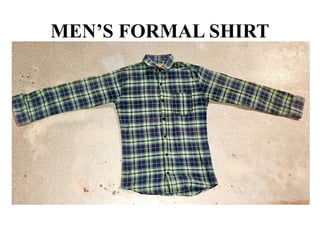
MEN’S FORMAL SHIRT
OBJECTIVES
• To analyze and identify the materials used in a
men's formal shirt.
• To conduct confirmative tests for fibers and
fabrics.
• To understand and map the production
processes used.
• To estimate the cost of producing the shirt.
APPARATUS AND MATERIALS REQUIRED
• Sample shirt (Men’s formal)
• Microscope (for fiber identification)
• Fabric analysis kit (burn test setup, GSM cutter, etc.)
• Pick glass / Fabric inspection glass
• GSM Cutter & Weighing Scale
• Stop watch (for production process timing)
• Measuring Tape
• Costing Sheet Template
• Stitching seam cutter
• Lab Manual & Worksheets
DESCRIPTION
Reverse engineering is a process of
deconstructing a product to understand its design,
materials, production process, and costing. In
apparel, this helps students understand:
- Fiber type (cotton, polyester, blend)
- Yarn specifications (count, twist)
- Fabric construction (woven, knit, type of weave)
- Accessories (buttons, labels, interlining)
- Process flow (cutting, stitching, finishing)
- Cost components (material, labour, overhead)
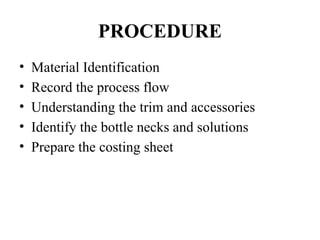
PROCEDURE
• Material Identification
• Record the process flow
• Understanding the trim and accessories
• Identify the bottle necks and solutions
• Prepare the costing sheet
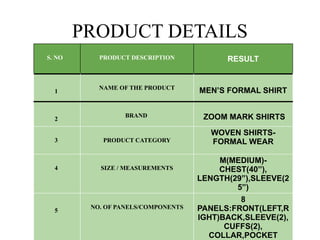
PRODUCT DETAILS
S. NO PRODUCT DESCRIPTION RESULT
1
NAME OF THE PRODUCT
MEN’S FORMAL SHIRT
2
BRAND ZOOM MARK SHIRTS
3 PRODUCT CATEGORY
WOVEN SHIRTS-
FORMAL WEAR
4 SIZE / MEASUREMENTS
M(MEDIUM)-
CHEST(40’’),
LENGTH(29”),SLEEVE(2
5”)
5
NO. OF PANELS/COMPONENTS
8
PANELS:FRONT(LEFT,R
IGHT)BACK,SLEEVE(2),
CUFFS(2),
COLLAR,POCKET
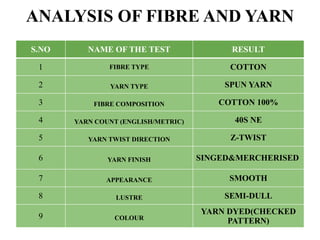
ANALYSIS OF FIBRE AND YARN
S.NO NAME OF THE TEST RESULT
1 FIBRE TYPE COTTON
2 YARN TYPE SPUN YARN
3 FIBRE COMPOSITION COTTON 100%
4 YARN COUNT (ENGLISH/METRIC) 40S NE
5 YARN TWIST DIRECTION Z-TWIST
6 YARN FINISH SINGED&MERCHERISED
7 APPEARANCE SMOOTH
8 LUSTRE SEMI-DULL
9 COLOUR
YARN DYED(CHECKED
PATTERN)
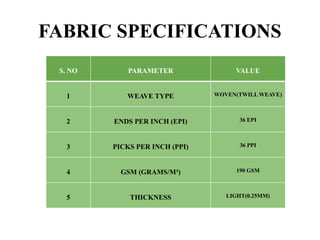
FABRIC SPECIFICATIONS
S. NO PARAMETER VALUE
1 WEAVE TYPE WOVEN(TWILL WEAVE)
2 ENDS PER INCH (EPI) 36 EPI
3 PICKS PER INCH (PPI) 36 PPI
4 GSM (GRAMS/M²) 190 GSM
5 THICKNESS LIGHT(0.25MM)
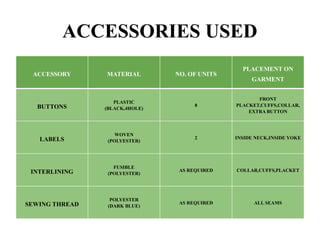
ACCESSORIES USED
ACCESSORY MATERIAL NO. OF UNITS
PLACEMENT ON
GARMENT
BUTTONS
PLASTIC
(BLACK,4HOLE)
8
FRONT
PLACKET,CUFFS,COLLAR,
EXTRA BUTTON
LABELS
WOVEN
(POLYESTER)
2 INSIDE NECK,INSIDE YOKE
INTERLINING
FUSIBLE
(POLYESTER)
AS REQUIRED COLLAR,CUFFS,PLACKET
SEWING THREAD
POLYESTER
(DARK BLUE)
AS REQUIRED ALL SEAMS
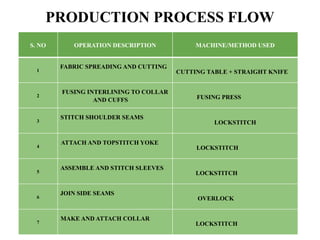
PRODUCTION PROCESS FLOW
S. NO OPERATION DESCRIPTION MACHINE/METHOD USED
1
FABRIC SPREADING AND CUTTING
CUTTING TABLE + STRAIGHT KNIFE
2
FUSING INTERLINING TO COLLAR
AND CUFFS FUSING PRESS
3
STITCH SHOULDER SEAMS
LOCKSTITCH
4
ATTACH AND TOPSTITCH YOKE
LOCKSTITCH
5
ASSEMBLE AND STITCH SLEEVES
LOCKSTITCH
6
JOIN SIDE SEAMS
OVERLOCK
7
MAKE AND ATTACH COLLAR
LOCKSTITCH
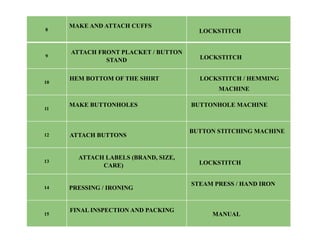
8
MAKE AND ATTACH CUFFS
LOCKSTITCH
9
ATTACH FRONT PLACKET / BUTTON
STAND LOCKSTITCH
10
HEM BOTTOM OF THE SHIRT LOCKSTITCH / HEMMING
MACHINE
11
MAKE BUTTONHOLES BUTTONHOLE MACHINE
12 ATTACH BUTTONS
BUTTON STITCHING MACHINE
13
ATTACH LABELS (BRAND, SIZE,
CARE) LOCKSTITCH
14 PRESSING / IRONING
STEAM PRESS / HAND IRON
15
FINAL INSPECTION AND PACKING
MANUAL
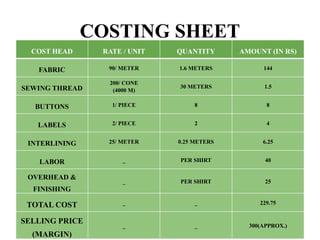
COSTING SHEET
COST HEAD RATE / UNIT QUANTITY AMOUNT (IN RS)
FABRIC 90/ METER 1.6 METERS 144
SEWING THREAD
200/ CONE
(4000 M)
30 METERS 1.5
BUTTONS 1/ PIECE 8 8
LABELS 2/ PIECE 2 4
INTERLINING 25/ METER 0.25 METERS 6.25
LABOR _ PER SHIRT 40
OVERHEAD &
FINISHING
_ PER SHIRT 25
TOTAL COST _ _ 229.75
SELLING PRICE
(MARGIN)
_ _ 300(APPROX.)
CONCLUSION
The product was successfully analyzed for its
fiber,yarn,fabric and overall construction. The
study helped in identifying the material
specifications.Understanding the yarn and
fabric properties and mapping the production
process and estimating the cost involved. this
experiment provided a comprehensive insight
into the components and engineering behind a
textile product.
REVERSE ENGINEERING OF
WOMEN’S TOP
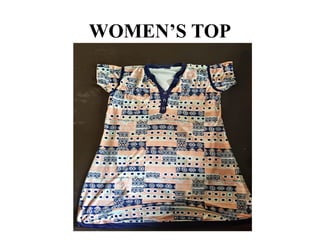
WOMEN’S TOP
OBJECTIVES
• To analyze and identify the materials used in a
women’s top.
• To conduct confirmative tests for fibers and
fabrics.
• To understand and map the production
processes used.
• To estimate the cost of producing the women’s
top.
APPARATUS AND MATERIALS REQUIRED
• Sample top (Women’s)
• Microscope (for fiber identification)
• Fabric analysis kit (burn test setup, GSM cutter, etc.)
• Pick glass / Fabric inspection glass
• GSM Cutter & Weighing Scale
• Stop watch (for production process timing)
• Measuring Tape
• Costing Sheet Template
• Stitching seam cutter
• Lab Manual & Worksheets
DESCRIPTION
Reverse engineering is a process of deconstructing
a product to understand its design, materials,
production process, and costing. In apparel, this
helps students understand:
- Fiber type (cotton, polyester, blend)
- Yarn specifications (count, twist)
- Fabric construction (woven, knit, type of weave)
- Accessories (buttons, labels, interlining)
- Process flow (cutting, stitching, finishing)
- Cost components (material, labour, overhead)
PROCEDURE
• Material Identification
• Record the process flow
• Understanding the trim and accessories
• Identify the bottle necks and solutions
• Prepare the costing sheet
PRODUCT DETAILS
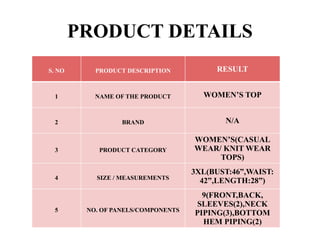
S. NO PRODUCT DESCRIPTION RESULT
1 NAME OF THE PRODUCT WOMEN’S TOP
2 BRAND N/A
3 PRODUCT CATEGORY
WOMEN’S(CASUAL
WEAR/ KNIT WEAR
TOPS)
4 SIZE / MEASUREMENTS
3XL(BUST:46”,WAIST:
42”,LENGTH:28”)
5 NO. OF PANELS/COMPONENTS
9(FRONT,BACK,
SLEEVES(2),NECK
PIPING(3),BOTTOM
HEM PIPING(2)
ANALYSIS OF FIBRE AND YARN
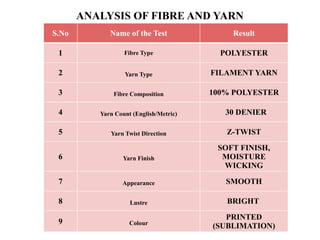
S.No Name of the Test Result
1 Fibre Type POLYESTER
2 Yarn Type FILAMENT YARN
3 Fibre Composition 100% POLYESTER
4 Yarn Count (English/Metric) 30 DENIER
5 Yarn Twist Direction Z-TWIST
6 Yarn Finish
SOFT FINISH,
MOISTURE
WICKING
7 Appearance SMOOTH
8 Lustre BRIGHT
9 Colour
PRINTED
(SUBLIMATION)
FABRIC SPECIFICATIONS
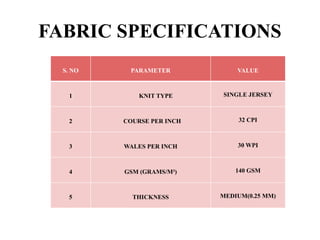
S. NO PARAMETER VALUE
1 KNIT TYPE SINGLE JERSEY
2 COURSE PER INCH 32 CPI
3 WALES PER INCH 30 WPI
4 GSM (GRAMS/M²) 140 GSM
5 THICKNESS MEDIUM(0.25 MM)
ACCESSORIES USED
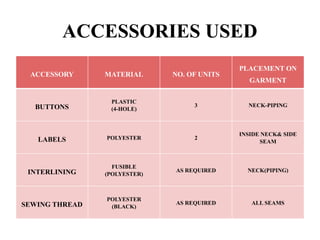
ACCESSORY MATERIAL NO. OF UNITS
PLACEMENT ON
GARMENT
BUTTONS
PLASTIC
(4-HOLE)
3 NECK-PIPING
LABELS POLYESTER 2
INSIDE NECK& SIDE
SEAM
INTERLINING
FUSIBLE
(POLYESTER)
AS REQUIRED NECK(PIPING)
SEWING THREAD
POLYESTER
(BLACK)
AS REQUIRED ALL SEAMS
PRODUCTION PROCESS FLOW
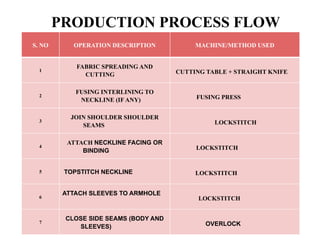
S. NO OPERATION DESCRIPTION MACHINE/METHOD USED
1
FABRIC SPREADING AND
CUTTING CUTTING TABLE + STRAIGHT KNIFE
2
FUSING INTERLINING TO
NECKLINE (IF ANY) FUSING PRESS
3
JOIN SHOULDER SHOULDER
SEAMS LOCKSTITCH
4
ATTACH NECKLINE FACING OR
BINDING LOCKSTITCH
5 TOPSTITCH NECKLINE LOCKSTITCH
6
ATTACH SLEEVES TO ARMHOLE
LOCKSTITCH
7
CLOSE SIDE SEAMS (BODY AND
SLEEVES) OVERLOCK
8
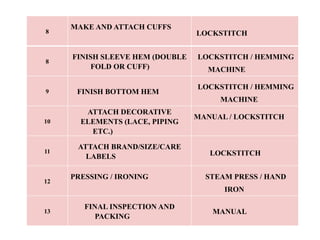
MAKE AND ATTACH CUFFS
LOCKSTITCH
8
FINISH SLEEVE HEM (DOUBLE
FOLD OR CUFF)
LOCKSTITCH / HEMMING
MACHINE
9 FINISH BOTTOM HEM
LOCKSTITCH / HEMMING
MACHINE
10
ATTACH DECORATIVE
ELEMENTS (LACE, PIPING
ETC.)
MANUAL / LOCKSTITCH
11
ATTACH BRAND/SIZE/CARE
LABELS LOCKSTITCH
12
PRESSING / IRONING STEAM PRESS / HAND
IRON
13
FINAL INSPECTION AND
PACKING
MANUAL
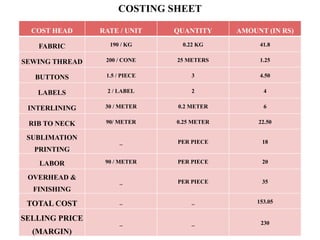
COSTING SHEET
COST HEAD RATE / UNIT QUANTITY AMOUNT (IN RS)
FABRIC 190 / KG 0.22 KG 41.8
SEWING THREAD 200 / CONE 25 METERS 1.25
BUTTONS 1.5 / PIECE 3 4.50
LABELS 2 / LABEL 2 4
INTERLINING 30 / METER 0.2 METER 6
RIB TO NECK 90/ METER 0.25 METER 22.50
SUBLIMATION
PRINTING
_ PER PIECE 18
LABOR 90 / METER PER PIECE 20
OVERHEAD &
FINISHING
_ PER PIECE 35
TOTAL COST _ _ 153.05
SELLING PRICE
(MARGIN)
_ _ 230
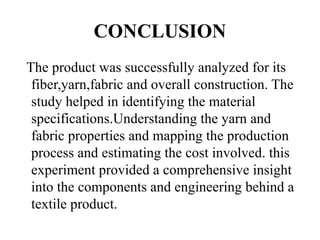
CONCLUSION
The product was successfully analyzed for its
fiber,yarn,fabric and overall construction. The
study helped in identifying the material
specifications.Understanding the yarn and
fabric properties and mapping the production
process and estimating the cost involved. this
experiment provided a comprehensive insight
into the components and engineering behind a
textile product.
REVERSE ENGINEERING OF
CHILDREN’S WEAR
CHILDREN’S WEAR
OBJECTIVES
• To analyze and identify the materials used in a
children’s wear.
• To conduct confirmative tests for fibers and
fabrics.
• To understand and map the production
processes used.
• To estimate the cost of producing the
children’s wear.
APPARATUS AND MATERIALS REQUIRED
• Sample (Children’s T-shirt)
• Microscope (for fiber identification)
• Fabric analysis kit (burn test setup, GSM cutter, etc.)
• Pick glass / Fabric inspection glass
• GSM Cutter & Weighing Scale
• Stop watch (for production process timing)
• Measuring Tape
• Costing Sheet Template
• Stitching seam cutter
• Lab Manual & Worksheets
DESCRIPTION
• Reverse engineering is a process of deconstructing
a product to understand its design, materials,
production process, and costing. In apparel, this
helps students understand:
- Fiber type (cotton, polyester, blend)
- Yarn specifications (count, twist)
- Fabric construction (woven, knit, type of weave)
- Accessories (buttons, labels, interlining)
- Process flow (cutting, stitching, finishing)
- Cost components (material, labour, overhead)
PROCEDURE
• Material Identification
• Record the process flow
• Understanding the trim and accessories
• Identify the bottle necks and solutions
• Prepare the costing sheet
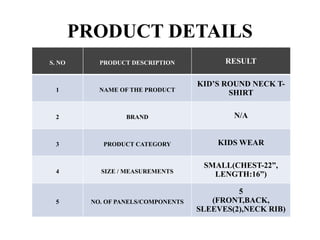
PRODUCT DETAILS
S. NO PRODUCT DESCRIPTION RESULT
1 NAME OF THE PRODUCT
KID’S ROUND NECK T-
SHIRT
2 BRAND N/A
3 PRODUCT CATEGORY KIDS WEAR
4 SIZE / MEASUREMENTS
SMALL(CHEST-22”,
LENGTH:16”)
5 NO. OF PANELS/COMPONENTS
5
(FRONT,BACK,
SLEEVES(2),NECK RIB)
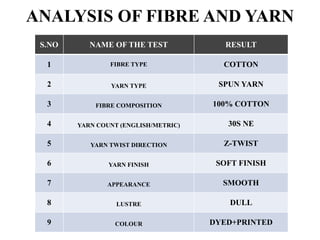
ANALYSIS OF FIBRE AND YARN
S.NO NAME OF THE TEST RESULT
1 FIBRE TYPE COTTON
2 YARN TYPE SPUN YARN
3 FIBRE COMPOSITION 100% COTTON
4 YARN COUNT (ENGLISH/METRIC) 30S NE
5 YARN TWIST DIRECTION Z-TWIST
6 YARN FINISH SOFT FINISH
7 APPEARANCE SMOOTH
8 LUSTRE DULL
9 COLOUR DYED+PRINTED
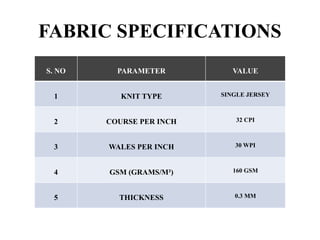
FABRIC SPECIFICATIONS
S. NO PARAMETER VALUE
1 KNIT TYPE SINGLE JERSEY
2 COURSE PER INCH 32 CPI
3 WALES PER INCH 30 WPI
4 GSM (GRAMS/M²) 160 GSM
5 THICKNESS 0.3 MM
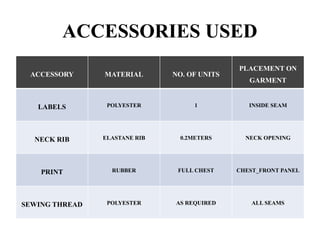
ACCESSORIES USED
ACCESSORY MATERIAL NO. OF UNITS
PLACEMENT ON
GARMENT
LABELS POLYESTER 1 INSIDE SEAM
NECK RIB ELASTANE RIB 0.2METERS NECK OPENING
PRINT RUBBER FULL CHEST CHEST_FRONT PANEL
SEWING THREAD POLYESTER AS REQUIRED ALL SEAMS
PRODUCTION PROCESS FLOW
S. NO OPERATION DESCRIPTION MACHINE/METHOD USED
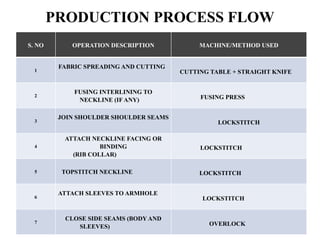
1
FABRIC SPREADING AND CUTTING
CUTTING TABLE + STRAIGHT KNIFE
2
FUSING INTERLINING TO
NECKLINE (IF ANY) FUSING PRESS
3
JOIN SHOULDER SHOULDER SEAMS
LOCKSTITCH
4
ATTACH NECKLINE FACING OR
BINDING
(RIB COLLAR)
LOCKSTITCH
5 TOPSTITCH NECKLINE LOCKSTITCH
6
ATTACH SLEEVES TO ARMHOLE
LOCKSTITCH
7
CLOSE SIDE SEAMS (BODY AND
SLEEVES) OVERLOCK
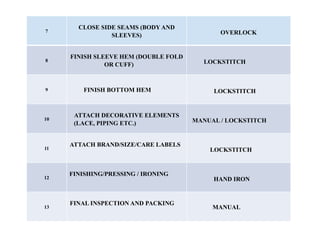
7
CLOSE SIDE SEAMS (BODY AND
SLEEVES) OVERLOCK
8
FINISH SLEEVE HEM (DOUBLE FOLD
OR CUFF) LOCKSTITCH
9 FINISH BOTTOM HEM LOCKSTITCH
10
ATTACH DECORATIVE ELEMENTS
(LACE, PIPING ETC.) MANUAL / LOCKSTITCH
11
ATTACH BRAND/SIZE/CARE LABELS
LOCKSTITCH
12
FINISHING/PRESSING / IRONING
HAND IRON
13
FINAL INSPECTION AND PACKING
MANUAL
COSTING SHEET
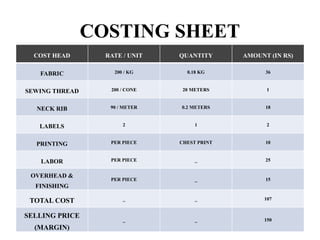
COST HEAD RATE / UNIT QUANTITY AMOUNT (IN RS)
FABRIC 200 / KG 0.18 KG 36
SEWING THREAD 200 / CONE 20 METERS 1
NECK RIB 90 / METER 0.2 METERS 18
LABELS 2 1 2
PRINTING PER PIECE CHEST PRINT 10
LABOR PER PIECE _ 25
OVERHEAD &
FINISHING
PER PIECE _ 15
TOTAL COST _ _ 107
SELLING PRICE
(MARGIN)
_ _ 150
CONCLUSION
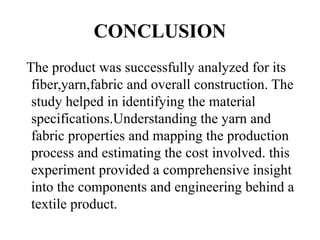
The product was successfully analyzed for its
fiber,yarn,fabric and overall construction. The
study helped in identifying the material
specifications.Understanding the yarn and
fabric properties and mapping the production
process and estimating the cost involved. this
experiment provided a comprehensive insight
into the components and engineering behind a
textile product.
THANK YOU

TEXTILE PRODUCT ENGINEERING LABORATORY (TPE) LAB.PPTX

  • 1.
    SSM COLLEGE OFENGINEERING DEPARTMENT OF TEXTILE TECHNOLOGY TT3611 / TEXTILE PRODUCT ENGINEERING LAB NAME OF THE STUDENT: KALEESWARAN N REGISTER NUMBER: 732322212012 YEAR / SEMESTER: 3rd / 6th
  • 2.
    REVERSE ENGINEERING OF AMEN’S FORMAL SHIRT
  • 3.
  • 4.
    OBJECTIVES • To analyzeand identify the materials used in a men's formal shirt. • To conduct confirmative tests for fibers and fabrics. • To understand and map the production processes used. • To estimate the cost of producing the shirt.
  • 5.
    APPARATUS AND MATERIALSREQUIRED • Sample shirt (Men’s formal) • Microscope (for fiber identification) • Fabric analysis kit (burn test setup, GSM cutter, etc.) • Pick glass / Fabric inspection glass • GSM Cutter & Weighing Scale • Stop watch (for production process timing) • Measuring Tape • Costing Sheet Template • Stitching seam cutter • Lab Manual & Worksheets
  • 6.
    DESCRIPTION Reverse engineering isa process of deconstructing a product to understand its design, materials, production process, and costing. In apparel, this helps students understand: - Fiber type (cotton, polyester, blend) - Yarn specifications (count, twist) - Fabric construction (woven, knit, type of weave) - Accessories (buttons, labels, interlining) - Process flow (cutting, stitching, finishing) - Cost components (material, labour, overhead)
  • 7.
    PROCEDURE • Material Identification •Record the process flow • Understanding the trim and accessories • Identify the bottle necks and solutions • Prepare the costing sheet
  • 8.
    PRODUCT DETAILS S. NOPRODUCT DESCRIPTION RESULT 1 NAME OF THE PRODUCT MEN’S FORMAL SHIRT 2 BRAND ZOOM MARK SHIRTS 3 PRODUCT CATEGORY WOVEN SHIRTS- FORMAL WEAR 4 SIZE / MEASUREMENTS M(MEDIUM)- CHEST(40’’), LENGTH(29”),SLEEVE(2 5”) 5 NO. OF PANELS/COMPONENTS 8 PANELS:FRONT(LEFT,R IGHT)BACK,SLEEVE(2), CUFFS(2), COLLAR,POCKET
  • 9.
    ANALYSIS OF FIBREAND YARN S.NO NAME OF THE TEST RESULT 1 FIBRE TYPE COTTON 2 YARN TYPE SPUN YARN 3 FIBRE COMPOSITION COTTON 100% 4 YARN COUNT (ENGLISH/METRIC) 40S NE 5 YARN TWIST DIRECTION Z-TWIST 6 YARN FINISH SINGED&MERCHERISED 7 APPEARANCE SMOOTH 8 LUSTRE SEMI-DULL 9 COLOUR YARN DYED(CHECKED PATTERN)
  • 10.
    FABRIC SPECIFICATIONS S. NOPARAMETER VALUE 1 WEAVE TYPE WOVEN(TWILL WEAVE) 2 ENDS PER INCH (EPI) 36 EPI 3 PICKS PER INCH (PPI) 36 PPI 4 GSM (GRAMS/M²) 190 GSM 5 THICKNESS LIGHT(0.25MM)
  • 11.
    ACCESSORIES USED ACCESSORY MATERIALNO. OF UNITS PLACEMENT ON GARMENT BUTTONS PLASTIC (BLACK,4HOLE) 8 FRONT PLACKET,CUFFS,COLLAR, EXTRA BUTTON LABELS WOVEN (POLYESTER) 2 INSIDE NECK,INSIDE YOKE INTERLINING FUSIBLE (POLYESTER) AS REQUIRED COLLAR,CUFFS,PLACKET SEWING THREAD POLYESTER (DARK BLUE) AS REQUIRED ALL SEAMS
  • 12.
    PRODUCTION PROCESS FLOW S.NO OPERATION DESCRIPTION MACHINE/METHOD USED 1 FABRIC SPREADING AND CUTTING CUTTING TABLE + STRAIGHT KNIFE 2 FUSING INTERLINING TO COLLAR AND CUFFS FUSING PRESS 3 STITCH SHOULDER SEAMS LOCKSTITCH 4 ATTACH AND TOPSTITCH YOKE LOCKSTITCH 5 ASSEMBLE AND STITCH SLEEVES LOCKSTITCH 6 JOIN SIDE SEAMS OVERLOCK 7 MAKE AND ATTACH COLLAR LOCKSTITCH
  • 13.
    8 MAKE AND ATTACHCUFFS LOCKSTITCH 9 ATTACH FRONT PLACKET / BUTTON STAND LOCKSTITCH 10 HEM BOTTOM OF THE SHIRT LOCKSTITCH / HEMMING MACHINE 11 MAKE BUTTONHOLES BUTTONHOLE MACHINE 12 ATTACH BUTTONS BUTTON STITCHING MACHINE 13 ATTACH LABELS (BRAND, SIZE, CARE) LOCKSTITCH 14 PRESSING / IRONING STEAM PRESS / HAND IRON 15 FINAL INSPECTION AND PACKING MANUAL
  • 14.
    COSTING SHEET COST HEADRATE / UNIT QUANTITY AMOUNT (IN RS) FABRIC 90/ METER 1.6 METERS 144 SEWING THREAD 200/ CONE (4000 M) 30 METERS 1.5 BUTTONS 1/ PIECE 8 8 LABELS 2/ PIECE 2 4 INTERLINING 25/ METER 0.25 METERS 6.25 LABOR _ PER SHIRT 40 OVERHEAD & FINISHING _ PER SHIRT 25 TOTAL COST _ _ 229.75 SELLING PRICE (MARGIN) _ _ 300(APPROX.)
  • 15.
    CONCLUSION The product wassuccessfully analyzed for its fiber,yarn,fabric and overall construction. The study helped in identifying the material specifications.Understanding the yarn and fabric properties and mapping the production process and estimating the cost involved. this experiment provided a comprehensive insight into the components and engineering behind a textile product.
  • 16.
  • 17.
  • 18.
    OBJECTIVES • To analyzeand identify the materials used in a women’s top. • To conduct confirmative tests for fibers and fabrics. • To understand and map the production processes used. • To estimate the cost of producing the women’s top.
  • 19.
    APPARATUS AND MATERIALSREQUIRED • Sample top (Women’s) • Microscope (for fiber identification) • Fabric analysis kit (burn test setup, GSM cutter, etc.) • Pick glass / Fabric inspection glass • GSM Cutter & Weighing Scale • Stop watch (for production process timing) • Measuring Tape • Costing Sheet Template • Stitching seam cutter • Lab Manual & Worksheets
  • 20.
    DESCRIPTION Reverse engineering isa process of deconstructing a product to understand its design, materials, production process, and costing. In apparel, this helps students understand: - Fiber type (cotton, polyester, blend) - Yarn specifications (count, twist) - Fabric construction (woven, knit, type of weave) - Accessories (buttons, labels, interlining) - Process flow (cutting, stitching, finishing) - Cost components (material, labour, overhead)
  • 21.
    PROCEDURE • Material Identification •Record the process flow • Understanding the trim and accessories • Identify the bottle necks and solutions • Prepare the costing sheet
  • 22.
    PRODUCT DETAILS S. NOPRODUCT DESCRIPTION RESULT 1 NAME OF THE PRODUCT WOMEN’S TOP 2 BRAND N/A 3 PRODUCT CATEGORY WOMEN’S(CASUAL WEAR/ KNIT WEAR TOPS) 4 SIZE / MEASUREMENTS 3XL(BUST:46”,WAIST: 42”,LENGTH:28”) 5 NO. OF PANELS/COMPONENTS 9(FRONT,BACK, SLEEVES(2),NECK PIPING(3),BOTTOM HEM PIPING(2)
  • 23.
    ANALYSIS OF FIBREAND YARN S.No Name of the Test Result 1 Fibre Type POLYESTER 2 Yarn Type FILAMENT YARN 3 Fibre Composition 100% POLYESTER 4 Yarn Count (English/Metric) 30 DENIER 5 Yarn Twist Direction Z-TWIST 6 Yarn Finish SOFT FINISH, MOISTURE WICKING 7 Appearance SMOOTH 8 Lustre BRIGHT 9 Colour PRINTED (SUBLIMATION)
  • 24.
    FABRIC SPECIFICATIONS S. NOPARAMETER VALUE 1 KNIT TYPE SINGLE JERSEY 2 COURSE PER INCH 32 CPI 3 WALES PER INCH 30 WPI 4 GSM (GRAMS/M²) 140 GSM 5 THICKNESS MEDIUM(0.25 MM)
  • 25.
    ACCESSORIES USED ACCESSORY MATERIALNO. OF UNITS PLACEMENT ON GARMENT BUTTONS PLASTIC (4-HOLE) 3 NECK-PIPING LABELS POLYESTER 2 INSIDE NECK& SIDE SEAM INTERLINING FUSIBLE (POLYESTER) AS REQUIRED NECK(PIPING) SEWING THREAD POLYESTER (BLACK) AS REQUIRED ALL SEAMS
  • 26.
    PRODUCTION PROCESS FLOW S.NO OPERATION DESCRIPTION MACHINE/METHOD USED 1 FABRIC SPREADING AND CUTTING CUTTING TABLE + STRAIGHT KNIFE 2 FUSING INTERLINING TO NECKLINE (IF ANY) FUSING PRESS 3 JOIN SHOULDER SHOULDER SEAMS LOCKSTITCH 4 ATTACH NECKLINE FACING OR BINDING LOCKSTITCH 5 TOPSTITCH NECKLINE LOCKSTITCH 6 ATTACH SLEEVES TO ARMHOLE LOCKSTITCH 7 CLOSE SIDE SEAMS (BODY AND SLEEVES) OVERLOCK
  • 27.
    8 MAKE AND ATTACHCUFFS LOCKSTITCH 8 FINISH SLEEVE HEM (DOUBLE FOLD OR CUFF) LOCKSTITCH / HEMMING MACHINE 9 FINISH BOTTOM HEM LOCKSTITCH / HEMMING MACHINE 10 ATTACH DECORATIVE ELEMENTS (LACE, PIPING ETC.) MANUAL / LOCKSTITCH 11 ATTACH BRAND/SIZE/CARE LABELS LOCKSTITCH 12 PRESSING / IRONING STEAM PRESS / HAND IRON 13 FINAL INSPECTION AND PACKING MANUAL
  • 28.
    COSTING SHEET COST HEADRATE / UNIT QUANTITY AMOUNT (IN RS) FABRIC 190 / KG 0.22 KG 41.8 SEWING THREAD 200 / CONE 25 METERS 1.25 BUTTONS 1.5 / PIECE 3 4.50 LABELS 2 / LABEL 2 4 INTERLINING 30 / METER 0.2 METER 6 RIB TO NECK 90/ METER 0.25 METER 22.50 SUBLIMATION PRINTING _ PER PIECE 18 LABOR 90 / METER PER PIECE 20 OVERHEAD & FINISHING _ PER PIECE 35 TOTAL COST _ _ 153.05 SELLING PRICE (MARGIN) _ _ 230
  • 29.
    CONCLUSION The product wassuccessfully analyzed for its fiber,yarn,fabric and overall construction. The study helped in identifying the material specifications.Understanding the yarn and fabric properties and mapping the production process and estimating the cost involved. this experiment provided a comprehensive insight into the components and engineering behind a textile product.
  • 30.
  • 31.
  • 32.
    OBJECTIVES • To analyzeand identify the materials used in a children’s wear. • To conduct confirmative tests for fibers and fabrics. • To understand and map the production processes used. • To estimate the cost of producing the children’s wear.
  • 33.
    APPARATUS AND MATERIALSREQUIRED • Sample (Children’s T-shirt) • Microscope (for fiber identification) • Fabric analysis kit (burn test setup, GSM cutter, etc.) • Pick glass / Fabric inspection glass • GSM Cutter & Weighing Scale • Stop watch (for production process timing) • Measuring Tape • Costing Sheet Template • Stitching seam cutter • Lab Manual & Worksheets
  • 34.
    DESCRIPTION • Reverse engineeringis a process of deconstructing a product to understand its design, materials, production process, and costing. In apparel, this helps students understand: - Fiber type (cotton, polyester, blend) - Yarn specifications (count, twist) - Fabric construction (woven, knit, type of weave) - Accessories (buttons, labels, interlining) - Process flow (cutting, stitching, finishing) - Cost components (material, labour, overhead)
  • 35.
    PROCEDURE • Material Identification •Record the process flow • Understanding the trim and accessories • Identify the bottle necks and solutions • Prepare the costing sheet
  • 36.
    PRODUCT DETAILS S. NOPRODUCT DESCRIPTION RESULT 1 NAME OF THE PRODUCT KID’S ROUND NECK T- SHIRT 2 BRAND N/A 3 PRODUCT CATEGORY KIDS WEAR 4 SIZE / MEASUREMENTS SMALL(CHEST-22”, LENGTH:16”) 5 NO. OF PANELS/COMPONENTS 5 (FRONT,BACK, SLEEVES(2),NECK RIB)
  • 37.
    ANALYSIS OF FIBREAND YARN S.NO NAME OF THE TEST RESULT 1 FIBRE TYPE COTTON 2 YARN TYPE SPUN YARN 3 FIBRE COMPOSITION 100% COTTON 4 YARN COUNT (ENGLISH/METRIC) 30S NE 5 YARN TWIST DIRECTION Z-TWIST 6 YARN FINISH SOFT FINISH 7 APPEARANCE SMOOTH 8 LUSTRE DULL 9 COLOUR DYED+PRINTED
  • 38.
    FABRIC SPECIFICATIONS S. NOPARAMETER VALUE 1 KNIT TYPE SINGLE JERSEY 2 COURSE PER INCH 32 CPI 3 WALES PER INCH 30 WPI 4 GSM (GRAMS/M²) 160 GSM 5 THICKNESS 0.3 MM
  • 39.
    ACCESSORIES USED ACCESSORY MATERIALNO. OF UNITS PLACEMENT ON GARMENT LABELS POLYESTER 1 INSIDE SEAM NECK RIB ELASTANE RIB 0.2METERS NECK OPENING PRINT RUBBER FULL CHEST CHEST_FRONT PANEL SEWING THREAD POLYESTER AS REQUIRED ALL SEAMS
  • 40.
    PRODUCTION PROCESS FLOW S.NO OPERATION DESCRIPTION MACHINE/METHOD USED 1 FABRIC SPREADING AND CUTTING CUTTING TABLE + STRAIGHT KNIFE 2 FUSING INTERLINING TO NECKLINE (IF ANY) FUSING PRESS 3 JOIN SHOULDER SHOULDER SEAMS LOCKSTITCH 4 ATTACH NECKLINE FACING OR BINDING (RIB COLLAR) LOCKSTITCH 5 TOPSTITCH NECKLINE LOCKSTITCH 6 ATTACH SLEEVES TO ARMHOLE LOCKSTITCH 7 CLOSE SIDE SEAMS (BODY AND SLEEVES) OVERLOCK
  • 41.
    7 CLOSE SIDE SEAMS(BODY AND SLEEVES) OVERLOCK 8 FINISH SLEEVE HEM (DOUBLE FOLD OR CUFF) LOCKSTITCH 9 FINISH BOTTOM HEM LOCKSTITCH 10 ATTACH DECORATIVE ELEMENTS (LACE, PIPING ETC.) MANUAL / LOCKSTITCH 11 ATTACH BRAND/SIZE/CARE LABELS LOCKSTITCH 12 FINISHING/PRESSING / IRONING HAND IRON 13 FINAL INSPECTION AND PACKING MANUAL
  • 42.
    COSTING SHEET COST HEADRATE / UNIT QUANTITY AMOUNT (IN RS) FABRIC 200 / KG 0.18 KG 36 SEWING THREAD 200 / CONE 20 METERS 1 NECK RIB 90 / METER 0.2 METERS 18 LABELS 2 1 2 PRINTING PER PIECE CHEST PRINT 10 LABOR PER PIECE _ 25 OVERHEAD & FINISHING PER PIECE _ 15 TOTAL COST _ _ 107 SELLING PRICE (MARGIN) _ _ 150
  • 43.
    CONCLUSION The product wassuccessfully analyzed for its fiber,yarn,fabric and overall construction. The study helped in identifying the material specifications.Understanding the yarn and fabric properties and mapping the production process and estimating the cost involved. this experiment provided a comprehensive insight into the components and engineering behind a textile product.
  • 44.