
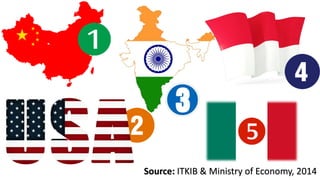

Introduction
History
Industry Profile
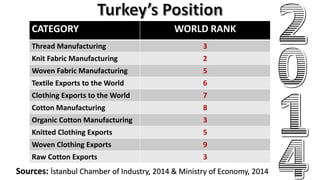
Turkey’s Position
Barriers
Export
Import
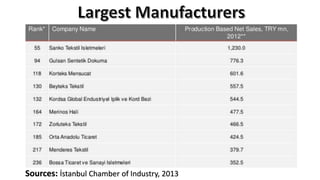
Largest Manufacturers
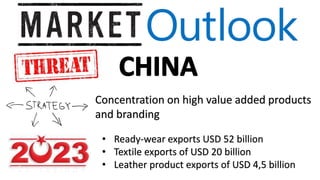
Market Outlook and 2023 Targets
 Turkey’s Textile and Clothing industry is regarded as a locomotive industry
 The textile and clothing industry is developing day by day and increasing its
exports by the availability of raw materials, relatively low labor costs,
closeness to Europe, the custom Union agreement with the European Union.
 It has some challenges due to rising labor costs, inefficiencies problems, other
low cost suppliers
o In the Ottoman Empire period, the development
was based on cotton production
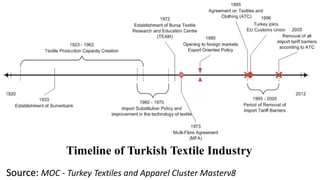
Timeline of Turkish Textile Industry
Source: MOC - Turkey Textiles and Apparel Cluster Masterv8
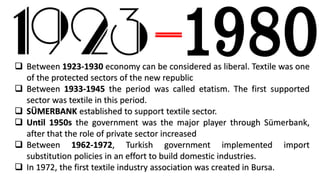
 Between 1923-1930 economy can be considered as liberal. Textile was one
of the protected sectors of the new republic
 Between 1933-1945 the period was called etatism. The first supported
sector was textile in this period.
 SÜMERBANK established to support textile sector.
 Until 1950s the government was the major player through Sümerbank,
after that the role of private sector increased
 Between 1962-1972, Turkish government implemented import
substitution policies in an effort to build domestic industries.
 In 1972, the first textile industry association was created in Bursa.
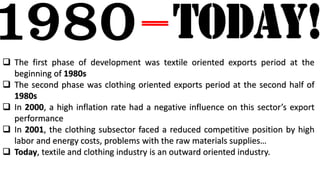
 The first phase of development was textile oriented exports period at the
beginning of 1980s
 The second phase was clothing oriented exports period at the second half of
1980s
 In 2000, a high inflation rate had a negative influence on this sector’s export
performance
 In 2001, the clothing subsector faced a reduced competitive position by high
labor and energy costs, problems with the raw materials supplies…
 Today, textile and clothing industry is an outward oriented industry.
Source: Social Security Institution, Ministry of Economy, 2013
CATEGORY WORLD RANK
Thread Manufacturing 3
Knit Fabric Manufacturing 2
Woven Fabric Manufacturing 5
Textile Exports to the World 6
Clothing Exports to the World 7
Cotton Manufacturing 8
Organic Cotton Manufacturing 3
Knitted Clothing Exports 5
Woven Clothing Exports 9
Raw Cotton Exports 3
Sources: İstanbul Chamber of Industry, 2014 & Ministry of Economy, 2014
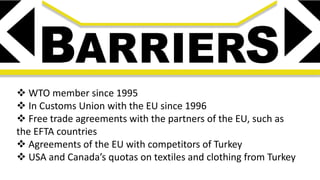
 WTO member since 1995
 In Customs Union with the EU since 1996
 Free trade agreements with the partners of the EU, such as
the EFTA countries
 Agreements of the EU with competitors of Turkey
 USA and Canada’s quotas on textiles and clothing from Turkey
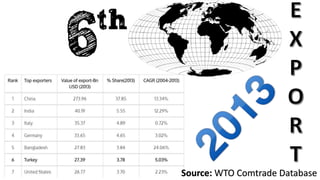
Source: WTO Comtrade Database
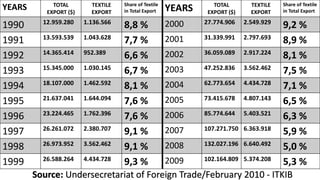
YEARS TOTAL
EXPORT ($)
TEXTILE
EXPORT
Share of Textile
in Total Export
1990 12.959.280 1.136.566
8,8 %
1991 13.593.539 1.043.628
7,7 %
1992 14.365.414 952.389
6,6 %
1993 15.345.000 1.030.145
6,7 %
1994 18.107.000 1.462.592
8,1 %
1995 21.637.041 1.644.094
7,6 %
1996 23.224.465 1.762.396
7,6 %
1997 26.261.072 2.380.707
9,1 %
1998 26.973.952 3.562.462
9,1 %
1999 26.588.264 4.434.728
9,3 %
YEARS TOTAL
EXPORT ($)
TEXTILE
EXPORT
Share of Textile
in Total Export
2000 27.774.906 2.549.929
9,2 %
2001 31.339.991 2.797.693
8,9 %
2002 36.059.089 2.917.224
8,1 %
2003 47.252.836 3.562.462
7,5 %
2004 62.773.654 4.434.728
7,1 %
2005 73.415.678 4.807.143
6,5 %
2006 85.774.644 5.403.521
6,3 %
2007 107.271.750 6.363.918
5,9 %
2008 132.027.196 6.640.492
5,0 %
2009 102.164.809 5.374.208
5,3 %
Source: Undersecretariat of Foreign Trade/February 2010 - ITKIB
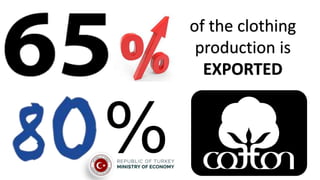
of the clothing
production is
EXPORTED
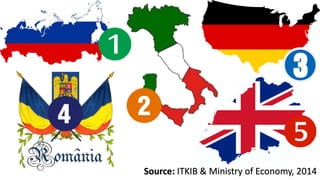
Source: ITKIB & Ministry of Economy, 2014
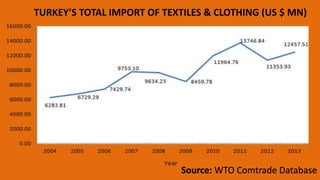
Source: WTO Comtrade Database
TURKEY’S TOTAL IMPORT OF TEXTILES & CLOTHING (US $ MN)
Source: ITKIB & Ministry of Economy, 2014
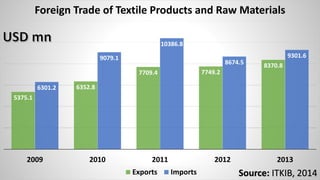
5375.1
6352.8
7709.4 7749.2
8370.8
6301.2
9079.1
10386.8
8674.5
9301.6
2009 2010 2011 2012 2013
Foreign Trade of Textile Products and Raw Materials
Exports Imports Source: ITKIB, 2014
Sources: İstanbul Chamber of Industry, 2013
Concentration on high value added products
and branding
• Ready-wear exports USD 52 billion
• Textile exports of USD 20 billion
• Leather product exports of USD 4,5 billion
Textile Industry in Turkey

Textile Industry in Turkey

  • 2.
  • 3.
     Turkey’s Textileand Clothing industry is regarded as a locomotive industry  The textile and clothing industry is developing day by day and increasing its exports by the availability of raw materials, relatively low labor costs, closeness to Europe, the custom Union agreement with the European Union.  It has some challenges due to rising labor costs, inefficiencies problems, other low cost suppliers
  • 4.
    o In theOttoman Empire period, the development was based on cotton production
  • 5.
    Timeline of TurkishTextile Industry Source: MOC - Turkey Textiles and Apparel Cluster Masterv8
  • 6.
     Between 1923-1930economy can be considered as liberal. Textile was one of the protected sectors of the new republic  Between 1933-1945 the period was called etatism. The first supported sector was textile in this period.  SÜMERBANK established to support textile sector.  Until 1950s the government was the major player through Sümerbank, after that the role of private sector increased  Between 1962-1972, Turkish government implemented import substitution policies in an effort to build domestic industries.  In 1972, the first textile industry association was created in Bursa.
  • 7.
     The firstphase of development was textile oriented exports period at the beginning of 1980s  The second phase was clothing oriented exports period at the second half of 1980s  In 2000, a high inflation rate had a negative influence on this sector’s export performance  In 2001, the clothing subsector faced a reduced competitive position by high labor and energy costs, problems with the raw materials supplies…  Today, textile and clothing industry is an outward oriented industry.
  • 8.
    Source: Social SecurityInstitution, Ministry of Economy, 2013
  • 9.
    CATEGORY WORLD RANK ThreadManufacturing 3 Knit Fabric Manufacturing 2 Woven Fabric Manufacturing 5 Textile Exports to the World 6 Clothing Exports to the World 7 Cotton Manufacturing 8 Organic Cotton Manufacturing 3 Knitted Clothing Exports 5 Woven Clothing Exports 9 Raw Cotton Exports 3 Sources: İstanbul Chamber of Industry, 2014 & Ministry of Economy, 2014
  • 10.
     WTO membersince 1995  In Customs Union with the EU since 1996  Free trade agreements with the partners of the EU, such as the EFTA countries  Agreements of the EU with competitors of Turkey  USA and Canada’s quotas on textiles and clothing from Turkey
  • 12.
  • 13.
    YEARS TOTAL EXPORT ($) TEXTILE EXPORT Shareof Textile in Total Export 1990 12.959.280 1.136.566 8,8 % 1991 13.593.539 1.043.628 7,7 % 1992 14.365.414 952.389 6,6 % 1993 15.345.000 1.030.145 6,7 % 1994 18.107.000 1.462.592 8,1 % 1995 21.637.041 1.644.094 7,6 % 1996 23.224.465 1.762.396 7,6 % 1997 26.261.072 2.380.707 9,1 % 1998 26.973.952 3.562.462 9,1 % 1999 26.588.264 4.434.728 9,3 % YEARS TOTAL EXPORT ($) TEXTILE EXPORT Share of Textile in Total Export 2000 27.774.906 2.549.929 9,2 % 2001 31.339.991 2.797.693 8,9 % 2002 36.059.089 2.917.224 8,1 % 2003 47.252.836 3.562.462 7,5 % 2004 62.773.654 4.434.728 7,1 % 2005 73.415.678 4.807.143 6,5 % 2006 85.774.644 5.403.521 6,3 % 2007 107.271.750 6.363.918 5,9 % 2008 132.027.196 6.640.492 5,0 % 2009 102.164.809 5.374.208 5,3 % Source: Undersecretariat of Foreign Trade/February 2010 - ITKIB
  • 14.
  • 15.
    Source: ITKIB &Ministry of Economy, 2014
  • 17.
    Source: WTO ComtradeDatabase TURKEY’S TOTAL IMPORT OF TEXTILES & CLOTHING (US $ MN)
  • 18.
    Source: ITKIB &Ministry of Economy, 2014
  • 19.
    5375.1 6352.8 7709.4 7749.2 8370.8 6301.2 9079.1 10386.8 8674.5 9301.6 2009 20102011 2012 2013 Foreign Trade of Textile Products and Raw Materials Exports Imports Source: ITKIB, 2014
  • 20.
    Sources: İstanbul Chamberof Industry, 2013
  • 21.
    Concentration on highvalue added products and branding • Ready-wear exports USD 52 billion • Textile exports of USD 20 billion • Leather product exports of USD 4,5 billion