INDIAN TEXTILE AND
APPAREL EXPORT
By : Muskan Jain
1/18
The Indian Textile and Apparel Industry
• India is the world's second-largest exporter of textiles and apparel with a massive
raw material and manufacturing base.
• It contributes about 7% to industry output, 2% to the GDP and 15% to the
country's total export earnings.
• India’s total exports was 11.4% in 2020-21
• Grown to $39 billion in 2018-19 which is further estimated to expand at a CAGR of 10% and
expected to surpass $70 billion by 2025-26
• Apparels with a share of about 39.8% is the largest exported T&A commodity
from India during 2020-21 followed by Home Textile and fabric with share of
18.5% and 13.3% respectively.
• Textiles Secretary has suggested the Indian apparel industry to focus on vertical
integration to increase its scale and size and benefit from the production-linked
incentive (PLI) scheme.
2/18
Textile Exports of last 5 years (Values in Million USD)
Sr.No. HS Code Commodity 2017–2018 2018–2019 2019–2020 2020–2021 2021–2022
1 50 SILK 77.03 84.48 83.95 79.21 116.46
2 51
• WOOL, FINE OR
• COARSE ANIMAL HAIR,
• HORSEHAIR
• YARN AND WOVEN FABRIC.
164.40 198.73 160.28 88.66 134.92
3 52 COTTON 7045.26 7888.29 5736.72 6319.07 10787.51
4 53
• OTHER VEGETABLE
• TEXTILE FIBRES;
• PAPER YARN AND
• WOVEN FABRICS OF PAPER YARN.
451.98 445.83 447.07 533.80 675.43
5 54 MAN-MADE FILAMENTS 2169.84 2291.70 2391.78 1554.34 2424.50
6 55 MAN-MADE STAPLE FIBRES 2049.36 1905.16 1669.05 1292.66 2066.02
7 56
• WADDING, FELT
• AND NONWOVENS;
• SPACIAL YARNS;
• TWINE, CORDAGE, ROPES
• CABLES AND ARTICLES
390.88 427.32 412.83 495.85 557.54
3/18
8 59
• IMPREGNATED, COATED, COVERED OR
LAMINATED TEXTILE FABRICS;
• TEXTILE ARTICLES
• OF A KIND
• SUITABLE FOR
• INDUSTRIAL USE.
233.71 258.42 291.10 363.63 443.41
9 60
• KNITTED OR
• CROCHETED
• FABRICS.
342.92 440.21 422.28 482.41 850.24
10 61
• ARTICLES OF APPAREL
• CLOTHING ACCESSORIES,
• KNITTED
• CORCHETED.
7997.21 7820.41 7514.83 6348.03 8175.08
11 62
• ARTICLES OF APPAREL
• CLOTHING ACCESSORIES,
• NOT KNITTED OR CROCHETED.
8724.53 8335.96 7994.76 5941.84 7845.60
12 63
• OTHER MADE UP TEXTILE ARTICLES;
• SETS; WORN
• CLOTHING AND
• WORN TEXTILE
• ARTICLES; RAGS
5013.35 5257.35 5011.84 5221.83 6757.45
Total Textile Export 36747.84 37497.68 34221.63 30904.37 43437.50
Sr. No. Importers
Exported
value in 2017
Exported
value in 2018
Exported
value in 2019
Exported
value in 2020
Exported
value in 2021
1 United States of America 7787.871 8118.862 8450.894 7510.099 10816.665
2 Bangladesh 2260.401 2499.759 2059.204 2079.231 4268.378
3
United Arab
Emirates
4109.43 2471.327 2441.259 2070.632 2673.935
4 China 1520.189 1842.894 1400.159 1316.79 2050.709
5 United Kingdom 2242.376 2193.809 2152.551 1596.582 1956.979
6 Germany 1785.767 1705.131 1515.276 1249.513 1464.592
7 France 956.481 972.519 919.371 708.886 903.578
8 Spain 1072.571 1055.924 1011.219 702.876 868.877
9 Netherlands 668.798 700.915 689.03 610.351 806.532
10 Turkey 740.737 654.414 585.937 465.42 779.233
11 Sri Lanka 604.955 601.471 644.202 534.804 777.579
12 Italy 853.32 889.462 745.542 563.742 774.412
13 Vietnam 511.463 634.996 341.023 402.098 648.97
14 Australia 429.913 438.296 466.858 457.226 604.532
15 Canada 438.8 454.528 443.151 399.934 544.377
India’s Ready Made Garments Export
• Sum of the value for (Apr-Nov) 2020-2021 is USD 7019.59 Mn and (Apr-Nov) 2021-22 is USD
9662.19 Mn. and (Apr-Nov) 2022-23 is USD 10359.4 Mn.
6/18
7/18
• Cumulative RMG exports for the period Apr-Nov, 2022-23 is USD 10359.4 Mn.
showing a growth of 7.2% over 2021-22; a growth of 47.6 % over 2020-21 and a
growth of 3.1 % over 2019-20.
• Traditional markets of Indian RMG including UK, EU and the USA have been
witnessing recession and global headwinds, leading to shrinking demand in these
countries on one hand and buyers asking for 15% discount on the other.
• In addition, inflation and rising raw material and freight cost aggravated by the
Russia- Ukraine war further adding to the burden.
• The total set target of apparel exports for 2022-23 is US$ 17.6 billion against
which we have been able to achieve more than US$ 10 billion during April -
November 2022.
8/18
Textile and Ready-Made Garment Export October in FY 2022-23
9/18
• Manufacturing of Textiles Index for the month
of October, 2022 is 102.3 which has shown a
decline of -18.6 % as compared to October,
2021.
• Manufacturing of Textiles Index for the
financial year April - October, 2022-23 is 107.6
which has shown a decline of -7.7 % as
compared to the financial year April - October,
2021-22.
• Manufacturing of Wearing Apparel Index for
the month of October, 2022 is 102.9 which has
shown a decline of -37.1 % as compared to
October, 2021.
• Manufacturing of Wearing Apparel Index for
the financial year April - October, 2022-23 is
129.8 which has shown a growth of 5.6 % as
compared to the financial year April - October,
2021-22
10/18
• Following the demand trends in the global markets, the council kept its focus intact on strengthening its
position in the traditional export destination of the USA -31% ( Export share) of the total RMG exports
from India.
• With the US ban on cotton products made from Xinjiang region of China, new opportunities have
opened for Indian apparel exporters in the US market.
• Other than USA and EU council is equally striving hard towards striking roots in new soils of emerging
markets within EU and in Asia Pacific Region and Latin America.
• Traditional destination of the EU and UK had been facing poor demand due to the availability of plenty
of stocks in the inventory leading to overall sluggish demand.
• Further, while the recession had also hit EU and the UK, an additional reason of decline in Indian
RMG exports since both these markets have been picking up RMG from India via UAE route to finally
target the markets of Russia.
• As a result of exit of EU and UK garment brands from Russia due to Russia-Ukraine war, the demand
of these brands procuring garments from India for Russia has been badly hit leading to lowering down
our exports in these traditional destinations.
• It was also realized that there was strong need for market diversification since India’s top 10 export
markets contributed to 74% of India’s total exports. Hence the council geared up to enhance the
footprint of Indian Garment Industry in newer markets of Australia and UAE.
11/18
• India is self-sufficient in basic MMF , fabrics
with certain finishes and effects are imported
not for re-exports but for value addition and
export of end product as finished garments
• Some of the major import items for Indian
apparel industry have been
- Polyester, Viscose Rayon, Acrylic or
modacrylic, Fabrics of artificial staple fiber,
specialized fabric needed for Medical textiles
and other specialized applications.
• India is a net importer, with imports largely for
domestic consumption or for value added
exports of MMF garments.
• Government initiatives such as
- PLI and PM MITRA schemes with the aim
of infusing more investment in this sector.
12/18
• The consumer preference towards the strong combination of protective clothing and fashion
trend is driving the demand for smart textiles and nanotechnology.
• More consumers have now started to prefer technical textiles over traditional textiles as it
fulfils their demand for flexible, durable, high-quality and high strength textiles in various
areas such as active wear or medical apparel.
• Owing to such a market trend, various companies are shifting their focus adoption of new
engineering technologies, and are increasing consumption of technical textiles.
• Emerging economies’ demographic rising birth rates and aging population shall continue to
boost the demand for hygienic and personal care medical equipment (meditech)
• The increasing awareness and preference of nanofibers and Nano-tubes to manufacture
lighter and stronger concrete material to make it long lasting in the construction industry
• The combination of rising demand for newer technologies and global focus on sustainability
and circular economy are raising the awareness towards use of Geotech solutions.
Technical Textiles
13/18
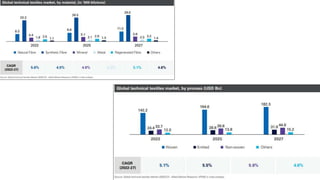
• India’s trade of technical textile products
has been growing strongly and the country
has been a net exporter.
• India’s exports of technical textile
products grew from USD2.21 billion in
2020-21 to USD 2.85 billion in 2021- 22,
registering a growth rate of 28.4 per cent
(YoY) whereas imports grew from USD
1.7 billion in 2020-21 to USD 2.46 billion
in 2021-22, registering a growth rate of 44
per cent (YoY).
• Considering the existing global market
dynamics, there exists a huge opportunity
for India to emerge as one of the key
leaders in world technical textile market.
• By strengthening research and
development in strategic areas of technical
textiles, upscaling manufacturing and
increasing cost competitiveness, India
stands a chance to be at par with advanced
countries in the world.
• https://nttm.texmin.gov.in/pdf/WhatsNew/India%202047_Vision%20
&%20Strategic%20Roadmap%20for%20Technical%20Textiles%20in%2
0India_KPMG.pdf
• https://aepcindia.com/sites/default/files/ceaZine/January%202023.p
df
• https://aepcindia.com/sites/default/files/ceaZine/April%202022.pdf
• https://www.ibef.org/blogs/the-textile-and-apparel-exports-of-india
THANKYOU

India's export pattern 2018-2023.pptx

  • 1.
    INDIAN TEXTILE AND APPARELEXPORT By : Muskan Jain 1/18
  • 2.
    The Indian Textileand Apparel Industry • India is the world's second-largest exporter of textiles and apparel with a massive raw material and manufacturing base. • It contributes about 7% to industry output, 2% to the GDP and 15% to the country's total export earnings. • India’s total exports was 11.4% in 2020-21 • Grown to $39 billion in 2018-19 which is further estimated to expand at a CAGR of 10% and expected to surpass $70 billion by 2025-26 • Apparels with a share of about 39.8% is the largest exported T&A commodity from India during 2020-21 followed by Home Textile and fabric with share of 18.5% and 13.3% respectively. • Textiles Secretary has suggested the Indian apparel industry to focus on vertical integration to increase its scale and size and benefit from the production-linked incentive (PLI) scheme. 2/18
  • 3.
    Textile Exports oflast 5 years (Values in Million USD) Sr.No. HS Code Commodity 2017–2018 2018–2019 2019–2020 2020–2021 2021–2022 1 50 SILK 77.03 84.48 83.95 79.21 116.46 2 51 • WOOL, FINE OR • COARSE ANIMAL HAIR, • HORSEHAIR • YARN AND WOVEN FABRIC. 164.40 198.73 160.28 88.66 134.92 3 52 COTTON 7045.26 7888.29 5736.72 6319.07 10787.51 4 53 • OTHER VEGETABLE • TEXTILE FIBRES; • PAPER YARN AND • WOVEN FABRICS OF PAPER YARN. 451.98 445.83 447.07 533.80 675.43 5 54 MAN-MADE FILAMENTS 2169.84 2291.70 2391.78 1554.34 2424.50 6 55 MAN-MADE STAPLE FIBRES 2049.36 1905.16 1669.05 1292.66 2066.02 7 56 • WADDING, FELT • AND NONWOVENS; • SPACIAL YARNS; • TWINE, CORDAGE, ROPES • CABLES AND ARTICLES 390.88 427.32 412.83 495.85 557.54 3/18
  • 4.
    8 59 • IMPREGNATED,COATED, COVERED OR LAMINATED TEXTILE FABRICS; • TEXTILE ARTICLES • OF A KIND • SUITABLE FOR • INDUSTRIAL USE. 233.71 258.42 291.10 363.63 443.41 9 60 • KNITTED OR • CROCHETED • FABRICS. 342.92 440.21 422.28 482.41 850.24 10 61 • ARTICLES OF APPAREL • CLOTHING ACCESSORIES, • KNITTED • CORCHETED. 7997.21 7820.41 7514.83 6348.03 8175.08 11 62 • ARTICLES OF APPAREL • CLOTHING ACCESSORIES, • NOT KNITTED OR CROCHETED. 8724.53 8335.96 7994.76 5941.84 7845.60 12 63 • OTHER MADE UP TEXTILE ARTICLES; • SETS; WORN • CLOTHING AND • WORN TEXTILE • ARTICLES; RAGS 5013.35 5257.35 5011.84 5221.83 6757.45 Total Textile Export 36747.84 37497.68 34221.63 30904.37 43437.50
  • 5.
    Sr. No. Importers Exported valuein 2017 Exported value in 2018 Exported value in 2019 Exported value in 2020 Exported value in 2021 1 United States of America 7787.871 8118.862 8450.894 7510.099 10816.665 2 Bangladesh 2260.401 2499.759 2059.204 2079.231 4268.378 3 United Arab Emirates 4109.43 2471.327 2441.259 2070.632 2673.935 4 China 1520.189 1842.894 1400.159 1316.79 2050.709 5 United Kingdom 2242.376 2193.809 2152.551 1596.582 1956.979 6 Germany 1785.767 1705.131 1515.276 1249.513 1464.592 7 France 956.481 972.519 919.371 708.886 903.578 8 Spain 1072.571 1055.924 1011.219 702.876 868.877 9 Netherlands 668.798 700.915 689.03 610.351 806.532 10 Turkey 740.737 654.414 585.937 465.42 779.233 11 Sri Lanka 604.955 601.471 644.202 534.804 777.579 12 Italy 853.32 889.462 745.542 563.742 774.412 13 Vietnam 511.463 634.996 341.023 402.098 648.97 14 Australia 429.913 438.296 466.858 457.226 604.532 15 Canada 438.8 454.528 443.151 399.934 544.377
  • 6.
    India’s Ready MadeGarments Export • Sum of the value for (Apr-Nov) 2020-2021 is USD 7019.59 Mn and (Apr-Nov) 2021-22 is USD 9662.19 Mn. and (Apr-Nov) 2022-23 is USD 10359.4 Mn. 6/18
  • 7.
  • 8.
    • Cumulative RMGexports for the period Apr-Nov, 2022-23 is USD 10359.4 Mn. showing a growth of 7.2% over 2021-22; a growth of 47.6 % over 2020-21 and a growth of 3.1 % over 2019-20. • Traditional markets of Indian RMG including UK, EU and the USA have been witnessing recession and global headwinds, leading to shrinking demand in these countries on one hand and buyers asking for 15% discount on the other. • In addition, inflation and rising raw material and freight cost aggravated by the Russia- Ukraine war further adding to the burden. • The total set target of apparel exports for 2022-23 is US$ 17.6 billion against which we have been able to achieve more than US$ 10 billion during April - November 2022. 8/18
  • 9.
    Textile and Ready-MadeGarment Export October in FY 2022-23 9/18
  • 10.
    • Manufacturing ofTextiles Index for the month of October, 2022 is 102.3 which has shown a decline of -18.6 % as compared to October, 2021. • Manufacturing of Textiles Index for the financial year April - October, 2022-23 is 107.6 which has shown a decline of -7.7 % as compared to the financial year April - October, 2021-22. • Manufacturing of Wearing Apparel Index for the month of October, 2022 is 102.9 which has shown a decline of -37.1 % as compared to October, 2021. • Manufacturing of Wearing Apparel Index for the financial year April - October, 2022-23 is 129.8 which has shown a growth of 5.6 % as compared to the financial year April - October, 2021-22 10/18
  • 11.
    • Following thedemand trends in the global markets, the council kept its focus intact on strengthening its position in the traditional export destination of the USA -31% ( Export share) of the total RMG exports from India. • With the US ban on cotton products made from Xinjiang region of China, new opportunities have opened for Indian apparel exporters in the US market. • Other than USA and EU council is equally striving hard towards striking roots in new soils of emerging markets within EU and in Asia Pacific Region and Latin America. • Traditional destination of the EU and UK had been facing poor demand due to the availability of plenty of stocks in the inventory leading to overall sluggish demand. • Further, while the recession had also hit EU and the UK, an additional reason of decline in Indian RMG exports since both these markets have been picking up RMG from India via UAE route to finally target the markets of Russia. • As a result of exit of EU and UK garment brands from Russia due to Russia-Ukraine war, the demand of these brands procuring garments from India for Russia has been badly hit leading to lowering down our exports in these traditional destinations. • It was also realized that there was strong need for market diversification since India’s top 10 export markets contributed to 74% of India’s total exports. Hence the council geared up to enhance the footprint of Indian Garment Industry in newer markets of Australia and UAE. 11/18
  • 12.
    • India isself-sufficient in basic MMF , fabrics with certain finishes and effects are imported not for re-exports but for value addition and export of end product as finished garments • Some of the major import items for Indian apparel industry have been - Polyester, Viscose Rayon, Acrylic or modacrylic, Fabrics of artificial staple fiber, specialized fabric needed for Medical textiles and other specialized applications. • India is a net importer, with imports largely for domestic consumption or for value added exports of MMF garments. • Government initiatives such as - PLI and PM MITRA schemes with the aim of infusing more investment in this sector. 12/18
  • 13.
    • The consumerpreference towards the strong combination of protective clothing and fashion trend is driving the demand for smart textiles and nanotechnology. • More consumers have now started to prefer technical textiles over traditional textiles as it fulfils their demand for flexible, durable, high-quality and high strength textiles in various areas such as active wear or medical apparel. • Owing to such a market trend, various companies are shifting their focus adoption of new engineering technologies, and are increasing consumption of technical textiles. • Emerging economies’ demographic rising birth rates and aging population shall continue to boost the demand for hygienic and personal care medical equipment (meditech) • The increasing awareness and preference of nanofibers and Nano-tubes to manufacture lighter and stronger concrete material to make it long lasting in the construction industry • The combination of rising demand for newer technologies and global focus on sustainability and circular economy are raising the awareness towards use of Geotech solutions. Technical Textiles 13/18
  • 16.
    • India’s tradeof technical textile products has been growing strongly and the country has been a net exporter. • India’s exports of technical textile products grew from USD2.21 billion in 2020-21 to USD 2.85 billion in 2021- 22, registering a growth rate of 28.4 per cent (YoY) whereas imports grew from USD 1.7 billion in 2020-21 to USD 2.46 billion in 2021-22, registering a growth rate of 44 per cent (YoY). • Considering the existing global market dynamics, there exists a huge opportunity for India to emerge as one of the key leaders in world technical textile market. • By strengthening research and development in strategic areas of technical textiles, upscaling manufacturing and increasing cost competitiveness, India stands a chance to be at par with advanced countries in the world.
  • 17.
  • 18.