LESSON PLAN
Your name: Caitlin Bergan     Cooperating teacher-librarian: Kathy Bennett
Date: December 6 – December 10      School & City: Lincoln Trail, Mahomet
Lesson Title: Text Features 2
Grade level: 4th grade        Length of lesson: 30 min

Purpose: (“why” of the lesson; where and how does it fit in the curriculum?)
We looked at a number of text features last week that help make reading nonfiction
easier. This week, we’ll look at a variety of different books and try to find these
features and see some more.
Learning Outcome(s): (what will students be able to do/know by the end of the
lesson?)
Students will…
    • Identify text features in non-fiction
Illinois Learning Standard(s) Addressed:
1.B.2a Establish purposes for reading; survey materials; ask questions; make predictions;
connect, clarify and extend ideas
1.C.2c Compare and contrast the content and organization of selections
1.C.2f Connect information presented in tables, maps and charts to printed or electronic
text
1.C.3f Interpret tables that display textual information and data in visual formats
17.A.2b Use maps and other geographic representations and instruments to gather
information about people, places and environments

Standards for 21st Century Learner Addressed:
1.1.2 Use prior and background knowledge as context for new learning.
1.1.6 Read, view, and listen for information presented in any format (e.g., textual, visual,
media, digital) in order to make inferences and gather meaning.

Materials:
Needed by you:                              Needed by students:
A variety of nonfiction titles                   Pencils
Scavenger hunt sheet

Instructional procedures:
Focusing event: (how will you get the students’ attention?)
Hello class – Last week we browsed through the culture grams. This week we will go on a
scavenger hunt through different books looking for text features. Write the page number
for an example of each feature you find. Not all books will have all features.
A bunch of different books are at your table, pick one
I’ll give you 7 minutes to look through your book and find examples
Input from you: (what are you teaching & how are you delivering the content?)
Did anyone find the features from last week (headings, maps, pictures, captions, italic
or bold words, sidebar/boxes, timeline, graph)?
Did anyone find new tools that were not in the culture grams (table of contents, index,
bulleted or enumerated list, glossaries, bibliography, diagram, tables)
What kind of information is found in a table of contents? How is that like the index?
How are they different?
What kind of information is in the glossary?
What kind of information works well in lists?
What kind of information is in a bibliography?
What kinds of diagrams did you find?
How do you read tables?
Guided practice: (application of knowledge by students)
I’ll give you 3 more minutes to try to find any more that you didn’t know about in your
book
Closure (how will you end the lesson?)
Text features will make reading nonfiction much easier – in books, but also magazines,
encyclopedias, online, and more
What’s next? (another related lesson, review, end of unit?)
End of unit
Feature             Is this feature in your text?   Page number
Table of Contents
Index
Headings
Maps
Pictures
Captions
Bold words
Sidebar / Textbox
Timeline
Graph
Bulleted List
Glossary
Bibliography
Tables
Diagram


Feature             Is this feature in your text?   Page number
Table of Contents
Index
Headings
Maps
Pictures
Captions
Bold words
Sidebar / Textbox
Timeline
Graph
Bulleted List
Glossary
Bibliography
Tables
Diagram

Text Features 2 Lesson Plan

  • 1.
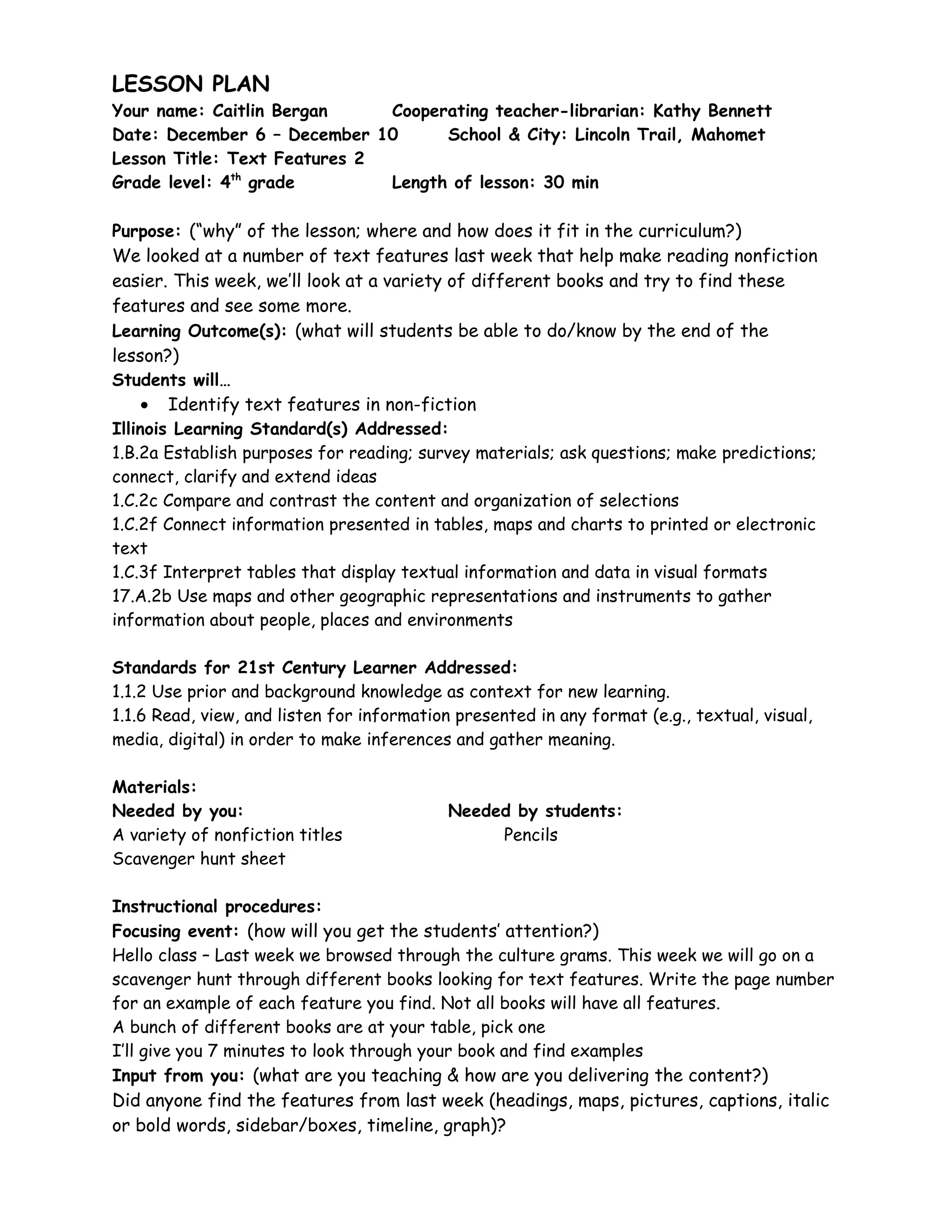
    LESSON PLAN Your name:Caitlin Bergan Cooperating teacher-librarian: Kathy Bennett Date: December 6 – December 10 School & City: Lincoln Trail, Mahomet Lesson Title: Text Features 2 Grade level: 4th grade Length of lesson: 30 min Purpose: (“why” of the lesson; where and how does it fit in the curriculum?) We looked at a number of text features last week that help make reading nonfiction easier. This week, we’ll look at a variety of different books and try to find these features and see some more. Learning Outcome(s): (what will students be able to do/know by the end of the lesson?) Students will… • Identify text features in non-fiction Illinois Learning Standard(s) Addressed: 1.B.2a Establish purposes for reading; survey materials; ask questions; make predictions; connect, clarify and extend ideas 1.C.2c Compare and contrast the content and organization of selections 1.C.2f Connect information presented in tables, maps and charts to printed or electronic text 1.C.3f Interpret tables that display textual information and data in visual formats 17.A.2b Use maps and other geographic representations and instruments to gather information about people, places and environments Standards for 21st Century Learner Addressed: 1.1.2 Use prior and background knowledge as context for new learning. 1.1.6 Read, view, and listen for information presented in any format (e.g., textual, visual, media, digital) in order to make inferences and gather meaning. Materials: Needed by you: Needed by students: A variety of nonfiction titles Pencils Scavenger hunt sheet Instructional procedures: Focusing event: (how will you get the students’ attention?) Hello class – Last week we browsed through the culture grams. This week we will go on a scavenger hunt through different books looking for text features. Write the page number for an example of each feature you find. Not all books will have all features. A bunch of different books are at your table, pick one I’ll give you 7 minutes to look through your book and find examples Input from you: (what are you teaching & how are you delivering the content?) Did anyone find the features from last week (headings, maps, pictures, captions, italic or bold words, sidebar/boxes, timeline, graph)?
  • 2.
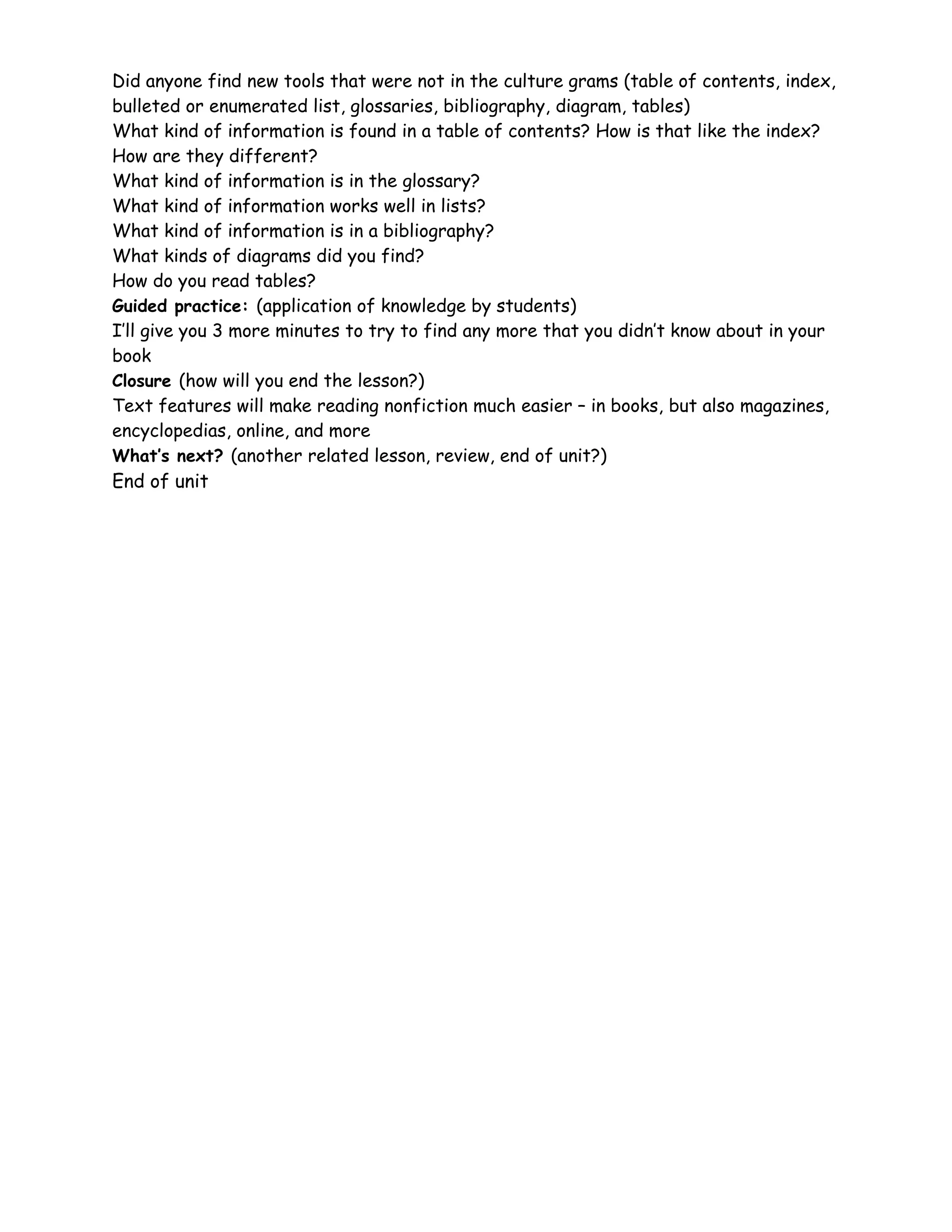
    Did anyone findnew tools that were not in the culture grams (table of contents, index, bulleted or enumerated list, glossaries, bibliography, diagram, tables) What kind of information is found in a table of contents? How is that like the index? How are they different? What kind of information is in the glossary? What kind of information works well in lists? What kind of information is in a bibliography? What kinds of diagrams did you find? How do you read tables? Guided practice: (application of knowledge by students) I’ll give you 3 more minutes to try to find any more that you didn’t know about in your book Closure (how will you end the lesson?) Text features will make reading nonfiction much easier – in books, but also magazines, encyclopedias, online, and more What’s next? (another related lesson, review, end of unit?) End of unit
  • 3.
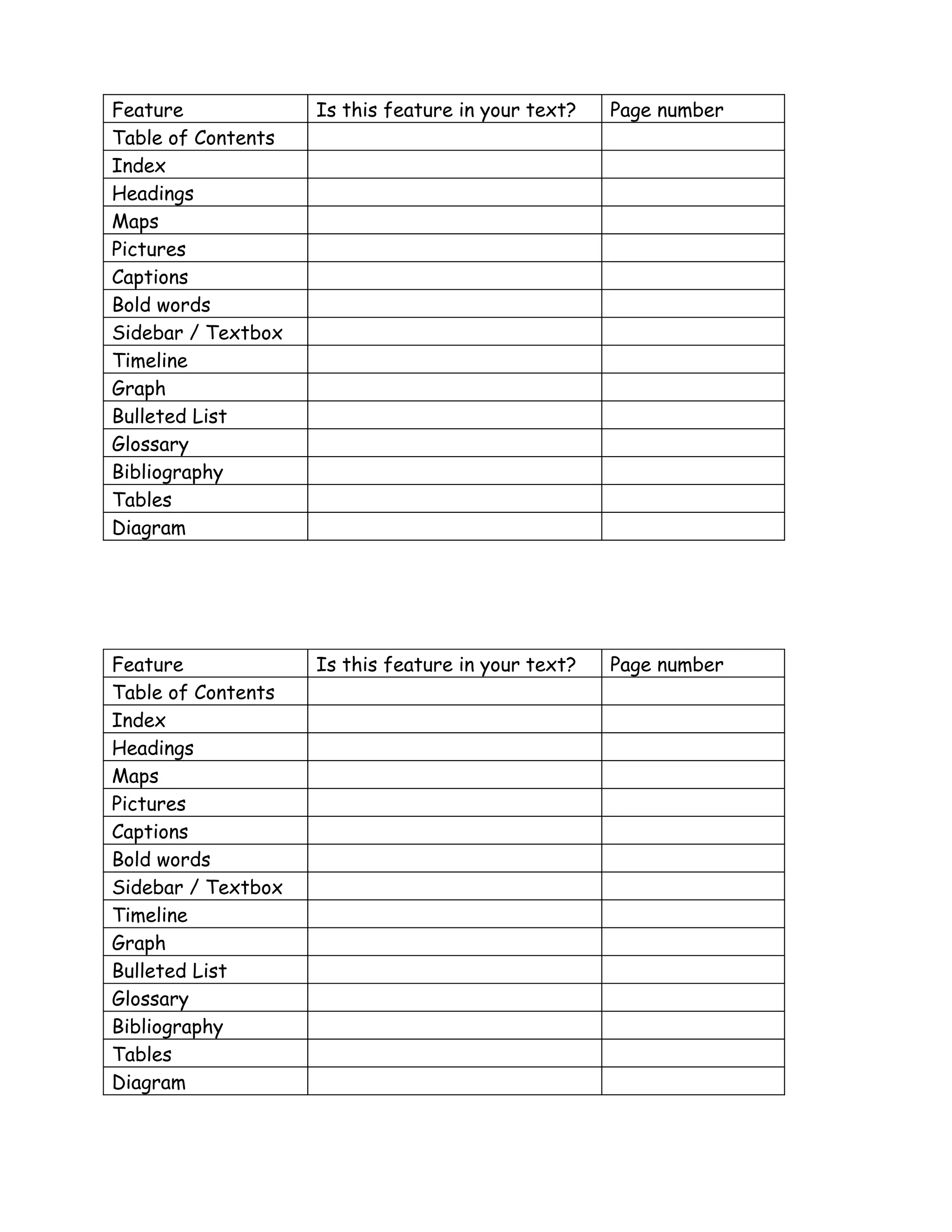
    Feature Is this feature in your text? Page number Table of Contents Index Headings Maps Pictures Captions Bold words Sidebar / Textbox Timeline Graph Bulleted List Glossary Bibliography Tables Diagram Feature Is this feature in your text? Page number Table of Contents Index Headings Maps Pictures Captions Bold words Sidebar / Textbox Timeline Graph Bulleted List Glossary Bibliography Tables Diagram