Texas: separation of powers on steroids
Weak governing institutions
Plural executive
Citizen legislature
Low pay
140 day sessions in odd numbered years only
Balanced budget required
Texas Legislature – The “Lege”
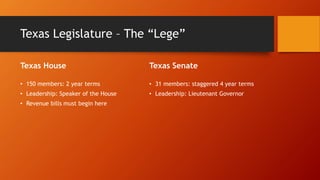
Texas House
• 150 members: 2 year terms
• Leadership: Speaker of the House
• Revenue bills must begin here
Texas Senate
• 31 members: staggered 4 year terms
• Leadership: Lieutenant Governor
Types of Bills
general
Apply everywhere in Texas
local
Apply to specific locations
Local bills apply to only a limited
geographical area or local government
(e.g., the city of Fort Worth, Tarrant).
Because of constitutional limitations
on the types of local bills, the Lege,
uses BRACKET BILLS which do not
name a specific local entity but by
specifying, for instance, that the bill
applies to all counties with a land
area between 6,190 and 6,200 square
miles (only one, Brewster County).
These are technically general bills,
but in reality they function like local
bills.
special
Apply to specific legal persons
The special bills provide exceptions
to general laws for specific
individuals or types of property
Resolutions
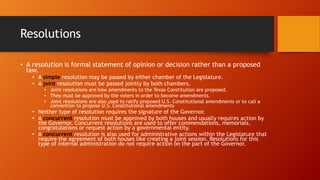
• A resolution is formal statement of opinion or decision rather than a proposed
law.
• A simple resolution may be passed by either chamber of the Legislature.
• A joint resolution must be passed jointly by both chambers.
• Joint resolutions are how amendments to the Texas Constitution are proposed.
• They must be approved by the voters in order to become amendments.
• Joint resolutions are also used to ratify proposed U.S. Constitutional amendments or to call a
convention to propose U.S. Constitutional amendments
• Neither type of resolution requires the signature of the Governor.
• A concurrent resolution must be approved by both houses and usually requires action by
the Governor. Concurrent resolutions are used to offer commendations, memorials,
congratulations or request action by a governmental entity.
• A concurrent resolution is also used for administrative actions within the Legislature that
require the agreement of both houses like creating a joint session. Resolutions for this
type of internal administration do not require action on the part of the Governor.
Investigations and impeachment
• The Lege has the authority to administer oaths and subpoena witnesses
and documents in order to obtain information about issues.
• Such investigations may be conducted jointly by both houses, or by a
single house or single committee within either house.
• The Texas House of Representatives has the power to impeach state
judges as executive branch officials.
• The impeachment process is the 1st step in prosecuting a state official
for crimes and offenses. If the House does impeach an official (i.e., finds
sufficient cause for the charges), the Senate then tries the case.
Texas State Senate Leadership
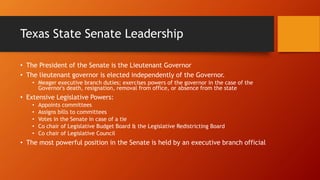
• The President of the Senate is the Lieutenant Governor
• The lieutenant governor is elected independently of the Governor.
• Meager executive branch duties; exercises powers of the governor in the case of the
Governor's death, resignation, removal from office, or absence from the state
• Extensive Legislative Powers:
• Appoints committees
• Assigns bills to committees
• Votes in the Senate in case of a tie
• Co chair of Legislative Budget Board & the Legislative Redistricting Board
• Co chair of Legislative Council
• The most powerful position in the Senate is held by an executive branch official
Texas House Leadership
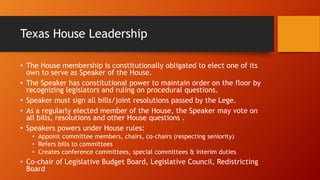
• The House membership is constitutionally obligated to elect one of its
own to serve as Speaker of the House.
• The Speaker has constitutional power to maintain order on the floor by
recognizing legislators and ruling on procedural questions.
• Speaker must sign all bills/joint resolutions passed by the Lege.
• As a regularly elected member of the House, the Speaker may vote on
all bills, resolutions and other House questions .
• Speakers powers under House rules:
• Appoint committee members, chairs, co-chairs (respecting seniority)
• Refers bills to committees
• Creates conference committees, special committees & interim duties
• Co-chair of Legislative Budget Board, Legislative Council, Redistricting
Board
Committees: Where the work is done
Senate
• Standing committees are the permanent committees of the Senate
whose chairs and members are named by the Lieutenant Governor.
• Special committees are essentially subcommittees of regular
Senate standing committees created to study important issues
• These committees have less permanence than standing committees
but can carry over from one session to the next.
House
• Substantive committees deal with issues of substantive public
policy like energy, the environment, and insurance.
• The House has slightly more than twice the number of
substantive committees as the Senate has standing committees.
• 150 member seeking a committee membershipchair or
membership on an important committee.
• Committees have considerable influence.
• Procedural committees are a type of permanent committee that
regulates the working of the. House.
• These committees play a critical role in the legislative process.
• The Calendars committee, e.g., can be very influential given the
short 140-day session.
• Getting an early date for consideration on the floor is critical to a
bill's chances of success.
• Consequently, these are prized committee assignments.
TEMPORARY Committees: within 1 chamber or joint
committee of both
Conference committees: composed of members of both
chambers; formed to resolve differences between bills that
deal with the same issue passed by each house. Compromise
bill is returned to both houses for a final vote.
Interim committees: formed to consider bills when the
legislature is not in session; prep work for the next session or
study a particular problem that has come up since the end of
the last session.
Ad hoc and select committees:formed to study specific
issues, problems or questions.
Impact of Committees
• House and Senate leadership have great impact on
committee membership and which bills go to which
committees.
• Once formed, committees and their committee leaders
have substantional influence over bills referred to them.
• This authority in turn provides considerable opportunity
for committee members, especially their chairs,
to collect substantial campaign contributions from
special interests
How bills are created and become law
• Introduction of bills:
• only members can introduce bills, but non-members write bills (often lobbyists)
• Bills introduced are given a number: Senate bills labelled SB; House bills labelled HB
• Bills can be prefiled on the 1st day in the week following the November elections by current
members and those just elected but not yet seated.
• Texas Constitution requires three readings of a bill on the floor of each house.
• The first reading occurs when the bill is introduced. The House or Senate reads aloud the bill's caption.
• The Speaker or/and the Lieutenant Governor refer bills to committees.
• The second reading occurs after committee hearings, markup, and favorable report.
• The third reading occurs when the bill reaches the floor.
• Because the legislative process is time-consuming and the legislative session is short, it is common for identical
companion bills to be introduced in both houses at once.
Scheduling bills for floor debate
House
• 2 calendar committees schedule floor action
• Local & Consent Calendar; local/minor bills
• Calendar Committee; all other placing them on one of three calendars:
• the Emergency Calendar
• Major State Calendar
• General State Calendar.
• The Calendars Committee has thirty days to place the bill on one of the three
legislative calendars for floor consideration. After this period, any member of
the House can make a motion on the floor to place the bill on a specific
calendar. If seconded by five members and passed by majority vote, the bill
may be scheduled for floor action. This procedure is rarely undertaken.
• When the bill comes up for consideration on the floor as scheduled, it is given
the second reading After all the debate and amendments, the bill is ready for
its third reading. Amendments may still be offered, but these require a two-
thirds majority approval at this point. A simple majority is needed to pass the
final version of the bill.
Senate
• Senate rules require that bills are
considered on the floor in the order they
come from committee
• Blocking bill: a bill that will not be
considered is reported out of committee
and takes the top spot.
• For any subsequent bill to reach the floor,
the Senate must suspend the rules by a 3/5
vote

Texas legislature

  • 1.
    Texas: separation ofpowers on steroids Weak governing institutions Plural executive Citizen legislature Low pay 140 day sessions in odd numbered years only Balanced budget required
  • 2.
    Texas Legislature –The “Lege” Texas House • 150 members: 2 year terms • Leadership: Speaker of the House • Revenue bills must begin here Texas Senate • 31 members: staggered 4 year terms • Leadership: Lieutenant Governor
  • 3.
    Types of Bills general Applyeverywhere in Texas local Apply to specific locations Local bills apply to only a limited geographical area or local government (e.g., the city of Fort Worth, Tarrant). Because of constitutional limitations on the types of local bills, the Lege, uses BRACKET BILLS which do not name a specific local entity but by specifying, for instance, that the bill applies to all counties with a land area between 6,190 and 6,200 square miles (only one, Brewster County). These are technically general bills, but in reality they function like local bills. special Apply to specific legal persons The special bills provide exceptions to general laws for specific individuals or types of property
  • 4.
    Resolutions • A resolutionis formal statement of opinion or decision rather than a proposed law. • A simple resolution may be passed by either chamber of the Legislature. • A joint resolution must be passed jointly by both chambers. • Joint resolutions are how amendments to the Texas Constitution are proposed. • They must be approved by the voters in order to become amendments. • Joint resolutions are also used to ratify proposed U.S. Constitutional amendments or to call a convention to propose U.S. Constitutional amendments • Neither type of resolution requires the signature of the Governor. • A concurrent resolution must be approved by both houses and usually requires action by the Governor. Concurrent resolutions are used to offer commendations, memorials, congratulations or request action by a governmental entity. • A concurrent resolution is also used for administrative actions within the Legislature that require the agreement of both houses like creating a joint session. Resolutions for this type of internal administration do not require action on the part of the Governor.
  • 5.
    Investigations and impeachment •The Lege has the authority to administer oaths and subpoena witnesses and documents in order to obtain information about issues. • Such investigations may be conducted jointly by both houses, or by a single house or single committee within either house. • The Texas House of Representatives has the power to impeach state judges as executive branch officials. • The impeachment process is the 1st step in prosecuting a state official for crimes and offenses. If the House does impeach an official (i.e., finds sufficient cause for the charges), the Senate then tries the case.
  • 6.
    Texas State SenateLeadership • The President of the Senate is the Lieutenant Governor • The lieutenant governor is elected independently of the Governor. • Meager executive branch duties; exercises powers of the governor in the case of the Governor's death, resignation, removal from office, or absence from the state • Extensive Legislative Powers: • Appoints committees • Assigns bills to committees • Votes in the Senate in case of a tie • Co chair of Legislative Budget Board & the Legislative Redistricting Board • Co chair of Legislative Council • The most powerful position in the Senate is held by an executive branch official
  • 7.
    Texas House Leadership •The House membership is constitutionally obligated to elect one of its own to serve as Speaker of the House. • The Speaker has constitutional power to maintain order on the floor by recognizing legislators and ruling on procedural questions. • Speaker must sign all bills/joint resolutions passed by the Lege. • As a regularly elected member of the House, the Speaker may vote on all bills, resolutions and other House questions . • Speakers powers under House rules: • Appoint committee members, chairs, co-chairs (respecting seniority) • Refers bills to committees • Creates conference committees, special committees & interim duties • Co-chair of Legislative Budget Board, Legislative Council, Redistricting Board
  • 8.
    Committees: Where thework is done Senate • Standing committees are the permanent committees of the Senate whose chairs and members are named by the Lieutenant Governor. • Special committees are essentially subcommittees of regular Senate standing committees created to study important issues • These committees have less permanence than standing committees but can carry over from one session to the next. House • Substantive committees deal with issues of substantive public policy like energy, the environment, and insurance. • The House has slightly more than twice the number of substantive committees as the Senate has standing committees. • 150 member seeking a committee membershipchair or membership on an important committee. • Committees have considerable influence. • Procedural committees are a type of permanent committee that regulates the working of the. House. • These committees play a critical role in the legislative process. • The Calendars committee, e.g., can be very influential given the short 140-day session. • Getting an early date for consideration on the floor is critical to a bill's chances of success. • Consequently, these are prized committee assignments. TEMPORARY Committees: within 1 chamber or joint committee of both Conference committees: composed of members of both chambers; formed to resolve differences between bills that deal with the same issue passed by each house. Compromise bill is returned to both houses for a final vote. Interim committees: formed to consider bills when the legislature is not in session; prep work for the next session or study a particular problem that has come up since the end of the last session. Ad hoc and select committees:formed to study specific issues, problems or questions.
  • 9.
    Impact of Committees •House and Senate leadership have great impact on committee membership and which bills go to which committees. • Once formed, committees and their committee leaders have substantional influence over bills referred to them. • This authority in turn provides considerable opportunity for committee members, especially their chairs, to collect substantial campaign contributions from special interests
  • 10.
    How bills arecreated and become law • Introduction of bills: • only members can introduce bills, but non-members write bills (often lobbyists) • Bills introduced are given a number: Senate bills labelled SB; House bills labelled HB • Bills can be prefiled on the 1st day in the week following the November elections by current members and those just elected but not yet seated. • Texas Constitution requires three readings of a bill on the floor of each house. • The first reading occurs when the bill is introduced. The House or Senate reads aloud the bill's caption. • The Speaker or/and the Lieutenant Governor refer bills to committees. • The second reading occurs after committee hearings, markup, and favorable report. • The third reading occurs when the bill reaches the floor. • Because the legislative process is time-consuming and the legislative session is short, it is common for identical companion bills to be introduced in both houses at once.
  • 11.
    Scheduling bills forfloor debate House • 2 calendar committees schedule floor action • Local & Consent Calendar; local/minor bills • Calendar Committee; all other placing them on one of three calendars: • the Emergency Calendar • Major State Calendar • General State Calendar. • The Calendars Committee has thirty days to place the bill on one of the three legislative calendars for floor consideration. After this period, any member of the House can make a motion on the floor to place the bill on a specific calendar. If seconded by five members and passed by majority vote, the bill may be scheduled for floor action. This procedure is rarely undertaken. • When the bill comes up for consideration on the floor as scheduled, it is given the second reading After all the debate and amendments, the bill is ready for its third reading. Amendments may still be offered, but these require a two- thirds majority approval at this point. A simple majority is needed to pass the final version of the bill. Senate • Senate rules require that bills are considered on the floor in the order they come from committee • Blocking bill: a bill that will not be considered is reported out of committee and takes the top spot. • For any subsequent bill to reach the floor, the Senate must suspend the rules by a 3/5 vote