
Testing with Spring:
An Introduction
Sam Brannen
@sam_brannen
Spring eXchange | London, England | November 6, 2014
eXchange 2014
2
Sam Brannen
•  Spring and Java Consultant @ Swiftmind
•  Java Developer for over 15 years
•  Spring Framework Core Committer since 2007
–  Component lead for spring-test
•  Spring Trainer
•  Speaker on Spring, Java, and testing
•  Swiss Spring User Group Lead
3
Swiftmind
Experts in Spring and Enterprise Java
Areas of expertise
•  Spring *
•  Java EE
•  Software Architecture
•  Software Engineering Best Practices
Where you find us
•  Zurich, Switzerland
•  @swiftmind
•  http://www.swiftmind.com
4
A Show of Hands…
? ?
?
?
5
Agenda
•  Unit testing
•  Integration testing
•  Context management and DI
•  Transactions and SQL scripts
•  Spring MVC and REST
•  Q&A
6
Unit Testing
7
Unit Tests
•  are simple to set up
•  use dynamic mocks or stubs for dependencies
•  instantiate the SUT, execute the code, and assert
expectations
•  run fast
•  but only test a single unit
8
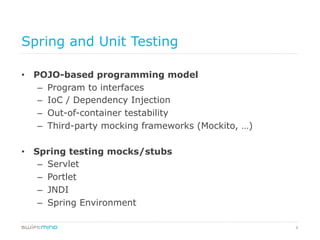
Spring and Unit Testing
•  POJO-based programming model
–  Program to interfaces
–  IoC / Dependency Injection
–  Out-of-container testability
–  Third-party mocking frameworks (Mockito, …)
•  Spring testing mocks/stubs
–  Servlet
–  Portlet
–  JNDI
–  Spring Environment
9
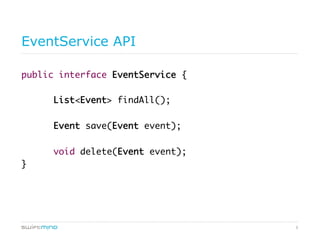
EventService API
public interface EventService {
List<Event> findAll();
Event save(Event event);
void delete(Event event);
}
10
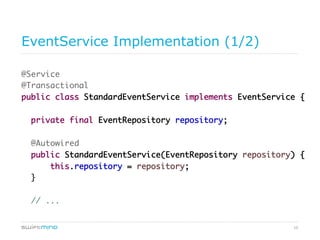
EventService Implementation (1/2)
@Service
@Transactional
public class StandardEventService implements EventService {
private final EventRepository repository;
@Autowired
public StandardEventService(EventRepository repository) {
this.repository = repository;
}
// ...
11
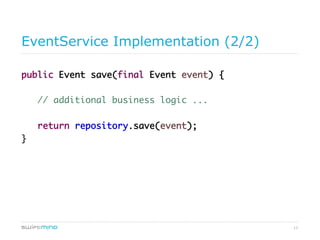
EventService Implementation (2/2)
public Event save(final Event event) {
// additional business logic ...
return repository.save(event);
}
12
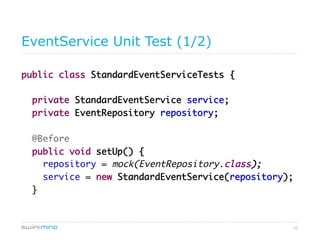
EventService Unit Test (1/2)
public class StandardEventServiceTests {
private StandardEventService service;
private EventRepository repository;
@Before
public void setUp() {
repository = mock(EventRepository.class);
service = new StandardEventService(repository);
}
13
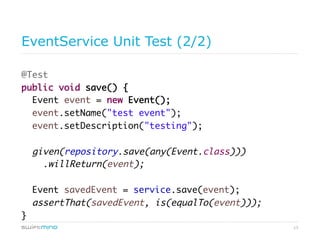
EventService Unit Test (2/2)
@Test
public void save() {
Event event = new Event();
event.setName("test event");
event.setDescription("testing");
given(repository.save(any(Event.class)))
.willReturn(event);
Event savedEvent = service.save(event);
assertThat(savedEvent, is(equalTo(event)));
}
14
Integration Testing
15
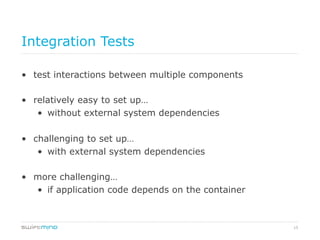
Integration Tests
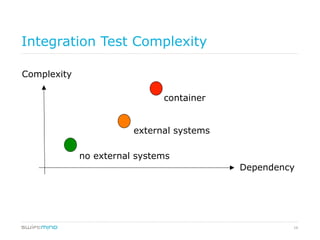
•  test interactions between multiple components
•  relatively easy to set up…
•  without external system dependencies
•  challenging to set up…
•  with external system dependencies
•  more challenging…
•  if application code depends on the container
16
Integration Test Complexity
Complexity
Dependency
no external systems
external systems
container
17
Modern Enterprise Java Apps
•  Integrate with external systems
•  SMTP, FTP, LDAP, RDBMS, Web Services, JMS
•  Rely on container-provided functionality
•  data sources, connection factories, transaction
managers
18
Effective Integration Testing
•  Fast
•  Repeatable
•  Automated
•  Easy to configure
•  Run out-of-container
19
Out-of-container
•  Zero reliance on availability of external systems
•  Can be run anywhere
•  developer workstation
•  CI server
•  Approximate the production environment
•  Embedded database
•  In-memory SMTP server, FTP server, JMS broker
20
Spring TestContext Framework
21
In a nutshell…
The Spring TestContext Framework
… provides annotation-driven unit and integration testing
support that is agnostic of the testing framework in use
… with a strong focus on convention over configuration
and reasonable defaults that can be overridden through
annotation-based configuration
… and integrates with JUnit and TestNG out of the box.
22
Testimony
“The Spring TestContext Framework is an
excellent example of good annotation usage
as it allows composition rather than
inheritance.”
- Costin Leau
23
Feature Set
•  Context management and caching
•  Dependency Injection of test fixtures
•  Transaction management
•  SQL script execution
•  Spring MVC and REST
•  Extension points for customization
24
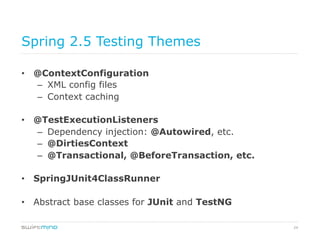
Spring 2.5 Testing Themes
•  @ContextConfiguration
–  XML config files
–  Context caching
•  @TestExecutionListeners
–  Dependency injection: @Autowired, etc.
–  @DirtiesContext
–  @Transactional, @BeforeTransaction, etc.
•  SpringJUnit4ClassRunner
•  Abstract base classes for JUnit and TestNG
25
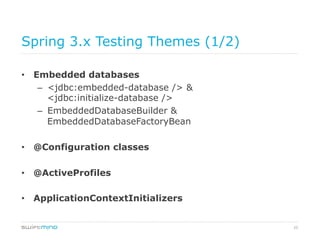
Spring 3.x Testing Themes (1/2)
•  Embedded databases
–  <jdbc:embedded-database /> &
<jdbc:initialize-database />
–  EmbeddedDatabaseBuilder &
EmbeddedDatabaseFactoryBean
•  @Configuration classes
•  @ActiveProfiles
•  ApplicationContextInitializers
26
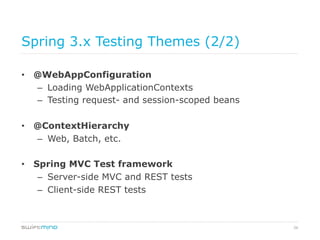
Spring 3.x Testing Themes (2/2)
•  @WebAppConfiguration
–  Loading WebApplicationContexts
–  Testing request- and session-scoped beans
•  @ContextHierarchy
–  Web, Batch, etc.
•  Spring MVC Test framework
–  Server-side MVC and REST tests
–  Client-side REST tests
27
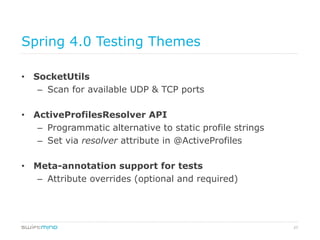
Spring 4.0 Testing Themes
•  SocketUtils
–  Scan for available UDP & TCP ports
•  ActiveProfilesResolver API
–  Programmatic alternative to static profile strings
–  Set via resolver attribute in @ActiveProfiles
•  Meta-annotation support for tests
–  Attribute overrides (optional and required)
28
New in 4.1 – Context Config
•  Context config with Groovy scripts
•  Declarative configuration for test property sources
–  @TestPropertySource
29
New in 4.1 – Transactions & SQL
•  Programmatic test transaction management
–  TestTransaction API
•  Declarative SQL script execution
–  @Sql, @SqlConfig, @SqlGroup
•  Improved docs for transactional tests
30
New in 4.1 – TestExecutionListeners
•  Automatic discovery of default TestExecutionListeners
–  Uses SpringFactoriesLoader
–  Already used by Spring Security
•  Merging custom TestExecutionListeners with defaults
–  @TestExecutionListeners(mergeMode=
MERGE_WITH_DEFAULTS)
–  Defaults to REPLACE_DEFAULTS
31
New in 4.1 – Spring MVC Test
•  Assert JSON responses with JSON Assert
–  Complements JSONPath support
•  Create MockMvcBuilder recipes with MockMvcConfigurer
–  Developed to apply Spring Security setup but can be used
by anyone
•  AsyncRestTemplate support in MockRestServiceServer
–  For asynchronous client-side testing
32
Context Management
33
@ContextConfiguration
•  Declared on test class
–  Inheritance supported but overridable
–  Spring Boot: use @SpringApplicationConfiguration
•  ContextLoader loads ApplicationContext based on:
–  Configuration in annotation
–  Or by detecting default configuration
•  Supports:
–  XML configuration files
–  @Configuration classes
–  Groovy scripts
34
@WebAppConfiguration
•  Declared on test class
•  Instructs Spring to load a WebApplicationContext for the test
•  ServletTestExecutionListener ensures that Servlet API mocks
are properly configured
•  Most often used with the Spring MVC Test Framework
35
@ContextHierarchy
•  Declared on test class
–  Used with @ContextConfiguration
•  Configures hierarchies of test application contexts
–  Useful for Spring MVC, Spring Batch, etc.
36
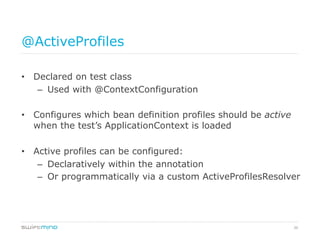
@ActiveProfiles
•  Declared on test class
–  Used with @ContextConfiguration
•  Configures which bean definition profiles should be active
when the test’s ApplicationContext is loaded
•  Active profiles can be configured:
–  Declaratively within the annotation
–  Or programmatically via a custom ActiveProfilesResolver
37
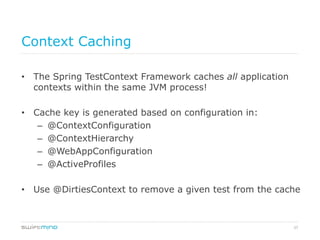
Context Caching
•  The Spring TestContext Framework caches all application
contexts within the same JVM process!
•  Cache key is generated based on configuration in:
–  @ContextConfiguration
–  @ContextHierarchy
–  @WebAppConfiguration
–  @ActiveProfiles
•  Use @DirtiesContext to remove a given test from the cache
38
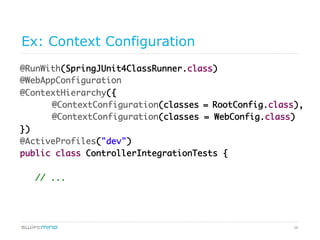
Ex: Context Configuration
@RunWith(SpringJUnit4ClassRunner.class)
@WebAppConfiguration
@ContextHierarchy({
@ContextConfiguration(classes = RootConfig.class),
@ContextConfiguration(classes = WebConfig.class)
})
@ActiveProfiles("dev")
public class ControllerIntegrationTests {
// ...
39
Dependency Injection
40
DI within Integration Tests
•  Dependencies can be injected into a test instance from
the test’s ApplicationContext
•  Using @Autowired, @Inject, @PersistenceContext, etc.
•  The ApplicationContext itself can also be injected into test
instances…
•  @Autowired ApplicationContext
•  @Autowired WebApplicationContext
41
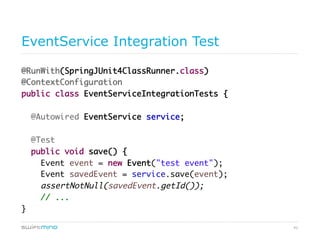
EventService Integration Test
@RunWith(SpringJUnit4ClassRunner.class)
@ContextConfiguration
public class EventServiceIntegrationTests {
@Autowired EventService service;
@Test
public void save() {
Event event = new Event("test event");
Event savedEvent = service.save(event);
assertNotNull(savedEvent.getId());
// ...
}
42
Transactional Tests
43
Transactions in Spring
•  Spring-managed transactions: managed by Spring in
the ApplicationContext
–  @Transactional and AOP
•  Application-managed transactions: managed
programmatically within application code
–  TransactionTemplate and
TransactionSynchronizationManager
•  Test-managed transactions: managed by the Spring
TestContext Framework
–  @Transactional on test classes and test methods
–  Transaction is rolled back by default!
44
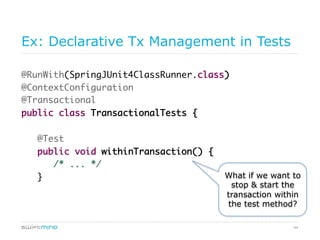
Ex: Declarative Tx Management in Tests
@RunWith(SpringJUnit4ClassRunner.class)
@ContextConfiguration
@Transactional
public class TransactionalTests {
@Test
public void withinTransaction() {
/* ... */
} What if we want to
stop & start the
transaction within
the test method?
45
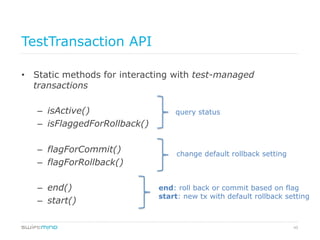
TestTransaction API
•  Static methods for interacting with test-managed
transactions
–  isActive()
–  isFlaggedForRollback()
–  flagForCommit()
–  flagForRollback()
–  end()
–  start()
query status
change default rollback setting
end: roll back or commit based on flag
start: new tx with default rollback setting
46
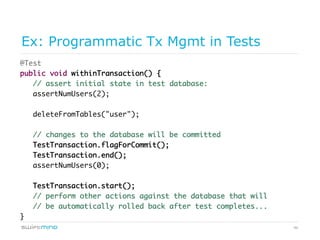
Ex: Programmatic Tx Mgmt in Tests
@Test
public void withinTransaction() {
// assert initial state in test database:
assertNumUsers(2);
deleteFromTables("user");
// changes to the database will be committed
TestTransaction.flagForCommit();
TestTransaction.end();
assertNumUsers(0);
TestTransaction.start();
// perform other actions against the database that will
// be automatically rolled back after test completes...
}
47
SQL Script Execution
48
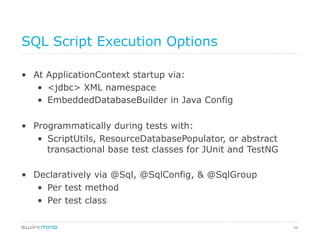
SQL Script Execution Options
•  At ApplicationContext startup via:
•  <jdbc> XML namespace
•  EmbeddedDatabaseBuilder in Java Config
•  Programmatically during tests with:
•  ScriptUtils, ResourceDatabasePopulator, or abstract
transactional base test classes for JUnit and TestNG
•  Declaratively via @Sql, @SqlConfig, & @SqlGroup
•  Per test method
•  Per test class
49
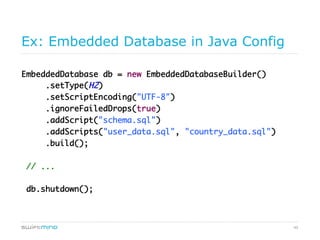
Ex: Embedded Database in Java Config
EmbeddedDatabase db = new EmbeddedDatabaseBuilder()
.setType(H2)
.setScriptEncoding("UTF-8")
.ignoreFailedDrops(true)
.addScript("schema.sql")
.addScripts("user_data.sql", "country_data.sql")
.build();
// ...
db.shutdown();
50
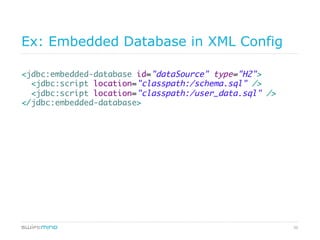
Ex: Embedded Database in XML Config
<jdbc:embedded-database id="dataSource" type="H2">
<jdbc:script location="classpath:/schema.sql" />
<jdbc:script location="classpath:/user_data.sql" />
</jdbc:embedded-database>
51
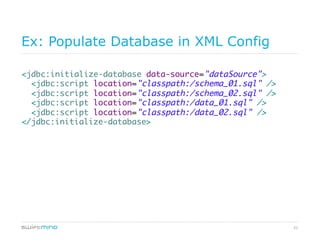
Ex: Populate Database in XML Config
<jdbc:initialize-database data-source="dataSource">
<jdbc:script location="classpath:/schema_01.sql" />
<jdbc:script location="classpath:/schema_02.sql" />
<jdbc:script location="classpath:/data_01.sql" />
<jdbc:script location="classpath:/data_02.sql" />
</jdbc:initialize-database>
52
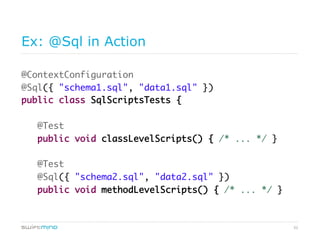
Ex: @Sql in Action
@ContextConfiguration
@Sql({ "schema1.sql", "data1.sql" })
public class SqlScriptsTests {
@Test
public void classLevelScripts() { /* ... */ }
@Test
@Sql({ "schema2.sql", "data2.sql" })
public void methodLevelScripts() { /* ... */ }
53
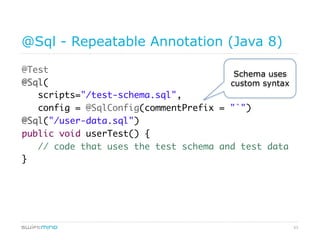
@Sql - Repeatable Annotation (Java 8)
@Test
@Sql(
scripts="/test-schema.sql",
config = @SqlConfig(commentPrefix = "`")
@Sql("/user-data.sql")
public void userTest() {
// code that uses the test schema and test data
}
Schema uses
custom syntax
54
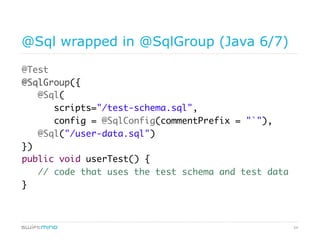
@Sql wrapped in @SqlGroup (Java 6/7)
@Test
@SqlGroup({
@Sql(
scripts="/test-schema.sql",
config = @SqlConfig(commentPrefix = "`"),
@Sql("/user-data.sql")
})
public void userTest() {
// code that uses the test schema and test data
}
55
Spring MVC Test Framework
56
What is Spring MVC Test?
•  Dedicated support for testing Spring MVC applications
•  Fluent API
•  Very easy to write
•  Includes client and server-side support
•  Servlet container not required
57
Details
•  Included in spring-test module of Spring Framework
3.2
•  Builds on
–  TestContext framework for loading Spring MVC
configuration
–  MockHttpServlet[Request|Response] and other
mock types
•  Server-side tests involve DispatcherServlet
•  Client-side REST testing for code using RestTemplate
58
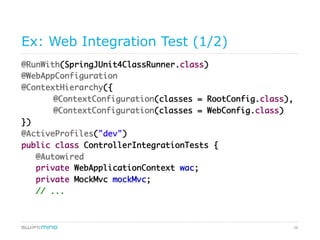
Ex: Web Integration Test (1/2)
@RunWith(SpringJUnit4ClassRunner.class)
@WebAppConfiguration
@ContextHierarchy({
@ContextConfiguration(classes = RootConfig.class),
@ContextConfiguration(classes = WebConfig.class)
})
@ActiveProfiles("dev")
public class ControllerIntegrationTests {
@Autowired
private WebApplicationContext wac;
private MockMvc mockMvc;
// ...
59
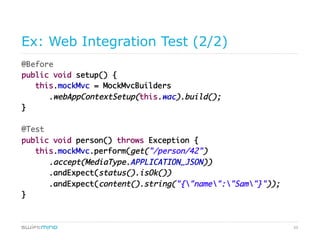
Ex: Web Integration Test (2/2)
@Before
public void setup() {
this.mockMvc = MockMvcBuilders
.webAppContextSetup(this.wac).build();
}
@Test
public void person() throws Exception {
this.mockMvc.perform(get("/person/42")
.accept(MediaType.APPLICATION_JSON))
.andExpect(status().isOk())
.andExpect(content().string("{"name":"Sam"}"));
}
60
In Closing…
61
Spring Resources
•  Spring Framework
–  http://projects.spring.io/spring-framework
•  Spring Guides
–  http://spring.io/guides
•  Spring Forums
–  http://forum.spring.io
•  Spring JIRA
–  https://jira.spring.io
•  Spring on GitHub
–  https://github.com/spring-projects/spring-framework
62
Blogs
•  Swiftmind Blog
–  http://www.swiftmind.com/blog
•  Spring Blog
–  http://spring.io/blog
63
Q & A
Sam Brannen
twitter: @sam_brannen
www.slideshare.net/sbrannen
www.swiftmind.com

Testing with Spring: An Introduction

  • 1.
    Testing with Spring: AnIntroduction Sam Brannen @sam_brannen Spring eXchange | London, England | November 6, 2014 eXchange 2014
  • 2.
    2 Sam Brannen •  Springand Java Consultant @ Swiftmind •  Java Developer for over 15 years •  Spring Framework Core Committer since 2007 –  Component lead for spring-test •  Spring Trainer •  Speaker on Spring, Java, and testing •  Swiss Spring User Group Lead
  • 3.
    3 Swiftmind Experts in Springand Enterprise Java Areas of expertise •  Spring * •  Java EE •  Software Architecture •  Software Engineering Best Practices Where you find us •  Zurich, Switzerland •  @swiftmind •  http://www.swiftmind.com
  • 4.
    4 A Show ofHands… ? ? ? ?
  • 5.
    5 Agenda •  Unit testing • Integration testing •  Context management and DI •  Transactions and SQL scripts •  Spring MVC and REST •  Q&A
  • 6.
  • 7.
    7 Unit Tests •  aresimple to set up •  use dynamic mocks or stubs for dependencies •  instantiate the SUT, execute the code, and assert expectations •  run fast •  but only test a single unit
  • 8.
    8 Spring and UnitTesting •  POJO-based programming model –  Program to interfaces –  IoC / Dependency Injection –  Out-of-container testability –  Third-party mocking frameworks (Mockito, …) •  Spring testing mocks/stubs –  Servlet –  Portlet –  JNDI –  Spring Environment
  • 9.
    9 EventService API public interfaceEventService { List<Event> findAll(); Event save(Event event); void delete(Event event); }
  • 10.
    10 EventService Implementation (1/2) @Service @Transactional publicclass StandardEventService implements EventService { private final EventRepository repository; @Autowired public StandardEventService(EventRepository repository) { this.repository = repository; } // ...
  • 11.
    11 EventService Implementation (2/2) publicEvent save(final Event event) { // additional business logic ... return repository.save(event); }
  • 12.
    12 EventService Unit Test(1/2) public class StandardEventServiceTests { private StandardEventService service; private EventRepository repository; @Before public void setUp() { repository = mock(EventRepository.class); service = new StandardEventService(repository); }
  • 13.
    13 EventService Unit Test(2/2) @Test public void save() { Event event = new Event(); event.setName("test event"); event.setDescription("testing"); given(repository.save(any(Event.class))) .willReturn(event); Event savedEvent = service.save(event); assertThat(savedEvent, is(equalTo(event))); }
  • 14.
  • 15.
    15 Integration Tests •  testinteractions between multiple components •  relatively easy to set up… •  without external system dependencies •  challenging to set up… •  with external system dependencies •  more challenging… •  if application code depends on the container
  • 16.
    16 Integration Test Complexity Complexity Dependency noexternal systems external systems container
  • 17.
    17 Modern Enterprise JavaApps •  Integrate with external systems •  SMTP, FTP, LDAP, RDBMS, Web Services, JMS •  Rely on container-provided functionality •  data sources, connection factories, transaction managers
  • 18.
    18 Effective Integration Testing • Fast •  Repeatable •  Automated •  Easy to configure •  Run out-of-container
  • 19.
    19 Out-of-container •  Zero relianceon availability of external systems •  Can be run anywhere •  developer workstation •  CI server •  Approximate the production environment •  Embedded database •  In-memory SMTP server, FTP server, JMS broker
  • 20.
  • 21.
    21 In a nutshell… TheSpring TestContext Framework … provides annotation-driven unit and integration testing support that is agnostic of the testing framework in use … with a strong focus on convention over configuration and reasonable defaults that can be overridden through annotation-based configuration … and integrates with JUnit and TestNG out of the box.
  • 22.
    22 Testimony “The Spring TestContextFramework is an excellent example of good annotation usage as it allows composition rather than inheritance.” - Costin Leau
  • 23.
    23 Feature Set •  Contextmanagement and caching •  Dependency Injection of test fixtures •  Transaction management •  SQL script execution •  Spring MVC and REST •  Extension points for customization
  • 24.
    24 Spring 2.5 TestingThemes •  @ContextConfiguration –  XML config files –  Context caching •  @TestExecutionListeners –  Dependency injection: @Autowired, etc. –  @DirtiesContext –  @Transactional, @BeforeTransaction, etc. •  SpringJUnit4ClassRunner •  Abstract base classes for JUnit and TestNG
  • 25.
    25 Spring 3.x TestingThemes (1/2) •  Embedded databases –  <jdbc:embedded-database /> & <jdbc:initialize-database /> –  EmbeddedDatabaseBuilder & EmbeddedDatabaseFactoryBean •  @Configuration classes •  @ActiveProfiles •  ApplicationContextInitializers
  • 26.
    26 Spring 3.x TestingThemes (2/2) •  @WebAppConfiguration –  Loading WebApplicationContexts –  Testing request- and session-scoped beans •  @ContextHierarchy –  Web, Batch, etc. •  Spring MVC Test framework –  Server-side MVC and REST tests –  Client-side REST tests
  • 27.
    27 Spring 4.0 TestingThemes •  SocketUtils –  Scan for available UDP & TCP ports •  ActiveProfilesResolver API –  Programmatic alternative to static profile strings –  Set via resolver attribute in @ActiveProfiles •  Meta-annotation support for tests –  Attribute overrides (optional and required)
  • 28.
    28 New in 4.1– Context Config •  Context config with Groovy scripts •  Declarative configuration for test property sources –  @TestPropertySource
  • 29.
    29 New in 4.1– Transactions & SQL •  Programmatic test transaction management –  TestTransaction API •  Declarative SQL script execution –  @Sql, @SqlConfig, @SqlGroup •  Improved docs for transactional tests
  • 30.
    30 New in 4.1– TestExecutionListeners •  Automatic discovery of default TestExecutionListeners –  Uses SpringFactoriesLoader –  Already used by Spring Security •  Merging custom TestExecutionListeners with defaults –  @TestExecutionListeners(mergeMode= MERGE_WITH_DEFAULTS) –  Defaults to REPLACE_DEFAULTS
  • 31.
    31 New in 4.1– Spring MVC Test •  Assert JSON responses with JSON Assert –  Complements JSONPath support •  Create MockMvcBuilder recipes with MockMvcConfigurer –  Developed to apply Spring Security setup but can be used by anyone •  AsyncRestTemplate support in MockRestServiceServer –  For asynchronous client-side testing
  • 32.
  • 33.
    33 @ContextConfiguration •  Declared ontest class –  Inheritance supported but overridable –  Spring Boot: use @SpringApplicationConfiguration •  ContextLoader loads ApplicationContext based on: –  Configuration in annotation –  Or by detecting default configuration •  Supports: –  XML configuration files –  @Configuration classes –  Groovy scripts
  • 34.
    34 @WebAppConfiguration •  Declared ontest class •  Instructs Spring to load a WebApplicationContext for the test •  ServletTestExecutionListener ensures that Servlet API mocks are properly configured •  Most often used with the Spring MVC Test Framework
  • 35.
    35 @ContextHierarchy •  Declared ontest class –  Used with @ContextConfiguration •  Configures hierarchies of test application contexts –  Useful for Spring MVC, Spring Batch, etc.
  • 36.
    36 @ActiveProfiles •  Declared ontest class –  Used with @ContextConfiguration •  Configures which bean definition profiles should be active when the test’s ApplicationContext is loaded •  Active profiles can be configured: –  Declaratively within the annotation –  Or programmatically via a custom ActiveProfilesResolver
  • 37.
    37 Context Caching •  TheSpring TestContext Framework caches all application contexts within the same JVM process! •  Cache key is generated based on configuration in: –  @ContextConfiguration –  @ContextHierarchy –  @WebAppConfiguration –  @ActiveProfiles •  Use @DirtiesContext to remove a given test from the cache
  • 38.
    38 Ex: Context Configuration @RunWith(SpringJUnit4ClassRunner.class) @WebAppConfiguration @ContextHierarchy({ @ContextConfiguration(classes= RootConfig.class), @ContextConfiguration(classes = WebConfig.class) }) @ActiveProfiles("dev") public class ControllerIntegrationTests { // ...
  • 39.
  • 40.
    40 DI within IntegrationTests •  Dependencies can be injected into a test instance from the test’s ApplicationContext •  Using @Autowired, @Inject, @PersistenceContext, etc. •  The ApplicationContext itself can also be injected into test instances… •  @Autowired ApplicationContext •  @Autowired WebApplicationContext
  • 41.
    41 EventService Integration Test @RunWith(SpringJUnit4ClassRunner.class) @ContextConfiguration publicclass EventServiceIntegrationTests { @Autowired EventService service; @Test public void save() { Event event = new Event("test event"); Event savedEvent = service.save(event); assertNotNull(savedEvent.getId()); // ... }
  • 42.
  • 43.
    43 Transactions in Spring • Spring-managed transactions: managed by Spring in the ApplicationContext –  @Transactional and AOP •  Application-managed transactions: managed programmatically within application code –  TransactionTemplate and TransactionSynchronizationManager •  Test-managed transactions: managed by the Spring TestContext Framework –  @Transactional on test classes and test methods –  Transaction is rolled back by default!
  • 44.
    44 Ex: Declarative TxManagement in Tests @RunWith(SpringJUnit4ClassRunner.class) @ContextConfiguration @Transactional public class TransactionalTests { @Test public void withinTransaction() { /* ... */ } What if we want to stop & start the transaction within the test method?
  • 45.
    45 TestTransaction API •  Staticmethods for interacting with test-managed transactions –  isActive() –  isFlaggedForRollback() –  flagForCommit() –  flagForRollback() –  end() –  start() query status change default rollback setting end: roll back or commit based on flag start: new tx with default rollback setting
  • 46.
    46 Ex: Programmatic TxMgmt in Tests @Test public void withinTransaction() { // assert initial state in test database: assertNumUsers(2); deleteFromTables("user"); // changes to the database will be committed TestTransaction.flagForCommit(); TestTransaction.end(); assertNumUsers(0); TestTransaction.start(); // perform other actions against the database that will // be automatically rolled back after test completes... }
  • 47.
  • 48.
    48 SQL Script ExecutionOptions •  At ApplicationContext startup via: •  <jdbc> XML namespace •  EmbeddedDatabaseBuilder in Java Config •  Programmatically during tests with: •  ScriptUtils, ResourceDatabasePopulator, or abstract transactional base test classes for JUnit and TestNG •  Declaratively via @Sql, @SqlConfig, & @SqlGroup •  Per test method •  Per test class
  • 49.
    49 Ex: Embedded Databasein Java Config EmbeddedDatabase db = new EmbeddedDatabaseBuilder() .setType(H2) .setScriptEncoding("UTF-8") .ignoreFailedDrops(true) .addScript("schema.sql") .addScripts("user_data.sql", "country_data.sql") .build(); // ... db.shutdown();
  • 50.
    50 Ex: Embedded Databasein XML Config <jdbc:embedded-database id="dataSource" type="H2"> <jdbc:script location="classpath:/schema.sql" /> <jdbc:script location="classpath:/user_data.sql" /> </jdbc:embedded-database>
  • 51.
    51 Ex: Populate Databasein XML Config <jdbc:initialize-database data-source="dataSource"> <jdbc:script location="classpath:/schema_01.sql" /> <jdbc:script location="classpath:/schema_02.sql" /> <jdbc:script location="classpath:/data_01.sql" /> <jdbc:script location="classpath:/data_02.sql" /> </jdbc:initialize-database>
  • 52.
    52 Ex: @Sql inAction @ContextConfiguration @Sql({ "schema1.sql", "data1.sql" }) public class SqlScriptsTests { @Test public void classLevelScripts() { /* ... */ } @Test @Sql({ "schema2.sql", "data2.sql" }) public void methodLevelScripts() { /* ... */ }
  • 53.
    53 @Sql - RepeatableAnnotation (Java 8) @Test @Sql( scripts="/test-schema.sql", config = @SqlConfig(commentPrefix = "`") @Sql("/user-data.sql") public void userTest() { // code that uses the test schema and test data } Schema uses custom syntax
  • 54.
    54 @Sql wrapped in@SqlGroup (Java 6/7) @Test @SqlGroup({ @Sql( scripts="/test-schema.sql", config = @SqlConfig(commentPrefix = "`"), @Sql("/user-data.sql") }) public void userTest() { // code that uses the test schema and test data }
  • 55.
  • 56.
    56 What is SpringMVC Test? •  Dedicated support for testing Spring MVC applications •  Fluent API •  Very easy to write •  Includes client and server-side support •  Servlet container not required
  • 57.
    57 Details •  Included inspring-test module of Spring Framework 3.2 •  Builds on –  TestContext framework for loading Spring MVC configuration –  MockHttpServlet[Request|Response] and other mock types •  Server-side tests involve DispatcherServlet •  Client-side REST testing for code using RestTemplate
  • 58.
    58 Ex: Web IntegrationTest (1/2) @RunWith(SpringJUnit4ClassRunner.class) @WebAppConfiguration @ContextHierarchy({ @ContextConfiguration(classes = RootConfig.class), @ContextConfiguration(classes = WebConfig.class) }) @ActiveProfiles("dev") public class ControllerIntegrationTests { @Autowired private WebApplicationContext wac; private MockMvc mockMvc; // ...
  • 59.
    59 Ex: Web IntegrationTest (2/2) @Before public void setup() { this.mockMvc = MockMvcBuilders .webAppContextSetup(this.wac).build(); } @Test public void person() throws Exception { this.mockMvc.perform(get("/person/42") .accept(MediaType.APPLICATION_JSON)) .andExpect(status().isOk()) .andExpect(content().string("{"name":"Sam"}")); }
  • 60.
  • 61.
    61 Spring Resources •  SpringFramework –  http://projects.spring.io/spring-framework •  Spring Guides –  http://spring.io/guides •  Spring Forums –  http://forum.spring.io •  Spring JIRA –  https://jira.spring.io •  Spring on GitHub –  https://github.com/spring-projects/spring-framework
  • 62.
    62 Blogs •  Swiftmind Blog – http://www.swiftmind.com/blog •  Spring Blog –  http://spring.io/blog
  • 63.
    63 Q & A SamBrannen twitter: @sam_brannen www.slideshare.net/sbrannen www.swiftmind.com