Spring 3.1 in a Nutshell


Sam Brannen
Swiftmind
Java Track 12.2
Talk #394
Speaker Profile

>    Java developer with 13+ years' experience
>    Spring Framework Core Developer
>    Lead author of Spring in a Nutshell
>    Previous SpringSource dm Server™ developer
>    Presenter on Spring, Java, OSGi, and testing
>    Senior Software Consultant @ Swiftmind


                                                    2
Agenda

>    Major Themes in 3.x
>    Environment and Profiles
>    Java-based Configuration
>    Testing
>    Caching
>    MVC and REST
>    Servlet 3.0
>    Odds & Ends


                                3
Major Themes in Spring 3.x


                             4
Spring Framework 3.0: A Quick Review


>  Annotation-based component model
   –  Stereotypes, autowiring, factory methods, JSR-330
>  Spring Expression Language
   –  Unified EL++
>  REST support in Spring MVC
   –  Various @MVC programming model improvements
>  Portlet API 2.0
   –  Event/Resource requests
>  Declarative model validation
   –  JSR-303 bean validation
>  Java EE 6 support
   –  JPA 2.0, JSF 2.0 but also JSR-330, JSR-303          5
Spring Framework 3.1: Major Themes


>  Environment Abstraction
   –  PropertySources, Bean Profiles, TestContext support
>  Java-based Application Configuration
   –  Equivalents for XML namespaces, FactoryBeans, TestContext support
>  High-level Cache API
   –  Transparent use of various caching solutions
>  Customizable @MVC Processing
   –  New infrastructure for annotated controllers
>  Explicit Support for Servlet 3.0
   –  ServletContainerInitializer and MultipartResolver


                                                                          6
Environment and Profiles


                           7
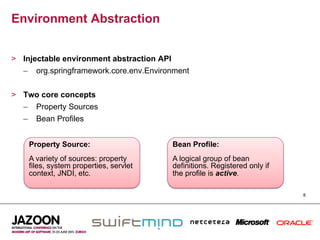
Environment Abstraction


>  Injectable environment abstraction API
   –  org.springframework.core.env.Environment


>  Two core concepts
   –  Property Sources
   –  Bean Profiles


    Property Source:                     Bean Profile:
    A variety of sources: property       A logical group of bean
    files, system properties, servlet    definitions. Registered only if
    context, JNDI, etc.                  the profile is active.

                                                                           8
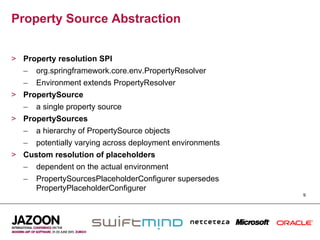
Property Source Abstraction


>  Property resolution SPI
   –  org.springframework.core.env.PropertyResolver
   –  Environment extends PropertyResolver
>  PropertySource
   –  a single property source
>  PropertySources
   –  a hierarchy of PropertySource objects
   –  potentially varying across deployment environments
>  Custom resolution of placeholders
   –  dependent on the actual environment
   –  PropertySourcesPlaceholderConfigurer supersedes
      PropertyPlaceholderConfigurer
                                                           9
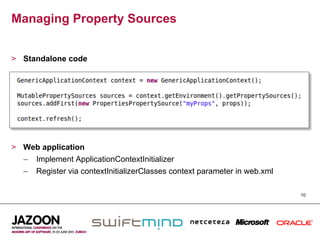
Managing Property Sources


>  Standalone code


>  Web application
   –  Implement ApplicationContextInitializer
   –  Register via contextInitializerClasses context parameter in web.xml

                                                                            10
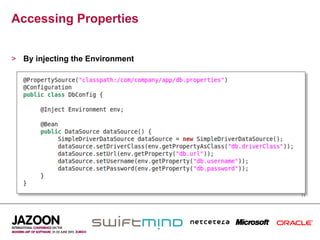
Accessing Properties


>  By injecting the Environment


                                  11
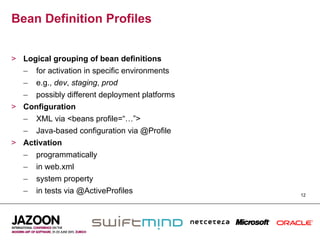
Bean Definition Profiles


>  Logical grouping of bean definitions
   –  for activation in specific environments
   –  e.g., dev, staging, prod
   –  possibly different deployment platforms
>  Configuration
   –  XML via <beans profile=“…”>
   –  Java-based configuration via @Profile
>  Activation
   –  programmatically
   –  in web.xml
   –  system property
   –  in tests via @ActiveProfiles              12
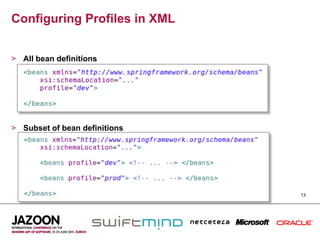
Configuring Profiles in XML


>  All bean definitions


>  Subset of bean definitions


                                13
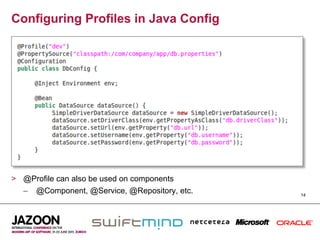
Configuring Profiles in Java Config


>  @Profile can also be used on components
   –  @Component, @Service, @Repository, etc.   14
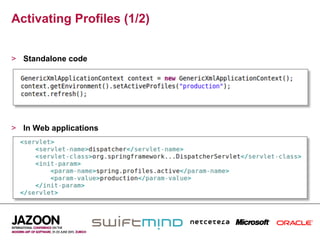
Activating Profiles (1/2)


>  Standalone code


>  In Web applications


                            15
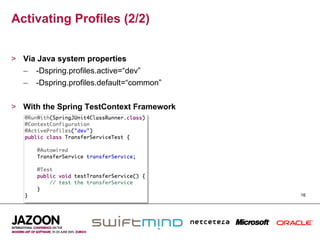
Activating Profiles (2/2)


>  Via Java system properties
   –  -Dspring.profiles.active=“dev”
   –  -Dspring.profiles.default=“common”


>  With the Spring TestContext Framework


                                           16
Java-based Configuration


                           17
Java Configuration Enhancements


>  Java-based equivalent to mechanisms available in XML
   –  XML namespaces  @Enable*
   –  FactoryBeans  builders
   –  GenericXmlContextLoader  AnnotationConfigContextLoader
>  Not a one-on-one mapping
   –  Make the most of what Java has to offer
   –  Intuitive annotation-oriented container configuration
>  Typical infrastructure setup
   –  transactions
   –  scheduling
   –  MVC customization
                                                                18
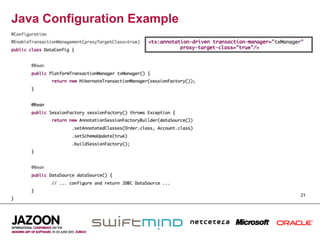
@Enable* Annotations


>  Applied at the class-level on @Configuration classes


>  Roughly equivalent to their XML namespace counterparts


>  Available in Spring 3.1 M2:
   –  @EnableTransactionManagement
   –  @EnableAsync
   –  @EnableScheduling
   –  @EnableLoadTimeWeaving
   –  @EnableWebMvc


                                                            19
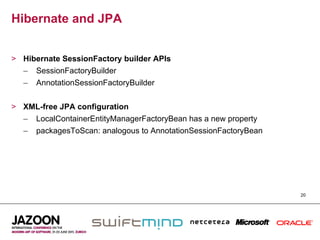
Hibernate and JPA


>  Hibernate SessionFactory builder APIs
   –  SessionFactoryBuilder
   –  AnnotationSessionFactoryBuilder


>  XML-free JPA configuration
   –  LocalContainerEntityManagerFactoryBean has a new property
   –  packagesToScan: analogous to AnnotationSessionFactoryBean


                                                                  20
Java Configuration Example


                             21
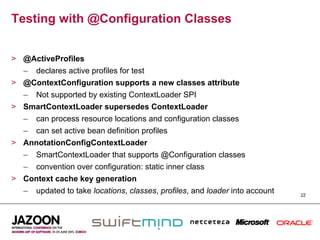
Testing with @Configuration Classes


>  @ActiveProfiles
   –  declares active profiles for test
>  @ContextConfiguration supports a new classes attribute
   –  Not supported by existing ContextLoader SPI
>  SmartContextLoader supersedes ContextLoader
   –  can process resource locations and configuration classes
   –  can set active bean definition profiles
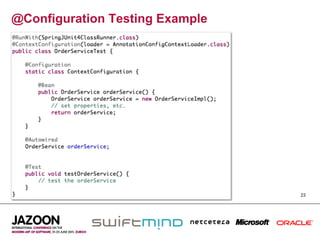
>  AnnotationConfigContextLoader
   –  SmartContextLoader that supports @Configuration classes
   –  convention over configuration: static inner class
>  Context cache key generation
   –  updated to take locations, classes, profiles, and loader into account   22
@Configuration Testing Example


                                 23
Caching


          24
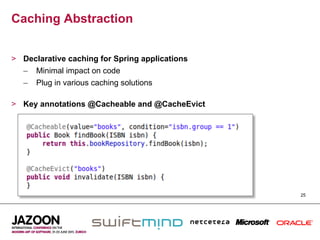
Caching Abstraction


>  Declarative caching for Spring applications
   –  Minimal impact on code
   –  Plug in various caching solutions

>  Key annotations @Cacheable and @CacheEvict


                                                 25
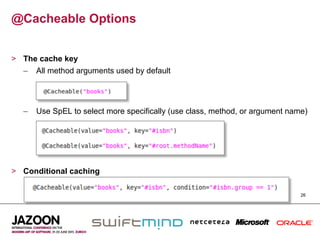
@Cacheable Options


>  The cache key
   –  All method arguments used by default


   –  Use SpEL to select more specifically (use class, method, or argument name)


>  Conditional caching

                                                                              26
Cache Providers


>  Cache and CacheManager SPI
   –  org.springframework.cache


>  Cache Implementations
   –  EhCacheCache
   –  ConcurrentMapCache and ConcurrentMapCacheFactoryBean
>  CacheManager Implementations
   –  EhCacheCacheManager
   –  SimpleCacheManager


>  Any other implementation can be plugged in
   –  GemFire, Coherence, etc.                               27
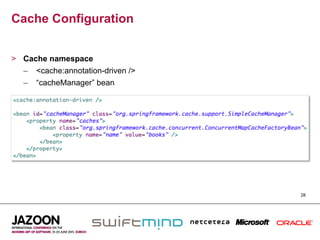
Cache Configuration


>  Cache namespace
   –  <cache:annotation-driven />
   –  “cacheManager” bean


                                    28
MVC and REST


               29
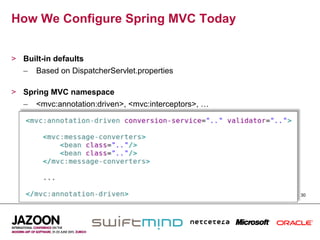
How We Configure Spring MVC Today


>  Built-in defaults
   –  Based on DispatcherServlet.properties

>  Spring MVC namespace
   –  <mvc:annotation:driven>, <mvc:interceptors>, …


                                                       30
Why Java-based Configuration For Spring MVC?


>  Most Spring MVC configuration is in Java already
   –  @Controller, @RequestMapping, etc.

>  Servlet 3.0 enhancements will further reduce the need for web.xml

>  XML namespace is convenient but …
   –  Not transparent
   –  Not easy to offer the right degree of customization


>  … What should a Java equivalent to the MVC namespace look like?
                                                                       31
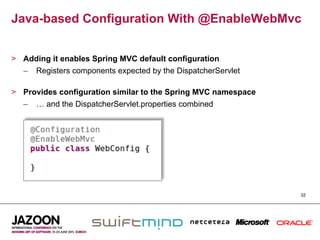
Java-based Configuration With @EnableWebMvc


>  Adding it enables Spring MVC default configuration
   –  Registers components expected by the DispatcherServlet

>  Provides configuration similar to the Spring MVC namespace
   –  … and the DispatcherServlet.properties combined


                                                                32
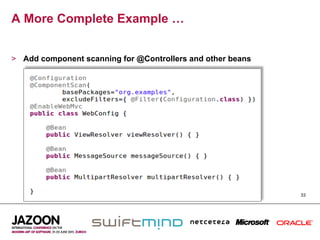
A More Complete Example …


>  Add component scanning for @Controllers and other beans


                                                             33
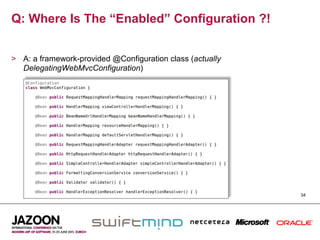
Q: Where Is The “Enabled” Configuration ?!


>  A: a framework-provided @Configuration class (actually
   DelegatingWebMvcConfiguration)


                                                            34
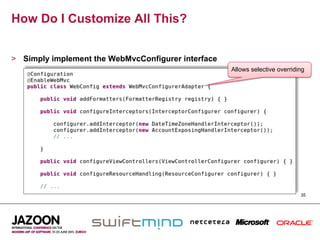
How Do I Customize All This?


>  Simply implement the WebMvcConfigurer interface
                                                     Allows selective overriding


                                                                              35
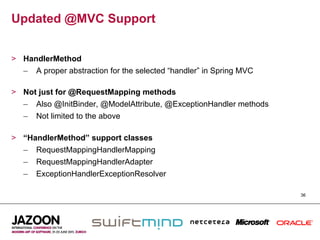
Updated @MVC Support


>  HandlerMethod
   –  A proper abstraction for the selected “handler” in Spring MVC

>  Not just for @RequestMapping methods
   –  Also @InitBinder, @ModelAttribute, @ExceptionHandler methods
   –  Not limited to the above

>  “HandlerMethod” support classes
   –  RequestMappingHandlerMapping
   –  RequestMappingHandlerAdapter
   –  ExceptionHandlerExceptionResolver

                                                                      36
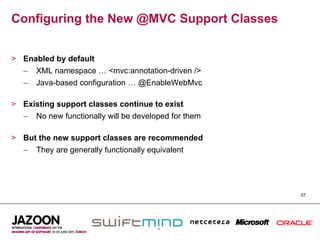
Configuring the New @MVC Support Classes


>  Enabled by default
   –  XML namespace … <mvc:annotation-driven />
   –  Java-based configuration … @EnableWebMvc

>  Existing support classes continue to exist
   –  No new functionally will be developed for them

>  But the new support classes are recommended
   –  They are generally functionally equivalent


                                                       37
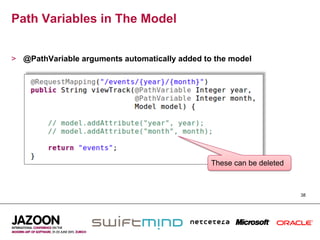
Path Variables in The Model


>  @PathVariable arguments automatically added to the model


                                                 These can be deleted


                                                                        38
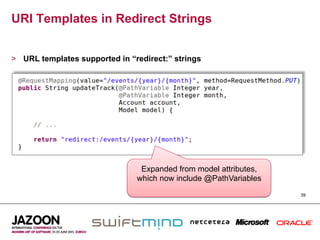
URI Templates in Redirect Strings


>  URL templates supported in “redirect:” strings


                                 Expanded from model attributes,
                                which now include @PathVariables
                                                                   39
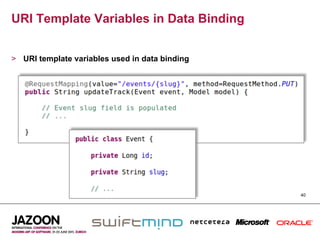
URI Template Variables in Data Binding


>  URI template variables used in data binding


                                                 40
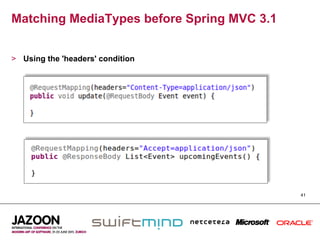
Matching MediaTypes before Spring MVC 3.1


>  Using the 'headers' condition


                                            41
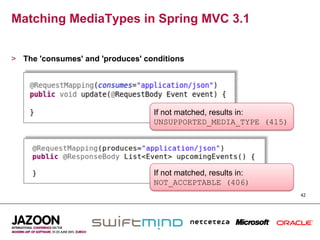
Matching MediaTypes in Spring MVC 3.1


>  The 'consumes' and 'produces' conditions


                                   If not matched, results in:
                                   UNSUPPORTED_MEDIA_TYPE (415)


                                   If not matched, results in:
                                   NOT_ACCEPTABLE (406)
                                                                  42
Servlet 3.0


              43
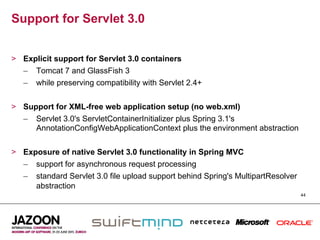
Support for Servlet 3.0


>  Explicit support for Servlet 3.0 containers
   –  Tomcat 7 and GlassFish 3
   –  while preserving compatibility with Servlet 2.4+


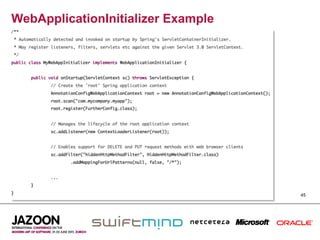
>  Support for XML-free web application setup (no web.xml)
   –  Servlet 3.0's ServletContainerInitializer plus Spring 3.1's
      AnnotationConfigWebApplicationContext plus the environment abstraction


>  Exposure of native Servlet 3.0 functionality in Spring MVC
   –  support for asynchronous request processing
   –  standard Servlet 3.0 file upload support behind Spring's MultipartResolver
      abstraction
                                                                                   44
WebApplicationInitializer Example


                                    45
Odds & Ends


              46
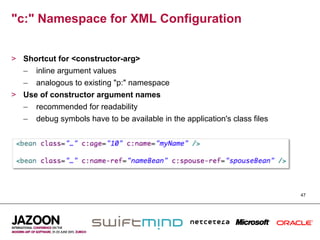
"c:" Namespace for XML Configuration


>  Shortcut for <constructor-arg>
   –  inline argument values
   –  analogous to existing "p:" namespace
>  Use of constructor argument names
   –  recommended for readability
   –  debug symbols have to be available in the application's class files


                                                                            47
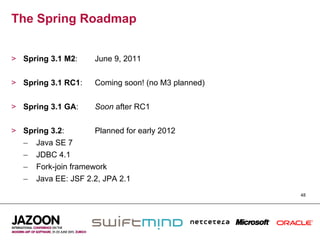
The Spring Roadmap


>  Spring 3.1 M2:     June 9, 2011


>  Spring 3.1 RC1:    Coming soon! (no M3 planned)


>  Spring 3.1 GA:     Soon after RC1


>  Spring 3.2:        Planned for early 2012
   –  Java SE 7
   –  JDBC 4.1
   –  Fork-join framework
   –  Java EE: JSF 2.2, JPA 2.1
                                                     48
Spring 3.1 in a Nutshell


>    Environment and Profiles
>    Java-based Configuration and @Enable*
>    Testing with @Configuration and Profiles
>    Cache Abstraction
>    MVC and REST Improvements
>    Servlet 3.0
>    c: Namespace


                                                49
Further Resources


>  Spring Framework
   –  http://springframework.org
   –  Spring Reference Manual
   –  JavaDoc
>  Spring Forums
   –  http://forum.springframework.org
>  Spring JIRA
   –  http://jira.springframework.org
>  SpringSource Team Blog – category 3.1
   –  http://blog.springsource.com/category/spring/31/
>  Swiftmind Blog
   –  http://www.swiftmind.com/blog/                     50
Special Thanks to…


>  Jürgen Höller, Chris Beams, and Rossen Stoyanchev of SpringSource
   –  for donating examples and content to make this presentation possible


                                                                             51
Q&A
Sam Brannen                         sam.brannen@swiftmind.com
Swiftmind                           twitter: @sam_brannen
                                    www.slideshare.net/sbrannen
                                    www.swiftmind.com


“Spring in a Nutshell”
   http://oreilly.com/catalog/9780596801946
   available from O’Reilly in early 2012

Spring 3.1 in a Nutshell

  • 1.
    Spring 3.1 ina Nutshell Sam Brannen Swiftmind Java Track 12.2 Talk #394
  • 2.
    Speaker Profile >  Java developer with 13+ years' experience >  Spring Framework Core Developer >  Lead author of Spring in a Nutshell >  Previous SpringSource dm Server™ developer >  Presenter on Spring, Java, OSGi, and testing >  Senior Software Consultant @ Swiftmind 2
  • 3.
    Agenda >  Major Themes in 3.x >  Environment and Profiles >  Java-based Configuration >  Testing >  Caching >  MVC and REST >  Servlet 3.0 >  Odds & Ends 3
  • 4.
    Major Themes inSpring 3.x 4
  • 5.
    Spring Framework 3.0:A Quick Review >  Annotation-based component model –  Stereotypes, autowiring, factory methods, JSR-330 >  Spring Expression Language –  Unified EL++ >  REST support in Spring MVC –  Various @MVC programming model improvements >  Portlet API 2.0 –  Event/Resource requests >  Declarative model validation –  JSR-303 bean validation >  Java EE 6 support –  JPA 2.0, JSF 2.0 but also JSR-330, JSR-303 5
  • 6.
    Spring Framework 3.1:Major Themes >  Environment Abstraction –  PropertySources, Bean Profiles, TestContext support >  Java-based Application Configuration –  Equivalents for XML namespaces, FactoryBeans, TestContext support >  High-level Cache API –  Transparent use of various caching solutions >  Customizable @MVC Processing –  New infrastructure for annotated controllers >  Explicit Support for Servlet 3.0 –  ServletContainerInitializer and MultipartResolver 6
  • 7.
  • 8.
    Environment Abstraction >  Injectableenvironment abstraction API –  org.springframework.core.env.Environment >  Two core concepts –  Property Sources –  Bean Profiles Property Source: Bean Profile: A variety of sources: property A logical group of bean files, system properties, servlet definitions. Registered only if context, JNDI, etc. the profile is active. 8
  • 9.
    Property Source Abstraction > Property resolution SPI –  org.springframework.core.env.PropertyResolver –  Environment extends PropertyResolver >  PropertySource –  a single property source >  PropertySources –  a hierarchy of PropertySource objects –  potentially varying across deployment environments >  Custom resolution of placeholders –  dependent on the actual environment –  PropertySourcesPlaceholderConfigurer supersedes PropertyPlaceholderConfigurer 9
  • 10.
    Managing Property Sources > Standalone code >  Web application –  Implement ApplicationContextInitializer –  Register via contextInitializerClasses context parameter in web.xml 10
  • 11.
    Accessing Properties >  Byinjecting the Environment 11
  • 12.
    Bean Definition Profiles > Logical grouping of bean definitions –  for activation in specific environments –  e.g., dev, staging, prod –  possibly different deployment platforms >  Configuration –  XML via <beans profile=“…”> –  Java-based configuration via @Profile >  Activation –  programmatically –  in web.xml –  system property –  in tests via @ActiveProfiles 12
  • 13.
    Configuring Profiles inXML >  All bean definitions >  Subset of bean definitions 13
  • 14.
    Configuring Profiles inJava Config >  @Profile can also be used on components –  @Component, @Service, @Repository, etc. 14
  • 15.
    Activating Profiles (1/2) > Standalone code >  In Web applications 15
  • 16.
    Activating Profiles (2/2) > Via Java system properties –  -Dspring.profiles.active=“dev” –  -Dspring.profiles.default=“common” >  With the Spring TestContext Framework 16
  • 17.
  • 18.
    Java Configuration Enhancements > Java-based equivalent to mechanisms available in XML –  XML namespaces  @Enable* –  FactoryBeans  builders –  GenericXmlContextLoader  AnnotationConfigContextLoader >  Not a one-on-one mapping –  Make the most of what Java has to offer –  Intuitive annotation-oriented container configuration >  Typical infrastructure setup –  transactions –  scheduling –  MVC customization 18
  • 19.
    @Enable* Annotations >  Appliedat the class-level on @Configuration classes >  Roughly equivalent to their XML namespace counterparts >  Available in Spring 3.1 M2: –  @EnableTransactionManagement –  @EnableAsync –  @EnableScheduling –  @EnableLoadTimeWeaving –  @EnableWebMvc 19
  • 20.
    Hibernate and JPA > Hibernate SessionFactory builder APIs –  SessionFactoryBuilder –  AnnotationSessionFactoryBuilder >  XML-free JPA configuration –  LocalContainerEntityManagerFactoryBean has a new property –  packagesToScan: analogous to AnnotationSessionFactoryBean 20
  • 21.
  • 22.
    Testing with @ConfigurationClasses >  @ActiveProfiles –  declares active profiles for test >  @ContextConfiguration supports a new classes attribute –  Not supported by existing ContextLoader SPI >  SmartContextLoader supersedes ContextLoader –  can process resource locations and configuration classes –  can set active bean definition profiles >  AnnotationConfigContextLoader –  SmartContextLoader that supports @Configuration classes –  convention over configuration: static inner class >  Context cache key generation –  updated to take locations, classes, profiles, and loader into account 22
  • 23.
  • 24.
  • 25.
    Caching Abstraction >  Declarativecaching for Spring applications –  Minimal impact on code –  Plug in various caching solutions >  Key annotations @Cacheable and @CacheEvict 25
  • 26.
    @Cacheable Options >  Thecache key –  All method arguments used by default –  Use SpEL to select more specifically (use class, method, or argument name) >  Conditional caching 26
  • 27.
    Cache Providers >  Cacheand CacheManager SPI –  org.springframework.cache >  Cache Implementations –  EhCacheCache –  ConcurrentMapCache and ConcurrentMapCacheFactoryBean >  CacheManager Implementations –  EhCacheCacheManager –  SimpleCacheManager >  Any other implementation can be plugged in –  GemFire, Coherence, etc. 27
  • 28.
    Cache Configuration >  Cachenamespace –  <cache:annotation-driven /> –  “cacheManager” bean 28
  • 29.
  • 30.
    How We ConfigureSpring MVC Today >  Built-in defaults –  Based on DispatcherServlet.properties >  Spring MVC namespace –  <mvc:annotation:driven>, <mvc:interceptors>, … 30
  • 31.
    Why Java-based ConfigurationFor Spring MVC? >  Most Spring MVC configuration is in Java already –  @Controller, @RequestMapping, etc. >  Servlet 3.0 enhancements will further reduce the need for web.xml >  XML namespace is convenient but … –  Not transparent –  Not easy to offer the right degree of customization >  … What should a Java equivalent to the MVC namespace look like? 31
  • 32.
    Java-based Configuration With@EnableWebMvc >  Adding it enables Spring MVC default configuration –  Registers components expected by the DispatcherServlet >  Provides configuration similar to the Spring MVC namespace –  … and the DispatcherServlet.properties combined 32
  • 33.
    A More CompleteExample … >  Add component scanning for @Controllers and other beans 33
  • 34.
    Q: Where IsThe “Enabled” Configuration ?! >  A: a framework-provided @Configuration class (actually DelegatingWebMvcConfiguration) 34
  • 35.
    How Do ICustomize All This? >  Simply implement the WebMvcConfigurer interface Allows selective overriding 35
  • 36.
    Updated @MVC Support > HandlerMethod –  A proper abstraction for the selected “handler” in Spring MVC >  Not just for @RequestMapping methods –  Also @InitBinder, @ModelAttribute, @ExceptionHandler methods –  Not limited to the above >  “HandlerMethod” support classes –  RequestMappingHandlerMapping –  RequestMappingHandlerAdapter –  ExceptionHandlerExceptionResolver 36
  • 37.
    Configuring the New@MVC Support Classes >  Enabled by default –  XML namespace … <mvc:annotation-driven /> –  Java-based configuration … @EnableWebMvc >  Existing support classes continue to exist –  No new functionally will be developed for them >  But the new support classes are recommended –  They are generally functionally equivalent 37
  • 38.
    Path Variables inThe Model >  @PathVariable arguments automatically added to the model These can be deleted 38
  • 39.
    URI Templates inRedirect Strings >  URL templates supported in “redirect:” strings Expanded from model attributes, which now include @PathVariables 39
  • 40.
    URI Template Variablesin Data Binding >  URI template variables used in data binding 40
  • 41.
    Matching MediaTypes beforeSpring MVC 3.1 >  Using the 'headers' condition 41
  • 42.
    Matching MediaTypes inSpring MVC 3.1 >  The 'consumes' and 'produces' conditions If not matched, results in: UNSUPPORTED_MEDIA_TYPE (415) If not matched, results in: NOT_ACCEPTABLE (406) 42
  • 43.
  • 44.
    Support for Servlet3.0 >  Explicit support for Servlet 3.0 containers –  Tomcat 7 and GlassFish 3 –  while preserving compatibility with Servlet 2.4+ >  Support for XML-free web application setup (no web.xml) –  Servlet 3.0's ServletContainerInitializer plus Spring 3.1's AnnotationConfigWebApplicationContext plus the environment abstraction >  Exposure of native Servlet 3.0 functionality in Spring MVC –  support for asynchronous request processing –  standard Servlet 3.0 file upload support behind Spring's MultipartResolver abstraction 44
  • 45.
  • 46.
  • 47.
    "c:" Namespace forXML Configuration >  Shortcut for <constructor-arg> –  inline argument values –  analogous to existing "p:" namespace >  Use of constructor argument names –  recommended for readability –  debug symbols have to be available in the application's class files 47
  • 48.
    The Spring Roadmap > Spring 3.1 M2: June 9, 2011 >  Spring 3.1 RC1: Coming soon! (no M3 planned) >  Spring 3.1 GA: Soon after RC1 >  Spring 3.2: Planned for early 2012 –  Java SE 7 –  JDBC 4.1 –  Fork-join framework –  Java EE: JSF 2.2, JPA 2.1 48
  • 49.
    Spring 3.1 ina Nutshell >  Environment and Profiles >  Java-based Configuration and @Enable* >  Testing with @Configuration and Profiles >  Cache Abstraction >  MVC and REST Improvements >  Servlet 3.0 >  c: Namespace 49
  • 50.
    Further Resources >  SpringFramework –  http://springframework.org –  Spring Reference Manual –  JavaDoc >  Spring Forums –  http://forum.springframework.org >  Spring JIRA –  http://jira.springframework.org >  SpringSource Team Blog – category 3.1 –  http://blog.springsource.com/category/spring/31/ >  Swiftmind Blog –  http://www.swiftmind.com/blog/ 50
  • 51.
    Special Thanks to… > Jürgen Höller, Chris Beams, and Rossen Stoyanchev of SpringSource –  for donating examples and content to make this presentation possible 51
  • 52.
    Q&A Sam Brannen sam.brannen@swiftmind.com Swiftmind twitter: @sam_brannen www.slideshare.net/sbrannen www.swiftmind.com “Spring in a Nutshell” http://oreilly.com/catalog/9780596801946 available from O’Reilly in early 2012