TEST TAKING
STRATEGIES
All art byTamsin Abbott
WITH ART BREAKS
Test-taking strategies
What goes into a successful test day?
• Going into the exam
• During the exam
• How to tackle different types of
questions
• Following up
Test-taking strategies
Going into the exam
What do you do to prepare
on the day of an exam?
Test-taking strategies
Going into the exam
• Bring what you need (Blue book, calculator, pencils, ruler)
• Reflect on your study habits
• Arrive early
• Sit in your usual desk
• Breathe
Test-taking strategies
Going into the exam
• Pump yourself up!
• Show what you do know and what you can do
• Reframe your perspective
• Negative perspective: This exam stinks. I don’t get it.
• Positive perspective: Every point counts!
• Find a theme song
Test-taking strategies
Taking the exam
• Brain Dump: Write down things you don’t want to forget
• Stick with what you know…at first
• Build momentum
• Read the questions and the directions
• Positive visualization
• Recall the study session
Test-taking strategies
Multiple choice
• Look for ways to eliminate choices
• Read all of the options and cross out wrong answers
• Check for grammatical fit
• Skip questions you don’t know
• If possible!
• Skim the exam for hints
• If possible!
Test-taking strategies
True/False – Decode the language
• Conditional language: (sometimes, often, generally, seldom, some)
• Usually true
• Unconditional language: (always, only, invariably, entirely)
• Usually false
• Be careful with math tests!!
• Pay attention to directions
• Some exams will have you explain why something is true or false
Test-taking strategies
True/False – Decode the language
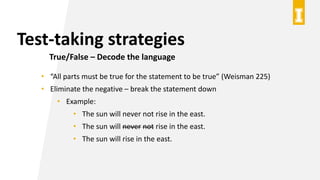
• “All parts must be true for the statement to be true” (Weisman 225)
• Eliminate the negative – break the statement down
• Example:
• The sun will never not rise in the east.
• The sun will rise in the east.
Test-taking strategies
Fill-in-the-blank
• Determine the theme of the unit
• Skim the rest of the exam
• Jog your memory with hidden hints
• Check grammatical fit
• Fill the blank space in with something
Test-taking strategies
Matching
• Read the directions
• Matching sections are good starting points on exam
• The power of elimination
• Make the matches that you know first
• Connect all of the items
Test-taking strategies
Math and Science Exams
• Show all of your work
• Use your work as a tool
• Watch for sneaky errors
• Units of measure
• Negatives/positives
• Tackle hard problems last
• When in doubt, write out your process in words
Partial Credit is real,
and can save your life!!
Test-taking strategies
Writing the essay
• Answer the question that is being asked
• Underline key words
• Look for space where you can write initial thoughts
• Open with a strong thesis statement
• Write something
• Sometimes partial credit is given for bullet point lists
Test-taking strategies
Writing the essay
Compare and contrast three test-taking strategies. Is
there a strategy that works best for you? Why or
why not?
Cader Idris by Tamsin Abbot
Test-taking strategies
Online exams
• At home:
• Ensure a solid internet connection
• Reserve a quiet and clean space
• Enable pop-ups
• Record your answers on a separate sheet of paper
• On campus:
• Check testing center hours
• Bring any required ID
Test-taking strategies
Online exams
• Understand the rules and the format
• Is there a time limit? What sort of resources are allowed?
• Read instructions for entering responses
• Math tests may require the answer be in a certain format
• Essay questions may require specific citation types
• Save as you go if possible
• Take a screen shot of the submission screen for your records
Test-taking strategies
Key test-taking tips during the exam
• Build momentum
• Skim the exam to help find answers
• Find a phrase or image that helps you recall the material
• Use the exam to demonstrate what you know
• Breathe
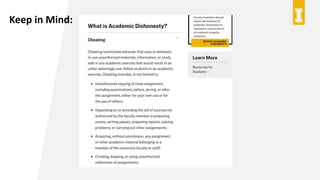
Keep in Mind:
Tamsin Abbott
Follow up
Reflect on your experience
How do you feel after
taking an exam?
Follow up
Reflect on your experience
• How do you feel after the exam?
• Find time post-exam to decompress
• One test will not seal your fate
• Learn from your mistakes
• Learning is a process
• Learning takes time
Follow up
Reflect on your experience
• Test anxiety is common
• 25% - 40% of college students experience test anxiety (Gore 206)
• Center for Disability Access and Resources (CDAR)
• Counseling and Testing Center (CTC)
• Managing anxiety
• Structured breathing
• Reframing/visualization
Follow up
Return to your preparations
• Contact your professor and TA
• Discuss resources and study strategies
• Evaluate successes and failures
• Meet with a tutor/SI-PASS leader
• Learn from their student perspective
• Reach out to other resources
Failure isn’t final
• Practice self-compassion
• Don’t judge yourself for past shortcomings
• Focus on how you’ll feel when you’ve mastered the material
• Adopt the proper mindset
• It isn’t failure, it’s a problem to be solved
• Define what success means to you, and let that be your guide
• Cultivate a successful identity
• You are not a failure, you are a person with a fixable problem
• A successful person has a balance of successes and failures
• Both are valuable
https://www.wikihow.com/Cope-with-Academic-Failure
Test Taking Strategies

Test Taking Strategies

  • 1.
    TEST TAKING STRATEGIES All artbyTamsin Abbott WITH ART BREAKS
  • 2.
    Test-taking strategies What goesinto a successful test day? • Going into the exam • During the exam • How to tackle different types of questions • Following up
  • 3.
    Test-taking strategies Going intothe exam What do you do to prepare on the day of an exam?
  • 4.
    Test-taking strategies Going intothe exam • Bring what you need (Blue book, calculator, pencils, ruler) • Reflect on your study habits • Arrive early • Sit in your usual desk • Breathe
  • 5.
    Test-taking strategies Going intothe exam • Pump yourself up! • Show what you do know and what you can do • Reframe your perspective • Negative perspective: This exam stinks. I don’t get it. • Positive perspective: Every point counts! • Find a theme song
  • 6.
    Test-taking strategies Taking theexam • Brain Dump: Write down things you don’t want to forget • Stick with what you know…at first • Build momentum • Read the questions and the directions • Positive visualization • Recall the study session
  • 7.
    Test-taking strategies Multiple choice •Look for ways to eliminate choices • Read all of the options and cross out wrong answers • Check for grammatical fit • Skip questions you don’t know • If possible! • Skim the exam for hints • If possible!
  • 8.
    Test-taking strategies True/False –Decode the language • Conditional language: (sometimes, often, generally, seldom, some) • Usually true • Unconditional language: (always, only, invariably, entirely) • Usually false • Be careful with math tests!! • Pay attention to directions • Some exams will have you explain why something is true or false
  • 9.
    Test-taking strategies True/False –Decode the language • “All parts must be true for the statement to be true” (Weisman 225) • Eliminate the negative – break the statement down • Example: • The sun will never not rise in the east. • The sun will never not rise in the east. • The sun will rise in the east.
  • 10.
    Test-taking strategies Fill-in-the-blank • Determinethe theme of the unit • Skim the rest of the exam • Jog your memory with hidden hints • Check grammatical fit • Fill the blank space in with something
  • 11.
    Test-taking strategies Matching • Readthe directions • Matching sections are good starting points on exam • The power of elimination • Make the matches that you know first • Connect all of the items
  • 12.
    Test-taking strategies Math andScience Exams • Show all of your work • Use your work as a tool • Watch for sneaky errors • Units of measure • Negatives/positives • Tackle hard problems last • When in doubt, write out your process in words Partial Credit is real, and can save your life!!
  • 13.
    Test-taking strategies Writing theessay • Answer the question that is being asked • Underline key words • Look for space where you can write initial thoughts • Open with a strong thesis statement • Write something • Sometimes partial credit is given for bullet point lists
  • 14.
    Test-taking strategies Writing theessay Compare and contrast three test-taking strategies. Is there a strategy that works best for you? Why or why not?
  • 15.
    Cader Idris byTamsin Abbot
  • 16.
    Test-taking strategies Online exams •At home: • Ensure a solid internet connection • Reserve a quiet and clean space • Enable pop-ups • Record your answers on a separate sheet of paper • On campus: • Check testing center hours • Bring any required ID
  • 17.
    Test-taking strategies Online exams •Understand the rules and the format • Is there a time limit? What sort of resources are allowed? • Read instructions for entering responses • Math tests may require the answer be in a certain format • Essay questions may require specific citation types • Save as you go if possible • Take a screen shot of the submission screen for your records
  • 18.
    Test-taking strategies Key test-takingtips during the exam • Build momentum • Skim the exam to help find answers • Find a phrase or image that helps you recall the material • Use the exam to demonstrate what you know • Breathe
  • 19.
  • 20.
  • 21.
    Follow up Reflect onyour experience How do you feel after taking an exam?
  • 22.
    Follow up Reflect onyour experience • How do you feel after the exam? • Find time post-exam to decompress • One test will not seal your fate • Learn from your mistakes • Learning is a process • Learning takes time
  • 23.
    Follow up Reflect onyour experience • Test anxiety is common • 25% - 40% of college students experience test anxiety (Gore 206) • Center for Disability Access and Resources (CDAR) • Counseling and Testing Center (CTC) • Managing anxiety • Structured breathing • Reframing/visualization
  • 24.
    Follow up Return toyour preparations • Contact your professor and TA • Discuss resources and study strategies • Evaluate successes and failures • Meet with a tutor/SI-PASS leader • Learn from their student perspective • Reach out to other resources
  • 25.
    Failure isn’t final •Practice self-compassion • Don’t judge yourself for past shortcomings • Focus on how you’ll feel when you’ve mastered the material • Adopt the proper mindset • It isn’t failure, it’s a problem to be solved • Define what success means to you, and let that be your guide • Cultivate a successful identity • You are not a failure, you are a person with a fixable problem • A successful person has a balance of successes and failures • Both are valuable https://www.wikihow.com/Cope-with-Academic-Failure

Editor's Notes

  • #5 Remember that you have studied – you have worked for this exam. You have sought out the resources that you needed, made the connections and prepared. Reflect on that experience
  • #24 Discuss symptoms of test anxiety
  • #25 I talked with a friend of mine who is a Chemical Engineering student working towards his PhD and he told me that one of the most helpful things for him was to talk with the professor about the questions he got wrong.