Quality Assurance /
Software Testing Training
Test Execution
Page 2Classification: Restricted
Agenda
• Test Execution and its purpose
• Entry and Exit Criteria
• Test Execution and its cycles
• Testing Methodology (BBT , WBT)
• Class Assignment
Page 3Classification: Restricted
Test Execution
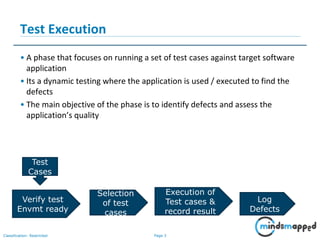
• A phase that focuses on running a set of test cases against target software
application
• Its a dynamic testing where the application is used / executed to find the
defects
• The main objective of the phase is to identify defects and assess the
application’s quality
Verify test
Envmt ready
Selection
of test
cases
Execution of
Test cases &
record result
Log
Defects
Test
Cases
Page 4Classification: Restricted
contd…
Purpose :
• To execute the test case and evaluate product quality
• To capture the test result that helps in accessing application functionality
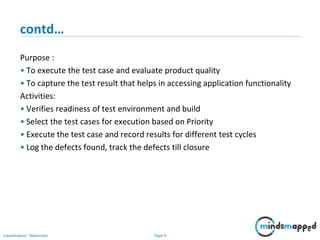
Activities:
• Verifies readiness of test environment and build
• Select the test cases for execution based on Priority
• Execute the test case and record results for different test cycles
• Log the defects found, track the defects till closure
Page 5Classification: Restricted
Entry Criteria
When to start test execution?
1. Readiness of test environment set up (S/w , H/w, DB, Tools, Test data)
2. Availability of approved test cases and test data
3. Receipt of Build in test environment
Build:
is a executable set of code files for the software application handed over
to the tester to test the developed functionality
Page 6Classification: Restricted
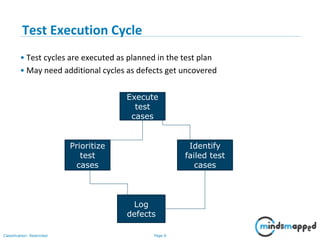
Test Execution Cycle
• Test cycles are executed as planned in the test plan
• May need additional cycles as defects get uncovered
Execute
test
cases
Identify
failed test
cases
Log
defects
Prioritize
test
cases
Page 7Classification: Restricted
Test Cycle
• Test cycle represents how many times testing would be done before
completion of testing phase.
• New build is received for every test cycle
• First cycle will include all test cases for the modules in scope
• Remaining cycles will have other test cases to be executed based on the
number and types of defects getting uncovered in the earlier cycle.
Page 8Classification: Restricted
Test Execution
• For each test execution cycle, depending on the scope the following steps
are followed:
1. Prioritize Test cases: Prioritize core functionality test cases when the
tester has insufficient time in hand.
2. Execute identified test cases
3. Perform the steps mentioned in the test case
4. Compare Actual and Expected result and update the Status as “Pass” or
“Fail”. “On hold” if test case dependant on completion of failed test
case. “Not executed” if functionality is not in scope for the current cycle.
5. Log defects for the failed test cases
Page 9Classification: Restricted
Further Testing
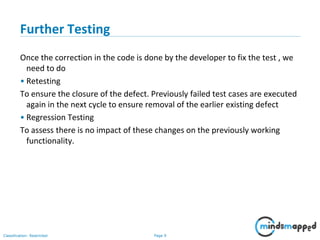
Once the correction in the code is done by the developer to fix the test , we
need to do
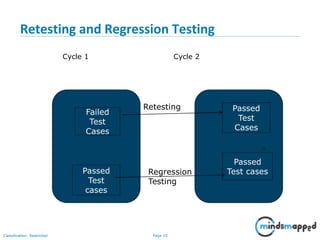
• Retesting
To ensure the closure of the defect. Previously failed test cases are executed
again in the next cycle to ensure removal of the earlier existing defect
• Regression Testing
To assess there is no impact of these changes on the previously working
functionality.
Page 10Classification: Restricted
Retesting and Regression Testing
Cycle 1 Cycle 2
Failed
Test
Cases
Passed
Test
cases
Passed
Test
Cases
Passed
Test cases
Retesting
Regression
Testing
Page 11Classification: Restricted
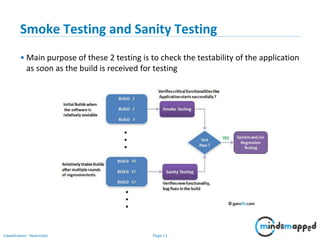
Smoke Testing and Sanity Testing
• Main purpose of these 2 testing is to check the testability of the application
as soon as the build is received for testing
Page 12Classification: Restricted
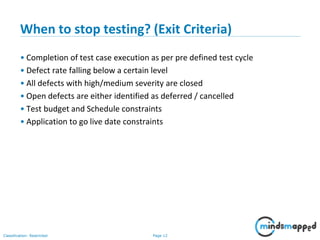
When to stop testing? (Exit Criteria)
• Completion of test case execution as per pre defined test cycle
• Defect rate falling below a certain level
• All defects with high/medium severity are closed
• Open defects are either identified as deferred / cancelled
• Test budget and Schedule constraints
• Application to go live date constraints
Page 13Classification: Restricted
Test Closure
• Data is collected from completed test activities to consolidate
1. Experience, learning
2. Facts and figures
Test closure activities also include:
• Check whether all the planned deliverables have been delivered?
• Create test summary report
• Handover the tested application to the maintenance team , so that they
can deploy it to the client
Page 14Classification: Restricted
Thank You

Test Execution

  • 1.
    Quality Assurance / SoftwareTesting Training Test Execution
  • 2.
    Page 2Classification: Restricted Agenda •Test Execution and its purpose • Entry and Exit Criteria • Test Execution and its cycles • Testing Methodology (BBT , WBT) • Class Assignment
  • 3.
    Page 3Classification: Restricted TestExecution • A phase that focuses on running a set of test cases against target software application • Its a dynamic testing where the application is used / executed to find the defects • The main objective of the phase is to identify defects and assess the application’s quality Verify test Envmt ready Selection of test cases Execution of Test cases & record result Log Defects Test Cases
  • 4.
    Page 4Classification: Restricted contd… Purpose: • To execute the test case and evaluate product quality • To capture the test result that helps in accessing application functionality Activities: • Verifies readiness of test environment and build • Select the test cases for execution based on Priority • Execute the test case and record results for different test cycles • Log the defects found, track the defects till closure
  • 5.
    Page 5Classification: Restricted EntryCriteria When to start test execution? 1. Readiness of test environment set up (S/w , H/w, DB, Tools, Test data) 2. Availability of approved test cases and test data 3. Receipt of Build in test environment Build: is a executable set of code files for the software application handed over to the tester to test the developed functionality
  • 6.
    Page 6Classification: Restricted TestExecution Cycle • Test cycles are executed as planned in the test plan • May need additional cycles as defects get uncovered Execute test cases Identify failed test cases Log defects Prioritize test cases
  • 7.
    Page 7Classification: Restricted TestCycle • Test cycle represents how many times testing would be done before completion of testing phase. • New build is received for every test cycle • First cycle will include all test cases for the modules in scope • Remaining cycles will have other test cases to be executed based on the number and types of defects getting uncovered in the earlier cycle.
  • 8.
    Page 8Classification: Restricted TestExecution • For each test execution cycle, depending on the scope the following steps are followed: 1. Prioritize Test cases: Prioritize core functionality test cases when the tester has insufficient time in hand. 2. Execute identified test cases 3. Perform the steps mentioned in the test case 4. Compare Actual and Expected result and update the Status as “Pass” or “Fail”. “On hold” if test case dependant on completion of failed test case. “Not executed” if functionality is not in scope for the current cycle. 5. Log defects for the failed test cases
  • 9.
    Page 9Classification: Restricted FurtherTesting Once the correction in the code is done by the developer to fix the test , we need to do • Retesting To ensure the closure of the defect. Previously failed test cases are executed again in the next cycle to ensure removal of the earlier existing defect • Regression Testing To assess there is no impact of these changes on the previously working functionality.
  • 10.
    Page 10Classification: Restricted Retestingand Regression Testing Cycle 1 Cycle 2 Failed Test Cases Passed Test cases Passed Test Cases Passed Test cases Retesting Regression Testing
  • 11.
    Page 11Classification: Restricted SmokeTesting and Sanity Testing • Main purpose of these 2 testing is to check the testability of the application as soon as the build is received for testing
  • 12.
    Page 12Classification: Restricted Whento stop testing? (Exit Criteria) • Completion of test case execution as per pre defined test cycle • Defect rate falling below a certain level • All defects with high/medium severity are closed • Open defects are either identified as deferred / cancelled • Test budget and Schedule constraints • Application to go live date constraints
  • 13.
    Page 13Classification: Restricted TestClosure • Data is collected from completed test activities to consolidate 1. Experience, learning 2. Facts and figures Test closure activities also include: • Check whether all the planned deliverables have been delivered? • Create test summary report • Handover the tested application to the maintenance team , so that they can deploy it to the client
  • 14.