ICT IN THE EFL CLASSROOM: WHY AND HOW
Presenter
Hayfa Majdoub
Tunisia TESOL Second International Conference
Emerging Technologies and Evolving Pedagogies in ELT
12-14 February, Cité des Sciences, Tunis
Contact: hayfamajdoub@gmail.com @haymajd
1- Introduction
2-Why you should integrate ICT in the EFL classroom
a-Who are our students?
b-The role of ICT in learning
c- Changing paradigms
3- My experience in incorporating Information and
Communication Technology
4- Wrap up
5- Questions & answers
Hayfa Majdoub, Feb 2015
ICT integration in education, and in English language
learning and teaching in particular, is the first step
towards living up to the 21st century students’ needs
because “ The child is the heart of the matter”
(Prensky)
Hayfa Majdoub, Feb 2015
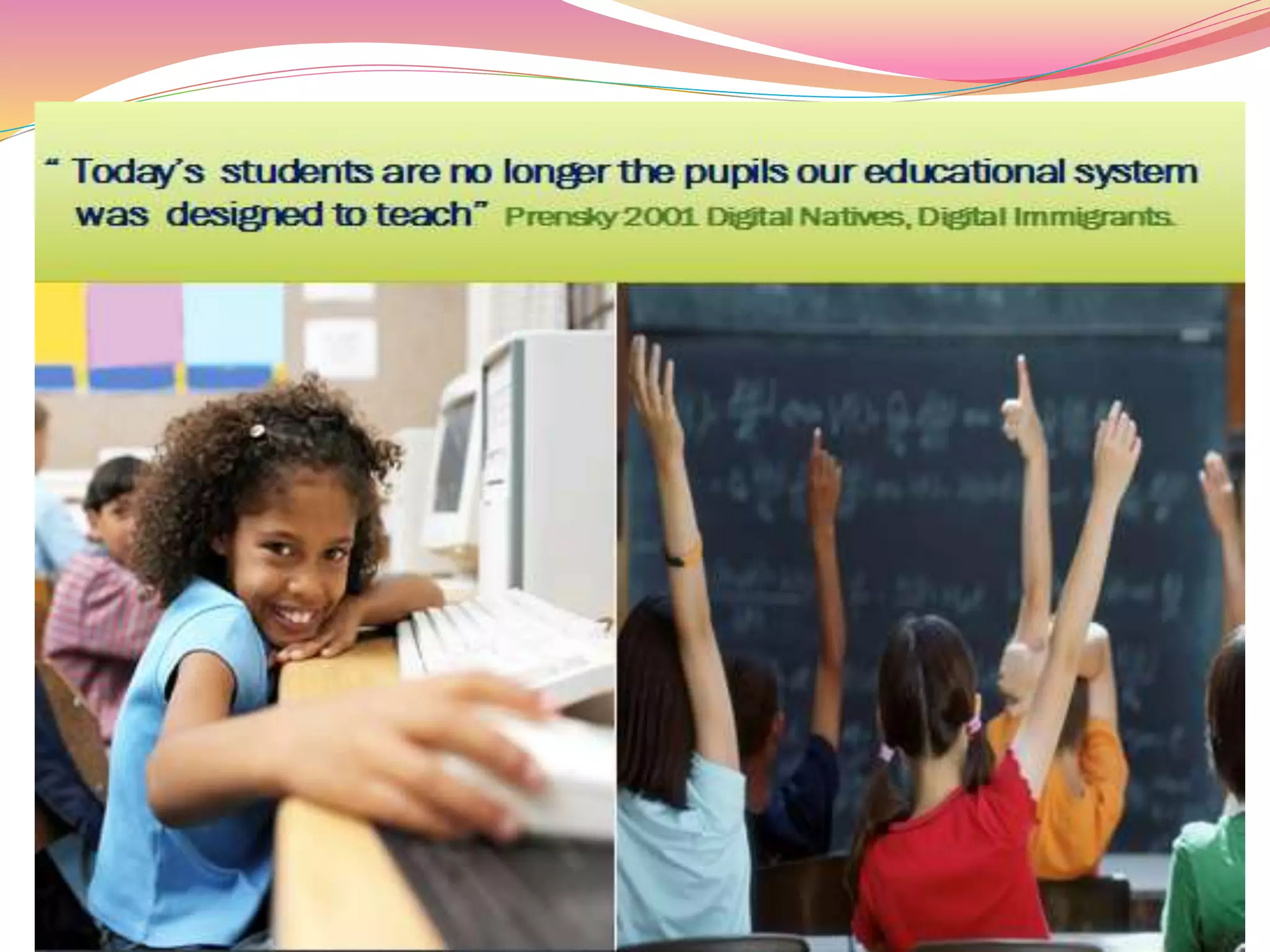
• Today’s students process information differently from their predecessors
• Their thinking patterns have changed (Prensky, 2001)
• ICT is a source of contextualized learning
• ICT gives students control over their learning
• They become autonomous independent learners
• It exposes students to various and authentic, critical-thinking situations.
• ICT provides more exposure to the target language, more practice, more time
on task, more opportunities for students to listen, speak and develop
their communicative competence.
Hayfa Majdoub, Feb 2015
“If a child can’t learn the way we teach ,
maybe we can teach the way they learn.”
Ignacio Estrada
“ It is not the strongest species that
survives, nor the most intelligent
that survives. It is the one that is
the most adaptable to change.”
Charles Darwin
Hayfa Majdoub, Feb 2015
HOW?
Hayfa Majdoub, Feb 2015
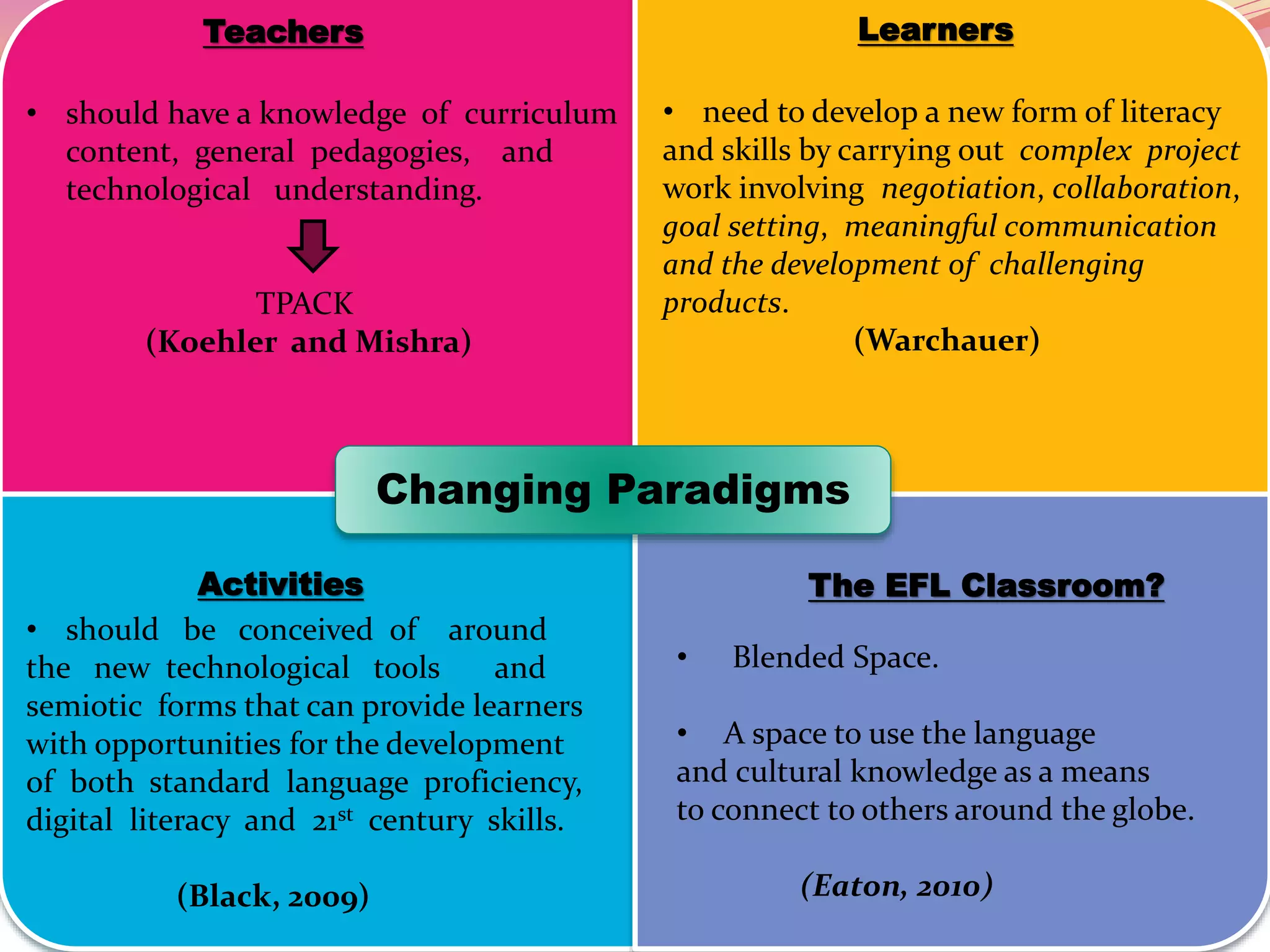
Changing Paradigms
• should be conceived of around
the new technological tools and
semiotic forms that can provide learners
with opportunities for the development
of both standard language proficiency,
digital literacy and 21st century skills.
(Black, 2009)
• Blended Space.
• A space to use the language
and cultural knowledge as a means
to connect to others around the globe.
(Eaton, 2010)
The EFL Classroom?Activities
Teachers
• should have a knowledge of curriculum
content, general pedagogies, and
technological understanding.
TPACK
(Koehler and Mishra)
Learners
• need to develop a new form of literacy
and skills by carrying out complex project
work involving negotiation, collaboration,
goal setting, meaningful communication
and the development of challenging
products.
(Warchauer)
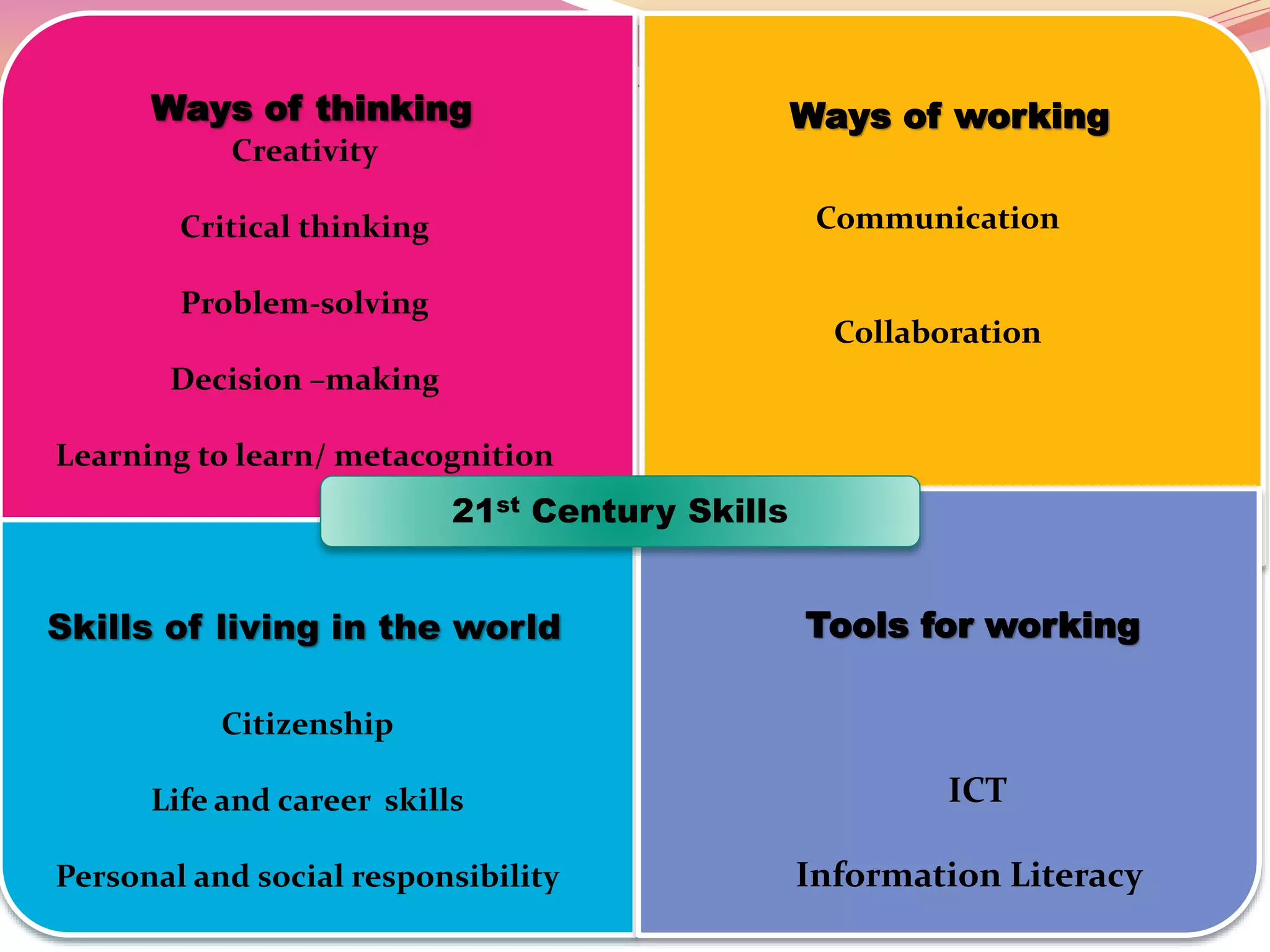
21st Century Skills
ICT
Information Literacy
Tools for working
Ways of thinking
Creativity
Critical thinking
Problem-solving
Decision –making
Learning to learn/ metacognition
Ways of working
Skills of living in the world
Citizenship
Life and career skills
Personal and social responsibility
Communication
Collaboration
In the light of the previously stated arguments and facts,
I designed the activities /instructions / techniques in which I
integrated ICT. I’ll demonstrate and explain how
• they ameliorate language learning
• promote a more learner-centred classroom
• develop students 21st century skills
Digital storytelling, comics, web2.0 tools, project work to
enhance language learning and engage learners in and
outside the classroom and to develop students’ 21st
century Skills
• Students develop high-level thinking when they create
their own comics either with their peers in the
classroom or in a virtual environment.
• Digital storytelling, comics enhance students writing
skills, especially the writing process. To make their
stories, students need to brainstorm and organize ideas,
draft and revise the script, share with an authentic
audience local or global. Hayfa Majdoub, Feb 2015
• To make their videos/ digital stories, students have to
collaborate with other students.
• Students communicate ideas combined with visuals.
They sequence the ideas with the visuals which
requires analyzing, simplifying, connecting,
synthesizing, thus developing their higher order
thinking skills.
Hayfa Majdoub, Feb 2015
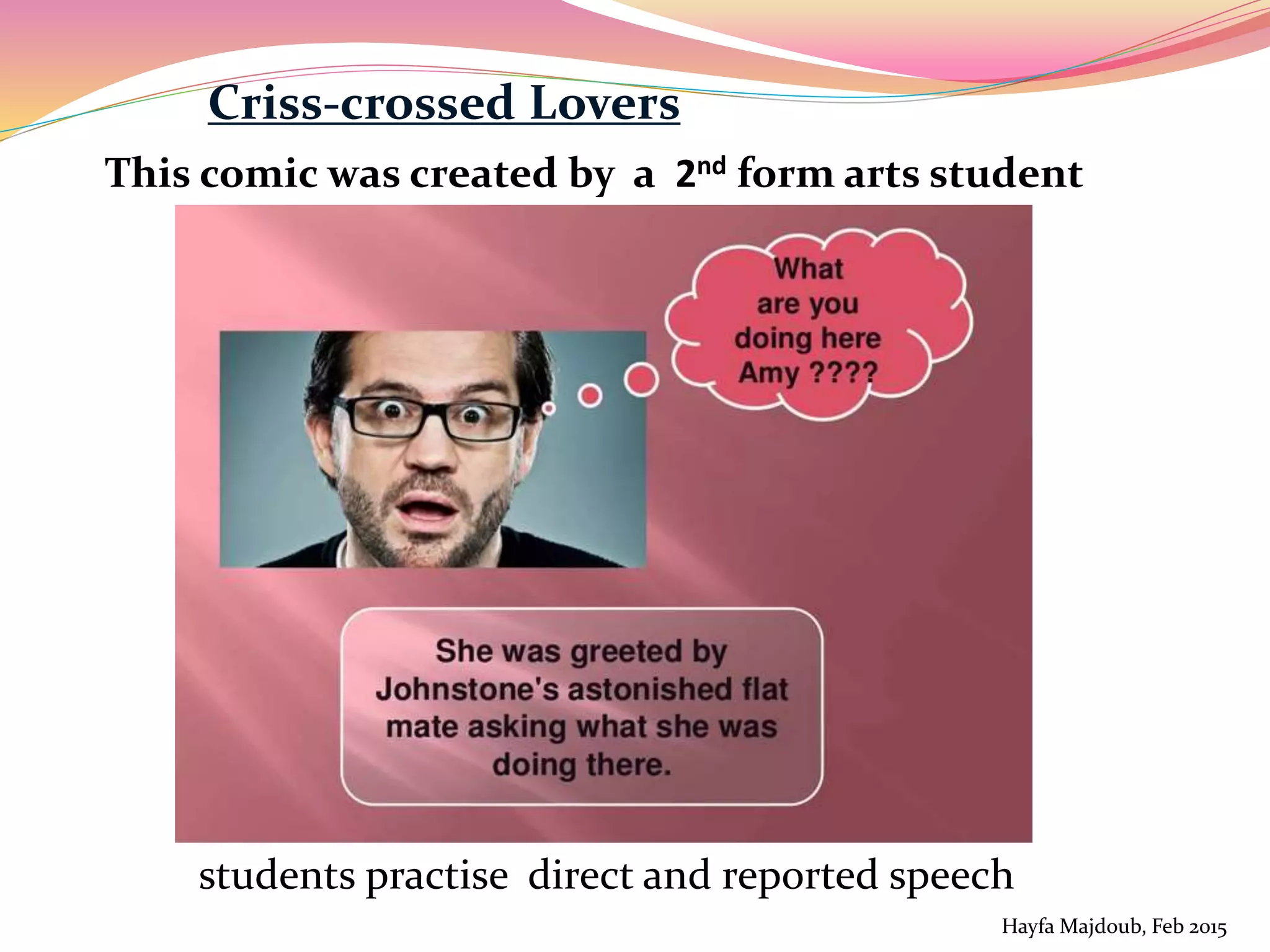
Criss-crossed Lovers
This comic was created by a 2nd form arts student
students practise direct and reported speech
Hayfa Majdoub, Feb 2015
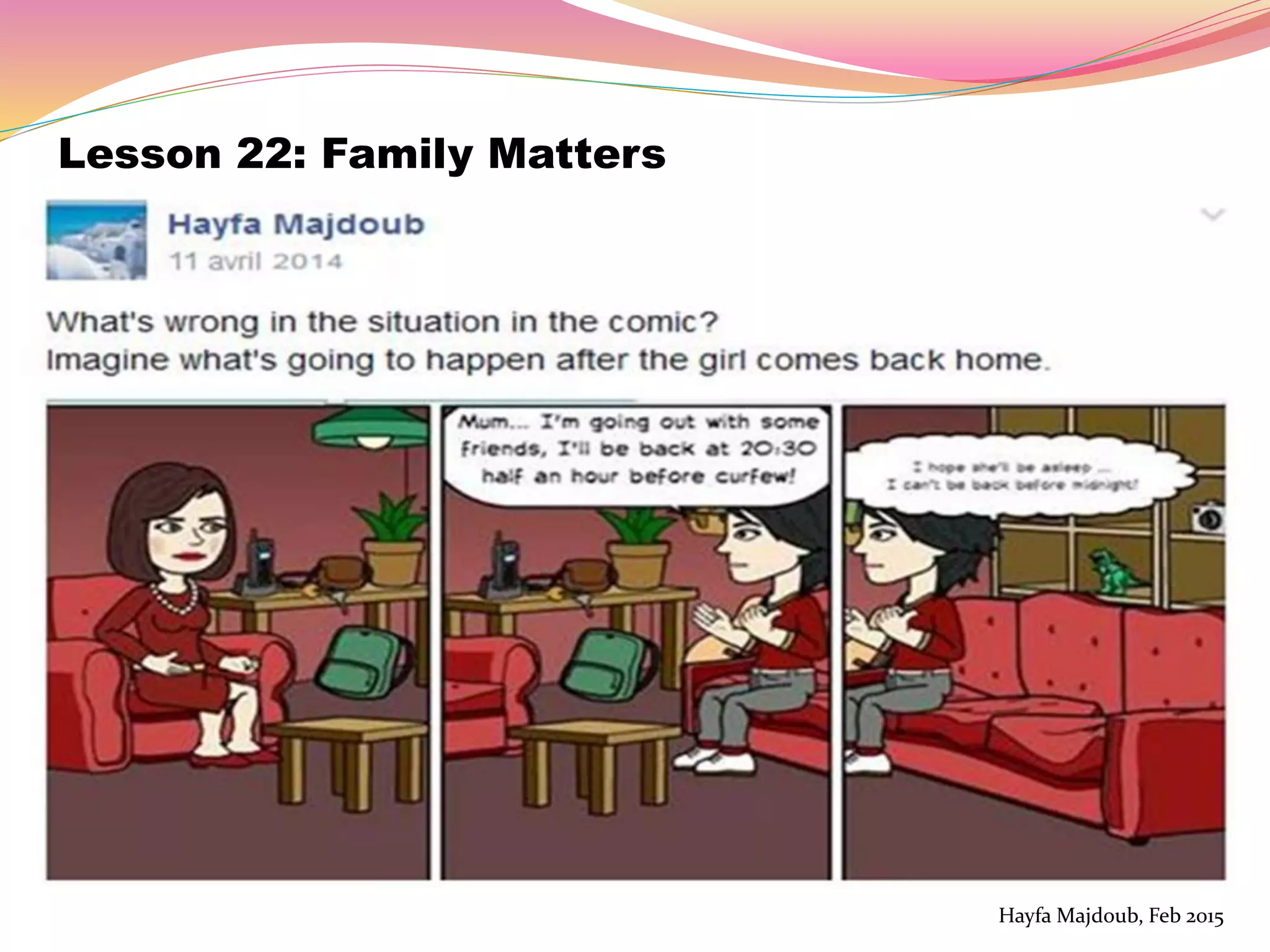
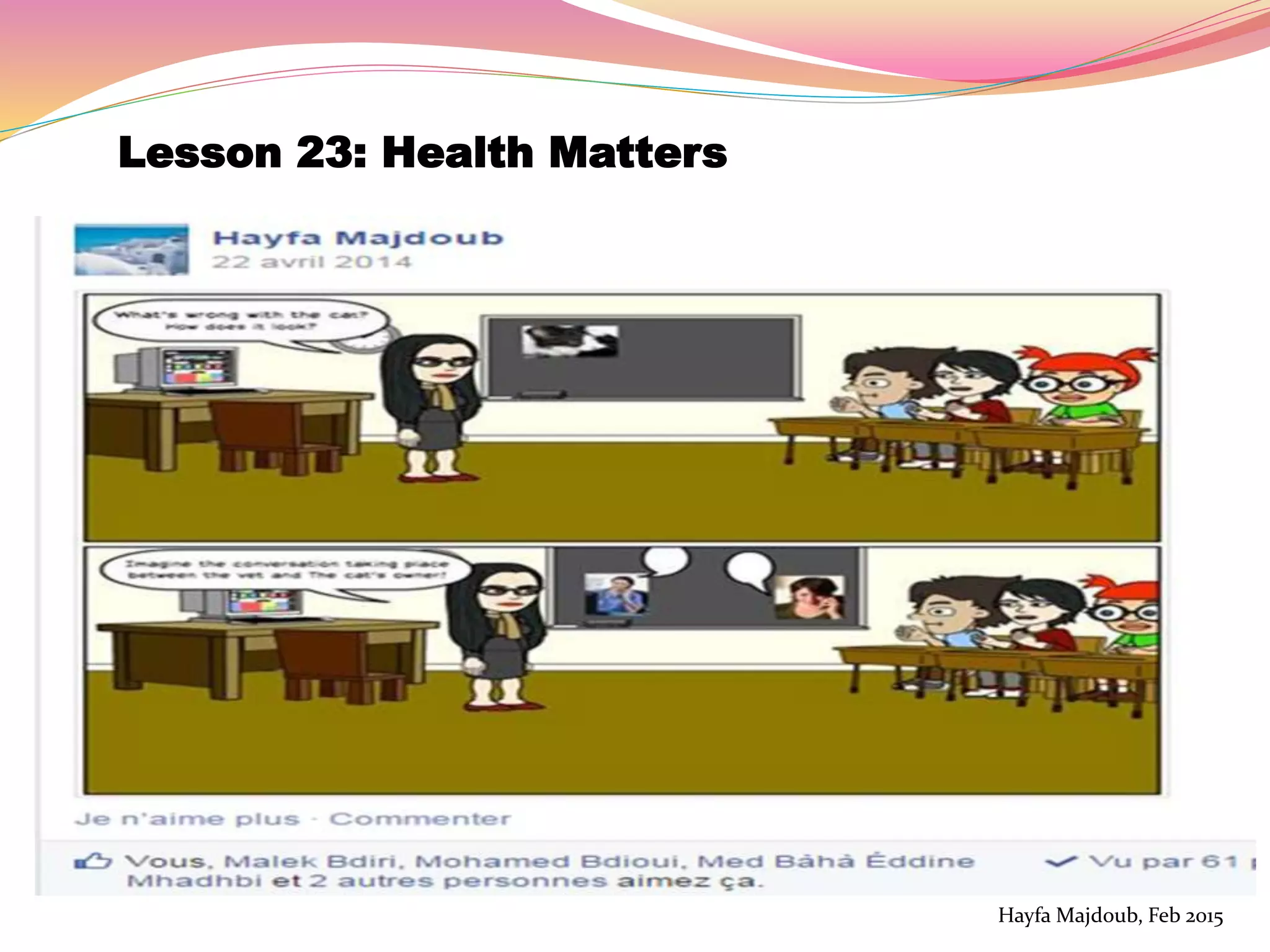
I used the following cartoon strips as a follow up activity, to
stimulate discussion and to review vocabulary related to
parents/teenagers relationship after the lesson.
I shared them in the class facebook group :
• to extend learning beyond the classroom
• create an opportunity for exposing the students to the language.
• give an opportunity to the introverted students to express their
ideas in a “relatively” secure environment.
Hayfa Majdoub, Feb 2015
Lesson 22: Family Matters
Hayfa Majdoub, Feb 2015
Lesson 23: Health Matters
Hayfa Majdoub, Feb 2015
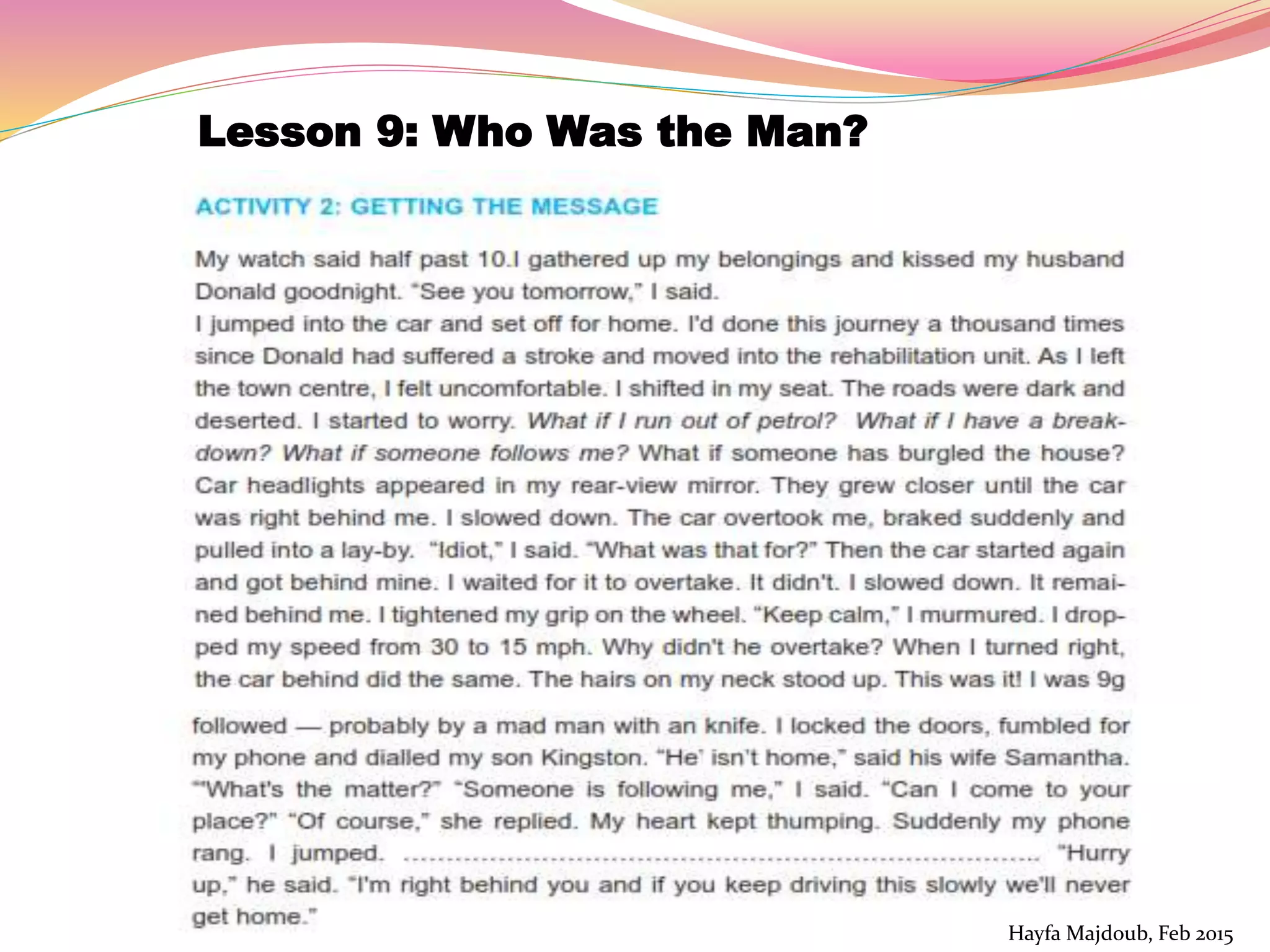
Lesson 9: Who Was the Man?
Hayfa Majdoub, Feb 2015
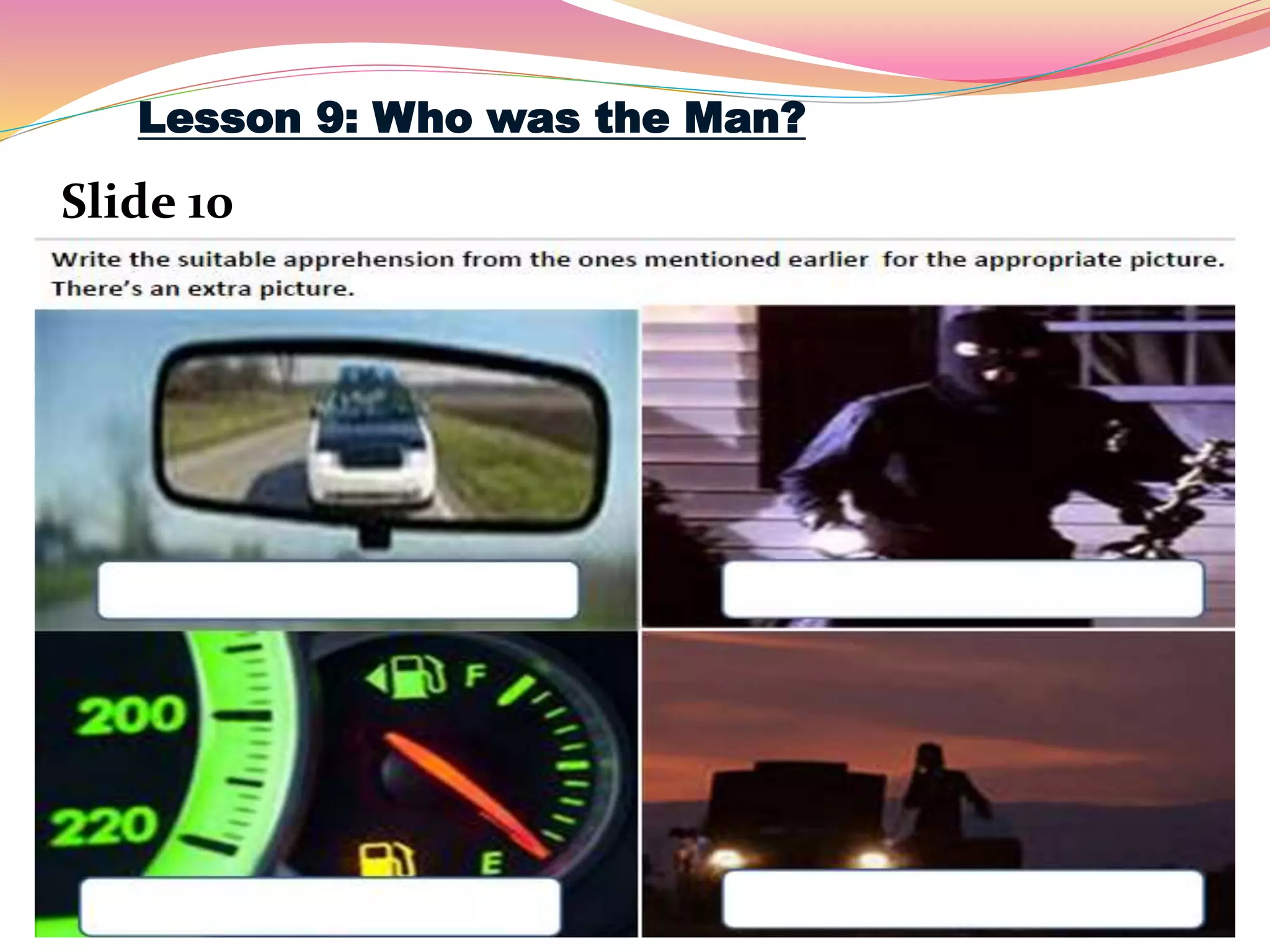
Lesson 9: Who was the Man?
Slide 10
Slide 13
Hayfa Majdoub, Feb 2015
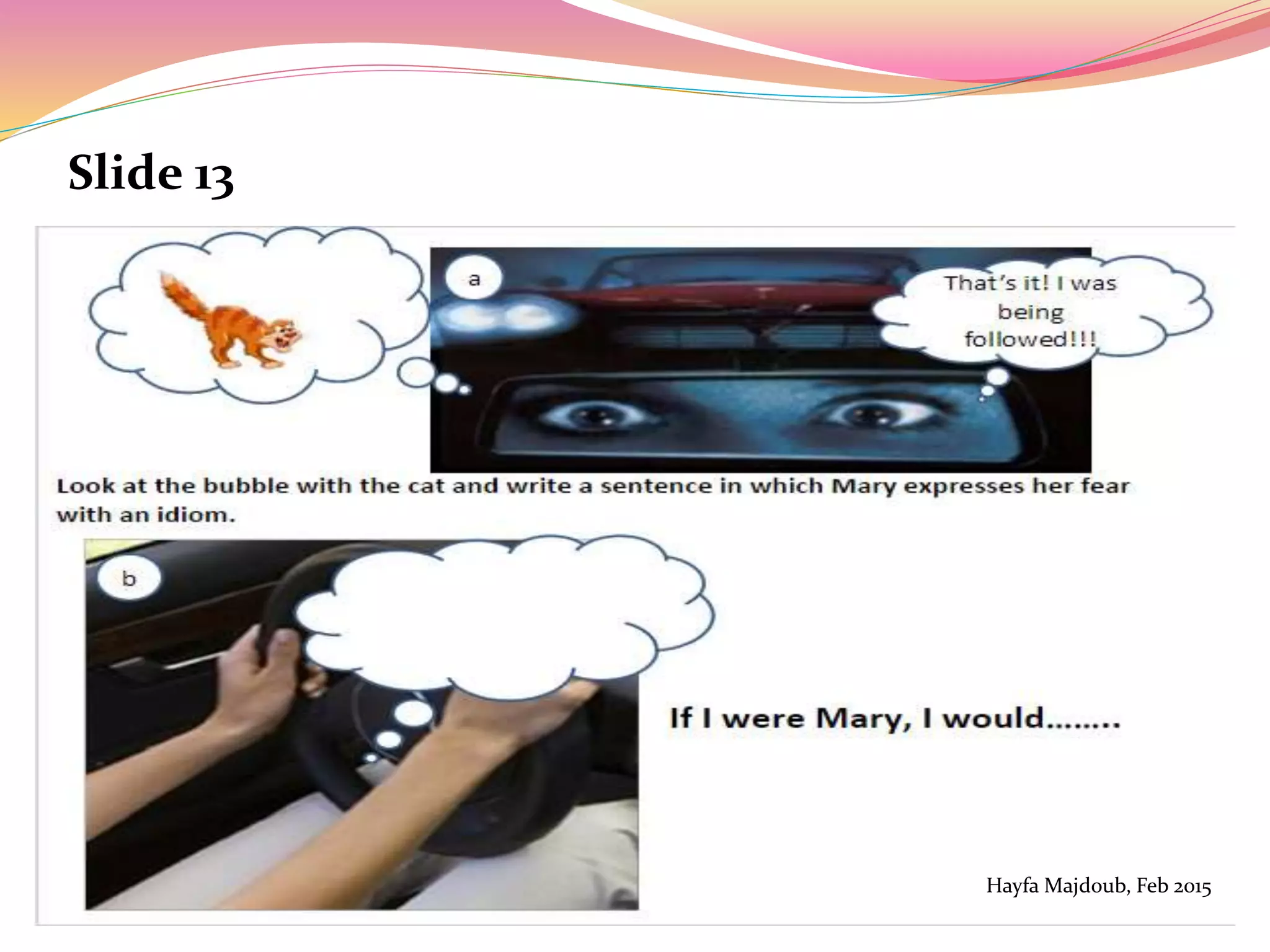
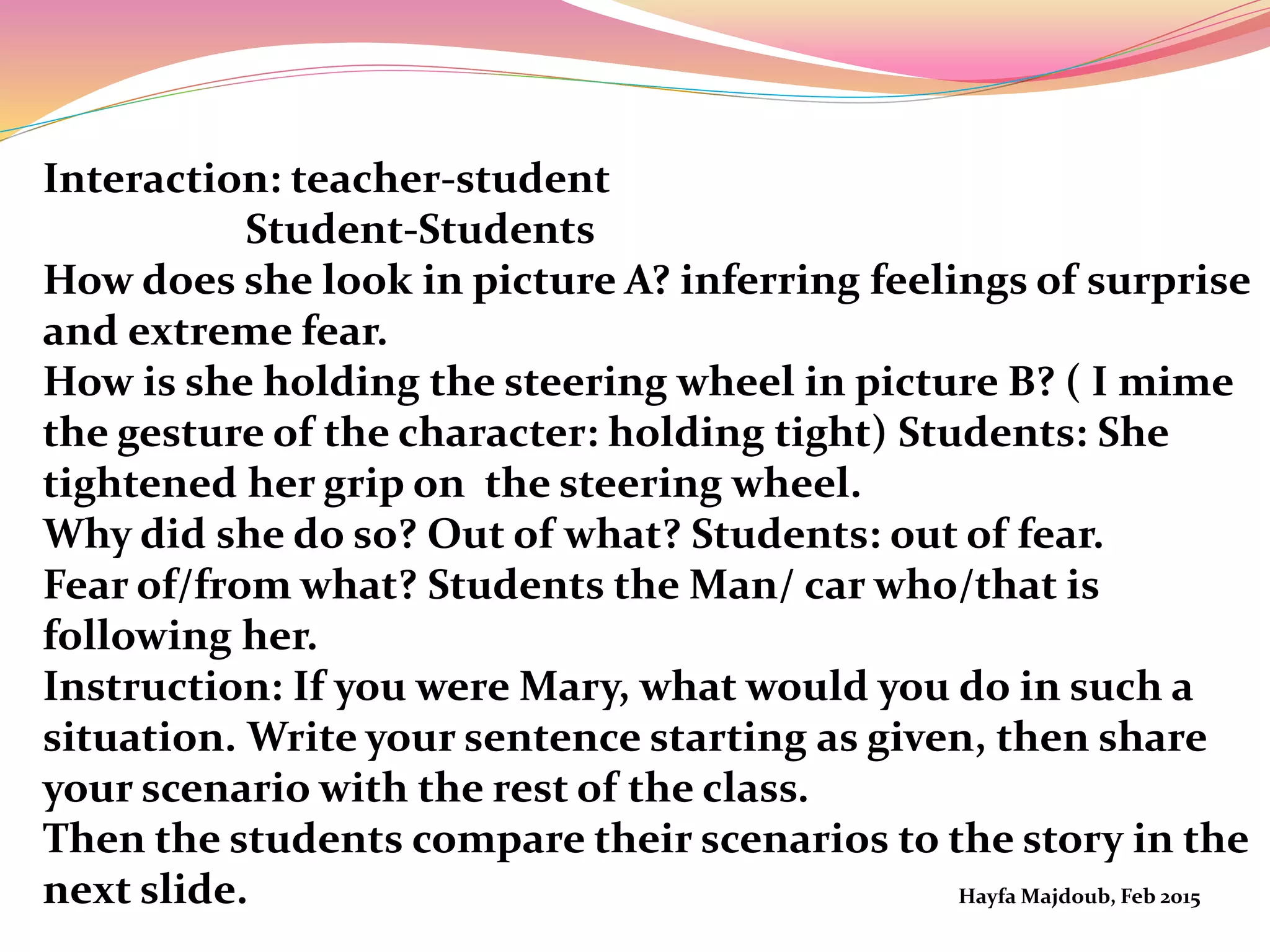
Interaction: teacher-student
Student-Students
How does she look in picture A? inferring feelings of surprise
and extreme fear.
How is she holding the steering wheel in picture B? ( I mime
the gesture of the character: holding tight) Students: She
tightened her grip on the steering wheel.
Why did she do so? Out of what? Students: out of fear.
Fear of/from what? Students the Man/ car who/that is
following her.
Instruction: If you were Mary, what would you do in such a
situation. Write your sentence starting as given, then share
your scenario with the rest of the class.
Then the students compare their scenarios to the story in the
next slide. Hayfa Majdoub, Feb 2015
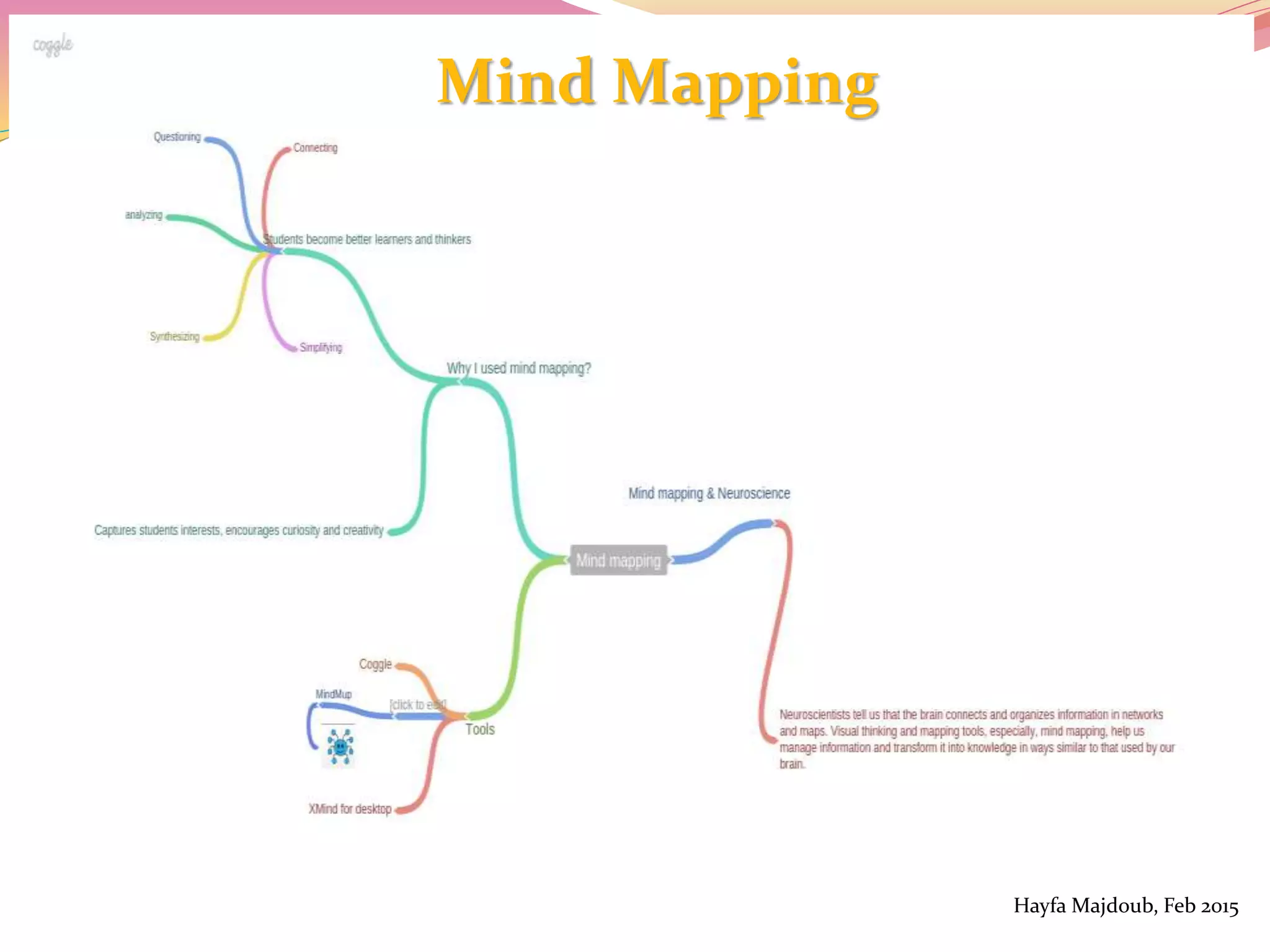
Mind Mapping
Hayfa Majdoub, Feb 2015
Mindmaps are not a new thing, however, what makes them the tool you might think
of using with your students is that they enable
• online, real time collaboration,
• the insertion of multimedia, comments, hyper links…
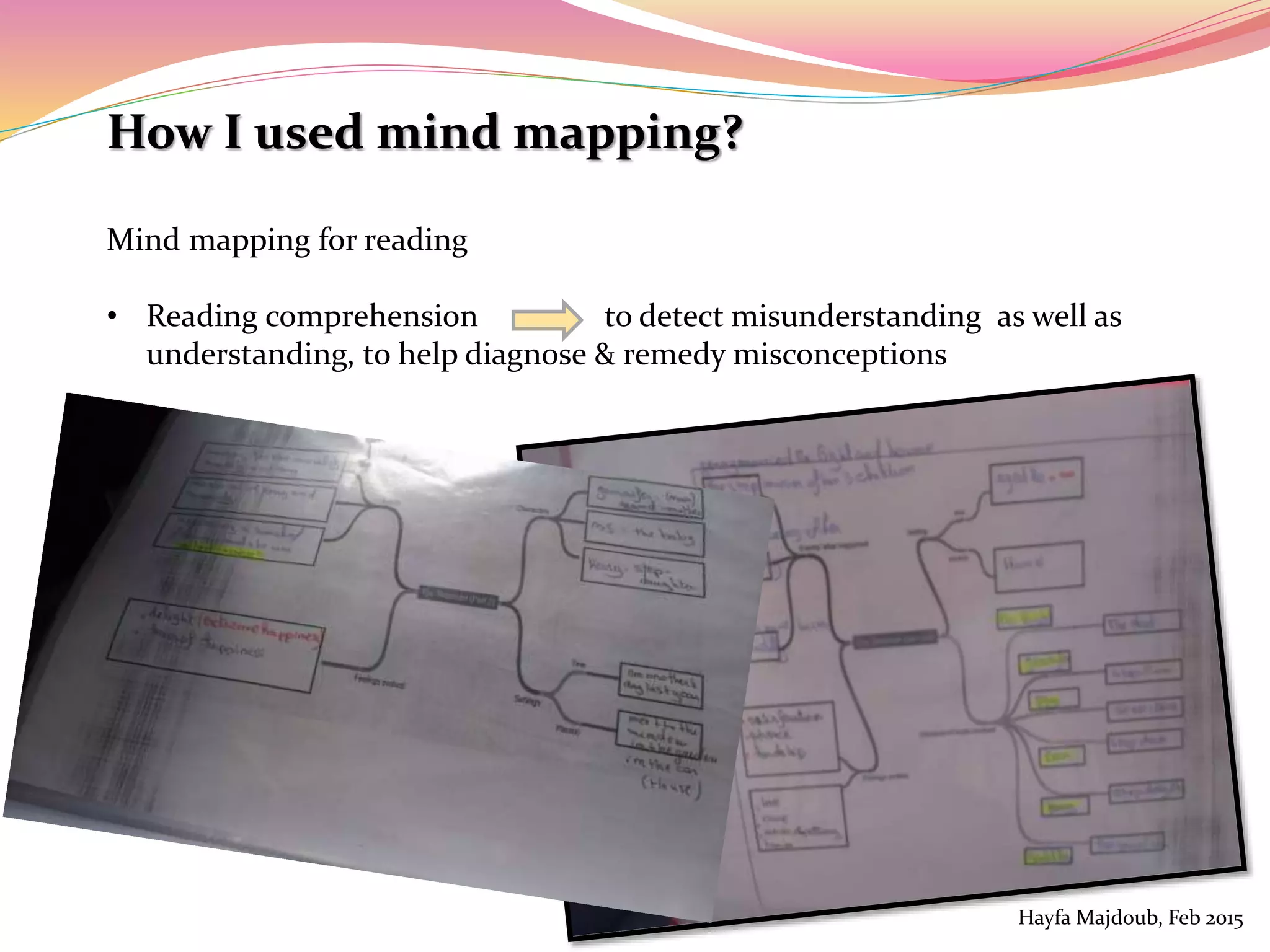
How I used mind mapping?
Mind mapping for reading
• Reading comprehension to detect misunderstanding as well as
understanding, to help diagnose & remedy misconceptions
Hayfa Majdoub, Feb 2015
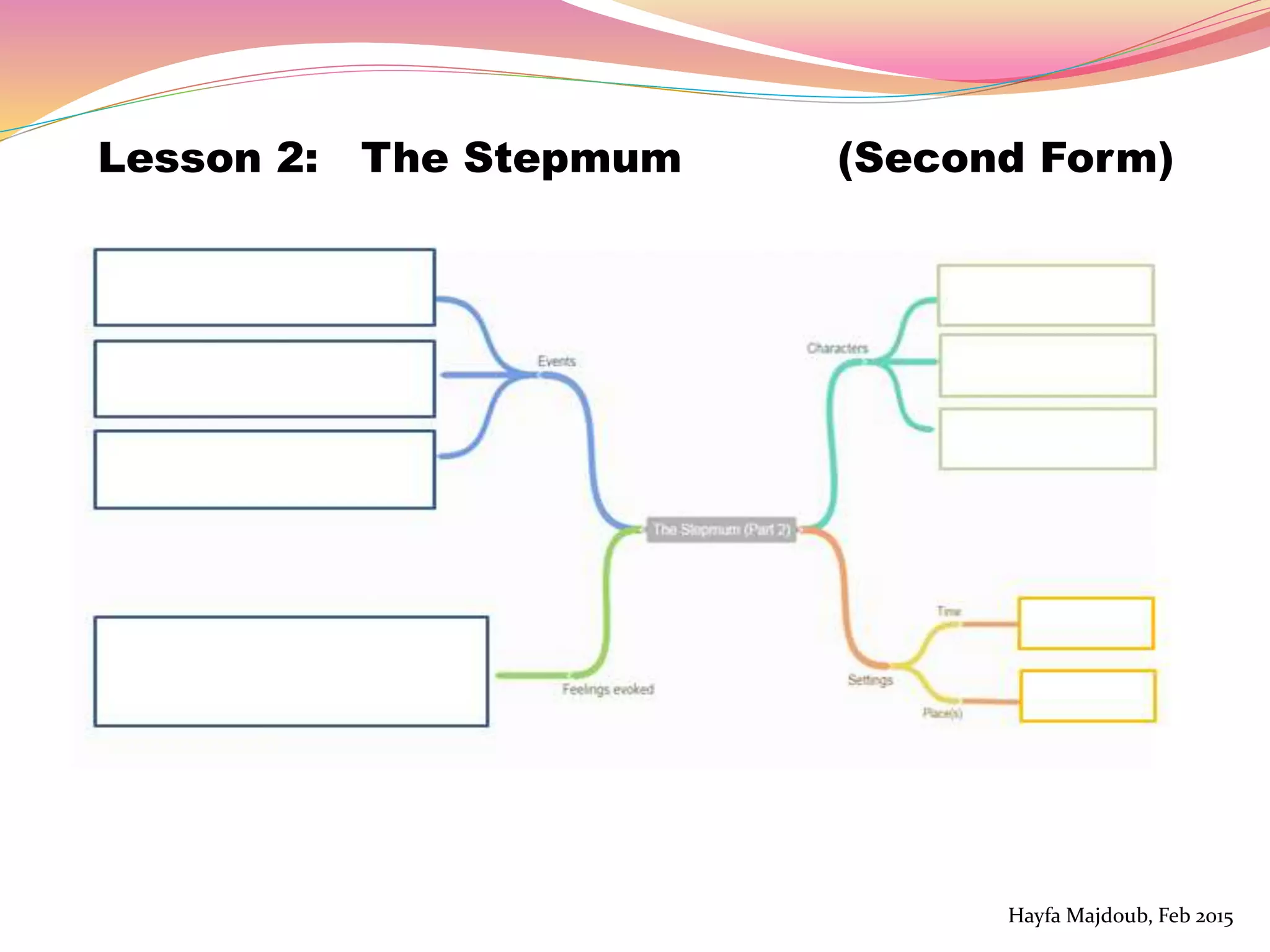
Lesson 2: The Stepmum (Second Form)
Hayfa Majdoub, Feb 2015
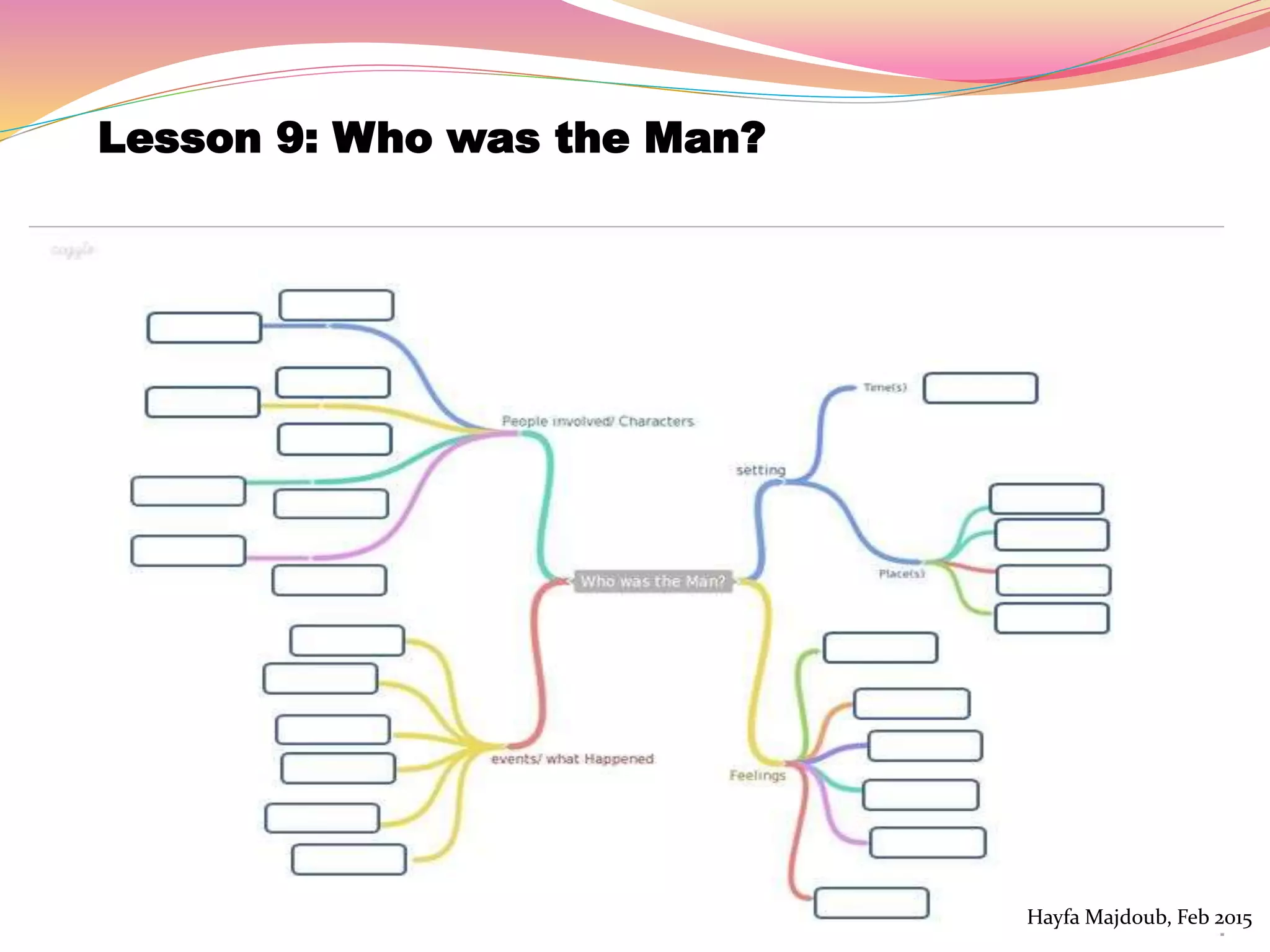
Lesson 9: Who was the Man?
Hayfa Majdoub, Feb 2015
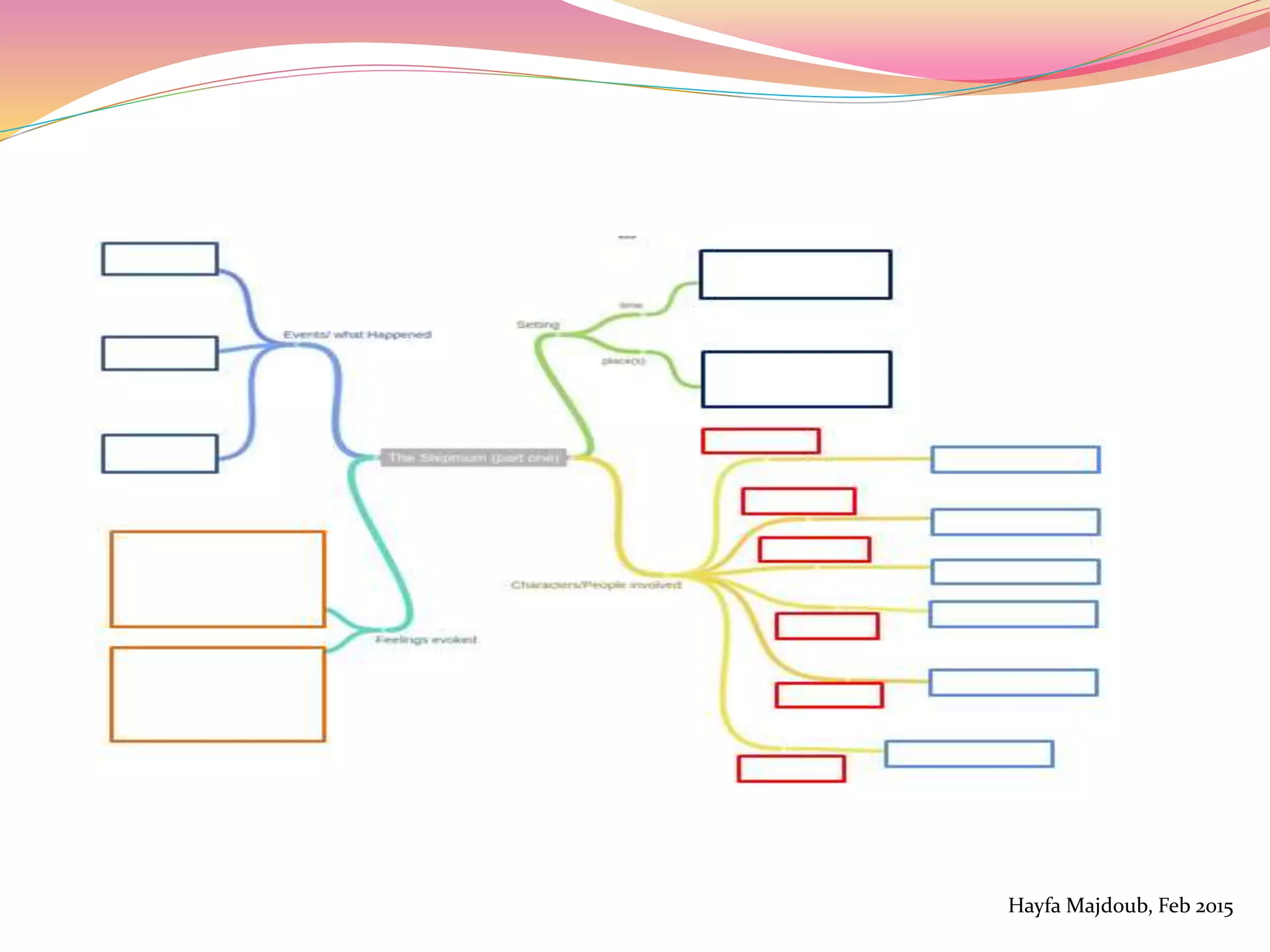
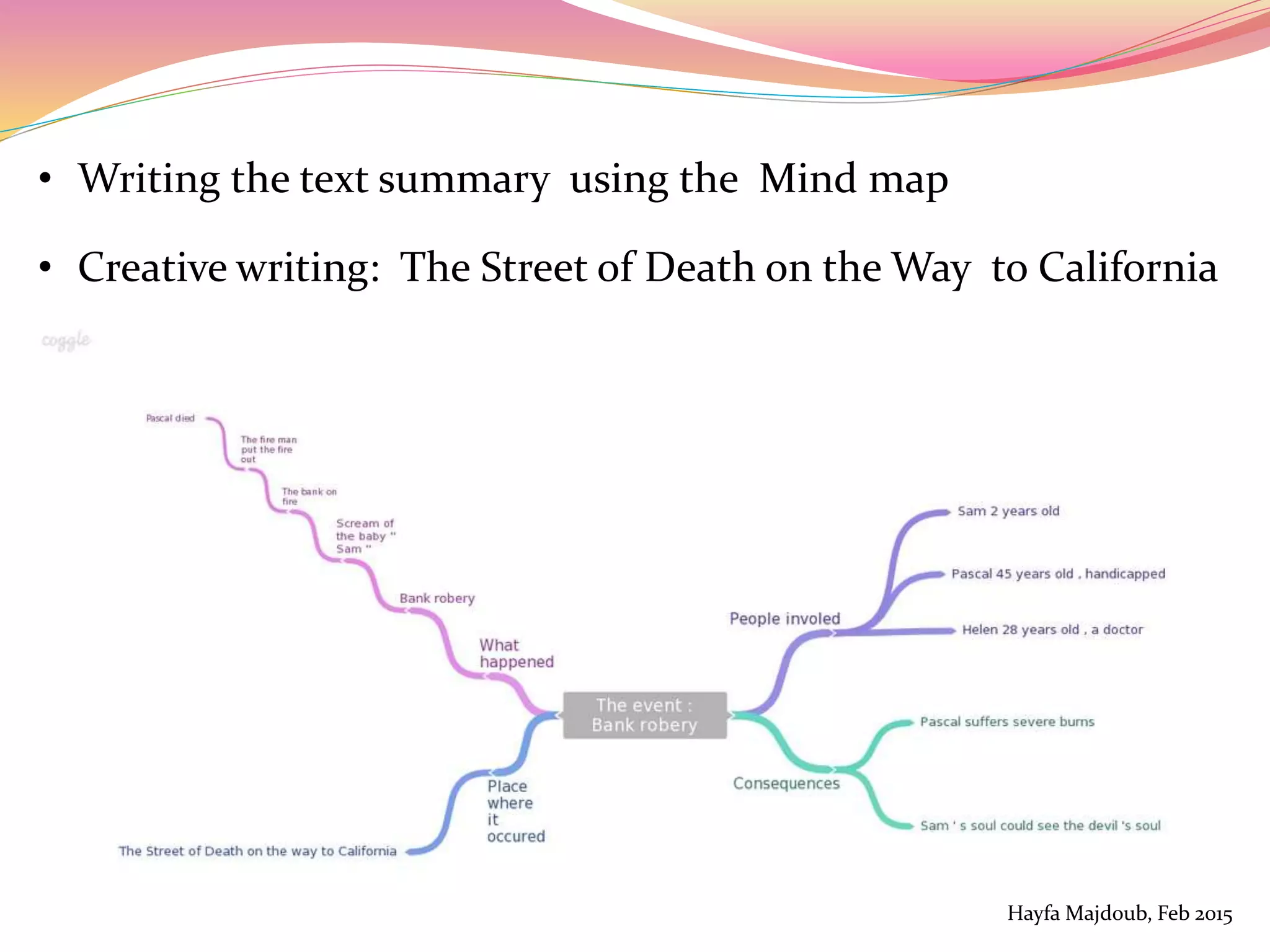
• Writing the text summary using the Mind map
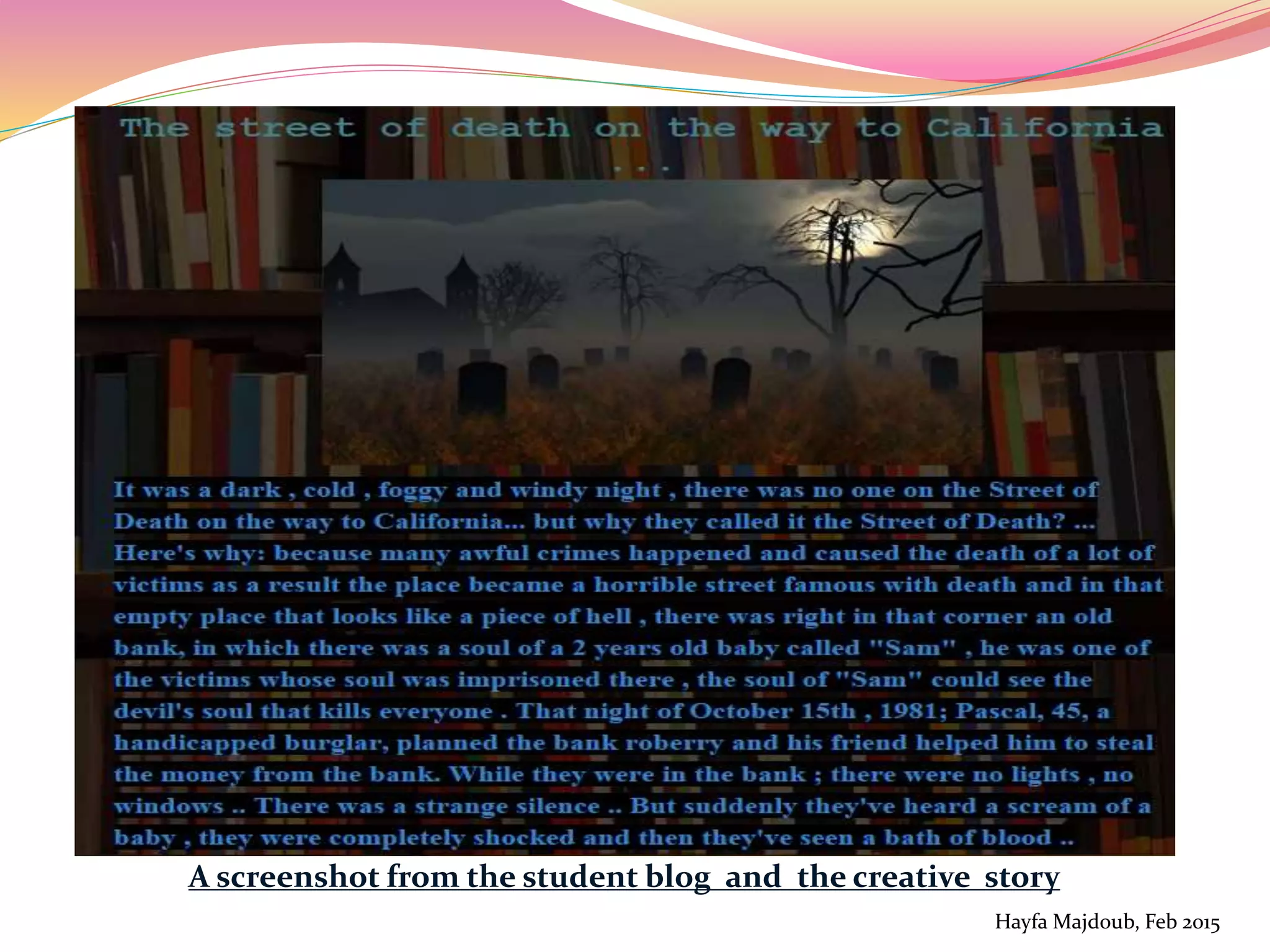
• Creative writing: The Street of Death on the Way to California
Oral test : students are handed out a mind map with all the necessary information
concerning a narrative text and then they use the mind map to narrate the story
Hayfa Majdoub, Feb 2015
A screenshot from the student blog and the creative story
Hayfa Majdoub, Feb 2015
Project Work:
Conducted with first / second formers over one term
Project objectives:
Hayfa Majdoub, Feb 2015
Overall objective: To apply clear strategies (visualize, plan, act) to
achieve a dream/an ambition.
Objectives: The project aims to:
• motivate my students to learn English in the classroom setting
(3 hours a week for first formers)and beyond by having a real audience
for what they produce e.g. blog posts, podcasts both local and global
since the content is shared on the students’ blogs, and the facebook
group of the project and other sites, by practicing their basic skills (
reading, writing, listening, speaking) and integrating ICT for learning in
a collaborative atmosphere .
• get students to think and act as leaders by taking initiatives, and
acting to bring a positive change to the community and the society
they live in.
• make my student identify and reflect on real world problems
(pollution issues, irresponsible people behavior, people with special
needs, recycling) by discussing, analyzing them to find solutions.
Hayfa Majdoub, Feb 2015
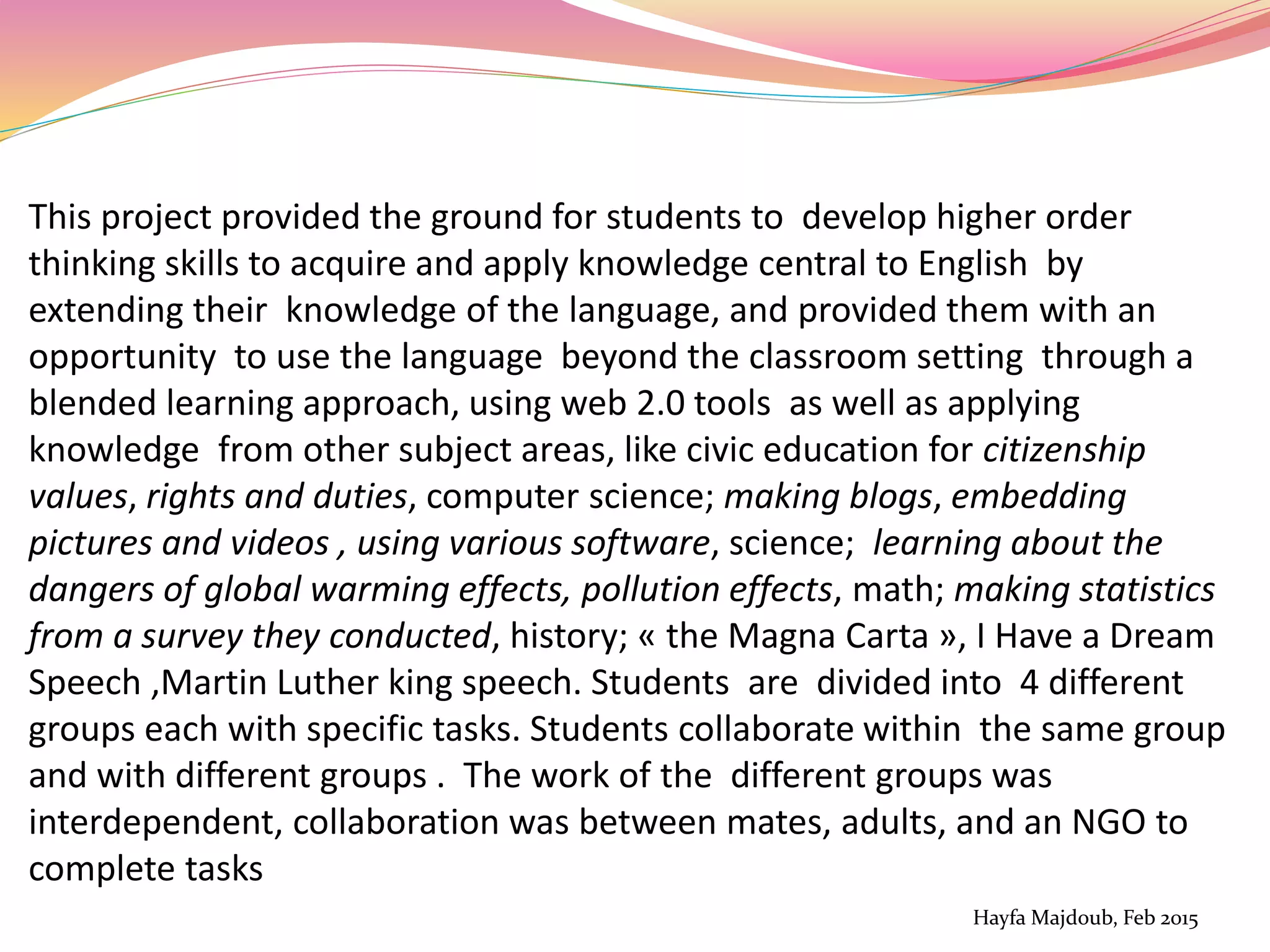
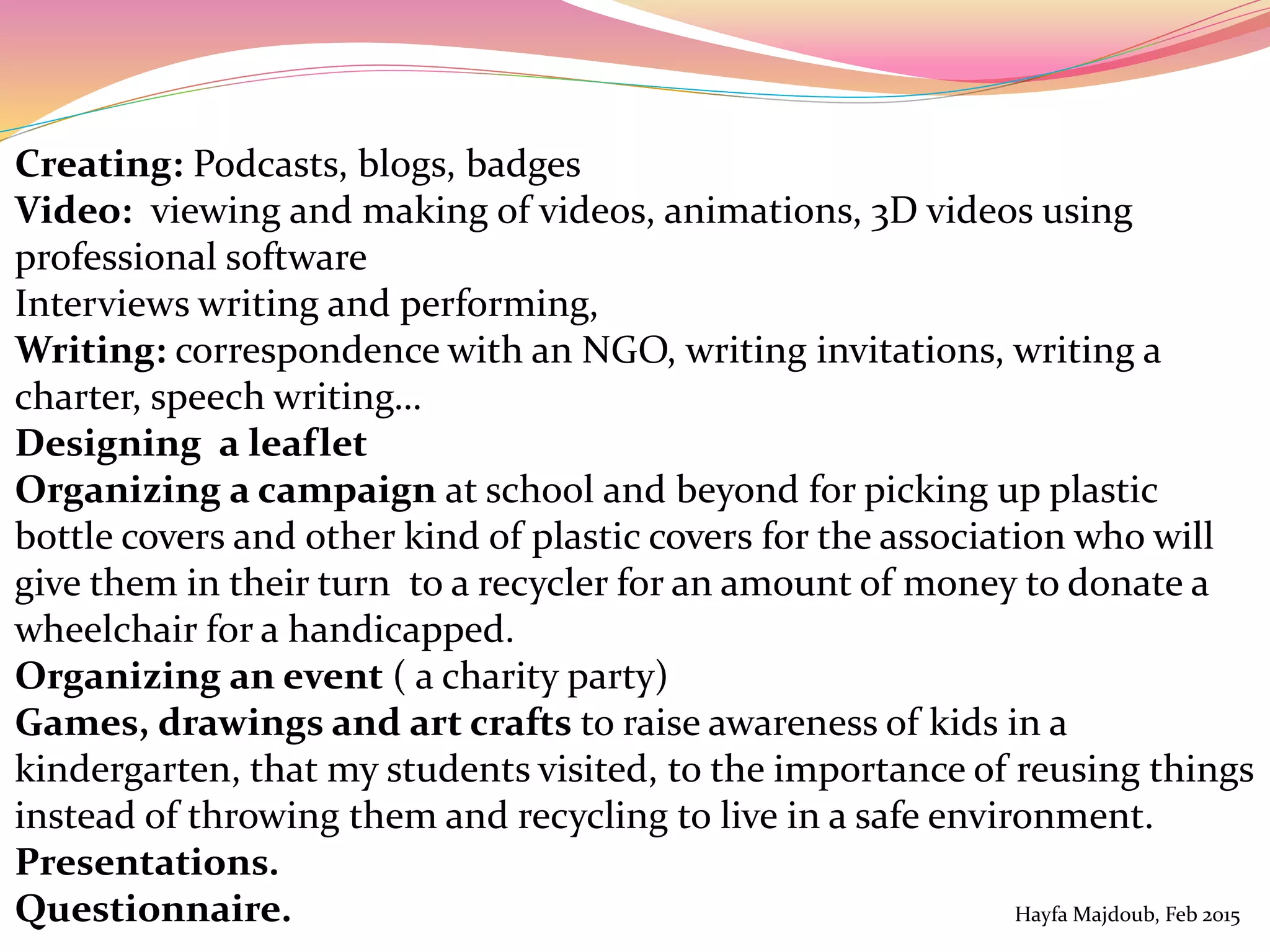
This project provided the ground for students to develop higher order
thinking skills to acquire and apply knowledge central to English by
extending their knowledge of the language, and provided them with an
opportunity to use the language beyond the classroom setting through a
blended learning approach, using web 2.0 tools as well as applying
knowledge from other subject areas, like civic education for citizenship
values, rights and duties, computer science; making blogs, embedding
pictures and videos , using various software, science; learning about the
dangers of global warming effects, pollution effects, math; making statistics
from a survey they conducted, history; « the Magna Carta », I Have a Dream
Speech ,Martin Luther king speech. Students are divided into 4 different
groups each with specific tasks. Students collaborate within the same group
and with different groups . The work of the different groups was
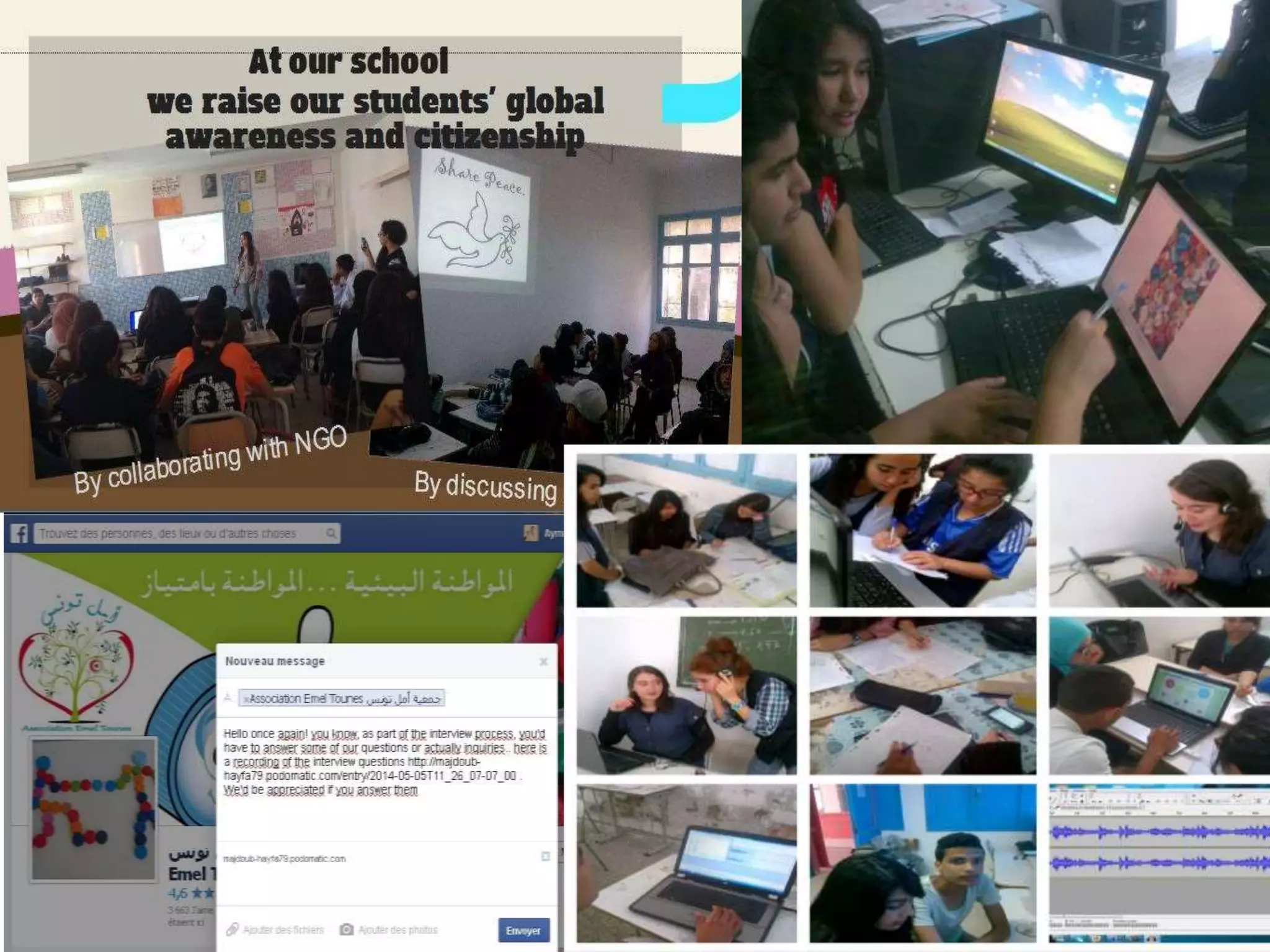
interdependent, collaboration was between mates, adults, and an NGO to
complete tasks
Hayfa Majdoub, Feb 2015
Creating: Podcasts, blogs, badges
Video: viewing and making of videos, animations, 3D videos using
professional software
Interviews writing and performing,
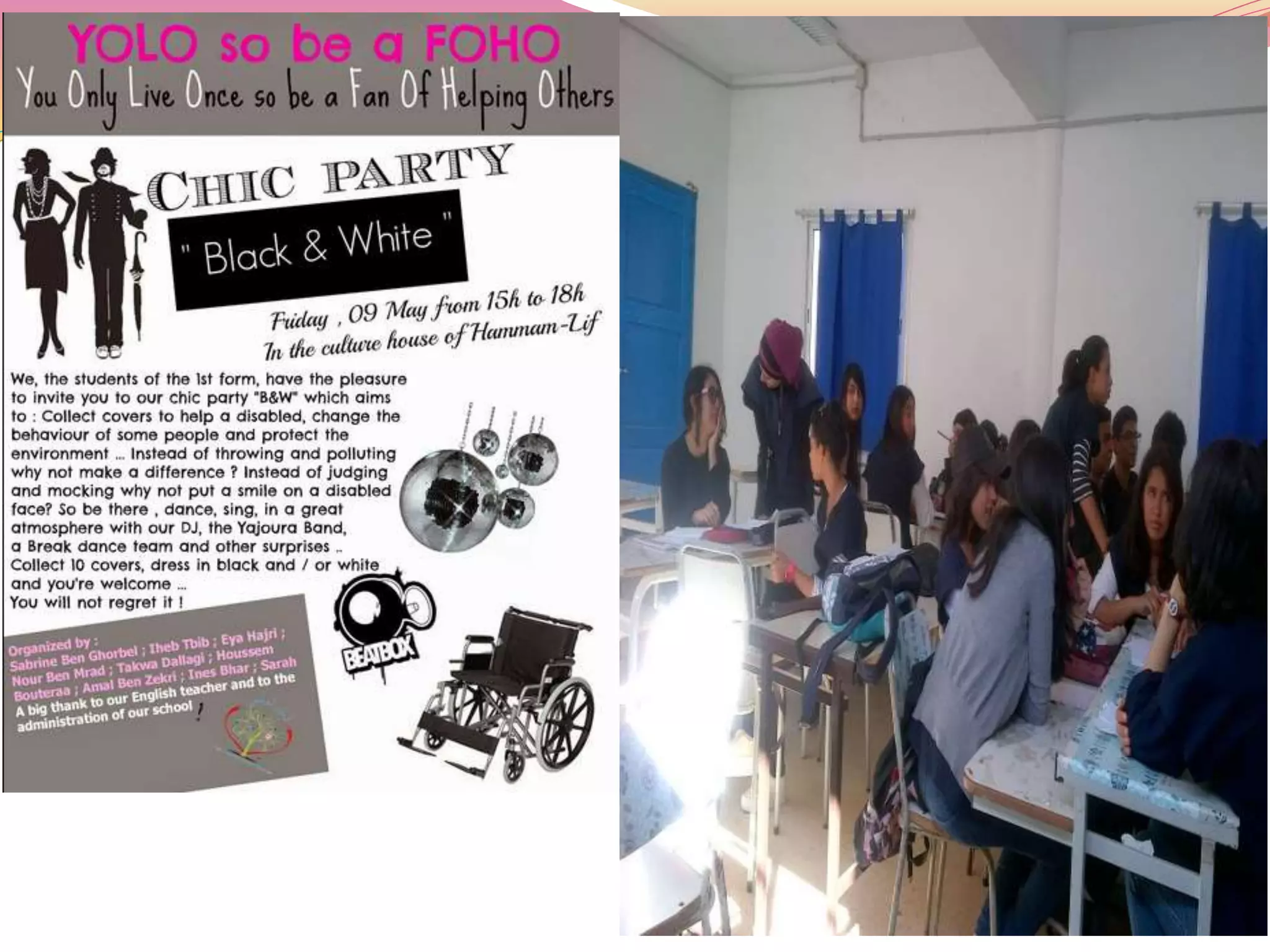
Writing: correspondence with an NGO, writing invitations, writing a
charter, speech writing…
Designing a leaflet
Organizing a campaign at school and beyond for picking up plastic
bottle covers and other kind of plastic covers for the association who will
give them in their turn to a recycler for an amount of money to donate a
wheelchair for a handicapped.
Organizing an event ( a charity party)
Games, drawings and art crafts to raise awareness of kids in a
kindergarten, that my students visited, to the importance of reusing things
instead of throwing them and recycling to live in a safe environment.
Presentations.
Questionnaire. Hayfa Majdoub, Feb 2015
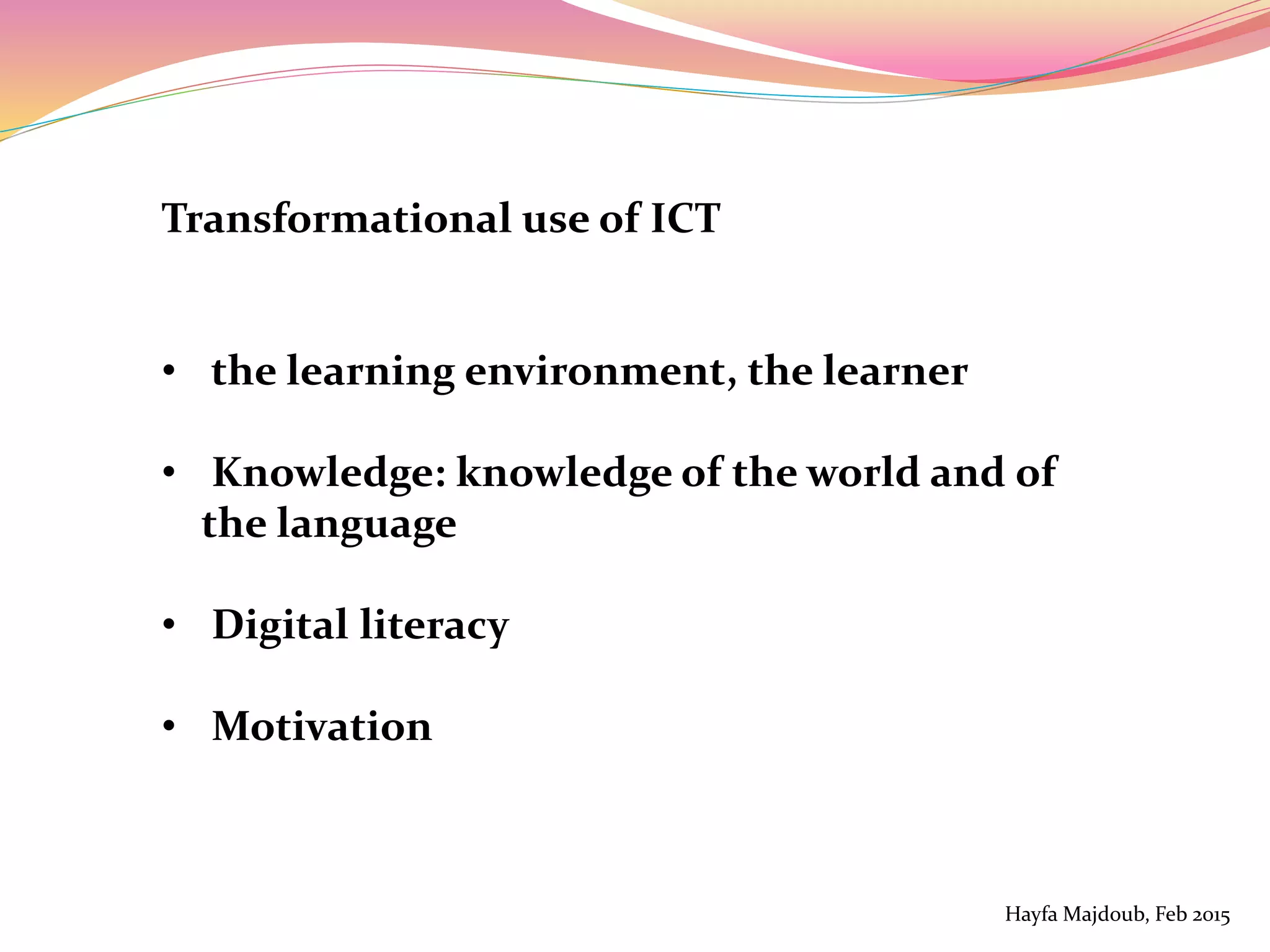
Transformational use of ICT
• the learning environment, the learner
• Knowledge: knowledge of the world and of
the language
• Digital literacy
• Motivation
Hayfa Majdoub, Feb 2015
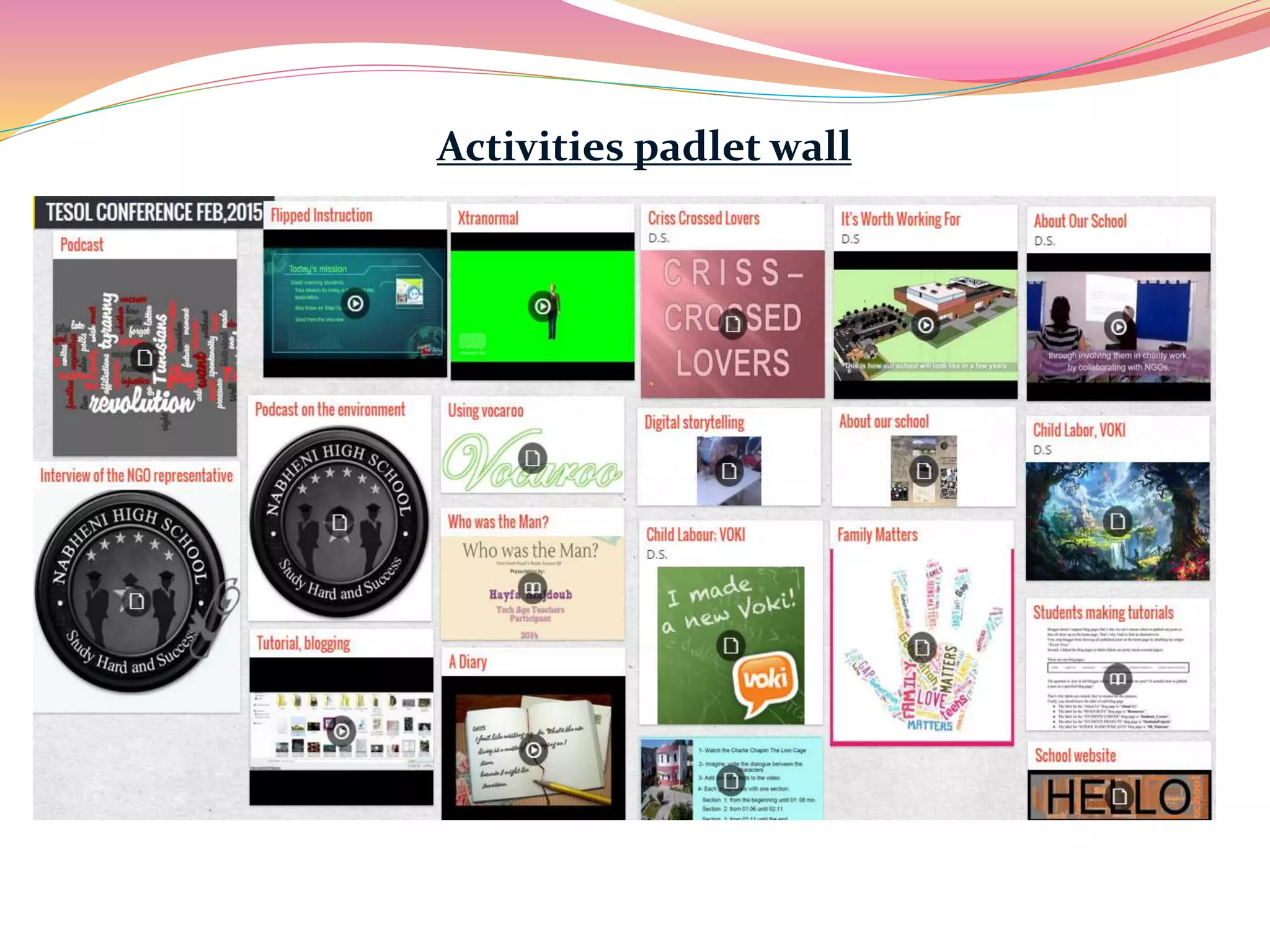
Activities padlet wall
Questions?
Bibliography:
Black, R. (2009). English –Language learners, fan communities, and 21st century
skills. Journal of adolescent and adult literacy, 52(8), 688-697
Eaton, S.E. (2010). Global Trends in language learning in the twenty – first century.
M. Prensky (2001) Digital Natives Digital Immigrants, part II, Do they really Think
Differently?
Warchauer, M. (2001). Millennialism and media: Language, literacy, and technology
in the 21st century.
Web resources:
TPACK.ORG
21st century skills adapted from Technology, Broadband and Education Advancing
the Education for all Agenda, A Report by the Broadband Commission, page 14

Tesol presentation, feb 2015

  • 1.
    ICT IN THEEFL CLASSROOM: WHY AND HOW Presenter Hayfa Majdoub Tunisia TESOL Second International Conference Emerging Technologies and Evolving Pedagogies in ELT 12-14 February, Cité des Sciences, Tunis Contact: hayfamajdoub@gmail.com @haymajd
  • 2.
    1- Introduction 2-Why youshould integrate ICT in the EFL classroom a-Who are our students? b-The role of ICT in learning c- Changing paradigms 3- My experience in incorporating Information and Communication Technology 4- Wrap up 5- Questions & answers Hayfa Majdoub, Feb 2015
  • 5.
    ICT integration ineducation, and in English language learning and teaching in particular, is the first step towards living up to the 21st century students’ needs because “ The child is the heart of the matter” (Prensky) Hayfa Majdoub, Feb 2015
  • 6.
    • Today’s studentsprocess information differently from their predecessors • Their thinking patterns have changed (Prensky, 2001) • ICT is a source of contextualized learning • ICT gives students control over their learning • They become autonomous independent learners • It exposes students to various and authentic, critical-thinking situations. • ICT provides more exposure to the target language, more practice, more time on task, more opportunities for students to listen, speak and develop their communicative competence. Hayfa Majdoub, Feb 2015
  • 8.
    “If a childcan’t learn the way we teach , maybe we can teach the way they learn.” Ignacio Estrada “ It is not the strongest species that survives, nor the most intelligent that survives. It is the one that is the most adaptable to change.” Charles Darwin Hayfa Majdoub, Feb 2015
  • 9.
  • 10.
    Changing Paradigms • shouldbe conceived of around the new technological tools and semiotic forms that can provide learners with opportunities for the development of both standard language proficiency, digital literacy and 21st century skills. (Black, 2009) • Blended Space. • A space to use the language and cultural knowledge as a means to connect to others around the globe. (Eaton, 2010) The EFL Classroom?Activities Teachers • should have a knowledge of curriculum content, general pedagogies, and technological understanding. TPACK (Koehler and Mishra) Learners • need to develop a new form of literacy and skills by carrying out complex project work involving negotiation, collaboration, goal setting, meaningful communication and the development of challenging products. (Warchauer)
  • 11.
    21st Century Skills ICT InformationLiteracy Tools for working Ways of thinking Creativity Critical thinking Problem-solving Decision –making Learning to learn/ metacognition Ways of working Skills of living in the world Citizenship Life and career skills Personal and social responsibility Communication Collaboration
  • 12.
    In the lightof the previously stated arguments and facts, I designed the activities /instructions / techniques in which I integrated ICT. I’ll demonstrate and explain how • they ameliorate language learning • promote a more learner-centred classroom • develop students 21st century skills
  • 13.
    Digital storytelling, comics,web2.0 tools, project work to enhance language learning and engage learners in and outside the classroom and to develop students’ 21st century Skills • Students develop high-level thinking when they create their own comics either with their peers in the classroom or in a virtual environment. • Digital storytelling, comics enhance students writing skills, especially the writing process. To make their stories, students need to brainstorm and organize ideas, draft and revise the script, share with an authentic audience local or global. Hayfa Majdoub, Feb 2015
  • 14.
    • To maketheir videos/ digital stories, students have to collaborate with other students. • Students communicate ideas combined with visuals. They sequence the ideas with the visuals which requires analyzing, simplifying, connecting, synthesizing, thus developing their higher order thinking skills. Hayfa Majdoub, Feb 2015
  • 15.
    Criss-crossed Lovers This comicwas created by a 2nd form arts student students practise direct and reported speech Hayfa Majdoub, Feb 2015
  • 16.
    I used thefollowing cartoon strips as a follow up activity, to stimulate discussion and to review vocabulary related to parents/teenagers relationship after the lesson. I shared them in the class facebook group : • to extend learning beyond the classroom • create an opportunity for exposing the students to the language. • give an opportunity to the introverted students to express their ideas in a “relatively” secure environment. Hayfa Majdoub, Feb 2015
  • 17.
    Lesson 22: FamilyMatters Hayfa Majdoub, Feb 2015
  • 18.
    Lesson 23: HealthMatters Hayfa Majdoub, Feb 2015
  • 19.
    Lesson 9: WhoWas the Man? Hayfa Majdoub, Feb 2015
  • 20.
    Lesson 9: Whowas the Man? Slide 10
  • 21.
  • 22.
    Interaction: teacher-student Student-Students How doesshe look in picture A? inferring feelings of surprise and extreme fear. How is she holding the steering wheel in picture B? ( I mime the gesture of the character: holding tight) Students: She tightened her grip on the steering wheel. Why did she do so? Out of what? Students: out of fear. Fear of/from what? Students the Man/ car who/that is following her. Instruction: If you were Mary, what would you do in such a situation. Write your sentence starting as given, then share your scenario with the rest of the class. Then the students compare their scenarios to the story in the next slide. Hayfa Majdoub, Feb 2015
  • 23.
  • 24.
    Mindmaps are nota new thing, however, what makes them the tool you might think of using with your students is that they enable • online, real time collaboration, • the insertion of multimedia, comments, hyper links…
  • 25.
    How I usedmind mapping? Mind mapping for reading • Reading comprehension to detect misunderstanding as well as understanding, to help diagnose & remedy misconceptions Hayfa Majdoub, Feb 2015
  • 26.
    Lesson 2: TheStepmum (Second Form) Hayfa Majdoub, Feb 2015
  • 27.
  • 28.
    Lesson 9: Whowas the Man? Hayfa Majdoub, Feb 2015
  • 29.
    • Writing thetext summary using the Mind map • Creative writing: The Street of Death on the Way to California Oral test : students are handed out a mind map with all the necessary information concerning a narrative text and then they use the mind map to narrate the story Hayfa Majdoub, Feb 2015
  • 30.
    A screenshot fromthe student blog and the creative story Hayfa Majdoub, Feb 2015
  • 31.
    Project Work: Conducted withfirst / second formers over one term Project objectives: Hayfa Majdoub, Feb 2015
  • 32.
    Overall objective: Toapply clear strategies (visualize, plan, act) to achieve a dream/an ambition. Objectives: The project aims to: • motivate my students to learn English in the classroom setting (3 hours a week for first formers)and beyond by having a real audience for what they produce e.g. blog posts, podcasts both local and global since the content is shared on the students’ blogs, and the facebook group of the project and other sites, by practicing their basic skills ( reading, writing, listening, speaking) and integrating ICT for learning in a collaborative atmosphere . • get students to think and act as leaders by taking initiatives, and acting to bring a positive change to the community and the society they live in. • make my student identify and reflect on real world problems (pollution issues, irresponsible people behavior, people with special needs, recycling) by discussing, analyzing them to find solutions. Hayfa Majdoub, Feb 2015
  • 33.
    This project providedthe ground for students to develop higher order thinking skills to acquire and apply knowledge central to English by extending their knowledge of the language, and provided them with an opportunity to use the language beyond the classroom setting through a blended learning approach, using web 2.0 tools as well as applying knowledge from other subject areas, like civic education for citizenship values, rights and duties, computer science; making blogs, embedding pictures and videos , using various software, science; learning about the dangers of global warming effects, pollution effects, math; making statistics from a survey they conducted, history; « the Magna Carta », I Have a Dream Speech ,Martin Luther king speech. Students are divided into 4 different groups each with specific tasks. Students collaborate within the same group and with different groups . The work of the different groups was interdependent, collaboration was between mates, adults, and an NGO to complete tasks Hayfa Majdoub, Feb 2015
  • 34.
    Creating: Podcasts, blogs,badges Video: viewing and making of videos, animations, 3D videos using professional software Interviews writing and performing, Writing: correspondence with an NGO, writing invitations, writing a charter, speech writing… Designing a leaflet Organizing a campaign at school and beyond for picking up plastic bottle covers and other kind of plastic covers for the association who will give them in their turn to a recycler for an amount of money to donate a wheelchair for a handicapped. Organizing an event ( a charity party) Games, drawings and art crafts to raise awareness of kids in a kindergarten, that my students visited, to the importance of reusing things instead of throwing them and recycling to live in a safe environment. Presentations. Questionnaire. Hayfa Majdoub, Feb 2015
  • 37.
    Transformational use ofICT • the learning environment, the learner • Knowledge: knowledge of the world and of the language • Digital literacy • Motivation Hayfa Majdoub, Feb 2015
  • 38.
  • 39.
  • 40.
    Bibliography: Black, R. (2009).English –Language learners, fan communities, and 21st century skills. Journal of adolescent and adult literacy, 52(8), 688-697 Eaton, S.E. (2010). Global Trends in language learning in the twenty – first century. M. Prensky (2001) Digital Natives Digital Immigrants, part II, Do they really Think Differently? Warchauer, M. (2001). Millennialism and media: Language, literacy, and technology in the 21st century. Web resources: TPACK.ORG 21st century skills adapted from Technology, Broadband and Education Advancing the Education for all Agenda, A Report by the Broadband Commission, page 14

Editor's Notes

  • #29 People involved/ characters, students write the name of the characters their relationship to other characters.
  • #30 The class agrees on a major event. Four groups are formed . One group to write events, what happened. A second group to imagine characters, their age, a description. A third group to think about possible consequences. A fourth group wrote about the place where the story happened. Step two: Every group then shared with the rest of the class their work Step three: Each group used the information shared to write a story. No matter the ideas, it has to become a logical story. Step Four: All the groups shared their stories with the rest of the class.