REVERSE ENGINEERING AND MALWARE THREAT IN DISTRIBUTED BIOMETRIC SYSTEMS Proyecto fin de carrera Autor: Benxamín Porto Domínguez Tutores: Carmen García Mateo Claus Vielhauer
Contents Introduction Malware Reverse Engineering  Conclusions Question time
Introduction Biometrics refers to the processing of biometrics signals in order to verify an user’s identity or identify within a group of possibilities The most used biometric traits are based on: voice, face, fingerprint, signature, etc.  INTRODUCTION
Objectives Analysis of the possible vulnerabilities that can be found in distributed biometric systems due to Malware or Reverse Engineering attacks Check the results shown by these attacks Find alternative implementations that can counter these types of attacks or at least minimize them INTRODUCTION INTRODUCTION
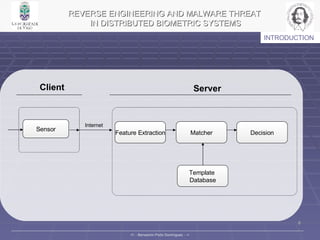
The system The system used is a prototype developed in Universidad de Vigo It is called BioWebAuth It is a distributed authentication system that uses biometrics to authenticate users on the internet It is based on a Client-Server architecture INTRODUCTION INTRODUCTION
INTRODUCTION INTRODUCTION Sensor Feature Extraction Matcher Decision Template  Database Client Server Internet
BioWebAuth INTRODUCTION INTRODUCTION
BioWebAuth (II) INTRODUCTION
Procedure Not use of knowledge unavailable for the attacker Use of diverse hacking tools to emulate Malware Seek for the reverse engineering processes of the biometric modalities Use of the reversed samples to test the system INTRODUCTION
Malware
Malware Set of instructions that run in one computer and make that system do something that an attacker wants it to do It can be found in any platform and in any computer language Growing problem in today’s Internet security  MALWARE
Methodology Study the different types of existent Malware  Find possible techniques against distributed biometric systems Create a threat level list reagarding the sucess possibilities of the different types of Malware MALWARE
Malware Types Malicious mobile code Virus Worms Trojan Horses Backdoors User and Kernel level RootKits Combo Malware MALWARE
Malware level threat Malicious mobile code: low Virus: low Worms: medium Trojan Horses: medium Backdoors: high User and Kernel RootKits: very High Combo Malware: the highest MALWARE +  level threat   |
Techniques Keylogger: Password recovery:  MALWARE
Techniques (II) MALWARE
Techniques  (III) Vulnerabilities scanning MALWARE
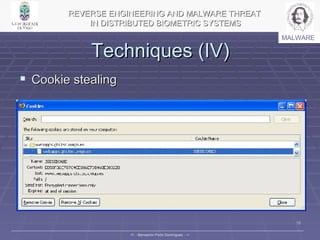
Techniques (IV) Cookie stealing MALWARE
Reverse Engineering
Reserve Engineering Process of analyzing a subject system to identify the system's components and their interrelationships and create representations of the system in another form or a higher level of abstraction Used for reconstruction of an input sample Grey box model is chosen in this work REVERSE ENGINEERING
REVERSE ENGINEERING Sensor Feature Extraction Matcher Decision Template  Database Client Server Internet Reverse Engineering
Methodology Study of the data distribution of templates Find information about the algorithms Create a reverse algorithm through the inversion of Gabor Jets Bypass the system with the use of these samples REVERSE ENGINEERING
Data Distribution Study REVERSE ENGINEERING
Reverse Algorithm  Creation REVERSE ENGINEERING
System Attack REVERSE ENGINEERING
Results The system was bypassed in all the matchings between the spoofed image and the template where it came from Correlated tests between different templates images of the same subject showed a 10% of success REVERSE ENGINEERING
Conclusions
Conclusions Reverse engineering of the system is a serious threat due to the possibility of acquiring an user’s sample Malware can give an attacker important information about the user Malware can modify the input devices and thus invalidate the whole process Biometric templates have to be stored using encryption techniques or, at least, methods for obscuring the identification of different patterns CONCLUSIONS
Conclusions (II) System have to advise all the users against social engineering attacks  Use of liveness detection techniques is highly recommended, although they do not ensure full protection against Malware CONCLUSIONS
Question time Thanks for your time I hope you enjoyed

Tesina Sobri

  • 1.
    REVERSE ENGINEERING ANDMALWARE THREAT IN DISTRIBUTED BIOMETRIC SYSTEMS Proyecto fin de carrera Autor: Benxamín Porto Domínguez Tutores: Carmen García Mateo Claus Vielhauer
  • 2.
    Contents Introduction MalwareReverse Engineering Conclusions Question time
  • 3.
    Introduction Biometrics refersto the processing of biometrics signals in order to verify an user’s identity or identify within a group of possibilities The most used biometric traits are based on: voice, face, fingerprint, signature, etc. INTRODUCTION
  • 4.
    Objectives Analysis ofthe possible vulnerabilities that can be found in distributed biometric systems due to Malware or Reverse Engineering attacks Check the results shown by these attacks Find alternative implementations that can counter these types of attacks or at least minimize them INTRODUCTION INTRODUCTION
  • 5.
    The system Thesystem used is a prototype developed in Universidad de Vigo It is called BioWebAuth It is a distributed authentication system that uses biometrics to authenticate users on the internet It is based on a Client-Server architecture INTRODUCTION INTRODUCTION
  • 6.
    INTRODUCTION INTRODUCTION SensorFeature Extraction Matcher Decision Template Database Client Server Internet
  • 7.
  • 8.
  • 9.
    Procedure Not useof knowledge unavailable for the attacker Use of diverse hacking tools to emulate Malware Seek for the reverse engineering processes of the biometric modalities Use of the reversed samples to test the system INTRODUCTION
  • 10.
  • 11.
    Malware Set ofinstructions that run in one computer and make that system do something that an attacker wants it to do It can be found in any platform and in any computer language Growing problem in today’s Internet security MALWARE
  • 12.
    Methodology Study thedifferent types of existent Malware Find possible techniques against distributed biometric systems Create a threat level list reagarding the sucess possibilities of the different types of Malware MALWARE
  • 13.
    Malware Types Maliciousmobile code Virus Worms Trojan Horses Backdoors User and Kernel level RootKits Combo Malware MALWARE
  • 14.
    Malware level threatMalicious mobile code: low Virus: low Worms: medium Trojan Horses: medium Backdoors: high User and Kernel RootKits: very High Combo Malware: the highest MALWARE + level threat |
  • 15.
  • 16.
  • 17.
    Techniques (III)Vulnerabilities scanning MALWARE
  • 18.
    Techniques (IV) Cookiestealing MALWARE
  • 19.
  • 20.
    Reserve Engineering Processof analyzing a subject system to identify the system's components and their interrelationships and create representations of the system in another form or a higher level of abstraction Used for reconstruction of an input sample Grey box model is chosen in this work REVERSE ENGINEERING
  • 21.
    REVERSE ENGINEERING SensorFeature Extraction Matcher Decision Template Database Client Server Internet Reverse Engineering
  • 22.
    Methodology Study ofthe data distribution of templates Find information about the algorithms Create a reverse algorithm through the inversion of Gabor Jets Bypass the system with the use of these samples REVERSE ENGINEERING
  • 23.
    Data Distribution StudyREVERSE ENGINEERING
  • 24.
    Reverse Algorithm Creation REVERSE ENGINEERING
  • 25.
  • 26.
    Results The systemwas bypassed in all the matchings between the spoofed image and the template where it came from Correlated tests between different templates images of the same subject showed a 10% of success REVERSE ENGINEERING
  • 27.
  • 28.
    Conclusions Reverse engineeringof the system is a serious threat due to the possibility of acquiring an user’s sample Malware can give an attacker important information about the user Malware can modify the input devices and thus invalidate the whole process Biometric templates have to be stored using encryption techniques or, at least, methods for obscuring the identification of different patterns CONCLUSIONS
  • 29.
    Conclusions (II) Systemhave to advise all the users against social engineering attacks Use of liveness detection techniques is highly recommended, although they do not ensure full protection against Malware CONCLUSIONS
  • 30.
    Question time Thanksfor your time I hope you enjoyed