
“The tenure contract is designed primarily to
provide a measure of security for teachers and
to ensure that they are protected from arbitrary
and capricious treatment by school authorities.”
                              (Essex, 2012, p. 249)
“The tenure contract is designed primarily to
provide a measure of security for teachers and
to ensure that they are protected from arbitrary
and capricious treatment by school authorities.”
“Tenure also is viewed as a means of providing
a degree of permanency in the teaching force
from which students ultimately benefit.”
                              (Essex, 2012, p. 249)
National Education Association (NEA) was
founded in 1857 as a policy making body
   Tenure became a topic for discussion in the late
   19th Century as conditions in schools continued to
   deteriorate
     Low wages
     No pension benefits
     No job security
     Poor air quality
     Overcrowded classrooms
     Nepotism and political favoritism for jobs
                                       (Coleman et al., 2005)
1800s
 1886 – Massachusetts enacts a rudimentary
 tenure law allowing schools to enter into
 contracts of longer than one year with teachers.


 Since then, NEA has considered tenure an
 integral part of teacher contract agreements
                    (Marshall, Baucom, & Webb, 1998)
1900s
 New Jersey enacts the first statewide tenure law
 in the country in 1909.
                                     (Schwartz, 2008)
1920s
 “The Committee of One Hundred on Problems
 of Tenure reported in 1924 that significant
 problems involving job instability for teachers
 were evident throughout the United States.
 Many had turnover rates higher than 50
 percent, while others were as low as 4 percent.”
                    (Marshall, Baucom, & Webb, 1998, p. 302)
1930s
 NEA conducts research on the effects of tenure
    Comparison of New Jersey teachers who had
    tenure law since 1910 and Connecticut teachers
    who had no tenure and could be dismissed at any
    time
    Studies showed that NJ teachers remained as
    competent as Conn teachers
                                  (Coleman et al., 2005)
1940s
 1946 – NEA’s Committee on Tenure and
 Academic Freedom introduced a purpose for
 tenure
    To develop due process procedures to support the
    dismissal of inept teachers
    To protect competent teachers from dismissal
                            (Marshall, Baucom, & Webb, 1998)
1950s
 Progress
    21 states had adopted a form of statewide tenure
    20 others had districts with tenure components in
    teacher contracts
    7 states had no laws on tenure or annual contracts
                             (Marshall, Baucom, & Webb, 1998)
1960s
 “It was not until the American Federation of
 Teachers’ successful effort to organize the New
 York City teachers, and the resulting rise of
 teacher-union militancy in the 1960s, that
 collective bargaining and tenure became a
 prominent part of public school systems.”
                          (Hess & Maranto, 1999, p. 29)
Today
 Georgia, Mississippi, and Texas are the only
 states with no tenure laws
 Public debate continues regarding the value of
 and need for tenure
 Those opposed believe that tenure simply
 protects incompetent teachers
                                   (Coleman et al., 2005)

                       Click here for a little
                           tenure humor
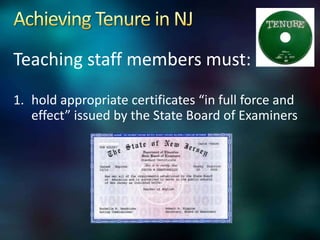
Teaching staff members must:
1. hold appropriate certificates “in full force and
   effect” issued by the State Board of Examiners
Teaching staff members must:
1. hold appropriate certificates “in full force and
   effect” issued by the State Board of Examiners

2. hold such positions delineated in the tenure
   statue, or in an otherwise certificated position
   for the required period, which consists of:
(a) Three consecutive calendar years or any shorter period
    which may be fixed by the employing board for such
    purpose; or
                                      (Schwartz, 2008, p. 3)
(a) Three consecutive calendar years or any shorter period
    which may be fixed by the employing board for such
    purpose; or
(b) three consecutive academic years, together with
    employment at the beginning of the next succeeding
    academic years; or
                                      (Schwartz, 2008, p. 3)
(a) Three consecutive calendar years or any shorter period
    which may be fixed by the employing board for such
    purpose; or
(b) three consecutive academic years, together with
    employment at the beginning of the next succeeding
    academic years; or
(c) The equivalent of more than three academic years
    within a period of any four consecutive academic
    years.
                                      (Schwartz, 2008, p. 3)
“No teaching staff member shall
acquire tenure unless he is, or until
he shall become , a citizen of the
United States.”
                     (N.J.S.A. 18A:28-3)
Tenure is intended to protect
teaching staff members from
dismissal for
“unfounded, flimsy, or political
reasons.”                  Zimmerman v.
Newark Board of Ed., (1962)
Tenure is created by the
legislature and cannot
 be changed by the
 courts. It can only be
changed through legislation.
Local 195, IFPTE, AFL-CIO v. State of New Jersey, 88 N.J. 393 (1982)
Acquisition of tenure is limited only to
positions in which the teaching staff
member has served.

Nelson v. Old Bridge Board of Ed. (1997) rejected
the assertion that tenure was transferable to any
position covered by the same certificate.
Tenure may only be achieved through
the actual passage of time in a position
and not the contractual term. Thus, if a
contract is long enough for tenure to be
achieved, but the employee is released
prior to the end of the contract, tenure is
NOT achieved.
    Canfield v. Board of Ed. Of the Borough of Pine Hills 51 N.J. 400 (1968)
Part time teachers CAN achieve
tenure          Spiewak v. Board of Ed. Of Rutherford (1982)
Leave replacement teachers CANNOT
accrue time toward tenure if the service
is temporary because the return of the
absent staff member is expected. If the
teacher on leave notifies the district that
they are not returning, the replacement
begins to accrue time toward tenure.
Sayreville Ed. Assoc. on behalf of Rucki v. BOE Of the Borough of Sayreville (1984)
By May 15th of each year non-tenured staff:

   must be notified in writing of continuing
   employment
                        OR
   must be notified in writing that employment will
   not be offered

                                   N.J.S.A. 18A:27-10
Failure to provide such notice is deemed an
  offer of employment for the succeeding year!
                                  N.J.S.A. 18A:27-11


                    TRANSLATION
If you forget to send notice of termination to a 3rd
year non-tenured staff member by May 15th, they
can consider it an offer of employment and will
gain tenure on the first day of the following school
year!
Non-tenured staff members
must be observed and
evaluated in the
performance of her or his
duties at least three times
during each school year .
These evaluations must
take place prior to April 30th
of each year.
               N.J.S.A. 18A:27-3.1
The probationary period for Non-tenured staff
members in New Jersey is 3 years.

“School boards are provided broad latitude in
determining whether tenure should be granted.
During the probationary period, a teacher may be
non-renewed at the end of the contract year without
cause or dismissed during the year with cause.”
                                 Essex, 2012, p. 250
“Donaldson v. Board of Ed of North
Wildwood 65 N.J. 236 (1974)
established the right of a teaching
staff member to have a hearing before
an employing board as to the
“reasons” given for the teachers non-
renewal.”
                        Schwartz, 2008
According to Essex, 2012,

“In Sum, non-tenured status involves the following:
    • No expectation for employment beyond the
      contracted year
    • No right to be provided reasons for nonrenewal
    • No right to due process
    • No hearing***”
                 (p. 250)

***This is only modified for NJ by the Donaldson decision. However, even in a
Donaldson hearing, there is no expectation of reinstatement unless it is deemed
that a liberty or property right has been violated.***
Tenured                                  Non-tenured
     Earns property right to the            Contract may be non renewed
     teaching position                      after it expires during the
     Earns continued service status         probationary period or without
     May only be dismissed for              cause
     statutory cause                        May or may not be provided
     Full due process procedures must       reasons for
     be met                                 nonrenewal, depending on state
                                            statutes
     Is entitled to a formal and fair
     hearing                                May or may not be provided a
                                            hearing based on state statute
     Must receive prior notice of
     intent and grounds for proposed        Written notice of nonrenewal
     dismissal by registered or             must be received on or before
     certified mail                         the statutory date required by
                                            law
                                            Failure to meet the statutory
                                            date by the school board may
Chart excerpted from Essex, 2012, p. 252    result in continued employment
Tenured                                  Non-tenured
     Must be provided information            Receives hearing if contract is
     regarding time, place of                cancelled before contract date
     hearing, with option of public or       expires or if required by state law
     closed hearing                          Hearing not provided unless
     Has right to legal counsel              stipulated by state law
     Has right to be provided names          Does not have right to appeal
     of witnesses                            unless stipulated by state statute
     Must be provided transcript of          May be provided hearing if there
     the hearing if requested                is evidence of a liberty right
     May appeal decision to higher           violation – injury to good name
     authority or the courts if decision     or information communicated
     is not favorable                        that affects future employment
                                             opportunities


Chart excerpted from Essex, 2012, p. 252
“Basis of tenure charges is
incapacity, unbecoming conduct or other just
cause.
Hearing required before Commissioner or
person appointed to act on his behalf.
Charges must be signed by the person making
them.
Nothing in the tenure laws may prevent
reduction in force (RIF).”
                             Schwartz, 2008, p. 17
Pro Tenure               Con Tenure
Tenure protects           Tenure fosters
teachers from unfair      complacency.
firing. Teachers          Without the
cannot be removed         incentive of keeping
for                       the job, teachers are
personal, political, o    likely to put in the
r non-work related        minimum
reasons.
Click either picture above to hear the
views of Randi Weingarten, president of
the American Federation of Teachers.
Pro Tenure              Con Tenure
Tenure keeps             Tenure makes is
districts from firing    extremely difficult
experienced              to get rid of
teachers to hire         underperforming or
inexperienced and        incompetent
less expensive ones.     teachers.
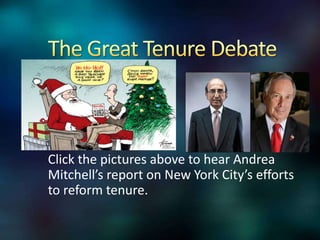
Click the pictures above to hear Andrea
Mitchell’s report on New York City’s efforts
to reform tenure.
Pro Tenure            Con Tenure
Tenure protects        Tenure makes
teachers from being    seniority the main
fired for teaching     factor in teacher
controversial or       dismissal rather
unpopular topics.      than teacher
                       quality.
Click the text or picture above to hear
New Jersey Governor Chris Christie’s views
on teacher tenure.
Tenure has a long history in the United States.

Tenure laws are intricate and there is a great
deal of case law that helps us to interpret.
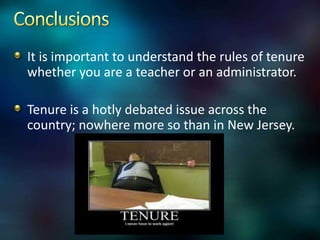
It is important to understand the rules of tenure
whether you are a teacher or an administrator.

Tenure is a hotly debated issue across the
country; nowhere more so than in New Jersey.
Canfield v. Board of Ed. Of the Borough of Pine Hills, 51 N.J. 400 (1968)

Coleman, J., Schroth, S. T., Molinaro, L., & Green, M. (2005). Tenure: An Important Due Process Right
           or a Hindrance to Change in the Schools? Journal of Personnel Evaluation in Education,
           18(3), 219-231. doi: 10.1007/s11092-006-9020-5

Donaldson v. Board of Ed of North Wildwood, 65 N.J. 236 (1974)

Essex, N. L. (2012). School Law and the Public Schools: A Practical Guide for Educational Leaders (5th
            ed.). Upper Saddle River, NJ: Pearson Education, Inc.

Hess, F. & Maranto, R. A. (1999). Reinventing Tenure. The American School Board Journal 186(5), 28–
           31.

Local 195, IFPTE, AFL-CIO v. State of New Jersey, 88 N.J. 393 (1982)

Marshall, P., Baucom, D., & Webb, A. (1998). Do you have tenure, and do you really want it? The
            Clearing House, 71(5), 302-304.
Nelson v. Old Bridge Board of Ed., 148 N.J. 358 (1997)

N.J.S.A. 18A

Sayreville Ed. Assoc. on behalf of Rucki v. BOE Of the Borough of Sayreville 193 N.J. Super 424 (App.
            Div. 1984)

Schwartz, R. M., (2008). NJPSA Education Law Primer: Tenure & Seniority. New Jersey Principals and
           Supervisors Association.

Spiewak v. Board of Ed. Of Rutherford 90 N.J. 63 (1982)

Zimmerman v. Newark Board of Ed. 38 N.J. 65 (1962)

Tenure and NJ

  • 2.
    “The tenure contractis designed primarily to provide a measure of security for teachers and to ensure that they are protected from arbitrary and capricious treatment by school authorities.” (Essex, 2012, p. 249)
  • 3.
    “The tenure contractis designed primarily to provide a measure of security for teachers and to ensure that they are protected from arbitrary and capricious treatment by school authorities.” “Tenure also is viewed as a means of providing a degree of permanency in the teaching force from which students ultimately benefit.” (Essex, 2012, p. 249)
  • 4.
    National Education Association(NEA) was founded in 1857 as a policy making body Tenure became a topic for discussion in the late 19th Century as conditions in schools continued to deteriorate Low wages No pension benefits No job security Poor air quality Overcrowded classrooms Nepotism and political favoritism for jobs (Coleman et al., 2005)
  • 5.
    1800s 1886 –Massachusetts enacts a rudimentary tenure law allowing schools to enter into contracts of longer than one year with teachers. Since then, NEA has considered tenure an integral part of teacher contract agreements (Marshall, Baucom, & Webb, 1998)
  • 6.
    1900s New Jerseyenacts the first statewide tenure law in the country in 1909. (Schwartz, 2008)
  • 7.
    1920s “The Committeeof One Hundred on Problems of Tenure reported in 1924 that significant problems involving job instability for teachers were evident throughout the United States. Many had turnover rates higher than 50 percent, while others were as low as 4 percent.” (Marshall, Baucom, & Webb, 1998, p. 302)
  • 8.
    1930s NEA conductsresearch on the effects of tenure Comparison of New Jersey teachers who had tenure law since 1910 and Connecticut teachers who had no tenure and could be dismissed at any time Studies showed that NJ teachers remained as competent as Conn teachers (Coleman et al., 2005)
  • 9.
    1940s 1946 –NEA’s Committee on Tenure and Academic Freedom introduced a purpose for tenure To develop due process procedures to support the dismissal of inept teachers To protect competent teachers from dismissal (Marshall, Baucom, & Webb, 1998)
  • 10.
    1950s Progress 21 states had adopted a form of statewide tenure 20 others had districts with tenure components in teacher contracts 7 states had no laws on tenure or annual contracts (Marshall, Baucom, & Webb, 1998)
  • 11.
    1960s “It wasnot until the American Federation of Teachers’ successful effort to organize the New York City teachers, and the resulting rise of teacher-union militancy in the 1960s, that collective bargaining and tenure became a prominent part of public school systems.” (Hess & Maranto, 1999, p. 29)
  • 12.
    Today Georgia, Mississippi,and Texas are the only states with no tenure laws Public debate continues regarding the value of and need for tenure Those opposed believe that tenure simply protects incompetent teachers (Coleman et al., 2005) Click here for a little tenure humor
  • 13.
    Teaching staff membersmust: 1. hold appropriate certificates “in full force and effect” issued by the State Board of Examiners
  • 14.
    Teaching staff membersmust: 1. hold appropriate certificates “in full force and effect” issued by the State Board of Examiners 2. hold such positions delineated in the tenure statue, or in an otherwise certificated position for the required period, which consists of:
  • 15.
    (a) Three consecutivecalendar years or any shorter period which may be fixed by the employing board for such purpose; or (Schwartz, 2008, p. 3)
  • 16.
    (a) Three consecutivecalendar years or any shorter period which may be fixed by the employing board for such purpose; or (b) three consecutive academic years, together with employment at the beginning of the next succeeding academic years; or (Schwartz, 2008, p. 3)
  • 17.
    (a) Three consecutivecalendar years or any shorter period which may be fixed by the employing board for such purpose; or (b) three consecutive academic years, together with employment at the beginning of the next succeeding academic years; or (c) The equivalent of more than three academic years within a period of any four consecutive academic years. (Schwartz, 2008, p. 3)
  • 18.
    “No teaching staffmember shall acquire tenure unless he is, or until he shall become , a citizen of the United States.” (N.J.S.A. 18A:28-3)
  • 19.
    Tenure is intendedto protect teaching staff members from dismissal for “unfounded, flimsy, or political reasons.” Zimmerman v. Newark Board of Ed., (1962)
  • 20.
    Tenure is createdby the legislature and cannot be changed by the courts. It can only be changed through legislation. Local 195, IFPTE, AFL-CIO v. State of New Jersey, 88 N.J. 393 (1982)
  • 21.
    Acquisition of tenureis limited only to positions in which the teaching staff member has served. Nelson v. Old Bridge Board of Ed. (1997) rejected the assertion that tenure was transferable to any position covered by the same certificate.
  • 22.
    Tenure may onlybe achieved through the actual passage of time in a position and not the contractual term. Thus, if a contract is long enough for tenure to be achieved, but the employee is released prior to the end of the contract, tenure is NOT achieved. Canfield v. Board of Ed. Of the Borough of Pine Hills 51 N.J. 400 (1968)
  • 23.
    Part time teachersCAN achieve tenure Spiewak v. Board of Ed. Of Rutherford (1982)
  • 24.
    Leave replacement teachersCANNOT accrue time toward tenure if the service is temporary because the return of the absent staff member is expected. If the teacher on leave notifies the district that they are not returning, the replacement begins to accrue time toward tenure. Sayreville Ed. Assoc. on behalf of Rucki v. BOE Of the Borough of Sayreville (1984)
  • 25.
    By May 15thof each year non-tenured staff: must be notified in writing of continuing employment OR must be notified in writing that employment will not be offered N.J.S.A. 18A:27-10
  • 26.
    Failure to providesuch notice is deemed an offer of employment for the succeeding year! N.J.S.A. 18A:27-11 TRANSLATION If you forget to send notice of termination to a 3rd year non-tenured staff member by May 15th, they can consider it an offer of employment and will gain tenure on the first day of the following school year!
  • 27.
    Non-tenured staff members mustbe observed and evaluated in the performance of her or his duties at least three times during each school year . These evaluations must take place prior to April 30th of each year. N.J.S.A. 18A:27-3.1
  • 28.
    The probationary periodfor Non-tenured staff members in New Jersey is 3 years. “School boards are provided broad latitude in determining whether tenure should be granted. During the probationary period, a teacher may be non-renewed at the end of the contract year without cause or dismissed during the year with cause.” Essex, 2012, p. 250
  • 29.
    “Donaldson v. Boardof Ed of North Wildwood 65 N.J. 236 (1974) established the right of a teaching staff member to have a hearing before an employing board as to the “reasons” given for the teachers non- renewal.” Schwartz, 2008
  • 30.
    According to Essex,2012, “In Sum, non-tenured status involves the following: • No expectation for employment beyond the contracted year • No right to be provided reasons for nonrenewal • No right to due process • No hearing***” (p. 250) ***This is only modified for NJ by the Donaldson decision. However, even in a Donaldson hearing, there is no expectation of reinstatement unless it is deemed that a liberty or property right has been violated.***
  • 31.
    Tenured Non-tenured Earns property right to the Contract may be non renewed teaching position after it expires during the Earns continued service status probationary period or without May only be dismissed for cause statutory cause May or may not be provided Full due process procedures must reasons for be met nonrenewal, depending on state statutes Is entitled to a formal and fair hearing May or may not be provided a hearing based on state statute Must receive prior notice of intent and grounds for proposed Written notice of nonrenewal dismissal by registered or must be received on or before certified mail the statutory date required by law Failure to meet the statutory date by the school board may Chart excerpted from Essex, 2012, p. 252 result in continued employment
  • 32.
    Tenured Non-tenured Must be provided information Receives hearing if contract is regarding time, place of cancelled before contract date hearing, with option of public or expires or if required by state law closed hearing Hearing not provided unless Has right to legal counsel stipulated by state law Has right to be provided names Does not have right to appeal of witnesses unless stipulated by state statute Must be provided transcript of May be provided hearing if there the hearing if requested is evidence of a liberty right May appeal decision to higher violation – injury to good name authority or the courts if decision or information communicated is not favorable that affects future employment opportunities Chart excerpted from Essex, 2012, p. 252
  • 33.
    “Basis of tenurecharges is incapacity, unbecoming conduct or other just cause. Hearing required before Commissioner or person appointed to act on his behalf. Charges must be signed by the person making them. Nothing in the tenure laws may prevent reduction in force (RIF).” Schwartz, 2008, p. 17
  • 34.
    Pro Tenure Con Tenure Tenure protects Tenure fosters teachers from unfair complacency. firing. Teachers Without the cannot be removed incentive of keeping for the job, teachers are personal, political, o likely to put in the r non-work related minimum reasons.
  • 35.
    Click either pictureabove to hear the views of Randi Weingarten, president of the American Federation of Teachers.
  • 36.
    Pro Tenure Con Tenure Tenure keeps Tenure makes is districts from firing extremely difficult experienced to get rid of teachers to hire underperforming or inexperienced and incompetent less expensive ones. teachers.
  • 37.
    Click the picturesabove to hear Andrea Mitchell’s report on New York City’s efforts to reform tenure.
  • 38.
    Pro Tenure Con Tenure Tenure protects Tenure makes teachers from being seniority the main fired for teaching factor in teacher controversial or dismissal rather unpopular topics. than teacher quality.
  • 39.
    Click the textor picture above to hear New Jersey Governor Chris Christie’s views on teacher tenure.
  • 40.
    Tenure has along history in the United States. Tenure laws are intricate and there is a great deal of case law that helps us to interpret.
  • 41.
    It is importantto understand the rules of tenure whether you are a teacher or an administrator. Tenure is a hotly debated issue across the country; nowhere more so than in New Jersey.
  • 42.
    Canfield v. Boardof Ed. Of the Borough of Pine Hills, 51 N.J. 400 (1968) Coleman, J., Schroth, S. T., Molinaro, L., & Green, M. (2005). Tenure: An Important Due Process Right or a Hindrance to Change in the Schools? Journal of Personnel Evaluation in Education, 18(3), 219-231. doi: 10.1007/s11092-006-9020-5 Donaldson v. Board of Ed of North Wildwood, 65 N.J. 236 (1974) Essex, N. L. (2012). School Law and the Public Schools: A Practical Guide for Educational Leaders (5th ed.). Upper Saddle River, NJ: Pearson Education, Inc. Hess, F. & Maranto, R. A. (1999). Reinventing Tenure. The American School Board Journal 186(5), 28– 31. Local 195, IFPTE, AFL-CIO v. State of New Jersey, 88 N.J. 393 (1982) Marshall, P., Baucom, D., & Webb, A. (1998). Do you have tenure, and do you really want it? The Clearing House, 71(5), 302-304.
  • 43.
    Nelson v. OldBridge Board of Ed., 148 N.J. 358 (1997) N.J.S.A. 18A Sayreville Ed. Assoc. on behalf of Rucki v. BOE Of the Borough of Sayreville 193 N.J. Super 424 (App. Div. 1984) Schwartz, R. M., (2008). NJPSA Education Law Primer: Tenure & Seniority. New Jersey Principals and Supervisors Association. Spiewak v. Board of Ed. Of Rutherford 90 N.J. 63 (1982) Zimmerman v. Newark Board of Ed. 38 N.J. 65 (1962)