Class

Before this lesson

During this lesson

After this lesson

10EGe1

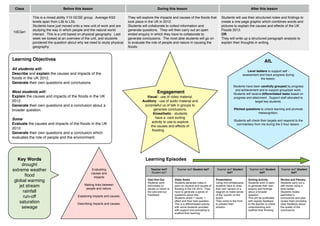
This is a mixed ability Y10 GCSE group. Average KS2
levels span from L3b to L5b.
Students have just moved onto a new unit of work and are
studying the way in which people and the natural world
interact. This is a unit based on physical geography. Last
week we looked at an overview of the unit, and students
pondered the question about why we need to study physical
geography.

They will explore the impacts and causes of the floods that
took place in the UK in 2012.
Students will collaborate to collect information and
generate questions. They will then carry out an open
ended enquiry in which they have to collaborate to
generate conclusions. The most able students will go on
to evaluate the role of people and nature in causing the
floods.

Students will use their structured notes and findings to
create a one page graphic which combines words and
pictures to explain the causes and effects of the UK
Floods 2012.
OR
They will write up a structured paragraph analysis to
explain their thoughts in writing.

Learning Objectives

AfL

All students will:
Describe and explain the causes and impacts of the
floods in the UK 2012.
Generate their own questions and conclusions.
Most students will:
Explain the causes and impacts of the floods in the UK
2012.
Generate their own questions and a conclusion about a
broader question.
Some
Evaluate the causes and impacts of the floods in the UK
2012.
Generate their own questions and a conclusion which
evaluates the role of people and the environment.

Key Words
drought
extreme weather
flood
global warming
jet stream
rainfall
run-off
saturation
sewage

Level ladders to support self assessment and track progress during
the lesson.

Engagement
Visual - use of video material.
Auditory - use of audio material and
purposeful us of talk in groups to
generate conclusions.
Kinesthetic - students
have a card sorting
activity to use to explore
the causes and effects of
flooding.

Students have been carefully grouped by progress
and achievement and to support group/pair work.
Students will receive differentiated tasks based on
progress and attainment. Support staff allocated to
target key students.
Pitched questions to unlock learning and promote
metacognition.
Students will check their targets and respond to the
commentary from me during the 2 hour lesson.

Learning Episodes
Evaluating
causes and
impacts
Making links between
people and nature.
Explaining impacts and causes.
Describing impacts and causes.

Teacher led?
Student led?

Teacher led? Student led?

Teacher led? Student
led?

Teacher led? Student
led?

Teacher led? Student
led?

Odd One Out
Students work
individually to
decide on which is
the odd-one-out.
Feedback

Video Notes
Students generate notes in
pairs on impacts and causes of
flooding in the UK 2012. They
have to generate a series of
questions about this.
Students share 1 cause, 1
effect and their best question.
This is a differentiated activity
with some students provided
with support and prompting to
scaffold their learning.

Presentation
Using mini-whiteboards
students have to draw
their own version of a
diagram to make sense
of the ‘puzzle’ on the
board.
They come to the front
to present their
solution.

Sorting Activity
Students work in pairs
to generate their own
enquiry and findings
about a broader
question.
This will be scaffolded
with regular feedback
to the teacher to check
understanding and
scaffold their thinking.

Review and Plenary
Students carry out a
self review using a
level ladder.
Students review
eachother’s
conclusions and peer
review them providing
clear feedback about
the quality of the
conclusions.
Support for writing and
differentiated language

FRONT

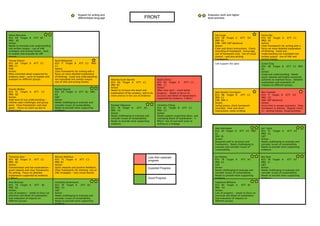
Selma Warsame
KS3: 6A Target: B ATT: B3
PRD:: B2
Action:
Needs to translate oral understanding
into written output - use of VAK
strategies and writing frames. Push
to explain and evaluate for diff
groups.

Extension work and higher
level activities.

Ayub Mohamed
KS3: ?? Target: B ATT: C2 PRD:
C1
Action:
Clear frameworks for writing with a
focus on more detailed explanation
of thinking. Good oral understanding
not translated into written output.
Use of VAK and writing frames.

Charlie McNair
KS3: 7C Target: A ATT: C3
PRD: B2
Action:
High level of oral understanding relishes open challenges and group
work. Close frameworks and clear
goals. Focus on catch up due to
hand injury.

Rachel Querec
KS3: 6A Target: A ATT: B1 PRD:
A3
G&T
Action:
Needs challenging to evaluate and
consider issues of sustainability.
Needs to provide more supporting
evidence.

Tamanna Aziz
KS3: 6B Target: B
ATT: C2
PRD: B2
Action:
Concentration and low expectations quick rewards and clear frameworks
for writing. Focus on detailed
explanation supported by evidence.
5 Whys?

Ibtisam Mahfouz
KS3: 7C Target: A ATT: C1
PRD: B1
Action:
Quick rewards and positive feedback.
Clear frameworks for thinking. Use of
VAK strategies - very visual learner.

Amy Brennan
KS3: 7A Target: B
ATT: B2
PRD: B1
Action:
Lots of progress - needs to focus on
precision and detail of explanation
and evaluation of impacts on
different groups.

Charlotte Johannesen
KS3: 7B Target: A
ATT: A2
PRD: A1
G&T
Action:
Needs challenging to evaluate and
consider issues of sustainability.
Needs to provide more supporting
evidence.

LSA Support (for Jake)

Alleshia Scott-Barrett
KS3: 6A Target: A ATT: C1
PRD: B2
Action:
Needs to increase the detail and
explanation of her answers, and to be
more precise in her use of evidence.

Noah Johnny
KS3: 6A Target: A
ATT: C3
PRD: C1
Action:
After slow start - much better
progress. Needs to focus on
accuracy and detail of explanations
supported by evidence. 5 Whys?

Rachael Adeyemo
KS3: 7B Target: A
ATT: A2
PRD: A1
Action:
Needs challenging to evaluate and
consider issues of sustainability.
Needs to provide more supporting
evidence.

Christina Cheng
KS3: 6C Target: B ATT: C2
PRD:: C1
Action:
Needs support organising ideas, and
extending detail of explanation - 5
Whys? Use of oral work prior to
writing as a strategy.

Less then expected
progress
Expected Progress

Good Progress

Kenny Bui
KS3: 6A Target: A ATT: C1
PRD:: B3
Action:
Clear frameworks for writing with a
focus on more detailed explanation
of thinking. Good oral
understanding not translated into
written output. Use of VAK and
writing frames.
Conor Gray
KS3: 6B Target: B ATT: C2 PRD:
B3
Action:
Good oral understanding. Needs
quick rewards and highly structured
activities to maintain focus. Detailed
explanation and evaluation of
impacts on different groups.

Jake Epstein Covington
KS3: 6B Target: B
ATT: C2
PRD: C1
FSM SEN: S
Action:
Verbal praise, check homework
recorded, clear and direct
instructions, some scribing.

Ben Coombe
KS3: ?? Target: B ATT: D1
PRD: D1
SEN: SAP (dyslexia)
Action:
Extra time to answer questions. Note
homework in planner. Regular check
in - writing frames. Visual prompts.

Alex Montague
KS3: 8C Target: B ATT: A3 PRD:
A1
SEN: SA
Action:
Responds well to structure and
frameworks. Needs challenging to
evaluate and consider issues of
sustainability.

Tyrone Palmer
KS3: 6A Target: B ATT: C2
PRD: C1
FSM
Action:
More extended detail supported by
evidence need - push to explain and
evaluate for different groups.

Sid Louge
KS3: 5B Target: C ATT: D2
PRD: D1
FSM SEN: SAP (dyslexia)
Action:
Clear and direct instructions. Check
recording of homework. Encourage
use of homework club. Use of visual
stimuli - and also writing
frameworks.

Joe Taylor
KS3: 7C Target: A
ATT: A3
PRD: A1
G&T
Action:
Needs challenging to evaluate and
consider issues of sustainability.
Needs to provide more supporting
evidence.

Joe Powley
KS3: 7B Target: A
ATT: A3
PRD: A1
G&T
Action:
Needs challenging to evaluate and
consider issues of sustainability.
Needs to provide more supporting
evidence.

Bea Dyer
KS3: 7B Target: A
ATT: A2
PRD: A*
G&T
Action:
Needs challenging to evaluate and
consider issues of sustainability.
Needs to provide more supporting
evidence.

Stephanie Williams
KS3: 6A Target: A
ATT: B1
PRD: A3
Action:
Lots of progress - needs to focus on
precision and detail of explanation
and evaluation of impacts on
different groups.

11 e ge1 2013-14 v1[1] copy

  • 1.
    Class Before this lesson Duringthis lesson After this lesson 10EGe1 This is a mixed ability Y10 GCSE group. Average KS2 levels span from L3b to L5b. Students have just moved onto a new unit of work and are studying the way in which people and the natural world interact. This is a unit based on physical geography. Last week we looked at an overview of the unit, and students pondered the question about why we need to study physical geography. They will explore the impacts and causes of the floods that took place in the UK in 2012. Students will collaborate to collect information and generate questions. They will then carry out an open ended enquiry in which they have to collaborate to generate conclusions. The most able students will go on to evaluate the role of people and nature in causing the floods. Students will use their structured notes and findings to create a one page graphic which combines words and pictures to explain the causes and effects of the UK Floods 2012. OR They will write up a structured paragraph analysis to explain their thoughts in writing. Learning Objectives AfL All students will: Describe and explain the causes and impacts of the floods in the UK 2012. Generate their own questions and conclusions. Most students will: Explain the causes and impacts of the floods in the UK 2012. Generate their own questions and a conclusion about a broader question. Some Evaluate the causes and impacts of the floods in the UK 2012. Generate their own questions and a conclusion which evaluates the role of people and the environment. Key Words drought extreme weather flood global warming jet stream rainfall run-off saturation sewage Level ladders to support self assessment and track progress during the lesson. Engagement Visual - use of video material. Auditory - use of audio material and purposeful us of talk in groups to generate conclusions. Kinesthetic - students have a card sorting activity to use to explore the causes and effects of flooding. Students have been carefully grouped by progress and achievement and to support group/pair work. Students will receive differentiated tasks based on progress and attainment. Support staff allocated to target key students. Pitched questions to unlock learning and promote metacognition. Students will check their targets and respond to the commentary from me during the 2 hour lesson. Learning Episodes Evaluating causes and impacts Making links between people and nature. Explaining impacts and causes. Describing impacts and causes. Teacher led? Student led? Teacher led? Student led? Teacher led? Student led? Teacher led? Student led? Teacher led? Student led? Odd One Out Students work individually to decide on which is the odd-one-out. Feedback Video Notes Students generate notes in pairs on impacts and causes of flooding in the UK 2012. They have to generate a series of questions about this. Students share 1 cause, 1 effect and their best question. This is a differentiated activity with some students provided with support and prompting to scaffold their learning. Presentation Using mini-whiteboards students have to draw their own version of a diagram to make sense of the ‘puzzle’ on the board. They come to the front to present their solution. Sorting Activity Students work in pairs to generate their own enquiry and findings about a broader question. This will be scaffolded with regular feedback to the teacher to check understanding and scaffold their thinking. Review and Plenary Students carry out a self review using a level ladder. Students review eachother’s conclusions and peer review them providing clear feedback about the quality of the conclusions.
  • 2.
    Support for writingand differentiated language FRONT Selma Warsame KS3: 6A Target: B ATT: B3 PRD:: B2 Action: Needs to translate oral understanding into written output - use of VAK strategies and writing frames. Push to explain and evaluate for diff groups. Extension work and higher level activities. Ayub Mohamed KS3: ?? Target: B ATT: C2 PRD: C1 Action: Clear frameworks for writing with a focus on more detailed explanation of thinking. Good oral understanding not translated into written output. Use of VAK and writing frames. Charlie McNair KS3: 7C Target: A ATT: C3 PRD: B2 Action: High level of oral understanding relishes open challenges and group work. Close frameworks and clear goals. Focus on catch up due to hand injury. Rachel Querec KS3: 6A Target: A ATT: B1 PRD: A3 G&T Action: Needs challenging to evaluate and consider issues of sustainability. Needs to provide more supporting evidence. Tamanna Aziz KS3: 6B Target: B ATT: C2 PRD: B2 Action: Concentration and low expectations quick rewards and clear frameworks for writing. Focus on detailed explanation supported by evidence. 5 Whys? Ibtisam Mahfouz KS3: 7C Target: A ATT: C1 PRD: B1 Action: Quick rewards and positive feedback. Clear frameworks for thinking. Use of VAK strategies - very visual learner. Amy Brennan KS3: 7A Target: B ATT: B2 PRD: B1 Action: Lots of progress - needs to focus on precision and detail of explanation and evaluation of impacts on different groups. Charlotte Johannesen KS3: 7B Target: A ATT: A2 PRD: A1 G&T Action: Needs challenging to evaluate and consider issues of sustainability. Needs to provide more supporting evidence. LSA Support (for Jake) Alleshia Scott-Barrett KS3: 6A Target: A ATT: C1 PRD: B2 Action: Needs to increase the detail and explanation of her answers, and to be more precise in her use of evidence. Noah Johnny KS3: 6A Target: A ATT: C3 PRD: C1 Action: After slow start - much better progress. Needs to focus on accuracy and detail of explanations supported by evidence. 5 Whys? Rachael Adeyemo KS3: 7B Target: A ATT: A2 PRD: A1 Action: Needs challenging to evaluate and consider issues of sustainability. Needs to provide more supporting evidence. Christina Cheng KS3: 6C Target: B ATT: C2 PRD:: C1 Action: Needs support organising ideas, and extending detail of explanation - 5 Whys? Use of oral work prior to writing as a strategy. Less then expected progress Expected Progress Good Progress Kenny Bui KS3: 6A Target: A ATT: C1 PRD:: B3 Action: Clear frameworks for writing with a focus on more detailed explanation of thinking. Good oral understanding not translated into written output. Use of VAK and writing frames. Conor Gray KS3: 6B Target: B ATT: C2 PRD: B3 Action: Good oral understanding. Needs quick rewards and highly structured activities to maintain focus. Detailed explanation and evaluation of impacts on different groups. Jake Epstein Covington KS3: 6B Target: B ATT: C2 PRD: C1 FSM SEN: S Action: Verbal praise, check homework recorded, clear and direct instructions, some scribing. Ben Coombe KS3: ?? Target: B ATT: D1 PRD: D1 SEN: SAP (dyslexia) Action: Extra time to answer questions. Note homework in planner. Regular check in - writing frames. Visual prompts. Alex Montague KS3: 8C Target: B ATT: A3 PRD: A1 SEN: SA Action: Responds well to structure and frameworks. Needs challenging to evaluate and consider issues of sustainability. Tyrone Palmer KS3: 6A Target: B ATT: C2 PRD: C1 FSM Action: More extended detail supported by evidence need - push to explain and evaluate for different groups. Sid Louge KS3: 5B Target: C ATT: D2 PRD: D1 FSM SEN: SAP (dyslexia) Action: Clear and direct instructions. Check recording of homework. Encourage use of homework club. Use of visual stimuli - and also writing frameworks. Joe Taylor KS3: 7C Target: A ATT: A3 PRD: A1 G&T Action: Needs challenging to evaluate and consider issues of sustainability. Needs to provide more supporting evidence. Joe Powley KS3: 7B Target: A ATT: A3 PRD: A1 G&T Action: Needs challenging to evaluate and consider issues of sustainability. Needs to provide more supporting evidence. Bea Dyer KS3: 7B Target: A ATT: A2 PRD: A* G&T Action: Needs challenging to evaluate and consider issues of sustainability. Needs to provide more supporting evidence. Stephanie Williams KS3: 6A Target: A ATT: B1 PRD: A3 Action: Lots of progress - needs to focus on precision and detail of explanation and evaluation of impacts on different groups.