An Overview of Temporal Features in SQL:2011

     Craig Baumunk, January 4, 2012


                                               1
Agenda
•   SQL Standards Process Overview

•   Temporal features in standard SQL history

•   Temporal data overview

•   Things to know about temporal features in SQL:2011

•   Application time period tables

•   System versioned tables

•   Application time period tables with system versioning (bitemporal tables)

•   Next Steps

                                                                                2
SQL Standards Process Overview

   •   INCITS DM32.2 (formerly X3H2) is responsible for SQL standard in US
         – International Committee for Information Technology Standards) is an ANSI (American
            National Standards Institute) accredited standards producing organization
   •   ISO/IEC JTC 1/SC 32 Data Management and Interchange/WG 3 committee is responsible for
       SQL Standard Internationally
   •   Much of the new capabilities in the SQL standard have originated in the US
         – Approval by DM32.2 before submission to WG3
         – Published by ISO then adopted as US standards by INCITS
   •   Typically 3 to 5 year cycle
   •   SQL is a multi-part standard which currently has 9 parts
         – The highest part number is currently 14 (parts 5, 6, 7, 8 &12) were terminated
         – Part 2: SQL/Foundation is the SQL language specification (biggest/most important part)
   •   Documentation of DM32.2 works in progress are not publicly available
   •   Anyone can join DM32 as an observer for $1,200 and get documentation of works in progress and
       what is approved but not yet published etc
   •   7 Versions of Standard SQL
         – 86 (SQL-87), 89, 92(SQL2), SQL:1999 (SQL3), SQL:2003, SQL:2008, SQL:2011


* Disclaimer: I am not and never been a member of X3H2 or INCITS DM32.2 personally
                                                                                                       3
Temporal Features First Attempt 1995 - 2001


•   X3H2 (now DM32.2) and WG 3 both approved work on a new part of SQL standard called
    SQL/Temporal in 1995
•   US made the first proposal on adding the new SQL extensions, largely based on the pioneering
    work of Prof. Rick Snodgrass of Univ. of Arizona
•   The US proposal was based on TSQL2, an extension of SQL-92, put together by a team headed
    by Prof. Snodgrass
•   The US proposal proved to be controversial at ISO. Some of the ISO members felt there were
    some serious problems with the US proposal
•   The UK brought in a competing proposal based on the work of Prof. Nikos Lorentzos of Univ.
    Athens, Greece
•   The US disagreed with the ISO comments on the US proposal. And the US also did not see the
    need for the UK proposal
•   Because of the controversy, both ANSI and ISO decided to defer further work on SQL/Temporal
    until SQL:99 was published
•   After the publication of SQL:99, neither US nor UK brought in any new proposals to resolve the
    differences
•   Because of inactivity, both ANSI and ISO decided to cancel SQL/Temporal part in 2001


                                                                                                     4
Temporal Features Second Attempt 2008 - 2011


•   A second attempt at adding temporal features to the SQL standard was made in
    2008. It started with the acceptance of a proposal on "system-versioned tables"
    by both INCITS DM32.2 and ISO/IEC JTC1 SC32 WG3. Rather than
    resurrecting SQL/Temporal, this proposal added the temporal extensions to
    SQL/Foundation.

•   Another temporal feature was added in 2010 in the form of "application-time
    period tables”.

•   Both system-versioned tables and application-time period tables are now part of
    the new version of the SQL standard (SQL:2011) which was approved and
    published in 2011.

•   The temporal features in SQL:2011 are largely inspired by the earlier proposals
    considered during the first attempt but with a substantially different syntax.


                                                                                      5
Temporal Data


   Temporal data is data which changes over time
     •  A company’s credit rating changes over time
          •    Referred to as valid time dimension, real world perspective or business perspective
          •    SQL:2011 calls this application time
     •  The value we have in a database for a company’s credit rating changes over time
          •    This may be different than application time due to timing differences
          •    This may have nothing to do with the application time perspective (for example corrections)
          •    Referred to as transaction time dimension or database perspective
          •    SQL:2011 calls this system time (or system versioning)

   Most data is temporal
     •   Most common dimensions are application time and system time (focus of temporal features of SQL:2011)

   It is helpful to think of non-temporal data as a trivial case of temporal data
      •    Non-temporal data would be data which does not change (in real life, in a system, or we do not store a
           history of changes in a database)

   Bitemporal data is data which changes over 2 dimensions of time independently
     •   SQL:2011 calls this application time with system versioning


                                                                                                                    6
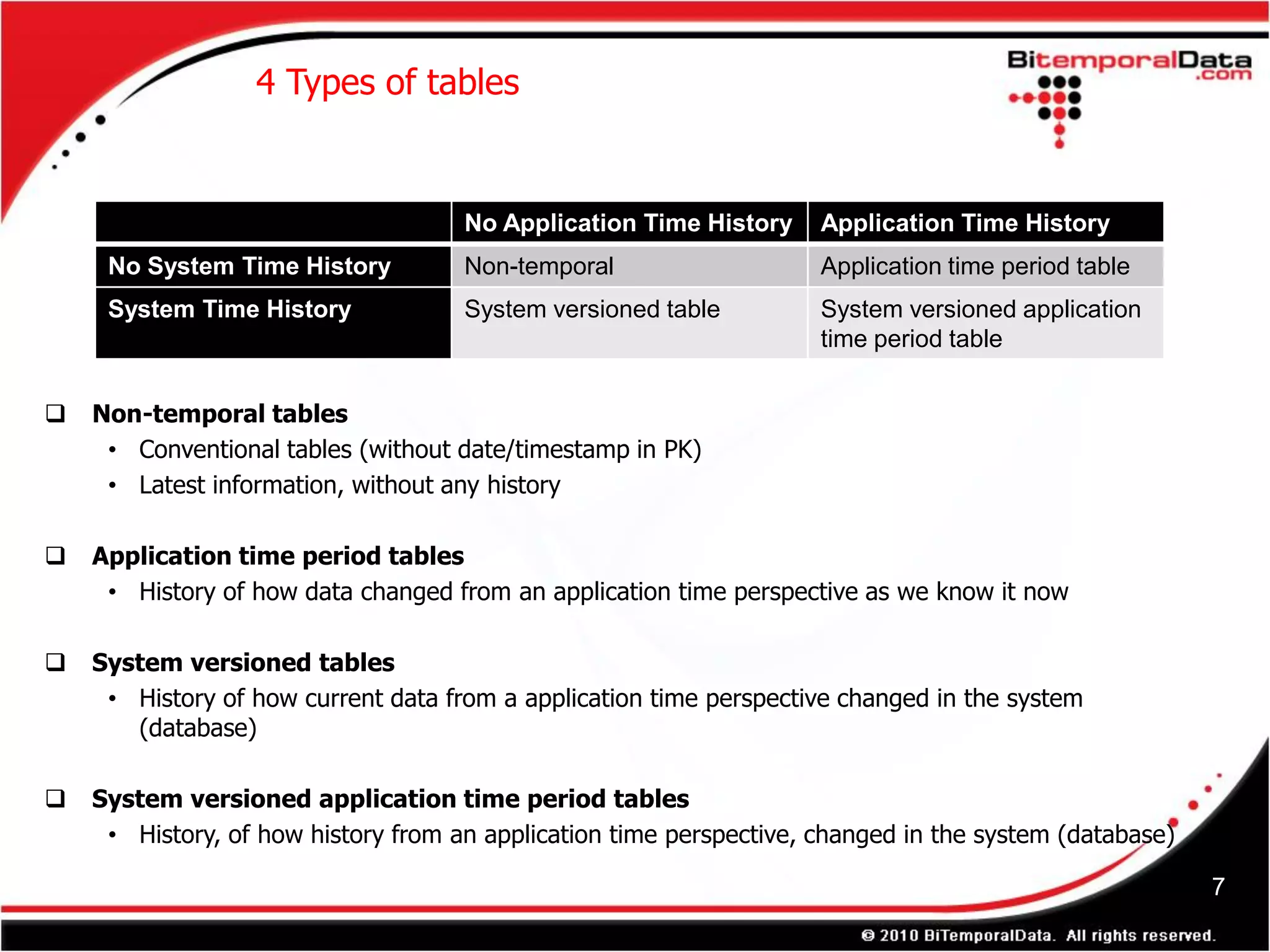
4 Types of tables


                                     No Application Time History     Application Time History
     No System Time History          Non-temporal                    Application time period table
     System Time History             System versioned table          System versioned application
                                                                     time period table


   Non-temporal tables
     • Conventional tables (without date/timestamp in PK)
     • Latest information, without any history

   Application time period tables
     • History of how data changed from an application time perspective as we know it now

   System versioned tables
     • History of how current data from a application time perspective changed in the system
       (database)

   System versioned application time period tables
     • History, of how history from an application time perspective, changed in the system (database)

                                                                                                        7
Things to know about temporal features in
                               SQL:2011
   Row based versioning
     • In contrast to column based versioning
     • But can be use to implement column based versioning

   State based storage
     • 2 timestamps for application time periods
     • 2 timestamps for system time periods
     • 4 timestamps for system versioned application time period tables

   State based inputs
     • User provides application period start AND application period end
     • Users do NOT provide system period start or end
           • Insert, update, and delete events are converted to states (till high datetime)

   Time periods use the Closed – Open convention
     • AKA inclusive – exclusive
     • Supports unambiguous comparisons with different precisions

   The strengths of the temporal features in SQL:2011 are:
     • Ease of migration (not dependent on period data type)
     • Fits well with SQL semantics (no statement modifiers)
     • Lots of user control (can update application start/end directly)
     • Compatibility (existing queries work against system versioned tables)
                                                                                              8
Primary Keys for 4 Types of Tables


   Non-temporal storage
     • No date/timestamp in PK

   Application time period table
     • 2 timestamps (Application Period Start & Application Period End) is not enough
     • Application time periods can not overlap for the same object

   System versioned table
     • System time periods should not overlap for the same object (but this is not part of the PK)
     • 2 rows for the same object can not have the same system start (constraint)
          • Transaction time is defined by implementation (high level of precision)
          • Transaction times should be sequential

   System versioned application time period table
     • Application time periods can overlap for the same object
     • System time periods can overlap for the same object
     • BOTH application time period AND system time period should NOT overlap for the same
       object

                                                                                                     9
Application time period tables

•   Table definition
      – Define columns for application period start and end (need to be a date/timestamp data types and not null)
      – New PERIOD clause specifies what columns implement an application time period and creates an implicit
           constraint that application time period start < application time period end (pick your period name)
      – New WITHOUT OVERLAPS keywords in PRIMARY KEY clause ensures that application time periods do
           not overlap
      – FOREIGN KEY clause extended to include referencing of period in parent table
•   Inserting
      – Normal syntax
              • Comply with constraints ( start and end not null, start < end, no overlaps)
•   Deletes
      – Delete rows with normal syntax
              • Constrain on application time period start and end as desired or not !
      – Delete using FOR PORTION OF application time period FROM DATE XXXX/XX/XX TO DATE XXXX/XX/XX
           clause results in automatic “row splitting”
•   Updates
      – Update rows with normal syntax (including application time period start and end columns)
              • Comply with constraints (start and end not null, start < end, no overlaps)
              • Constrain on application time period start and end as desired or not !
      – Update using FOR PORTION OF application time period FROM DATE XXXX/XX/XX TO DATE
           XXXX/XX/XX clause results in automatic “row splitting”
              • Can’t update application period start or end using this option
•   Select
      – Normal Syntax (application time period start and end can be used since they are explicit columns)
                                                                                                                    10
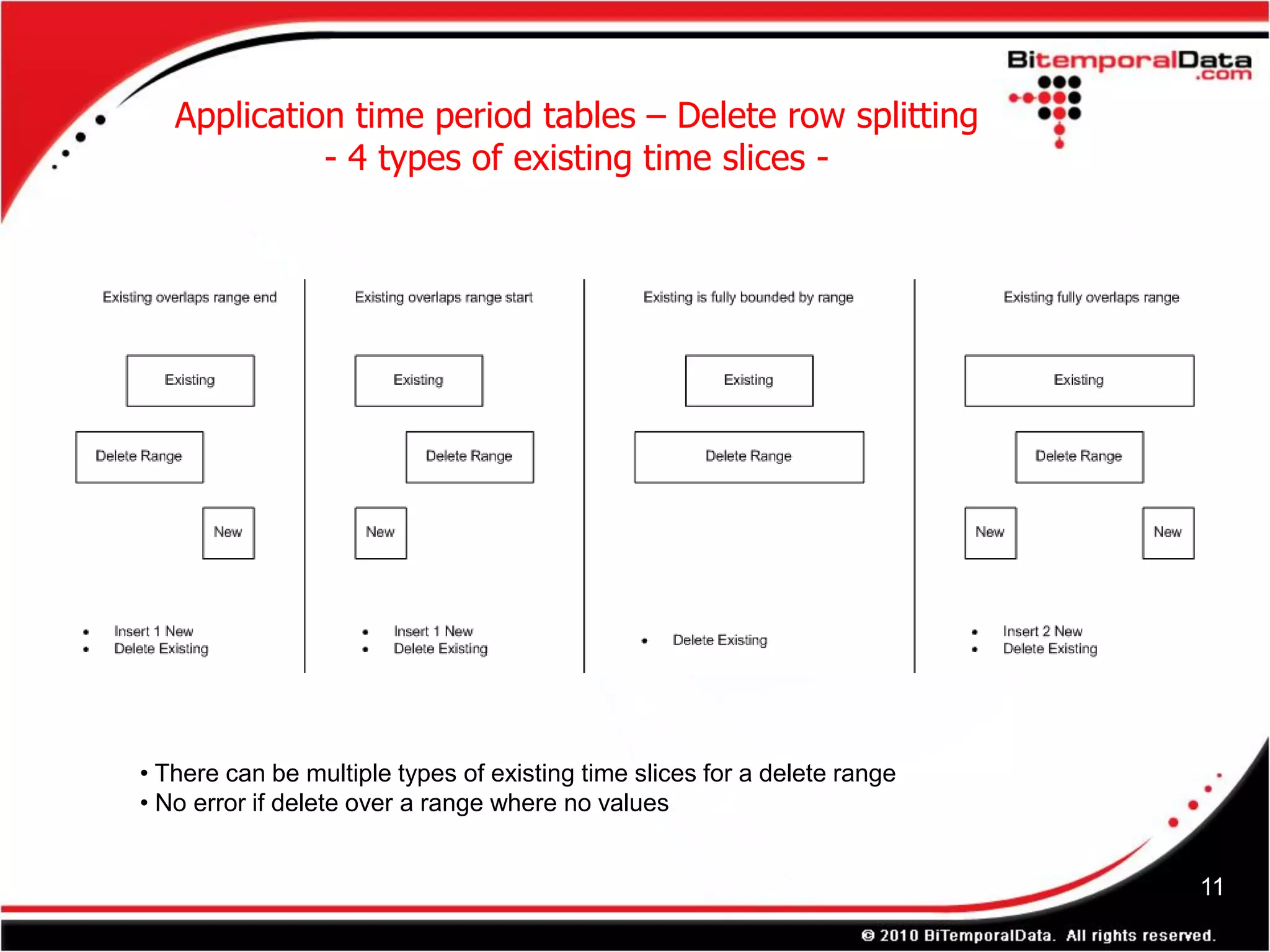
Application time period tables – Delete row splitting
             - 4 types of existing time slices -


• There can be multiple types of existing time slices for a delete range
• No error if delete over a range where no values


                                                                           11
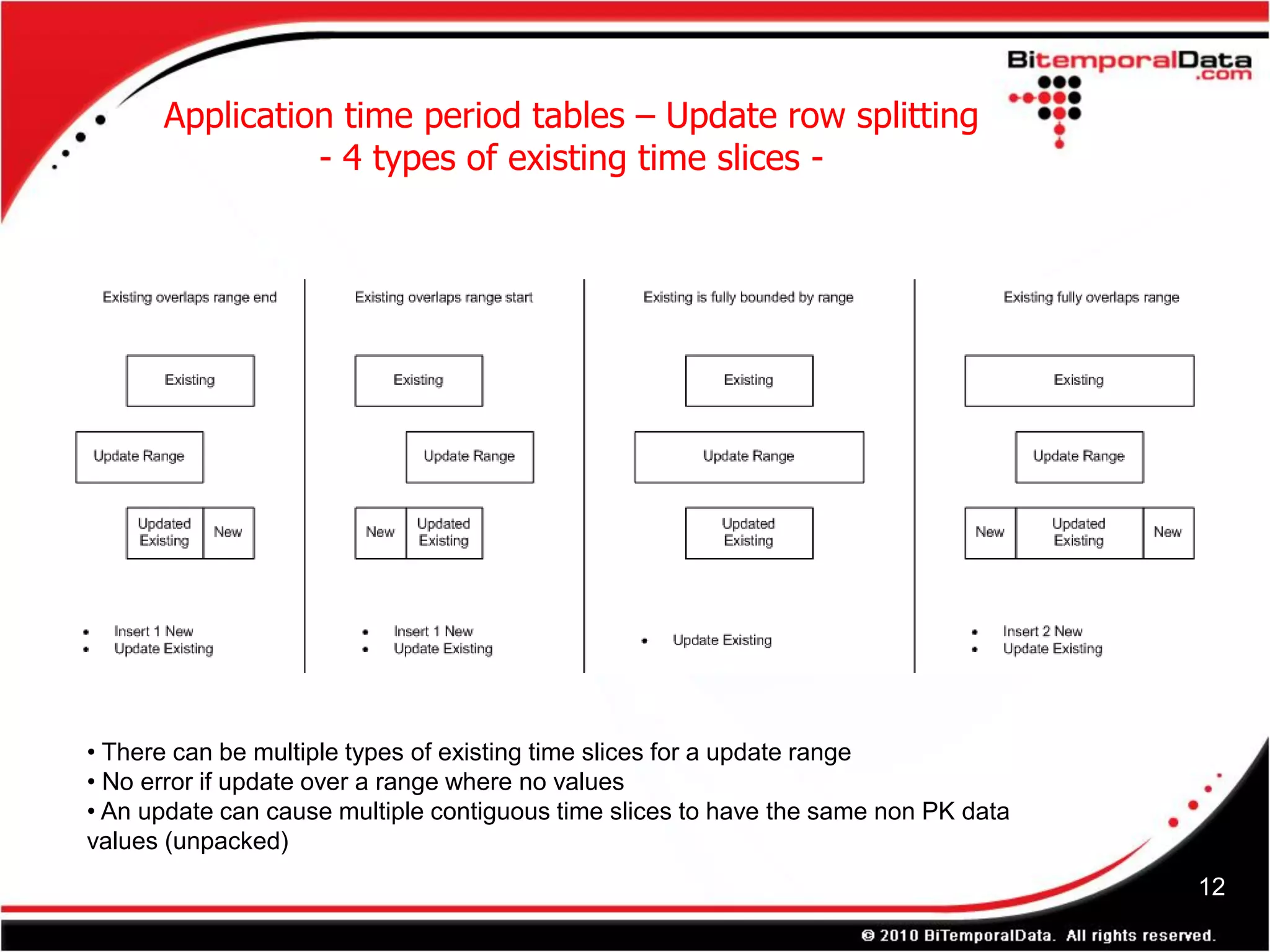
Application time period tables – Update row splitting
                - 4 types of existing time slices -


• There can be multiple types of existing time slices for a update range
• No error if update over a range where no values
• An update can cause multiple contiguous time slices to have the same non PK data
values (unpacked)
                                                                                     12
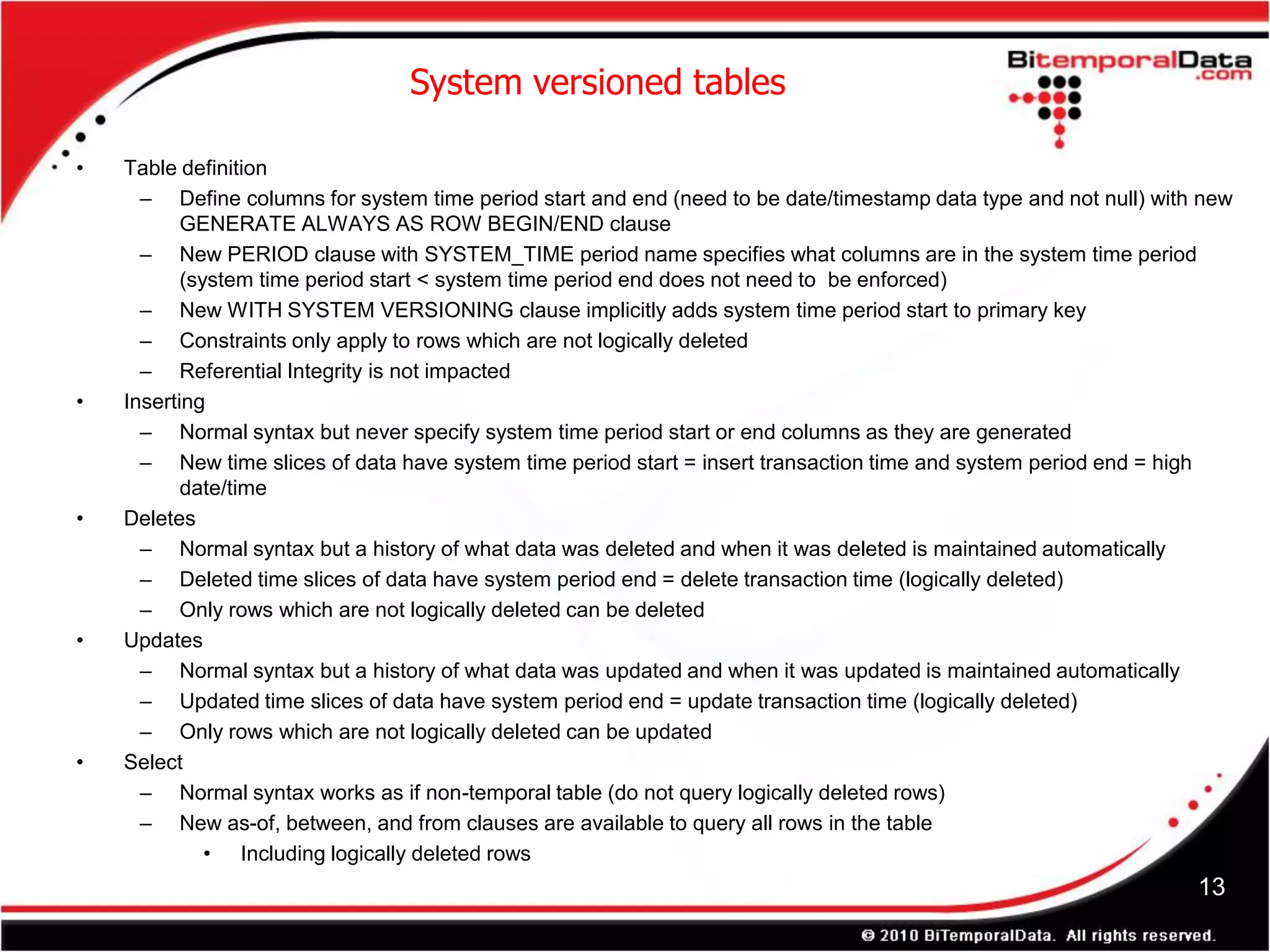
System versioned tables

•   Table definition
      – Define columns for system time period start and end (need to be date/timestamp data type and not null) with new
           GENERATE ALWAYS AS ROW BEGIN/END clause
      – New PERIOD clause with SYSTEM_TIME period name specifies what columns are in the system time period
           (system time period start < system time period end does not need to be enforced)
      – New WITH SYSTEM VERSIONING clause implicitly adds system time period start to primary key
      – Constraints only apply to rows which are not logically deleted
      – Referential Integrity is not impacted
•   Inserting
      – Normal syntax but never specify system time period start or end columns as they are generated
      – New time slices of data have system time period start = insert transaction time and system period end = high
           date/time
•   Deletes
      – Normal syntax but a history of what data was deleted and when it was deleted is maintained automatically
      – Deleted time slices of data have system period end = delete transaction time (logically deleted)
      – Only rows which are not logically deleted can be deleted
•   Updates
      – Normal syntax but a history of what data was updated and when it was updated is maintained automatically
      – Updated time slices of data have system period end = update transaction time (logically deleted)
      – Only rows which are not logically deleted can be updated
•   Select
      – Normal syntax works as if non-temporal table (do not query logically deleted rows)
      – New as-of, between, and from clauses are available to query all rows in the table
              • Including logically deleted rows
                                                                                                                   13
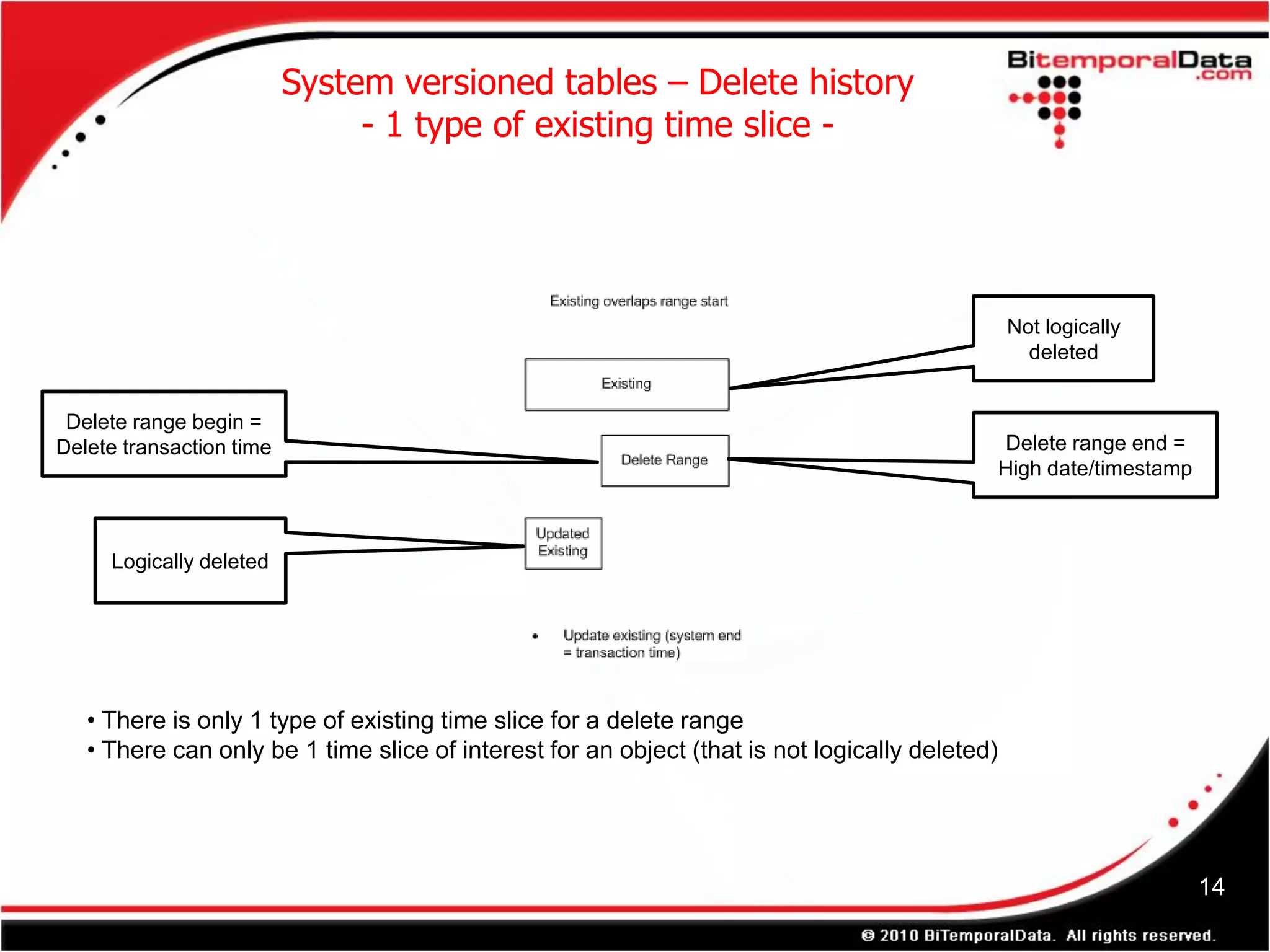
System versioned tables – Delete history
                               - 1 type of existing time slice -


                                                                                                Not logically
                                                                                                  deleted


 Delete range begin =
Delete transaction time                                                                         Delete range end =
                                                                                                High date/timestamp


     Logically deleted


   • There is only 1 type of existing time slice for a delete range
   • There can only be 1 time slice of interest for an object (that is not logically deleted)


                                                                                                                      14
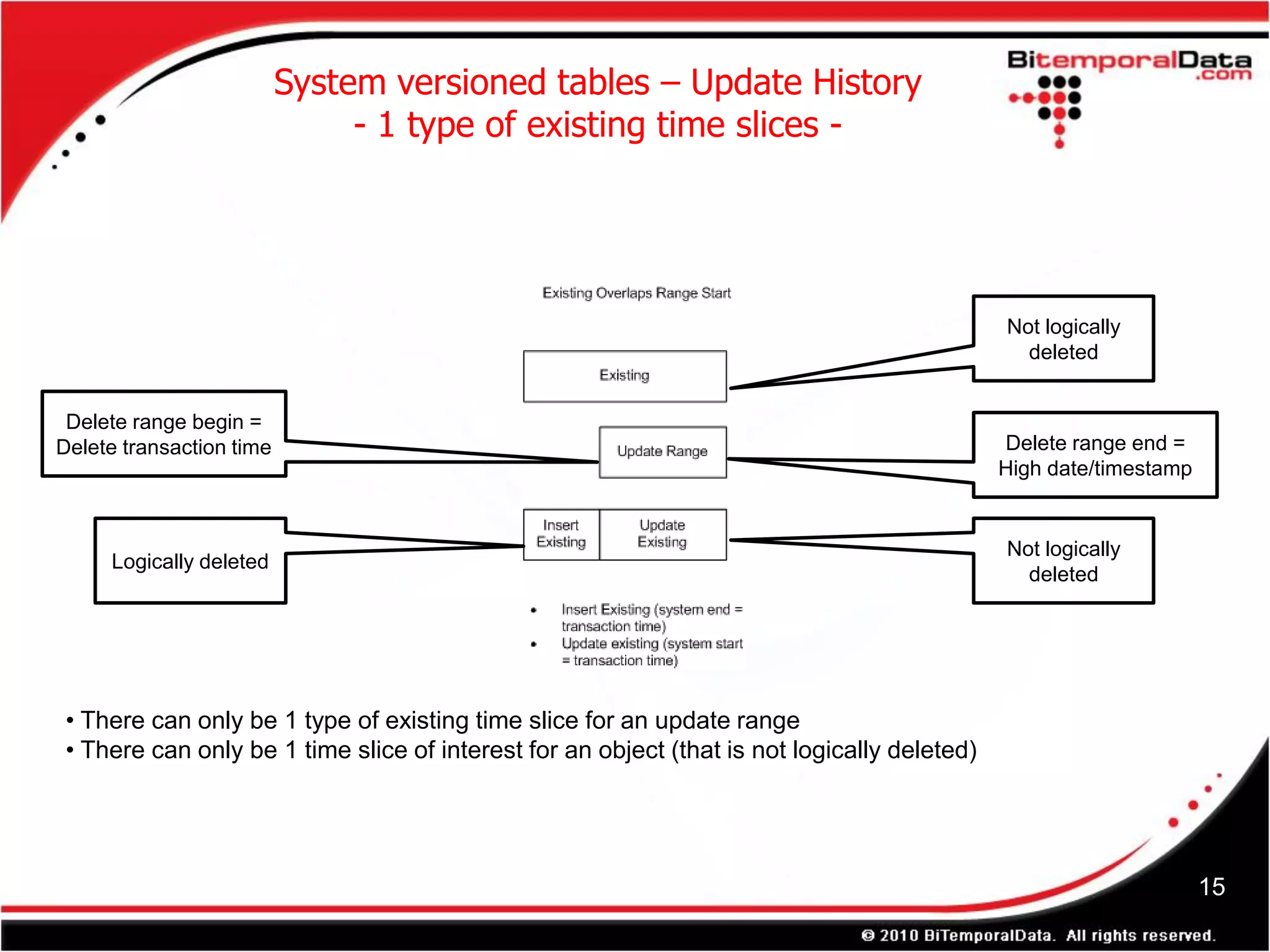
System versioned tables – Update History
                               - 1 type of existing time slices -


                                                                                              Not logically
                                                                                                deleted


 Delete range begin =
Delete transaction time                                                                       Delete range end =
                                                                                              High date/timestamp


                                                                                              Not logically
     Logically deleted
                                                                                                deleted


 • There can only be 1 type of existing time slice for an update range
 • There can only be 1 time slice of interest for an object (that is not logically deleted)


                                                                                                                    15
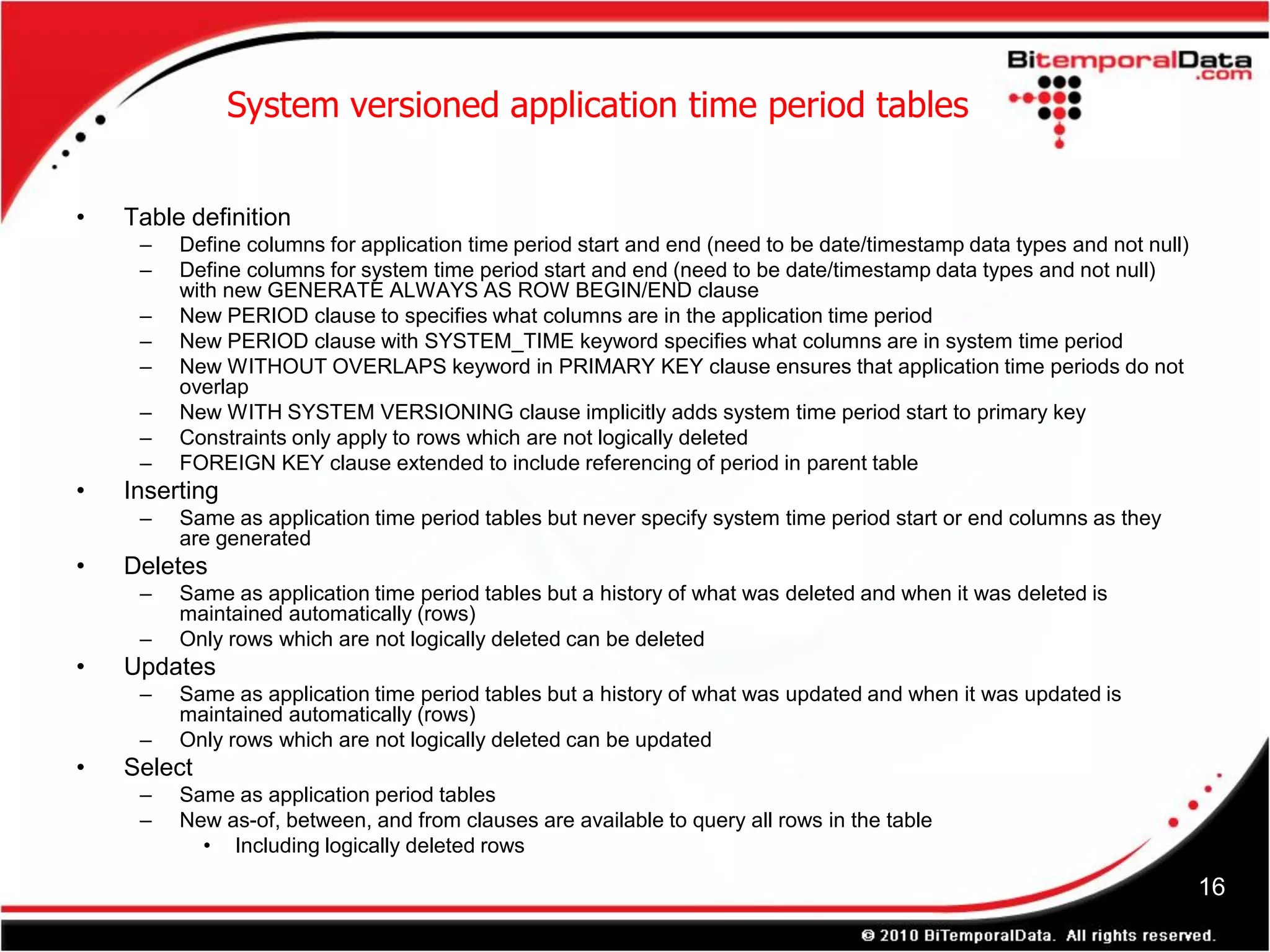
System versioned application time period tables


•   Table definition
     –   Define columns for application time period start and end (need to be date/timestamp data types and not null)
     –   Define columns for system time period start and end (need to be date/timestamp data types and not null)
         with new GENERATE ALWAYS AS ROW BEGIN/END clause
     –   New PERIOD clause to specifies what columns are in the application time period
     –   New PERIOD clause with SYSTEM_TIME keyword specifies what columns are in system time period
     –   New WITHOUT OVERLAPS keyword in PRIMARY KEY clause ensures that application time periods do not
         overlap
     –   New WITH SYSTEM VERSIONING clause implicitly adds system time period start to primary key
     –   Constraints only apply to rows which are not logically deleted
     –   FOREIGN KEY clause extended to include referencing of period in parent table
•   Inserting
     –   Same as application time period tables but never specify system time period start or end columns as they
         are generated
•   Deletes
     –   Same as application time period tables but a history of what was deleted and when it was deleted is
         maintained automatically (rows)
     –   Only rows which are not logically deleted can be deleted
•   Updates
     –   Same as application time period tables but a history of what was updated and when it was updated is
         maintained automatically (rows)
     –   Only rows which are not logically deleted can be updated
•   Select
     –   Same as application period tables
     –   New as-of, between, and from clauses are available to query all rows in the table
           • Including logically deleted rows

                                                                                                                        16
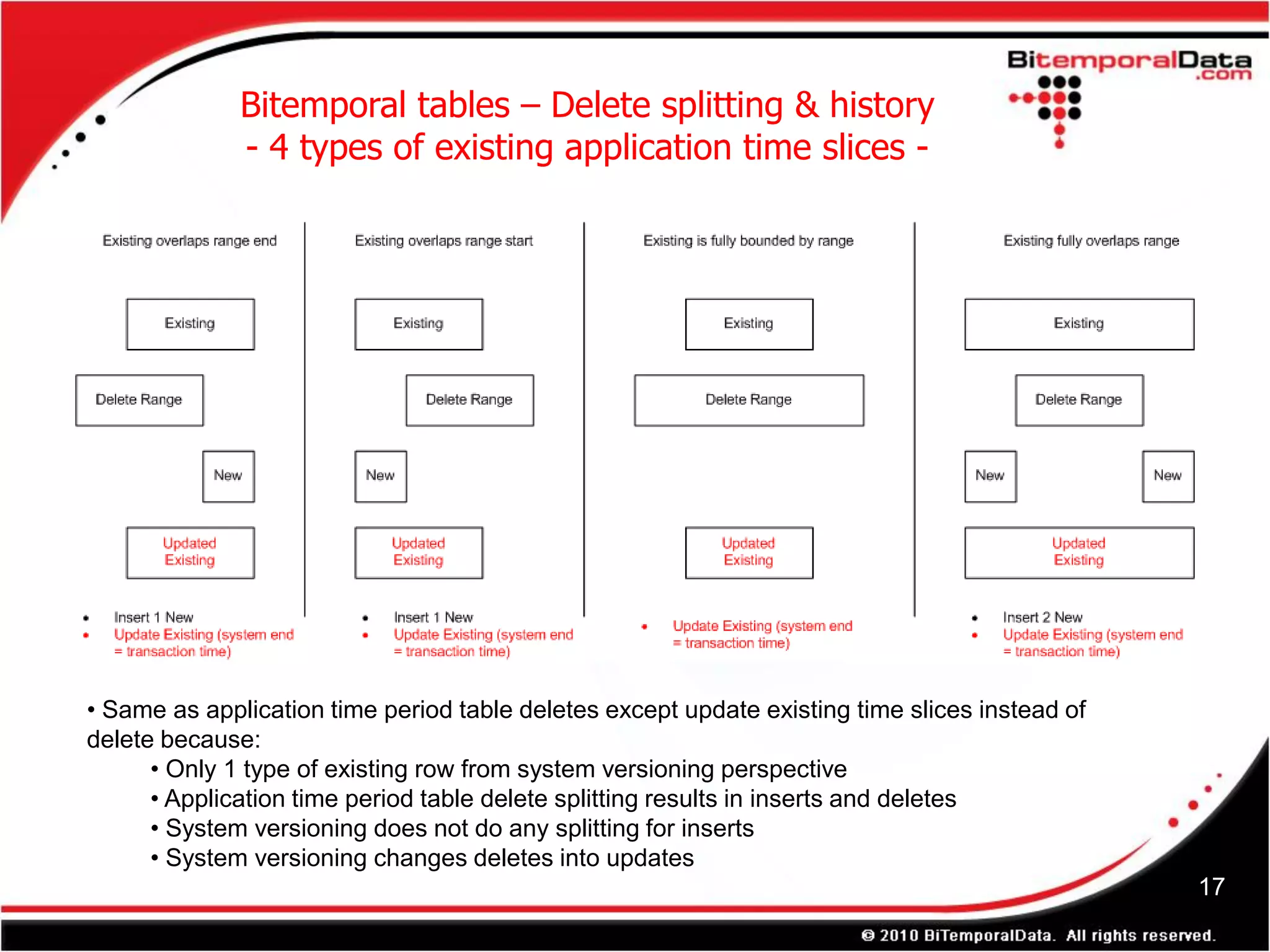
Bitemporal tables – Delete splitting & history
              - 4 types of existing application time slices -


• Same as application time period table deletes except update existing time slices instead of
delete because:
      • Only 1 type of existing row from system versioning perspective
      • Application time period table delete splitting results in inserts and deletes
      • System versioning does not do any splitting for inserts
      • System versioning changes deletes into updates
                                                                                                17
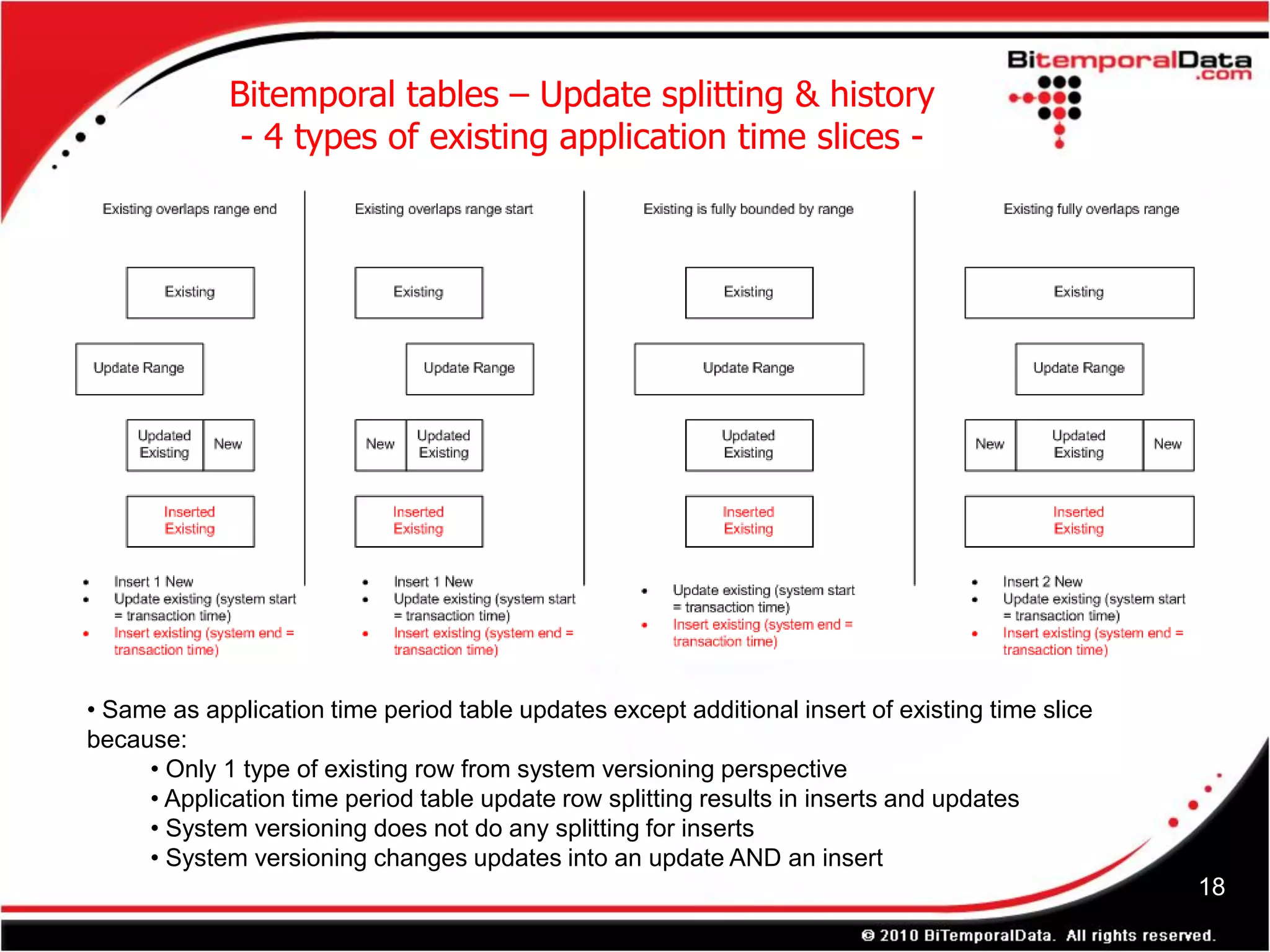
Bitemporal tables – Update splitting & history
              - 4 types of existing application time slices -


• Same as application time period table updates except additional insert of existing time slice
because:
     • Only 1 type of existing row from system versioning perspective
     • Application time period table update row splitting results in inserts and updates
     • System versioning does not do any splitting for inserts
     • System versioning changes updates into an update AND an insert
                                                                                                  18
Summary & Conclusions


• Significant new temporal features have been included in SQL:2011
• Temporal features represent a significant extension to the SQL
  language that will take time for people to utilize
• Vendors are beginning to adopt these features
• Methodology for how to utilize new temporal features of SQL will
  probably be a factor in utilization
• Time will tell how much the SQL:2011 temporal extensions are
  utilized
• Implications of temporal extensions on replication, partitioning,
  archiving etc are still being sorted


                                                                      19
Next Steps


•   Actual syntax

•   Examples, Examples and more examples

•   Advanced topics
     –   Temporal predicates
     –   Joining different types of temporal tables
     –   Referential integrity implications
     –   Schema migration implications

•   Where are vendors with compliance/adoption

•   How vendors CAN comply but also differentiate

•   How vendors ARE differentiating


                                                      20
Resources


 Search YouTube.com for “Case for Bitemporal Data”
    http://www.youtube.com/playlist?list=PL4CB3C8161D2804E6

 TemporalData.com

 “Temporal Data” LinkedIn group
    http://www.linkedin.com/groups?gid=3885228

 http://stacresearch.com/btd
    Functional and performance benchmarks


                                                               21
THANK YOU!


USA                            UK

BitemporalData.com LLC         BitemporalData Ltd
1330 Route 206                 Suite 13493, 2nd floor
Suite 318                      145-157 St John Street
Skillman, NJ 08558             London EC1V 4PY


Tel: +1.201.332.5000           Tel: +44.20.3318.5919


                                                        22

An Overview of Temporal Features in SQL:2011

  • 1.
    An Overview ofTemporal Features in SQL:2011 Craig Baumunk, January 4, 2012 1
  • 2.
    Agenda • SQL Standards Process Overview • Temporal features in standard SQL history • Temporal data overview • Things to know about temporal features in SQL:2011 • Application time period tables • System versioned tables • Application time period tables with system versioning (bitemporal tables) • Next Steps 2
  • 3.
    SQL Standards ProcessOverview • INCITS DM32.2 (formerly X3H2) is responsible for SQL standard in US – International Committee for Information Technology Standards) is an ANSI (American National Standards Institute) accredited standards producing organization • ISO/IEC JTC 1/SC 32 Data Management and Interchange/WG 3 committee is responsible for SQL Standard Internationally • Much of the new capabilities in the SQL standard have originated in the US – Approval by DM32.2 before submission to WG3 – Published by ISO then adopted as US standards by INCITS • Typically 3 to 5 year cycle • SQL is a multi-part standard which currently has 9 parts – The highest part number is currently 14 (parts 5, 6, 7, 8 &12) were terminated – Part 2: SQL/Foundation is the SQL language specification (biggest/most important part) • Documentation of DM32.2 works in progress are not publicly available • Anyone can join DM32 as an observer for $1,200 and get documentation of works in progress and what is approved but not yet published etc • 7 Versions of Standard SQL – 86 (SQL-87), 89, 92(SQL2), SQL:1999 (SQL3), SQL:2003, SQL:2008, SQL:2011 * Disclaimer: I am not and never been a member of X3H2 or INCITS DM32.2 personally 3
  • 4.
    Temporal Features FirstAttempt 1995 - 2001 • X3H2 (now DM32.2) and WG 3 both approved work on a new part of SQL standard called SQL/Temporal in 1995 • US made the first proposal on adding the new SQL extensions, largely based on the pioneering work of Prof. Rick Snodgrass of Univ. of Arizona • The US proposal was based on TSQL2, an extension of SQL-92, put together by a team headed by Prof. Snodgrass • The US proposal proved to be controversial at ISO. Some of the ISO members felt there were some serious problems with the US proposal • The UK brought in a competing proposal based on the work of Prof. Nikos Lorentzos of Univ. Athens, Greece • The US disagreed with the ISO comments on the US proposal. And the US also did not see the need for the UK proposal • Because of the controversy, both ANSI and ISO decided to defer further work on SQL/Temporal until SQL:99 was published • After the publication of SQL:99, neither US nor UK brought in any new proposals to resolve the differences • Because of inactivity, both ANSI and ISO decided to cancel SQL/Temporal part in 2001 4
  • 5.
    Temporal Features SecondAttempt 2008 - 2011 • A second attempt at adding temporal features to the SQL standard was made in 2008. It started with the acceptance of a proposal on "system-versioned tables" by both INCITS DM32.2 and ISO/IEC JTC1 SC32 WG3. Rather than resurrecting SQL/Temporal, this proposal added the temporal extensions to SQL/Foundation. • Another temporal feature was added in 2010 in the form of "application-time period tables”. • Both system-versioned tables and application-time period tables are now part of the new version of the SQL standard (SQL:2011) which was approved and published in 2011. • The temporal features in SQL:2011 are largely inspired by the earlier proposals considered during the first attempt but with a substantially different syntax. 5
  • 6.
    Temporal Data  Temporal data is data which changes over time • A company’s credit rating changes over time • Referred to as valid time dimension, real world perspective or business perspective • SQL:2011 calls this application time • The value we have in a database for a company’s credit rating changes over time • This may be different than application time due to timing differences • This may have nothing to do with the application time perspective (for example corrections) • Referred to as transaction time dimension or database perspective • SQL:2011 calls this system time (or system versioning)  Most data is temporal • Most common dimensions are application time and system time (focus of temporal features of SQL:2011)  It is helpful to think of non-temporal data as a trivial case of temporal data • Non-temporal data would be data which does not change (in real life, in a system, or we do not store a history of changes in a database)  Bitemporal data is data which changes over 2 dimensions of time independently • SQL:2011 calls this application time with system versioning 6
  • 7.
    4 Types oftables No Application Time History Application Time History No System Time History Non-temporal Application time period table System Time History System versioned table System versioned application time period table  Non-temporal tables • Conventional tables (without date/timestamp in PK) • Latest information, without any history  Application time period tables • History of how data changed from an application time perspective as we know it now  System versioned tables • History of how current data from a application time perspective changed in the system (database)  System versioned application time period tables • History, of how history from an application time perspective, changed in the system (database) 7
  • 8.
    Things to knowabout temporal features in SQL:2011  Row based versioning • In contrast to column based versioning • But can be use to implement column based versioning  State based storage • 2 timestamps for application time periods • 2 timestamps for system time periods • 4 timestamps for system versioned application time period tables  State based inputs • User provides application period start AND application period end • Users do NOT provide system period start or end • Insert, update, and delete events are converted to states (till high datetime)  Time periods use the Closed – Open convention • AKA inclusive – exclusive • Supports unambiguous comparisons with different precisions  The strengths of the temporal features in SQL:2011 are: • Ease of migration (not dependent on period data type) • Fits well with SQL semantics (no statement modifiers) • Lots of user control (can update application start/end directly) • Compatibility (existing queries work against system versioned tables) 8
  • 9.
    Primary Keys for4 Types of Tables  Non-temporal storage • No date/timestamp in PK  Application time period table • 2 timestamps (Application Period Start & Application Period End) is not enough • Application time periods can not overlap for the same object  System versioned table • System time periods should not overlap for the same object (but this is not part of the PK) • 2 rows for the same object can not have the same system start (constraint) • Transaction time is defined by implementation (high level of precision) • Transaction times should be sequential  System versioned application time period table • Application time periods can overlap for the same object • System time periods can overlap for the same object • BOTH application time period AND system time period should NOT overlap for the same object 9
  • 10.
    Application time periodtables • Table definition – Define columns for application period start and end (need to be a date/timestamp data types and not null) – New PERIOD clause specifies what columns implement an application time period and creates an implicit constraint that application time period start < application time period end (pick your period name) – New WITHOUT OVERLAPS keywords in PRIMARY KEY clause ensures that application time periods do not overlap – FOREIGN KEY clause extended to include referencing of period in parent table • Inserting – Normal syntax • Comply with constraints ( start and end not null, start < end, no overlaps) • Deletes – Delete rows with normal syntax • Constrain on application time period start and end as desired or not ! – Delete using FOR PORTION OF application time period FROM DATE XXXX/XX/XX TO DATE XXXX/XX/XX clause results in automatic “row splitting” • Updates – Update rows with normal syntax (including application time period start and end columns) • Comply with constraints (start and end not null, start < end, no overlaps) • Constrain on application time period start and end as desired or not ! – Update using FOR PORTION OF application time period FROM DATE XXXX/XX/XX TO DATE XXXX/XX/XX clause results in automatic “row splitting” • Can’t update application period start or end using this option • Select – Normal Syntax (application time period start and end can be used since they are explicit columns) 10
  • 11.
    Application time periodtables – Delete row splitting - 4 types of existing time slices - • There can be multiple types of existing time slices for a delete range • No error if delete over a range where no values 11
  • 12.
    Application time periodtables – Update row splitting - 4 types of existing time slices - • There can be multiple types of existing time slices for a update range • No error if update over a range where no values • An update can cause multiple contiguous time slices to have the same non PK data values (unpacked) 12
  • 13.
    System versioned tables • Table definition – Define columns for system time period start and end (need to be date/timestamp data type and not null) with new GENERATE ALWAYS AS ROW BEGIN/END clause – New PERIOD clause with SYSTEM_TIME period name specifies what columns are in the system time period (system time period start < system time period end does not need to be enforced) – New WITH SYSTEM VERSIONING clause implicitly adds system time period start to primary key – Constraints only apply to rows which are not logically deleted – Referential Integrity is not impacted • Inserting – Normal syntax but never specify system time period start or end columns as they are generated – New time slices of data have system time period start = insert transaction time and system period end = high date/time • Deletes – Normal syntax but a history of what data was deleted and when it was deleted is maintained automatically – Deleted time slices of data have system period end = delete transaction time (logically deleted) – Only rows which are not logically deleted can be deleted • Updates – Normal syntax but a history of what data was updated and when it was updated is maintained automatically – Updated time slices of data have system period end = update transaction time (logically deleted) – Only rows which are not logically deleted can be updated • Select – Normal syntax works as if non-temporal table (do not query logically deleted rows) – New as-of, between, and from clauses are available to query all rows in the table • Including logically deleted rows 13
  • 14.
    System versioned tables– Delete history - 1 type of existing time slice - Not logically deleted Delete range begin = Delete transaction time Delete range end = High date/timestamp Logically deleted • There is only 1 type of existing time slice for a delete range • There can only be 1 time slice of interest for an object (that is not logically deleted) 14
  • 15.
    System versioned tables– Update History - 1 type of existing time slices - Not logically deleted Delete range begin = Delete transaction time Delete range end = High date/timestamp Not logically Logically deleted deleted • There can only be 1 type of existing time slice for an update range • There can only be 1 time slice of interest for an object (that is not logically deleted) 15
  • 16.
    System versioned applicationtime period tables • Table definition – Define columns for application time period start and end (need to be date/timestamp data types and not null) – Define columns for system time period start and end (need to be date/timestamp data types and not null) with new GENERATE ALWAYS AS ROW BEGIN/END clause – New PERIOD clause to specifies what columns are in the application time period – New PERIOD clause with SYSTEM_TIME keyword specifies what columns are in system time period – New WITHOUT OVERLAPS keyword in PRIMARY KEY clause ensures that application time periods do not overlap – New WITH SYSTEM VERSIONING clause implicitly adds system time period start to primary key – Constraints only apply to rows which are not logically deleted – FOREIGN KEY clause extended to include referencing of period in parent table • Inserting – Same as application time period tables but never specify system time period start or end columns as they are generated • Deletes – Same as application time period tables but a history of what was deleted and when it was deleted is maintained automatically (rows) – Only rows which are not logically deleted can be deleted • Updates – Same as application time period tables but a history of what was updated and when it was updated is maintained automatically (rows) – Only rows which are not logically deleted can be updated • Select – Same as application period tables – New as-of, between, and from clauses are available to query all rows in the table • Including logically deleted rows 16
  • 17.
    Bitemporal tables –Delete splitting & history - 4 types of existing application time slices - • Same as application time period table deletes except update existing time slices instead of delete because: • Only 1 type of existing row from system versioning perspective • Application time period table delete splitting results in inserts and deletes • System versioning does not do any splitting for inserts • System versioning changes deletes into updates 17
  • 18.
    Bitemporal tables –Update splitting & history - 4 types of existing application time slices - • Same as application time period table updates except additional insert of existing time slice because: • Only 1 type of existing row from system versioning perspective • Application time period table update row splitting results in inserts and updates • System versioning does not do any splitting for inserts • System versioning changes updates into an update AND an insert 18
  • 19.
    Summary & Conclusions •Significant new temporal features have been included in SQL:2011 • Temporal features represent a significant extension to the SQL language that will take time for people to utilize • Vendors are beginning to adopt these features • Methodology for how to utilize new temporal features of SQL will probably be a factor in utilization • Time will tell how much the SQL:2011 temporal extensions are utilized • Implications of temporal extensions on replication, partitioning, archiving etc are still being sorted 19
  • 20.
    Next Steps • Actual syntax • Examples, Examples and more examples • Advanced topics – Temporal predicates – Joining different types of temporal tables – Referential integrity implications – Schema migration implications • Where are vendors with compliance/adoption • How vendors CAN comply but also differentiate • How vendors ARE differentiating 20
  • 21.
    Resources  Search YouTube.comfor “Case for Bitemporal Data”  http://www.youtube.com/playlist?list=PL4CB3C8161D2804E6  TemporalData.com  “Temporal Data” LinkedIn group  http://www.linkedin.com/groups?gid=3885228  http://stacresearch.com/btd  Functional and performance benchmarks 21
  • 22.
    THANK YOU! USA UK BitemporalData.com LLC BitemporalData Ltd 1330 Route 206 Suite 13493, 2nd floor Suite 318 145-157 St John Street Skillman, NJ 08558 London EC1V 4PY Tel: +1.201.332.5000 Tel: +44.20.3318.5919 22