Temporal Databases
Outline
 Spatial Databases
 Indexing, Query processing
 Temporal Databases
 Spatio-temporal
 ….
Temporal DBs – Motivation
 Conventional databases represent the state of an enterprise at a single
moment of time
 Many applications need information about the past
 Financial (payroll)
 Medical (patient history)
 Government
 Temporal DBs: a system that manages time varying data
Comparison
 Conventional DBs:
 Evolve through transactions from one state to the next
 Changes are viewed as modifications to the state
 No information about the past
 Snapshot of the enterprise
 Temporal DBs:
 Maintain historical information
 Changes are viewed as additions to the information
stored in the database
 Incorporate notion of time in the system
 Efficient access to past states
Temporal Databases
 Temporal Data Models: extension of
relational model by adding temporal
attributes to each relation
 Temporal Query Languages: TQUEL, SQL3
 Temporal Indexing Methods and Query
Processing
Taxonomy of time
 Transaction time databases
 Transaction time is the time when a fact is
stored in the database
 Valid time databases:
 Valid time is the time that a fact becomes
effective in reality
 Bi-temporal databases:
 Support both notions of time
Example
 Sales example: data about sales are stored at the
end of the day
 Transaction time is different than valid time
 Valid time can refer to the future also!
 Credit card: 03/01-04/06
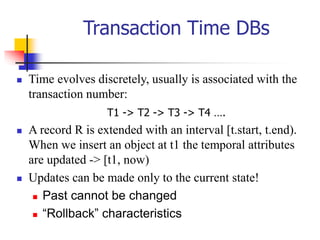
Transaction Time DBs
 Time evolves discretely, usually is associated with the
transaction number:
 A record R is extended with an interval [t.start, t.end).
When we insert an object at t1 the temporal attributes
are updated -> [t1, now)
 Updates can be made only to the current state!
 Past cannot be changed
 “Rollback” characteristics
T1 -> T2 -> T3 -> T4 ….
Transaction Time DBs
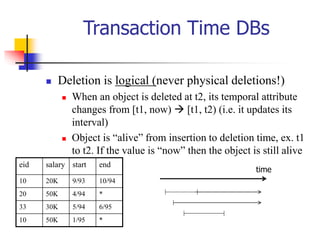
 Deletion is logical (never physical deletions!)
 When an object is deleted at t2, its temporal attribute
changes from [t1, now)  [t1, t2) (i.e. it updates its
interval)
 Object is “alive” from insertion to deletion time, ex. t1
to t2. If the value is “now” then the object is still alive
eid salary start end
10 20K 9/93 10/94
20 50K 4/94 *
33 30K 5/94 6/95
10 50K 1/95 *
time
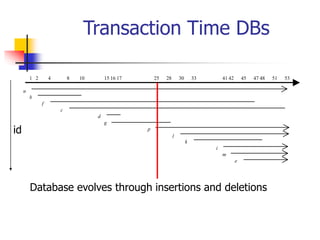
Transaction Time DBs
1 2 4 8 10 15 16 17 25 28 30 33 41 42 45 47 48 51 53
u
b
f
c
d
g
p
j
k
i
m
e
Database evolves through insertions and deletions
id
Transaction Time DBs
 Requirements for index methods:
 Store past logical states
 Support addition/deletion/modification changes
on the objects of the current state
 Efficiently access and query any database state
Transaction Time DBs
 Queries:
 Timestamp (timeslice) queries: ex. “Give me all
employees at 05/94”
 Range-timeslice: “Find all employees with id
between 100 and 200 that worked in the
company on 05/94”
 Interval (period) queries: “Find all employees
with id in [100,200] from 05/94 to 06/96”
Valid Time DBs
 Time evolves continuously
 Each object is a line segment representing
its time span (eg. Credit card valid time)
 Support full operations on interval data:
 Deletion at any time
 Insertion at any time
 Value change (modification) at any time (no
ordering)
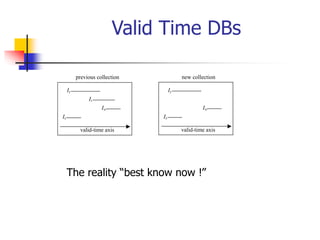
Valid Time DBs
 Deletion is physical:
 No way to know about the previous states of
intervals
 The notion of “future”, “present” and “past”
is relative to a certain timestamp t
Valid Time DBs
Iy
Iz
Ix
Iw
valid-time axis
previous collection
Iy
Ix
Iw
valid-time axis
new collection
The reality “best know now !”
Valid Time DBs
 Requirements for an Index method:
 Store the latest collection of interval-objects
 Support add/del/mod changes to this collection
 Efficiently query the intervals in the collection
 Timestamp query
 Interval (period) query
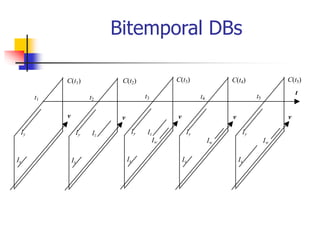
Bitemporal DBs
 A transaction-time Database, but each record is an
interval (plus the other attributes of the record)
 Keeping the evolution of a dynamic collection of
interval-objects
 At each timestamp, it is a valid time database
Bitemporal DBs
Iy
Ix
v
Iy Iz
Ix
v
Iy Iz
Ix
Iw
v
Iy
Ix
Iw
v
Iy
Ix
Iw
v
t
t1 t5
t4
t3
t2
C(t1) C(t5)
C(t4)
C(t3)
C(t2)
Bitemporal DBs
 Requirements for access methods:
 Store past/logical states of collections of objects
 Support add/del/mod of interval objects of the
current logical state
 Efficient query answering
Temporal Indexing
 Straight-forward approaches:
 B+-tree and R-tree
 Problems?
 Transaction time:
 Snapshot Index, TSB-tree, MVB-tree, MVAS
 Valid time:
 Interval structures: Segment tree, even R-tree
 Bitemporal:
 Bitemporal R-tree
Temporal Indexing
 Lower bound on answering timeslice and
range-timeslace queries:
 Space O(n/B), search O(logBn + s/B)
 n: number of changes, s: answer size, B
page capacity

tempDB.ppt

  • 1.
  • 2.
    Outline  Spatial Databases Indexing, Query processing  Temporal Databases  Spatio-temporal  ….
  • 3.
    Temporal DBs –Motivation  Conventional databases represent the state of an enterprise at a single moment of time  Many applications need information about the past  Financial (payroll)  Medical (patient history)  Government  Temporal DBs: a system that manages time varying data
  • 4.
    Comparison  Conventional DBs: Evolve through transactions from one state to the next  Changes are viewed as modifications to the state  No information about the past  Snapshot of the enterprise  Temporal DBs:  Maintain historical information  Changes are viewed as additions to the information stored in the database  Incorporate notion of time in the system  Efficient access to past states
  • 5.
    Temporal Databases  TemporalData Models: extension of relational model by adding temporal attributes to each relation  Temporal Query Languages: TQUEL, SQL3  Temporal Indexing Methods and Query Processing
  • 6.
    Taxonomy of time Transaction time databases  Transaction time is the time when a fact is stored in the database  Valid time databases:  Valid time is the time that a fact becomes effective in reality  Bi-temporal databases:  Support both notions of time
  • 7.
    Example  Sales example:data about sales are stored at the end of the day  Transaction time is different than valid time  Valid time can refer to the future also!  Credit card: 03/01-04/06
  • 8.
    Transaction Time DBs Time evolves discretely, usually is associated with the transaction number:  A record R is extended with an interval [t.start, t.end). When we insert an object at t1 the temporal attributes are updated -> [t1, now)  Updates can be made only to the current state!  Past cannot be changed  “Rollback” characteristics T1 -> T2 -> T3 -> T4 ….
  • 9.
    Transaction Time DBs Deletion is logical (never physical deletions!)  When an object is deleted at t2, its temporal attribute changes from [t1, now)  [t1, t2) (i.e. it updates its interval)  Object is “alive” from insertion to deletion time, ex. t1 to t2. If the value is “now” then the object is still alive eid salary start end 10 20K 9/93 10/94 20 50K 4/94 * 33 30K 5/94 6/95 10 50K 1/95 * time
  • 10.
    Transaction Time DBs 12 4 8 10 15 16 17 25 28 30 33 41 42 45 47 48 51 53 u b f c d g p j k i m e Database evolves through insertions and deletions id
  • 11.
    Transaction Time DBs Requirements for index methods:  Store past logical states  Support addition/deletion/modification changes on the objects of the current state  Efficiently access and query any database state
  • 12.
    Transaction Time DBs Queries:  Timestamp (timeslice) queries: ex. “Give me all employees at 05/94”  Range-timeslice: “Find all employees with id between 100 and 200 that worked in the company on 05/94”  Interval (period) queries: “Find all employees with id in [100,200] from 05/94 to 06/96”
  • 13.
    Valid Time DBs Time evolves continuously  Each object is a line segment representing its time span (eg. Credit card valid time)  Support full operations on interval data:  Deletion at any time  Insertion at any time  Value change (modification) at any time (no ordering)
  • 14.
    Valid Time DBs Deletion is physical:  No way to know about the previous states of intervals  The notion of “future”, “present” and “past” is relative to a certain timestamp t
  • 15.
    Valid Time DBs Iy Iz Ix Iw valid-timeaxis previous collection Iy Ix Iw valid-time axis new collection The reality “best know now !”
  • 16.
    Valid Time DBs Requirements for an Index method:  Store the latest collection of interval-objects  Support add/del/mod changes to this collection  Efficiently query the intervals in the collection  Timestamp query  Interval (period) query
  • 17.
    Bitemporal DBs  Atransaction-time Database, but each record is an interval (plus the other attributes of the record)  Keeping the evolution of a dynamic collection of interval-objects  At each timestamp, it is a valid time database
  • 18.
    Bitemporal DBs Iy Ix v Iy Iz Ix v IyIz Ix Iw v Iy Ix Iw v Iy Ix Iw v t t1 t5 t4 t3 t2 C(t1) C(t5) C(t4) C(t3) C(t2)
  • 19.
    Bitemporal DBs  Requirementsfor access methods:  Store past/logical states of collections of objects  Support add/del/mod of interval objects of the current logical state  Efficient query answering
  • 20.
    Temporal Indexing  Straight-forwardapproaches:  B+-tree and R-tree  Problems?  Transaction time:  Snapshot Index, TSB-tree, MVB-tree, MVAS  Valid time:  Interval structures: Segment tree, even R-tree  Bitemporal:  Bitemporal R-tree
  • 21.
    Temporal Indexing  Lowerbound on answering timeslice and range-timeslace queries:  Space O(n/B), search O(logBn + s/B)  n: number of changes, s: answer size, B page capacity