Templates in Linguistics: Why
Garbage Garbage?
Presented by:
Hussein Ghaly
1- Garbage Disposal
Yaseen Ghaly, 3 Years Old:
• Papy laih zebala zebala? (Dad, why
garbage garbage?) > Why are you
carrying two garbage bags?
• Papy laih bang bang? (Dad, why bang
bang?) > Why are you making this “bang
bang/hammering” sound?
2- Making a Template
• Yaseen seems to be using this template:
• “Papy, laih X?” (Dad, why X)
• Where X can be anything:
– Garbage Garbage
– Bang Bang
– Sleeping
– …
– 天空是绿色的 (foreign word/code switching)
3- To build a language
• How can the linguistic expression from
simple sentences into language such as
ours?
• Answer: Recursion
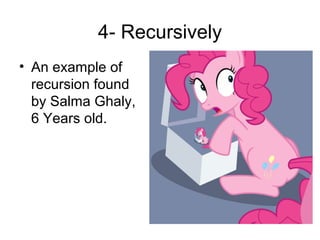
4- Recursively
• An example of
recursion found
by Salma Ghaly,
6 Years old.
Main Claim
• Language is built using simple (idiomatic)
templates. The complexity comes from
recursion.
Outline
• Starting Assumptions
• Learning templates (Language Acquisition)
• Cross Linguistic Template Linearity
• Selecting A template (Semantic-Pragmatic
Prompt)
• Extending A template (Template Malleability)
• Applications of Templates (Information
Extraction and Machine Translation)
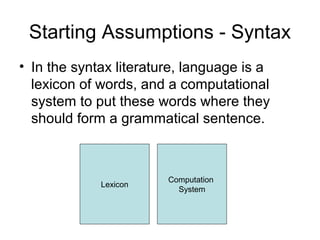
Starting Assumptions - Syntax
• In the syntax literature, language is a
lexicon of words, and a computational
system to put these words where they
should form a grammatical sentence.
Lexicon
Computation
System
Starting Assumptions – Templates
Framework
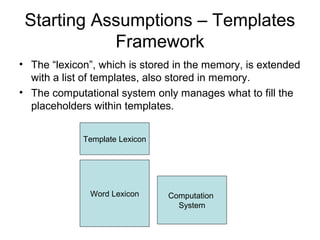
• The “lexicon”, which is stored in the memory, is extended
with a list of templates, also stored in memory.
• The computational system only manages what to fill the
placeholders within templates.
Word Lexicon Computation
System
Template Lexicon
Learning Templates
• The “garbage gabage” example indicates:
– A child can intuitively form a template for
plurals (that is applicable in some human
languages such as Bhasa Malaysia (e.g.
kanak kanak=children)
– A child can put anything in the placeholder X
within the sentence template “Dad, Why X?”
• But these hypotheses would need further
evidence from First Language Acquistion
Template Linearity
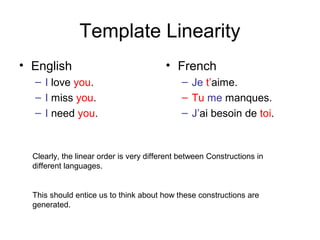
• English
– I love you.
– I miss you.
– I need you.
• French
– Je t’aime.
– Tu me manques.
– J’ai besoin de toi.
Clearly, the linear order is very different between Constructions in
different languages.
This should entice us to think about how these constructions are
generated.
Semantic-Pragmatic Prompt
• An area of overlap between the reason, context,
and information content of some sentence.
• Start with list of arguments (X1: I, X2: You)
• I Want to express [+feeling] [+positive]
[+distance], therefore:
– in English, we invoke the template I miss X2.
– In French, we invoke the template X2 me manques
(with some adjustments depending on pronouns, etc)
• So I can utter the sentence after filling the
template:
– I miss Randa.
– Randa me manque.
Template Variability
• Almost everything can be said in an alternative
way:
– Godzilla destroyed the City, which is unfortunate.
– It is unfortunate that Godzilla destroyed the city.
– The destruction of the city by Godzilla is unfortunate.
• So, there are different templates to express the
relation between these four entities (being
unfortunate, the destruction, Godzilla, the City).
This again feeds into the argument of non-
linearity of templates, this time within the same
language.
Template Malleability
• Meaning how easy the template can be re-
shaped. This includes the following:
– Tense malleability:
• John was eating fish.
• John has been eating fish.
– Synonym malleability:
• Sarah cannot tolerate this any more.
• Sarah cannot put up with this anymore.
• The idea of malleability enables us to avoid
accounting for hundreds of millions of
combinations of basic templates.
Using Templates
• For information Extraction (e.g. Banko and
Etzioni 2008), where templates where
used to extract (is-a) relationships
between entities.
Using Templates in Machine
Translation
• Was first suggested by (Nagao, 1984)
under the name of Example-Based
Machine Translation. He also indicted this
approach is relevant to Second Language
Acquisition.
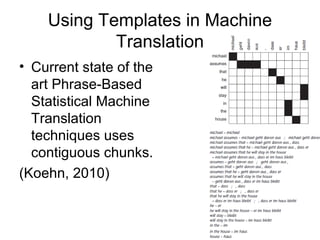
Using Templates in Machine
Translation
• Current state of the
art Phrase-Based
Statistical Machine
Translation
techniques uses
contiguous chunks.
(Koehn, 2010)
Using Templates in Machine
Translation
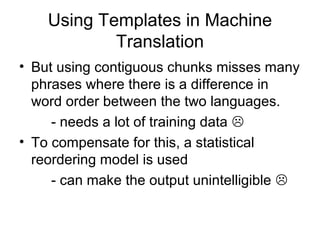
• But using contiguous chunks misses many
phrases where there is a difference in
word order between the two languages.
- needs a lot of training data 
• To compensate for this, a statistical
reordering model is used
- can make the output unintelligible 
Using Templates in Machine
Translation
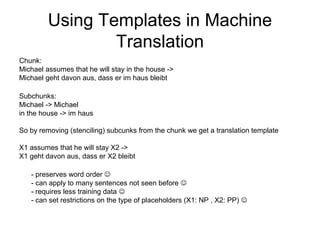
Chunk:
Michael assumes that he will stay in the house ->
Michael geht davon aus, dass er im haus bleibt
Subchunks:
Michael -> Michael
in the house -> im haus
So by removing (stenciling) subcunks from the chunk we get a translation template
X1 assumes that he will stay X2 ->
X1 geht davon aus, dass er X2 bleibt
- preserves word order 
- can apply to many sentences not seen before 
- requires less training data 
- can set restrictions on the type of placeholders (X1: NP , X2: PP) 
•Thank X1!
(X1 = You )

Templates in linguistics - Why Garbage Garbage

  • 1.
    Templates in Linguistics:Why Garbage Garbage? Presented by: Hussein Ghaly
  • 2.
    1- Garbage Disposal YaseenGhaly, 3 Years Old: • Papy laih zebala zebala? (Dad, why garbage garbage?) > Why are you carrying two garbage bags? • Papy laih bang bang? (Dad, why bang bang?) > Why are you making this “bang bang/hammering” sound?
  • 3.
    2- Making aTemplate • Yaseen seems to be using this template: • “Papy, laih X?” (Dad, why X) • Where X can be anything: – Garbage Garbage – Bang Bang – Sleeping – … – 天空是绿色的 (foreign word/code switching)
  • 4.
    3- To builda language • How can the linguistic expression from simple sentences into language such as ours? • Answer: Recursion
  • 5.
    4- Recursively • Anexample of recursion found by Salma Ghaly, 6 Years old.
  • 6.
    Main Claim • Languageis built using simple (idiomatic) templates. The complexity comes from recursion.
  • 7.
    Outline • Starting Assumptions •Learning templates (Language Acquisition) • Cross Linguistic Template Linearity • Selecting A template (Semantic-Pragmatic Prompt) • Extending A template (Template Malleability) • Applications of Templates (Information Extraction and Machine Translation)
  • 8.
    Starting Assumptions -Syntax • In the syntax literature, language is a lexicon of words, and a computational system to put these words where they should form a grammatical sentence. Lexicon Computation System
  • 9.
    Starting Assumptions –Templates Framework • The “lexicon”, which is stored in the memory, is extended with a list of templates, also stored in memory. • The computational system only manages what to fill the placeholders within templates. Word Lexicon Computation System Template Lexicon
  • 10.
    Learning Templates • The“garbage gabage” example indicates: – A child can intuitively form a template for plurals (that is applicable in some human languages such as Bhasa Malaysia (e.g. kanak kanak=children) – A child can put anything in the placeholder X within the sentence template “Dad, Why X?” • But these hypotheses would need further evidence from First Language Acquistion
  • 11.
    Template Linearity • English –I love you. – I miss you. – I need you. • French – Je t’aime. – Tu me manques. – J’ai besoin de toi. Clearly, the linear order is very different between Constructions in different languages. This should entice us to think about how these constructions are generated.
  • 12.
    Semantic-Pragmatic Prompt • Anarea of overlap between the reason, context, and information content of some sentence. • Start with list of arguments (X1: I, X2: You) • I Want to express [+feeling] [+positive] [+distance], therefore: – in English, we invoke the template I miss X2. – In French, we invoke the template X2 me manques (with some adjustments depending on pronouns, etc) • So I can utter the sentence after filling the template: – I miss Randa. – Randa me manque.
  • 13.
    Template Variability • Almosteverything can be said in an alternative way: – Godzilla destroyed the City, which is unfortunate. – It is unfortunate that Godzilla destroyed the city. – The destruction of the city by Godzilla is unfortunate. • So, there are different templates to express the relation between these four entities (being unfortunate, the destruction, Godzilla, the City). This again feeds into the argument of non- linearity of templates, this time within the same language.
  • 14.
    Template Malleability • Meaninghow easy the template can be re- shaped. This includes the following: – Tense malleability: • John was eating fish. • John has been eating fish. – Synonym malleability: • Sarah cannot tolerate this any more. • Sarah cannot put up with this anymore. • The idea of malleability enables us to avoid accounting for hundreds of millions of combinations of basic templates.
  • 15.
    Using Templates • Forinformation Extraction (e.g. Banko and Etzioni 2008), where templates where used to extract (is-a) relationships between entities.
  • 16.
    Using Templates inMachine Translation • Was first suggested by (Nagao, 1984) under the name of Example-Based Machine Translation. He also indicted this approach is relevant to Second Language Acquisition.
  • 17.
    Using Templates inMachine Translation • Current state of the art Phrase-Based Statistical Machine Translation techniques uses contiguous chunks. (Koehn, 2010)
  • 18.
    Using Templates inMachine Translation • But using contiguous chunks misses many phrases where there is a difference in word order between the two languages. - needs a lot of training data  • To compensate for this, a statistical reordering model is used - can make the output unintelligible 
  • 19.
    Using Templates inMachine Translation Chunk: Michael assumes that he will stay in the house -> Michael geht davon aus, dass er im haus bleibt Subchunks: Michael -> Michael in the house -> im haus So by removing (stenciling) subcunks from the chunk we get a translation template X1 assumes that he will stay X2 -> X1 geht davon aus, dass er X2 bleibt - preserves word order  - can apply to many sentences not seen before  - requires less training data  - can set restrictions on the type of placeholders (X1: NP , X2: PP) 
  • 20.