©2014 PowerSkills
Training & Development,
Inc. & Robert J Schout
December 7, 2014
By: Robert J Schout
TELEWORK SUCCESS
1
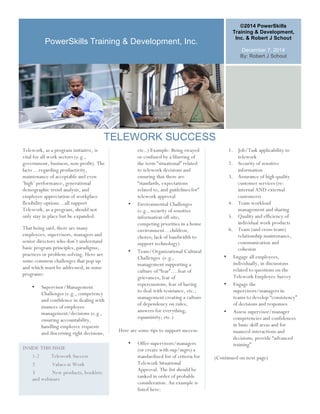
Telework, as a program initiative, is
vital for all work sectors (e.g.,
government, business, non-profit). The
facts …regarding productivity,
maintenance of acceptable and even
‘high’ performance, generational
demographic trend analysis, and
employee appreciation of workplace
flexibility options…all support
Telework, as a program, should not
only stay in place but be expanded.
That being said, there are many
employees, supervisors, managers and
senior directors who don’t understand
basic program principles, paradigms,
practices or problem-solving. Here are
some common challenges that pop up
and which must be addressed, in some
programs:
• Supervisor/Management
Challenges (e.g., competency
and confidence in dealing with
nuances of employee
management/decisions (e.g.,
ensuring accountability,
handling employee requests
and discerning right decisions,
2
etc..) Example: Being swayed
or confused by a blurring of
the term “situational” related
to telework decisions and
ensuring that there are
“standards, expectations
related to, and guidelines for”
telework approval
• Environmental Challenges
(e.g., security of sensitive
information off-site;
competing priorities in a home
environment…children,
chores; lack of bandwidth to
support technology)
• Team/Organizational Cultural
Challenges (e.g.,
management supporting a
culture of “fear”….fear of
grievances, fear of
repercussions, fear of having
to deal with resistance, etc.;
management creating a culture
of dependency on rules,
answers for everything,
equanimity; etc.)
Here are some tips to support success:
• Offer supervisors/managers
(or create with sup/mgrs) a
standardized list of criteria for
Telework Situational
Approval. The list should be
ranked in order of probable
consideration. An example is
listed here:
3
1. Job/Task applicability to
telework
2. Security of sensitive
information
3. Assurance of high quality
customer services (re:
internal AND external
customers)
4. Team workload
management and sharing
5. Quality and efficiency of
individual work products
6. Team (and cross-team)
relationship maintenance,
communication and
cohesion
• Engage all employees,
individually, in discussions
related to questions on the
Telework Employee Survey
• Engage the
supervisors/managers in
teams to develop “consistency”
of decisions and responses
• Assess supervisor/manager
competencies and confidences
in basic skill areas and for
nuanced interactions and
decisions; provide “advanced
training”
(Continued on next page)
INSIDE THIS ISSUE
1-2 Telework Success
2 Values at Work
3 New products, booklets
and webinars
PowerSkills Training & Development, Inc.
Training & development, Inc.
Lorem Ipsum
(TELEWORK cont.)
• Formalize agreements for
monthly performance assessment,
weekly monitoring of
tasks/projects, intervention
criteria and processes,
restrictions on telework
agreements themselves, etc.
• Step into “supervisory” roles and
habits and define your practices
to ensure accountability, quality,
development, team building,
customer services, etc.
• Make “development”,
“management of people and
processes” and “monitoring”
mainstays of your daily and
weekly practices.
• Convene weekly team meetings
and monthly partner meetings to
assess challenges early.
• Engage in immediate corrective
actions even for micro-offences.
• Balance telework time with on-
site face time to ensure worksite
coverage, relationship
development, and supervisory
face-time.
• Partner with labor relations
garnering the acceptance of tools
and strategies to insure employee
performance and productivity;
demonstrating that those tools
and strategies also ensure the
continuation of an employee’s
opportunities to engage in
telework.
©2014 Bob Schout & PowerSkills
Training & Development, Inc. All
rights reserved.
1
Values form the foundation of workplace
cultures. Whether the leaders and
organizational stakeholder values
demonstrate respect and integrity, or
coercion and autocracy…values in action
are experienced by all who interact with
the organization. They influence the
climate (collective attitudes), the culture
(agreed upon norms), motivation, morale
and ultimately performance and
productivity.
Values may be identified by the leaders
but they must be acquiesced to and lived
by all…beginning with the leaders, right
off the bat. However, even if certain
leaders do not live up to nor demonstrate
positive values-in-action, that does not
and should not give other stakeholders
leeway to become more lenient in
demonstration of their own – or the
agreed upon – values. Everyone
influences a culture through value-
demonstrations.
The trick, for success, is for an
organization to weave them into its very
culture. Organizations do this by first
identifying core values. Then
collaboratively defining them so that
everyone’s on the same page. Once that’s
done an organization must attach specific
behavioral metrics/measurements to
each value, along with specific ways to
weave them into processes, procedures,
policies, and operational management
practices.
Organizations trip up, inadvertently, in a
few ways. Take a look at this list and see
if your organization may be accidentally
tripping up:
1) Beginning the process of values
identification and definement
2
but then abruptly, or over time,
not finishing it.
2) Allowing leaders (e.g., senior
directors, managers, supervisors,
or team leads) to behave in ways
that are in opposition to the
stated values.
3) Identifying values and posting,
distributing and highlighting them
but not weaving them into
specific organizational operations,
management practices, and team
practices.
4) Lack of sustainment with
maintaining a value-based culture
as a permanent facet, instead,
implying that it is the
organizational change ‘flavor of
the month’.
5) Allowing employees or other
stakeholders to absolve
themselves from value-based
interactions because they can
point to one or a few leaders who
have tripped up.
Remember how long it took for you, as a
child and adolescent, to learn and then
integrate values into your everyday
behaviors and belief systems. My guess is
that it took years, and that you’re still
working on some day-to-day.
For values to be permanently in place and
enhance a workplace, it takes time,
persistence, fortitude, consistency, and
patience…all are VIRTUES. We’ll talk
about virtues in the next issue.
©2014 Bob Schout & PowerSkills
Training & Development, Inc. All
rights reserved.
Values at work
3
2015 New Products
Products that will Enhance Your
Team, Organizational Culture and
Leadership Skills
• Team Up Relationship
Building Question Cards:
52 cards containing fun and
provocative questions that
will help you break the ice
and build relationships at
work ($18 per set)
• The Virtue Deck & The Virtue
Deal: 52 virtue cards that can
help you weave virtues into
your own development and
workplace practices and
processes ($18 per set)
2015 New Booklets
Brief guides focused on topics that will
build your professional leadership skills
and capacities.
• Forgiveness @ Work:
principles, practices and
strategies for healing hurts in the
workplace ($18)
• Value, Virtues & Vestiges @
Work: creating a culture of
empowerment and integrity at
work ($18)
• Building a Program to Last:
volunteer program development
from start to success ($18)
• Diversity Appreciation @
Work: practical action steps,
programs and initiatives for
meaningful diversity appreciation
at work ($18)
Email for order forms & payment options:
yourpowerskills@gmail.com
bob@yourpowerskills.com
2015 Webinar Series
• Anger Management @ Work
• Forgiveness @ Work
• Leadership Star Basic Training
• Meeting Management Techniques
• Mentor Program Success
• Motivation & Morale and
Recognition & Reward Practices
that Work @ Work
• Power, Influence and Negotiation
Skills for Supervisors & Managers
• Solutions to Telework Troubles
• Values, Virtues and Vestiges @
Work
• Work-Life Balancing Strategies
and Practices
Email or call for course overviews,
schedules, registration forms and payment
processes.
Email options:
yourpowerskills@gmail.com
Bob@yourpowerskills.com
Ph. 619-517-6299
Make every day a step along the path of learning, leading, loving
and living a little bit more, as you grow into the fullness of your
potential. Don’t force it. Let it happen. Each day offers
multitudes of interactional possibilities; each one a chance and a
choice to learn more, lead more, love more and live more…
than you did just the moment before.
– Bob Schout
Powerskills training & development, Inc.
PowerSkills offers training seminars, coaching services,
organizational consulting, and retreat programs that are designed
to grow skills, spirit and community at work and in each
person’s life. We work with non-profit organizations,
government agencies, business and corporate enterprises, and
community groups to create empowering and enriching cultures
that ensure high performance, productivity, diversity, creativity,
opportunity and harmony.
For a list of our services contact us soon!
PowerSkills Training & Development, Inc.
Ph. 619-517-6299
4224 Plaza Sonata . Santa Fe . NM . 87507
Facebook.com/yourpowerskills . Twitter@yourpowerskills
Email Options: yourpowerskills@gmail or Bob@yourpowerskills.com
www.yourpowerskills.com

Telework Success

  • 1.
    ©2014 PowerSkills Training &Development, Inc. & Robert J Schout December 7, 2014 By: Robert J Schout TELEWORK SUCCESS 1 Telework, as a program initiative, is vital for all work sectors (e.g., government, business, non-profit). The facts …regarding productivity, maintenance of acceptable and even ‘high’ performance, generational demographic trend analysis, and employee appreciation of workplace flexibility options…all support Telework, as a program, should not only stay in place but be expanded. That being said, there are many employees, supervisors, managers and senior directors who don’t understand basic program principles, paradigms, practices or problem-solving. Here are some common challenges that pop up and which must be addressed, in some programs: • Supervisor/Management Challenges (e.g., competency and confidence in dealing with nuances of employee management/decisions (e.g., ensuring accountability, handling employee requests and discerning right decisions, 2 etc..) Example: Being swayed or confused by a blurring of the term “situational” related to telework decisions and ensuring that there are “standards, expectations related to, and guidelines for” telework approval • Environmental Challenges (e.g., security of sensitive information off-site; competing priorities in a home environment…children, chores; lack of bandwidth to support technology) • Team/Organizational Cultural Challenges (e.g., management supporting a culture of “fear”….fear of grievances, fear of repercussions, fear of having to deal with resistance, etc.; management creating a culture of dependency on rules, answers for everything, equanimity; etc.) Here are some tips to support success: • Offer supervisors/managers (or create with sup/mgrs) a standardized list of criteria for Telework Situational Approval. The list should be ranked in order of probable consideration. An example is listed here: 3 1. Job/Task applicability to telework 2. Security of sensitive information 3. Assurance of high quality customer services (re: internal AND external customers) 4. Team workload management and sharing 5. Quality and efficiency of individual work products 6. Team (and cross-team) relationship maintenance, communication and cohesion • Engage all employees, individually, in discussions related to questions on the Telework Employee Survey • Engage the supervisors/managers in teams to develop “consistency” of decisions and responses • Assess supervisor/manager competencies and confidences in basic skill areas and for nuanced interactions and decisions; provide “advanced training” (Continued on next page) INSIDE THIS ISSUE 1-2 Telework Success 2 Values at Work 3 New products, booklets and webinars PowerSkills Training & Development, Inc. Training & development, Inc.
  • 2.
    Lorem Ipsum (TELEWORK cont.) •Formalize agreements for monthly performance assessment, weekly monitoring of tasks/projects, intervention criteria and processes, restrictions on telework agreements themselves, etc. • Step into “supervisory” roles and habits and define your practices to ensure accountability, quality, development, team building, customer services, etc. • Make “development”, “management of people and processes” and “monitoring” mainstays of your daily and weekly practices. • Convene weekly team meetings and monthly partner meetings to assess challenges early. • Engage in immediate corrective actions even for micro-offences. • Balance telework time with on- site face time to ensure worksite coverage, relationship development, and supervisory face-time. • Partner with labor relations garnering the acceptance of tools and strategies to insure employee performance and productivity; demonstrating that those tools and strategies also ensure the continuation of an employee’s opportunities to engage in telework. ©2014 Bob Schout & PowerSkills Training & Development, Inc. All rights reserved. 1 Values form the foundation of workplace cultures. Whether the leaders and organizational stakeholder values demonstrate respect and integrity, or coercion and autocracy…values in action are experienced by all who interact with the organization. They influence the climate (collective attitudes), the culture (agreed upon norms), motivation, morale and ultimately performance and productivity. Values may be identified by the leaders but they must be acquiesced to and lived by all…beginning with the leaders, right off the bat. However, even if certain leaders do not live up to nor demonstrate positive values-in-action, that does not and should not give other stakeholders leeway to become more lenient in demonstration of their own – or the agreed upon – values. Everyone influences a culture through value- demonstrations. The trick, for success, is for an organization to weave them into its very culture. Organizations do this by first identifying core values. Then collaboratively defining them so that everyone’s on the same page. Once that’s done an organization must attach specific behavioral metrics/measurements to each value, along with specific ways to weave them into processes, procedures, policies, and operational management practices. Organizations trip up, inadvertently, in a few ways. Take a look at this list and see if your organization may be accidentally tripping up: 1) Beginning the process of values identification and definement 2 but then abruptly, or over time, not finishing it. 2) Allowing leaders (e.g., senior directors, managers, supervisors, or team leads) to behave in ways that are in opposition to the stated values. 3) Identifying values and posting, distributing and highlighting them but not weaving them into specific organizational operations, management practices, and team practices. 4) Lack of sustainment with maintaining a value-based culture as a permanent facet, instead, implying that it is the organizational change ‘flavor of the month’. 5) Allowing employees or other stakeholders to absolve themselves from value-based interactions because they can point to one or a few leaders who have tripped up. Remember how long it took for you, as a child and adolescent, to learn and then integrate values into your everyday behaviors and belief systems. My guess is that it took years, and that you’re still working on some day-to-day. For values to be permanently in place and enhance a workplace, it takes time, persistence, fortitude, consistency, and patience…all are VIRTUES. We’ll talk about virtues in the next issue. ©2014 Bob Schout & PowerSkills Training & Development, Inc. All rights reserved. Values at work
  • 3.
    3 2015 New Products Productsthat will Enhance Your Team, Organizational Culture and Leadership Skills • Team Up Relationship Building Question Cards: 52 cards containing fun and provocative questions that will help you break the ice and build relationships at work ($18 per set) • The Virtue Deck & The Virtue Deal: 52 virtue cards that can help you weave virtues into your own development and workplace practices and processes ($18 per set) 2015 New Booklets Brief guides focused on topics that will build your professional leadership skills and capacities. • Forgiveness @ Work: principles, practices and strategies for healing hurts in the workplace ($18) • Value, Virtues & Vestiges @ Work: creating a culture of empowerment and integrity at work ($18) • Building a Program to Last: volunteer program development from start to success ($18) • Diversity Appreciation @ Work: practical action steps, programs and initiatives for meaningful diversity appreciation at work ($18) Email for order forms & payment options: yourpowerskills@gmail.com bob@yourpowerskills.com 2015 Webinar Series • Anger Management @ Work • Forgiveness @ Work • Leadership Star Basic Training • Meeting Management Techniques • Mentor Program Success • Motivation & Morale and Recognition & Reward Practices that Work @ Work • Power, Influence and Negotiation Skills for Supervisors & Managers • Solutions to Telework Troubles • Values, Virtues and Vestiges @ Work • Work-Life Balancing Strategies and Practices Email or call for course overviews, schedules, registration forms and payment processes. Email options: yourpowerskills@gmail.com Bob@yourpowerskills.com Ph. 619-517-6299 Make every day a step along the path of learning, leading, loving and living a little bit more, as you grow into the fullness of your potential. Don’t force it. Let it happen. Each day offers multitudes of interactional possibilities; each one a chance and a choice to learn more, lead more, love more and live more… than you did just the moment before. – Bob Schout
  • 4.
    Powerskills training &development, Inc. PowerSkills offers training seminars, coaching services, organizational consulting, and retreat programs that are designed to grow skills, spirit and community at work and in each person’s life. We work with non-profit organizations, government agencies, business and corporate enterprises, and community groups to create empowering and enriching cultures that ensure high performance, productivity, diversity, creativity, opportunity and harmony. For a list of our services contact us soon! PowerSkills Training & Development, Inc. Ph. 619-517-6299 4224 Plaza Sonata . Santa Fe . NM . 87507 Facebook.com/yourpowerskills . Twitter@yourpowerskills Email Options: yourpowerskills@gmail or Bob@yourpowerskills.com www.yourpowerskills.com